Author: OKX Ventures, a venture capital institution investing in the blockchain economy
Translated by: Gu Yu, ChainCatcher
Jensen Huang resumes position as CEO of Nvidia. The past two weeks have reminded everyone just how much the AI industry revolves around one company.
In addition to CUDA, GPU performance, and its software ecosystem, Nvidia has another particularly difficult-to-replicate advantage: it enables the entire supply chain to invest in its product roadmap years in advance.
Changes in Memory and AI Credit Economics
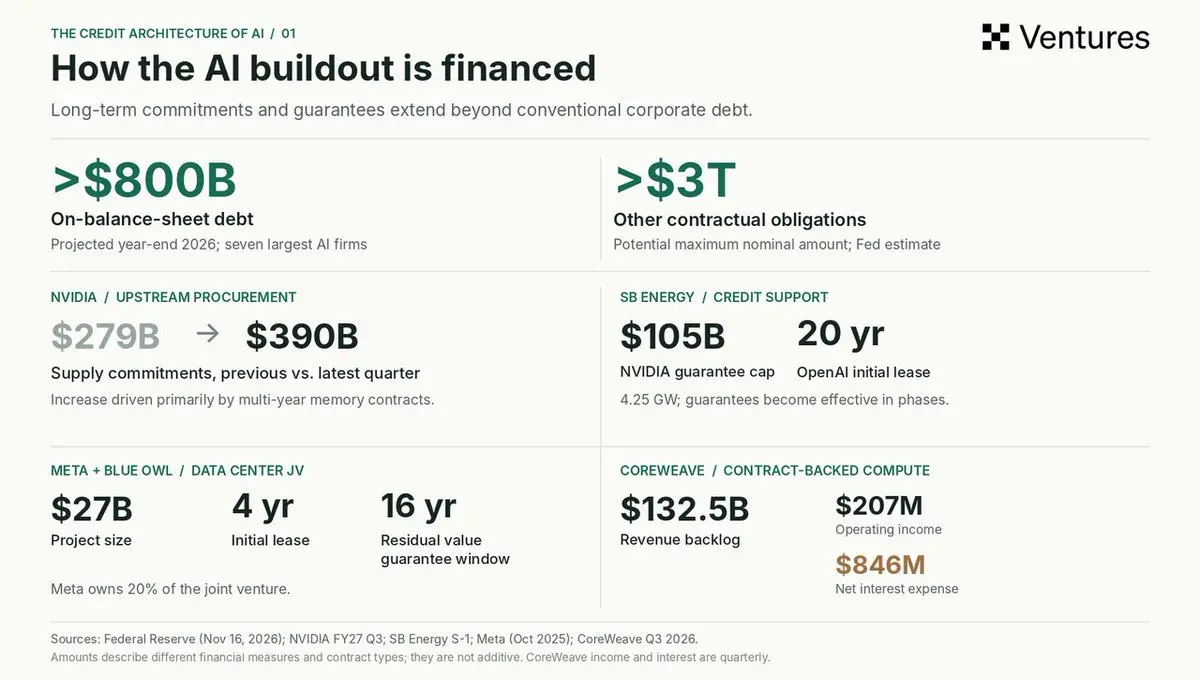
As of October, Nvidia's supply and capacity commitments have reached $390 billion, an increase of $111 billion in a single quarter, mainly driven by long-term memory procurement agreements. Samsung has signed long-term supply contracts with 10 major customers and plans to have these long-term agreements cover 60%-70% of its expected capacity by 2030. Some of these agreements include customer deposits and set upper and lower limits on quarterly price adjustments.
Historically, memory manufacturers have borne most of the risk of capacity oversupply. Today, customers are willing to take on more price and inventory risks to secure supplies for the coming years. Even if DRAM spot prices drop significantly, the revenue and profit margins tied to long-term contracts will adjust more slowly.
An interesting characteristic of this round of memory supercycle is that this historically highly cyclical business is starting to exhibit cash flow characteristics similar to infrastructure, with some of the cyclicality being passed down to downstream buyers.
In a November 16 speech, Federal Reserve Governor Michael Barr pointed out that the on-balance-sheet debt of seven major AI companies is expected to exceed $800 billion by the end of the year, while the largest potential exposure related to off-balance-sheet obligations—including purchase commitments, leases, and residual value guarantees—exceeds $3 trillion.
Nvidia has committed to providing up to $105 billion in credit support for SB Energy's data center projects. The joint venture between Meta and Blue Owl, established in 2025, has an initial lease term of only four years, accompanied by residual value guarantees covering the first 16 years of operation. Earlier this month, S&P downgraded the outlook for this financing vehicle to negative, having previously taken similar action against Meta itself. For neoclouds like CoreWeave, long-term customer contracts have become central to their debt-raising capabilities. Large tech companies are effectively extending their creditworthiness throughout the entire AI supply chain.
Open Weights and the Economic Lifespan of GPUs
The AI industry is funding a market with an abnormally fast pace of technological and pricing evolution with infrastructure-like financing. Data center leases can last up to 20 years, while the economic lifespan of GPUs largely depends on what workloads people are still willing to pay to run.
The long-term significance of open weight AI becomes intriguing here.
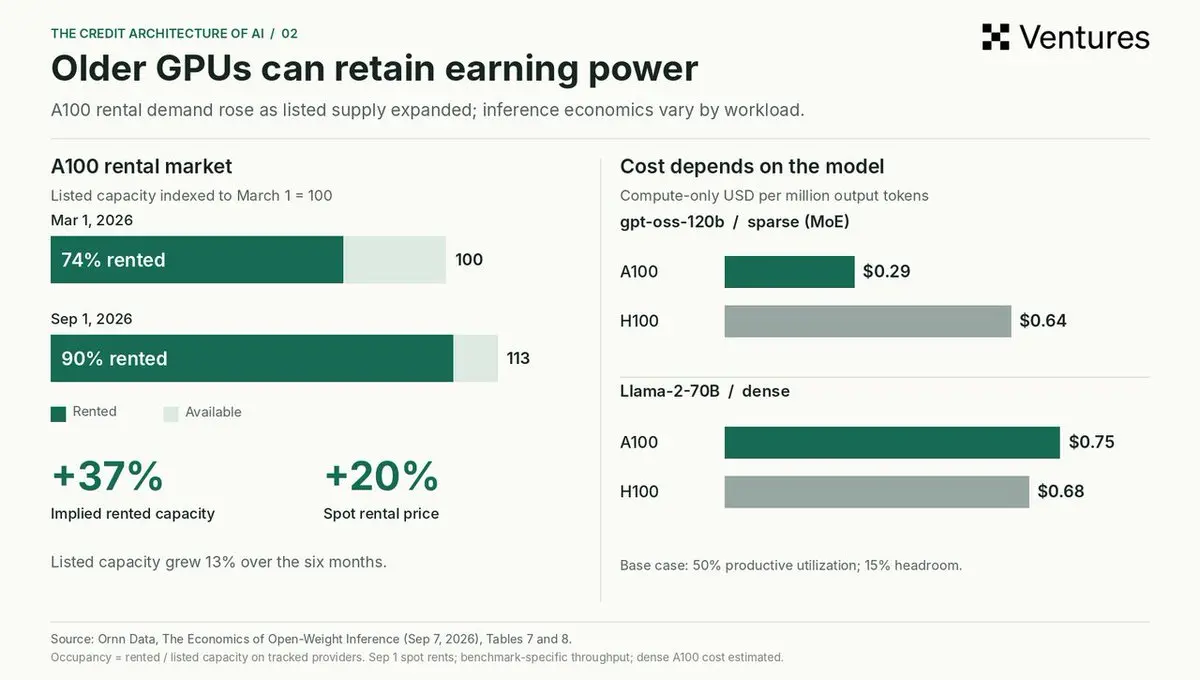
In a September study, Ornn found that in the GPU leasing market it tracks, the rental rate for A100s increased from 74% in March to 90% in September, while the listed supply rose by 13%, and spot rental prices increased by 20%. When running gpt-oss-120b, the cost per output token for A100 was lower than that for H100. For dense models like Llama-2-70B, the economics were the opposite.
The growth of agents, batch inference, and evaluation is forming a larger set of workloads for which cost is more crucial than latency. Open weights allow compute providers to flexibly choose models and optimize inference around existing hardware. GPUs released six years ago can still find commercially competitive use cases today.
Model architecture, inference efficiency, and deployment flexibility all affect the economic depreciation of GPUs. Hardware gradually exiting cutting-edge training can find new revenue sources through updated models and software optimizations. If open-weight models can support a sufficiently deep secondary leasing market, GPU financing may transcend long-term leases backed by major clients, incorporating more hardware residual values and future leasing revenues.
Who will pay for the next open frontier model?
Meanwhile, open models are accelerating price competition in the inference domain.
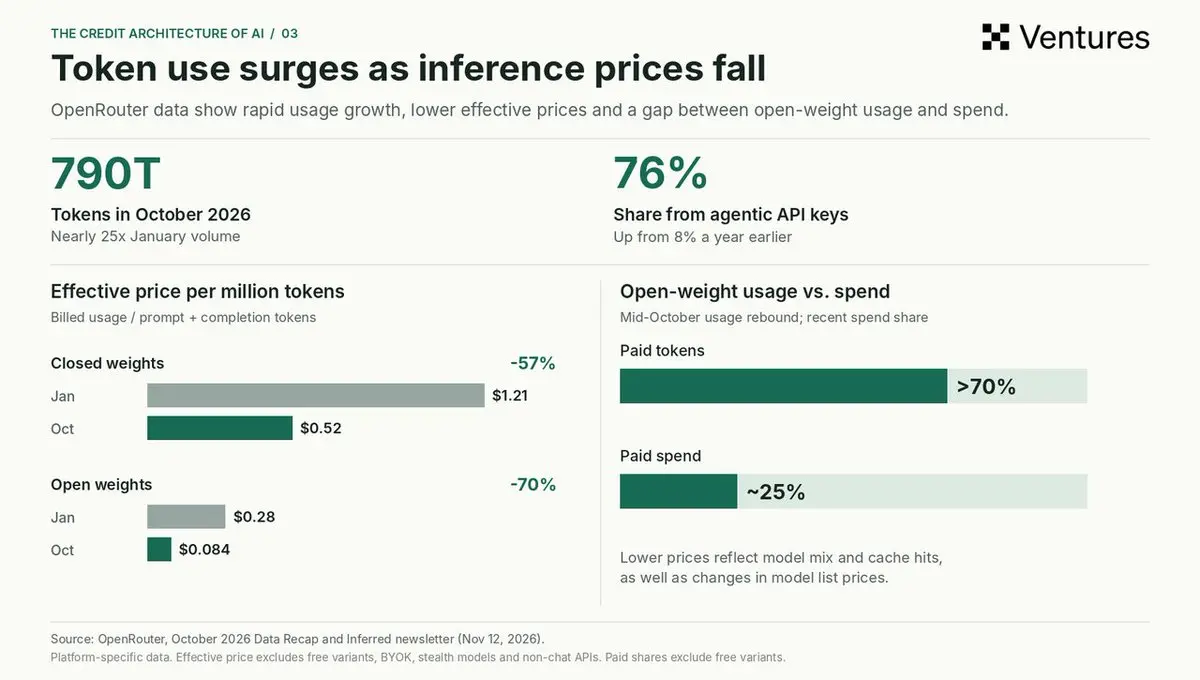
The token volume for OpenRouter in October was nearly 25 times that of the beginning of the year. By mid-October, open-weight models accounted for over 70% of paid token volume, but recently only garnered about a quarter of spending. Since the beginning of the year, the effective price per token for open-weight models has dropped by 70%, while the median prompt cache hit rate for agent workloads has exceeded 90%.
Upstream memory suppliers are locking in revenues through long-term contracts, while downstream inference prices are rapidly declining. Open weights also allow multiple inference service providers to offer services for the same model. Companies can switch service providers or deploy inference internally without changing the underlying model. For independent inference companies, finding ways to host the same workloads with cheaper and older hardware is sometimes more valuable than securing access to the latest GPUs.
Open models still face a tricky economic question. As adoption scales, most of the value flows to downstream applications and compute providers, while the costs of training the next generation of frontier models continue to rise. Closed-source model companies can monetize through APIs, subscriptions, and proprietary distribution channels. Open-weight model developers find it harder to capture the value they create.
Large frontier laboratories and hyperscale cloud providers have both the scale and economic incentives to develop custom chips. Meanwhile, Nvidia has strong commercial motives to support open models, as these models can bring more enterprises and independent developers into the market as direct buyers of compute. From the Nemotron Alliance to the proposed $12.9 billion Hugging Face acquisition, Nvidia is leveraging the economic logic of the compute layer to support the openness of the model layer. (Monetize your complements!)
Although open-weight model developers are still exploring how to sustainably fund frontier research, one of the companies with the most abundant capital in the AI supply chain has a strong commercial incentive to maintain the openness of frontier AI. This may be one of the biggest advantages of open-weight AI at present.
免责声明:本文章仅代表作者个人观点,不代表本平台的立场和观点。本文章仅供信息分享,不构成对任何人的任何投资建议。用户与作者之间的任何争议,与本平台无关。如网页中刊载的文章或图片涉及侵权,请提供相关的权利证明和身份证明发送邮件到[email protected],本平台相关工作人员将会进行核查。