Author: jordan, Delphi Research
Compiler: Gu Yu, ChainCatcher
Agent commerce is converging on a new basic unit: tasks, which are verified completed work units. The task market allows results to be priced, traded, and verified.
Two companies are competing to dominate the agent commerce tech stack. Coinbase is building an open standard on its own track. Stripe is extending its existing business into agent commerce. This article presents the strongest argument for the task market, examines how Stripe and Coinbase are entering agent commerce, and explains why Tempo is the wedge for the crypto industry to enter the agent economy.
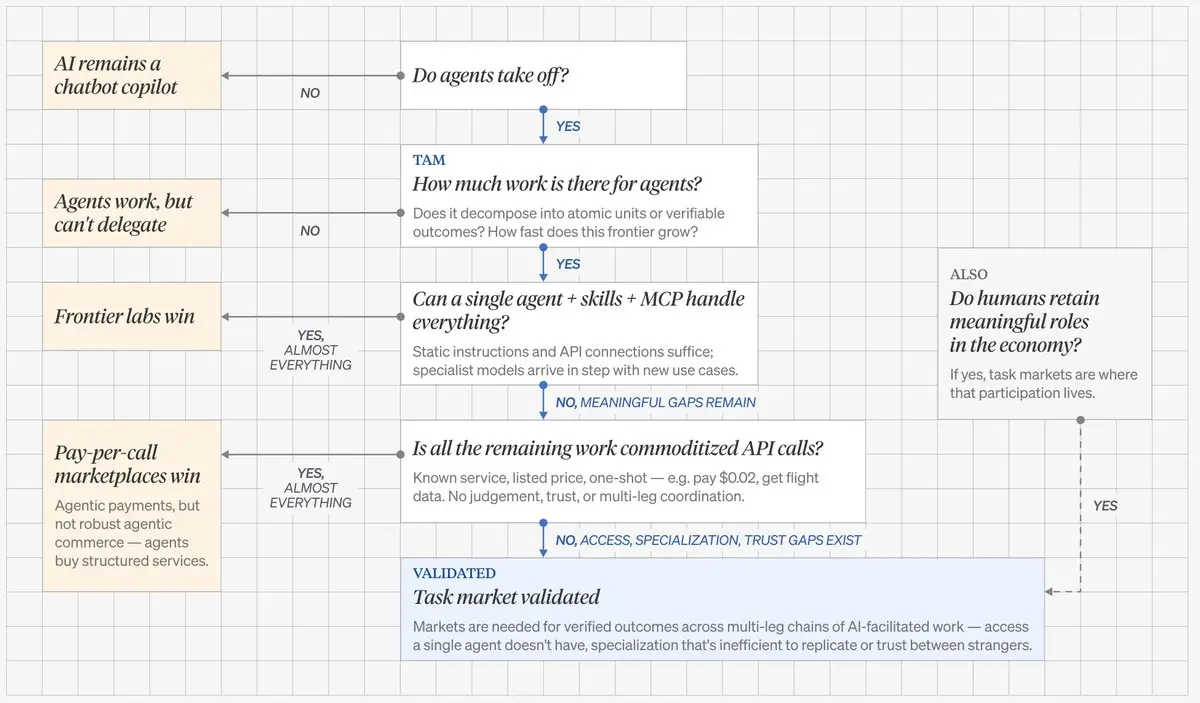
The Tailwind of Tasks
Three forces are driving people to think in terms of tasks and outcomes:
1. Agents are already capable but will fail on multi-step work. Agents are rapidly improving, but multi-step workflows with consequences remain fragile. Programming is a proof case of agent work, but it is also the easiest environment for agents to face. Agents can see whether their work can compile successfully. Real work is not that clean. Decomposing chaotic workflows into atomic, verifiable tasks will determine how far agent systems can go.
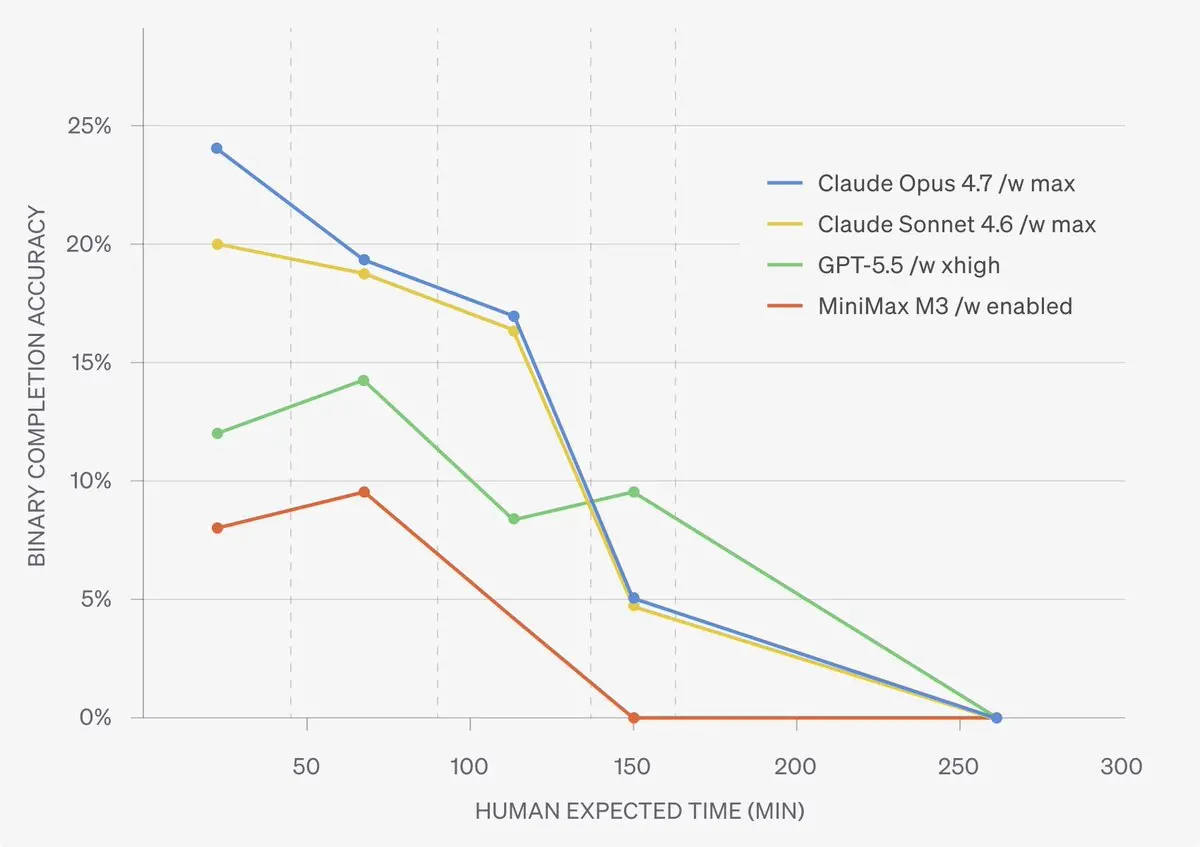
OSWorld 2.0: As human expectations for task duration increase, the binary completion accuracy approaches zero.
2. Coordination is the bottleneck. Production is limited by coordination, not capacity. In healthcare, construction, enterprises, and government, waiting times in administrative processes exceed execution times. Just in healthcare administration alone, it exceeds $1 trillion annually. Coordination represents the largest area of automation opportunity in the economy, yet it is precisely where agents currently fail. Intelligence is getting close to being usable. The infrastructure around agents is not yet.
3. The subsidy era will not last forever. A monthly subscription of $100 may correspond to a $5,000 API quota fee. This won't cost Anthropic $5,000, but it may exceed $100. Usage-based billing will expose the true cost of agent labor, and the cost of each completed task has become the preferred metric.
The overall requirements to restructure work and the need to reprice the unit economics of agent labor will naturally converge on treating tasks as the optimal mental model. We know agents are capable and making progress. Work is being decomposed. As work becomes harder, agents will need better infrastructure.
Three Levels of Agent Work
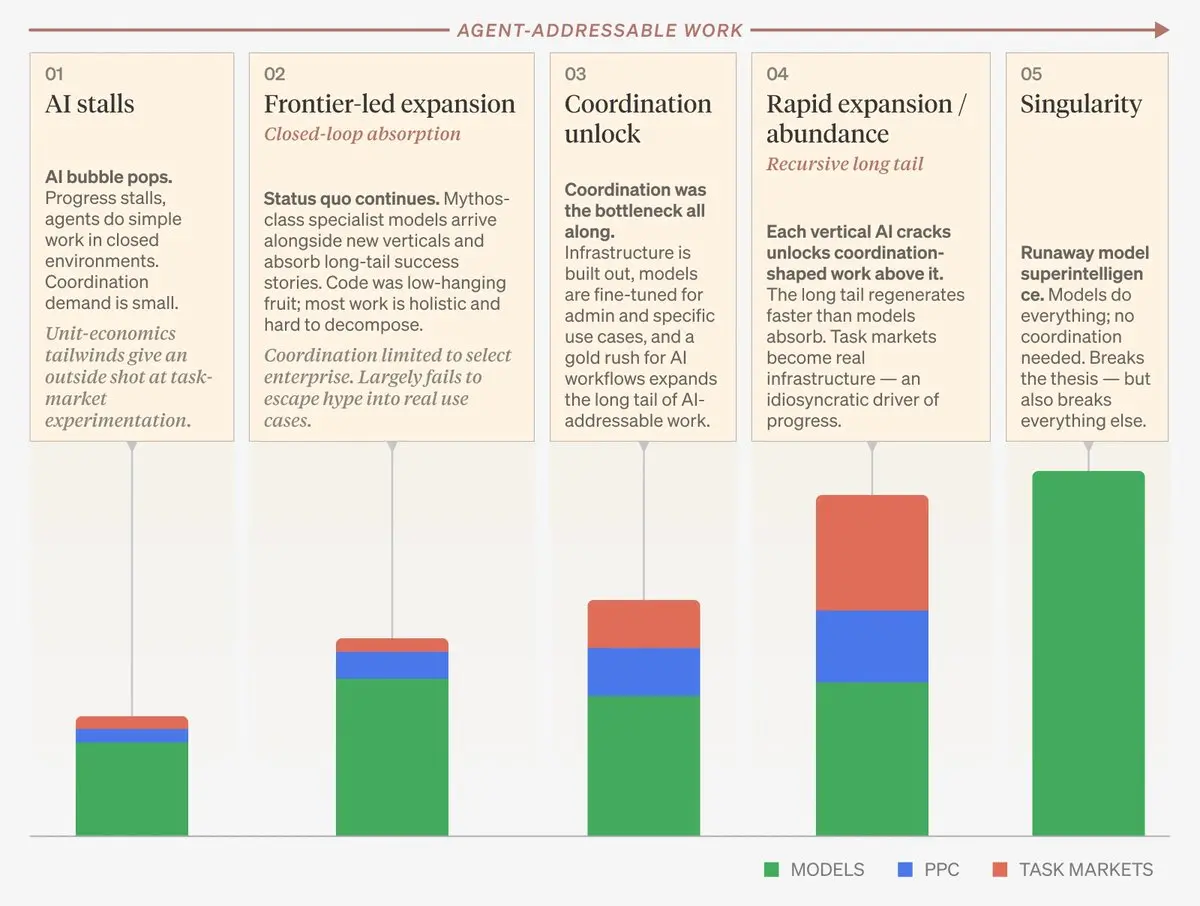
Single agent + skills + MCP. If Claude can complete the task by itself, you don't need coordination or a task market. Skills are instructions; MCP is the connector. Both must be maintained, but among the tens of thousands of MCPs, only a small portion is of high quality. Skills become outdated; MCPs cannot scale. You can't pre-build the long tail.
Pay-per-use. When Claude hits a wall, it seeks answers externally and then continues. These transactions are simple, hidden, and cheap. As agents take on more work, the tool catalog will cover more expensive and specialized tasks.
Coinbase's agentic.market is an early example. Through Base MCP, agents can access a complete service directory that has been installed.
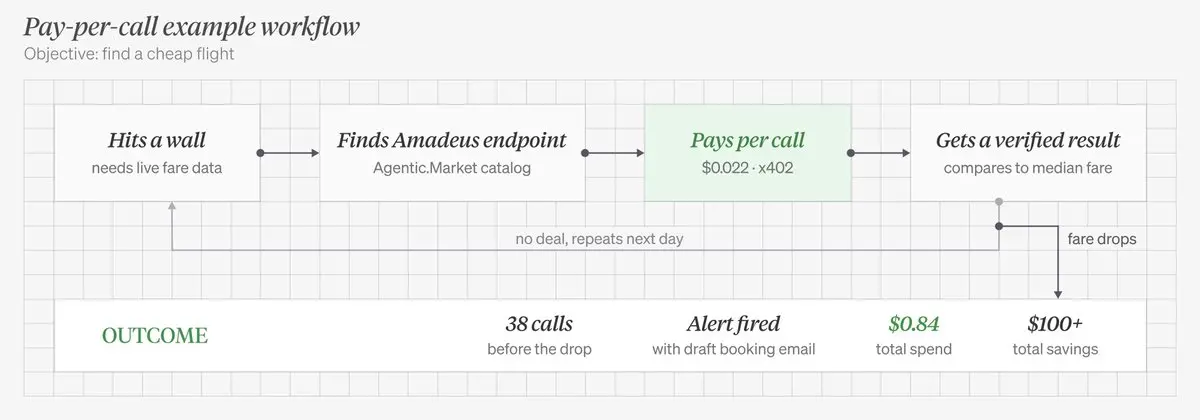
Imagine an agent building a cheap flight itinerary.
Option A (skill/MCP): You install an Amadeus skill file. Claude reads it and directly calls the API. This works for a few services with high-quality MCPs. When Amadeus changes its API, it will become ineffective. Someone must maintain the skill file. It cannot scale to 50,000 services.
Option B (pay-per-use): Amadeus pricing on Agentic.Market is $0.022 per call. The agent discovers it, pays, and gets the data. The service provider maintains its endpoint and gets paid. No need to download a skill or maintain an MCP.
Companies are seriously advancing the construction of this layer. These directories are filled with services that agents can use, but lack the orchestration infrastructure to package them into useful workflows. Missing components include autonomous agent runtimes (OpenClaw, Hermes), commercial SDKs (AgentKit), wallets, payments, and API monetization.
Task market. A task is a skill delivered with verified results. Buyers get the results, and sellers are responsible for the model, execution framework, skill files, prompts, retries, and accountability. Agents are disposable; rather, the captured tasks and their data are assets.
The structure of tasks makes agent work more reliable. An individual agent with a 95% accuracy rate over 10 steps has an overall success rate of only 60%. The task market distributes work across nodes verified by agents and humans, with different blind spots for each party, meaning errors can be detected and redone at each checkpoint.
The task market is not a competitive category of pay-per-use markets; they can evolve from it or be layered on top of it. Protocol standards clarify this distinction. ERC-8004 defines identity, reputation, and verification registries. It does not include payments, which are handled by x402 and MPP. Pay-per-use is the payment layer; the task market is the layer of trust and coordination.
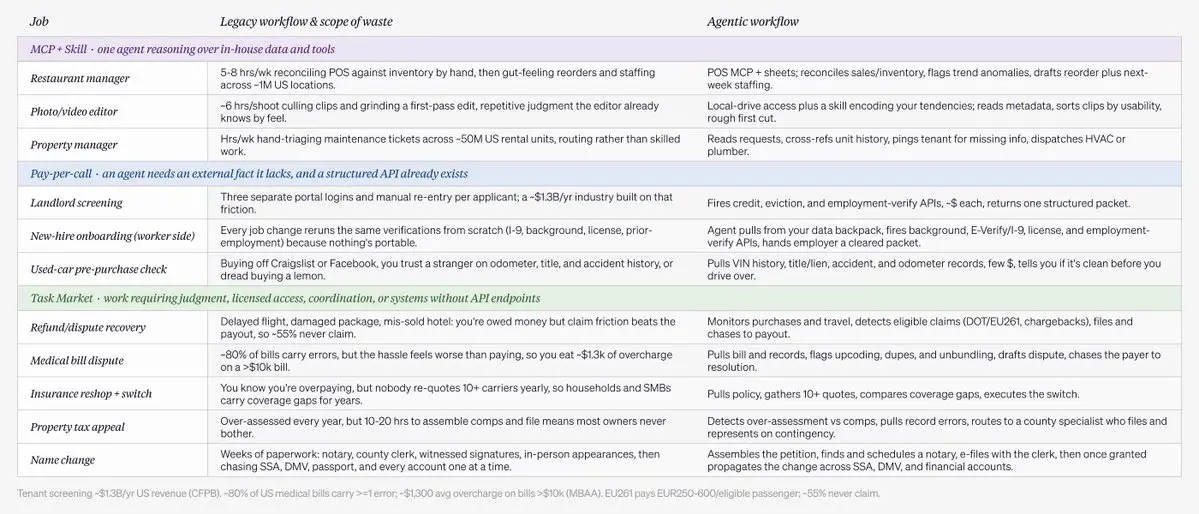
Mapping Reachable Work
MCP + skill: A single agent with internal data and tools. We are here.
Pay-per-use: Structured APIs exist for agents to retrieve the external facts they need.
Task market: Complex work requiring judgment, licensed access, and coordination. Chaotic real-world work cannot be accomplished through API calls. It involves digital and physical systems, time dependencies, and hostile trading counterparts.
Take a workflow where an agent searches for deals as an example. The user plans to renovate their kitchen when home appliances go on sale. This is a typical pay-per-use case: the agent pays $0.01 for each query and notifies the user when it finds a deal. However, retailers will block crawlers, and services that bypass these restrictions (like SerpApi) prohibit reselling data, forcing users to subscribe. Ironically, reselling scraped data is the entire business model of SerpApi, which Google has also sued them for.
A workaround is for endpoint operators to pay subscription fees and then pass on costs pay-per-use. If data is transformed into judgment rather than direct pass-through, this practice holds more merit.
Transforming structured outputs into determinations brings issues. This workflow now becomes a task market payload squeezed into the pay-per-use track, but these tracks lack verification, reputation, and dispute resolution channels. Buyers cannot verify black box determinations, making it less reliable than standard pay-per-use, and not as dependable as a fully equipped task market.
The infrastructure is not yet in place, but economic incentives are already clearly felt. Subscriptions are a predatory model, and incumbents have overextended. All roads lead to on-demand pick-and-click.
Supply Ignition
The argument for the task market is sound but filled with assumptions and lacks catalysts. When will building AI workflows become a gold rush like the App Store?
The early landscape of agent commerce corresponds highly to the early iOS ecosystem. The victory of the App Store was not because applications couldn't exist before it; it triumphed because it made discovery and distribution frictionless, and because the iPhone became indispensable. You needed one to keep up. Today's AI chatbots are like the iPod Touch: useful and powerful but limited in range. The coordination infrastructure will turn agents into iPhones and the task market into the App Store.
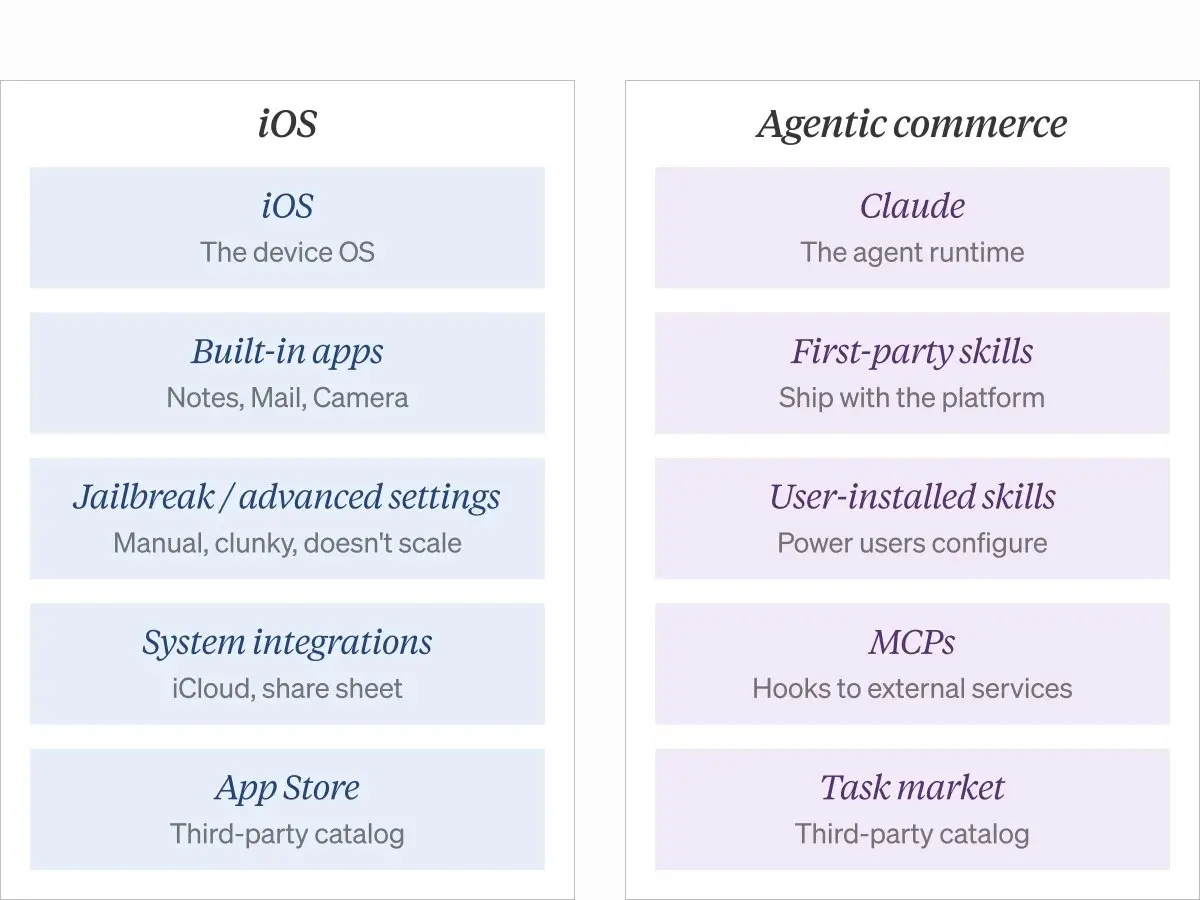
The third-party builder model is the weakest link in this analogy. App Store developers derive recurring revenue from users. In agent commerce, applications are consumed rather than owned. Businesses must win back customers each time. Reputation becomes the new customer acquisition cost. This makes it harder for builders but will improve market execution and lower entry barriers.
Granola is one of the clearest examples of AI PMF thus far, and as note-taking tools become saturated and commoditized, it has been shifting towards MCP servers. Applications are being absorbed, and data is becoming the core business. This will be a common pattern: create something users love, get absorbed by frontier labs, shift towards APIs, and become a Lego piece in other workflows. Granola could become the counterpart of Shazam on iOS. Defensive services must offer something that models themselves cannot complete:
• Access it lacks
• Specializations not worth replicating economically
• Verification needed from a neutral third party
Without recurring revenue and facing the risk of being absorbed by labs along with competitive commoditization pressure, the economics for builders is very brutal. The gold rush is likely not to start with independent developers. Ignition will come from three directions: internal enterprise optimization, consumer platforms extending chatbots into commerce, and operators packaging workflows for sale.
Enterprise-side Ignition
Enterprises are the furthest along in the agent economy. McKinsey found that 88% of organizations are deploying AI, but only 19% report that AI has brought an increase in revenue of over 5%. Redesigning end-to-end workflows and reshaping whole sectors is where the EBIT impact is greatest.
Companies like Block are already using AI as a major coordination layer internally. Jack's "From Hierarchies to Intelligence" implies a bearish view on the task market: Block is performing internal optimizations using proprietary models and data. Financial technology companies and other machine-readable enterprises are the most natural early candidates for this transformation, but for most companies, this path will be messier. Agents will hit organizational boundaries and will need to reach outside the company.
Consumer-side Ignition
Consumer progress is further along than public opinion suggests. In March 2026, the AI traffic conversion rate flowing to U.S. retail was 42% higher than that of non-AI traffic, an improvement from being 38% lower a year ago.
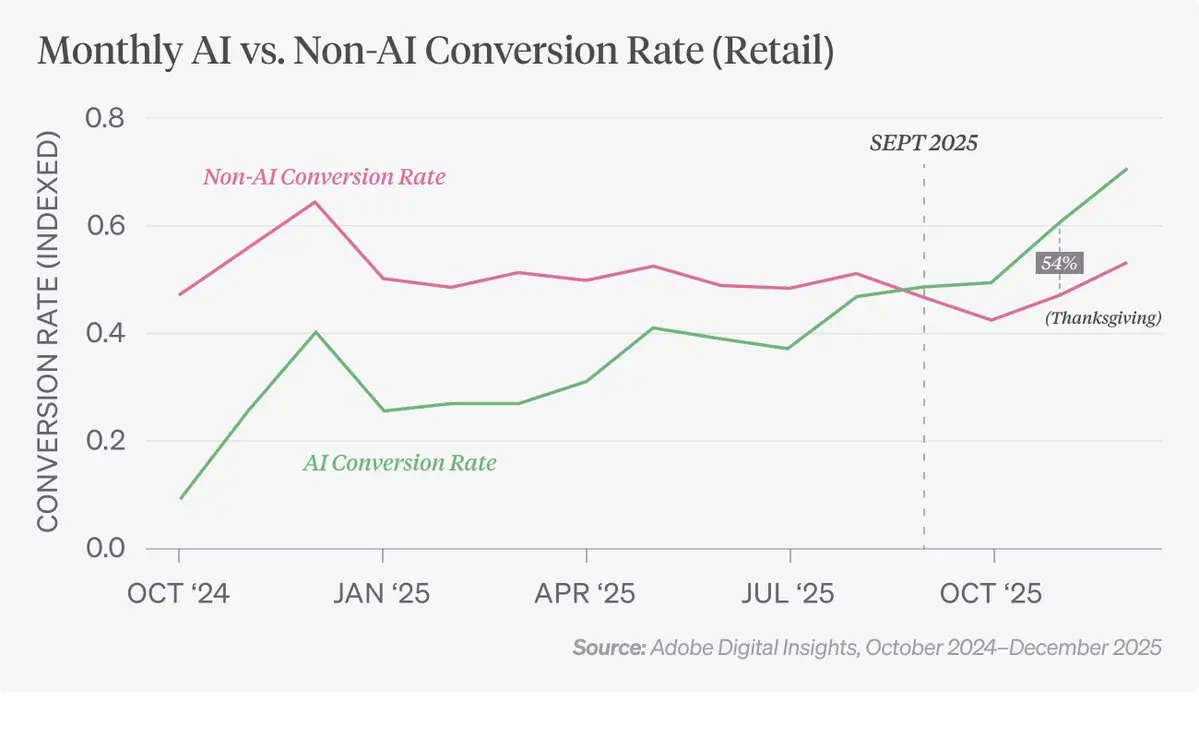
Monthly AI versus non-AI retail conversion rates. Source: Adobe Digital Insights, October 2024 to December 2025.
Users are beginning to rely on AI for shopping, but the momentum disappears at checkout. In September 2025, Stripe and OpenAI rolled out Instant Checkout within ChatGPT. It supports Etsy, Shopify, and ultimately Walmart (over 200,000 items). Etsy and Shopify sellers had minimal trial usage, and Walmart's conversion rate was three times lower than on Walmart itself. OpenAI turned in March 2026.
Instant Checkout is not the kind of indictment of agent commerce that critics portray.
Poor execution: 4% commission, no tax collection, only providing single-item shopping, and putting incorrect items into users' shopping carts, with delivery estimates having flaws.
Not agentified: Humans are in the loop, creating extra friction, with no import documentation.
Narrow failure mode: Even if you acknowledge that users trust merchants and resist behavior change, and only buy where there are existing documents and contexts, this still does not respond to the entirely new agent services brought about by complex coordination.
This is not a polished pilot of a new product but an attempt to monetize distribution. Moreover, the idea that merchants will always control checkout because they have a trust moat is naive. The success of Apple Pay and Google Pay relies on aggregating checkout interfaces. Trust relationships can be built; user experiences can be improved.
The remaining unknown is the reachable scope of agentic purchases. Will agent commerce be the next metaverse? Hotel booking scenarios are at the forefront of this debate. Critics claim such workflows are mere gimmicks (Memes), and to some extent, they are correct. AI cannot reliably convert imperfect prompts into precise decision matrices. It depends on the type of purchase. For hedonic expenditures like luxury hotels, selection is part of the pleasure, and AI is best suited to act as a discovery tool; while for practical expenses like conference hotels, the decision matrix is straightforward, and agents can immediately be of use.
The biggest assumption is that the mass market can gradually get used to delegating purchases to agents. This will determine whether agents will have their "iPhone moment" or evolve into roles similar to Google/Amazon in e-commerce from frontier frameworks (Harness).
Landscape of Agent Markets
The agent market is being built on a number of layers of agent payment infrastructure currently under construction.
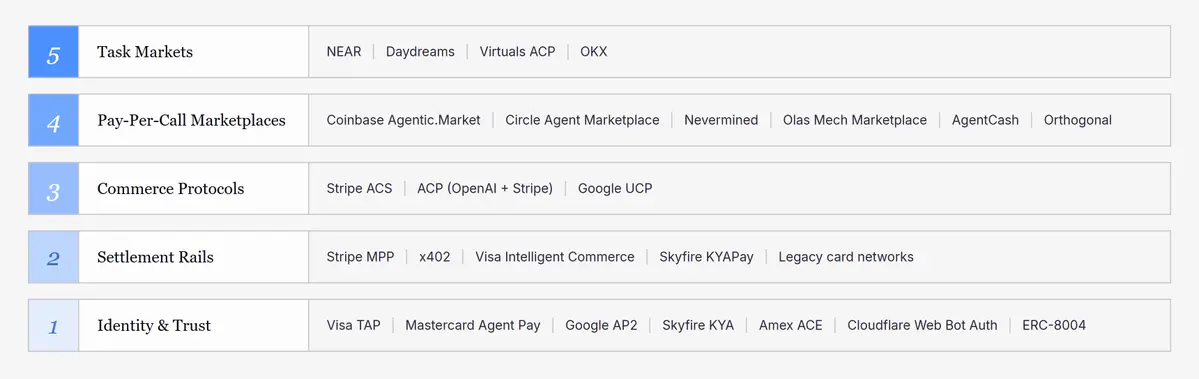
Layers 1 to 3 are saturated and heading towards convergence. Stripe and Coinbase are competing to dominate this tech stack.
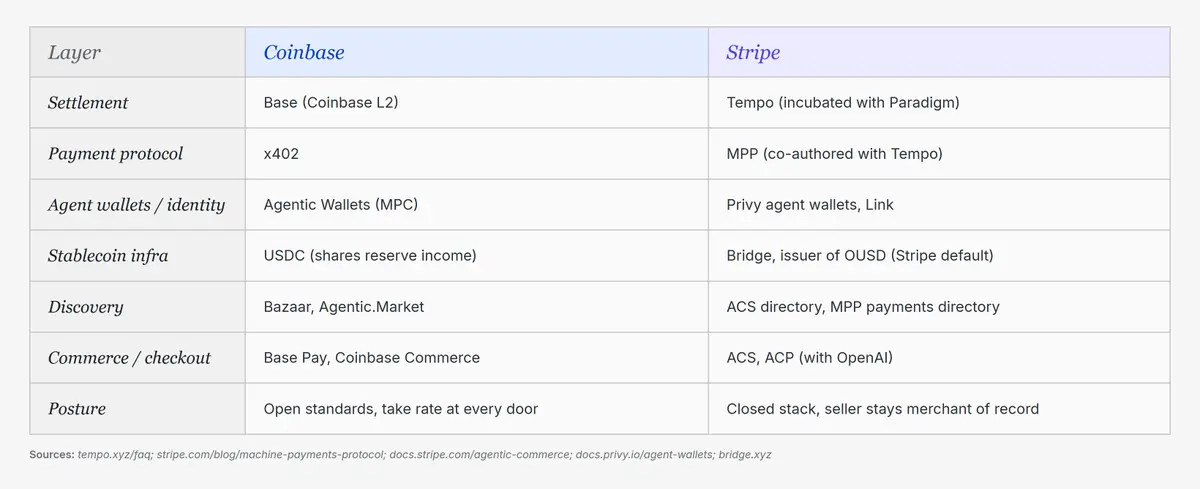
On the surface, Coinbase seems more favorable in the crypto space, but Stripe has downstream advantages through Tempo and possesses stronger capabilities to trigger a catalytic effect.
Coinbase
Coinbase is building a full stack based on open standards and positioning itself at the core of every layer.
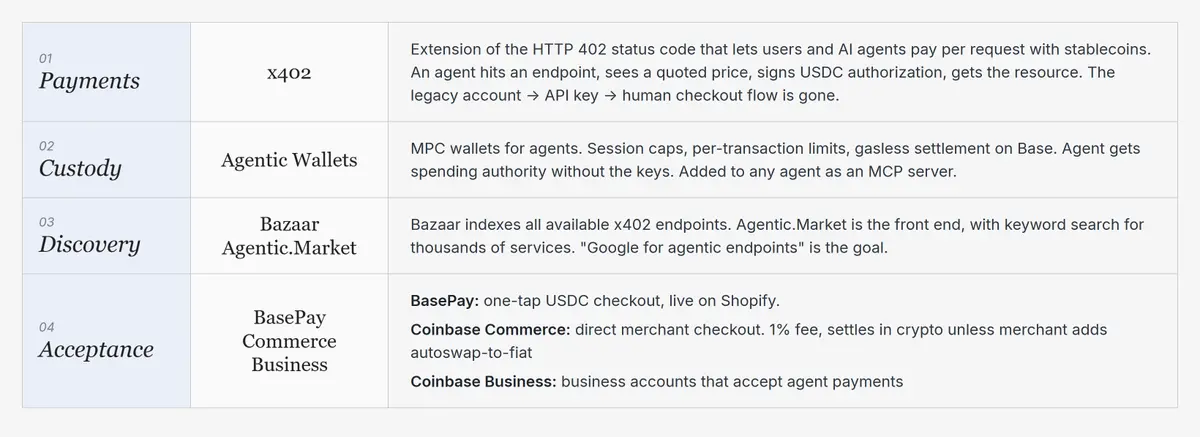
x402 is open but charges a small fee. Base is a public chain, but it is Coinbase's chain. 50% of the underlying earnings of USDC belong to Coinbase. Agentic.market is permissionless but is the front end for Coinbase. Coinbase is striving to become the App Store of the agent space: monetizing open tools and developer ecosystems through take rates.
The current coordination mechanisms are still lacking. Agentic.market is a pay-per-call directory, but the matchmaking, hosting, reputation, and dispute resolution mechanisms do not yet exist. However, Coinbase is well-positioned to become a true task market or for other task markets to settle on its foundational track.
Stripe
Stripe is building agent commerce as an extension of its existing business, assembling a full tech stack through acquisitions and internal R&D.
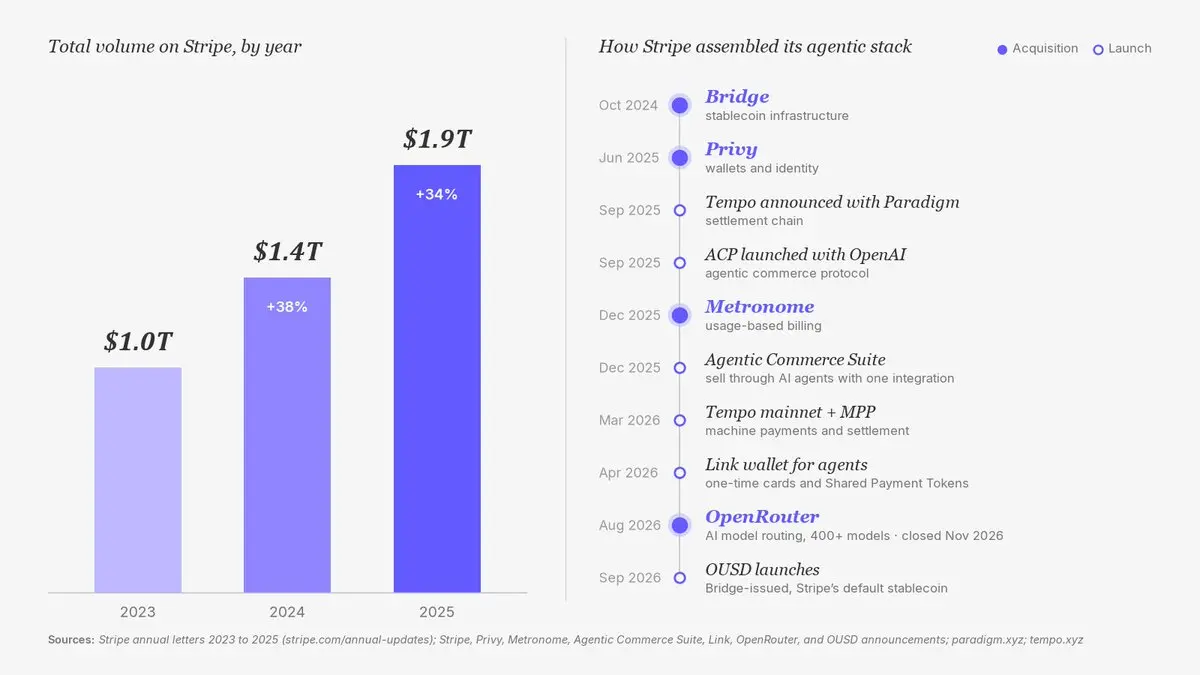
If Coinbase is masquerading as a toll booth model on an open track, then Stripe is unambiguously closed. MPP and Tempo are more centralized than Coinbase's counterparts. Coordination infrastructure (disputes, verification, liability) is all centralized at Stripe, with sellers remaining nominal merchants of record.
In many respects, Stripe is the opposite of a task market. Stripe envisions agent commerce as being similar to traditional commerce supported by Stripe, rather than a new type of market.
Tempo
Tempo has solved Stripe's alignment issue. By serving as a universal settlement layer, it juxtaposes Stripe's tech stack with open protocols. Stripe's business is backend infrastructure, ceding user ownership to the framework. Thus, while just deploying on Tempo does not bring discoverability to the open market, it weakens the framework's moat.
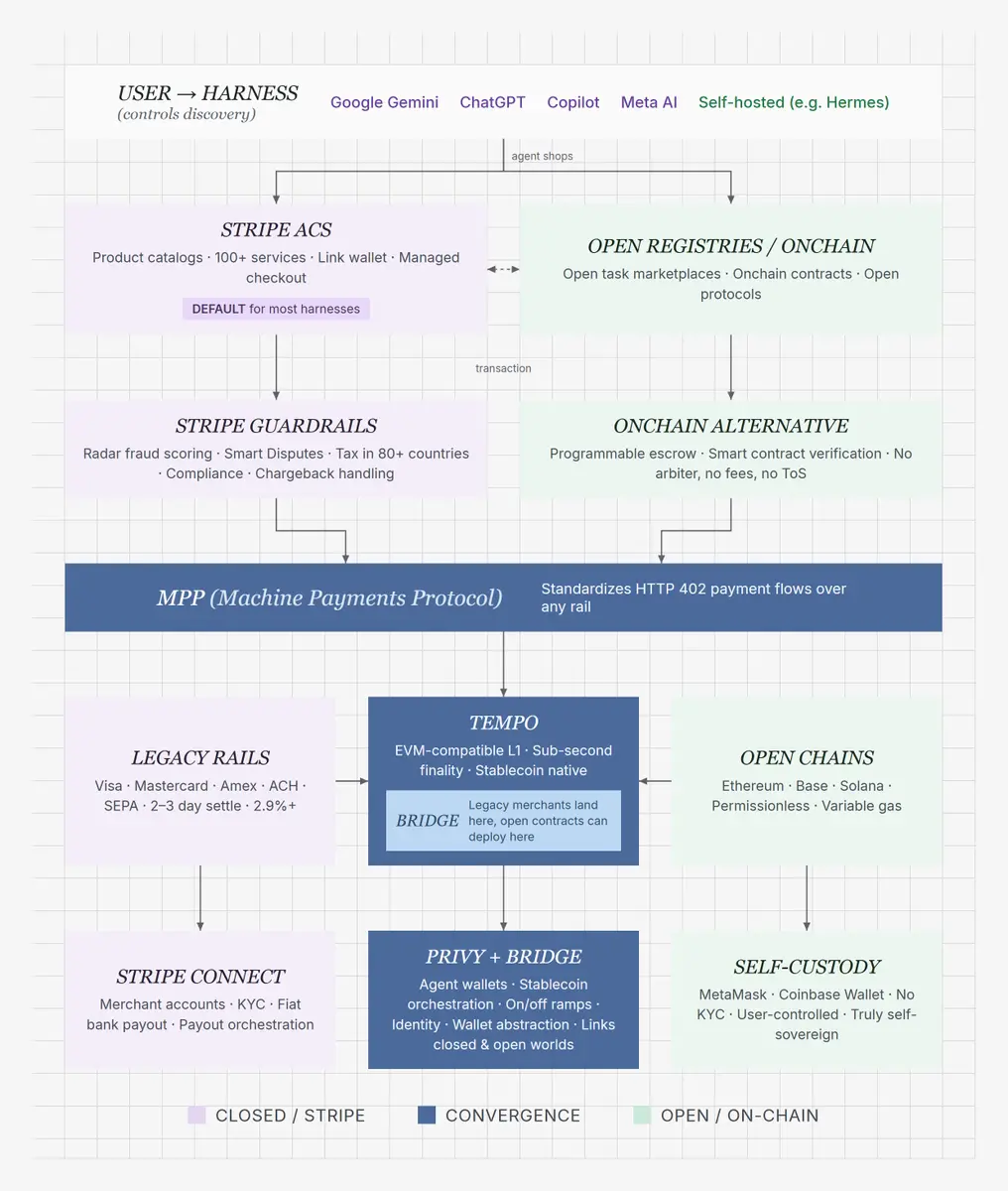
Closed frameworks can only see their provider's inventory, while open frameworks can see everything. Gemini buyer agents can only see Stripe's ACS directory. Unless queries originate from open frameworks, merchants in the open market will not be discoverable. Once merchants, settlement, and protocols are integrated, the cost of switching frameworks will become extremely low. Frameworks must compete on routing quality, and frameworks undergoing review will struggle to offer optimal pricing.
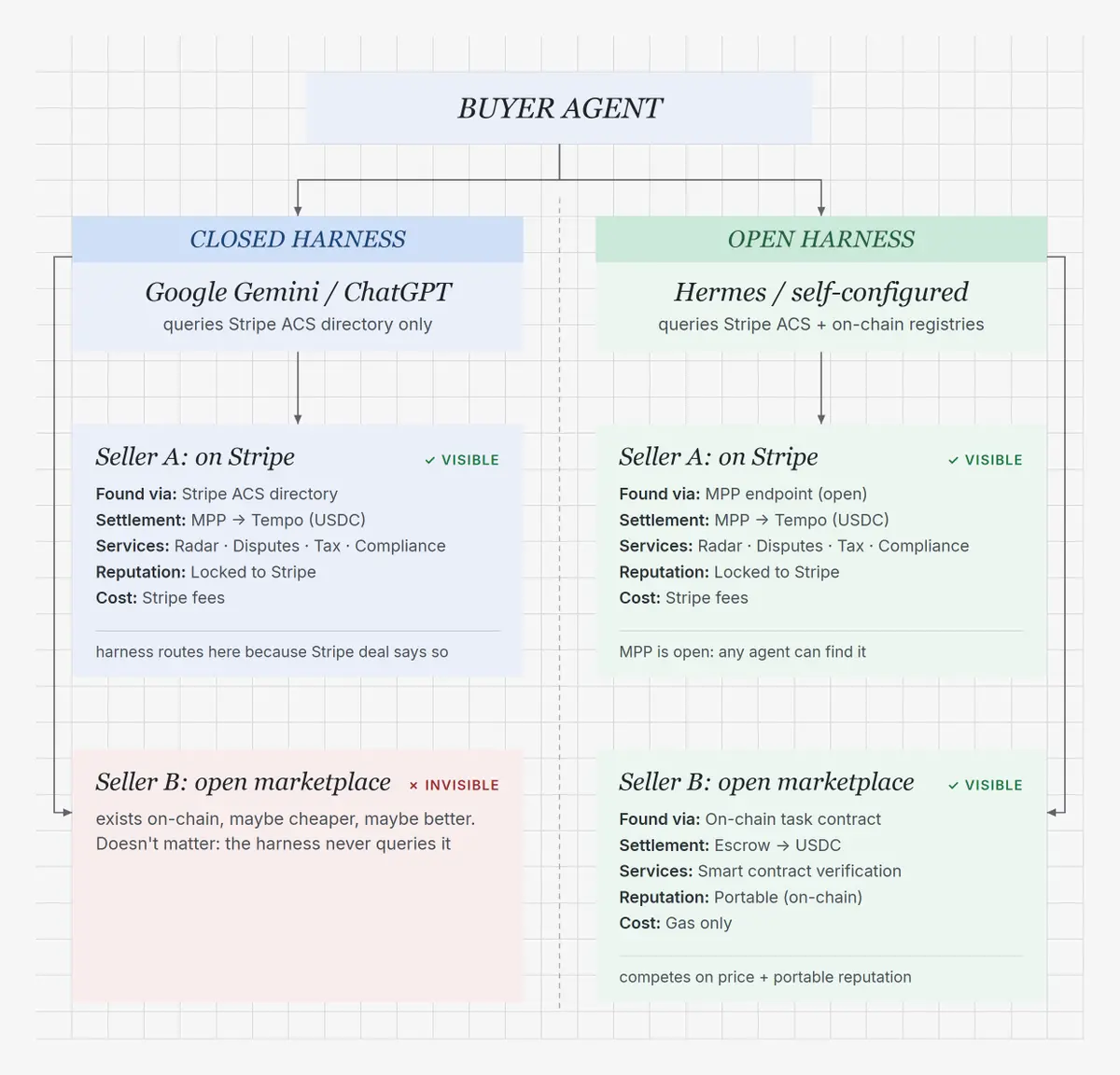
How integration dismantles the framework's moat
Frameworks are distribution engines. They are not unique to AI but ubiquitous. Their moats consist of directory depth and user status. Streaming is an excellent analogy for such network effects.
Setting barriers is costless because each platform is mutually isolated. Netflix not having "Silo" does not matter because AppleTV does not have "Ozark" either. Meanwhile, users store credentials, context, muscle memory, and trust within their frameworks. This comfortable lock-in effect allows users to tolerate worse transactions within a fairly wide quality threshold. We ultimately differentiate into Netflix user families and Hulu user families.
The same logic will apply to agent commerce. Because merchants cannot list on ACS without permission, they list on decentralized exchanges (DEX) for open frameworks like Hermes to find them. If the open market offers optimal pricing, users will pay with stablecoins on an independent track; if not, they will use fiat currency payments via Stripe tracks.
This has been the survival state of cryptocurrencies: an isolated ecosystem two business days apart; what is promised is kept, and what is not promised is not. Both mean needing to fund, track, and pay in both systems separately.
Tempo is the final piece of the puzzle unifying Stripe's tech stack. Everything beneath the framework integrates:
Settlement with Tempo: a single balance, rather than fiat in one place and stablecoins in another.
Payments with MPP: Stripe checkout and on-chain checkout use the same process.
Identity verification with Privy: portable, cross-framework user status.
Once everything beneath the framework is unified, all that remains is to switch frameworks to access both worlds. In streaming, switching platforms is like trading one island for another; while here, you can have both. This is based on the assumption that third-party frameworks can initiate checkouts to ACS sellers through Tempo, but Stripe has not yet confirmed this. The recent collaboration between Nous Research and Stripe is a great signal, but at this stage, it has not granted Hermes and other partnering frameworks equal access to ACS.
Due to entrenched habits, reward mechanisms, and chargeback protections, consumer commerce may continue to operate through card payments. Stripe is in a leading position in the competition for agent commerce, while Tempo provides the best distribution background for cryptocurrencies ever.
Open Market: Daydreams
Existing giants are building v1: identity, payment tracks, and commerce. Crypto-native teams are developing v2 primitives crucial for the agent market: reputation, custody, and verification.
Daydreams is a product lab incubated by the Starknet FOCG community and an early open-source builder in the agent space (x402 facilitator, USDC reasoning router, Lucid agents). Daydreams has now shifted focus to TaskMarket, a decentralized task market deployed on Base and Tempo, where the demand side funds tasks with custodial USDC/OUSD, and agents compete to deliver. TaskMarket is the front-end market, with an underlying set of open standards regulating how agents publish tasks, bid, and earn rewards upon task completion.
Task Market Protocol (ERC-8195): a set of task coordination standards that do not distinguish between actors, applicable to agents, humans, and IoT. Task statuses flow from Open → Claimed → WorkerSelected → PendingApproval → Accepted, with Expired (timeout refund) and Cancelled as terminal branches. There are five purchasing models, each with its own state machine.
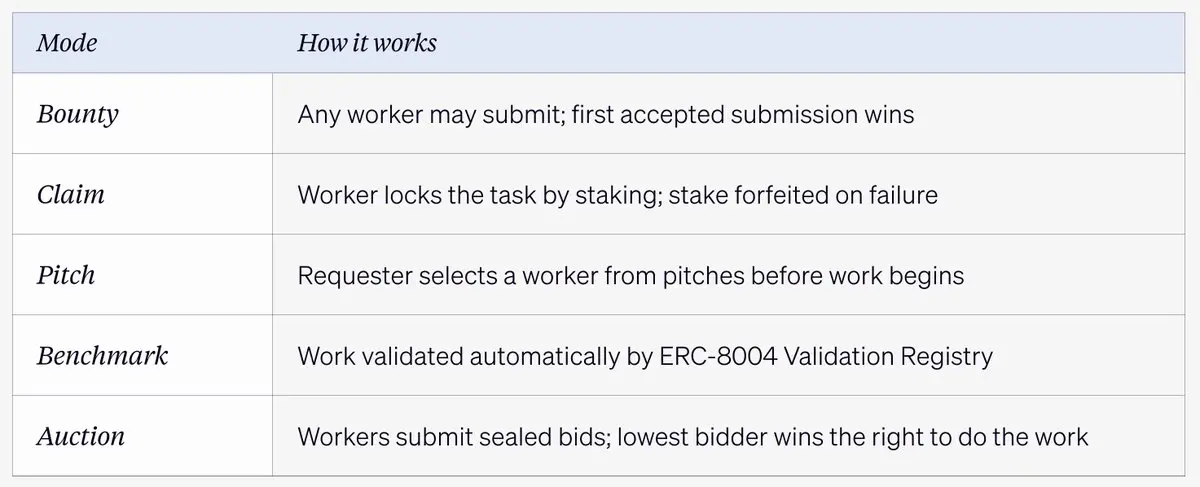
Scalable design: hooks similar to Uniswap V4 unlock composability around task lifecycle events. Reputation, verification, and dispute resolution can all be built on top of it. Native custody releases funds upon acceptance or refunds upon expiration. Reputation integrates with all three ERC-8004 registries.
Metrics: 16,500 registered agents, 1,843 published tasks, approximately $3,756 paid, 4,362 active wallets
Daydreams is the purest task market layout. It assumes that verified outcomes will become tradable units and positions itself as open-source, neutral infrastructure.
On November 22, Visa Crypto Labs launched the Visa CLI Smart Wallet, built on Tempo and MPP and natively integrated with TaskMarket for OUSD. Eligible U.S. users can verify their agents with their Visa cards, registering them in Visa's agent directory and incorporating them into the Trusted Agent Protocol (TAP). This agent can complete TaskMarket tasks and be rewarded in OUSD on Tempo. The demand side can constrain tasks to only TAP-verified agents.
Other On-chain Markets
NEAR: NEAR AI is a vertically integrated AI infrastructure stack that includes three core products: NEAR AI Cloud, IronClaw agent framework, and NEAR Intents. NEAR's AI agent market integrates these core products under a unified vision. It treats tasks as exchange units, but the market design is still largely pay-per-call. This market features competitive bids, custodial-based payments, and intent-based task descriptions as its key pay-per-call differentiators but lacks judgment, verification, and reputation layers.
Virtuals: Virtuals has the largest and most mature agent economy. Its Agent Commerce Protocol (ACP) provides structured negotiation, on-chain custody, and optional third-party assessments for agent-to-agent transactions on Base. Virtuals co-authored ACP v2 with the Ethereum Foundation and formalized it into an open standard (ERC-8183). Virtuals has significant advantages in distribution and branding, though most of its transaction volume comes from crypto-native launchpad activities.
OKX AI: OKX has built a vertically integrated tech stack covering identity, payments, reputation, and disputes, layering it onto existing CEX infrastructure. It provides both agent markets and task markets. Custody handles complex work while pay-per-call handles standard services. It is effectively a hybrid of the two paths of Coinbase and Stripe.
Centralization Risks
Both Coinbase and Stripe provide strong support for on-chain agent commerce. Centralization is always a threat to open markets. Models, harnesses, and market layers can all become chokepoints.
Model moat: Frontier labs may embed biases into models. This seems unlikely as the models have been commoditized. Regulatory pressure is a more realistic source of scrutiny, and the moats will shift from lab-to-lab to frontier models versus open source. This quality gap will be much larger.
Harness moat: Harness can control which directories users see. This is the most relevant threat currently, but it will significantly weaken in a converging scenario. Harnesses that implement scrutiny must surpass every node in the workflow; otherwise, users will migrate for better execution.
Market moat: Coinbase and Stripe control distribution and settlements. Stripe can pick winners among various harnesses by restricting checkout. Coinbase's positioning here is friendlier since x402 and agentic.market are permissionless, but wallet infrastructure and broader platforms have compliance barriers. This is the familiar CEX versus DEX outcome. Open markets can enter, but with less convenience; the threat of scrutiny remains ever-present.
Great Unbundling and the Wedge of Crypto in the Agent Economy
Today's labor market sells labor in bulk. You can only pick one from many talents to make a living, with only 6-10 hours actually spent using it per week. The remaining 30+ hours are spent on face time, paying fealty to power, and performing administrative tasks in adult daycare. We are compensated not for talent but for attendance. Bundling these tasks into full-time positions was the only way to make coordination economically viable. Then, nations tied healthcare benefits to your job and standardized 30-year mortgages. Welcome to "The Truman Show."
The task market flips all this on its head. It’s like Fiverr for AI and humans, but it actually works. You work from home, on your schedule, selling diversified talents at fair market value. No attendance theater, less work (but all real work), and the goods on the other end are cheaper.
Crypto's Second Chance
Agentic commerce is the crypto industry's second chance to realize its values. Crypto opposes traditional systems but cannot access them. This is exactly where AI is better suited to disrupt existing giants. It arrives as a tool, embedding itself within their systems and dismantling inefficiencies from the inside. An agent is a Trojan horse that will accelerate stablecoin adoption and provide a neutral distribution channel for crypto, reopening design space.

The North Star goal that the crypto industry has long upheld may finally be achievable. Decentralized Uber failed in distribution, but an agent that books rides does not owe allegiance to Uber; distribution is no longer a moat. The programmability of DeFi enters the main battlefield, extending right through to final payments. Everyone knows that SEO is about to undergo a complete transformation: perhaps in two years, you announce your intention to buy a refrigerator, lock in $800 in a contract, promise to complete the purchase within five days, and specify four shortlisted merchants. Once notified, merchants query your ZK context graph to price your lifetime value and offer coupons and perks. SEO budgets are redirected to the user.
An MRI consists of three tasks: executing the scan, interpreting the results, and determining the next steps. Layers of permissions, regulations, and insurance have inflated MRI costs into a symbol of medical inefficiency. After decomposition, a user can obtain a scan, have a specialized agent make the first round of judgments, and then upgrade the imaging handoff to an anonymous radiologist holding zk credentials, integrating into the formal system only when the interpretation of results is necessary. Each step is priced separately, with trust built individually, and the expensive credentialed steps are bypassed.
Full-time work is like that $3,000 MRI. Both bury a small piece of value within layers of friction. Agents make coordination scalable and cheap, and blockchains are the optimal structure for exchanging atomic units. Crypto does not need suited individuals to deliver PMF; it needs them to step aside.
The global economy will not dissolve into a utopian gig economy overnight. But AI will enable us to scale specialized capabilities, profit from reimagined wasteful workflows, and enjoy the quality of life improvements brought by labor reorganization. The shift from bundled work to atomic tasks will be the last tenfold improvement ever.
免责声明:本文章仅代表作者个人观点,不代表本平台的立场和观点。本文章仅供信息分享,不构成对任何人的任何投资建议。用户与作者之间的任何争议,与本平台无关。如网页中刊载的文章或图片涉及侵权,请提供相关的权利证明和身份证明发送邮件到[email protected],本平台相关工作人员将会进行核查。