Author: Zhou, ChainCatcher
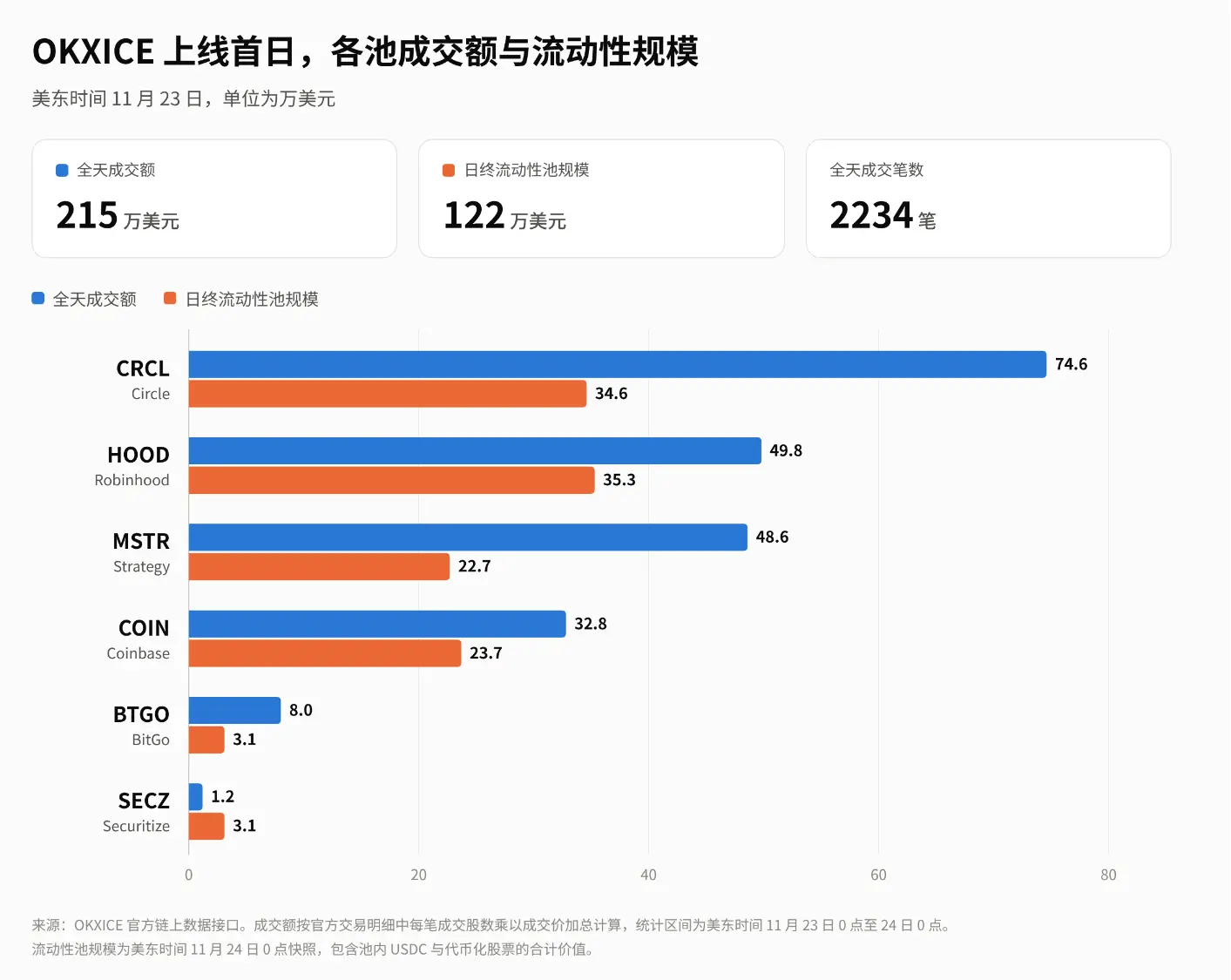
On November 23, Eastern Time, the joint platform OKXICE TSV launched, with the first batch of 6 stocks being Coinbase, Securitize, Strategy, BitGo, Robinhood, and Circle. The platform had previously confirmed 113 assets, including stocks and ETFs, which will be launched in batches.
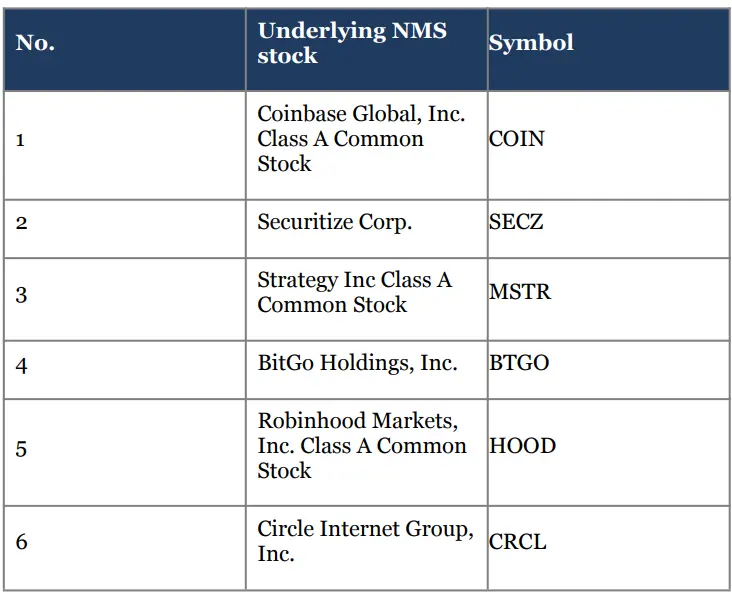
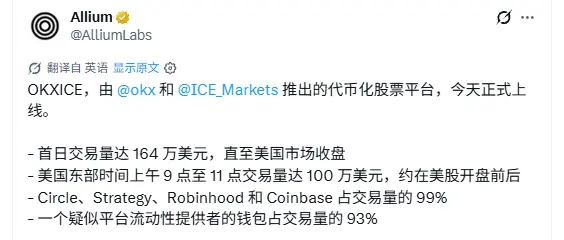
According to official data from OKXICE, on November 23, Eastern Time, the 6 pools had a total of 2,234 transactions, with a transaction volume of approximately 2.15 million dollars. Among them, CRCL topped with about 746,000 dollars, followed by HOOD and MSTR with about 490,000 dollars each, COIN with about 328,000 dollars, BTGO with about 80,000 dollars, and SECZ with about 12,000 dollars.
In terms of liquidity scale, as of midnight on November 24, Eastern Time, the total liquidity of the 6 pools was approximately 1.22 million dollars, with the HOOD and CRCL pools each having about 350,000 dollars, and COIN and MSTR each having about 230,000 dollars, while BTGO and SECZ each had about 30,000 dollars.
From the trading structure perspective, the on-chain data platform Allium pointed out that as of the close of the U.S. stock market on that day, a wallet suspected of being a liquidity provider for the platform contributed 93% of the trading volume.
This platform took over half a year to prepare before its launch. In March of this year, ICE invested in OKX at a valuation of 25 billion dollars, obtaining a board seat. By June, both parties announced the establishment of the joint venture OKXICE, with former New York Governor Andrew Cuomo and ICE Futures Exchange Senior Vice President Trabue Bland serving as co-chairs.
Although ICE is a shareholder, OKX stated that the New York Stock Exchange neither operates nor regulates this platform.
On September 17, the SEC issued an innovation exemption, allowing qualified tokenized securities trading platforms to trade the on-chain versions of U.S. stocks without registering as an exchange or alternative trading system with the SEC.
OKXICE issued a public notice on October 4, and after an over one-month notification period, it officially launched. Before it, TSV LLC on the Canton network had already completed the first batch of transactions, making OKXICE the second platform to start trading under this exemption.
Official information shows that OKXICE TSV operates on the Ethereum Layer 2 Network X Layer under OKX, and trades are completed through a permissioned AMM liquidity pool built on Uniswap v4. Users must complete identity verification and hold a non-transferable soulbound token to enter the trading pool.
Compared to traditional exchanges, the platform has no order book and does not custody assets; the tokens are held in users' own wallets. All trades require full payment, with no margin or borrowing. Third-party contracts must be whitelisted to connect, and aggregators and other DeFi protocols currently cannot access these pools.
All listed stocks are tokenized by Securitize Markets, with each token representing a share of underlying stock securities, traded paired with USDC. Holders enjoy the same dividends and voting rights as common stock, which are conveyed by Securitize.
This arrangement relies on the normal operations of Securitize and its brokerage. The official notice also warns that if the counterpart makes a mistake or goes bankrupt, dividends and voting may not be conveyed, and it is uncertain whether self-custodied tokens will be protected under SIPA.
In terms of liquidity, OKXICE stated that neither the platform nor its affiliates will act as liquidity providers; the funds in the pools come from third parties, which do not have to be registered brokers and can withdraw at any time.
There is also a trading volume limit. Following the LULD tier rules, COIN, HOOD, MSTR, and CRCL are Tier 1, with a daily trading volume limit of 0.25% of the average daily trading volume of the common stock from the previous month; BTGO and SECZ are Tier 2, with a limit of 2.5%. If a stock exceeds the limit for the second time, it will be suspended for three months.
Regarding fees, the official website currently shows a total fee rate of 0.3%, of which 0.2% goes to liquidity providers, and 0.1% is the platform service fee.
67 Companies Oppose, Tokenization Route Controversy Emerges
The first batch includes only 6 stocks, directly related to a design in the innovation exemption. According to regulations, before third-party tokenized stocks can go live on the platform, the issuer must be notified, and if the issuer raises a written objection within 30 days, that stock cannot be traded on the platform; if there is no response, it is deemed as agreement.
Jamie Selway, head of the SEC's Trading and Markets Division, also mentioned that after the 30-day period, the platform actually does not have to accept new objections; OKXICE's decision to allow issuers to withdraw later is aimed at making the platform more attractive.
In the more than one month before launching, the number of companies raising objections gradually increased. There were 9 companies in the notice on October 15, exceeding 50 by the end of October, and rising to 67 by November 5, including companies like Apple, Microsoft, NVIDIA, and Tesla. Excluding duplicate codes, among the initially selected 62 companies, 56 raised objections, and the other 6 are the stocks launched this time. Additionally, 11 companies not on the original list also proactively raised objections, including Meta, Arm, and Wells Fargo.
Most companies did not publicly explain the reasons for their objections. According to Fortune, a few publicly stating companies like Applied Optoelectronics indicated that this framework is too new, and its impact on stock prices, liquidity, and volatility is still unclear, with no current benefits deemed sufficient to offset these uncertainties. Reports have also mentioned that some companies have concerns about OKX's offshore background.
However, opposition does not necessarily equate to rejection. CNBC believes that the high rate of opposition is more likely to reflect that companies are not yet ready. Seth Ginns, CIO of Franklin Templeton's crypto division, stated that the 30-day window coincides with earnings season and the midterm elections, and many issuers are willing to understand tokenization but do not want to rush into decisions.
MassPay CEO Ran Grushkowsky also noted that executives from client companies are generally very interested; mainly, resistance comes from the investor relations department, which fears that 24/7 trading will disrupt the rhythm of announcement releases. Securitize CEO Carlos Domingo found that among some companies that raised objections, executives responsible for digital assets were even unaware of who rejected. OKXICE co-chair Andrew Cuomo stated that most companies are not familiar with tokenization, and the more they learn, the higher their acceptance will be.
Some view this wave of opposition from an interest perspective. Crypto KOL Crypto Unafraid believes that the essence of the resistance lies in old money's unwillingness to hand over pricing power to the on-chain; exchanges also want to maintain their own price discovery rights. Although OKX's compliance route is more stable, gaining regulatory acceptance is just the beginning, and in the future, they may need to cede more benefits to traditional capital in ongoing negotiations.
Around the OKXICE model itself, opinions within the industry are also divided. OKX founder Star believes that although TSV has many limitations, it allows tokenized stocks held on-chain to have the same legal rights as custody stocks for the first time, enabling retail investors to provide liquidity in AMM pools directly using the stocks they hold. Figure CEO Mike Cagney, on the other hand, argues that AMM transaction prices are naturally inferior to order books, and the platform's lack of margin and borrowing markets diminishes the experimental significance of this sandbox after a large number of companies exit.
Outside of OKXICE, offshore markets have already had tokenized U.S. stock products. OKX itself has launched over 260 tokenized U.S. stocks provided by Ondo on CeDeFi, including Apple, NVIDIA, and Tesla, but the official statement clearly indicates that these tokens only provide price exposure, and holders are not company shareholders.
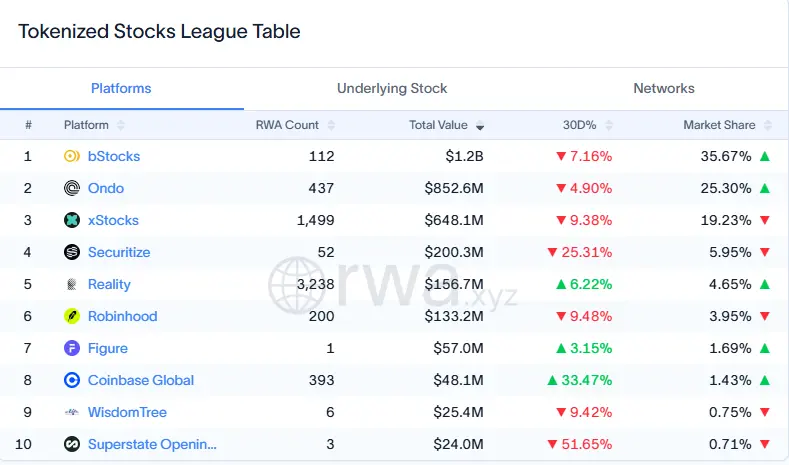
Data from RWA.xyz shows that as of November 22, the distributed value of tokenized stocks is approximately 3.37 billion dollars, with bStocks leading at about 1.2 billion dollars, followed by Ondo and xStocks at around 852 million and 648 million dollars, respectively.
Meanwhile, Nasdaq is promoting another tokenization route. In September this year, Nasdaq announced a 100 million dollar investment in Kraken's parent company Payward, aiming to jointly promote Nasdaq equity tokens led by issuers, with plans to launch in the second quarter of 2027. Nasdaq had previously announced the withdrawal of its own stocks from the innovation exemption framework and stated that TSV is not the best path for tokenization.
Clear Street analyst Owen Lau believes that tokenization may not bring sufficient new revenue to exchanges in the short term, but the trend of stock on-chain and 24/7 trading has already been established.
In light of this trend, the choices of listed companies remain one of the biggest variables. Is this wave of opposition aimed at the third-party model like OKXICE, or at tokenization itself? Perhaps the answer will become clear once Nasdaq's plan is launched.
免责声明:本文章仅代表作者个人观点,不代表本平台的立场和观点。本文章仅供信息分享,不构成对任何人的任何投资建议。用户与作者之间的任何争议,与本平台无关。如网页中刊载的文章或图片涉及侵权,请提供相关的权利证明和身份证明发送邮件到[email protected],本平台相关工作人员将会进行核查。