Author: AiPlot Research Institute
Focus: RWA / Digital Assets / In-depth Analysis of Financial Infrastructure
Website: https://aiplot.com/?utm_source=aicoin
The core contradiction of RWA has shifted from "Can it go on-chain?" to "Who owns the gateway to the capital market?"
Recently, three discussions regarding RWA focused on market size, data caliber, and industry structure, ultimately pointing to the same issue.
The first update relayed Standard Chartered's prediction about the market for tokenized real-world assets: the market size could grow from approximately $45 billion to $2 trillion by the end of 2028, with the tokenization of Japanese government bonds seen as a significant driver. The second update pointed out that the cryptocurrency space is not lacking in funds; what is truly in short supply is qualification to participate in the primary market for quality assets. If the crypto industry can only distribute assets on-chain after traditional finance has completed issuance, underwriting, and pricing, then it will merely obtain secondary liquidity, not the core power of the capital market. The third update reminded the market that different institutions report RWA sizes that can vary from roughly $36 billion to $60 billion, with discrepancies mainly arising from statistical timings, coverage, and different definitions like "distributed value" and "representative value."
Collectively, these three pieces of information lead to a judgment that is more important than "The RWA market will grow rapidly":
The first phase of RWA is to create on-chain certificates for traditional assets; the second phase is to compete for functions like issuance, distribution, pricing, collateralization, and settlement in the capital market.
If the industry remains at the stage of wrapping U.S. stocks, government bonds, gold, or fund shares into tokens and selling them through crypto platforms, then blockchain mainly acts as a distribution channel. It can improve transaction times, methods of transfer, and asset composability, but may not alter the distribution structure of asset yields.
A truly long-term valuable on-chain capital market must enable quality enterprises, funds, and financial asset issuers to view the on-chain market as a native venue for financing and asset management, rather than just a supplementary distribution channel after traditional market issuance.
First, addressing a common misconception: How big is RWA?
The frequent appearance of multiple figures for RWA size does not necessarily imply data contradictions. More importantly, it reflects that different platforms measure different objects.
Distinguishing market cap from total asset value is crucial. The former is the token supply multiplied by secondary market price, applicable only to assets with observable secondary markets; the latter is the token supply multiplied by the net asset value reported by issuers, applicable to funds, private credit, and institutional products that do not have active secondary markets and transact with the issuer through subscriptions and redemptions.
This distinction is critical. A tokenized money market fund without a public secondary market should not be deemed small simply because there are no real-time trading prices. Conversely, if compared directly with tokenized stocks or gold tokens that have public market prices, it may misinterpret price fluctuations as new capital.
According to AiPlot's current RWA market page, the rankings of asset classes show U.S. government bonds at about $14.1 billion, commodities around $5.33 billion, active strategies about $4.72 billion, and stocks around $3.73 billion; asset-backed credit is about $3.07 billion, and specialized finance around $2.65 billion.
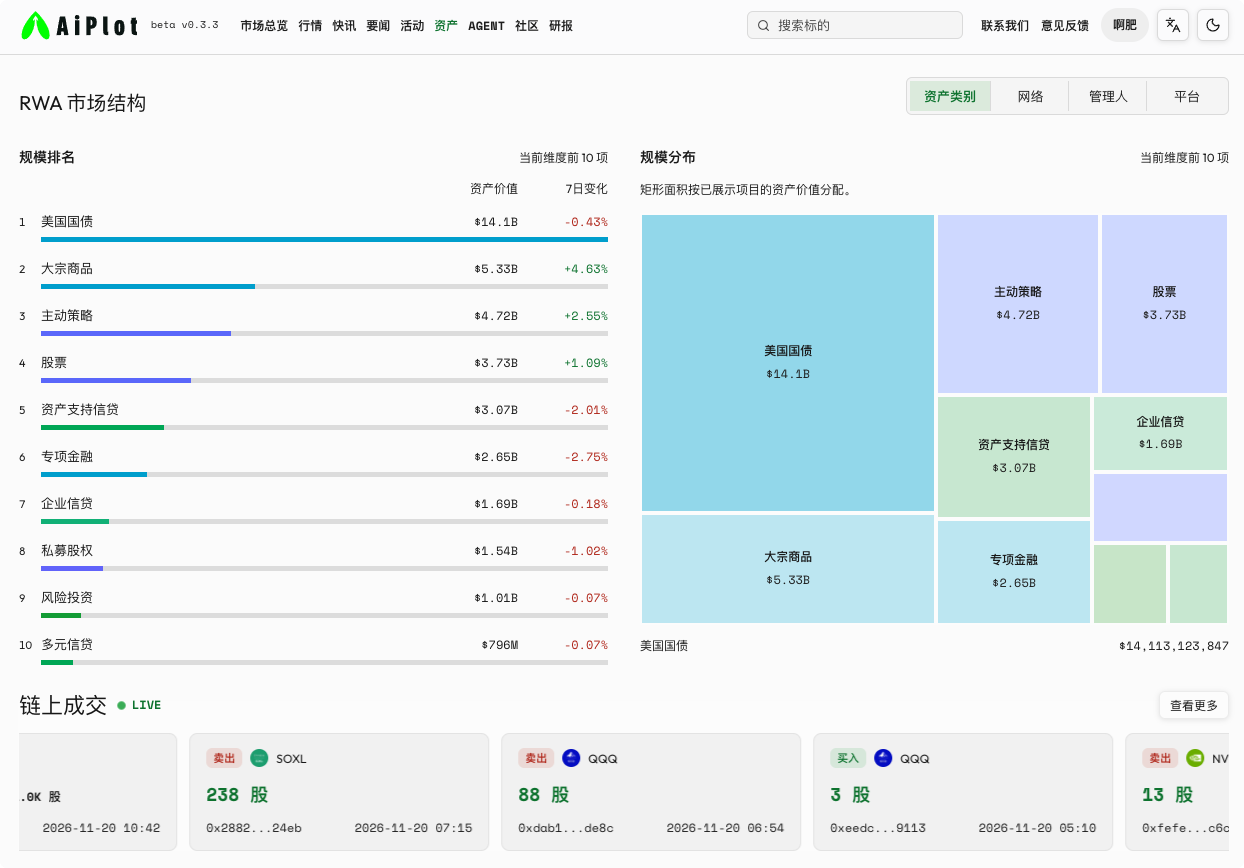
These figures are useful for observing the structure and relative changes of on-chain assets but should not simply be summed up to declare, "The entire RWA market has a fixed size." Researchers must also confirm:
- Whether the data counts distributed asset value or represented asset value;
- Whether the assets include stablecoins;
- Whether it includes institutional products without a formed secondary market;
- Whether values come from market prices or issuer NAV;
- Whether assets are newly issued or migrated from other networks;
- Whether scale changes arise from subscriptions/redemptions or price changes.
Therefore, RWA weekly reports or market analyses should not simply state "this week's market size reached X," but should simultaneously specify three criteria: statistical object, pricing method, and whether there is a secondary market price.
Third, Standard Chartered's $2 trillion prediction: What's truly important is not the number, but the source of growth
According to public reports, Standard Chartered predicted that the market for tokenized RWA could reach $2 trillion by the end of 2028, far surpassing the approximate $45 billion size at that time; one reason for this judgment is that Japan’s push for government bond tokenization could reduce transaction costs, support longer trading times, and expand investor participation.
This prediction should not be directly understood as "on-chain asset prices will grow 44 times." A more reasonable breakdown is that the future market size may come from three types of increments:
The first type is the on-chain migration of traditional assets. Government bonds, money market funds, gold, stocks, and private credit already exist; tokenization will not create economic value out of thin air, but will alter how they are registered, distributed, settled, and collateralized.
The second type is increased tradability and funding efficiency. Japan's JGB tokenization pilot is not merely turning bonds into tokens. The proof of concept launched by MUFG, Digital Asset, and Progmat in 2026 explores on-chain repurchase transactions for Japanese government bonds, including synchronized settlement of bonds and digital currencies, automation of the repurchase lifecycle, and real-time intraday settlement.
The third type is changes in the ways financial assets are combined. If bonds can settle over longer time windows, if tokenized deposits can directly be used for fund settling, and if collateral can move between multiple institutions and protocols, then what is tokenized is not a single asset but the entire financial business process.
This is why the Japanese government bond case deserves more attention than "a certain company issued a bond token." The former attempts to change repurchase, collateral management, and liquidity management; the latter may merely change the form of holding certificates.
Fourth, Hong Kong is strengthening key infrastructure for RWA: 24/7 settlement and regulated secondary trading
Hong Kong’s advantage lies not only in being able to issue tokenized products but also in its simultaneous construction of product regulation, bank settlement, and trading infrastructure.
The Hong Kong Securities and Futures Commission launched a regulatory framework for secondary trading of tokenized investment products in April 2026, focusing on supporting secondary trading of tokenized open-end funds recognized by the commission on licensed virtual asset trading platforms, with potential consideration for over-the-counter secondary trades on a case-by-case basis. As of March 2026, the commission disclosed that there were already 13 tokenized products available to the public, and the asset management scale of tokenized categories grew approximately seven times within a year to $10.7 billion.
This indicates that the Hong Kong market is transitioning from "issuing products" to "solving liquidity" stage. Initially, tokenized funds often only need to complete issuance, subscriptions, and redemptions, but when products allow for wider trading, regulation must further address price fairness, trading order, liquidity provision, and information disclosure issues.
The Hong Kong Monetary Authority announced in November 2026 that Project Ensemble's EnsembleTX had entered a new phase supporting 24/7 tokenized deposit trading and interbank settlement backed by tokenized central bank currency. The number of participating banks increased to 12, with industry pioneers rising to 20; relevant scenarios include corporate treasury management and tokenized money market fund trading.
These two developments combined create a complete on-chain financial loop:
- Fund companies or asset management institutions issue tokenized products;
- Regulated platforms provide secondary trading entry;
- Banks offer tokenized deposits and related funding services;
- Central bank currency or tokenized deposits complete interbank settlement;
- On-chain data, compliant identities, and custodial systems collectively support trading and redemptions.
Thus, the core competitiveness of Hong Kong's RWA may not necessarily be "issuing the most tokens," but rather the ability to integrate tokenized assets into the daily processes of banks, funds, trading platforms, and settlement institutions.
Fifth, why does the crypto space have funds but still struggle to acquire primary market shares of quality assets?
The second update posed a sharp yet important question: Why can the crypto industry raise substantial funds for public chains and new projects but often struggles to participate in early financing of top tech companies, IPO allocations, and distribution of quality assets in the primary market?
The answer lies not only in regulatory restrictions but also in differences in the attributes and financial capabilities of funds.
Quality enterprises usually do not only look at the amount of funds when financing. They also consider whether investors can provide long-term capital, industrial resources, computational power, and supply chain support, whether they can assist companies in expanding customers and markets, and whether they can continuously bear risks throughout the business development cycle. For a tech company that does not lack cash, the value of short-term capital and long-term strategic capital is not the same.
The current funding advantage of the crypto industry is concentrated in three areas: global user distribution, rapid fundraising, and high-frequency trading liquidity. These advantages suit secondary market distribution and early community awareness of new assets, but do not necessarily replace the roles of investment banks, sovereign wealth funds, pension funds, asset management institutions, and industrial capital in the primary market.
Therefore, many tokenized products in the U.S. stock market are structurally closer to traditional finance's secondary distribution: traditional institutions handle securities issuance, custody, pricing, and compliance arrangements, while crypto platforms package some economic exposure as on-chain products, then distribute them to their users. It resolves accessibility and trading method issues but does not change who owns the asset, who gets allocations, or who decides prices.
This does not mean that secondary distribution lacks value. It can enhance asset accessibility, lower some trading thresholds, expand trading times, and provide previously hard-to-access financial exposure for on-chain users. However, its upper limit of value is also quite clear: if issuance and pricing rights remain with traditional markets, the bargaining power and profit margins of on-chain platforms will be restricted.
Sixth, the ultimate goal of RWA is not "to move all stocks on-chain," but to establish a new mechanism for capital formation
Making global stocks available as 24/7 trading tokens is a type of RWA application but is not necessarily the most valuable endpoint.
The core value of stock tokens is to expand trading time, distribution channels, and collateral combinations. However, if the underlying stocks continue to be issued, held, and priced by traditional institutions, the on-chain market will still be an extension of existing capital markets.
Higher-level RWA applications may appear in the following scenarios:
- A yet-to-be-listed tech company can finance through compliant on-chain securities;
- Investors can participate in early equity, bond, or revenue rights products under a unified identity and compliance framework;
- Tokenized securities can be transferred in regulated secondary markets;
- Tokenized cash and collateral can participate in financing, repurchase, and risk management;
- Corporate financing, investor allocation, custody, settlement, and corporate actions are connected by the same set of digital infrastructure.
This approaches "on-chain capital markets" rather than "a retail shelf for traditional assets on-chain."
However, this route is considerably more challenging than issuing stock tokens. It requires resolving issues related to securities issuance licenses, investor suitability, custody, information disclosure, valuation, transfer restrictions, bankruptcy isolation, cross-border legal enforcement, and secondary market manipulation. Technology can only reduce process costs but cannot replace these institutional arrangements.
Conclusion: RWA needs to compete not for more tokens, but for more financial functions
The $2 trillion prediction by Standard Chartered indicates that traditional financial institutions have already viewed tokenization as a potential significant infrastructure change. However, the size forecast itself does not answer who will capture this portion of market value.
If the on-chain platform only handles asset distribution, while traditional financial institutions still grasp issuance, underwriting, pricing, and allocation, then the significance of RWA for the crypto industry mainly lies in expanding the range of tradable assets. It can create new user entry points but may not create new capital market power.
What's currently noteworthy in Hong Kong is that it is connecting product regulation, secondary trading, tokenized deposits, and 24/7 interbank settlement. The Japanese JGB repurchase pilot showcases another path: tokenization can be used not just for asset holding but also for changing the efficiency of repurchase, collateral, and funding.
Therefore, the next phase to track should not be, "Which stock has been tokenized again?" but rather:
Who starts financing in the on-chain market, who can participate in early distribution of assets, who holds the pricing and settlement power, and who can integrate trading, collateral, and cash management into the same financial process.
This is also the research direction best suited for AiPlot to delve into: not just counting how many RWAs exist but continuously observing whether these assets truly gain funding, liquidity, institutional usage, and financial functions.
For more data and analysis, please follow Aiplot:
https://aiplot.com/?utm_source=aicoin
📖 Community Communication:
- Telegram:
https://t.me/+IIYMcJigBAo4Mjg1
The content of this article reflects the author's personal views and does not represent the platform's stance. The opinions, conclusions, and suggestions in this article are for investor reference only and do not constitute any investment advice related to the platform. The market is risky, and investment should be undertaken with caution.
免责声明:本文章仅代表作者个人观点,不代表本平台的立场和观点。本文章仅供信息分享,不构成对任何人的任何投资建议。用户与作者之间的任何争议,与本平台无关。如网页中刊载的文章或图片涉及侵权,请提供相关的权利证明和身份证明发送邮件到[email protected],本平台相关工作人员将会进行核查。