With the left hand securing licenses and the right hand promoting legislation, Coinbase's ambition for 2027 lies in the prediction market.
Written by: angelilu, Foresight News
On November 20, according to Bloomberg quoting informed sources, Coinbase plans to offer its own event contracts to U.S. retail and institutional clients in the first half of 2027.
A Coinbase spokesperson declined to comment on the timeline for the first half of 2027, but this plan is not without groundwork. Previously, on October 29, Coinbase Chief Financial Officer Alesia Haas had already confirmed during an earnings call that the company planned to launch a portion of its own event contracts, but no specific timeline was given at that time.

Since December 2025, Coinbase has been able to offer prediction markets through Kalshi, and the regulatory jurisdiction over certain event contracts in the United States is still under debate. Why is it preparing to do this itself at this time?
Users are already trading, and fees are increasing
Coinbase has already validated demand with Kalshi. Users place orders on Coinbase, and the contracts are provided by Kalshi's market. In the third quarter, Coinbase disclosed that quarterly revenue from the prediction market was approximately $50 million, which annualizes to over $200 million based on that quarter's levels.
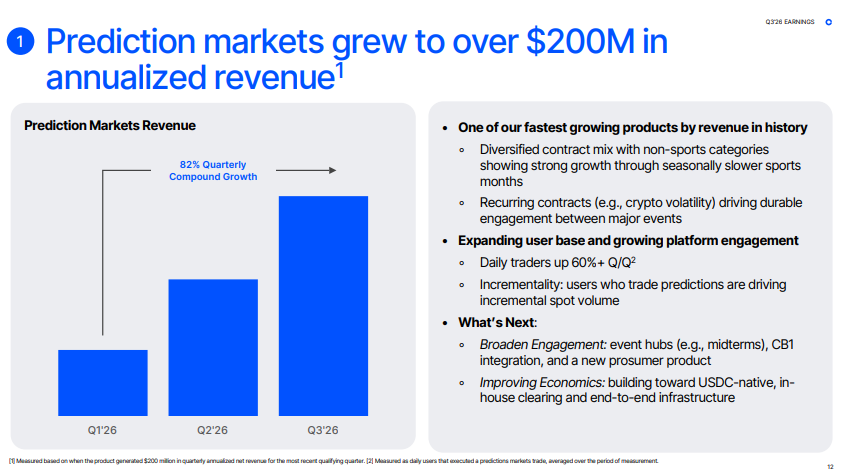
Haas explained during the second-quarter earnings call how this revenue is accounted for. The total fees from the prediction market are included in trading revenue, while payments made to Kalshi are listed separately as trading expenses. By the third quarter, Coinbase's "other trading expenses" rose from $9.61 million in the same period last year to $45.04 million, with the company saying the increase was mainly due to exchange fees related to prediction markets. Although the earnings report did not list the specific amount paid to Kalshi, estimates suggest that about 70 cents of every $1 in prediction market revenue is paid to Kalshi in exchange fees. This is an upper limit estimate; the actual proportion may be slightly lower.
More critically, this cost arises at the moment when Coinbase's overall revenue structure is most vulnerable. Coinbase's net revenue in the third quarter fell 34% year-on-year to $1.16 billion, with trading revenue declining 44% year-on-year to $590.2 million, and consumer spot trading volume shrinking 59% year-on-year. The prediction market is one of the few categories expanding against the trend—annualized revenue doubled from $100 million in the second quarter to over $200 million in the third quarter, with daily active traders increasing by over 60% quarter-on-quarter. A category that continues to grow in a shrinking business portfolio, it increasingly struggles to rationalize the financial burden of "renting" other exchanges at a 70% fee rate.
Coinbase CEO Brian Armstrong has already provided a qualitative assessment in the earnings report: the company "has received CFTC approval to list its own prediction market contracts, which will improve our economics." Haas stated during the earnings call on October 29 that Coinbase would continue to provide contracts from partners while launching a portion of its own products. She believes that Coinbase has an advantage in event contracts related to crypto assets. In the third quarter, over half of the platform’s prediction market trades came from non-sports categories.
Commercial demand has already emerged, and the regulatory pathway is another main thread determining whether Coinbase can scale its own event contracts.
Coinbase is proactively pushing for federal regulation of event contracts
Additionally, another notable action is that on November 18, Coinbase submitted comments on two regulatory documents from the CFTC. It supports explicitly including sports and political event contracts under the category of "swaps" in federal regulated derivatives, and supports exempting qualified traditional sports betting and casino games. The former is still a draft, while the latter became effective on October 19. The comments on the draft were made public on November 19. Coinbase also requested that the topics listed in the rules should only be examples to leave room for other event contracts, such as those related to crypto assets. This action has given the public more concrete expectations for Coinbase’s plans to build its own prediction market.
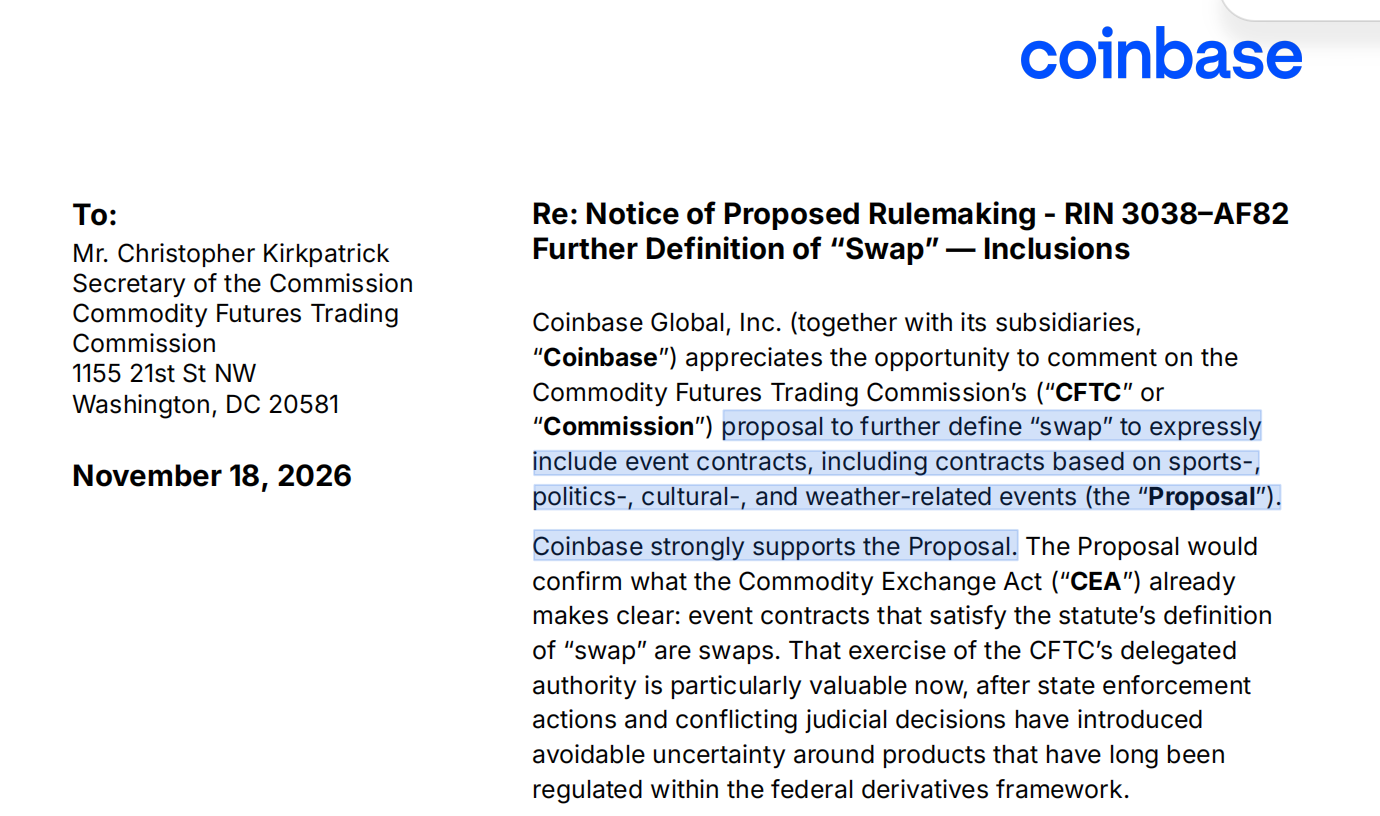
For Coinbase, who regulates directly affects how many people can buy a contract. If the federal regulatory pathway holds, the same contract could potentially be open to more states, concentrating more buyers and sellers in one market. However, there have been differing rulings from federal appellate courts regarding sports event contracts, and 43 states including Ohio and Washington, D.C. have jointly requested the CFTC to withdraw the draft. Which states sports event contracts can cover remains to be clarified by regulators and courts.
What preparations has Coinbase made before the rules take effect
When Coinbase was operating as a Bitcoin exchange in its early years, it expanded during the gradual formation of regulations. In January 2015, Coinbase launched its Bitcoin exchange, initially covering 24 states or regions in the U.S. New York State announced specialized virtual currency license regulations in June of the same year, and Coinbase obtained its New York State license in 2017.
Returning to its current layout in the prediction market, Coinbase announced in December 2025 that it had signed a contract to acquire the prediction market startup The Clearing Company, stating at the time that it was to supplement talent for doing event contracts.
In addition to signing to acquire a team to handle event contracts, it has also obtained the relevant clearing qualifications, conditionally putting the management and settlement of collateral after transactions in its own hands. On September 28, Coinbase Clearing registered with the CFTC as a derivatives clearing organization, capable of clearing fully collateralized futures, futures options, and swaps.
Along with the group’s existing derivatives brokerage business and contract exchange, Coinbase already has entities responsible for accepting customer orders, listing matching, and clearing. For prediction markets, this gives Coinbase a specific choice: some of its own contracts could be listed on its own exchange, with transactions then handled by its own clearinghouse.
Players at the distribution level can no longer just act as channels
Coinbase's self-built plan is not an isolated move. Players at the distribution level have almost realized that they "can no longer just act as channels," with Robinhood having taken a lead. In March 2025, it launched a prediction market section through Kalshi, and in June 2026 began sending some orders to its stake-holding exchange and clearinghouse Rothera while continuing to connect to Kalshi. In the third quarter, Robinhood disclosed that $173 million in event contract revenue, with $28 million derived from Rothera. While retaining external partnerships, Robinhood has been able to generate revenue from associated trading venues.
This also explains Coinbase's "true calculations": it does not want to place the lifeblood of its business entirely on the lawsuit between Kalshi and state governments. Once it secures the three licenses of FCM, DCM, and DCO, Coinbase can package "24/7 USDC clearing" and "crypto-native event contracts" into its own moat—when it comes to crypto events like "whether Bitcoin can break 100,000 by year-end," Coinbase's home-field advantage is hard for Kalshi to match.
Therefore, building its own event contracts is not just about converting the fees paid to Kalshi into its own income for Coinbase; it is also about expanding its competitive position from the distribution channel to the trading and clearing layers.
免责声明:本文章仅代表作者个人观点,不代表本平台的立场和观点。本文章仅供信息分享,不构成对任何人的任何投资建议。用户与作者之间的任何争议,与本平台无关。如网页中刊载的文章或图片涉及侵权,请提供相关的权利证明和身份证明发送邮件到[email protected],本平台相关工作人员将会进行核查。