The default risks and liquidation dilemmas concealed by the stable net value of private credit lending in DeFi.
Written by: @FranPalminha
Translated by: AididiaoJP, Foresight News
The lending capability of DeFi for tokenized real-world assets is improving, but private credit has become the most challenging shortcoming.
Protocols can read token prices, calculate collateral values, and automatically liquidate positions, but once the underlying loans begin to deteriorate and the reported prices remain stagnant, the risk models can easily fail. The traditional credit risks are transferred on-chain and are not easy to manage.
Stable prices do not equal low risks
Ethereum prices fluctuate in real-time, but the net value of private loans is often updated weekly, monthly, or even quarterly.
Between two valuations, the token price may appear almost unchanged, while borrowers may experience income declines, overdue payments, or collateral depreciation at any time. The protocol will still see the same net value until the next update, and assets with small price fluctuations seem safer in the model than they actually are.
Traditional institutions look beyond just price
Banks and credit funds consider borrowers' cash flows, outstanding debts, repayment records, collateral quality, and financial constraints, while estimating default probabilities and recoverable amounts post-default.
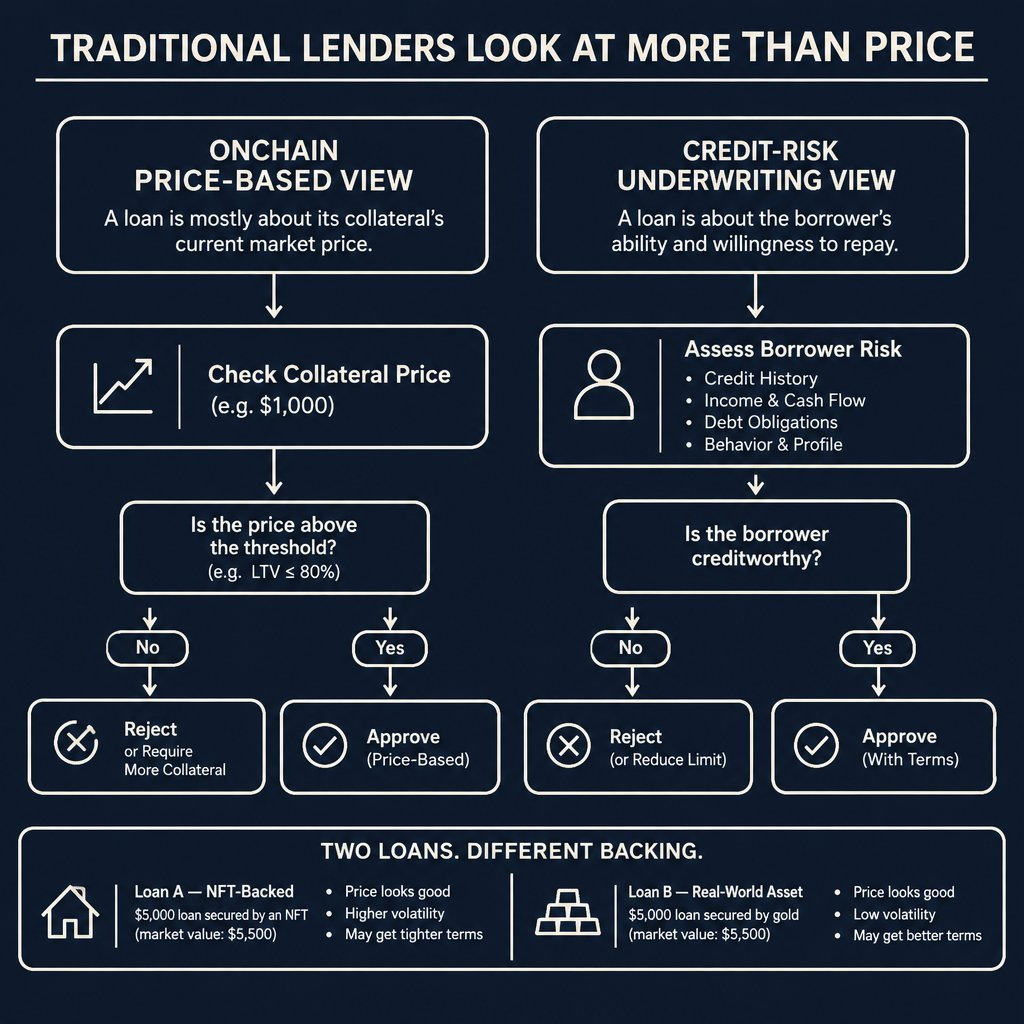
Loans collateralized by liquid securities carry a different risk nature compared to loans collateralized by equipment or unpaid invoices, even if both are currently valued at face value. For DeFi to precisely price these risks, reliable information about the underlying borrower is needed rather than just looking at token balances and historical returns.
Credit ratings start to go on-chain
On November 10, Moody's and Chainlink completed a pilot project, successfully distributing credit rating information to multiple blockchains; the tests used representative data and did not launch real ratings.
S&P Global is also developing risk assessments for DeFi lending pools, covering credit quality, liquidity, and operational risks. These advancements are expected to make it easier for protocols to obtain independent risk information, but ratings are ultimately judgments, not guarantees, and data on-chain will not automatically become more accurate or timely.
Oracles are not wrong, loans may still be overvalued
Assuming a tokenized credit fund reports a net asset value of $100 per token, the protocol accepts collateral and allows borrowing based on this. Subsequently, multiple borrowers begin to default, but the fund has not completed the next valuation, and the oracle continues to report $100.
It accurately publishes the latest official net asset value, yet this value may no longer reflect the actual price at which the loans could be sold. Those with more information may use the tokens to cash out before the losses are accounted for in the valuation, transferring the risk to the protocol and lenders.
Liquidation is another challenge
Even if the protocol identifies a decline in credit quality, a feasible exit path is necessary. Ethereum collateral can be sold directly in mature markets, but there may be few buyers for private credit, and disposing of the underlying loans can take weeks or even months.
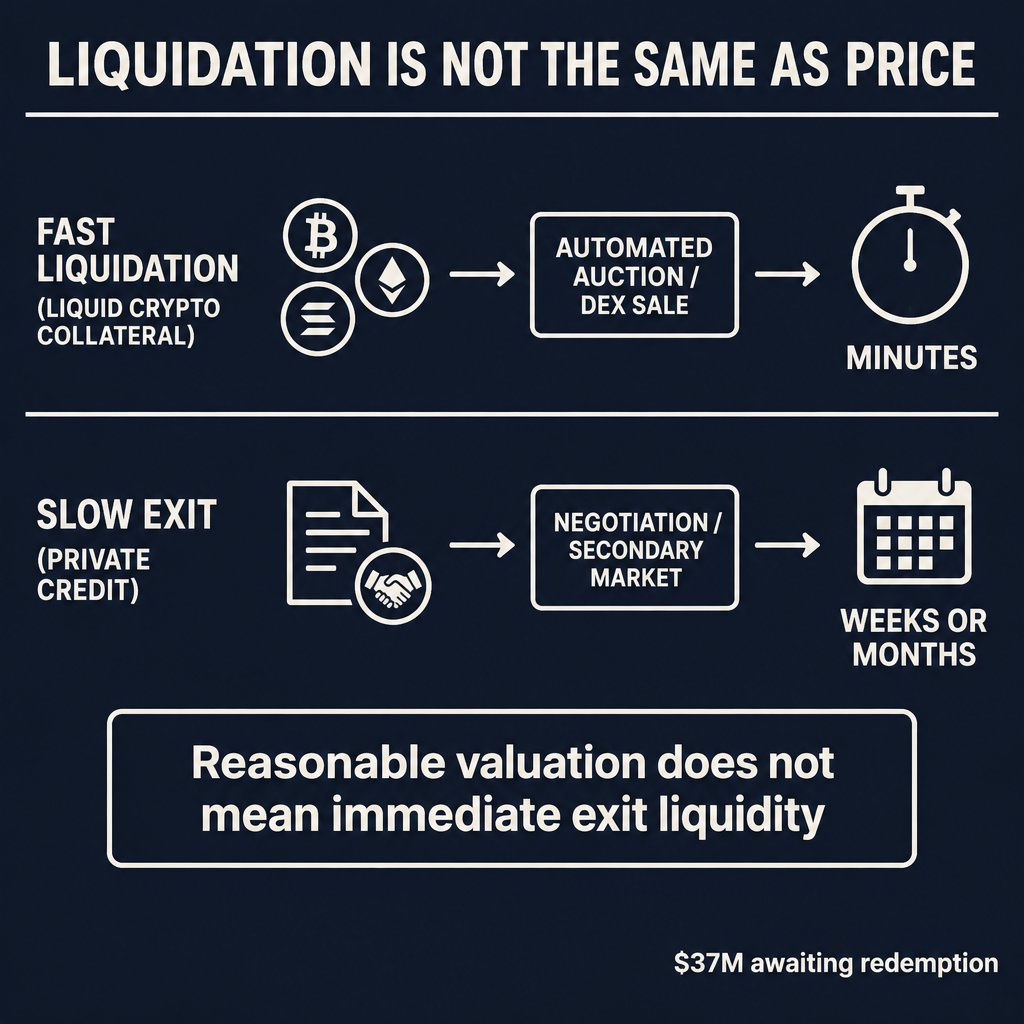
Analysis shows that the tokenized mF-ONE credit fund had about $37 million in tokens awaiting redemption as of February 2026, clearly exposing the gap between reported values and actual cash recovery speeds. A credit token valuation may appear reasonable, yet it could become difficult to dispose of collateral in an automated lending market.
Credit data may change lending logic
Currently, most markets primarily rely on collateral prices, liquidation thresholds, and preset borrowing limits. With more timely credit information, protocols can reduce limits, restrict new borrowings, or require additional collateral when loan performance deteriorates.
These adjustments still depend on external information, risk management, and designing reasonable liquidation mechanisms. Smart contracts can automatically execute decisions but cannot independently verify company financial statements or recover unpaid loans.
Credit data will become an increasingly critical component of RWA lending infrastructure, but DeFi needs more than ratings transmitted through oracles.
It also requires timely borrower information, independent valuations, conservative collateral parameters, and realistically feasible liquidation arrangements.
Otherwise, protocols are likely to mistake assets with infrequent updates as genuinely low-risk collateral. The real test lies in whether DeFi can recognize the deteriorating loans before the losses are reflected in the reported prices.
免责声明:本文章仅代表作者个人观点,不代表本平台的立场和观点。本文章仅供信息分享,不构成对任何人的任何投资建议。用户与作者之间的任何争议,与本平台无关。如网页中刊载的文章或图片涉及侵权,请提供相关的权利证明和身份证明发送邮件到[email protected],本平台相关工作人员将会进行核查。


