
Author: Chainalysis
Translation: Deep Tide TechFlow
Deep Tide Insight: In Chainalysis's latest global cryptocurrency geography report, Eastern Europe exhibits an extremely rare anomaly. Although the overall scale of cryptocurrency transactions in the region has decreased by 7.9% year-on-year, becoming the weakest market globally, the number of small transfers under $10,000 and cash-like cryptocurrency services has surged against the trend, with retail funding accounting for the highest proportion among all major global regions.
The underlying driver of this unique structure is profound geopolitical issues and refugee migration. The ongoing conflict between Russia and Ukraine has led to a flow of Ukrainian populations to countries like Poland and the Czech Republic, who are using cryptocurrency as a critical lifeline for crossing borders. Ukraine has become the number one destination for peer-to-peer (P2P) stablecoin flows from 16 neighboring countries, with Poland becoming the largest cryptocurrency ATM hub in Eastern Europe, holding nearly 40% of the market share.
Intertwined with this imperative for safe havens are market shocks triggered by sudden changes in tax policies across countries. After Romania canceled its tax exemption for cryptocurrencies, the trading volume on centralized compliant exchanges halved, as users quickly flocked to instant exchange platforms that do not require KYC. From humanitarian assistance to regulatory evasion, Eastern Europe is becoming the ultimate testing ground for the real social embedding of cryptocurrencies and policy resilience.

Key Points Overview
· The region overall has contracted but retail resilience remains strong: Eastern Europe's overall cryptocurrency economy shrank by 7.9% over the past year, making it the weakest-performing major region in the world. However, the proportion of retail transfers under $10,000 has risen to the highest global level, with a total annual service inflow from retail exceeding $11 billion.
· Cash-like services lead global growth: In stark contrast to the decline in large institutional transfers, cryptocurrency ATMs and over-the-counter P2P exchanges, which heavily rely on cash, have experienced a counter-trend growth of 1.5%, outpacing all other regions worldwide.
· Conflict-driven migration reshapes cross-border capital flows: Four years after the outbreak of the Russia-Ukraine conflict, millions of dispersed Ukrainian refugees have established a thriving cross-border cryptocurrency remittance network. Among the 21 neighboring market countries, 16 markets have Ukraine as their primary destination for retail stablecoin P2P remittances.
· Poland rises as a regional cryptocurrency cashout hub: Poland hosts 38.5% of the cryptocurrency ATM terminals in Eastern Europe, with growth rates for ATM transactions and cash withdrawals reaching 21.8% and 28.6%, respectively, significantly surpassing other fiat cashout channels, and P2P transaction volumes of stablecoins have increased fourfold.
· Strict tax reforms drive users toward decentralization and gray channels: After Romania proposed eliminating the cryptocurrency tax exemption threshold, the inflow of funds into mainstream compliant exchanges plummeted, while the usage of KYC-exempt instant exchange platforms surged by 59%, indicative of a direct change in on-chain behavioral preferences due to drastic tax policy shifts.
Eastern Europe Under Pressure: Institutional Funds Withdraw, Retail Proportion Remains Highest Globally
During the reporting period of Chainalysis's latest "Global Cryptocurrency Geography Report," Eastern Europe has become the weakest economy among major global regions, with an overall contraction in cryptocurrency asset reception of 7.9% year-on-year.
Of the ten core countries in the region, five experienced year-on-year changes of less than 2%, indicating that overall macro liquidity has stagnated. However, penetrating beneath the surface of this cold macro data reveals starkly different micro diversifications within the region.
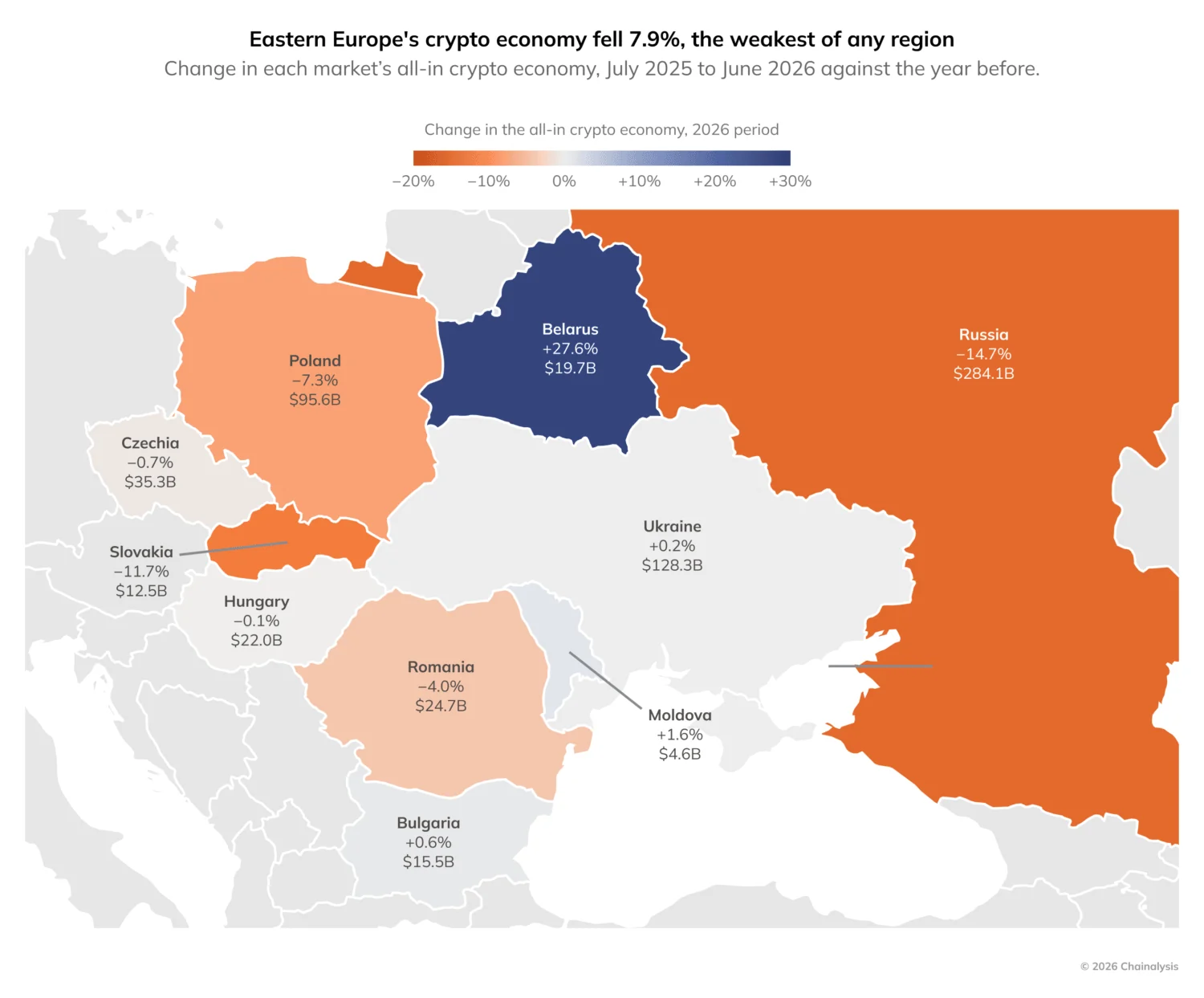
Figure: Eastern Europe's cryptocurrency economy has decreased by 7.9%, making it the weakest performing region.
Data indicates that the downturn in Eastern Europe is primarily driven by significant withdrawals of large institutional and whale funds. In sharp contrast, transfers below $10,000 from retail users have shown remarkable resilience.
In the total funds flowing to cryptocurrency service platforms, Eastern European retail funds account for the highest share among all major global regions. Annual trading totals from retail in the region have slightly increased to over $11 billion, with retail activity on decentralized exchanges (DEX) showing an increase of nearly 25%.
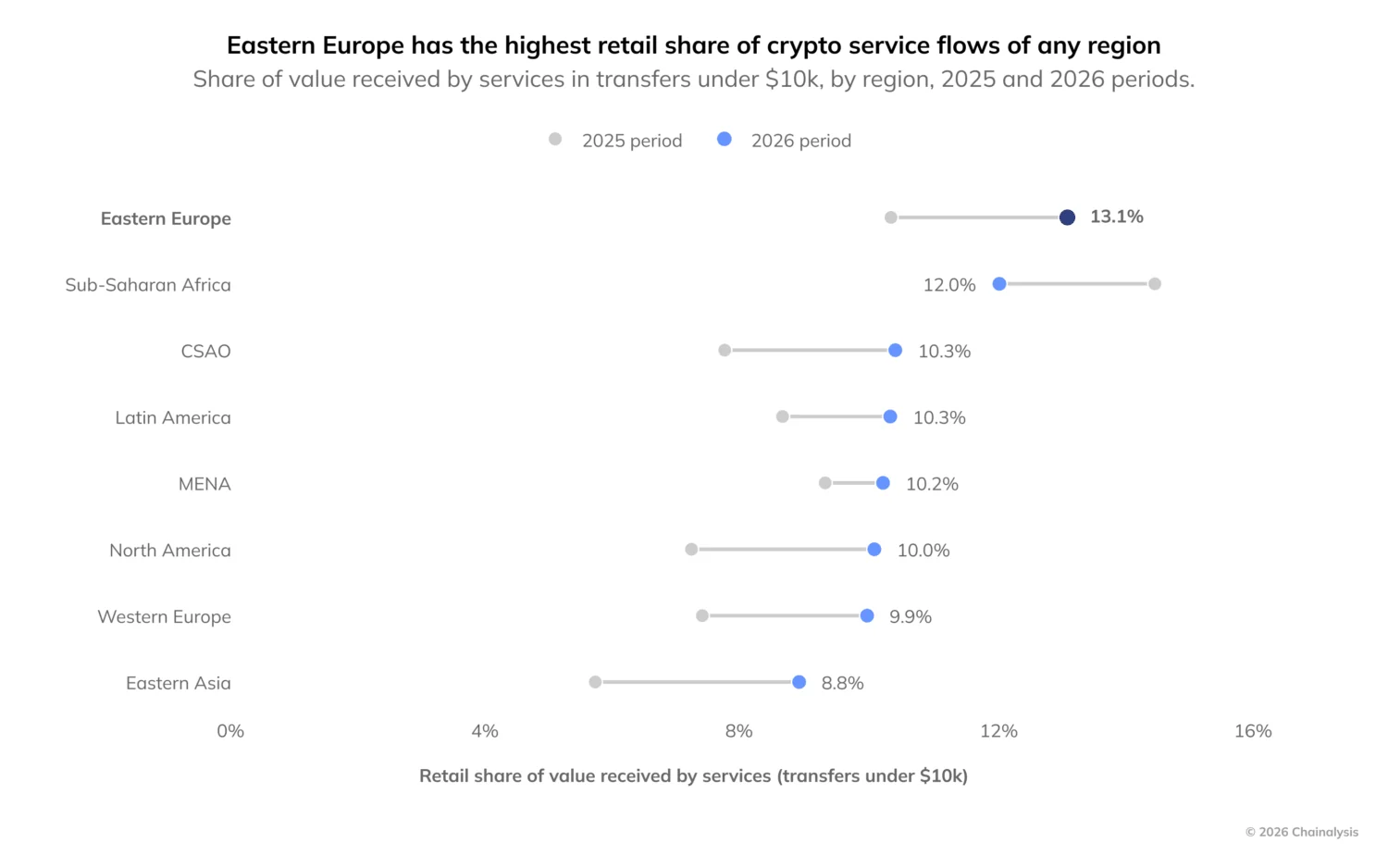
Figure: Eastern Europe has the highest retail proportion in all cryptocurrency service funding flows globally.
Cash-like Services Surge Against the Trend: Cryptocurrency ATMs and P2P Become Liquidity Oases
Even amidst an overall contraction of Eastern Europe's cryptocurrency economy, cash-dependent cryptocurrency services have charted an entirely independent counter-cyclical trend.
The scale of cryptocurrency ATMs and over-the-counter P2P exchanges in Eastern Europe has risen against the trend by 1.5%, a growth rate that exceeds all other geographical regions globally, including North America, Western Europe, and Asia-Pacific.
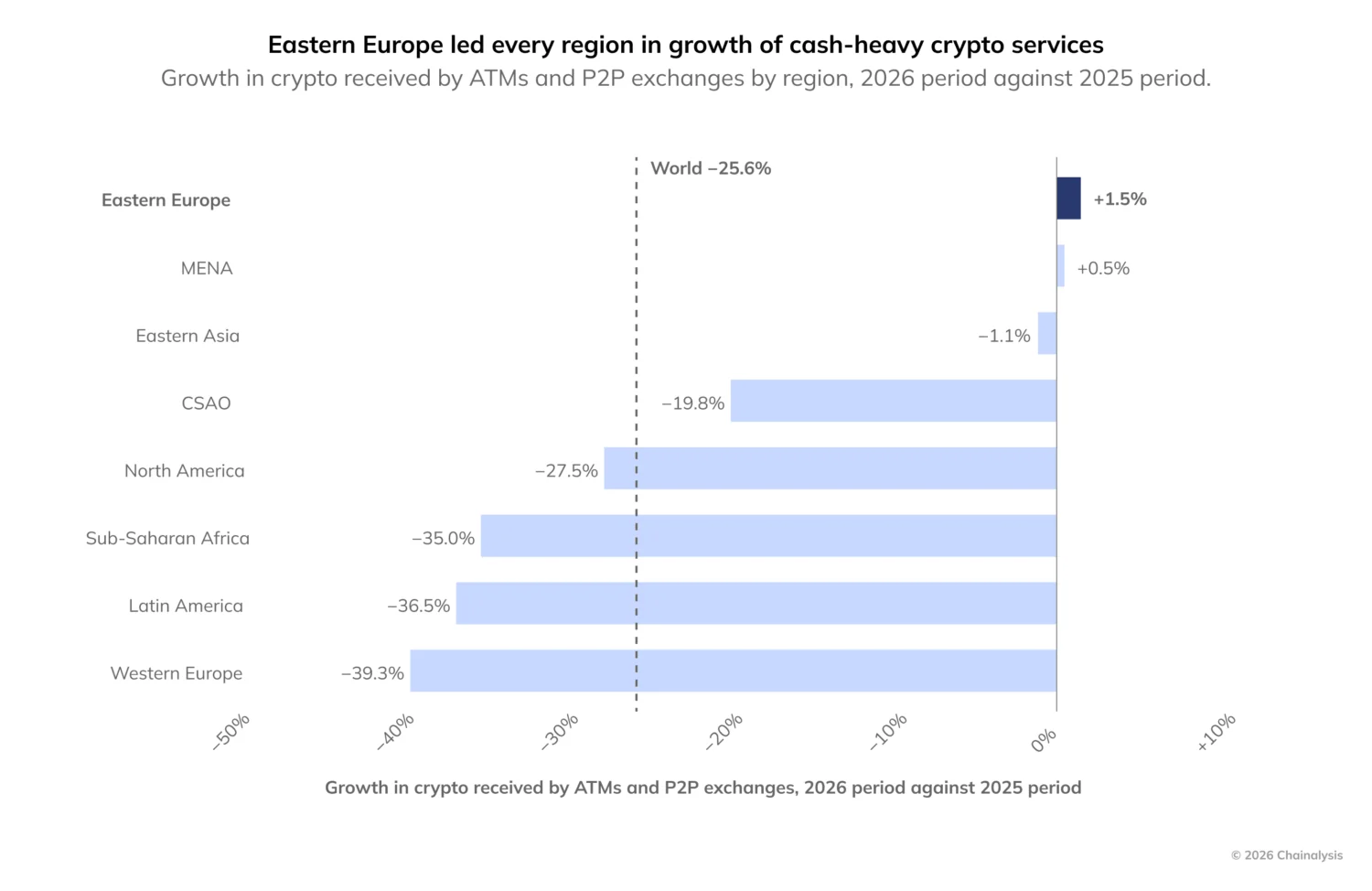
Figure: Eastern Europe leads global growth rates in cash-heavy cryptocurrency services.
This unique cash preference is deeply rooted in the complex social structure of Eastern Europe. For a long time, some residents in Eastern Europe have lacked trust in the stability and privacy protections of traditional banking systems.
More importantly, a significant number of cross-border workers, operators of the gray economy, and war refugees lack complete local bank accounts and residency proof. Physical cryptocurrency ATMs and cash P2P, which do not require stringent identity verification, have become their necessary choices for exchanging daily living expenses and transferring private property.
Lifeline Amidst the Refugee Crisis: A Panorama of Ukraine's Cross-Border Stablecoin Network
Since the outbreak of the Russia-Ukraine conflict more than four years ago, the economic ties between millions of Ukrainian refugees abroad and friends and family within Ukraine have deeply embedded themselves in the blockchain network.
On-chain fund tracking shows that funds flowing from Eastern European neighboring countries such as Poland, the Czech Republic, Bulgaria, and Romania to Ukraine have exhibited a high degree of consistency in trend fluctuations with funds flowing to Ukrainian communities residing in these countries.
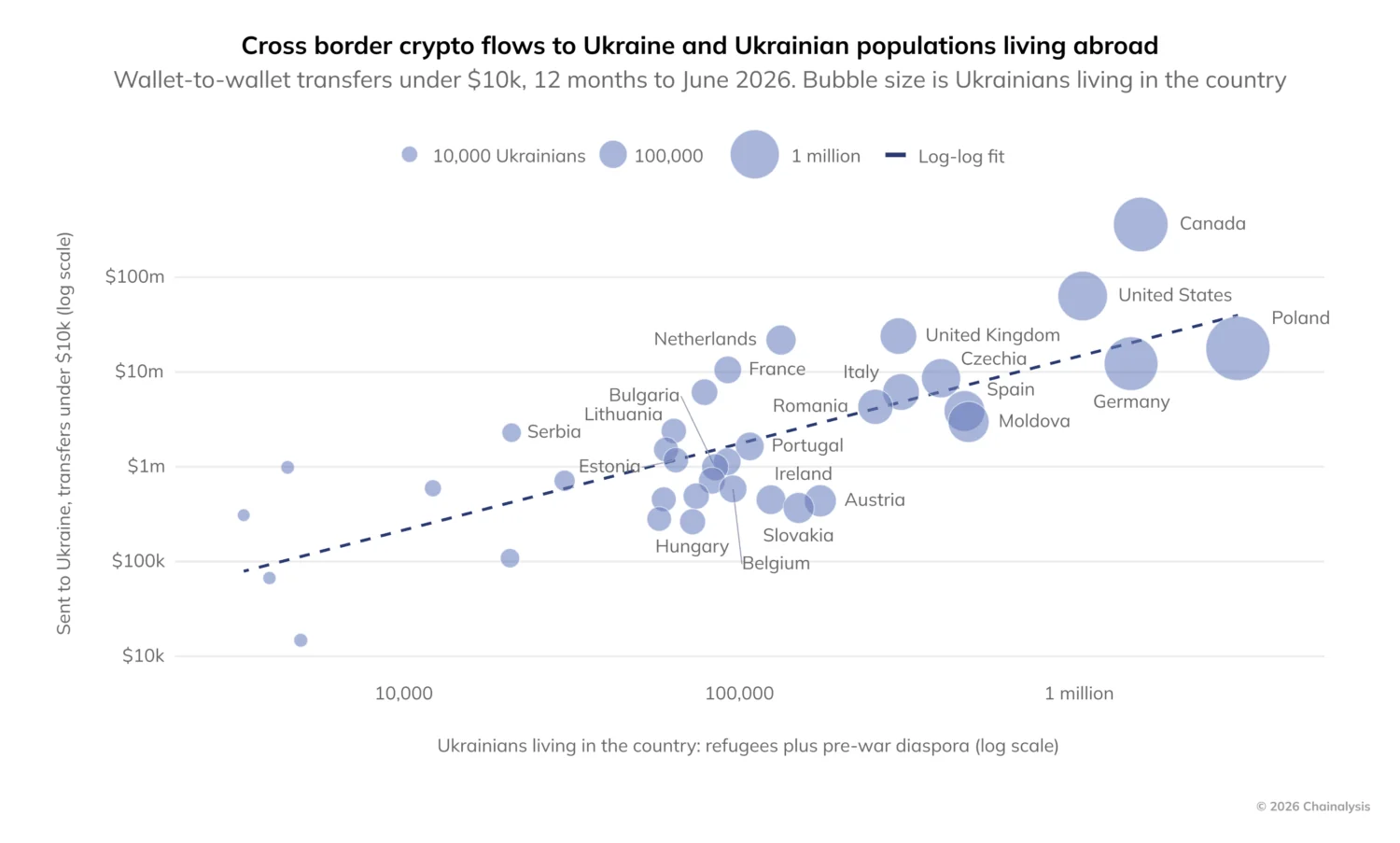
Figure: The cross-border cryptocurrency flow from Ukraine's homeland to overseas scattered refugee groups is highly aligned.
Particularly in the peer-to-peer (P2P) stablecoin payment sector, this humanitarian and survival-maintaining characteristic is especially pronounced.
Statistics show that among the 21 central and eastern European markets surrounding Ukraine, 16 markets have their primary destination for retail stablecoin P2P remittances as Ukraine.
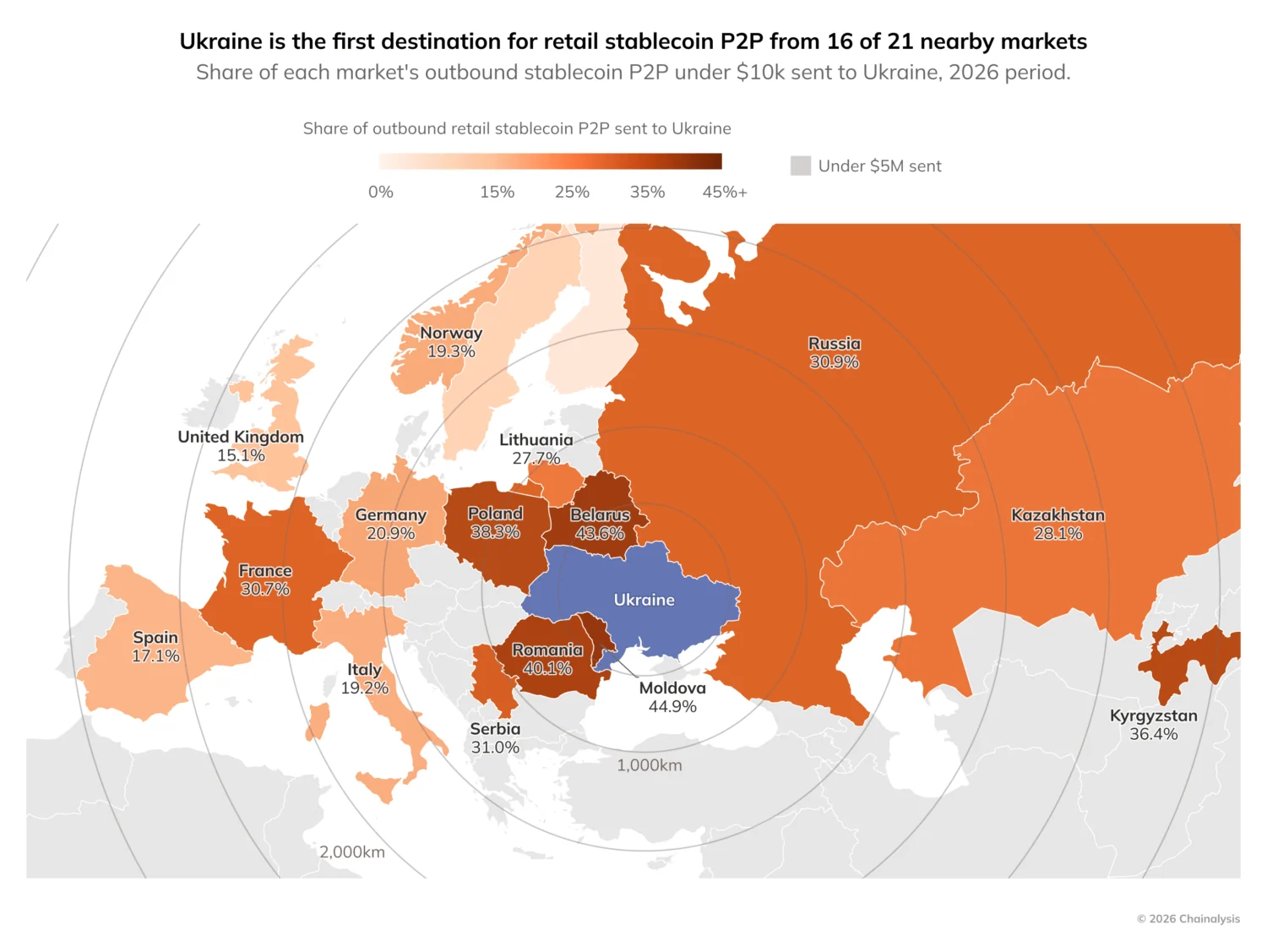
Figure: Ukraine is the primary destination for retail stablecoin P2P remittances from 16 countries surrounding Eastern Europe.
In an environment of high inflation, wartime foreign exchange restrictions, and the lengthy and costly cycles of traditional bank cross-border remittances, stablecoins pegged to the US dollar have become "hard currency" for millions of Ukrainian civilians sending family support and conducting self-rescue for their businesses across borders.
Poland as a Hub: Hosting Over 30% of Cryptocurrency ATMs and Surging P2P Withdrawals
As the core frontline country that hosts the most displaced Ukrainian population, Poland has rapidly grown into the largest cryptocurrency fiat exchange and cashout hub across Eastern Europe.
Data shows that Poland accounts for approximately 38.5% of the cryptocurrency ATM terminal devices in Eastern Europe, creating an extremely dense offline physical network.
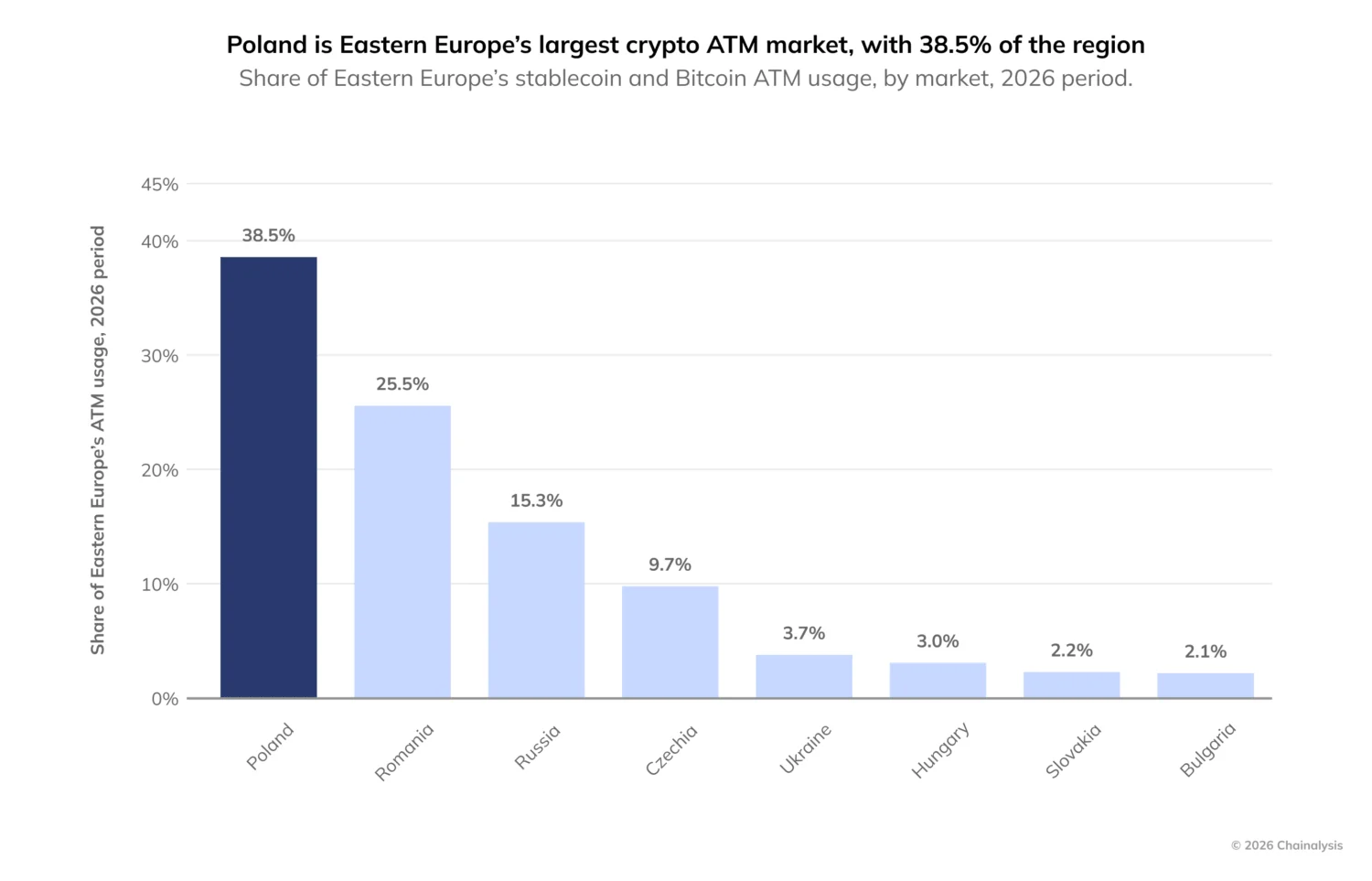
Figure: Poland holds 38.5% of cryptocurrency ATMs in Eastern Europe, becoming the region's largest market.
Among various cashout channels, Poland's cryptocurrency ATMs have exhibited astonishing growth momentum. In the past year, the number of withdrawal transactions from cryptocurrency ATMs in Poland has grown by 21.8%, while the total amount of fiat withdrawals has surged by 28.6%, significantly exceeding both Eastern European averages and all other fiat channels.
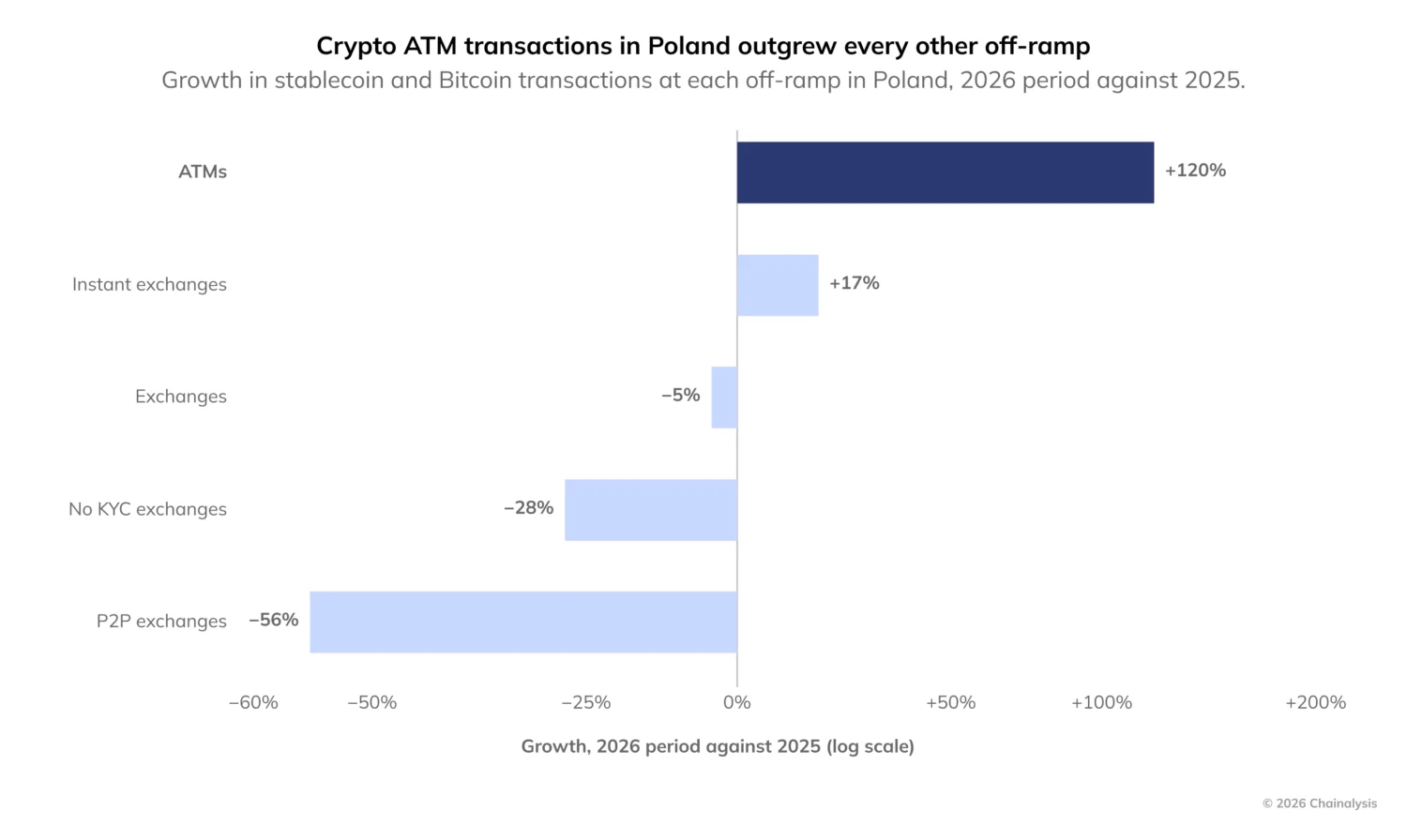
Figure: Poland's cryptocurrency ATM transaction numbers and amounts are growing far beyond those of other traditional cashout channels.
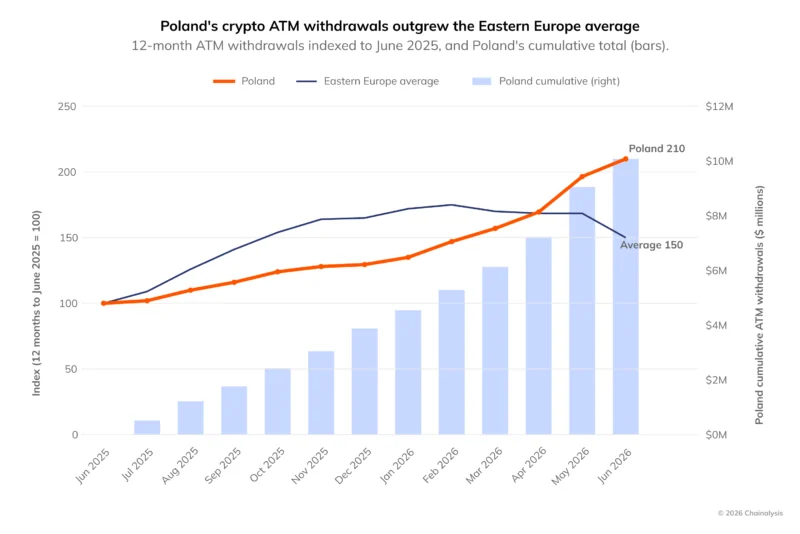
Figure: The growth rate of Poland's cryptocurrency ATM withdrawal scale continues to outpace the overall average of the Eastern European region.
Even more noteworthy is the dramatic evolution of the asset structure. In Poland’s P2P trading scene, the total trading volume of stablecoins (USDT / USDC) has surged fourfold, while the trading volume of traditional Bitcoin P2P has shrunk by a third.
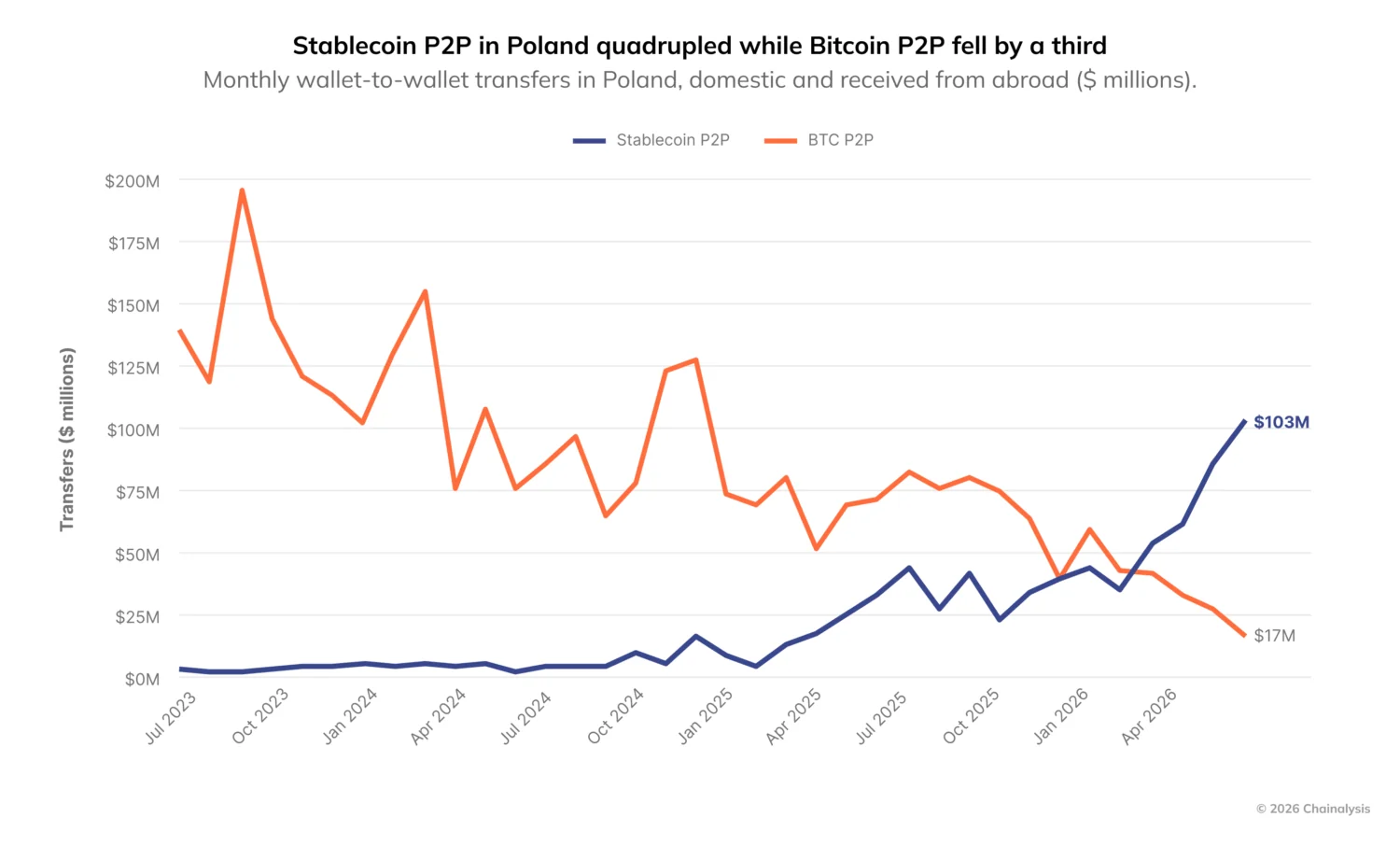
Figure: Poland's stablecoin P2P scale has skyrocketed four times, while Bitcoin P2P has declined by a third.
This fully demonstrates that crypto assets in Eastern Europe have already transcended pure price speculation and investment tool attributes, evolving into a high liquidity, price-stable, and instant settlement infrastructure for daily transactions.
Impact of Tax Reforms: How Romania's Stringent Tax Laws Push Funds Toward Unregulated Trading
If the cross-border movement of refugees showcases the hedging value of cryptocurrency technology, the case of Romania vividly illustrates the tremendous counterforce that government regulation and tax policies have on the flow of on-chain funds.
By the end of 2024, the Romanian government signaled its intention to eliminate the long-standing tax-exempt treatment for micro transactions of cryptocurrencies, which are set at 200 lei (approximately $45) per transaction and a cumulative 600 lei (approximately $135) annually, while imposing a uniform tax on all crypto gains.
Once this legislative news was announced, there was an immediate intense restructuring of hedging behavior in the Romanian market.
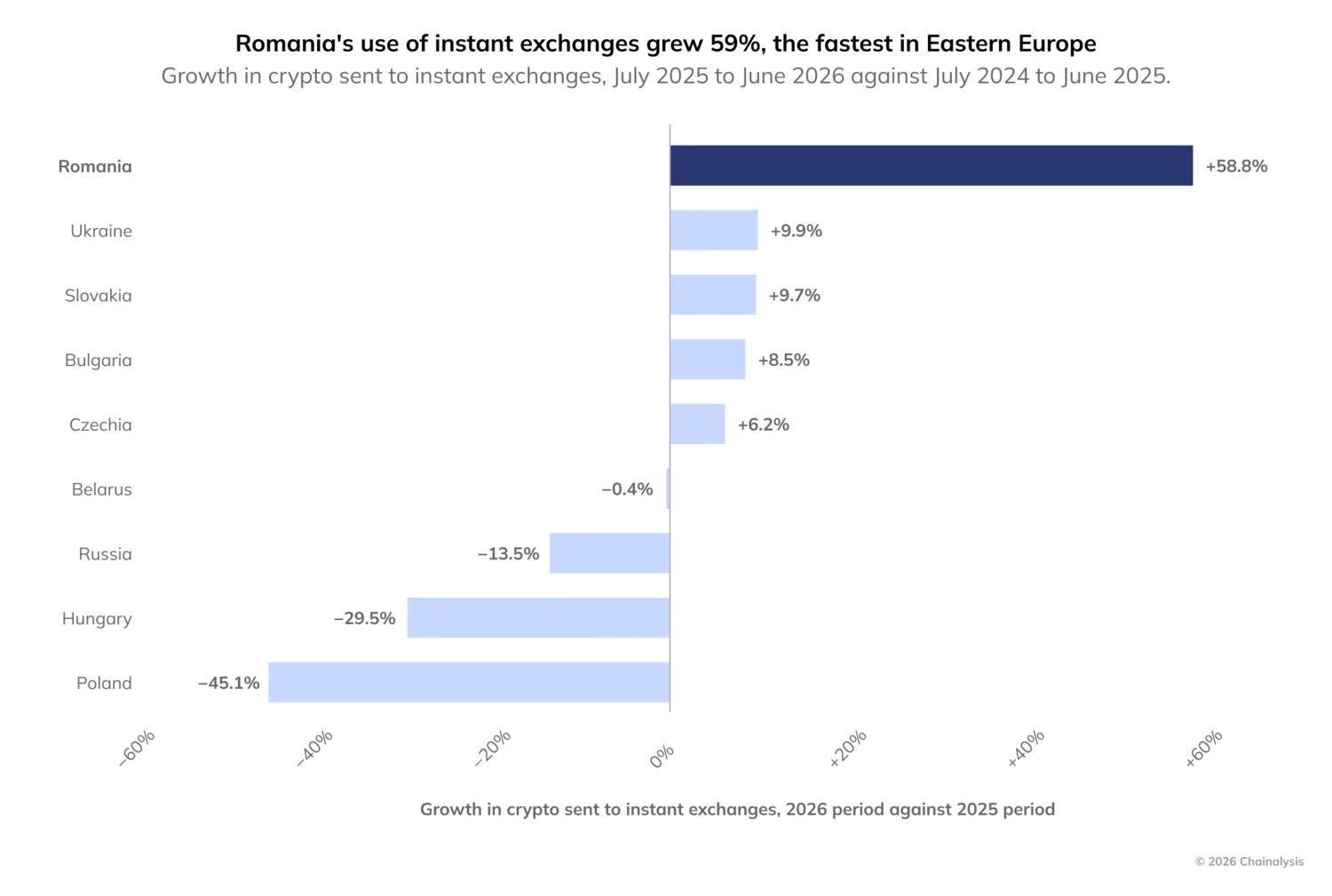
Figure: The usage of instant exchanges in Romania surged by 59%, marking the highest growth rate in Eastern Europe.
On-chain data reveals that after the announcement, the mainstream centralized exchanges that require strict real-name authentication (KYC) and regular reporting to tax authorities saw their market utilization in Romania drop sharply, plummeting from above the Eastern European average to significantly below the mean.
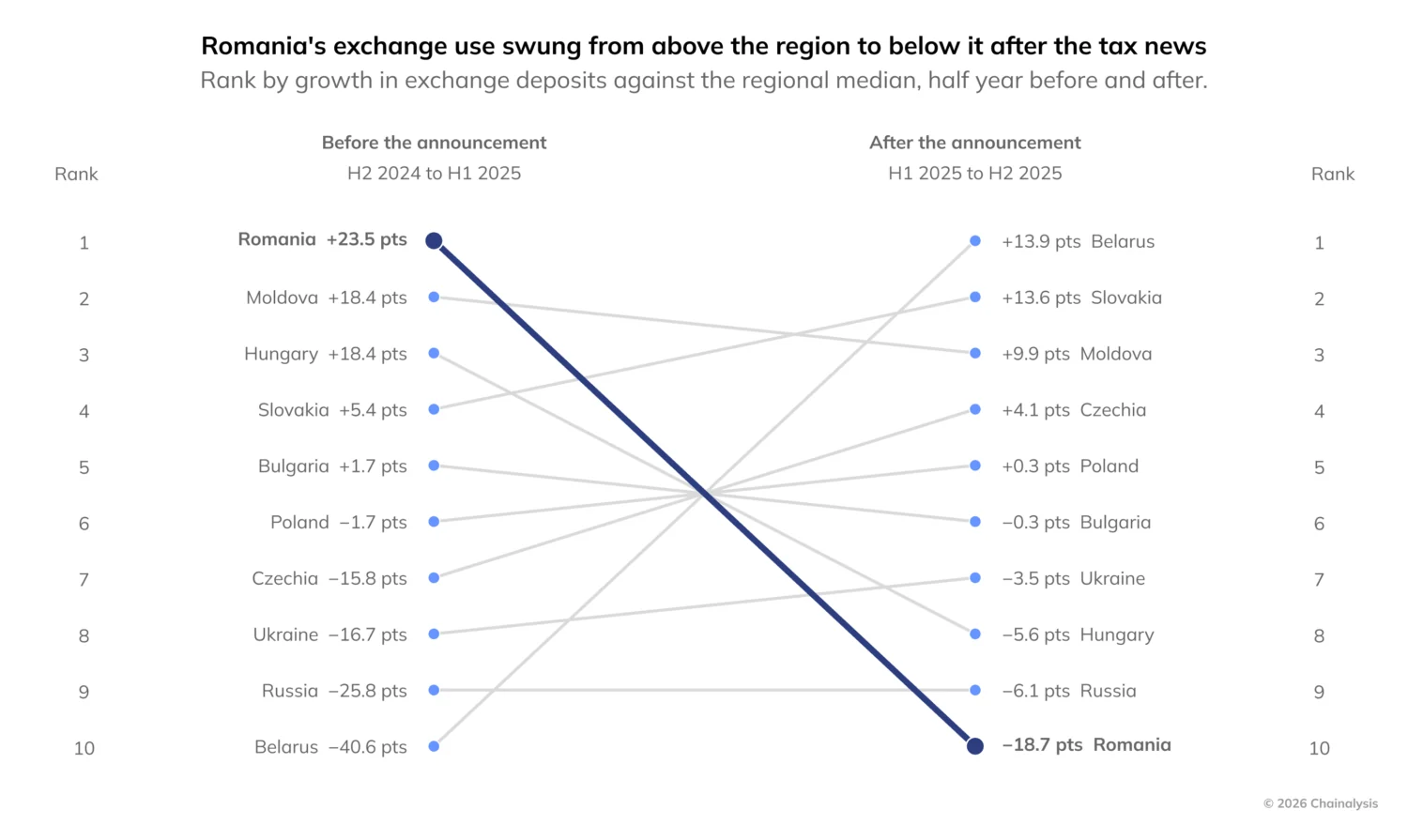
Figure: Following the tax reform announcement, the utilization rate of compliant exchanges in Romania experienced a dramatic decline.
The outflowing funds did not leave the cryptocurrency market but instead flocked to "instant exchange platforms” and decentralized alternatives that do not require account custody or identity verification, with their share of inflow surging by an astonishing 59%, positioning them atop Eastern Europe's rankings.
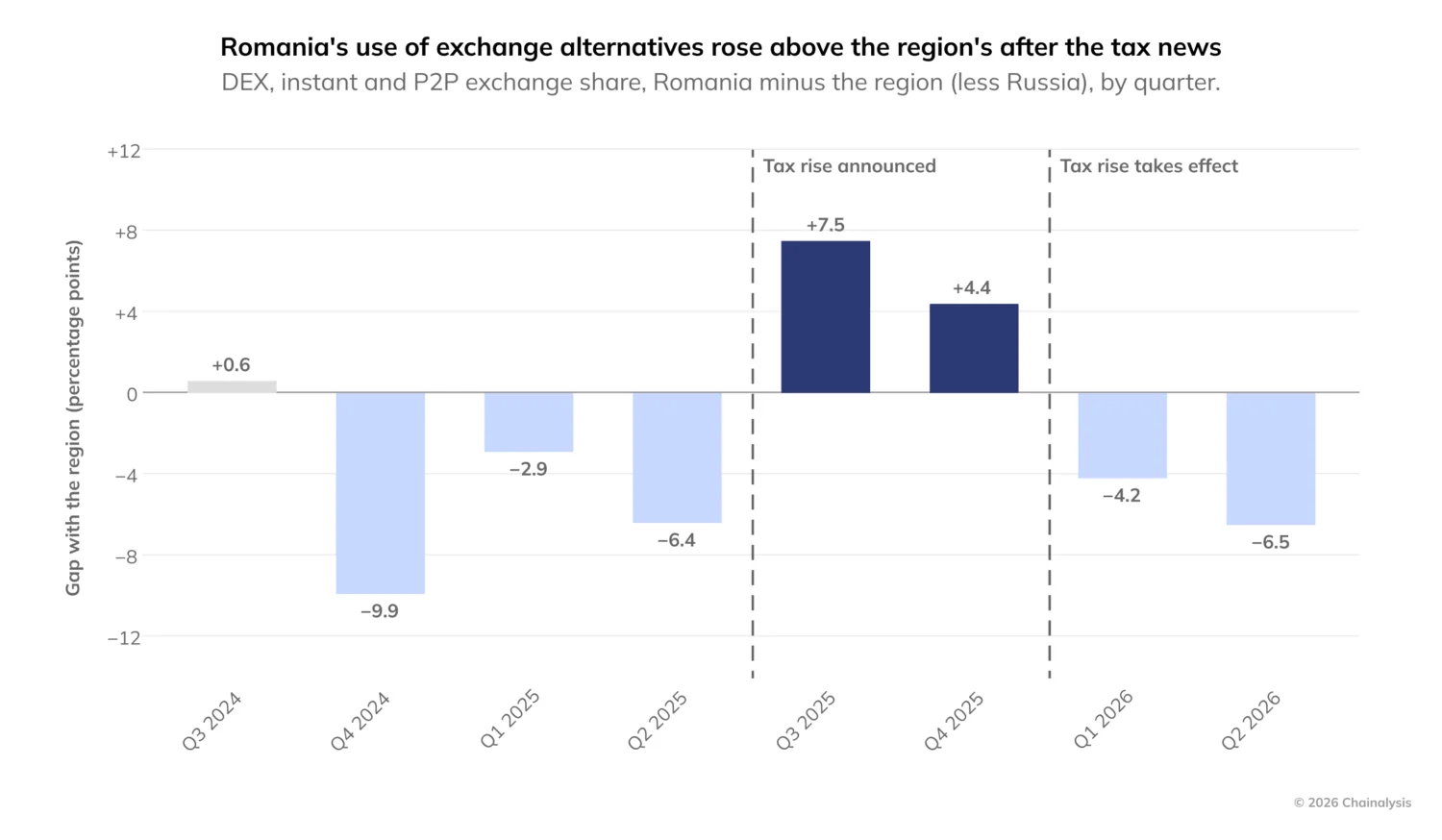
Figure: Strict tax regulations compel Romanian users to fully shift toward decentralized and alternative trading channels.
The Romanian case serves as a warning to global regulators: in the blockchain world, which possesses strong anti-censorship characteristics, crude taxation and restrictions often do not yield the expected fiscal gains; instead, they push a significant amount of compliant trading into harder-to-regulate and less protected unlicensed underground channels.
Conclusion and Reflection: The Fundamental Color of Crypto Necessity Amidst Turbulent Geopolitics
The cryptocurrency landscape in Eastern Europe is far richer and heavier than the fluctuations shown by the market trends.
Here, cryptocurrency is not a technological utopia of Silicon Valley salons, nor an arbitrage code in Wall Street quantitative models; it is a hardcore tool for ordinary people to safeguard their labor outcomes and family survival amidst the spread of war, currency devaluation, foreign livelihoods, and volatile policies.
From cryptocurrency ATMs queuing day and night on the streets of Poland to the stablecoin P2P remittance networks connecting Ukrainian refugee families, Eastern Europe is proving to the world that when traditional financial orders fracture, blockchain, as the fundamental value of open financial protocols, will unleash its most authentic vitality.
免责声明:本文章仅代表作者个人观点,不代表本平台的立场和观点。本文章仅供信息分享,不构成对任何人的任何投资建议。用户与作者之间的任何争议,与本平台无关。如网页中刊载的文章或图片涉及侵权,请提供相关的权利证明和身份证明发送邮件到[email protected],本平台相关工作人员将会进行核查。


