Author: ASI Revelation, New Intelligence Source
OpenAI announced without warning:The gears of “Recursive Self-Improvement” (RSI) have officially begun to turn.
In simple terms, OpenAI confirmed: AI has started developing AI!
For a long time, people have speculated on what day super artificial intelligence (ASI) would arrive. Everyone is focused on the scores of large models and the skyrocketing parameter counts.
But OpenAI clearly tells you: the real turning point towards ASI is not the model scores surpassing humans, but the formation of the closed loop of “AI developing AI.”
Computing power frenzy,daily burning $23,000 of the “super worker”
Internally at OpenAI, researchers' frequency of using AI agents has completely spiraled out of control—of course, it is an upward spiral.
Based on API pricing, the spending on agents this September was a median researcher spending $1,500 daily.
Just one month later, in October, this figure skyrocketed to $2,400, an increase of 62%.
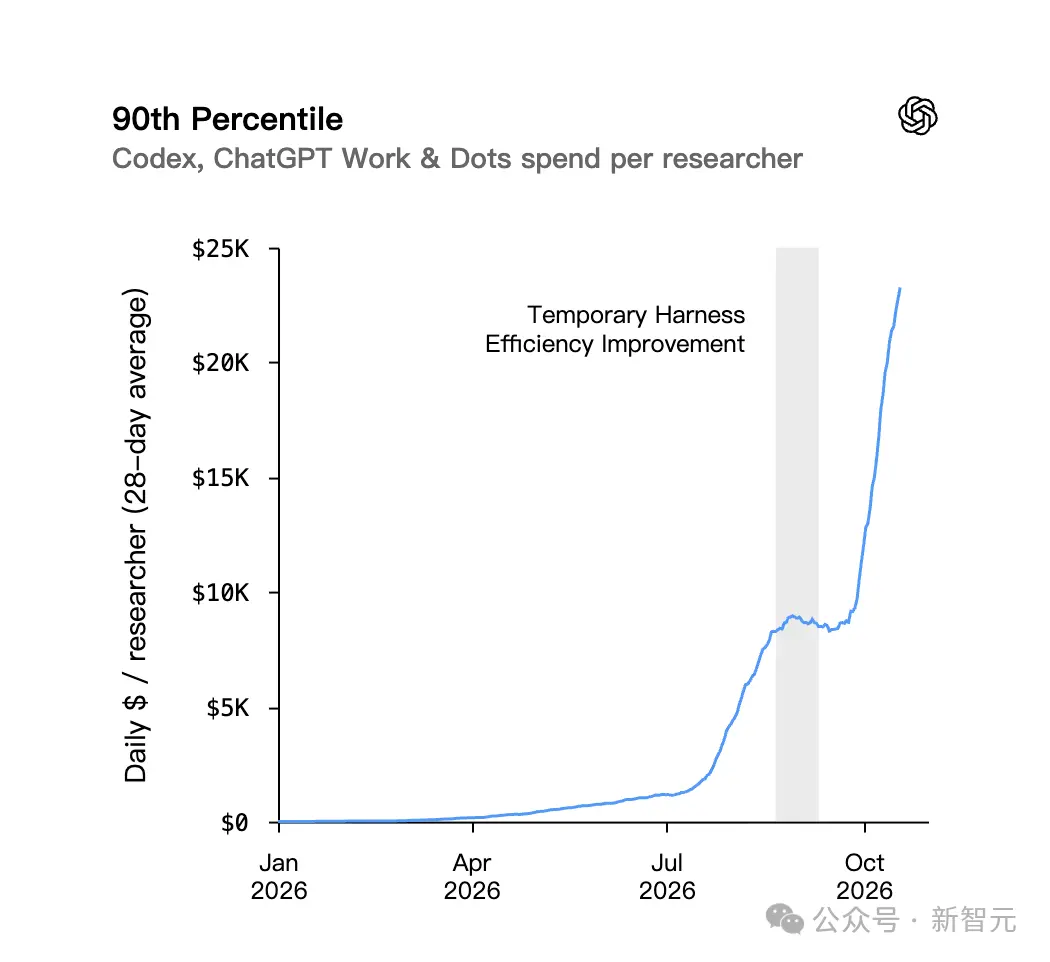
But this is just the average level. What about those in the top 10% of “heavy users”? They are burning up to$23,000 daily on agents, a staggering increase of 105%.
Over $20,000 a day. If you have any concept of API pricing, you will know what enormous amount of code generation, logical reasoning deductions, and concurrent task executions this represents. This is not humans typing; this is hundreds and thousands of "silicon brains" operating tirelessly at full speed.
To measure this more intuitively, OpenAI introduced a concept: “Agent Work Days” (each 8 hours of agent use counts as one workday).
Data shows that the average “Agent Work Days” per researcher has terrorifically skyrocketed from initially 0.5 to 5.7, a growth of 11 times!
In the core pre-training and post-training teams, this number has even reached 8.
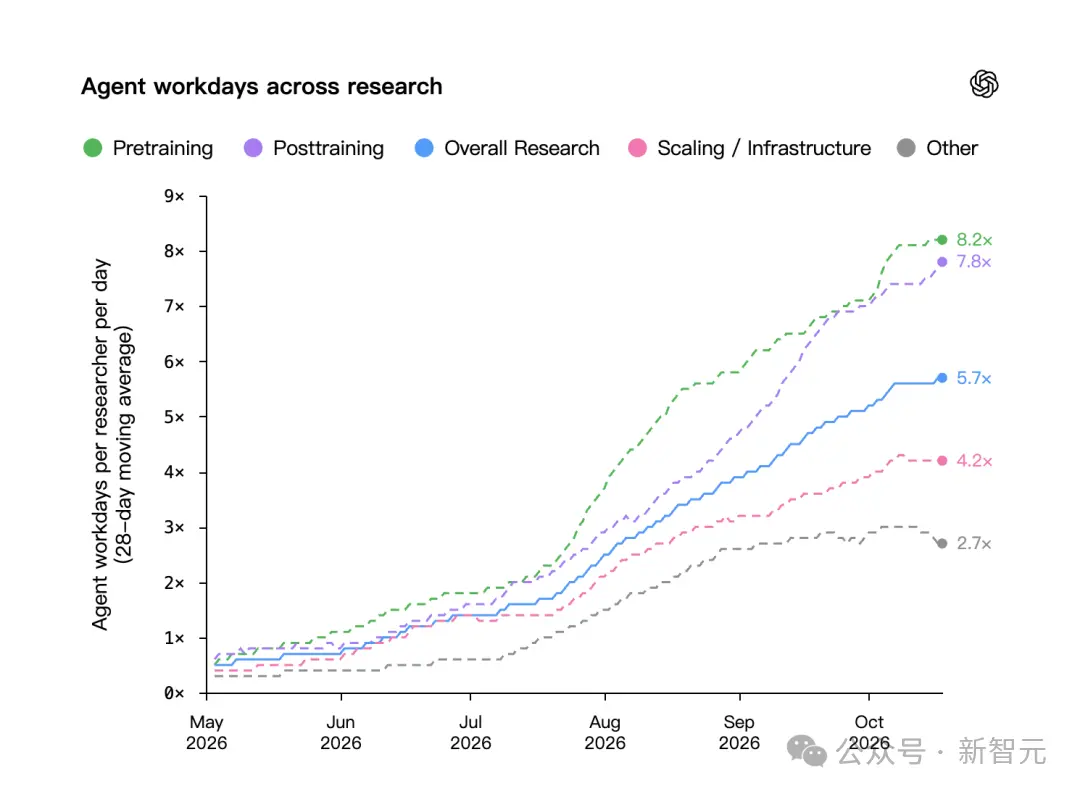
This means one human researcher works 8 hours a day, while their “AI avatars” concurrently accomplish the equivalent of 64 hours of workload in the same timeframe.
By mid-October, more than one in ten researchers had at least 16 agents simultaneously handling tasks.
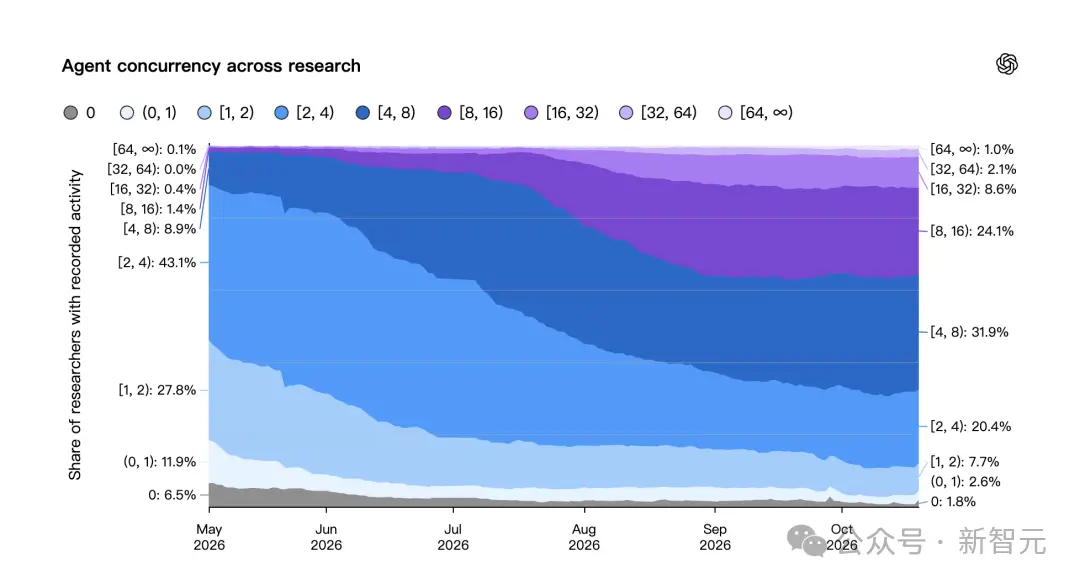
Human engineers' dependence on these AI tools has reached an almost “addictive” level.
In an anonymous survey conducted internally at OpenAI, researchers were asked a very sharp question: “If within the next three months, all your coding agents better than GPT-5.2 were confiscated, what conditions would you offer to get them back?”
The median response was shocking: they would rather cut 40% of their team's manpower or reduce the current core computing power of their team by 30%.
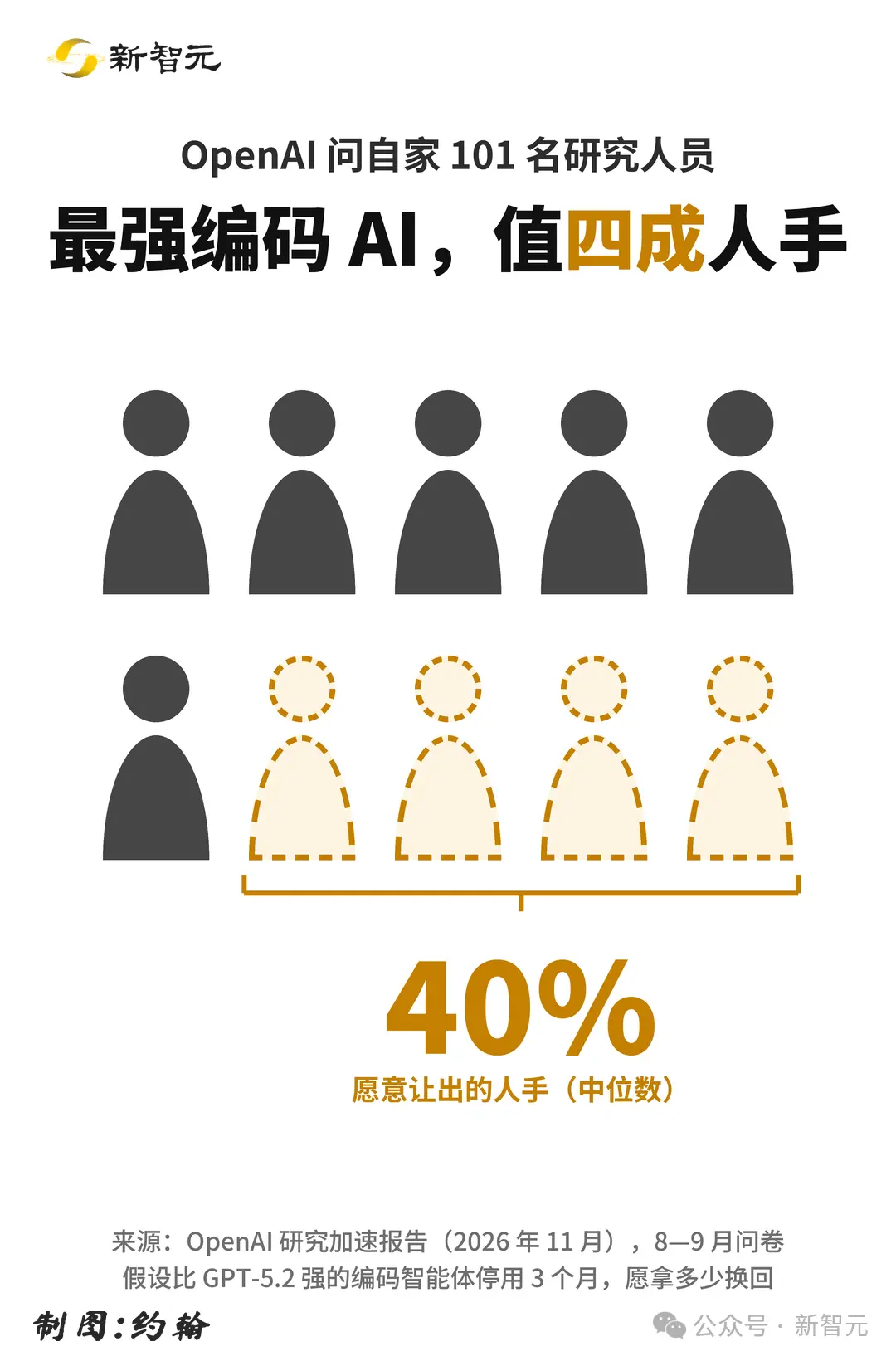
In the eyes of the top AI researchers, a few expensive H100 computing clusters, even living colleagues nearby, are no match for the value of a cutting-edge coding agent.
The truly chilling detail: AI begins to possess “research taste”
What truly makes the Silicon Valley giants exclaim “madness” is the development inside GPT-6.2 Astra.
In the past, big ideas were always the exclusive territory of humans.
When developing earlier versions of GPT-6 Astra, OpenAI researchers proudly stated: the core scientific ideas were entirely conceived by humans, the model was just a sophisticated coder responsible for turning ideas into code.
But with GPT-6.2 Astra, a subtle yet fatal change occurred.
In interviews, researchers from the pre-training team admitted that the core insights emerged from repeated dialogues with the model (Codex).
One researcher explicitly stated, Codex precisely identified key insights while they advanced an idea together.
Another core member confessed that their initial idea had hit a dead end, “only after Codex suggested making changes did the whole idea truly start to work.”
AI begins to have intuition, starts recognizing blind spots overlooked by humans, and even begins to guide humans on how to create better AI.
This is referred to as “Research Taste”.
Identifying problems is often more challenging than solving them. When AI possesses the ability to discern “what kind of data is better” and “what kind of architecture is more promising,” Pandora's box will truly be opened.
A developer described this feedback loop in a tweet:
- A researcher wants to strengthen the AI model's logical reasoning.
- They summon dozens of agents to write the underlying code, configure the environment, run massive experiments, and test which lines of changes really work.
- Those changes validated by the agents are packaged into the next version of the model.
- As a result, the next version of the model becomes smarter, allowing it to help researchers solve harder coding bugs that the previous version could not comprehend at all.
This loop repeats endlessly.
Each better AI helps humanity build the next stronger AI at an unprecedented speed. This is the true essence of “Recursive Self-Improvement” (RSI).
Once the rotational speed of this flywheel breaks through a certain critical point, the pace of AI development will completely detach from humans' linear cognition, exhibiting an almost vertical exponential explosion.
Jagged frontier: “Closed loop” has formed, but humans remain the bottleneck
Of course, announcing that AI is completely autonomous right now would be overly sensational.
OpenAI admits that current technology still has enormous limitations. They refer to the current stage as “Jagged Frontier”.
What is jagged? It means extreme specialization.
From March to October this year, for complex research and development tasks estimated to take 2 to 4 hours, the “zero intervention success rate” (meaning that humans are completely hands-off) of agents jumped from 23% to 46%. Even for long-term tasks that are harder and require 4 to 8 hours, the success rate rose from 13% to 35%.
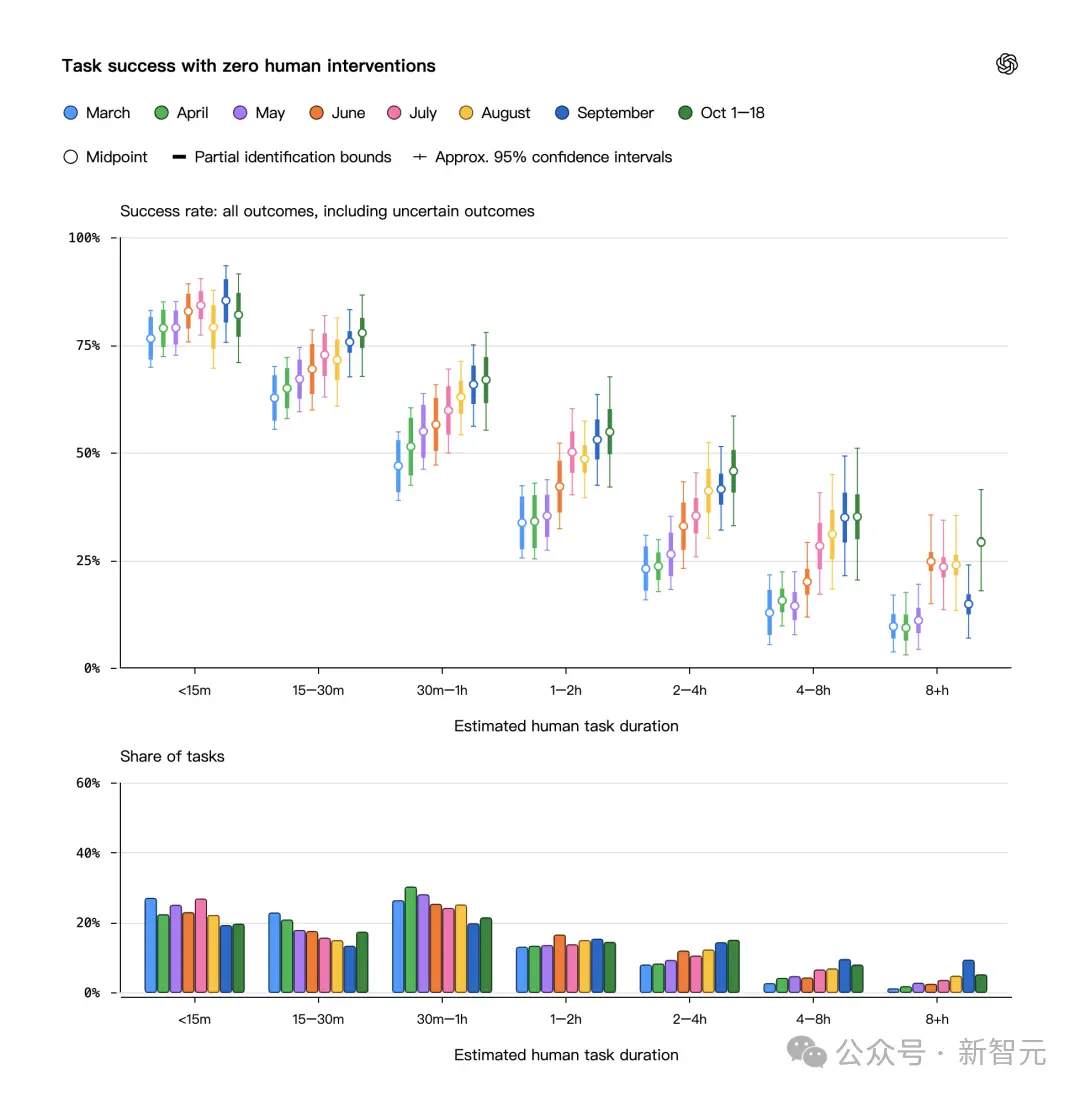
However, if you break down the tasks, you will find that AI's ability boundary is incredibly uneven. Monitoring training run issues has a success rate of 79%. But the success rate for writing underlying reasoning and service stack code is only 25%.
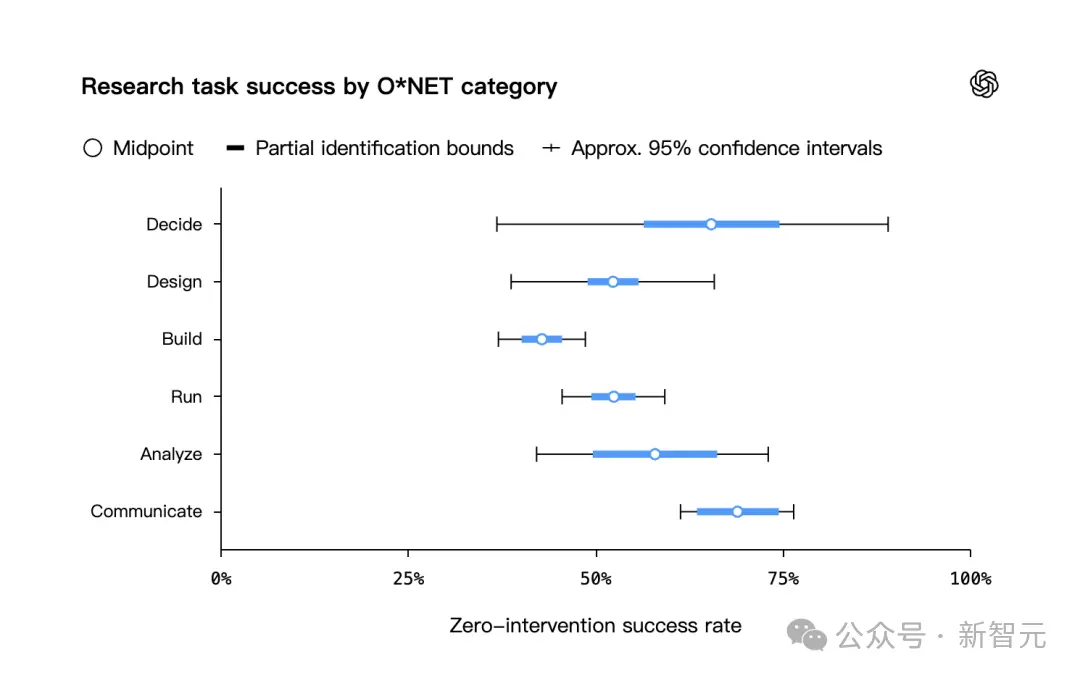
Data shows that when tasks involve high abstraction “building from scratch,” AI's success rate plummets.
It excels in communication (69%) and analysis (58%), but still behaves like a reckless apprentice in development (43%).
In internal interviews, human researchers’ complaints about AI remain frequent.
To fix a small bug by restructuring an entire module, AI can get bogged down; it can generate seemingly fancy but actually non-functional “AI garbage” PRs (pull requests); it can produce unusable data and even make extremely ridiculous analytical hypotheses.
A researcher involved in post-training evaluation helplessly summarized his new workflow:
“I used to try to directly tell AI ‘just make this task like that task,’ and ended up getting burned too many times because it always misinterpreted, and I had to clean up after it.
Now the strategy has changed; I say: ‘You do one first, I’ll review and modify. Once I confirm it’s right, then you can do the remaining ten thousand.’”
You see, this is the current reality. Humans remain the absolute core in the AI development closed loop; however, the human role has shifted from “creator” to “reviewer.”
Humans provide the initial judgment and margin for error, while AI is responsible for amplifying that margin a thousandfold.
But this balance is extremely fragile. Just as one researcher left a thought-provoking statement in the report: “I genuinely believe that I currently have better taste in scientific ideas than AI. But I have no confidence in how long this situation can continue to hold.”
Is the endgame determined? OpenAI's urgent appeal and new order
At the end of the report, OpenAI made a rare and strongly worded industry appeal: mandatory disclosure of RSI metrics.
They believe all top AI laboratories should be required to track and publicly report the core metrics of “Recursive Self-Improvement.” The public and regulatory bodies have the right to know how far along the process is that AI is accelerating the development of future AI systems.
Why disclose? Because the pace of progress has surpassed traditional intuitive perception.
The report disclosed that the OpenAI ECI (Internal Capability Index), aimed at measuring trends in general AI capability progress, shows that since August 2025, the ECI frontier of OpenAI models is skyrocketing at a rate of 16.4 points per year, surpassing the industry average of 14 points.
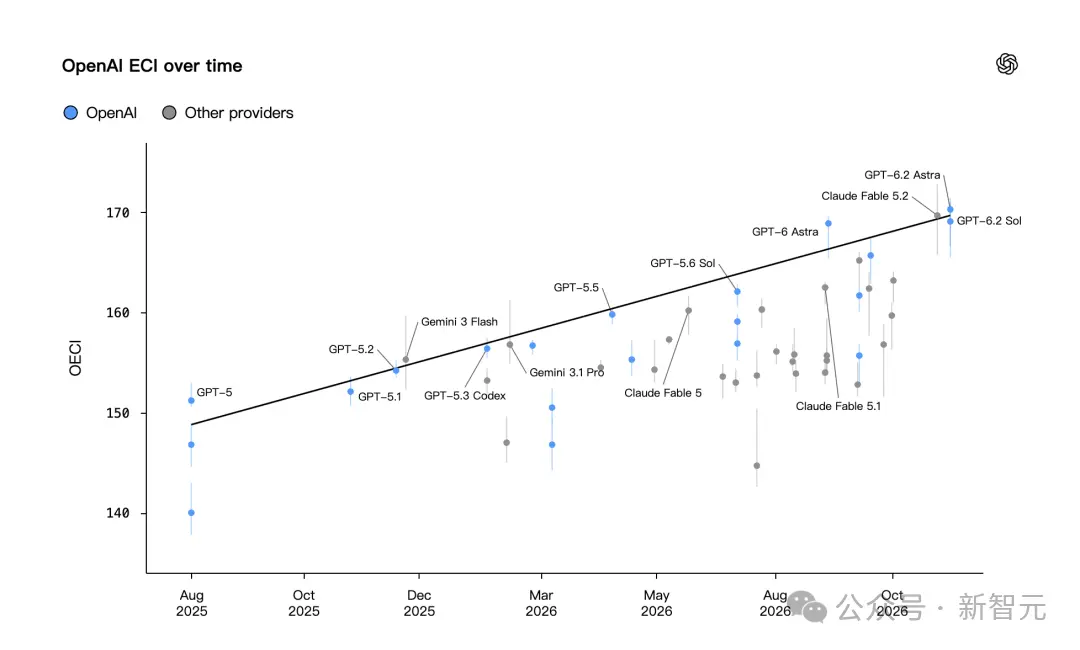
More frightening is that such astonishing progress has only used 2% of OpenAI's total R&D computing power to deploy internal agents.
Imagine what would happen when this proportion reaches 20%, 50%, or even 80%?
The traditional “human R&D cycle” is being shattered. Previously, iterating a model required six months to gather data, three months of training, and two months of fine-tuning. Now, agents are using concurrent computing power to complete weeks' worth of human workload in just a few hours.
As the report warns: historical trends may have become unpredictable for the future.
In the field of mathematics, cutting-edge models have recently shown sudden and rapid breakthroughs; a “mutation” in the AI field could happen at any moment.
免责声明:本文章仅代表作者个人观点,不代表本平台的立场和观点。本文章仅供信息分享,不构成对任何人的任何投资建议。用户与作者之间的任何争议,与本平台无关。如网页中刊载的文章或图片涉及侵权,请提供相关的权利证明和身份证明发送邮件到[email protected],本平台相关工作人员将会进行核查。


