
Author: Jae, PANews
As the year-end approaches, the crypto market is feeling chilly, with the Fear and Greed Index plunging into the "extreme fear" zone and the wallets of primary market investors being tighter than ever. However, the on-chain derivatives protocol Variational has received the heaviest check in the Perp DEX (decentralized perpetual contract exchange) space this year.
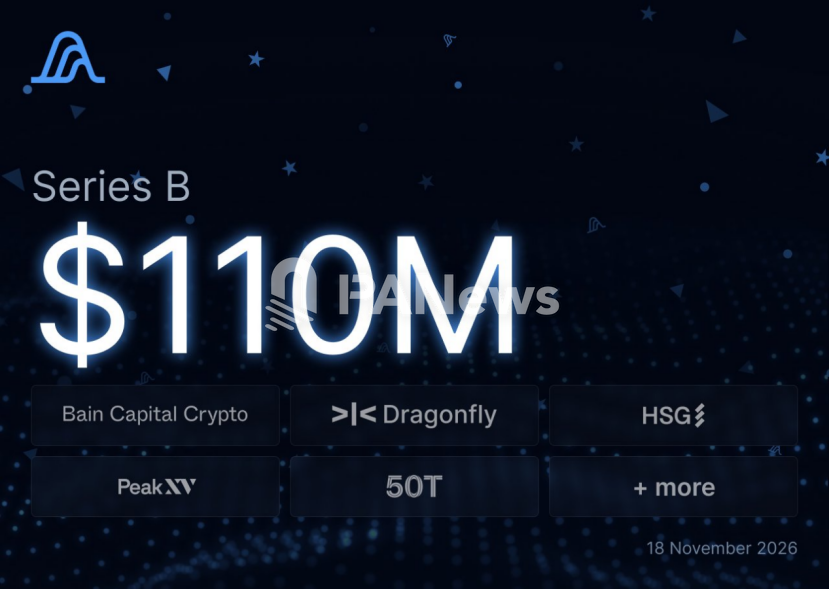
On November 18, Variational announced the completion of a $110 million Series B financing round, with a post-money valuation soaring to $1.5 billion. The lead investor is Bain Capital Crypto, with follow-ons from Dragonfly, HSG, Peak XV, 50T Funds, and Coinbase Ventures.
Although the financing valuation comes at a slight "discount," Variational, having secured a substantial new investment, is redefining the business model of Perp DEX. It aims to bring Wall Street's brokerage market-making and institutional RFQ (Request for Quote) onto Arbitrum, allowing global retail users to connect directly with the liquidity depth and financing rates of traditional financial primary market makers through USDC.
Variational's Valuation Discount, RWA Becomes the Second Growth Curve
Following Lighter's $68 million financing, Variational's record has set a new high on the Perp DEX battlefield. The protocol had previously raised about $61.8 million, and the Series B amount of $110 million exceeds the total of all previous rounds, bringing its total financing to $171.8 million.
Based on Variational's disclosed annualized net revenue of $75 million, the protocol's valuation/revenue multiple is about 20 times. Compared to last November's financing of Lighter, which had the same $1.5 billion valuation, Variational's primary market valuation carries a distinct discount.
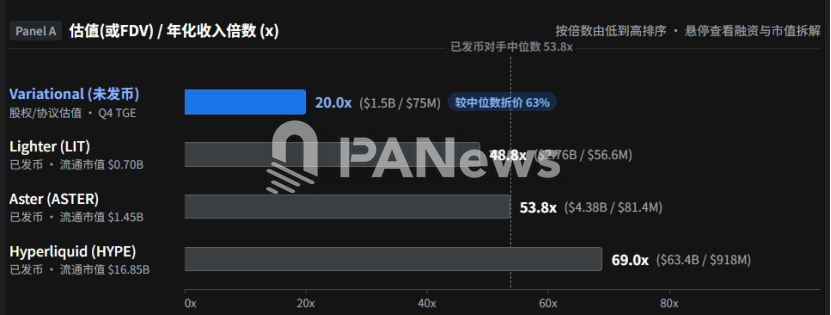
The price offered by capital is based on a report that has already produced revenue, and behind the revenue lies a steep curve of trading volume.
Variational has delivered a high-growth report card over the past three months. According to DefiLlama, the protocol's volume in August was $29.7 billion, rising to $59.1 billion in September, and further climbing to $77.8 billion in October. Within two months, the trading volume grew by approximately 162%.
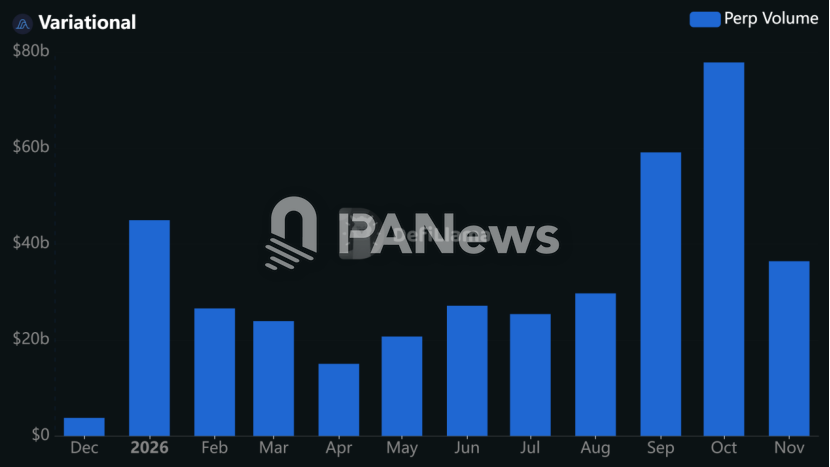
More notably, there is a structural shift in assets behind the growth in trading volume.
The RWA open interest (OI) on Variational exceeds $356 million, covering nearly 130 markets. Among them, the index-related OI reached $165 million, with the NASDAQ 100 index surpassing gold to become the main trading target on the platform.
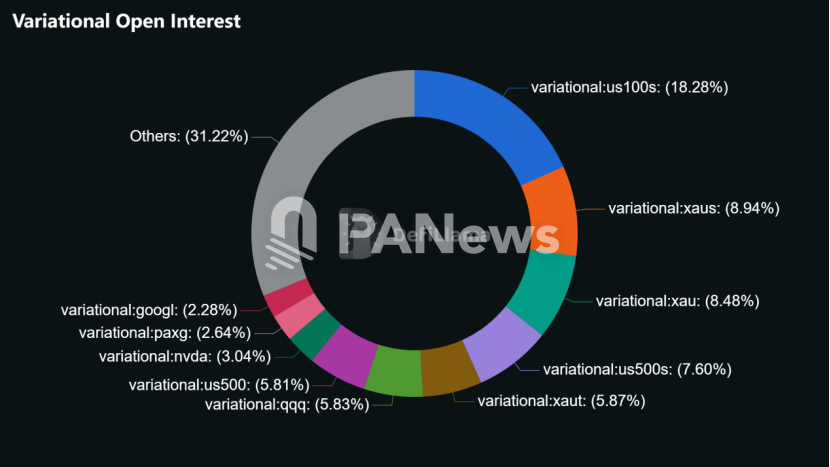
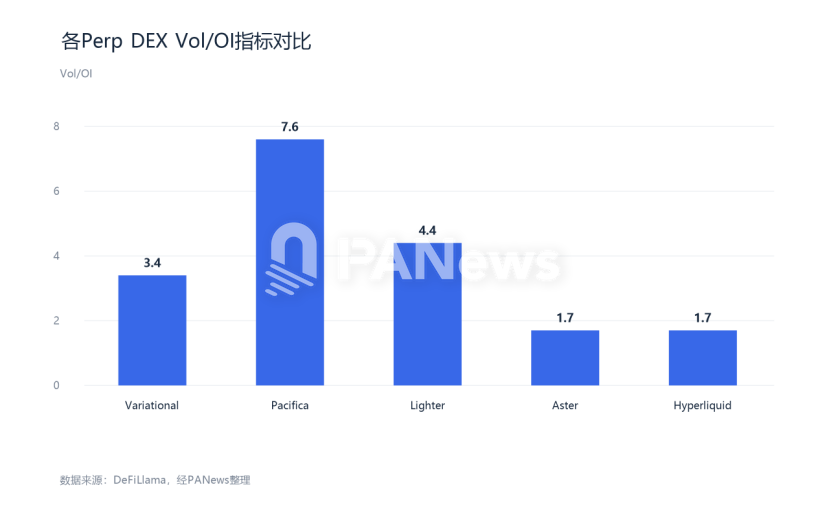
From the volume metric Vol/OI, possibly due to incentive programs, Variational's single-day ratio is around 3.4 times. This is significantly lower than Pacifica's 7.6 times, and even more solid than Lighter's 4.4 times, yet still higher than Hypeliquid and Aster's 1.7 times.
A Perp DEX Without Order Books: OLP Takes the Spread Alone and Bears the Risk
Although Variational's Vol/OI ratio is slightly higher, it is fundamentally a Perp DEX without an "order book."
The protocol does not match traditional buy and sell orders and does not rely on Maker/Taker transaction fees as a primary income source. Instead, the built-in OLP (Omni Liquidity Provider) replaces the many counterparties in the order book.
Variational's founder, Lucas Schuermann, compares OLP to "on-chain Robinhood," where its role is akin to a broker that integrates quoting, risk control, and hedging. Behind the "zero trading fee" front is a mature business logic that Wall Street has operated on for decades: internalization of order flow and capturing the spread.
When users want to buy an asset, OLP offers a sell price; when users want to sell, OLP gives a buy price. The difference between the two is the protocol's revenue. For example, if the reference price of an asset is $100, OLP might quote a sell price of $100.02 and a buy price of $99.98. Traders do not need to pay explicit transaction commissions, but costs are hidden within the price. This logic is also the business model of internet brokers like Robinhood.
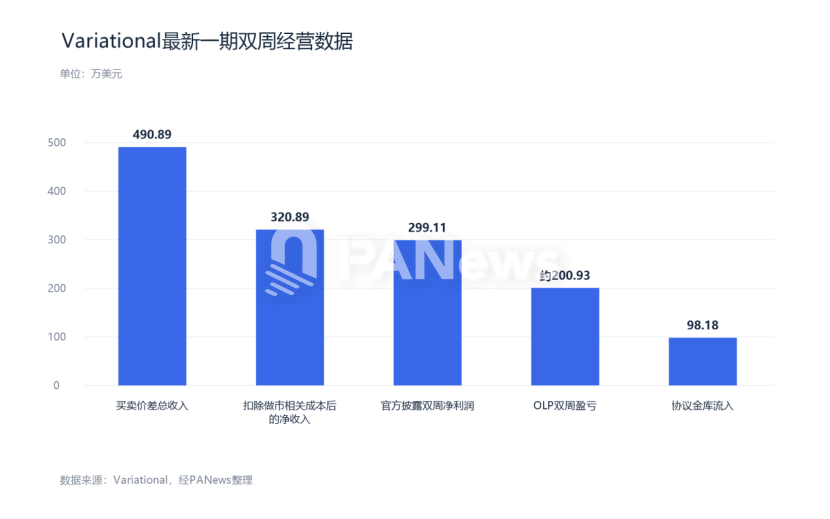
After taking the order, OLP hedges the exposure through centralized exchanges, decentralized exchanges, or traditional financial traders, and the remaining portion of the spread after deducting hedging costs is profit. Variational's biweekly operational data released on November 13 indicates that the net profit achieved by the protocol accounts for about 61% of the total revenue from bid-ask spreads.
Therefore, "zero fees" have never been a free lunch; it merely swaps explicit transaction fees for hidden market-making spreads. The only difference is that past spread profits were shared with external market makers, while now Variational has entered the field as the sole market maker, keeping it internal.
The cost is that users do not trade in a publicly transparent order book, instead entrusting the fairness of pricing, the robustness of hedging, and the availability of settlement entirely to the centrally controlled OLP by the team. Once OLP's risk control fails or operations go awry, there are no backup market makers available on-chain.
Swap Expansion, Financing Leverage
After securing $110 million in financing, Variational co-founder Edward Yu posted on X revealing the two main uses of the funds.
On one hand, to expand the scale of swap contract business: increase OI limits, optimize liquidity, add tradable assets, and explore new asset categories; on the other hand, to bring institutional-grade derivatives on-chain: the Pro version will create a flexible multi-dealer network, supporting various derivatives that can be settled through peer-to-peer methods, including Swaps, Perpetual Contracts (Perp), options, and more types of derivatives.
It is important to emphasize that Variational's Swap is not the spot exchange familiar to DeFi users, but a type of derivative settled in USDC that provides price exposure without needing to actually hold the underlying asset.
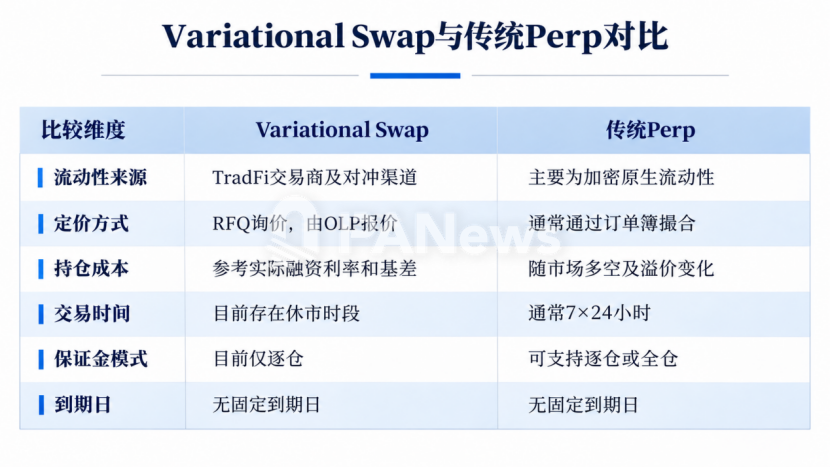
Like Perp, Swaps also have no fixed expiration date, can use leverage, and can bet on the direction of gold, indices, or other assets. The difference lies in their logic for forming quotes and calculating holding costs.
Order book Perp DEX liquidity comes from on-market orders, with funding rates fluctuating based on long-short supply and demand and contracts' prices deviating from index prices,
whereas Variational's Swap connects directly to traditional financial traders through OLP, making quotes and holding costs much closer to the actual financing costs of the underlying assets.
For example, making a large gold trade on a Perp DEX order book, if the willing market makers are limited, the buy orders will consume the sell orders, ultimately pushing up the average transaction price. The liquidity in traditional financial markets for gold is much richer, with banks, brokers, professional traders, and futures markets all able to provide quotes or hedges.
However, Swaps are a "capital-intensive" business. The order book Perp DEX only needs to match longs and shorts without using much of its own capital; but Variational's OLP, as the sole counterparty, must lock USDC margins on-chain and pay high margins to traditional institutions off-chain to leverage the credit limit.
In September this year, although the institutional credit capacity signed by Variational exceeded $1 billion, in the early stage of launch, in order to control risks, an OI cap of about $10 million was set for individual Swap markets, leading to frequent limitations on whale trades.
Therefore, financing, raising OI limits, and expanding the Swap market are interdependent links in the same business model expansion process. It can be said that the $110 million in financing is essentially used to supplement OLP's capital, leverage larger institutional credit, lift OI caps, and release large amounts of new traditional asset market margin.
Q4 Token Launch Countdown: On the First Day, There May Be $480 Million of Selling Pressure, Single Token About $40
For most Perp DEX players, financing valuation and Swap products are undoubtedly important, but what truly moves the needle is often the token.
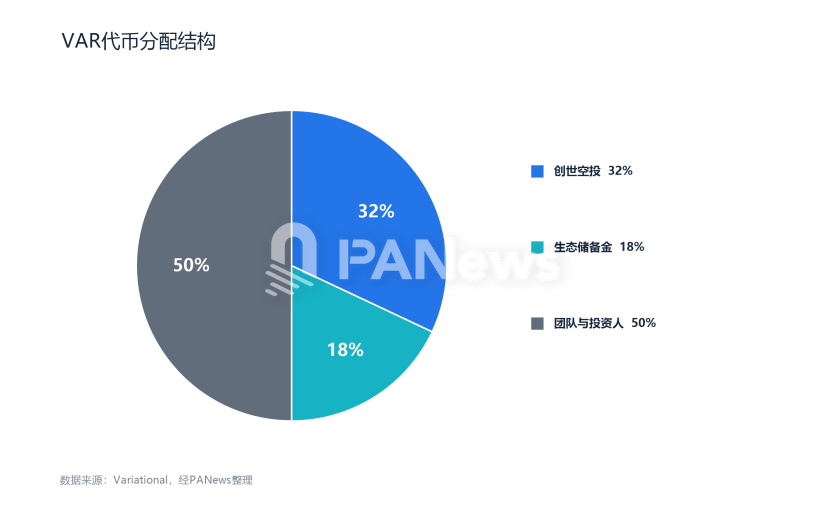
In September this year, Variational announced the token economics of the protocol token VAR and its token generation event window, confirming the TGE in the fourth quarter. Among them, 32% of the total supply will be used for the initial distribution, allocated to users according to their points ratio and fully unlocked at TGE; 18% allocated to ecological reserves; and 50% reserved for the team and investors.
The $1.5 billion Series B valuation has nailed an anchor for the soon-to-be-launched VAR token.
By this calculation, there could be $480 million of zero-lockup sellable tokens flooding the market on the first day of TGE. Most holders of these tokens are those "arbitrageurs" who have endured spread losses over the past year and are eager to recoup their investments.
Perhaps because of this, the implied median pricing for VAR's first-day Fully Diluted Valuation (FDV) in the prediction market Polymarket is set at $1.43 billion, with only 26% betting on it breaking $2 billion.
The cost-performance ratio of the last train is also rapidly narrowing. With the public testing opening, account numbers surpassing 100,000, and the $1.5 billion valuation attracting market attention, the fixed weekly 150,000 point pool is facing unprecedented competition. Based on the current total points pool of 10,050,000 (3 million retroactive + about 47 weeks × 150,000), if VAR's FDV falls within the $1 billion to $1.5 billion range after listing, the value of a single point would be approximately $31.8 to $47.8.
Currently, a more rational approach is to naturally transfer part of your existing real trading demand for gold, Nasdaq, or cryptocurrency orders to Variational, while obtaining risk exposure and conveniently swapping for a low-cost airdrop ticket.
The $110 million in financing and the $1.5 billion valuation are merely the final pass for Variational. The new stress test will commence within an hour after VAR's launch.
免责声明:本文章仅代表作者个人观点,不代表本平台的立场和观点。本文章仅供信息分享,不构成对任何人的任何投资建议。用户与作者之间的任何争议,与本平台无关。如网页中刊载的文章或图片涉及侵权,请提供相关的权利证明和身份证明发送邮件到[email protected],本平台相关工作人员将会进行核查。


