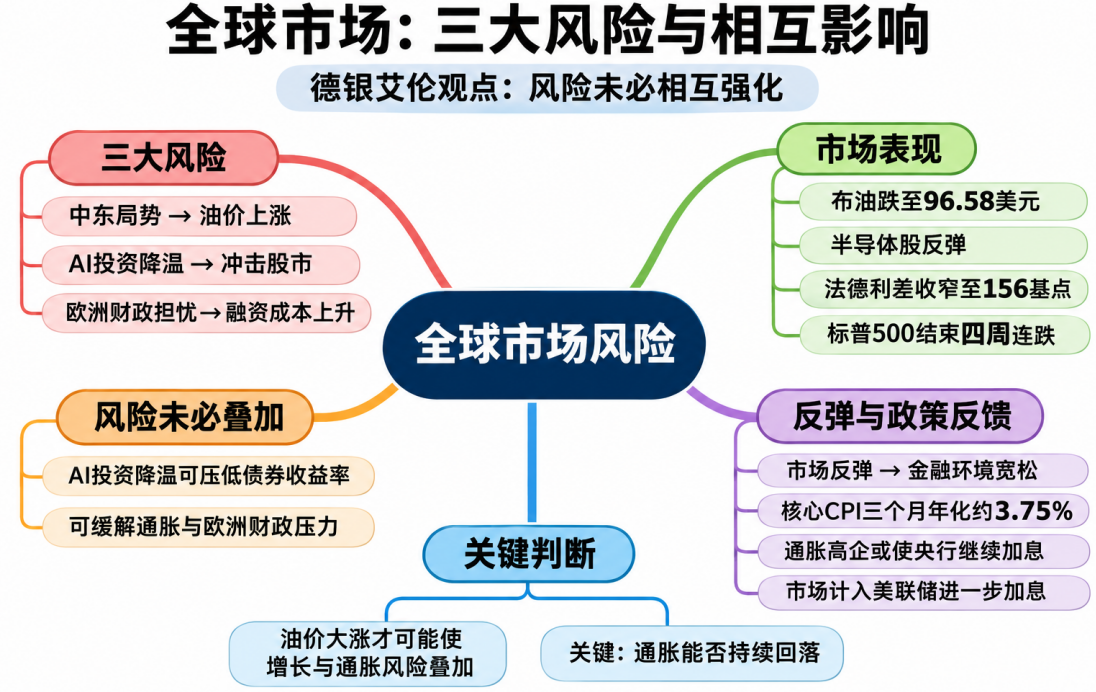
Deutsche Bank analyzed three major market threats: the energy shock in the Middle East, the cooling of the AI investment cycle, and the debt risks in Europe. It pointed out that these threats may not necessarily reinforce each other and could even counteract one another. However, every market rebound resulting from risk mitigation may loosen financial conditions and rekindle the Federal Reserve's hawkish stance.
Written by: Xiao Yanyan, Jinshi Data
The global market is facing three major risks: the escalation of the situation in the Middle East raising oil prices, the cooling of the AI investment cycle impacting the stock market, and concerns over European finances increasing government financing costs.
Henry Allen, a macro strategist at Deutsche Bank, pointed out in the latest report, "How the Bearish Risks Can Offset Each Other," that investors tend to believe these three risks will reinforce each other, but this is not necessarily the case. The negative impact of one risk may be partially offset by the market effects of another risk.
The Cooling of AI Investments May Relieve Debt and Inflation Pressures
Allen believes that there is a special relationship between the slowdown of AI investments and the other two risks.
If AI investment cools significantly, technology stocks will be the first to be impacted. The demand for semiconductors, data centers, and related infrastructure may decline, which will affect corporate profits and future productivity growth expectations.
On the other hand, a reduction in AI investment may bring about two positive market effects.
First, the slowdown in AI investments will weaken economic growth expectations, prompting investors to turn to safe assets like U.S. Treasury bonds, driving up bond prices and lowering yields. Lower bond yields can alleviate the financing pressures on highly indebted countries in Europe, easing market concerns about sovereign debt.
Second, AI infrastructure construction consumes a significant amount of energy and drives demand for high-end storage chips and other products. The slowdown in investment may reduce demand in these areas, thereby easing some inflationary pressures.
Therefore, while the cooling of AI investments may not be beneficial for the stock market, it could simultaneously lower bond yields, alleviate inflation, and relieve some fiscal pressures. The three major risks do not necessarily develop in the same direction.
Market Rebound Brings New Issues: Central Banks May Continue to Raise Rates
Recent market trends have shown signs of this mutual offsetting of risks.
Since the end of October, tensions in the Middle East have eased somewhat, with Brent crude oil prices falling from $113.43 per barrel to $96.58, and short-term inflation expectations in Europe and the U.S. have receded accordingly.
At the same time, semiconductor stocks have rebounded from their low on November 5, with the Philadelphia Semiconductor Index accumulating an increase of over 12% by the subsequent Friday. The credit spreads in the U.S. and Europe have also narrowed, indicating that market concerns about the risk of AI investment spilling into the financing market have diminished.
European debt pressures have also shown signs of easing. The spread between French 10-year government bonds and German bonds narrowed from about 174 basis points on October 22 to 156 basis points.
These changes helped the S&P 500 index end a four-week decline, registering its first weekly gain in four weeks.
However, the issue is that the rebound in the stock and credit markets means that financial conditions are becoming looser. If inflation remains high, central banks will have no need to ease monetary policy in response to previous market pressures, and may even consider further rate hikes.
The core consumer price index in the U.S. for October showed a three-month annualized increase of around 3.75%, the highest level since April 2024. Inflation pressures are re-emerging, and the market has begun to factor in the likelihood of further rate hikes by the Federal Reserve, even considering a 50 basis point increase in December.
Allen believes that investors often associate stock market declines and slowing economic growth with central bank rate cuts, while overlooking another possibility: a rebound in the stock market and narrowing credit spreads could also provide more room for central banks to raise rates.
This is also the most contradictory aspect of the current market: the more confidence the market restores, the more difficult it may be for monetary policy to turn towards easing.
Rising Oil Prices Could Truly Compound the Triple Risks
Unlike the slowdown in AI investments, the escalation of the situation in the Middle East and a significant rise in oil prices could simultaneously hit economic growth and push up inflation.
Rising energy prices increase household consumption, corporate production, and transportation costs, weakening economic activity while raising inflation expectations and interest rates. Government financing costs may also rise, further exacerbating debt pressures in Europe.
This situation is in stark contrast to the cooling of AI investments. The latter may decrease economic growth expectations and bond yields, but an energy shock could simultaneously lead to slowing economic growth and rising inflation, making decision-making for central banks even more difficult.
Allen also cited the interest rate hike cycle from 2022 to 2023 as an example, noting that the market repeatedly expected central banks to stop raising rates, but persistent inflation and strong economic activity consistently contradicted that expectation. The collapse of Silicon Valley Bank and turmoil in regional banks in 2023 did not stop the Federal Reserve and the European Central Bank from continuing to tighten policy.
Currently, the market expects that by September 2027, the cumulative rate hike by the Federal Reserve will reach about 113 basis points, higher than the 95 basis points anticipated before this tightening cycle began.
This indicates that the market is gradually raising its expectations for future interest rates.
The core of Deutsche Bank's analysis is that the energy shock in the Middle East, the cooling of AI investments, and the debt risks in Europe do not simply sum up. While the slowdown in AI investment may relieve inflation and fiscal pressures, if oil prices rise sharply again or a rebound in the stock market leads to excessively loose financial conditions, the market may still face harsher monetary policies.
The key factor determining market direction remains whether inflation can consistently decline. Only when inflationary pressures are truly alleviated can a rebound in the stock market and an easing of monetary policy by central banks potentially occur simultaneously.
免责声明:本文章仅代表作者个人观点,不代表本平台的立场和观点。本文章仅供信息分享,不构成对任何人的任何投资建议。用户与作者之间的任何争议,与本平台无关。如网页中刊载的文章或图片涉及侵权,请提供相关的权利证明和身份证明发送邮件到[email protected],本平台相关工作人员将会进行核查。


