Source: Bankless, Kairos Research, Ryan Watkins (Co-founder of Syncracy Capital), Ignas
Editor: Big Pliers, PANews
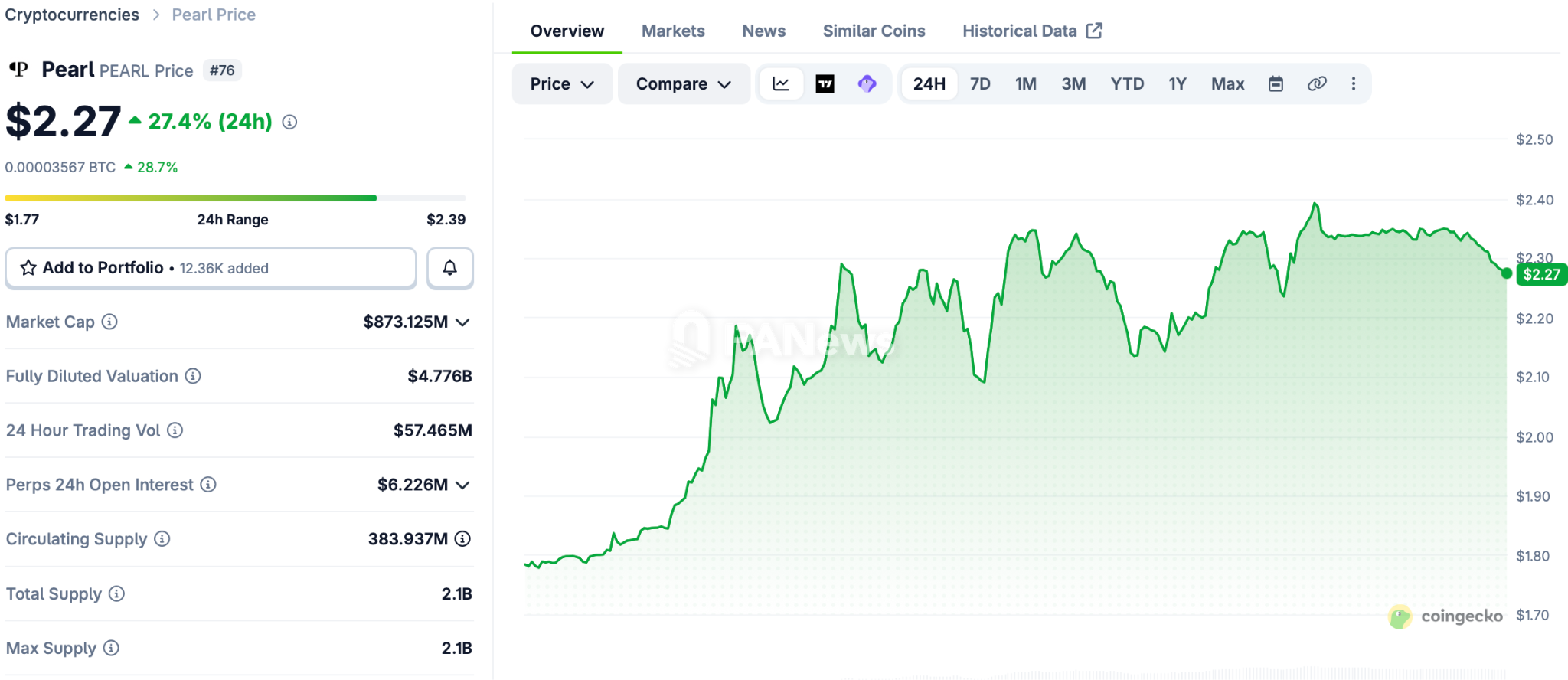
Pearl's recent price surge has prompted the market to reassess the potential for AI computing power to combine with cryptocurrency. Coinbase and Kraken listed it, Syncracy Capital disclosed large holdings, and the launch of the FP8 upgrade test network collectively pushed PEARL to perform against the background of market decline. According to data from CoinGecko, PRL has risen about 28% in the past 24 hours, approaching the historic high of $2.44 on October 21.
The problem Pearl attempts to solve is: when AI becomes one of the most economically valuable applications of GPUs, can traditional cryptocurrencies continue to monopolize these computing resources? And as AI computing power gradually becomes the new infrastructure, can it be used for both AI services and blockchain security, allowing miners to rely not solely on block rewards, but to earn income through genuine business demands?
The FP8 upgrade is a key step in Pearl's attempt to answer this question, yet there remains a need to verify the distance between technological advancements, economic models, and long-term value.
Bitcoin's Security Budget Trap and AI's Computing Power Competition
For a long time, Bitcoin has been seen as the best carrier of non-sovereign digital value storage. However, over time, the security model that Bitcoin relies on is facing unprecedented external pressures and internal bottlenecks.
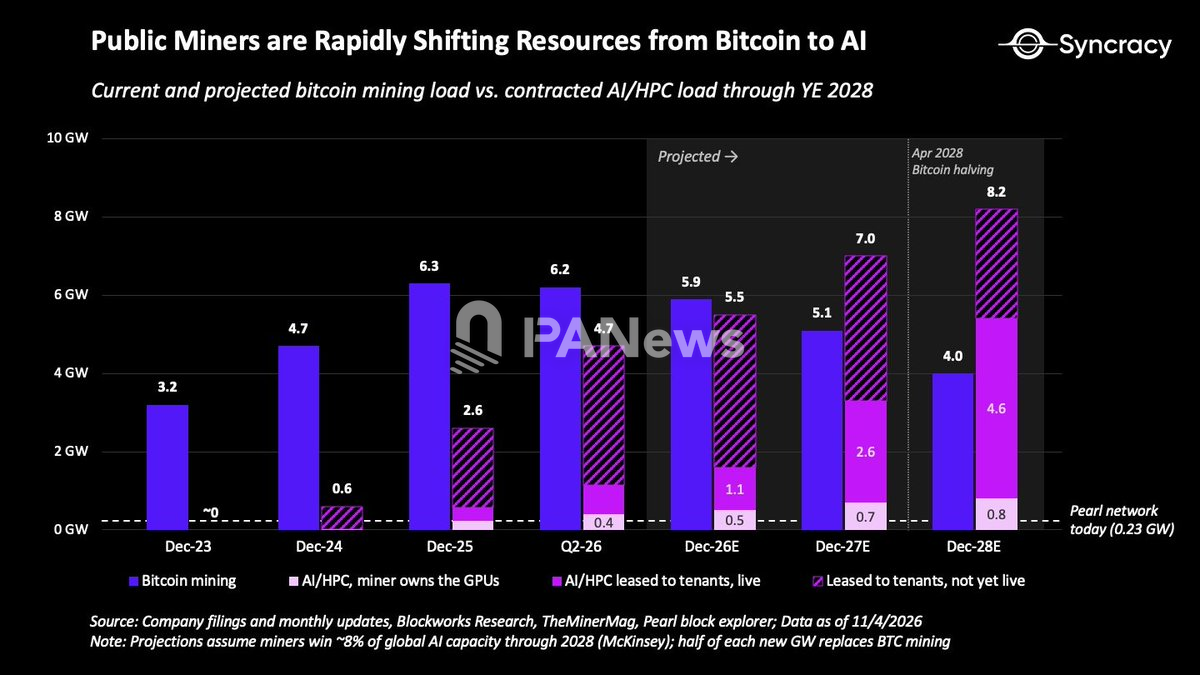
The primary survival challenge is the continued shrinking of the security budget. Bitcoin relies on block rewards and transaction fees to pay miners for maintaining network security. However, under the halving mechanism which occurs every four years, newly issued block rewards drop sharply, while machine and power costs remain unchanged. Initially, the fee boom envisioned by Satoshi Nakamoto did not follow, Bitcoin failed to achieve transaction expansion and did not nurture a vibrant payment and application ecosystem, gradually solidifying into a purely static value storage. This means Bitcoin's security budget is entirely betting on the fragile logic that its price must double every four years.
Even more grim is the reality that the AI infrastructure construction wave is ruthlessly consuming the ground that Bitcoin stands on. Amid ongoing dollar depreciation and a sovereign debt crisis, global assets seek safe havens. But on the other side, according to Goldman Sachs, as much as $7.6 trillion is expected to be invested in AI infrastructures such as GPUs, power, and data centers from 2026 to 2031.
Given that the annualized profit from AI computing power per unit of electricity is about three times that of Bitcoin mining, Bitcoin miners are defecting on a large scale. In the first quarter of 2026, listed mining companies sold a record of over 32,000 bitcoins, while miner MARA recently sold about 40% of its bitcoin holdings since the end of September to pivot to AI, with up to 44% of megawatt-level power contracts being reallocated to AI and high-performance computing among listed miners from 2026 to 2028.
Moreover, the longtime adherence of the Bitcoin development community to the philosophy of "code immutability" hampers the network's progress when confronting the complex engineering tasks of imminent post-quantum signature migration, scaling, and resistance to quantum attacks.
Dual-Function Proof of Work and the Ultimate Ambition of "P-Day"
Faced with the impasse where Bitcoin's proprietary hardware (ASIC) cannot create additional external value and is crushed by AI power, Pearl has chosen a completely different path: it directly "parasitizes" on the AI arms race, combining blockchain and AI computing, allowing the same computing power to serve commercial applications and network security simultaneously.
1. Technical Breakthrough of Useful Proof of Work (PoUW)
Past attempts in academia to realize "Useful Proof of Work" often ended in failure, mainly due to excessive additional system overhead or the inability to avoid miner speculation. In 2025, former NVIDIA senior research scientist Omri Weinstein and Hebrew University cryptography professor Ilan Komargodski made a theoretical breakthrough, proving that the large-scale matrix multiplication operation, which is core to modern AI reasoning, can be transformed into a proof of work for decentralized networks with nearly zero overhead. A year later, they, along with a third co-founder Idan Sugarman, launched Pearl as a Bitcoin fork.
2. Economic Flywheel of Dual-Function Mining
Every time a user questions a large model, the backend essentially performs massive matrix multiplications. Pearl's underlying logic is "Dual-Function Proof of Work": it allows this part of matrix computation to simultaneously serve as proof of competitive block packaging. In an ideal state, AI cloud service providers charge end customers a normal reasoning service fee to cover GPU depreciation and electricity costs, while the PEARL tokens mined along the way represent additional pure profit. If this model is successful, it could change the vicious cycle where traditional POW miners must fully sell tokens to cover electricity costs.
3. P-Day Hypothesis
Syncracy Capital proposed the concept of P-Day in its lengthy article "Beyond Bitcoin Standards"—the day when Pearl's total computing power and energy coverage scale surpasses that of Bitcoin. In their view, Pearl stands at a vantage point of latecomer advantage: the mainnet has natively supported post-quantum cryptography and is developing a native privacy layer, and may even build a decentralized computing futures settlement market utilizing globally distributed GPU clusters in the future.
As long as the additional costs incurred by AI data centers connecting to Pearl approach zero or even turn negative (for instance, Pearl's team previously achieved a 15% speedup over top competitors in GEMM kernel optimization on Blackwell chips, and PearlQuant memory optimization technology improved long text throughput by 24%), global computing power will flow in rapidly, making Pearl the largest and most secure PoW cryptocurrency in a few years, becoming the native digital gold of the AI era.
Major FP8 Hard Fork: From "Garbage Mining Power" to Industrial-Grade AI
Despite the grand vision, as of this upgrade, there exists a significant gap between Pearl's mainnet status and its ideal: dual-function proof of work is not a mandatory requirement.
As the network cannot distinguish which matrix multiplications come from genuine AI responses, anyone can have their GPUs compute random matrices of no practical significance to compete for block rewards. According to Blockworks calculations, the proportion of blocks matching authentic AI models across the network was previously less than 1%. This so-called "garbage mining" of useless computing power occupied over 90% of the network, with about 80% of the computing power contributed by consumer-grade GPUs mainly located in China.
The core reason for this disconnect lies in the technical settings of the old protocol. The mainnet previously only recognized computation proofs in INT7 (7-bit integer) format, but actual industrial-grade AI reasoning has fully transitioned to low-precision floating-point numbers. Faced with INT7, service providers must sacrifice native acceleration and are forced to convert model formats, with mining directly leading to a 10% to 15% decrease in model service speed; mainstream reasoning platforms do not even provide an INT7 format option.
The recently activated FP8 upgrade on the test net (PIP-3 proposal) is precisely aimed at solving this issue. By directly supporting the FP8 floating-point format commonly adopted by today's AI data centers, service providers can mine seamlessly using conventional large model weights (BF16 to FP8) without cumbersome conversions.
However, this comes with a significant hardware compromise. Due to slight tolerances in how various chip manufacturers handle FP8 rounding rules, it is impossible to achieve precise and consistent results on a decentralized ledger; hence Pearl strictly limits its official hardware to NVIDIA's latest Hopper (such as H100) and Blackwell (such as B200 and RTX 50 series) chips. Older NVIDIA GPUs (RTX 40, 30, 20 series, etc.) and AMD and Intel chips are completely excluded.
Actual Results: Test Net Performance and On-Chain Selling Pressure Estimates
Facing the official optimism that FP8 can reduce reasoning performance loss to between 1% to 5%, the independent research institution Kairos Research, which holds PEARL, rented an H100 GPU and conducted a first independent pressure test by connecting it to the test net using the Llama 3.1 8B model.
1. Performance Testing and Exposed Weaknesses
In the test net environment, the H100 successfully mined a real FP8 block while providing model services, but revealed real disparities in throughput performance:
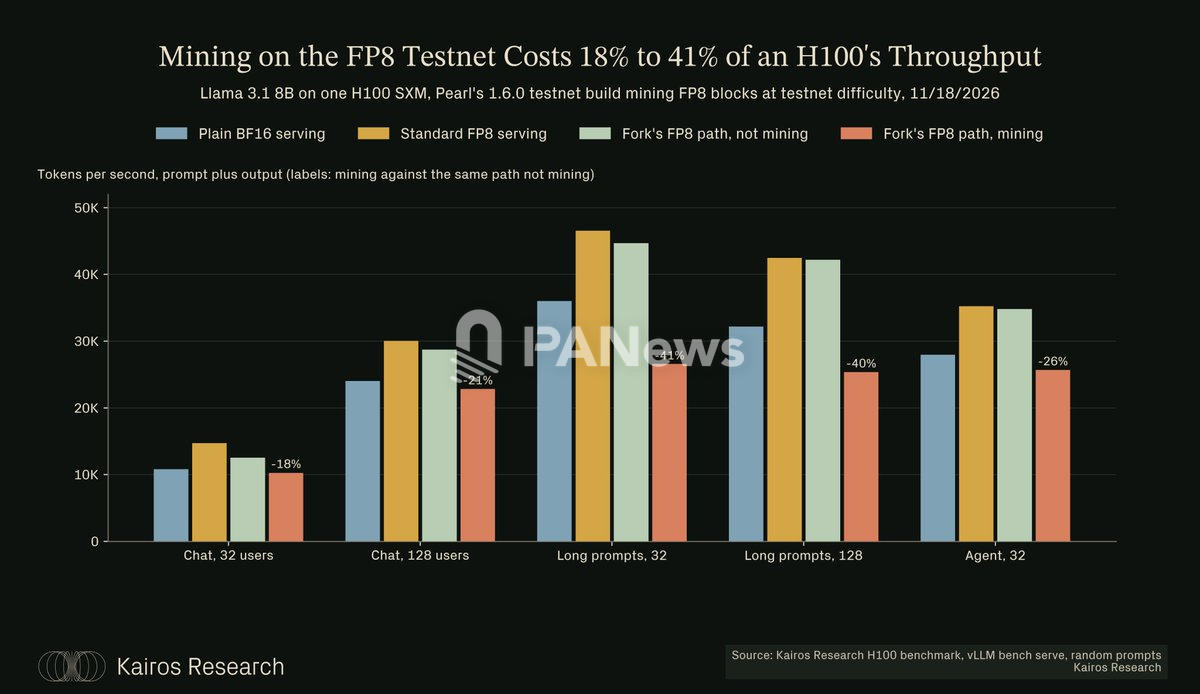
In comparison with itself when the mining plugin was simply turned off, mining in normal conversational scenarios caused an 18% to 21% loss in throughput, 26% loss in scenarios with lengthy prompts for agents, and as high as 40% to 41% loss in pure long prompt scenarios. When directly compared with the standard FP8 native reasoning services of data centers, the throughput reduction of mining machines reached 24% to 48%.
In addition, the current version has obvious functional shortcomings. Tests show that machines can only effectively mine during the pre-fill stage of reading prompts. If mining is forcefully conducted during the word-by-word generation of responses, the model's accuracy rating in mathematical evaluations drops from around 87% to an abandoned state of about 1%; simultaneously, support for the new hybrid expert architecture (MoE) is inconsistent, able to run OLMoE but completely unable to load Qwen3 related models. This also means that in the current version, cards dedicated to mining random matrices still earn more than dual-function service providers that mine while serving clients.
2. Computing Power Fluctuations and Miner Selling Model Analysis
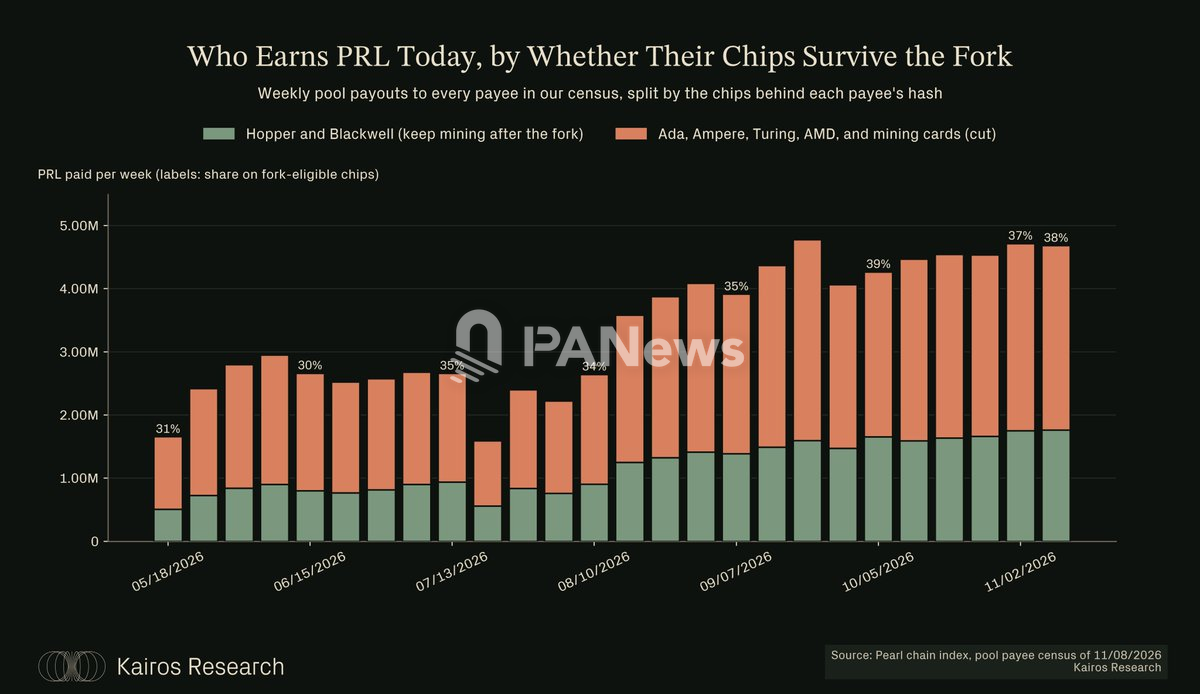
In a survey of computing power across six main mining pools and approximately 24,200 addresses, Kairos pointed out that currently, Hopper and Blackwell chips only carry about 37% of the total computing power in the network; once the hard fork is executed on the mainnet, about two-thirds of the old computing power will be forcibly stripped away (if subsequent combination with the Ada architecture scheme occurs, the retention rate may rebound from about 31.5% to 41%).
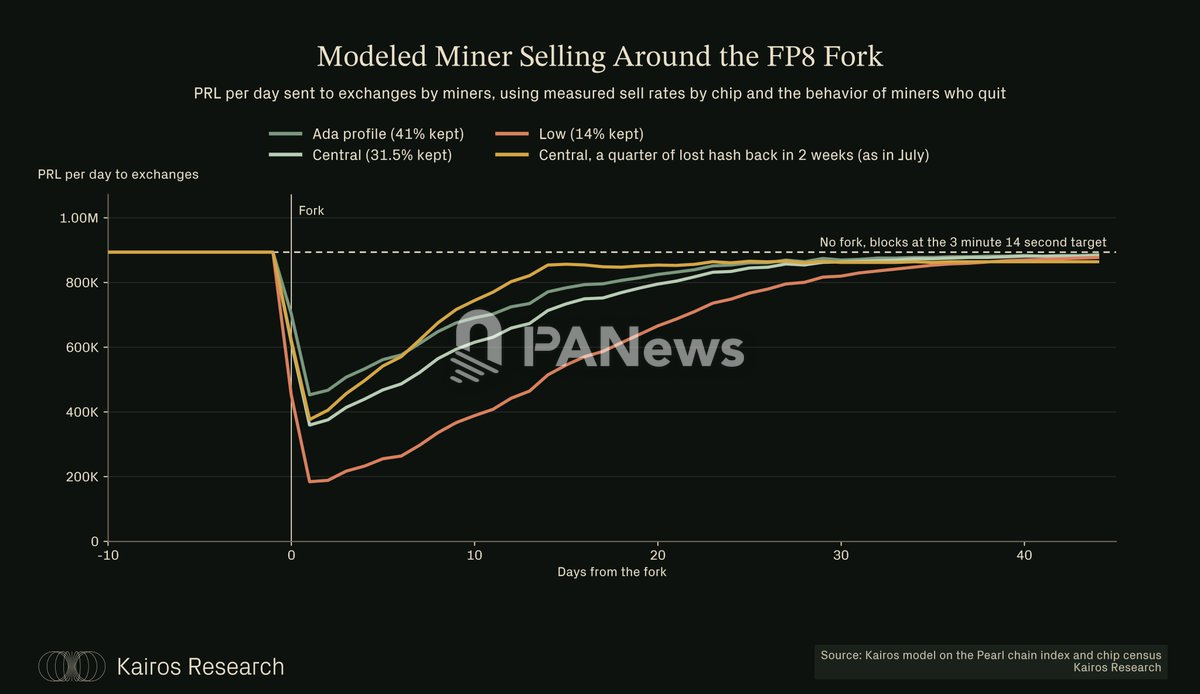
However, the steep drop in computing power does not equate to a violent sell-off. Historical on-chain tracking indicates a high consistency in behavioral patterns between eliminated old miners and surviving miners; for a long time, both have transferred 85% to 96% of their mining income to exchanges or OTC transactions for cashing out. When miners stop operating, they typically only cash out the remaining inventory gradually over a few months rather than in a panic sell.
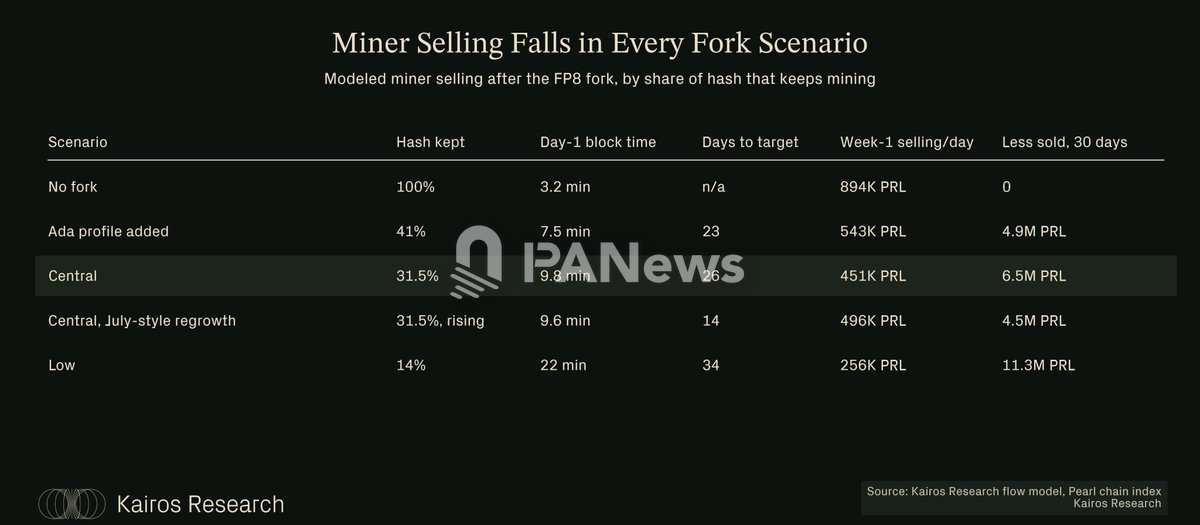
Model predictions indicate that due to the sudden drop in computing power, the network's block generation speed will significantly slow down for two to five weeks before a difficulty adjustment, and in the first 30 days after the hard fork takes effect, the total sell-off volume by miners is expected to decrease by about 6.5 million PEARL (an estimated corresponding supply vacuum of about $14 million at current prices), with the selling pressure from miners in the first week expected to be halved.
Three Core Concerns of Pearl
Despite the high-profile strategic partnerships announced by unicorns like Together AI while maintaining a scarcity of tokens early on, the rising narrative has led to market skepticism due to the distribution of chips and the closed-loop logic of the business model.
1. Concerns About Chip Distribution and "Fair Launch"
In terms of chip distribution, Pearl is accused of having a high concentration risk. Within the first six days of the network launch, a total of 121.7 million tokens were mined, accounting for about 32% of the circulation at that time. Meanwhile, the company, core team, and affiliated shareholders hold up to 98 million tokens (about 26% of the circulation). Although the project claims to voluntarily lock half of the holdings until May 2027, the underlying chain itself has not deployed any locking logic that strongly enforces smart contracts, leading to suspicions of a replay of the "false fair launch" model from 2021.
Any value storage asset needs to go through several rounds of complete bull and bear washouts and chip turnover; to expect a project that has been online for half a year to maintain a myth of no selling pressure under immense initial inflation clearly fails the test of historical cycles.
2. The Disconnection Between Equity and Tokens, and the Closed-Loop Dilemma of "Retail Investors Paying for AI"
In the business model, the entity behind the Pearl project raised $55 million in equity financing and a $75 million GPU ecological special fund. Venture capitalists hold the company's equity; as long as retail investors drive up the token value in the secondary market, equity holders and the computing power fund can reap substantial returns, while ordinary token holders have no cash flow recourse to the actual AI reasoning income.
Under the current business logic, AI service providers are able to offer cheaper computing power interfaces because they have mined PEARL and shifted it to speculative buyers in the market. This raises a brutal question: are secondary market token buyers investing in the ultimate currency of the future, or are they endlessly acting as "suckers" paying for someone else's commercial AI use?
3. The Fundamental Game of Decentralized Security
Unlike Bitcoin ASIC miners, which become useless scrap iron once a 51% attack is successfully initiated, GPUs running Pearl have extremely high external general value.
Even if ill-intent causes network paralysis, the GPUs can still redirect to undertake AI training and rendering tasks for large firms, leading to the logic that measures the network's attack and defense costs solely by computing power being inflated. Additionally, the rapid iterations in precision of cutting-edge AI reasoning dictate that Pearl must frequently undergo hard fork upgrades, with its developers' privileges and the inability to solidify consensus rules entirely contrasting with the absolute immutability sought by traditional hardcore cryptography.
A Gamble Still Waiting to Be Verified
Nevertheless, the FP8 upgrade of Pearl has made a substantive step in the intersection of crypto and AI. It marks the official shift from consumer-grade graphics cards and small model applications to industrial-grade AI infrastructure competition by standardizing data center chips and supporting mainstream large model weights and FP8 computing pathways.
However, the pathway to technological unification does not prove the success of the business model. In the coming months, the market will closely watch the completion of the FP8 upgrade in the mainnet fork and whether the actual losses in AI reasoning can indeed converge to single digits in subsequent code versions.
If major data centers begin to demonstrate substantial income from dual-function mining in their financial reports, and the on-chain authentic AI block proportion achieves a breakthrough, Pearl may have the chance to establish a POW economic model distinct from Bitcoin, allowing genuine business demands to become an important source of the network's security budget.
Conversely, if inefficiencies remain unrectified and genuine reasoning access struggles, with high inflation and capital unlocks arriving as expected, Pearl may ultimately become yet another computing power experiment sustained only by token subsidies.
免责声明:本文章仅代表作者个人观点,不代表本平台的立场和观点。本文章仅供信息分享,不构成对任何人的任何投资建议。用户与作者之间的任何争议,与本平台无关。如网页中刊载的文章或图片涉及侵权,请提供相关的权利证明和身份证明发送邮件到[email protected],本平台相关工作人员将会进行核查。


