Annualized funding rate of 11%, average 23% inter-platform funding rate spread, Delta neutral strategies are now extending to stock perpetuals.
Written by: Tanay Ved
Translated by: Saoirse, Foresight News
After the approval of Bitcoin spot ETFs in 2024, basis trading (also known as cash-and-carry arbitrage) has become a popular strategy in the market. This strategy involves buying Bitcoin spot (or Bitcoin spot ETFs) while shorting an equivalent nominal size of futures to hedge directional price risks and earn arbitrage profits. However, from 2025 to 2026, as institutional capital continues to enter the market and it matures, the returns of this strategy have been significantly compressed, with some periods yielding less than U.S. Treasury bonds.
At the same time, perpetual contracts linked to real-world assets (RWAs) such as individual stocks, indices, and commodities have experienced explosive growth, extending this trading logic to a new class of assets. On November 3, the CFTC officially clarified that stock perpetual futures can be traded on U.S. licensed regulated exchanges. With domestic platforms joining the fray and competing with established platforms like Binance and Hyperliquid, stock perpetual contracts are expected to attract more retail and institutional capital.
This article outlines the reasons behind the declining arbitrage returns of cryptocurrencies, analyzes how stock perpetual contracts have become a new target for Delta neutral strategies. We compare the funding rates of mainstream cryptocurrencies with stock perpetual contracts, discuss the impact of market segmentation between exchanges on strategy execution, and use Binance tokenized stocks as a sample to verify whether this kind of premium has practical arbitrage potential.
(Note: The funding rate is a specific cash flow that is periodically transferred between long and short holders of perpetual contracts, which is also the source of arbitrage profits.)
Cryptocurrency Arbitrage Returns Continuing to Narrow
Perpetual contracts have no expiration date and rely on both long and short sides periodically transferring funding rates, anchoring the contract price to the underlying spot price. When the funding rate is positive, the long side pays the fee to the short side, and short investors who are hedging can receive this cash flow.
At the beginning of 2024, the funding rate for Bitcoin perpetual contracts and the 30-day futures basis momentarily surged to an annualized 20%–40%; by 2026, it stabilized in the 3%–5% range, with the funding rate even briefly turning negative in the second quarter. When the yield equals or is lower than that of U.S. Treasuries, the cost-effectiveness of holding cryptocurrency hedge positions significantly declines.
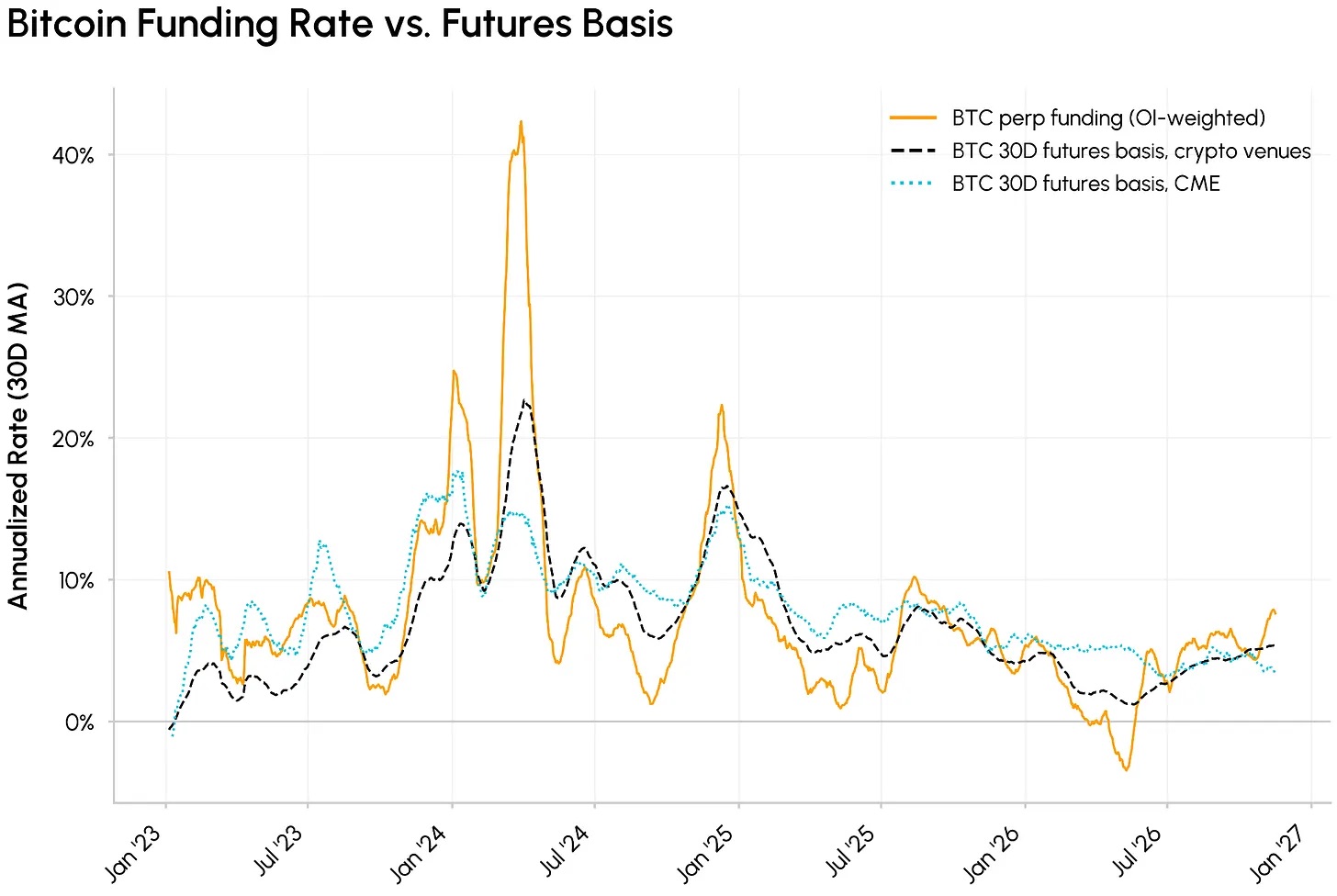
The funding rate of BTC perpetuals moves in sync with the 30-day futures basis of exchanges and CME, which is used to observe the leverage heat in the Bitcoin market and futures premium sentiment. Data source: Talos CM Market Data Pro
Ethena has created a Delta neutral strategy as an on-chain tokenized product, launching USDe in February 2024. The product logic involves holding cryptocurrency assets and pairing them with short futures for hedging; its staking version sUSDe can continuously accumulate profits from funding rates and staking rewards. Ethena's capital peak directed at cryptocurrency basis strategies once exceeded $8 billion. However, on October 10, the market's open interest dramatically dropped, and the basis premium fell to a historical low. Since then, USDe's market cap has declined from a peak of over $14 billion to the current $4.5 billion.
Rapid Expansion of Stock Perpetual Contracts
Since October 2025, the open interest ratio of RWA perpetual contracts on mainstream platforms has risen from nearly 0% to 18%, with the total scale surpassing $11 billion in November 2026. Retail and institutional investors worldwide are increasingly favoring these types of 24/7 trading products for speculation or hedging traditional assets such as stocks, indices, and commodities.
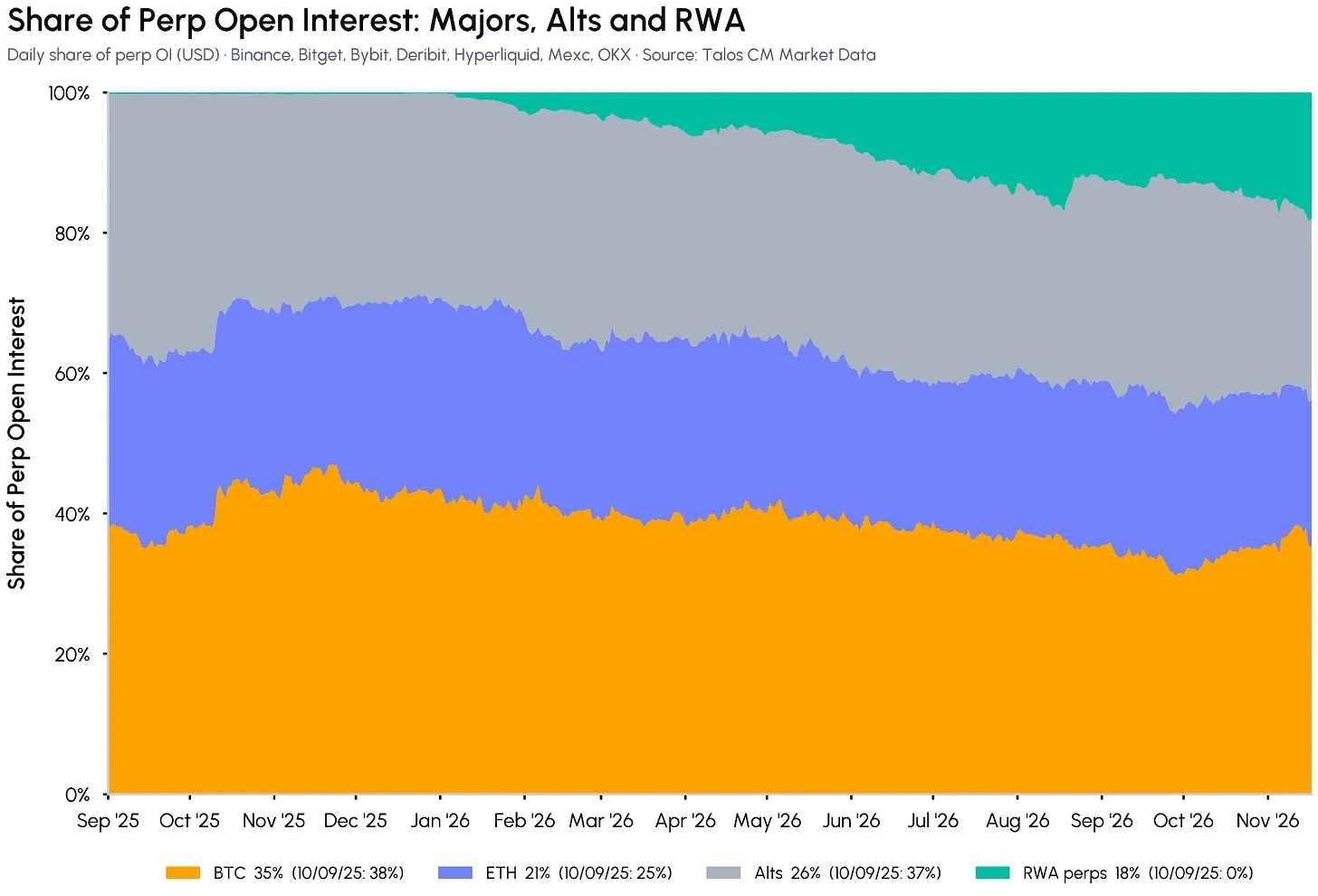
Changes in the share of open interest for perpetual contracts: BTC and ETH shares are slowly declining, altcoins' share is receding, while RWA perpetual contracts are steadily capturing market positions from zero. Data source: Talos CM Market Data Pro
Before mid-2026, Hyperliquid held most of the open positions in RWA perpetual contracts; in the second half of the year, centralized exchanges rapidly grew in scale, capturing a significant market share. Under the statistics of the five leading exchanges, Binance's open interest in RWA perpetuals accounts for 39%, corresponding to a scale of $4.3 billion. With the CFTC's regulatory guidelines for individual stock perpetual contracts, U.S. compliant platforms like Kalshi have formally entered the market.
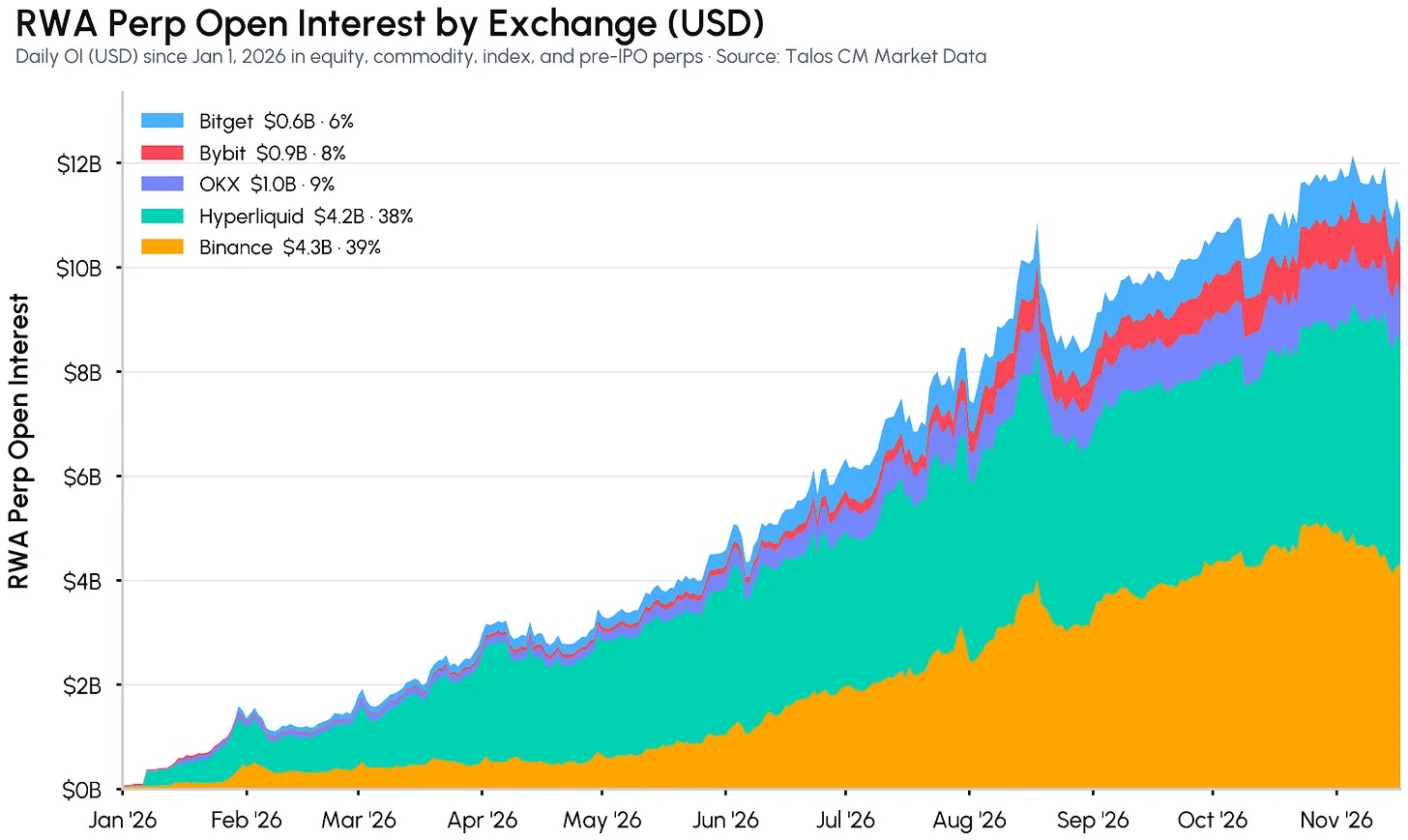
The open interest of RWA perpetual contracts has exploded since early 2026, with Binance and Hyperliquid being two core bases, together accounting for nearly 80% of the positions. Data source: Talos CM Market Data Pro
Kalshi launched stock perpetual contracts in early November, with a cumulative trading volume of over $3 billion for 58 individual stocks; Hyperliquid listed around 118 targeted stocks. On trading days after launch, Kalshi's daily trading volume for individual stock perpetuals averaged about $2.4 billion, while Hyperliquid averaged about $31 billion, with Kalshi's volume being about 8% of the leading on-chain platform, reaching a daily maximum share of 19% on November 16.
As the first compliant individual stock perpetual trading market in the U.S. that launched only two weeks ago, this performance is impressive. This also verifies the trend of the industry moving towards comprehensive exchanges: platforms originally focused on stocks, crypto, and prediction markets are increasingly shifting to offer a full range of assets within the same account, paired with perpetual contract products.
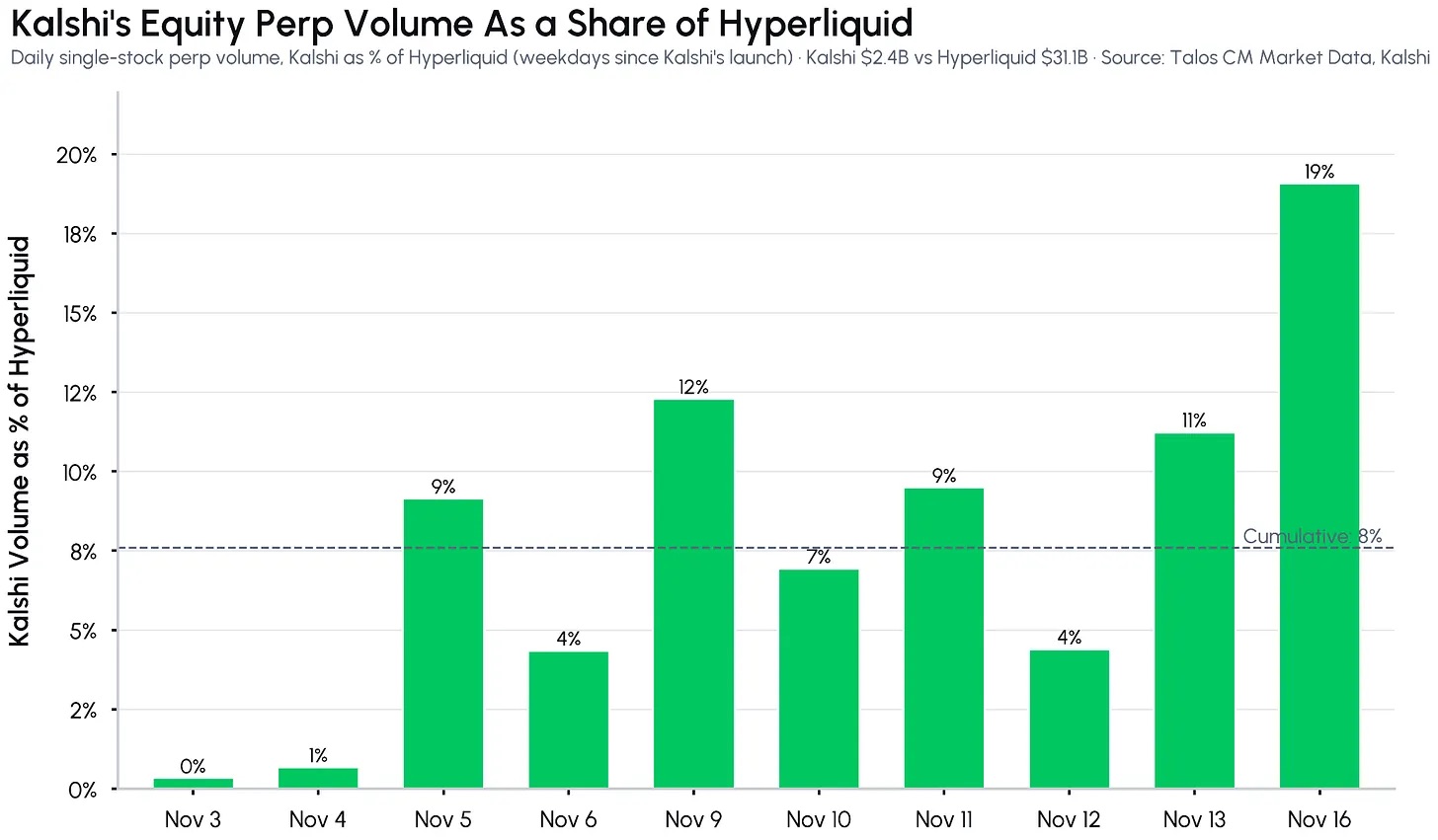
The trading volume of Kalshi stock perpetuals has quickly increased in proportion to Hyperliquid, reaching a peak single day ratio of 19%, rapidly capturing market share in RWA stock perpetuals. Data source: Talos CM Market Data Pro, Kalshi
Comparison of Funding Rates between Cryptocurrency Perpetuals and Stock Perpetuals
Based on open interest statistics, the average annualized funding rate for the top ten stock perpetual contracts in 2026 is about 11%; the top ten cryptocurrency perpetual contracts are about 3%. The high premium mainly comes from storage chip-related stocks: SK Hynix, Micron, SanDisk. Many overseas investors cannot directly participate in some Korean stocks, leading to high demand for leveraged and all-weather trading price exposure. Even excluding SK Hynix, the average annualized rate for stock perpetuals remains 8%, more than twice that of crypto perpetuals. Perpetual contracts for stocks like Anthropic, which have not yet gone public, are now also among the top products, allowing investors to position for price exposure before the company goes public.
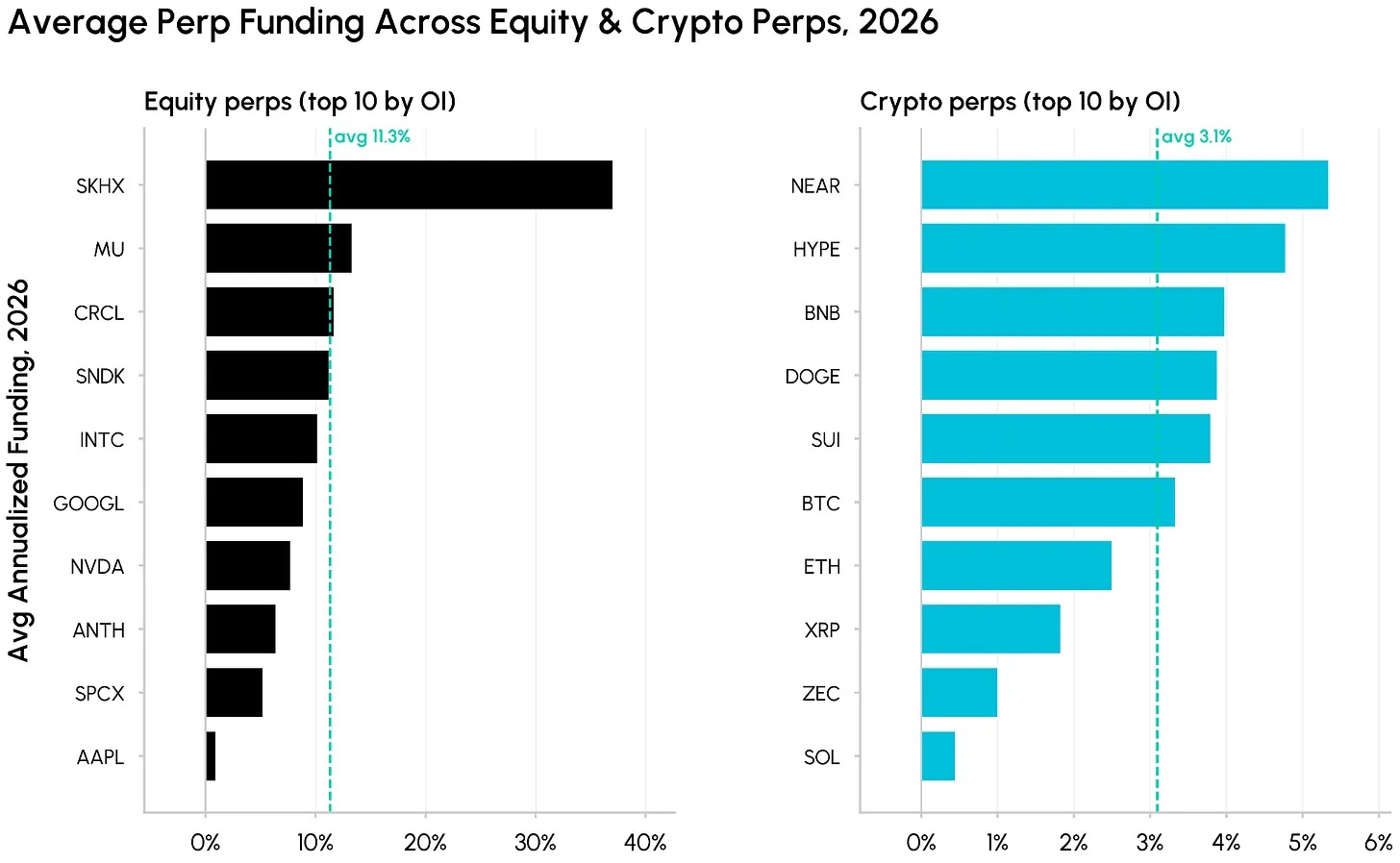
The average annualized funding rate for stock RWA perpetual contracts is 11.3%, significantly higher than that of cryptocurrency perpetuals at 3.1%, indicating a higher cost of going long on RWA stocks. Data source: Talos CM Market Data Pro
In the first half of 2026, stock perpetuals had the highest premiums and strongest volatility, with some stocks' funding rates breaking through 20%, while cryptocurrency perpetual rates remained around 0 for a long time. As August arrived, the funding rates for stock perpetuals receded while those for crypto perpetuals rose, gradually converging their yields. The funding rate trends for stock perpetuals and cryptocurrencies show low correlation, providing diversified returns for Delta neutral strategies and trading volumes across exchanges.
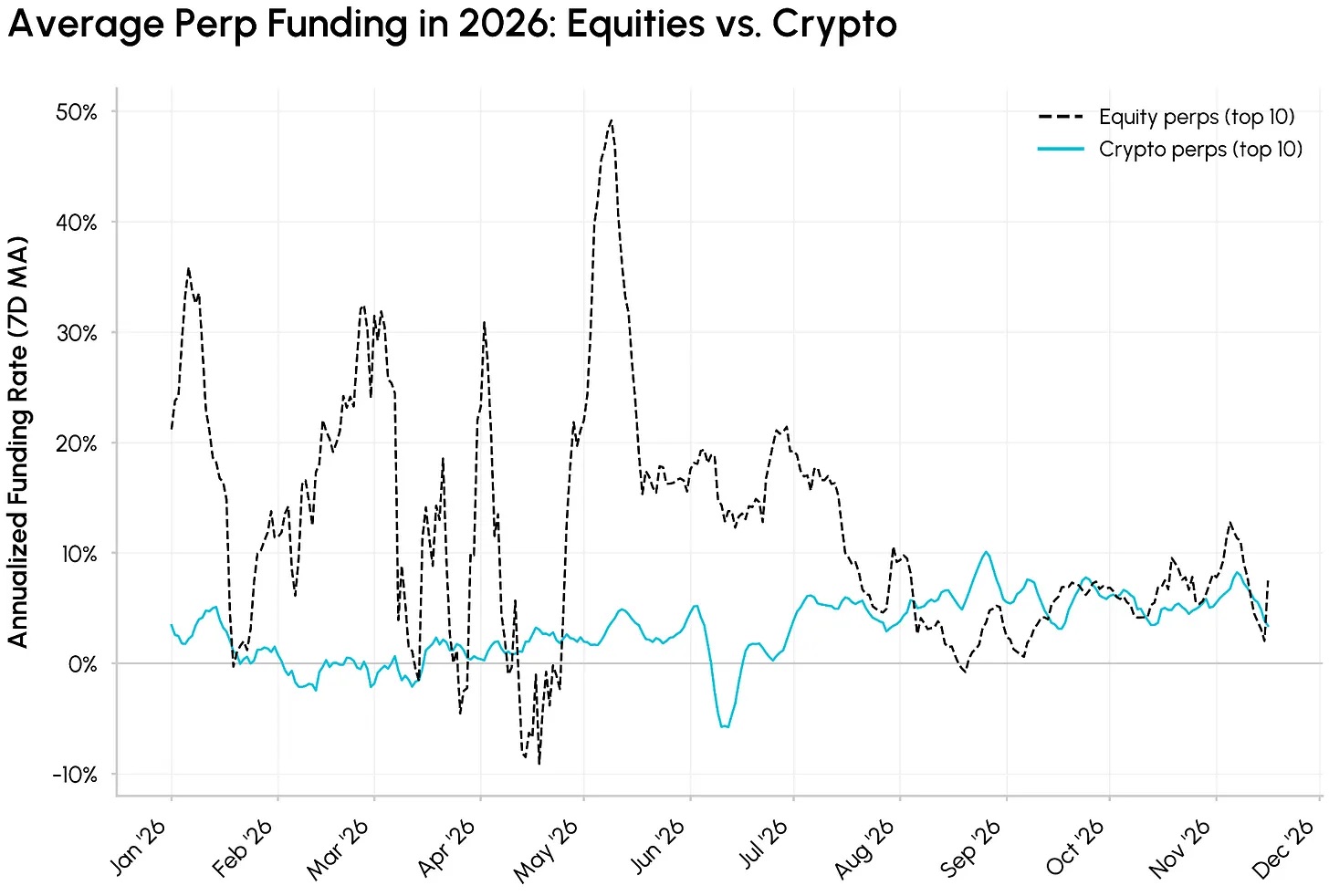
In 2026, the volatility of stock RWA perpetual funding rates far exceeds that of crypto perpetuals, remaining significantly higher most of the time and occasionally slipping into negative territory. Data source: Talos CM Market Data Pro
For the same stock perpetual contract, the inter-platform funding rate spread is almost twice that of cryptocurrency perpetual contracts. The average cross-platform spread for the top ten stock perpetuals is 23%; the average spread for crypto perpetuals is only 12%. The differential in yields for the same asset across different exchanges creates significant cross-platform arbitrage opportunities.
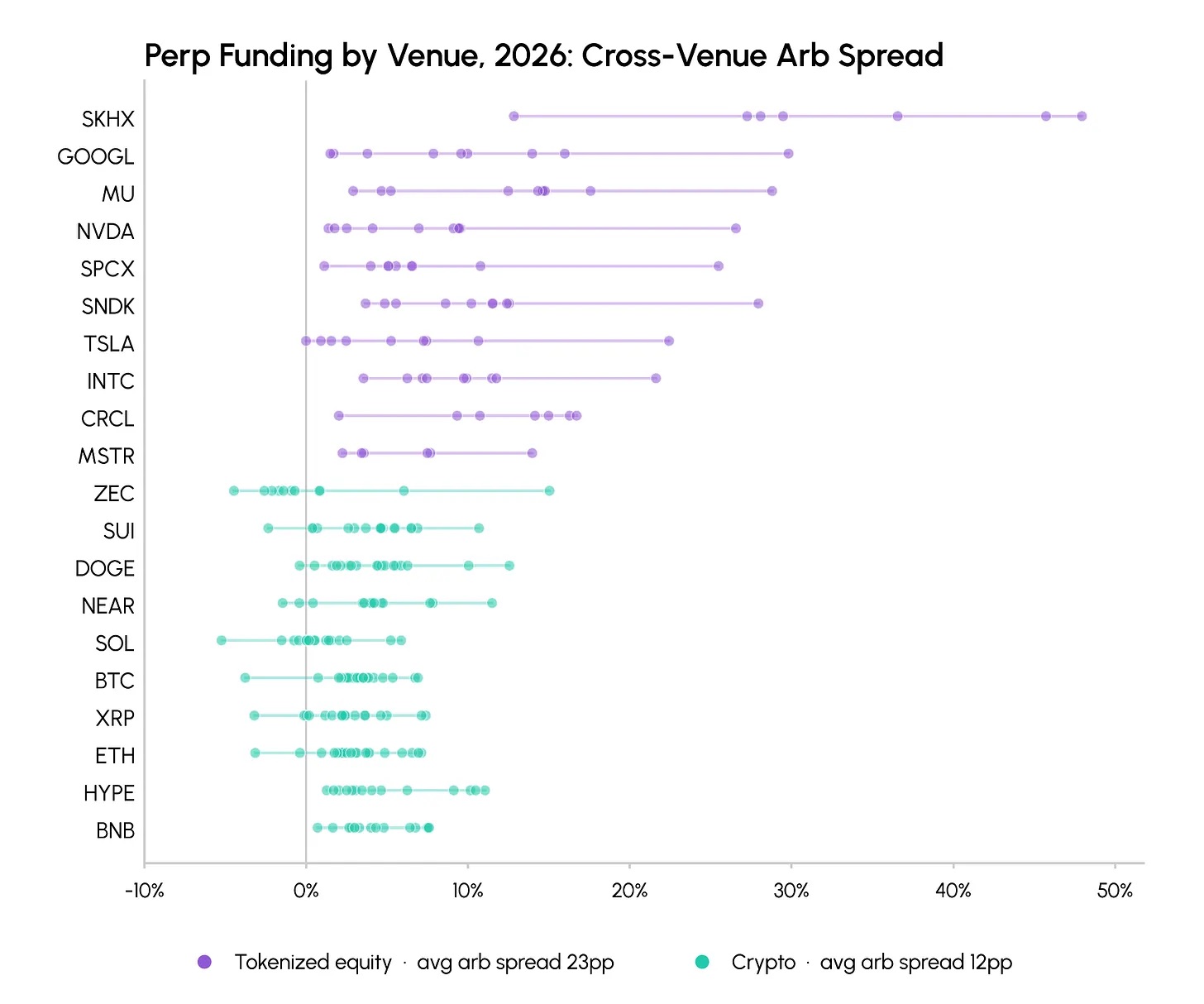
The arbitrage spread of cross-platform funding rates for tokenized stock RWA perpetuals (average 23bp) is significantly greater than that for cryptocurrency perpetuals (average 12bp), indicating larger arbitrage potential. Data source: Talos CM Market Data Pro
Basis Trading of Binance Tokenized Stocks
Now multiple exchanges have simultaneously launched tokenized stock spots and corresponding stock perpetual contracts. As we detailed in our previous report "Competition and Development Path of Tokenized Stocks," basis trading can be completed in a closed loop on a single platform.
Binance's tokenized stock bStocks is a typical example, with total spot trading volume exceeding $13 billion in the past three months. The platform simultaneously offers bStocks spot and stock perpetual contracts, allowing the basis trading positions on both ends to be executed within the same account: investors buy tokenized stock spots and short corresponding stock perpetual contracts to earn arbitrage profits.
In our article "The Unceasing Stock Market," we calculated that in 96% of the statistical samples, the slippage of Binance's NVDAb is superior to other versions of tokenized Nvidia stock; the downside is that after U.S. stock market closes, the liquidity of tokenized stocks tends to decrease significantly.
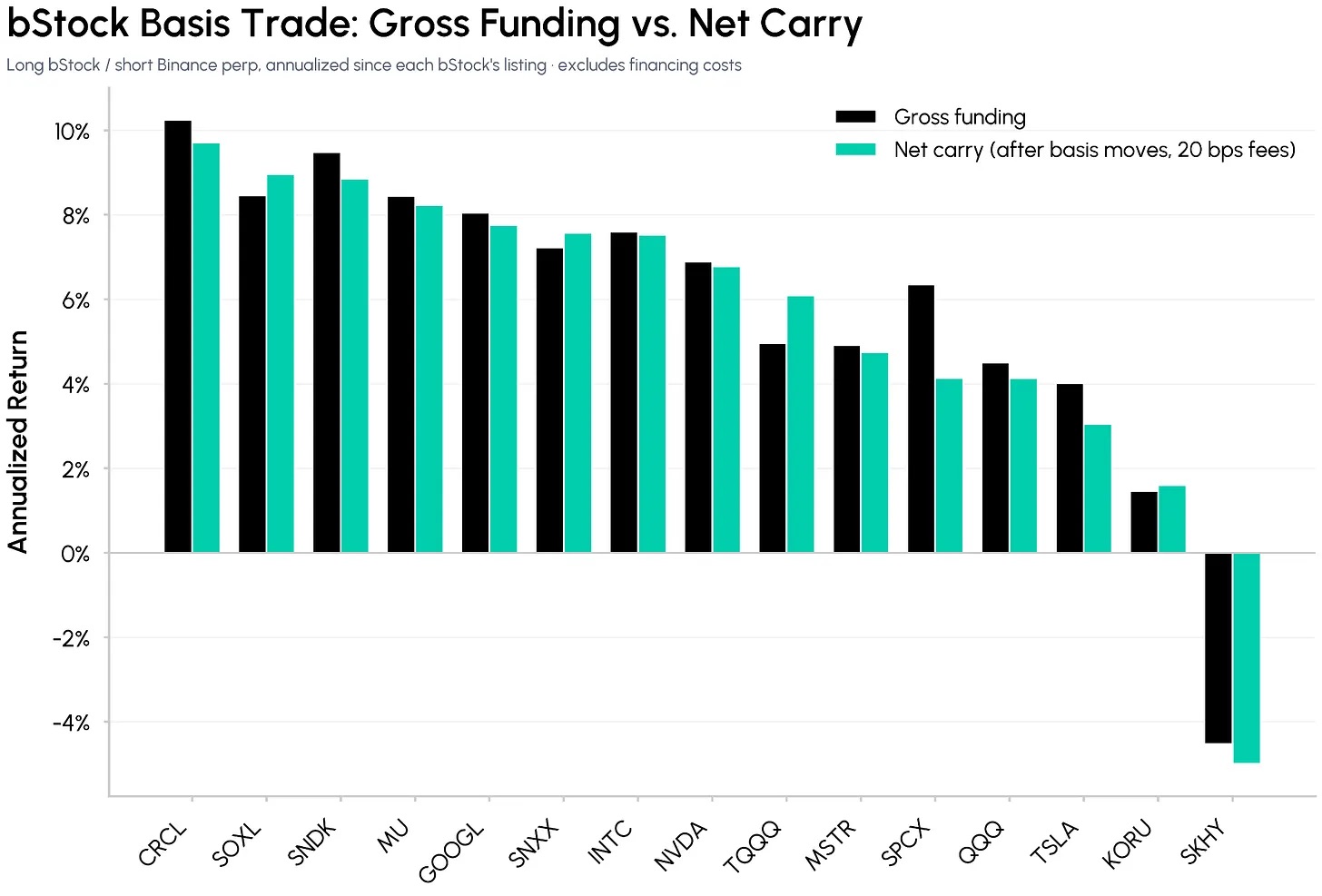
The bStock basis strategy (long bStock spot, short Binance perpetual) still yields positive net arbitrage profits for most assets after deducting basis volatility and 20bp fees, while SKHY showed a loss. Data source: Talos CM Market Data Pro
Note: Gross funding return refers to the annualized funding received from shorting perpetual contracts; net arbitrage return has already deducted the price volatility between token stocks and perpetual contracts, assuming a bilateral transaction cost of 20 basis points and does not account for capital financing costs.
Observing the top bStocks on Binance shows that the trends of net arbitrage profits and gross funding are highly synchronized. For assets like CRCL, SNDK, MU, NVDA, this strategy can achieve annualized net returns of 7%-10%; however, SK Hynix has shown losses due to a negative funding rate.
Implications for Delta Neutral Strategies
In conclusion: Basis trading has not disappeared but has expanded to new asset tracks. The average annualized funding rate for top stock perpetuals in 2026 is approximately 11%, while for crypto perpetuals it is about 3%; the cross-platform price spread for stock assets is roughly twice that of cryptocurrency assets. By using bStocks with stock perpetuals on Binance, most individual stocks can achieve an annualized net arbitrage return of 7%-10%.
This premium arises from market frictions, dispersed liquidity, and strong demand in the market for 24/7 leveraged stock exposure.
As more capital enters the market, the funding rates for stock perpetuals have been converging towards the earnings level of crypto assets since August. The remaining profits ultimately achieved by the strategies are highly dependent on platform and asset selection and require solid risk management: price fluctuations during U.S. stock market closures, rapid reversals in funding rates, and various financing costs will erode nominal profits.
As U.S. compliant exchanges successively launch individual stock perpetuals, liquidity in stock perpetuals will further be diverted to multiple platforms. To capture such opportunities, it is necessary to unify the collection of funding rates, basis, open interest, and liquidity data across exchanges.
免责声明:本文章仅代表作者个人观点,不代表本平台的立场和观点。本文章仅供信息分享,不构成对任何人的任何投资建议。用户与作者之间的任何争议,与本平台无关。如网页中刊载的文章或图片涉及侵权,请提供相关的权利证明和身份证明发送邮件到[email protected],本平台相关工作人员将会进行核查。


