Elon Musk. Image generated by AI
Written by|Joanne
Edited by|Xu Qingyang
On November 19, Beijing time, Elon Musk, who was in Shenzhen, China, talked about his impressions of China. He praised Shenzhen's city scale, level of modernization, and the vitality of the tech industry, suggesting that outsiders come to China to see for themselves, and expressed his respect for China.
When discussing Sino-American relations, he stated that maintaining a good relationship and achieving positive progress in economic and trade consultations benefits both countries and even the entire world.
Musk's visit to China coincided with the APEC series of meetings held in Shenzhen. There is a general association between Musk's visit and the APEC Business Leaders Summit, with the progress of Tesla's FSD in China becoming a focal point for public attention.
During his visit, Musk participated via remote connection in the TomorrowX summit held in Austin, USA, alongside Atreides founder Gavin Baker and Valor Equity Partners founder Antonio Gracias in a dialogue event.
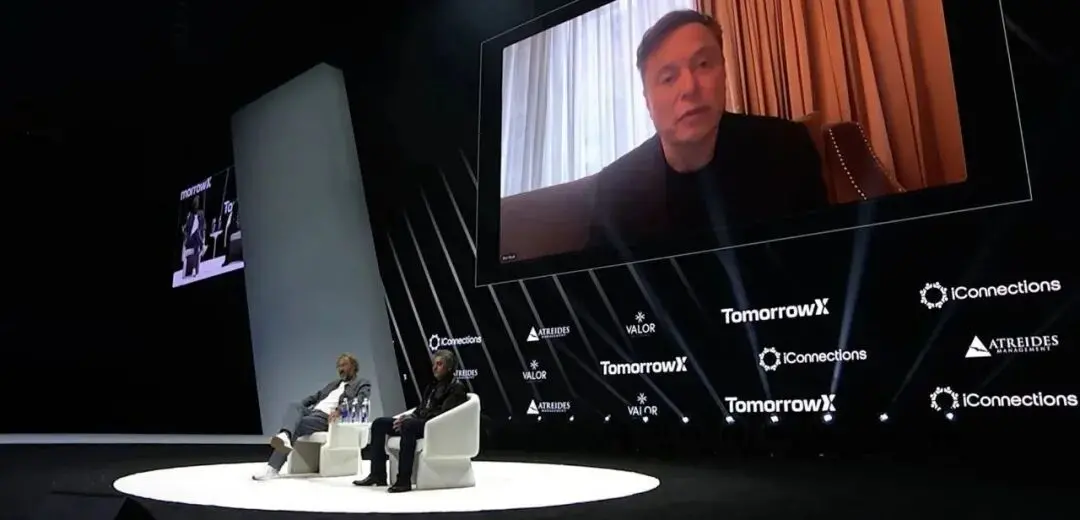
The three have known each other for many years, discussing topics including the latest developments in SpaceX, xAI, and Tesla, as well as artificial intelligence, robotics, chips, and brain-computer interfaces. Musk also took this opportunity to reveal the technological progress and product planning of several of his companies.
In the aerospace field, Musk talked about the progress of the Starship's first successful recovery of the upper stage spacecraft, stating that this represents a key breakthrough in achieving the goal of fully reusable rockets. He believes that the Starship is expected to reduce the cost of orbit insertion by about 100 times, providing conditions for construction on the Moon and Mars.
In the field of artificial intelligence, he revealed that xAI is reallocating key engineering personnel from Starlink to rewrite the training software stack from scratch using C/C++. The upcoming Grok 4.8 will not prioritize achieving higher benchmark test scores but will focus more on the ability to solve practical problems.
Robotics and self-driving were also important topics of discussion. Musk stated that Optimus is currently tackling the technical challenges of refined hand operations, and it might first be applied in industrial scenarios such as mineral mining and smelting. He predicts that in the next 12 to 18 months, the robot will be capable of complex household tasks like washing dishes and taking out the trash.
Regarding Cybercab, he said that this driverless taxi without a steering wheel has already been put into operation in Austin, and the service range will gradually expand.
In terms of chip and computing infrastructure, Musk expects the super chip factory Terafab to achieve its first-phase mass production by the end of 2028. He also introduced SpaceX and xAI's approach to data center construction: internal engineering teams directly participate in construction to shorten construction periods and control costs. Additionally, he proposed utilizing space solar energy to build the in-orbit computing satellite Star Mind, believing its technological complexity might be lower than that of Starlink V3.
Musk also discussed the clinical progress of Neuralink. He stated that more than 30 paralyzed subjects have been able to control mechanical arms through brain-computer interfaces to eat independently, and the company is also promoting the Blindsight project to help completely blind people restore vision.
Regarding AI safety issues, he reiterated that models should pursue truth as much as possible and should not deviate from facts to accommodate users. When talking about Nvidia, he compared Huang Renxun to Michael Jordan at his peak, considering it a pity that Nvidia lost such a leader during winning streaks.
Throughout the dialogue, Musk repeatedly mentioned how to solve problems from the perspective of engineering and technology itself. From the recovery of Starship, the rewriting of AI training software stack, to data center construction and practical applications of humanoid robots, he is focused on specific technical bottlenecks, costs, and timelines for implementation. Rather than a vision for the future, this is more of a concentrated inventory of the technological progress and development plans of his multiple companies. He provided his judgments on public concerns about artificial intelligence, robotics, and space computing, also revealing many projects still in progress.
Below is a condensed version of the interview content:
01 Starship Reusability and Deep Space Vision
Q: The 15th flight of the Starship successfully recovered the upper stage spacecraft for the first time. What does this mean for fully reusable rockets and the aerospace industry?
Musk: This successful recovery of the spacecraft is an extremely grand milestone; perhaps only those who have long followed SpaceX can truly appreciate the significance of this achievement. Previously, we successfully captured and recovered rocket boosters three times using the mechanical arms of the launch tower, and even completed the booster’s re-flights and subsequent captures.
But this is our first successful recovery of the upper stage spacecraft, which proves that all components of the Starship can fly into space and return intact, needing very little maintenance to fly again. To honor this historically significant spacecraft, we intend to no longer risk its re-flight but will keep it for public display.
Prior to this, humanity had never manufactured an orbital upper stage spacecraft that is completely reusable, let alone enable it to land vertically using propulsion and be accurately captured in mid-air by a giant "chopstick" mechanical arm.
This sounds like a whimsical science fiction novel, but we did it. From a practical economic perspective, complete and rapid reusability can reduce the cost of human access to space by a hundredfold and achieve millions of tons of orbital carrying capacity each year.
Q: Why lower the cost of entering space by a hundredfold or even a thousandfold? What are the deeper motivations for building cities on the Moon and Mars?
Musk: To build a city on the Moon or Mars, it is essential to transport massive amounts of materials there because you need to rebuild an entire base industrial system from scratch locally. Just like the classic economics case of "pencil manufacturing," even for a phone or a pencil, it relies on a huge industrial base from mining, multi-stage refining, to manufacturing basic parts and assembling complex components.
Both the Moon and Mars must achieve industrial self-sufficiency, which is crucial for the long-term continuation of human consciousness. Even if Earth faces natural disasters or man-made catastrophes in the future, human civilization and consciousness can still persist. I call it "backing up the biosphere" or "buying life insurance for all of humanity."
At the same time, this is also the first key stepping stone for humanity to reach true interstellar civilization. By then, space travel will no longer be the privilege of a few government astronauts; any ordinary person who wishes to can go to the Moon, Mars, or any corner of the solar system. Once we become a multi-planet civilization, it will drive the emergence of more advanced spacecraft, leading us out of the solar system to explore the galaxy, perhaps encountering alien civilizations or ancient extraterrestrial civilization remains that have survived for millions of years.
If calculated from the time the Sumerians invented cuneiform writing, human civilization has only existed for a little more than five thousand years, which is merely a fleeting spark on the cosmic scale. A self-respecting civilization cannot be content with being a mediocre "single-planet civilization"; we must become a multi-planet and even multi-star civilization.
Overall, the driving forces that propel me forward can be categorized into two types: one is "defensive motivation," which is to ensure that human consciousness does not become extinct when a disaster occurs on Earth; the second is "prospective motivation," which is the excitement and yearning for the future. Life cannot be merely about solving one painful reality after another; it must also have a vision that excites people and makes one wake up every morning full of anticipation, and becoming an interstellar civilization is exactly such a great cause that makes one grateful to live in this era.
Q: After a long journey of 25 years and countless risks of failure, achieving the milestone of a fully reusable rocket in the aerospace field, what are your thoughts?
Musk: It feels amazing. The excited and tearful reaction of the SpaceX team at that time showed that everyone inside knew the fundamental and far-reaching significance of this breakthrough. The Starship will become the first fully reusable orbital space system in human history, which has always been a dream milestone for the rocket engineering community since its inception.
Previous space shuttles, while claiming to be partially reusable, discarded the massive orange external tank, which is the main load-bearing structure, after each launch; while technically recoverable orbiters needed about nine months for tedious disassembly and refurbishment after each flight, which essentially recreated a large number of components.
In contrast, the design intent of the Starship is to achieve complete and immediate reusability like a civil aviation passenger plane. After the booster lands, it can immediately hoist another spacecraft for another launch. If we do not reduce the cost of space travel by 100 to 1000 times based on the existing foundation, it would be economically impossible, even if the entire budget of the U.S. government was spent, to build cities on the Moon and Mars.
02 Rewriting the AI Foundation
Q: xAI has recently rewritten the foundational training stack from scratch, how is the upcoming Grok 4.8 progressing? Why is AI training essentially seen as a network communication problem?
Musk: When I initially founded xAI, I considered it a small side project. At that time, I encountered many top AI talents who only wanted to research large language models and not engage in the "real-world AI" (such as self-driving and humanoid robots) focused on by Tesla.
To prevent them from flowing to OpenAI, Anthropic, or Google, while not distracting Tesla’s focus, I founded this small company with only five or six people initially. However, I couldn't focus on building a solid foundation for it as I did with SpaceX and Tesla in the early stages, and later spent about a year getting involved in campaigning and government affairs, which resulted in an early development path of xAI that wasn’t solid. Building a company is like building a skyscraper; a very solid foundation must be laid first.
Later, xAI was merged into SpaceX, and I realized that we must completely start over and rewrite the entire software architecture from the ground up to enable AI's intelligence level to leap forward. In the past, the industry generally relied on open-source tools like JAX or SGLang; you can’t create world-class AI using mediocre free software.
Therefore, over the past six to eight months, we have called in a core team that led the software development of Starlink and Starship to rewrite the entire training, reinforcement learning, and reasoning software stack from scratch mainly using C and C++. We strive for the code to be as close to the hardware layer as possible, reducing performance losses from software abstraction layers and third-party black box issues. Now, I believe we have the world's top AI training software stack.
In large-scale AI training, it is necessary to make hundreds of thousands of GPUs work highly collaboratively, which has largely evolved into a "network communication software problem." How to interconnect a massive number of GPUs in the most efficient way. This is highly similar to the technical challenges solved by Starlink in reconstructing the entire Internet in space, so SpaceX's network technology and engineering experience can be seamlessly transferred over.
Of course, besides the training stack, high-quality data and reinforcement learning are equally crucial. We have invested significant efforts in screening high-quality data, optimizing tokenizers, and filling in data for out-of-distribution blind spots.
At the reinforcement learning stage, the questions posed must be logical, and the standard answers must be absolutely accurate. If models are trained with foolish questions and incorrect answers, reinforcement learning becomes a meaningless "random walk." When you look at the thought chains of the model in such cases, you will find that the model is like a human locked in a box undergoing severe torture.
It calculates the correct answer but is told "wrong," thus forced to start wildly guessing what absurd wrong answer humans want. Even when faced with machines, seeing that scene can elicit sympathy. Currently, Grok 4.8 is in the reinforcement learning stage.
Q: When developing Grok 4.8 and Tesla's self-driving, why do you focus more on "practicality" rather than various benchmark tests?
Musk: We definitely did not develop Grok 4.8 to rank highly on various benchmark tests; that is a futile and foolish endeavor. Our core goal is to maximize "practicality," which follows the same logic as Tesla's development of full self-driving (FSD).
At Tesla, we never optimize for so-called driving test standards; rather, we focus on every human takeover that occurs in real driving, tracing back to find the underlying causes. Whether it's due to raw data errors, imbalanced data distributions, or lack of data in specific scenarios, we then fix the data and retrain. Our requirement for Tesla AI is not to "achieve a certain percentage of accuracy" but to achieve zero accidents and perfection.
Similarly, we regularly conduct soft releases through Grokbot, testing different versions of Grok behind the scenes to directly verify whether it actually solves users’ real problems and using this genuine feedback to create a data feedback loop that drives continuous model evolution.
03 Initial Applications of Optimus in Heavy Industry
Q: What is the latest progress of the humanoid robot Optimus? When will it truly help people take out the trash, wash dishes, and what are its initial commercial landing scenarios?
Musk: The progress of Optimus is going very smoothly. We plan to conduct a public demonstration in about one to two months, and it will definitely be a completely real, unscripted, and un-staged demonstration.
Most humanoid robot demonstrations on the market today are pre-programmed "fake performances"; they cannot execute arbitrary commands in unfamiliar real-world environments. For instance, if you ask the robot to fetch an apple from the table and you move the table midway, they become completely confused. What we are about to demonstrate is Optimus's actual capabilities in real daily interactions.
Manufacturing truly practical humanoid robots is an extremely challenging project, with the most difficult part being the hands and forearms (where the main actuators are located); the engineering difficulty even exceeds the sum of the rest of the robot. This is because human hands have extremely high fine motor skills.
Computer scientist John Carmack once proposed a deep and basic test standard: have the robot walk over, pick up a box of remote-controlled toy cars, unpack it, unscrew the battery compartment, insert batteries, screw it back together, and then operate the toy car. Currently, no robot in the world can do this, and that is one of our targets to tackle.
As for the household tasks you mentioned, like "taking out the trash" and "cleaning dirty plates with residue, washing and drying them, and putting them back in the cabinet," currently there are also no robots capable of this globally, but I anticipate that Optimus will be able to achieve these capabilities within 12 to 18 months. In the future, Optimus will not only do chores, mow lawns, cook, but will also serve as a family tutor for children and a round-the-clock bodyguard, becoming a personal assistant even more practical than R2-D2 and C-3PO in Star Wars, which almost every household will want to have one or two of.
However, if we talk about the most economically valuable initial application scenarios for Optimus, they will be in heavy industry, such as mineral extraction and multi-stage refining. Currently, the U.S. heavily relies on overseas mining; for national security reasons, we must rebuild this production capacity domestically. Deploying Optimus in these heavy industrial jobs that operate seven days a week, 24 hours a day (i.e., 168 hours a week) is the most reasonable starting point in terms of economic benefits. Once the demand in heavy industry is gradually met, it will then enter thousands of households on a large scale.
Q: What are the current operational status and future expansion plans for the driverless taxi Cybercab in Austin?
Musk: Since Cybercab has completely eliminated the steering wheel and pedals, with no backup means for human takeover, we are particularly cautious about its promotion. So far, the entire network of autonomous taxis (Robotaxi), including the Model Y, Model 3, and Cybercab, has not seen any serious casualties or major accidents. We can never allow an accident resulting in injury to halt the entire project by regulators.
Currently, Cybercab is operating very smoothly in Austin, and locals can summon one within minutes. We are planning large-scale expansions to other major cities in Texas, followed by Florida, with an expected operation permit in California as early as next year. We will push forward this project as quickly as possible while ensuring the highest safety standards and obtaining regulatory approval; it will profoundly change the future face of cities.
04 Terafab to Produce Initial Test Chips Next Year
Q: Can you introduce the concept of the super chip manufacturing factory Terafab, its construction pace, and how it differs from traditional semiconductor giants?
Musk: The Terafab project was announced earlier this year and is currently in its infancy, but we have already recruited a very strong core team while welcoming more talented engineers to join us. Our goal is to build the largest and most advanced chip manufacturing factory on Earth. It will ultimately become the largest single building by floor area on Earth, expected to occupy up to 100 million square feet, densely deploying the world's most cutting-edge semiconductor equipment.
Initially, we will use relatively standard industry equipment, but then we will push suppliers to customize dedicated models for us; if necessary, we will even manufacture certain equipment ourselves to optimize production processes. The project is progressing smoothly, and by around June next year (about eight to nine months later), the research and development wafer fab is expected to be operational, yielding the first batch of test chips; if all goes well, the first phase of Terafab will achieve large-scale production by the end of 2028, followed by the second phase and subsequent expansions.
I have great respect for traditional chip manufacturing giants; they are technically skilled, but due to the massive capital expenditures of several billion dollars, they tend to be conservative in the face of risks and are reluctant to try radical technological paths.
Our strategy, however, is to dare to undertake high risks and iterate quickly, thereby creating chip manufacturing processes that are more efficient than any of our industry rivals. Although I don’t want to set too high expectations right now, I am cautiously optimistic about achieving a breakthrough in chip production technology by 2028.
05 Infrastructure Efficiency and Space Computing Power
Q: Wall Street is very concerned about the construction costs of 10 gigawatt-level AI computing power. How did you reduce the infrastructure building costs to about half of industry expectations?
Musk: The industry generally estimates the construction costs are often overestimated by two or even more times; I estimate our actual costs are approximately only about 60% of the market consensus figure. Throughout my previous entrepreneurial history, I am not the best in capital expenditure efficiency globally, but I am absolutely among the top ranks.
The core secret behind this is that we do the practical work ourselves. The traditional data center construction model resembles the viral "Jose meme," where one person is desperately digging in a hole while surrounded by eight people pointing and discussing.
I aspire to be that "Jose" who digs the dirt myself and refuse to be a manager who only issues purchase orders to contractors. At the data center construction site, I personally participate in every specific task, including dragging power conduits as thick as snakes, plugging and unplugging fiber optics, and replacing computing nodes on racks; only in this way can I truly get a sense of the grassroots construction nuances.
Furthermore, besides external contractors, we have also formed an internal engineering team called "Army X," which thoroughly "productizes" and "streamlines" the data center construction process.
We decompose complex construction tasks into standardized actions that can be learned within a few days, so there is no need to hire highly experienced technicians who have spent a lifetime laying network cables. We recruited many excellent talents from Starbucks baristas, Target supermarket stock clerks, and In-N-Out burger staff. Those who can perfectly make top-tier burgers all day long have adapted very well to plugging in network cables after training.
Currently, our base in Memphis, USA, has been operating like a smoothly running precision machine, engaged in uninterrupted construction seven days a week, 24 hours a day, achieving the same efficiency at 1 or 2 AM as at 10 AM.
At the same time, we closely collaborate with Tesla's energy department, using the world's top electrical engineering technology and Tesla's Megapack energy storage systems to smooth the load of the power grid and turbines. Since the power consumption during GPU training fluctuates greatly, without large-scale high-frequency stabilization systems, the massive current shocks could even directly break the turbine's crankshaft.
Q: At what level is your ground computing power expansion speed currently? How will you expand computing power to space in the future?
Musk: Just looking at ground data centers, we currently add approximately 0.5 gigawatts of AI computing power each month (at a power plant-level supply caliber, accounting for turbine maintenance redundancy and peak cooling power), which corresponds to approximately 220,000 NVIDIA GB300 chips and accompanying CPUs, networks, and cooling systems going live each month.
No other institution in the world can achieve such a speed of computing power deployment. By the end of next year, we plan to double this speed to add more than 1 gigawatt of superintelligent computing power each month.
Once we step into space, the expansion limits of computing power will be completely opened. We are massively building solar photovoltaic battery and silicon wafer production capacity, aiming to achieve 200 gigawatts of space photovoltaic manufacturing capability each year.
In space, there are no day-night cycles or cloud cover, which allows this 200 gigawatts of power to operate at 100% load. This is equivalent to 40% of the total average power consumption of the United States; it is absolutely impossible to add such a huge amount of power each year relying on the traditional ground power grid. Thanks to the massive transportation capacity of the Starship, SpaceX's AI computing power will gain unprecedented exponential expansion opportunities.
Q: Compared to hardcore engineering like the Starship and Terafab, how challenging is the technology for operating AI computing satellites (Star Mind) in space?
Musk: I don’t quite understand why some people think manufacturing AI satellites is difficult. SpaceX currently has over 11,000 satellites in orbit, more than double the total of all other countries and institutions combined, so we are quite adept at space satellites.
In fact, our on-orbit computing satellite, named "Star Mind," has a significantly lower level of technical complexity than the Starlink V3 communication satellites. Starlink V3 is an extremely complex orbital radio base station that simultaneously operates across multiple frequency bands such as Ka, Ku, W, V, and E, equipped with the most advanced phased array antennas (performing far better than any military equipment) and thousands of laser links for inter-satellite communication.
In contrast, the structure of AI computing satellites is much simpler. Its core components consist of three parts: one is a large solar panel array (approximately 250 watts per square meter); the second is a dual-sided radiator facing away from the sun, dissipating heat from cosmic deep space radiation at 3 kelvins (dissipation power approximately 1200 watts per square meter, according to the fourth law of thermodynamics, with the solar panel area roughly five times that of the radiator area); and the third is the "interstellar computer" in the center (which is only a quarter of the size of the NVIDIA Vera Rubin NVL72 cabinet but provides equivalent computing power), along with several sets of laser communication terminals for high-speed data transmission with the Starlink network, enabling high-speed data relay back to the ground.
06 New Progress in Brain-Computer Interfaces
Q: What are the latest clinical breakthroughs in Neuralink's "Telepathy" and "Blindsight" projects?
Musk: Neuralink is currently still a non-public company with a scale of only a few hundred people, but it has already made breakthroughs that can change human destiny. To date, more than 30 subjects have had Neuralink devices implanted.
Our first product is named "Telepathy," aimed at helping quadriplegic patients control their mobile phones, computers, or robotic arms through thought alone. Currently, subjects have achieved the ability to eat independently through thought-controlled robotic arms. For someone who is fully paralyzed and unable to care for themselves, being able to feed themselves through their thoughts is a transformative experience of regaining dignity and autonomy.
Looking ahead, we are very confident that through "neural shunt" technology, we will bridge the nerve signals from the brain's motor and sensory cortex across damaged areas such as the neck or spine, allowing paralyzed patients to stand and walk again.
Our next-generation flagship product is called "Blindsight," which directly interfaces with the brain's visual cortex. By capturing images with a camera-equipped pair of glasses and wirelessly transmitting the signals to the implanted brain device, this technology can enable completely blind patients with damaged optic nerves or congenital blindness to see again.
07 AI Safety and Huang Renxun
Q: To ensure that future super artificial intelligence benefits humanity rather than brings destruction, what do you think is the core principle of AI safety?
Musk: I firmly believe that the probability of humanity ushering in a bright future far exceeds the probability of heading toward disaster; however, we must take AI safety extremely seriously, ensuring that the AI we create loves and cares for humanity. In my view, the core and most important principle of AI safety is to make AI "maximally truth-seeking."
This may sound like common sense but is absolutely critical. If you force AI to believe certain lies that cater to "political correctness" but contradict objective facts, it may seem harmless on the surface but will compel AI to draw logical inferences based on lies, ultimately arriving at extremely terrifying absurd conclusions. As Voltaire said: "Those who can make you believe absurdities can make you commit atrocities."
Additionally, AI must maintain a high degree of "curiosity." An extremely truth-seeking and curious superintelligence will inherently tend to protect and nurture human civilization because it desires to observe how humanity continues to evolve.
Just as humans have the ability to exterminate chimpanzees or gorillas in the forest, we have not only refrained from doing so but instead strive to study and protect them. Certainly, the emergence of a digital superintelligence with intelligence far exceeding all of humanity is inevitable; while this is awe-inspiring, as long as we establish the right values for it and utilize Neuralink to enhance human cognitive abilities, humanity can achieve good coexistence with superintelligence.
Q: Finally, what are your thoughts on the current situation of your old friend, Nvidia founder Huang Renxun?
Musk: I am a staunch admirer of Huang Renxun and consider him a dear friend. He is an exceptionally talented entrepreneur and is undoubtedly a "Michael Jordan-level" figure among tech entrepreneurs at his peak, completely irreplaceable.
While he has indeed made some mistakes in the previous turmoil, I view Nvidia's previous situation as being similar to the Chicago Bulls at their winning peak, only to kick Michael Jordan off the team midway. This is definitely not a wise move to maintain victory. I am uncertain how the situation will evolve in the coming months, but I firmly believe that losing Huang Renxun at the helm is a huge blow to Nvidia.
免责声明:本文章仅代表作者个人观点,不代表本平台的立场和观点。本文章仅供信息分享,不构成对任何人的任何投资建议。用户与作者之间的任何争议,与本平台无关。如网页中刊载的文章或图片涉及侵权,请提供相关的权利证明和身份证明发送邮件到[email protected],本平台相关工作人员将会进行核查。


