Analyze the source of Morpho's third quarter loan growth and treasury structure.
Written by: Alea Research
Translated by: AididiaoJP, Foresight News
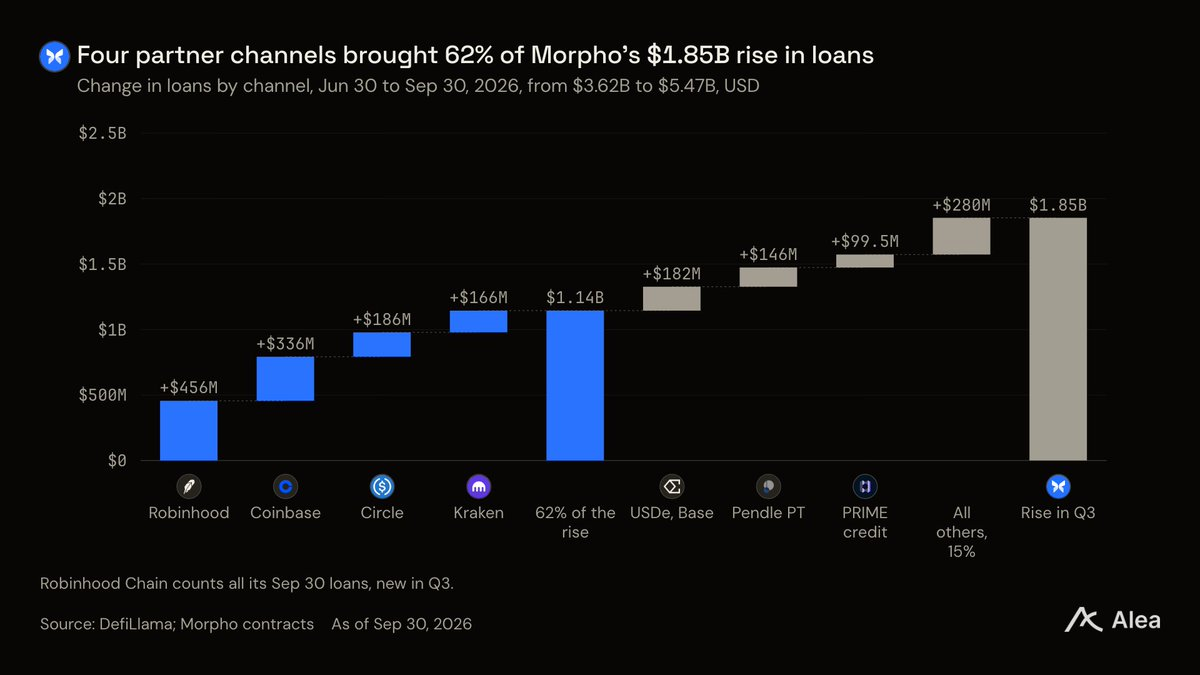
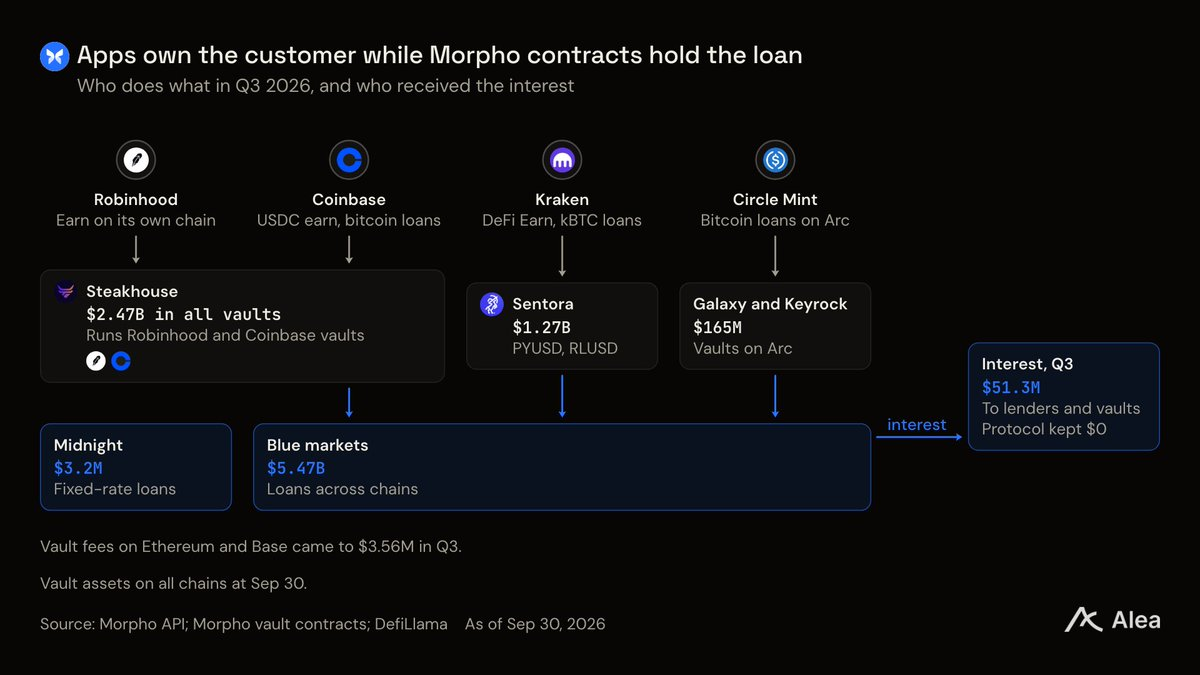
Morpho positions itself as the loan engine behind other brand applications. The official statement is “Robinhood in front, Morpho behind.” The data from the third quarter confirmed this distribution model: chains and collateral related to Robinhood, Coinbase, Circle, and Kraken contributed 62% of the $1.85 billion increase in Morpho loans.
Among the nine major loan protocols, Morpho’s loan share more than doubled in a year, reaching 20.3% by the end of the third quarter. The annualized interest paid by borrowers reached $235 million in September. MORPHO holders have a switch that can add protocol fees to these interests, but they currently choose to keep it off.
How credit is transmitted in Morpho
Morpho was designed as a loan infrastructure from the beginning, rather than a user-facing loan application. The market is responsible for holding loans, the treasury is responsible for aggregating lender funds, Midnight provides fixed terms, and partner applications manage customer relationships. Each layer charges different participants.
A market locks in loan assets, collateral, oracle, and liquidation thresholds when it opens. Most lenders do not choose the market directly, but deposit money into the treasury. Managers write risk policies into contracts to determine which markets the treasury lends to and how much quota each market can receive.
This is closest to the "banking as a service" model in traditional finance: a licensed balance sheet supports the fintech brand in the background. The difference is that here the balance sheet belongs to the depositors. Coinbase and Robinhood are vying for the same customer base, yet both connect to Morpho. This is the most direct evidence of network neutrality. Another explanation is price: zero protocol fees make Morpho the current lowest-cost credit engine to access.
Partnership channels dominated growth this quarter
By the end of the quarter, chains and collateral related to Robinhood, Coinbase, Circle, and Kraken accounted for 47.1% of Morpho loans, up from 39.6% three months ago. Robinhood Chain contributed the most, growing from zero to $456 million in its first quarter.
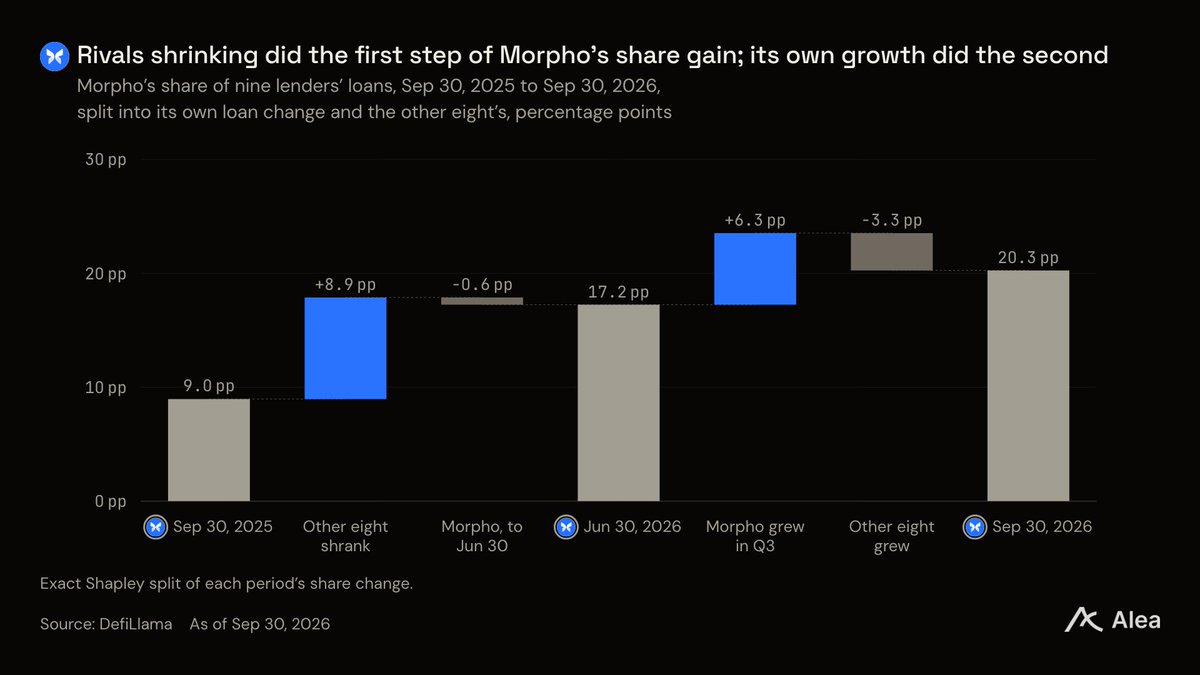
The share increase occurred in two steps. Over the nine months until the end of June, mainly due to competitor loan contractions, Morpho's share rose to 17.2%; entering the third quarter, Morpho’s own loan grew by 51%, outpacing the recovery speed of the other eight protocols.
Managers determine risk preference
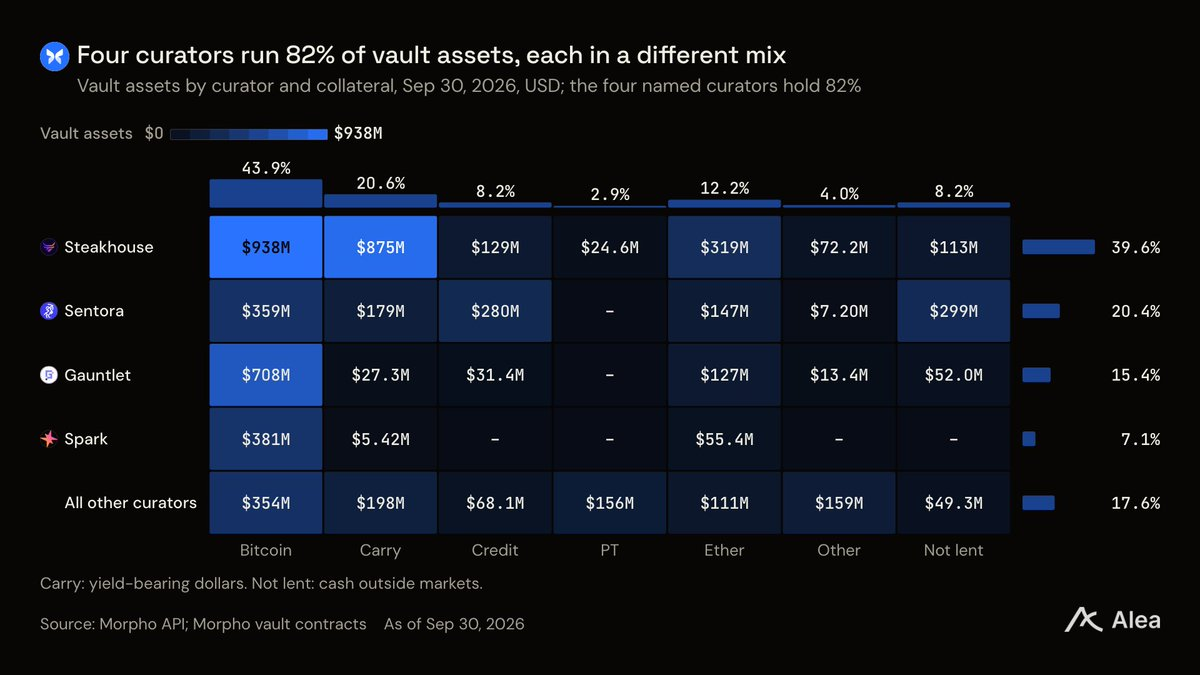
The treasury’s size reached $6.24 billion by the end of the quarter, growing 52% in a single quarter. Four curators manage 82% of the funds, each with different collateral preferences. Gauntlet and Spark primarily focus on Bitcoin-related markets, while Steakhouse had the largest increase, reaching $764 million, managing both Robinhood and Coinbase application treasuries. Sentora is responsible for the dollar treasury of PayPal and Ripple, with assets nearly doubling to $1.27 billion.
Loop trading and USDe oracle
The loop market reached $1.63 billion by the end of the quarter, nearly double from June. A typical operation is: stake USDe to receive a 5% collateral reward, borrow dollars at an interest rate of about 4%, and then buy more USDe. Operating repeatedly at a 89.4% loan-to-value ratio, $1 of own funds can leverage about $9.4 of USDe, yielding an annualized return of about 13%. USDe itself does not pay earnings in these markets; returns rely entirely on rewards, which are distributed weekly.
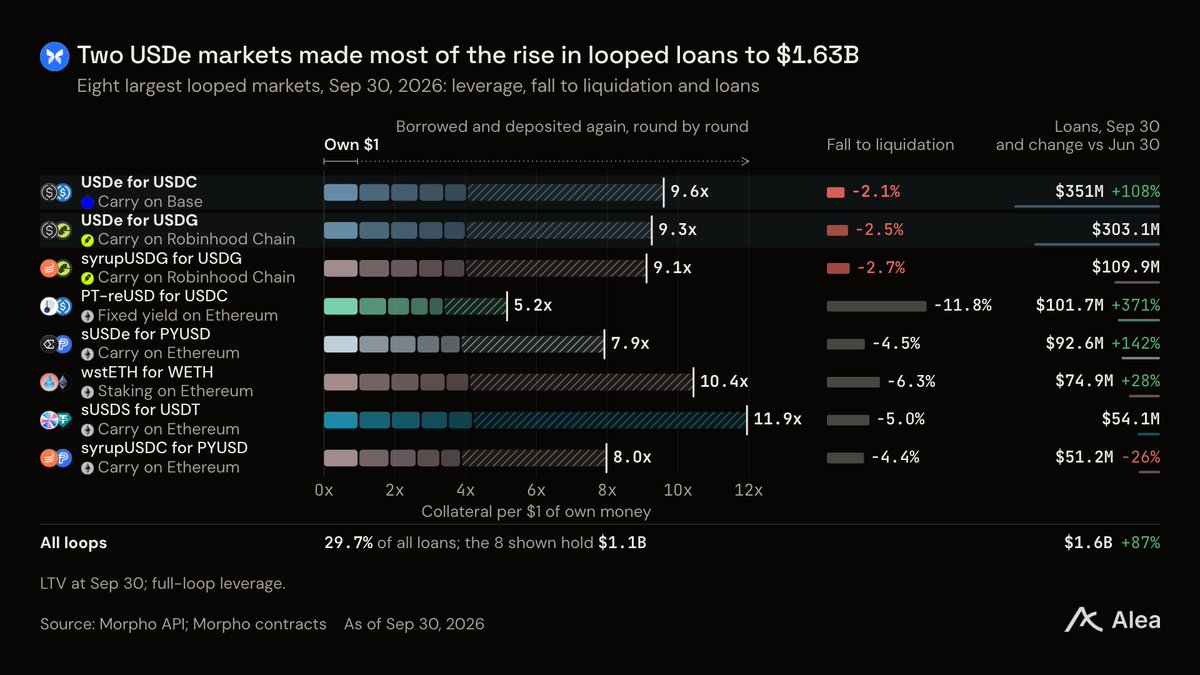
The Steakhouse oracle fixes USDe's price at $1, switching only when the backup feed deviates from parity by more than 0.5% for 16 consecutive hours. Depositors of Robinhood Earn and Coinbase High Yield provide funding for this transaction. Their core risk is that USDe's discount persists beyond this window.
From September 2025 to November 9, the hourly closing price of USDe against USDT never fell below parity by 0.5% for 16 consecutive hours. The longest instance was only two hours, occurring on October 10, 2025, when the closing price fell below parity by 6.35%. Under the current oracle rules, such a brief discount would not trigger a price adjustment.
Rewards are mainly paid by token issuers
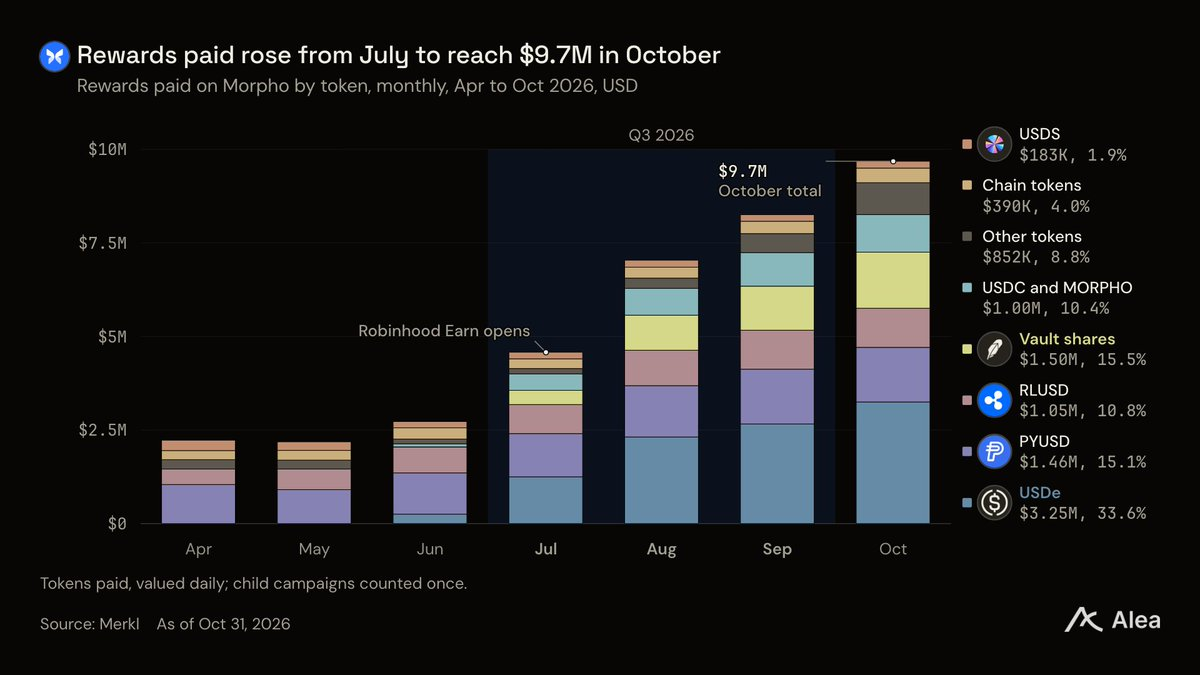
The reward plan for the third quarter issued a total of $19.9 million, most of which was paid by the issuers of the promoted dollars. Ethena paid $7.59 million, PayPal paid $3.99 million. DAO's own activities accounted for only $730,000. The Morpho rewards committee additionally supplemented $2.49 million for the Robinhood treasury.
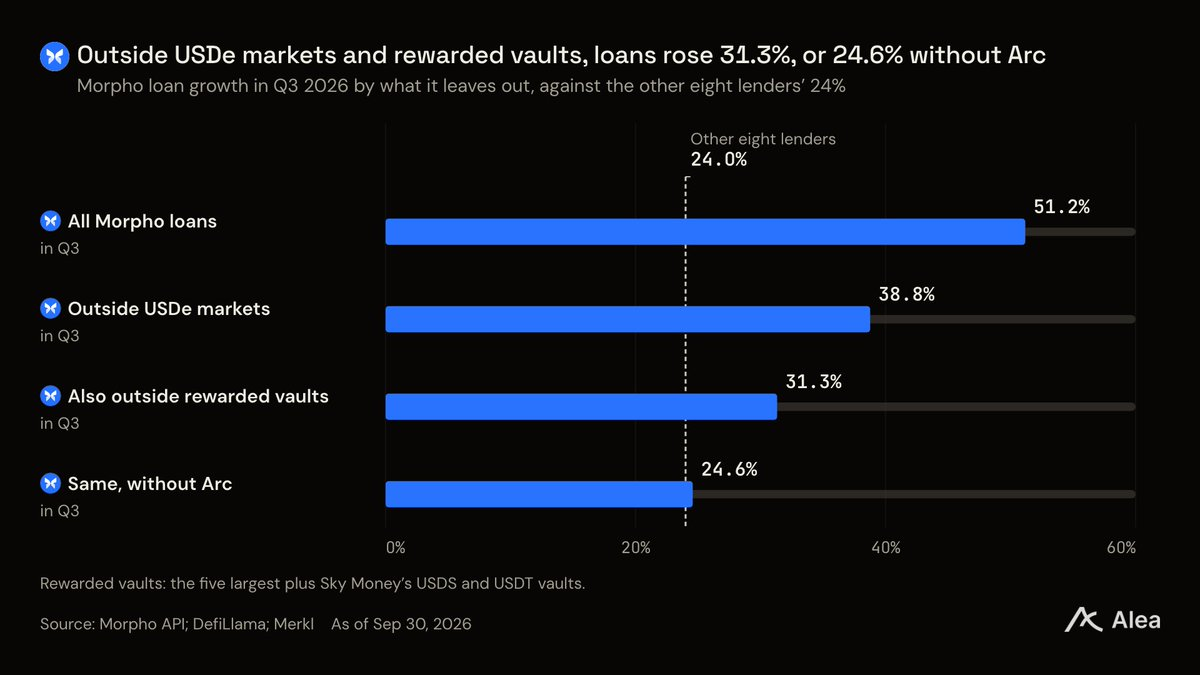
Excluding the USDe market and the seven largest reward treasuries, Morpho loans still grew 31.3% in the third quarter; excluding Circle's Arc chain, it was 24.6%, roughly in line with the 24% increase of the other eight protocols.
Midnight market expansion accelerated in October
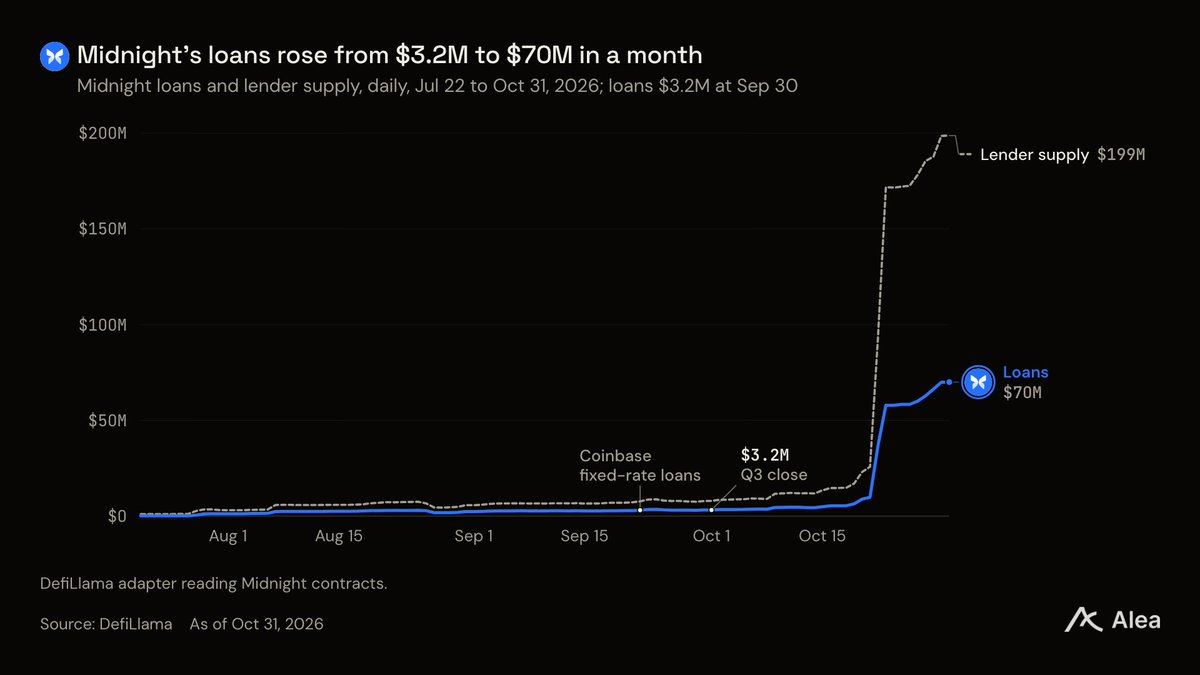
Midnight is Morpho's fixed-rate market, launched on Base in July. In October, loans exceeded 20 times growth, reaching $70 million, with $48 million concentrated on October 22 and 23. A treasury adapter will be launched in the fourth quarter; once the DAO lists it on the registry, existing V2 treasuries will be able to lend to Midnight. These treasuries collectively held $3.77 billion on Ethereum and Base at the end of the quarter.
Fee switch and valuation
Lenders and treasury depositors took 90.3% of the quarter's fees. Currently, all markets have zero protocol fees, but the DAO can vote to raise the proportion to 25% of interest.
Based on Aave's quarter-end valuation multiple of 35 times annualized revenue, the $1.75 billion market value of MORPHO on September 30 implied an annual revenue of about $50 million, equivalent to 24.6% of the interest rhythm for the third quarter, just within the 25% cap.
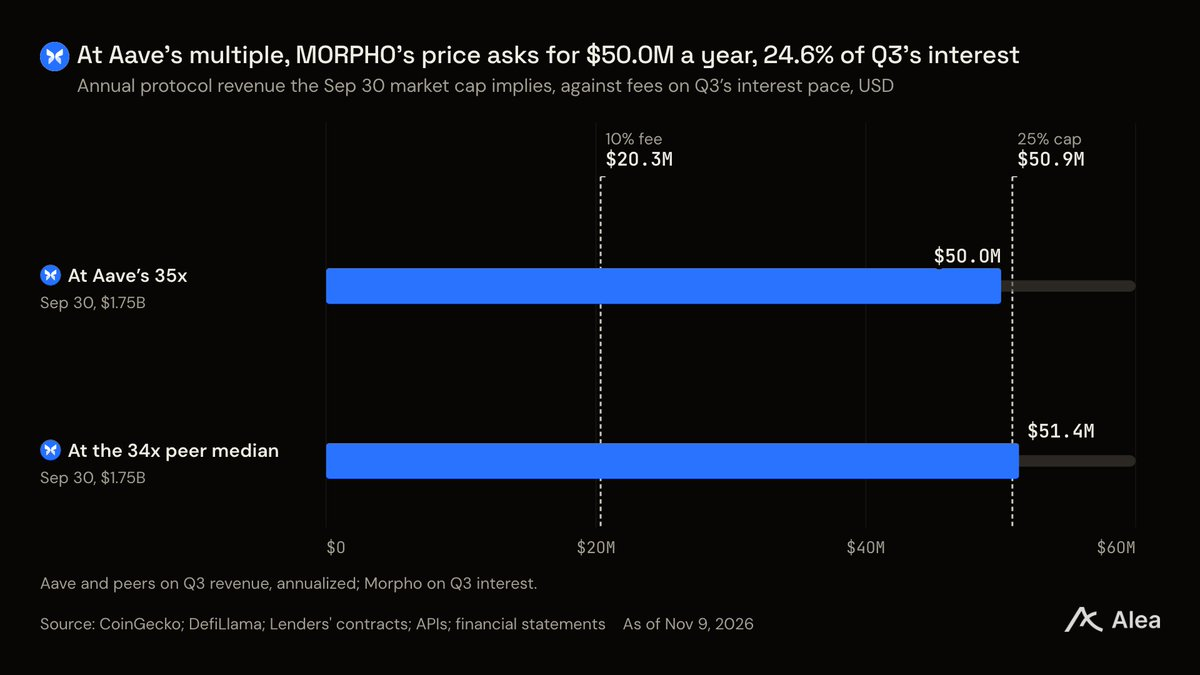
Aave's revenue has already been used for buybacks, while Morpho, even if it opens fees, cannot temporarily flow to holders before voting establishes a distribution path.
After the quarter
From September 30 to November 9, MORPHO fell by 17.8%, roughly in line with AAVE. During the same period, Morpho loans rose to $5.73 billion, with its share among the nine protocols further increasing to 22.7%.
免责声明:本文章仅代表作者个人观点,不代表本平台的立场和观点。本文章仅供信息分享,不构成对任何人的任何投资建议。用户与作者之间的任何争议,与本平台无关。如网页中刊载的文章或图片涉及侵权,请提供相关的权利证明和身份证明发送邮件到[email protected],本平台相关工作人员将会进行核查。


