It is still unclear how many shares of Strategy BlackRock will ultimately sell.
Written by: Andjela Radmilac
Translated by: Chopper, Foresight News
Buying index funds essentially means you pay a manager to track a specific set of stocks. MSCI compiles these indices and sets the rules for the constituents, while companies like BlackRock are responsible for managing funds that track these indices.
After November 30, MSCI will remove Strategy from several of its indices. Thereafter, funds tracking these indices will no longer include the company owned by Michael Saylor that hoards Bitcoin in their portfolios.
It is easy to understand why investors expect selling pressure. A fund that bought into Strategy to track the index will lose its reason to hold once the stock is removed. However, two BlackRock funds that track the same MSCI index illustrate why we cannot simply total their holdings and treat it as a sell order.
One fund directly holds shares of Strategy, while the other obtains index returns through contracts with financial institutions. Both managers must adjust to the same change but are not required to complete it through the same transactions.
Through their fund documents and public holdings, we can track part of this adjustment, including BlackRock reporting a holding of 123,000 shares of Strategy on November 13. However, we will not know how many shares will be sold by the end of the month.
Are you buying stocks, or stock performance?
The MSCI index combines stocks that meet a set of rules (such as company size and location) and assigns a weight to each stock in terms of the total value of the index.
The stocks with larger weights have a greater impact on index performance. This index serves as the benchmark for the funds that track it, which is their performance target.
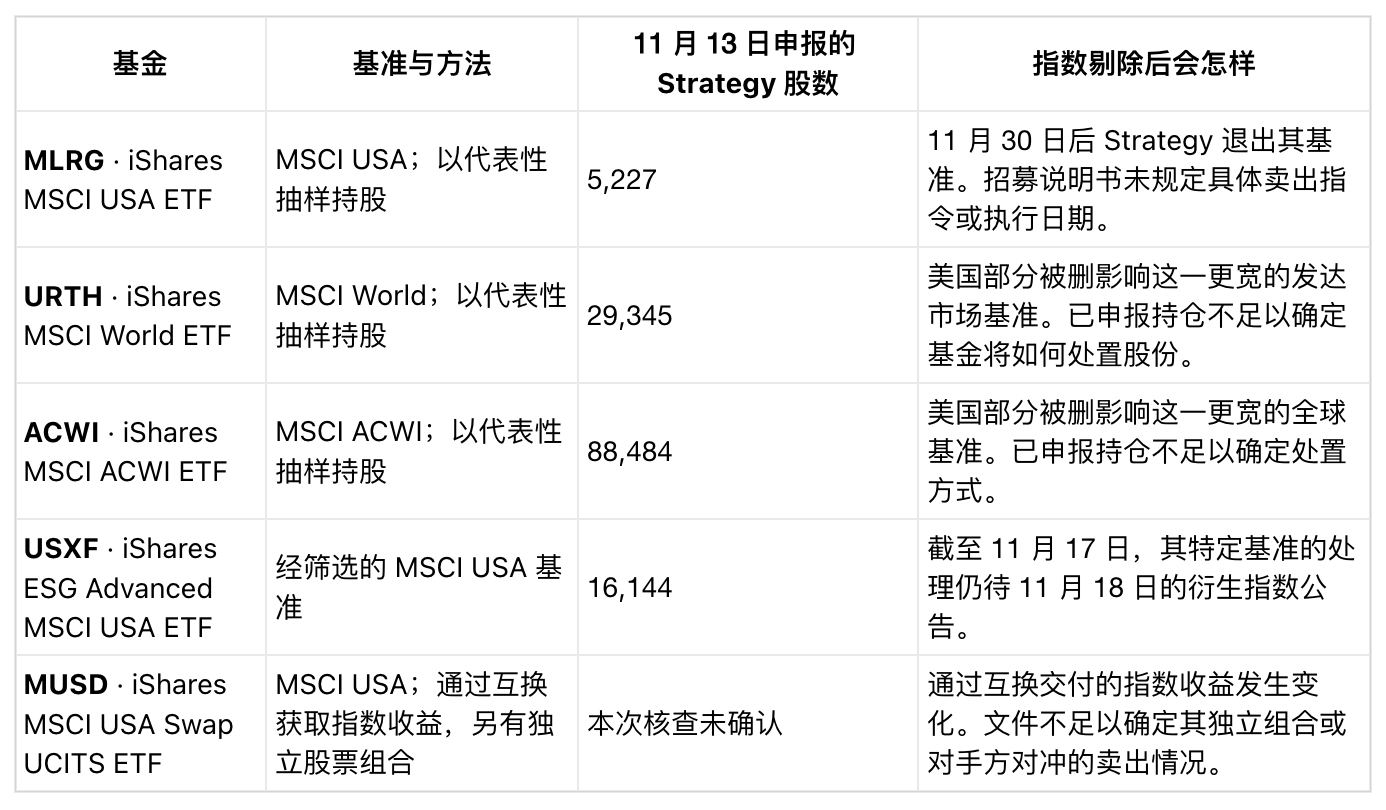
The MSCI USA Index covers large and mid-sized companies in the United States; the Class A shares of Strategy are set to be removed at the close on November 30, with the change effective from December 1. MSCI has introduced new inclusion criteria for its classified "non-operational" companies, and Strategy is one of the stocks selected for removal.
Other adjustments to MSCI's specialized indices are scheduled to be announced on November 18.
BlackRock’s iShares MSCI USA ETF (ticker MLRG) tracks the aforementioned US index. As an ETF, investors buy and sell shares on the exchange, while the manager is responsible for the investments within the fund. Its public holdings show that it held 5,227 shares of Strategy worth approximately $583,000 as of November 13.
MLRG employs what's called representative sampling. The manager selects a set of investments to make their performance close to the index but does not commit to holding every stock on the list at all times.
The fund's prospectus states that the fund intends to invest all or nearly all of its assets in index constituents and generally allocate according to index weights. The document also allows holding some investments outside the index when it helps track index performance, including arrangements made for anticipated constituent changes.
This gives the manager some flexibility while keeping the fund focused on performance targets. The removal of Strategy provides a reason for adjusting the portfolio, but the document does not require the sale of all 5,227 shares reported on November 13 to occur all at once at the close on November 30.
BlackRock also has another fund tracking the exact same index: iShares MSCI USA Swap UCITS ETF, traded in Europe under the ticker MUSD. This fund holds a different set of developed market stocks and uses contracts known as total return swaps.
According to its investor documents, this fund uses the performance of this set of stocks to exchange for the performance of the MSCI USA Index with financial institutions.
You are still buying a fund designed to track MSCI USA, but this connection is realized through contracts rather than through a portfolio that replicates the index constituents one by one. When Strategy exits the index, it will no longer contribute to the index performance that these contracts are supposed to deliver.
But this does not tell us whether MUSD holds any shares of Strategy in its own stock portfolio or whether it will sell any shares.
Counterparties to these contracts may also adjust their investments to manage the risks they face. Their transactions are not disclosed in the fund documents, so multiplying MUSD’s asset size by Strategy’s weight in the index will not yield how many shares this fund must sell.
The Strategy Holdings We Can Actually Count
BlackRock’s iShares MSCI World ETF (URTH) tracks companies in developed markets (including the US), reporting a holding of 29,300 shares of Strategy worth approximately $3.3 million as of November 13.
Its iShares MSCI ACWI ETF tracks companies in developed and emerging markets and reported holding 88,500 shares on the same day, worth approximately $9.9 million. These broader indices include a portion of the US, so the removal of Strategy from the MSCI USA Index will also affect them.
Including MLRG, these three funds hold a total of 123,000 shares of Strategy, worth $13.74 million. We are looking at specific day, three identifiable fund portfolios, not all funds affected by MSCI's decision.
URTH and ACWI both employ representative sampling, so their managers also have some flexibility when matching the index.
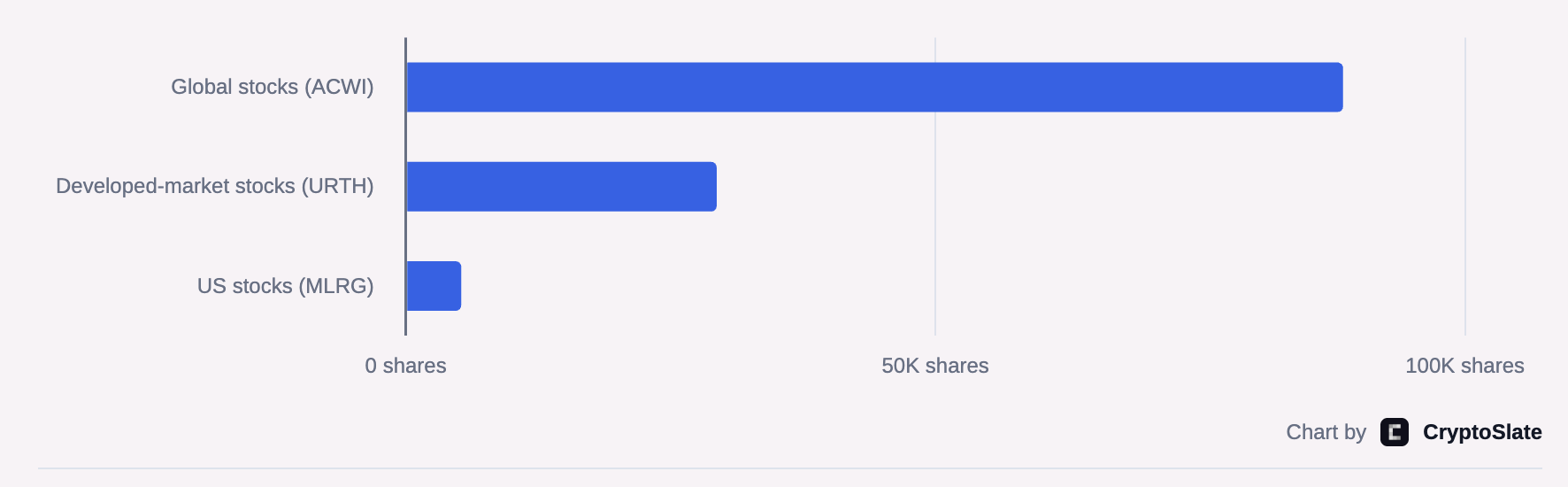
According to November 13, 2026 report data, the three BlackRock funds collectively hold 123,000 shares of Strategy
The iShares ESG Advanced MSCI USA ETF (USXF) tracks a version of the MSCI USA index with additional screening rules for constituents. It reported holding 16,100 shares of Strategy on November 13; however, as of November 17, the announcement regarding the standard index could not confirm how this particular version would adjust.
MSCI's announcement regarding these specialized indices is scheduled for November 18, so USXF is not included in the tally of the three aforementioned funds.
Investors in Strategy through other index-linked funds will not automatically face the same changes. For example, Invesco QQQ tracks the Nasdaq-100, which has its own compiler and inclusion rules.
Managers hired to select stocks can continue to evaluate Strategy by their standards, just as investors directly holding its stock can.
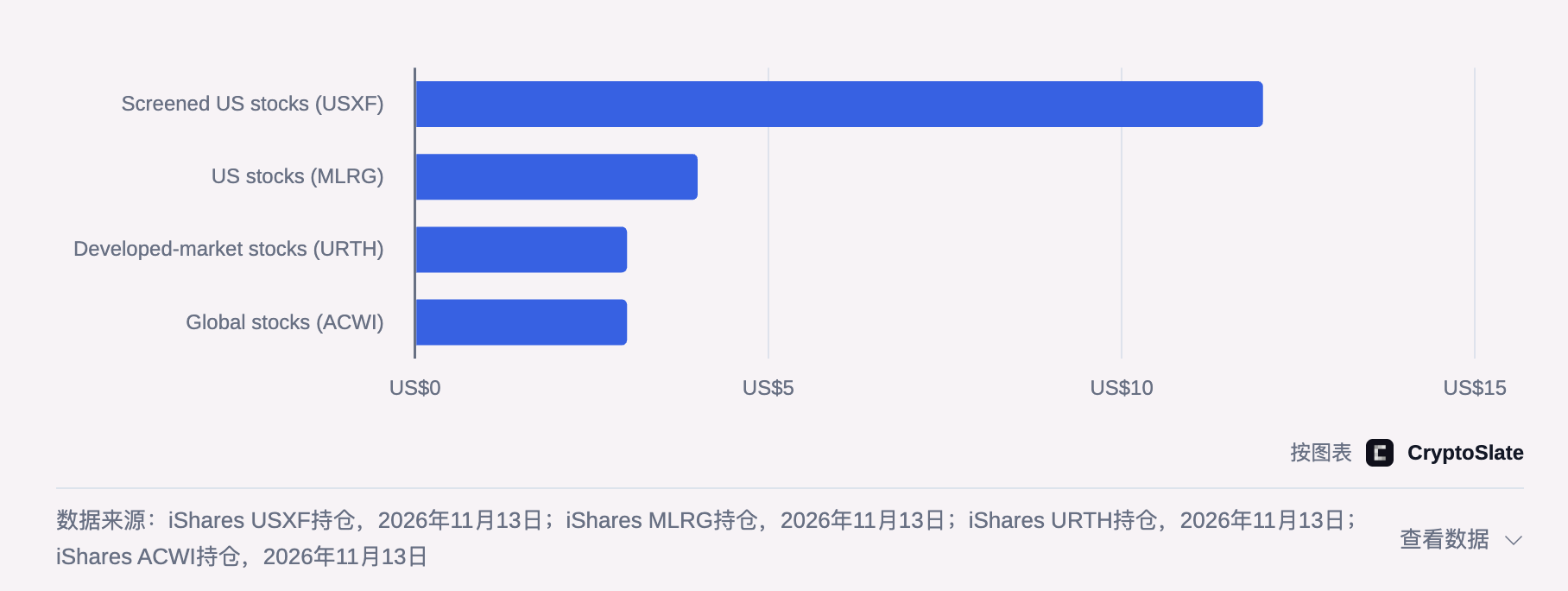
How much of each $10,000 in assets is invested in Strategy
In response to MSCI's consultation, Strategy stated that funds tracking the agency's global investable indices collectively hold about 13 million shares, which is 3.1% of the basic float.
This is considerably larger than the sample of the three funds in this article, but the public statement does not list specific funds and does not give an observation date for current holdings.
Fewer holdings do not mean someone is selling
After index adjustments, daily holdings documents allow us to compare the previous and subsequent holdings of these funds. These documents can show that a portfolio's holding of Strategy has decreased, but they may not indicate how those shares decreased and why.
ETFs can grow and shrink due to investor subscriptions or redemptions. When a fund's size grows, its holding of Strategy may simply increase because it needs more existing shares.
Comparing the number of Strategy shares with the number of fund shares helps distinguish between "changes in fund size" and "changes in the weight of Strategy within the portfolio." When the ETF size shrinks, some stocks may exit through the redemption process. Financial institutions can return fund shares to the ETF in exchange for the underlying securities.
Thus, Strategy shares can leave the ETF without the fund selling them on the exchange, and the institutions receiving those stocks then decide how to handle them. The next holdings document will only record the reduced position, without informing us of those subsequent decisions.
MUSD further complicates observability since its contracts directly deliver index performance. Its counterparties may adjust investments as Strategy exits, but simply tracking the fund's stock holdings does not reflect those adjustments.
Even if we can see holdings changes, comparing two dates cannot show how much of Strategy's price fluctuations were driven by MSCI, particularly when investors could trade ahead of the announcement changes.
Ultimately, Strategy will lose its place in the performance targets of these funds. This may weaken demand for its stock, making a company that buys Bitcoin through issuing securities less attractive when seeking financing. However, that said, the index removal does not require Strategy itself to sell any Bitcoin.
免责声明:本文章仅代表作者个人观点,不代表本平台的立场和观点。本文章仅供信息分享,不构成对任何人的任何投资建议。用户与作者之间的任何争议,与本平台无关。如网页中刊载的文章或图片涉及侵权,请提供相关的权利证明和身份证明发送邮件到[email protected],本平台相关工作人员将会进行核查。


