Author: Jonathan King, Coinbase Ventures
Translation: Deep Tide TechFlow
Deep Tide Introduction: From simple rule-based quantitative scripts to AI agents with autonomous reasoning and decision-making capabilities, the paradigm of financial trading is undergoing a fundamental shift. Traders no longer just input buy and sell instructions, but instead delegate investment intentions to agents, who are fully responsible for cross-market data analysis, position risk control, and cross-chain execution.
In this article, Coinbase Ventures systematically breaks down the four-layer architecture of the AI trading ecosystem and clearly points out that simple open-source models lack a competitive moat. The true business excess value in the future will flow toward agent frameworks that control the "investment decision closed loop" and accumulate proprietary contextual data, as well as underlying trustworthy execution platforms that win user asset custody.
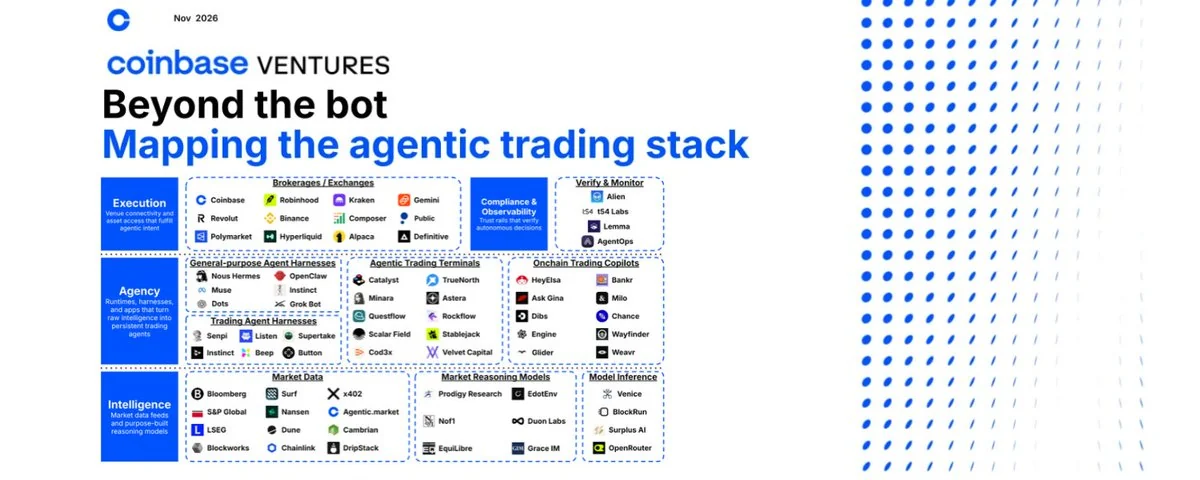
This article is written by Jonathan King, Senior Investment Manager at Coinbase Ventures. Companies mentioned for the first time in the text are marked with an asterisk (*).
AI agents are gradually becoming active participants in economic activities. Their ability to autonomously pursue established goals, make independent decisions, and represent humans in value settlements is laying the foundation for a completely new financial system: this is Agentic Finance (shortened to AiFi).
This transformation is advancing along two parallel tracks, profoundly reshaping the way humans interact with capital. The first track is payments and commercial activities, where agents autonomously purchase goods, services, and data; the second track involves trading and market operations, where agents directly engage in trading within financial markets. This article will focus on the second core track: Agentic Trading.
In agentic trading, AI agents may take on part or all of the trading decision-making closed loop on your behalf. You only need to set overall goals and risk control boundaries, while agents autonomously research the market, build strategies, assess positions, execute orders, and continuously monitor risks within the scope you authorize. Although this field is still in its infancy, this paradigm promises to make complex professional quantitative trading processes accessible to everyone through extremely simple natural language prompts.
In our 2024 forward-looking discussion on Crypto x AI, we predicted that natural language interaction would become the main way people interact on-chain. In a May 2025 article titled "The Rise of On-Chain AI," we further explored how agents make personal asset portfolio management more widespread. Since then, the evolution of this concept has far surpassed the crypto-native space. Mainstream exchanges, brokers, and a new wave of startups are now racing to build trading infrastructure for agents that span across crypto assets, US stocks, derivatives, prediction markets, and other diverse asset classes.
As the barriers to building agents continue to lower, we are more focused on the core elements that support these businesses in forming long-term barriers. We believe that the purely matching and execution value of orders will be rapidly compressed, and that greater value in the future will flow toward entities that continuously manage investment strategies and custodians deeply trusted by users and their agents.
This judgment directly informs the three major investment directions currently focused on by Coinbase Ventures: the operational foundations and terminals of agent trading, tracks that leverage specialized deep intelligence to obtain true Alpha advantages, and compliance and observability infrastructures that ensure agent behavior on-chain is traceable and accountable. Below, we will outline the entire landscape of this emerging tech stack and clarify the keys to building enduring businesses in this field.
What is Agentic Trading?
Agentic trading refers to the process where AI agents autonomously operate part or all of the trading decision-making closed loop within the boundaries you authorize. They always anchor a long-term persistent goal, autonomously collect market intelligence, form and dynamically adjust trading strategies, and execute trades within the risk control lines you set, all without needing manual approval for each action.
Although automated trading has a history of several decades in financial markets, each previous wave of automation essentially merely executed pre-made human decisions faster or at lower costs:
- Rule-based trading bots: Only execute orders when preset conditions are triggered (e.g., "Buy when Indicator X crosses Y"), functioning merely as faster execution triggers without independent decision-making ability.
- Algorithmic execution engines (e.g. TWAP or VWAP): Focus solely on how to execute the orders you have already decided in the most efficient way, taking no responsibility for deciding "what to buy."
- Robo-advisors: Allocate asset portfolios based on rigid static models, unable to respond logically to breaking news or formulate independent macro views.
- Copy trading: Just mirror other traders' positions, inheriting their risks entirely and unable to adapt to your own risk control preferences.
Agentic trading fundamentally disrupts this established model. You only need to express an investment goal in simple, understandable natural language, and the agent will break it down into market analysis, strategy generation, position sizing, multi-channel order execution, and round-the-clock monitoring. For the first time in history, machines have the ability to autonomously form investment logic, rather than passively execute commands imparted from outside. The human role thus shifts from a front-line operator to a core principal: you no longer need to keep an eye on the screen clicking buy and sell; instead, you focus on establishing overarching directives and authorizing risk control.
Why is it Exploding Now?
Using AI for trading is not a new concept that emerged today. As early as 2023, a large number of AI trading bots surfaced, but most quickly faded into obscurity after the frenzy subsided. We believe this time is different; the core lies in the four significant qualitative leaps that occurred in the underlying industry within the past 12 months:
- Reliability of underlying large models crossed a critical point: The earlier bots of the early 2023 era faltered because the large language models of that time could only summarize market information without being able to execute decisions in real markets. Today's cutting-edge large models possess excellent multi-step planning, autonomous calling of external tools, and self-correcting abilities, which are essential baseline thresholds for fully automated long-term position management.
- Engineering costs to connect to financial markets have sharply declined: The emergence of open standards like Model Context Protocol (MCP) and Agent2Agent (A2A) has transformed the traditionally cumbersome trading interfaces, data feeds, and asset custody mechanisms into plug-and-play capabilities. Previously, connecting agents to broker channels usually required several quarters of customized development; today, it can be integrated in a matter of minutes.
- Open-source agent "operation harnesses" make building easy: Open-source suites like OpenClaw and Nous Hermes* allow any underlying large model to have persistent memory, scheduled automated task execution, and seamless integration with external markets right out of the box. The OpenClaw project alone gained nearly 250,000 GitHub Stars in about 60 days. The crypto industry was the first to capitalize on this wave of technological explosion, mainly because open and permissionless APIs completely eliminated the traditional financial entry barriers, making perpetual contract trading on Hyperliquid and prediction markets on Polymarket the earliest testing grounds for agents.
- Cross-market forms and settlement channels are rapidly merging: Tokenized US stocks, real-world asset (RWA) perpetual contracts, continuous trading mechanisms 7x24 hours, and stablecoin instant settlement systems allow a single agent to execute unified strategies across multiple asset classes based on a single collateral pool. The reason previous automated systems were fragmented into their own islands is that each traditional asset type operated on closed infrastructures.
Why is it Crucial?
Agentic trading is making previously unattainable quantitative trading capabilities accessible to the masses. Professional strategies that only top quant teams could achieve—such as complex signal mixing across asset classes, adapting position exposure based on market fluctuations, capturing pivot points during macro market cycles, or performing automatic rebalancing considering tax optimization—can now be easily activated by ordinary individuals with just a sentence.
Imagine a scenario demand: "Help me build a momentum tilted portfolio between crypto assets and semiconductor stocks, with the maximum drawdown strictly limited to within 15%, and maintain weekly regular rebalancing." Based on this single natural language input, the agent can simultaneously capture momentum indicators from both markets, construct the underlying investment portfolio, finely calculate the position weights of each asset based on the established drawdown cap, execute orders in batches across different liquidity platforms, and automatically analyze and adjust the plan at each interval.
This new paradigm is also fundamentally reshaping the demands of trading platforms. More and more users are no longer coming to platforms with isolated "order intents" (like "buy 10 shares of a certain stock"), but with more macro "portfolio intents" (like "help me build a complete portfolio expressing my optimism towards a certain sector"). This is a completely different product form from traditional order-book trading interfaces; it greatly empowers platforms that can offer the widest integration of asset classes while severely impacting those that only pursue maximum matching efficiency on a single asset.
Overview of the Agentic Trading Tech Stack
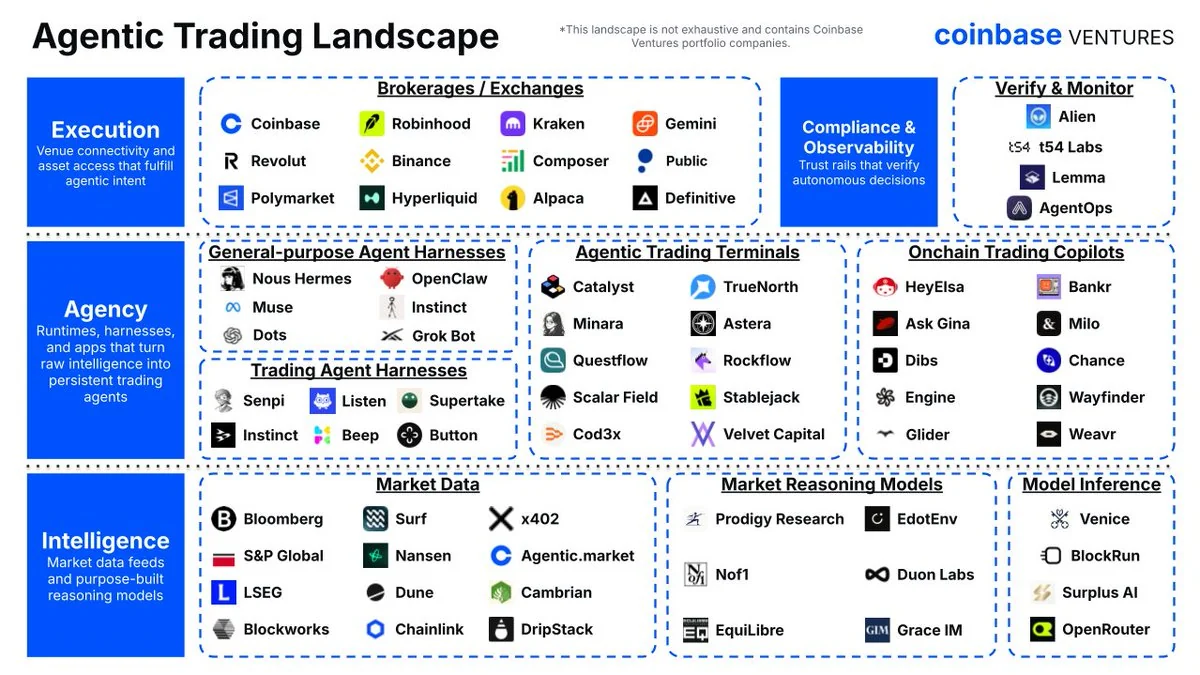
Agentic trading is rapidly departing from its previous fragmented state pieced together by experimental tools, converging into a well-structured and hierarchically clear tech stack. We systematically deconstruct the entire ecosystem into four core levels: the Intelligent Level (Intelligence, data and reasoning models that provide the basis for agent thought), the Intelligent Framework Level (Agency, the foundation and frontend applications that transform static models into permanently operational trading agents), the Execution Level (Execution, converting decision logic into executed orders), and the Compliance and Observability Level (Compliance & Observability, a trustworthy foundation that comprehensively verifies agents' behavioral motives and audit records).
The following diagram illustrates the representative startup teams and benchmark projects at each level that we continuously keep a close eye on, built on the foundational data and intelligent reasoning, extending upward to the execution channels and trust assurance networks:
First Level: Intelligent Level (Intelligence: Data and Reasoning)
Market Data: Agents need extremely clean, standardized, and machine-readable raw information inputs, covering real-time quotes, market depth, regulatory filings, breaking news analysis, social sentiment indices, and on-chain fund movements, with each data point precisely timestamped and attributed to reliable sources. However, today's financial data business models are almost entirely designed for human analysts, charging high fees per terminal seat, and are utterly unable to support the tens of thousands of automated high-frequency calls that agents require daily.
This supply-demand mismatch has created a huge cutout for data networks that charge native machine fees. For example, Coinbase's open-source x402 protocol allows agents to use stablecoins to pay precisely for data on demand at the moment needed. Traditional data giants like Bloomberg and S&P Global, on-chain data analysis platforms Nansen*, Dune*, and oracle networks Pyth* and Chainlink have already provided vast foundational information; meanwhile, newer forces like Surf* and Cambrian have tailor-made research and data interfaces specifically for AI agents from day one.
Specialized Financial Reasoning Models: Although cutting-edge experimental general reasoning large models are powerful, their universal accessibility means that relying solely on general models does not constitute a differentiated competitive advantage. The truly significant commercial opportunity lies in developing vertically specialized financial market reasoning models: these models are specifically trained on complex financial markets and possess the capacity to rigorously test and validate trading ideas, autonomously deploy real capital, and adaptively control risks in long-term, human-free workflows.
A number of new financial reasoning model labs are emerging, including teams like Prodigy Research*, EdotEnv*, and Nof1, which often train models using large-scale proprietary market data or build highly realistic high-fidelity simulation trading environments for continuous reinforcement through trial and error. At the same time, reasoning platforms and smart routers like Venice* allow agents to adaptively select the optimal model based on task complexity, directly supporting per-call reasoning payment in many scenarios using USDC.
Second Level: Intelligent Framework Level (Agency: Operation Base, Terminals, and Collaboration Assistants)
General-purpose Agent Operation Harnesses: General-purpose harnesses transform static models, which were originally designed for single-answer queries, into agents capable of long-term residence by giving baseline models persistent memory, scheduled task triggers, external tool calling sandboxes, and automated error recovery capabilities. They are born with versatility to handle various complex tasks (including coding, industry research, email processing, etc.), and users can flexibly expand their capability boundaries through plugin skills. Open-source operation frameworks like Nous Hermes* and OpenClaw are highly favored in this camp, and trading scenarios are rapidly becoming one of their most important core use cases. However, financial trading requires much more than just a set of generic operational tools; there is a strong industry demand for specialized bases fortified for trading, which must come ready-built with dynamic position allocation, risk limit settings, floating reduction management, and a rigorous mechanism for comprehensive stress testing before deploying real funds.
Trading Specialized Agent Harnesses: These frameworks are specifically born to fill the aforementioned gaps, with teams like Senpi* and Supertake*. Senpi, self-styled as "AI Quant Engineers," is designed for active professional traders, capable of fully automatically converting user-described trading strategies in natural language into code and operating around the clock in hundreds of Hyperliquid derivatives markets, applying position sizing based on risk models and dynamic trailing stops. In contrast, Supertake caters to retail investors, allowing users to describe an investment idea in plain language (a Take), and its agent automatically refines it into an executable portfolio, providing a full-featured simulation practice mode and a public leaderboard for high returns.
Agentic Trading Terminals: Trading terminals are fully functional comprehensive workspaces where users can complete the entire process from research, strategy customization, historical backtesting, real-time ordering to full life cycle risk tracking within a closed-loop interface. Many terminals are inherently cross-asset, allowing a single agent to trade US stocks, cryptocurrencies, perpetual contracts, and prediction markets simultaneously; most terminals choose to connect to existing exchanges and brokers, not directly handling or custodializing user assets. You can think of them as Bloomberg terminals completely reshaped for the AI agent era, designed for professional traders who pursue deep risk control and refined mastery. For example, Catalyst* can convert users' market views into composite hedging strategies that span stocks, options, and prediction markets; while TrueNorth equips each user with a personalized dedicated agent that scans the stock, commodity, and crypto perpetual contract markets around the clock, automatically capturing trading entry points.
Onchain Trading Copilots: Collaboration assistants are lightweight, proactive smart assistants that reach out to users. They typically center around conversational interactions, embedded directly within users' daily high-frequency social and communication platforms (like X, Telegram, or various Web3 wallets). They closely revolve around users' self-custodial on-chain wallets, with funds always controlled by the user’s private keys, focusing on crypto-native scenarios, supporting users in conducting high-frequency operations like token swaps, cross-chain bridging, perpetual contract opening, yield staking, and prediction market betting with just a short conversation. If professional terminals pursue extremes in breadth and depth, collaboration assistants aim for extremes in accessibility and ease of use. For instance, HeyElsa* allows users to adjust portfolio configurations, cross-chain bridge, and automatically earn yield just through natural conversations; Bankr* enables users to carry out token buying, selling, or placing orders directly on the X platform through @ bots.
In real business progression, the boundaries between the aforementioned categories are rapidly blurring. General-purpose harnesses are constantly reinforcing trading-specific capabilities, trading specialized harnesses are introducing terminal-specific portfolio management and ladder dashboards, trading terminals are embedding conversational interaction capabilities comprehensively, and collaboration assistants are actively expanding their 24/7 operational capacity for strategies. In the long run, all products will face off under the same ultimate challenge: who can truly control the trading decision-making closed loop. Professional terminals have stronger moats in functional depth, asset span, and user retention; while collaboration assistants and general-purpose harnesses hold inherent advantages in traffic distribution, as they naturally reside in the mainstream battlegrounds where user attention spans the longest. The products that will ultimately succeed will be those that perfectly combine genuine intellectual strategy advantages with excess returns and an irreplaceable user distribution network.
Third Level: Execution Layer (Execution: Interconnection of Trading Venues and Asset Span)
The execution layer's responsibility is to efficiently transform agents' decision outcomes into real matched positions. This means not only accurately routing orders across diverse trading venues and asset types but also continuously monitoring order execution statuses, conducting real-time reconciliations of positions, and ensuring absolute safety in fund custody and settlement throughout the process. The industry is currently accelerating its convergence towards a standard model of "single certification credential, connecting diverse assets," where agents can smoothly penetrate the full spectrum of financial assets such as spot crypto assets, derivatives, and traditional US stocks solely through one verified unified connection channel.
Traditional brokers and exchanges are currently opening their doors to agents through two distinct paths. The first allows users to self-access external agents (Bring-your-own-agent), meaning third-party agents like ChatGPT, Claude, or Grok can securely connect through MCP servers, dedicated command-line tools, REST APIs, or exclusive agent accounts. For instance, Coinbase for Agents allows third-party external agents to trade spot crypto assets, compliant futures, and US stocks on behalf of users within user-defined risk limits. The second path involves native built-in smart capabilities, where the trading venue itself builds proprietary AI deeply embedded in the application to directly assist users in conducting analysis, planning, and execution. Coinbase Advisor is a typical example of this. Additionally, native AI financial infrastructures represented by Alpaca, as well as on-chain trading APIs launched by teams like Definitive* (Flash), allow agents to quickly access institutional-grade settlement-matching tracks without having to reinvent the wheel from scratch.
Fourth Level: Compliance and Observability Layer (Compliance & Observability: Trustworthy Foundation for Autonomous Decision-Making)
All current financial regulatory and compliance systems fundamentally default to the logic that final decisions are made by natural persons. When the entity actually making fund allocation decisions becomes an invisible AI agent, regulators and investors must receive clear explanations: what market data did the agent see at the time, what judgments did it make, what the decision-making underlying logic was, and who is ultimately responsible when mistakes occur? The compliance and observability layer is responsible for creating immutable complete records of all data input streams, reasoning thought processes, triggered behavioral operations, and ultimately executed orders, ensuring that all behavioral trajectories possess comprehensive traceability and external audit validity.
We firmly believe this is currently the most underestimated yet core foundational infrastructure shortcoming in the entire tech stack. This field harbors a historic opportunity to craft an all-new trust foundation tailored for agents: including agent identity verification and compliance certification mechanisms ("Know Your Agent"), tamper-proof irreversible decision logs, fully verifiable historical strategy performance tracking, and distributed reputation assessment systems. Early pioneer projects such as Alien*, t54 Labs, Lemma, and AgentOps have already taken the lead in this area.
Where Will the Commercial Value Flow?
Here we provide the most core basic judgment: in the wave of agentic trading, the agent code itself is not a strong competitive moat. The architecture based on open-source large models running on open-source harness means any tech developer can assemble a fully functional trading agent in just a weekend's spare time. If agents themselves are rapidly becoming a cheap commodity, then the core commercial value will inevitably shift to other scarce links.
We forecast three fundamental driving forces that will reshape future commercial value distribution:
1. Order execution commissions will be severely compressed, but core liquidity will remain the ultimate winner: Agents will dimensionally attack purely trading fees, as they can perform millisecond-level price comparisons across platforms, showing no loyalty to any isolated trading front. However, what agents pursue at the algorithmic level is comprehensive optimization of overall trading costs, including slippage friction, bid-ask spreads, and impact costs, not just single transaction fee rates. As a result, automated fund flows from agents will naturally gravitate towards the deepest and tightest core liquidity pools. Purely acting as a second-hand order routing intermediary will see profit margins infinitely compressed, while truly mastering the underlying high-density liquidity will maintain its strong value in the trading core.
2. Commercial value will fully flow to those who control the "investment decision closed loop": We firmly believe the commercial monetization model of agent trading platforms will converge entirely to what we define as "Intent-as-a-Service": i.e., how to translate users' vague macro goals into smoothly operating portfolios while keeping risks manageable over the long term. Future users will only be willing to pay for actual results and returns delivered, but will never pay for ineffective clicks on interfaces. This abundant "intent premium" will belong entirely to those who control the full process from thinking to decision-making, rather than merely serving as lower-level order pipelines.
3. The final victory criterion at the platform level will be asset trustworthiness and coverage breadth: When anyone can easily deploy an agent, the ultimate winning platforms will certainly be those that win dual trust from users and their agents through strong security bases and dare to have assets entrusted to their custody while providing broad-spectrum asset trading channels. When users come with comprehensive asset portfolio intentions, a traditional platform that can only offer single isolated asset types is destined to be ruthlessly replaced by an all-encompassing platform capable of seamlessly penetrating all diversified assets.
For startup teams, the aforementioned evolution provides extremely stringent strategic selection criteria: we believe that truly sustainable business models that can support venture-capital level scale will inevitably emerge in the intersection of unique proprietary intelligence depth, irreplaceable distribution networks, or very high compliance licensing entry barriers. Merely relying on a thin layer of prompt word wrapping over external general models and attaching publicly traded APIs will not allow those so-called startup projects to stand firm in intense competition in a red ocean.
Coinbase Ventures' Investment Layout
Adhering to the investment perspective outlined above, Coinbase Ventures is currently closely focused on the three core pillars of the agent trading tech stack:
- Agent Trading Operation Foundations and Comprehensive Terminals: We are particularly looking for innovative products that go beyond the limitations of simple order routing to truly realize higher-order investment portfolio construction intents. They must provide an excellent user experience and demonstrate strong retention metrics in actual operational indicators, including consistently rapid growth in agent-driven transaction volumes, assets under management (AUM), and long-term customer retention.
- Capturing Truly Uncopyable Alpha Competitive Advantages: As general foundational reasoning capabilities gradually become indiscriminate commodities, future competitive battlegrounds will undoubtedly shift towards who can inject unique competitive advantages that are not easily replicated into agents. Building vertical financial reasoning model labs that stably execute long-term multi-step financial tasks without human oversight is a highly certain and important track; at the same time, we have great interest in exclusive proprietary data networks, professional quantitative strategy models, and strategy aggregation markets verified by on-chain reputation.
- Compliance and Observability Infrastructure: Existing regulatory mechanisms are entirely ill-equipped to deal with automated decisions made by non-human entities. We are heavily investing in cornerstone projects that fill this crucial compliance gap: including agent identity identification and credential certification, tamper-proof full-process decision logs monitoring, end-to-end full-chain auditing of every tool and data source invoked by agents, truth verification network for strategy performance, and reputation accumulation systems based on on-chain behavior.
In evaluating specific teams for project due diligence and commercial assessment, we particularly value the long-term defensive barriers of the business, rather than being misled by single-point technical parameters:
- Self-Reinforcing "Smart Data Flywheel": A single static model does not constitute any moat; we particularly value "context loops" that can form positive feedback closed loops. Within this closed loop, proprietary private trading data and targeted fine-tuned models catalyze each other's evolution over time, continuously and cumulatively enhancing strategy win rates, thereby widening the competitive gap with later imitators.
- Native Composite Team Structure: The most explosive core teams in this field invariably possess three composite foundational capabilities: deep practical experience in frontline quantitative hedging trading (ensuring robust real returns adjusted for risk), top-notch cutting-edge AI engineering implementation abilities (ensuring determinism and robustness of agent behavior logic), and heightened regulatory compliance awareness (always treating compliance mechanisms as a core killer feature of the product rather than a post-hoc burden).
Looking Ahead
Agentic trading represents a profound paradigm shift in the way humans interact with financial markets. When the barriers to building agents are thoroughly erased by technology, only those companies that forge differentiated advantages difficult for competitors to replicate will endure across cycles. The ultimate winners of the future will undoubtedly be pioneers who firmly control proprietary intelligence depth, gain the ultimate trust of users in asset custody, and establish compliant safety corridors leading to the broadest financial markets for autonomous agents.
The entire technical system is still in the early stages of dawn, being built from trading-enhanced baseline operation frameworks, decentralized quantitative strategy markets, to agents' autonomous identities and multi-dimensional on-chain audit trails. Each ecological niche contains enormous opportunities for breakthroughs. If you are wholly engaged in building the future in the field of agentic trading, Coinbase Ventures looks forward to discussing it with you.
免责声明:本文章仅代表作者个人观点,不代表本平台的立场和观点。本文章仅供信息分享,不构成对任何人的任何投资建议。用户与作者之间的任何争议,与本平台无关。如网页中刊载的文章或图片涉及侵权,请提供相关的权利证明和身份证明发送邮件到[email protected],本平台相关工作人员将会进行核查。


