Author: Zhou, ChainCatcher
This past year has been particularly tough for E Guardians.
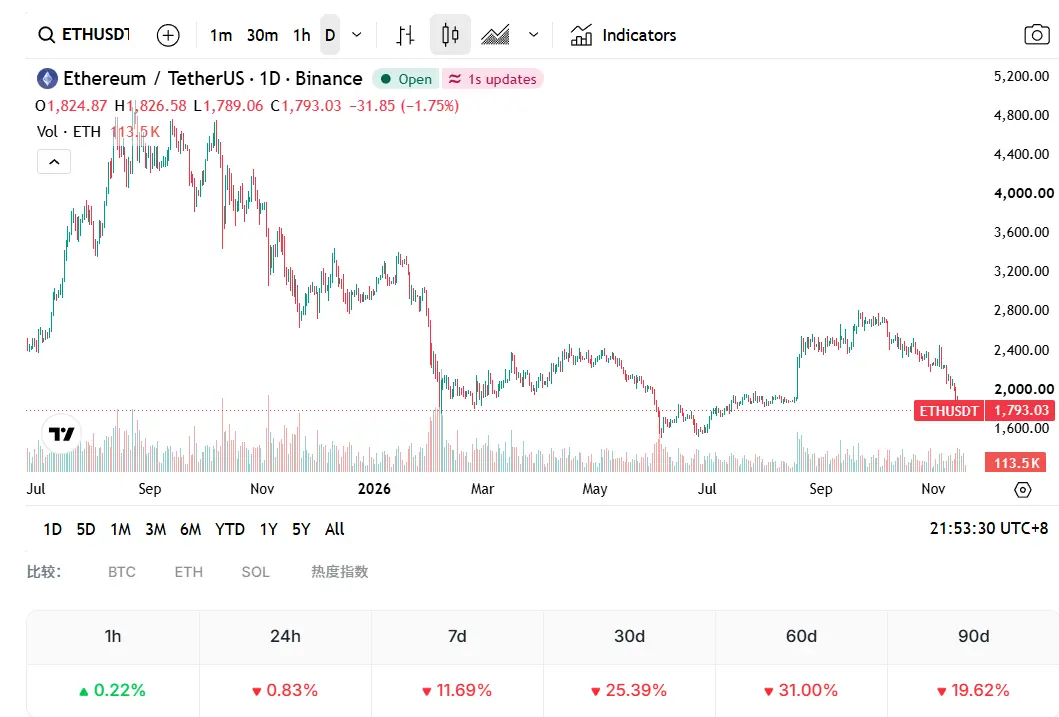
Since surging to an all-time high of $4,954 last year, the price of ETH has steadily declined. This year alone, ETH has repeatedly fallen below the $2,000 mark, dropping below $1,600 at one point in June, and is currently hovering around $1,800, representing a retreat of over sixty percent from its historical peak.
The heaviest losses have been incurred by Bitmine, led by Tom Lee. As of November 8, the company held 6,070,092 ETH, with an average cost of about $3,353, resulting in unrealized losses approaching ten billion dollars at one point.
Over a year ago, this co-founder of Fundstrat stood as a Wall Street strategist to endorse ETH, being seen as a rare institutional spokesperson for Ethereum.
Since then, regardless of the market conditions, he has almost always been able to provide bullish reasons; by the end of October this year, he still expressed his belief that ETH is expected to reach around $62,000 in the next cycle.
From the market's perspective, his statements increasingly resemble a form of “mindless bullishness.” How much weight does the voice of a bull, whose positions have nearly been halved and who has lost close to ten billion, still carry?
1. Why Can't Tom Lee Move ETH Anymore?
The second half of last year was the peak of Tom Lee's influence. Leveraging stock price premiums, Bitmine continually increased its coin purchases and quickly became the world's largest ETH treasury company, with Tom Lee’s short-term judgments being validated repeatedly, even being hailed as the King of Calls for ETH.
After ETH peaked and fell back in August, his bullish tone did not change. At the Binance Blockchain Week in early December, he still claimed that $3,000 ETH was severely undervalued and predicted that BTC and ETH would hit new highs in January 2026.
However, a couple of weeks later, an internal report shattered this image. On December 20, Fundstrat's head of digital asset strategy, Sean Farrell, outlined a baseline scenario for 2026 for paid subscribers, using the significant pullback in the first half of the year, providing ETH's target range as $1,800 to $2,000 and BTC as $60,000 to $65,000.
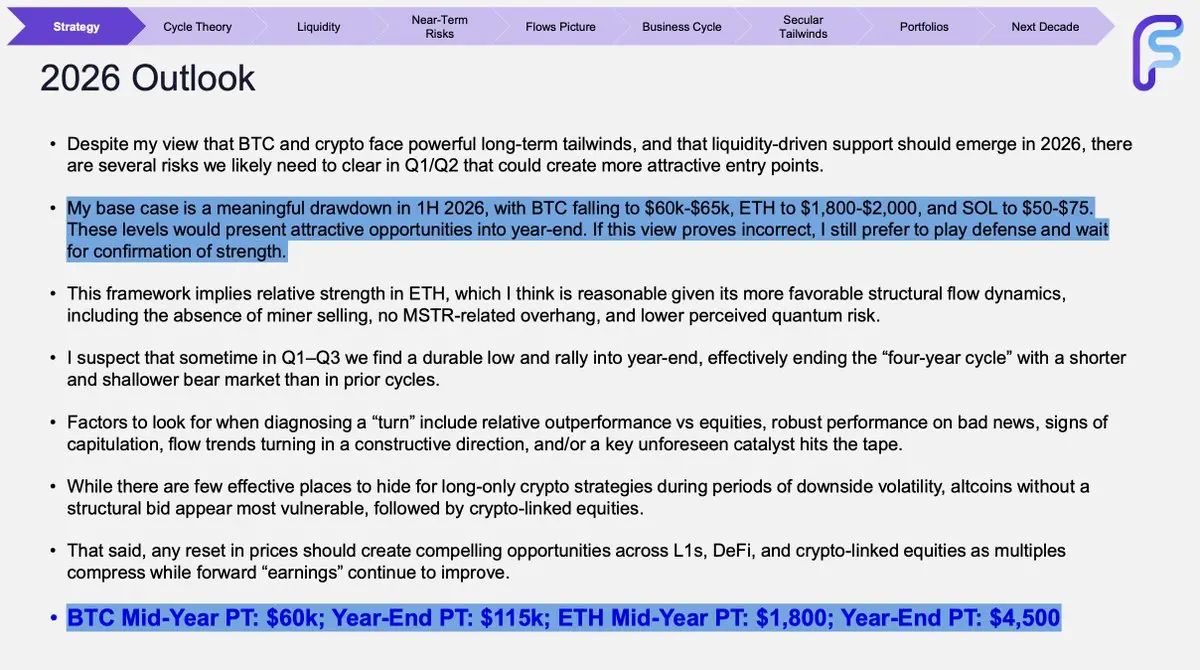
With public bullish statements and internal bearish outlooks, this contrast has thrown Tom Lee and his team into a crisis of trust, with many viewing it as the beginning of the collapse of Tom Lee’s persona.
Sean Farrell later clarified that the report emphasized risk management and did not represent a bearish outlook. Tom Lee explained that the two stemmed from different methodologies and time dimensions.
The market trends that followed basically aligned with the judgments from that internal report. By January 2026, neither BTC nor ETH had created new highs, and ETH fell below $2,000 multiple times afterward, dipping below $1,600 in June.
Starting in September 2025, he repeatedly predicted that ETH could reach around $62,000. By his calculations, if Ethereum were to replace payment and banking infrastructure, the ETH/BTC exchange rate could rise to around 0.25, with BTC valued at $250,000 making ETH around $62,000.
Subsequently, he also added historical cycle arguments, noting that Ethereum has previously surged 50 to 200 times in past cycles, and even conservatively estimating a 25-fold increase could reach this price level.
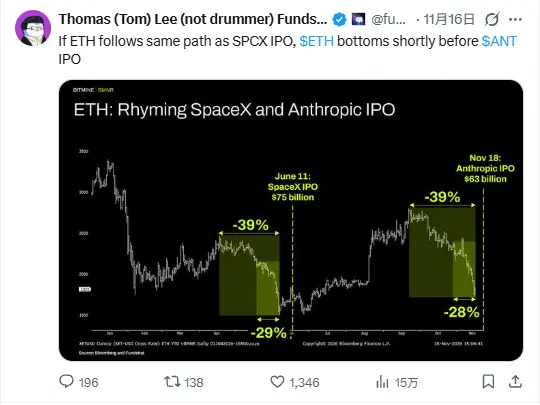
Regarding ETH's decline, in Bitmine's weekly report on November 16, he described the 28% drop in ETH over two weeks as a waterfall decline inconsistent with fundamentals, possibly caused by external factors like Nvidia dynamics and investors raising cash for Anthropic’s IPO. A year ago, he attributed the reason to the damage to market makers' balance sheets.
Beyond credibility issues, Bitmine's own situation is also undermining Tom Lee's voice. The model of issuing more shares to support expansion, which bolstered its growth last year, has now become unsustainable.
As ETH declines, the company's stock price remains consistently below the value of its held assets, and further issuance would only dilute shareholders; Bitmine has shifted to buying back its shares. According to Bitmine's disclosure, by late October 2026, the company had repurchased approximately 22.9 million shares at a cost of about $400 million.
In the last two weeks, Bitmine bought 9,587 and 7,653 ETH respectively, the latter amounting to about $14 million at current prices, indicating a significant contraction in its buying scale. The company has achieved 99% of its 5% holdings target, but has yet to disclose plans following the target completion, and is very likely not to purchase further ETH.
More importantly, Bitmine’s unique position as a bridge between Wall Street and ETH is disappearing. In January of this year, Grayscale completed the United States' first spot ETH ETF staking yield distribution, and in March, BlackRock launched its staking ETH ETF, allowing institutions to directly gain ETH exposure and staking income via ETFs.
Currently, Bitmine has virtually no debt, with approximately 86% of its ETH staked, generating an annualized staking income of about $245 million, and there is no pressure for forced liquidation in the short term. Although Tom Lee's persona has not completely collapsed, his words are no longer as impactful in the market.
2. After the Failure of the ETH Destruction Narrative, Can Value Storage Win Public Support?
Looking back at Tom Lee's bullish logic over the past year, the most frequently mentioned theme has been the tokenization super cycle. In his view, tokenization is making steady progress, primarily on Ethereum.
Based on usage, tokenization is indeed occurring. According to a report by Binance Research, Ethereum's network usage grew by about 50% in the first half of 2026, but due to continuously declining gas fees, the total network revenue for the year is expected to decrease by 53%.
While on-chain activity has become increasingly busy, value has failed to return to ETH. Since the shift to proof of stake, ETH has fallen over sixty percent relative to BTC.
The previous destruction logic supporting ETH's valuation has also failed. With the advancement of L2 scaling and a significant drop in mainnet transaction fees, the amount of ETH being destroyed has lagged far behind the new issuance.
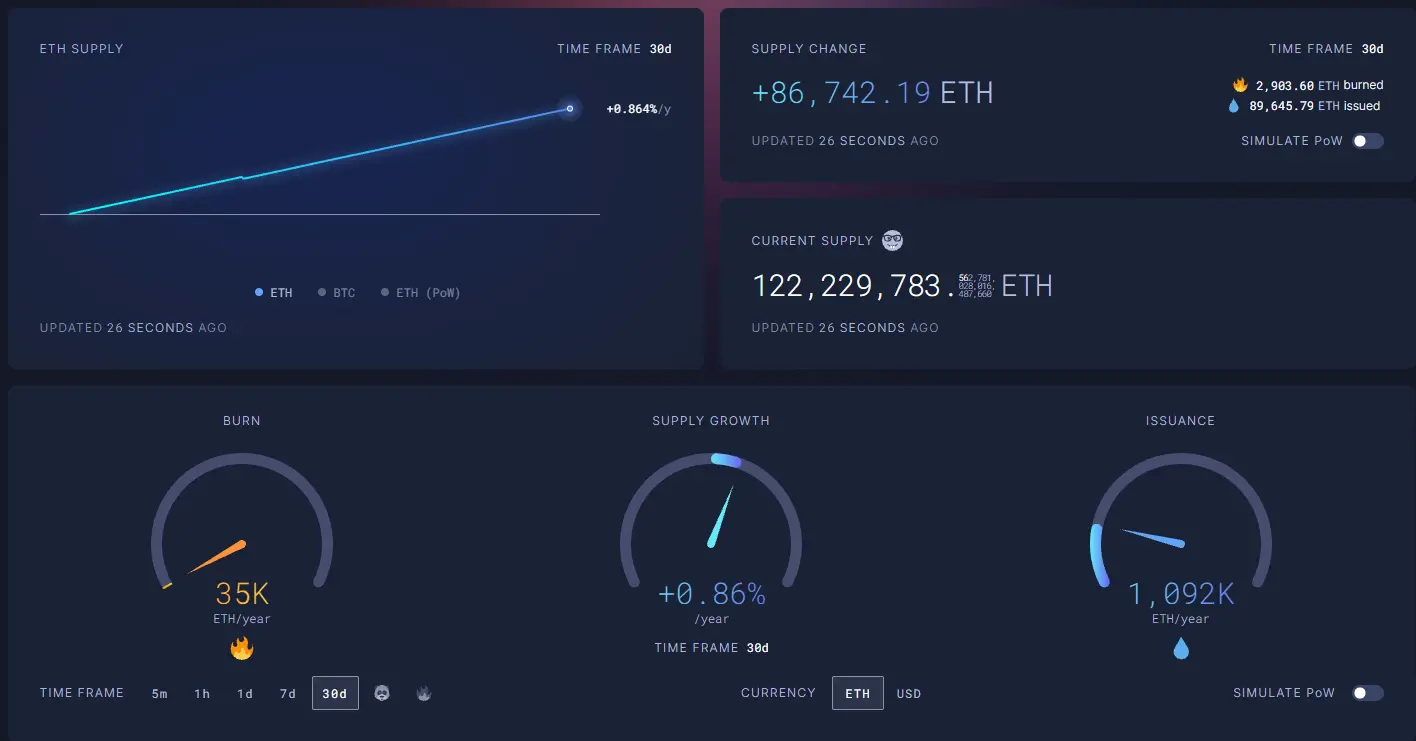
According to ultrasound.money data, based on the last 30 days, the annualized destruction amount of ETH is about 35,000 coins, while the annualized issuance amount is approximately 1.09 million coins, with a supply growth rate of about 0.86%. Since the merge, the net increase in ETH supply has been about 1.7 million coins, and expectations for deflation have completely dissipated.
Bitcoin can occupy the position of digital gold largely because it has changed almost no rules over the years, whereas Ethereum is still in rapid iteration.
On November 8, Vitalik reaffirmed in a post the positioning of ETH as a value storage and proposed no longer using transaction fees destruction as the core valuation logic.
In his view, the previous destruction mostly stemmed from speculative demand within the crypto circle, which cannot be considered a true price floor. The pursuit of high destruction would also conflict with the goals of decentralization and anti-capture, and even if destruction is long-term insufficient to reach the breakeven level by 10%, there is no need for regret.
Tom Lee consistently includes Vitalik's affirmation that ETH is a value storage in his bullish rationale.
However, institutional investors see it differently. According to estimates by Arca's Chief Investment Officer Jeff Dorman, Ethereum generates about $6 million in monthly revenue, plus the ETH held in wallets for gas payments, which can only explain about $45 billion to $50 billion of the $246 billion market cap, with the remainder coming from social value and market imagination.
Crypto KOL Blue Fox also asserts that it is too early to discuss value storage; Ethereum should first charge reasonable fees of 10% to 20% from L2 and block builders to address the value capture issue at the mechanisms level. Value storage must form naturally and cannot be achieved just by shouting slogans.
Vitalik noted that Ethereum's roadmap is relatively mature, with major changes mostly predictable in advance, but he also listed a long series of anticipated protocol characteristics that may change, including potential significant adjustments to the consensus algorithm in the next two years.
Crypto KOL Chen Mo stated that the impact of the technical roadmap on price takes a long time to manifest, and the real focus should be whether Ethereum can continue to attract developers, while destruction data is a secondary concern.
3. With the Foundation Retreating Behind the Scenes, Can Bitmine Catch the Ball?
Ethereum may succeed well, but there is still a lack of convincing answers to why ETH must be expensive.
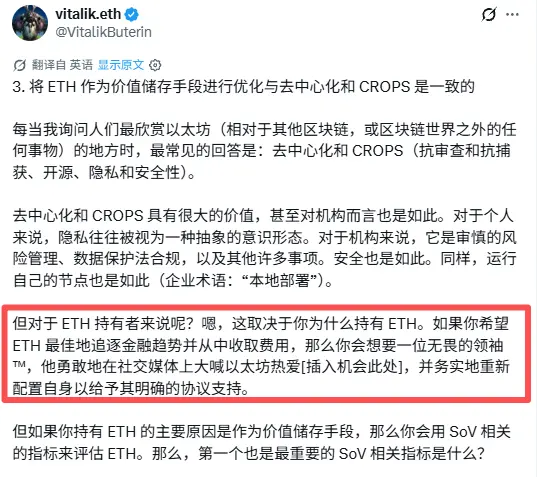
In a lengthy post on X, Vitalik wrote that if holding ETH is to chase financial trends, then a fearless leader shouting slogans on social media is needed. This statement carries a hint of irony, indicating the foundation's disinterest in playing such a role.
The mission document released in March of this year lists anti-censorship and anti-capture as core principles.
Meanwhile, the foundation is experiencing turmoil internally. Two co-executive directors, Tomasz Stańczak and Hsiao-Wei Wang, left in February and June respectively, and currently, board member Bastian Aue is in temporary charge. In June, the foundation announced layoffs of 54 people, about 20% of the total staff, and cut the annual budget by about 40%.
Recently, the former protocol support lead Kayleen Fulton of the foundation has filed a lawsuit in a U.S. federal court, stating that she and Trent Van Epps led an open letter signed by 53 people opposing controversial clauses in the mission document, and both were subsequently dismissed in April. The foundation has yet to submit a defense.
Additionally, recent market reports frequently suggest that the foundation is selling ETH, with several wallets labeled as foundation-related beginning to sell ETH. According to on-chain analyst Ai Yi, as of October 26, foundation-related addresses have cumulatively sold about 7,785 ETH.
However, on-chain analyst Specter warns that the ownership tags of some wallets lack sufficient evidence, and earlier financial interactions with the foundation do not imply they are still controlled by the foundation.
In terms of scale, these sales have limited direct impact on price. The ETH held by the foundation accounts for about 0.16% of the total supply, and this year approximately 70,000 ETH has been staked, using the revenue to offset some selling.
But for retail investors, Vitalik positioning ETH as a value storage, coupled with the continuous news of the foundation selling coins, creates a contrast that is shaking market confidence.
Notably, the sales confirmed publicly by the foundation have all been bought by Bitmine. According to the foundation's announcement, from March to May, the foundation sold a total of 25,000 ETH to Bitmine through three OTC trades, with transaction prices ranging from $2,043 to $2,387.
In June of this year, five former senior researchers from the foundation founded a non-profit R&D organization, Ethlabs, supported by Bitmine, SharpLink, and Ethereum co-founder Joe Lubin. In July, the same group of sponsors also supported the establishment of Ethereum Institutional, focused on institutional promotion and ETH marketing.
However, the linkage between the two currently remains largely at the level of buying and funding. After Vitalik reiterated the value storage concept, this narrative will need to be converted into a valuation logic understood by institutions for it to be accepted by Wall Street.
Conclusion
For ETH investors, there are now very few reliable entities to rely on. The foundation is unwilling to speak for the coin price, and recent spot ETF funds have continued to flow out. Bitmine, holding around 5% of ETH's circulating supply, is still considered the most motivated and capable entity to support the ETH narrative at present.
The problem is that Bitmine's interests do not entirely overlap with those of retail investors. Its income mainly comes from staking, and stock performance depends on asset premiums. After nearing its 5% target, the scale of additional purchases has also notably reduced.
Tom Lee’s calls have become increasingly difficult to persuade the market. Rather than his next target price, it may be more worthwhile to focus on whether Bitmine can collaborate more directly with the foundation to find a valuation anchor for ETH recognized by Wall Street.
免责声明:本文章仅代表作者个人观点,不代表本平台的立场和观点。本文章仅供信息分享,不构成对任何人的任何投资建议。用户与作者之间的任何争议,与本平台无关。如网页中刊载的文章或图片涉及侵权,请提供相关的权利证明和身份证明发送邮件到[email protected],本平台相关工作人员将会进行核查。


