Written by: Xiaobing
In the summer of 2026, YC released a 15-item "Request for Startups" list, covering lunar manufacturing, reasoning chips, anti-drone defense, effectively laying out the entire hard technology spectrum.
Three months later, the Fall 2026 batch was reduced to 13 items.
Another three months, the Winter 2027 batch had 11 items.
Each round of cuts is refining the focus.
From this year's four RFS lists (YC has shifted to four batches a year), a clear evolutionary path for investment themes can be discerned: the battlefield of AI is rapidly migrating from cloud models to the infrastructure and bottleneck layers of the physical world.
Below is a complete breakdown of the latest lists for Fall 2026 (13 items) and Winter 2027 (11 items).
A Letter from an Army Secretary
One of the most eye-catching entries in the Fall 2026 list has nothing to do with AI technology: a handwritten submission from the current U.S. Army Secretary Daniel P. Driscoll.
This marks the first time in YC's history that a serving government official has signed their RFS.
The title is "The Future of American Defense," and someone from the Pentagon is calling for help in the accelerator's recruitment brochure: We need you.
This implies that the U.S. military is bypassing the traditional defense contractor system (the comfort zone of companies like Lockheed Martin) and is directly reaching out to garages in Silicon Valley.
As a result, YC’s role subtly changes: it is becoming the interface that connects entrepreneurs with national will.
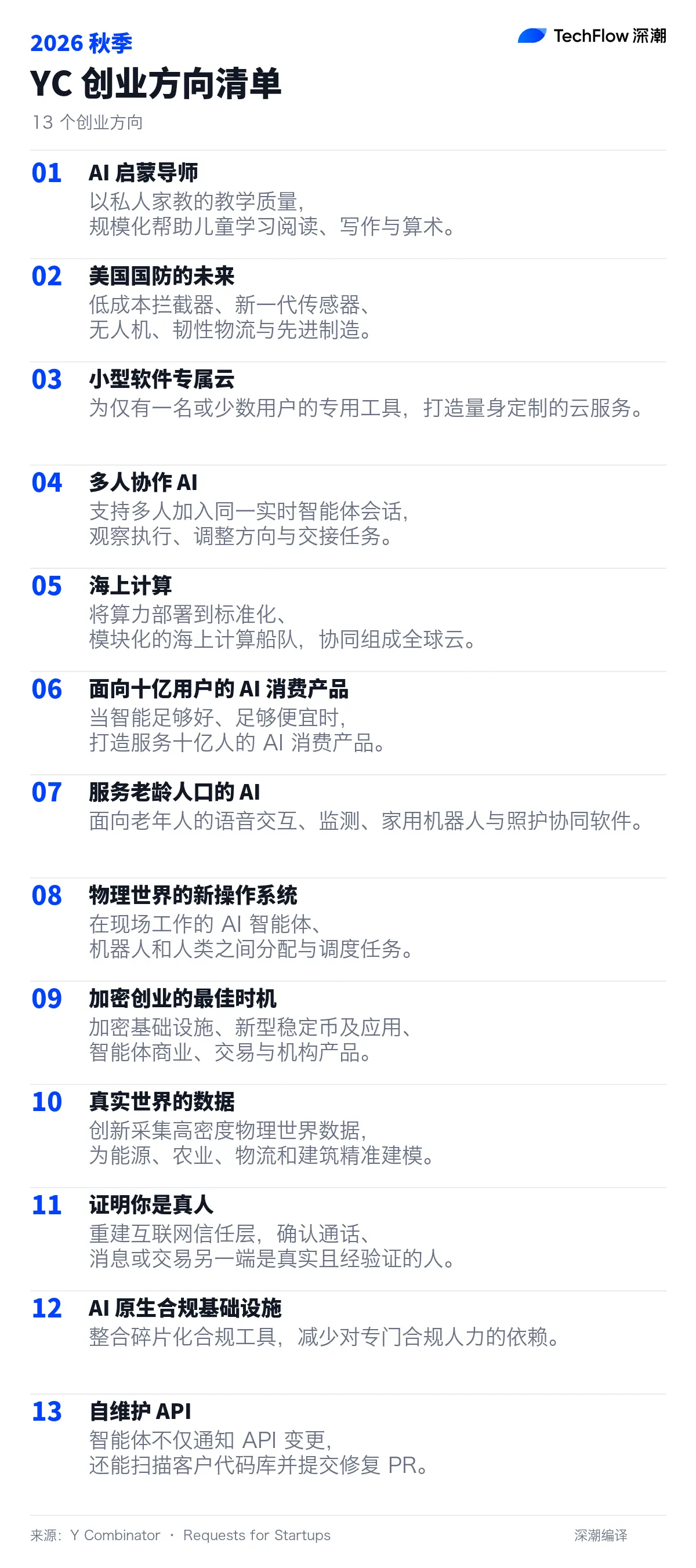
Looking at the complete list for Fall 2026, Driscoll’s appearance is by no means an isolated case.
Sea-based computing, AI-native compliance infrastructure, operating systems for the physical world... elements of military and national security permeate multiple directions.
Fall 2026: A Three-Layer Structure of 13 Directions
When we lay out the 13 entries of the Fall 2026 list, a clear three-layer structure can be found.
Physical Layer: AI Needs Hardware, Hardware Needs New Ground
Francois Chaubard’s proposal "Compute at Sea" is the boldest imagination at this layer.
Building data centers on land is becoming increasingly difficult: power approvals, environmental compliance, land costs—each factor is slowing AI's computational expansion.
Moving modular computing to the sea circumvents land bottlenecks; YC alumni company Atomarine is already constructing nuclear-powered computing barges.
Charlie Warren's "New Operating Systems for the Physical World" targets another pain point: AI can write code and chat, but it cannot yet directly control physical devices.
Robots in factories, irrigation systems on farms, traffic lights in cities—all need a set of AI-native operating systems to manage.
"Data for the Real World" points to an even more fundamental issue: the internet data used to train AI is running out, and the next wave of data must be collected from the physical world.
Data generated by sensors, cameras, and industrial equipment is the fuel for the next stage of AI.
Trust Layer: The Stronger AI Becomes, the More Important "Who You Are" Is
"Proving You’re Human" directly addresses a problem that is deteriorating rapidly: as AI-generated content and behavior become increasingly indistinguishable from reality, identity verification will become a necessary infrastructure for the entire internet.
"AI-Native Compliance Infrastructure" is aimed at enterprises.
AI is starting to make decisions; who will audit? Who is responsible when mistakes occur? The traditional compliance framework is simply not designed for the AI era.
The logic of this layer can be condensed into one sentence: the greater the ability, the more urgent the need for trust infrastructure.
Application Layer: From Tools to Services
Andrew Miklas's "The Primer" pays homage to the AI tutor in Neal Stephenson’s sci-fi novel "Diamond Age," aiming to provide each child with a personalized AI mentor.
Raphael Schaad’s "AI-Powered Consumer Products for 1 Billion People" targets consumer products for a global audience of one billion users.
Max Kolysh's "AI for the Aging Population" addresses a market that is rarely taken seriously in the tech world: global aging.
Japan, South Korea, and China's demographic structures are collapsing rapidly; AI caregiving, companionship, and health management represent a highly certain huge market.
Pete Koomen's "A Cloud for Small Software" and Aaron Epstein's "Multiplayer AI" return to developer tools.
The former aims to provide dedicated cloud infrastructure for small applications in the AI era, while the latter focuses on AI experiences in multiplayer collaborative scenarios.
Harsha Gaddipati's "Self-Maintaining APIs" proposes allowing APIs to monitor and repair themselves using AI, freeing up developer capacity.
Now is the Best Time to Build in Crypto
This phrase comes from YC visiting partner Nemil Dalal.
He wrote an entry dedicated to Crypto in the Fall 2026 RFS titled "The Best Time to Build in Crypto."
Dalal's confidence primarily stems from stablecoins.
The global settled volume of stablecoins is catching up to Visa, and the advancement of the GENIUS Act and CLARITY Act means the U.S. regulatory framework is shifting from suppression to integration.
Stablecoins have found their product-market fit and are becoming part of the global financial infrastructure.
He specifically mentioned a concept: Agentic Commerce.
When AI agents begin to replace humans in procurement and trading, they will not apply for bank accounts or credit cards.
On-chain payments are the most natural settlement method for AI agents.
This intersecting narrative (AI × Crypto) is becoming a common frontier for both industries.
The wave of institutionalization is also accelerating.
ETFs, custody, and compliant trading platforms... traditional financial institutions' interest in Crypto assets has evolved from a tentative phase to strategic allocation.
Even more interesting is YC's own actions.
In February 2026, YC partnered with Coinbase to start using USDC stablecoins to fund all YC startups, supporting Ethereum, Base, and Solana chains, with transfer costs below $0.01 and transaction times measured in seconds.
Note: This option is available to all YC startups, not limited to Crypto directions.
On October 28, Dalal also released a more detailed "Crypto Request for Startups," further breaking down specific tracks into sub-directions such as stablecoin infrastructure, on-chain trading tools, and institutionalized DeFi products.
Winter 2027: The Bottleneck is Not in the Models but in Transformers and Rare Earth Magnets
If Fall 2026 is still sketching the blueprint for AI's advance into the physical world, Winter 2027 directly points to the most painful spot: the bottleneck.
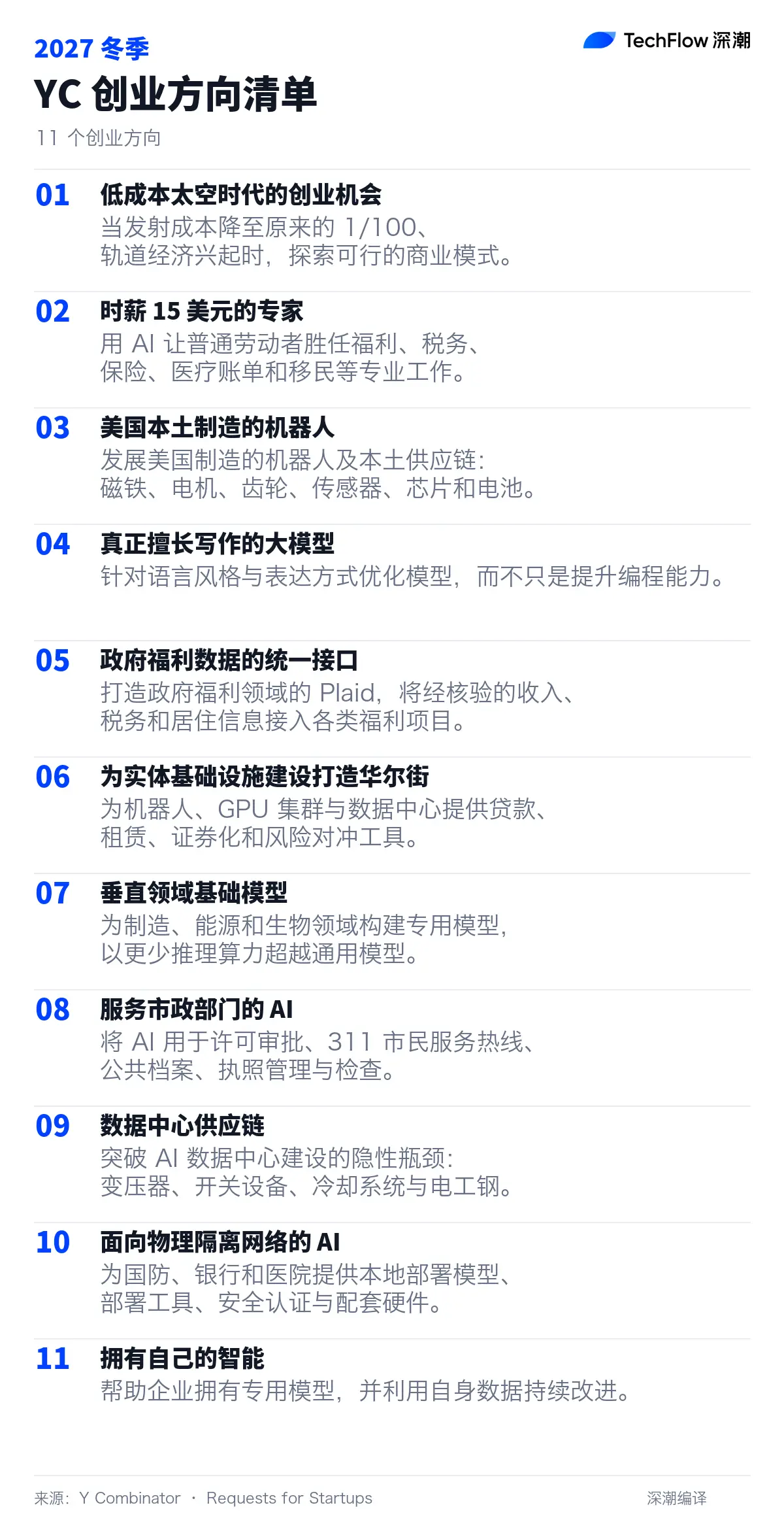
Six partners, 11 directions, almost every one answers the same question: The models are strong enough; what is preventing them from landing?
The answer is surprisingly "low-tech."
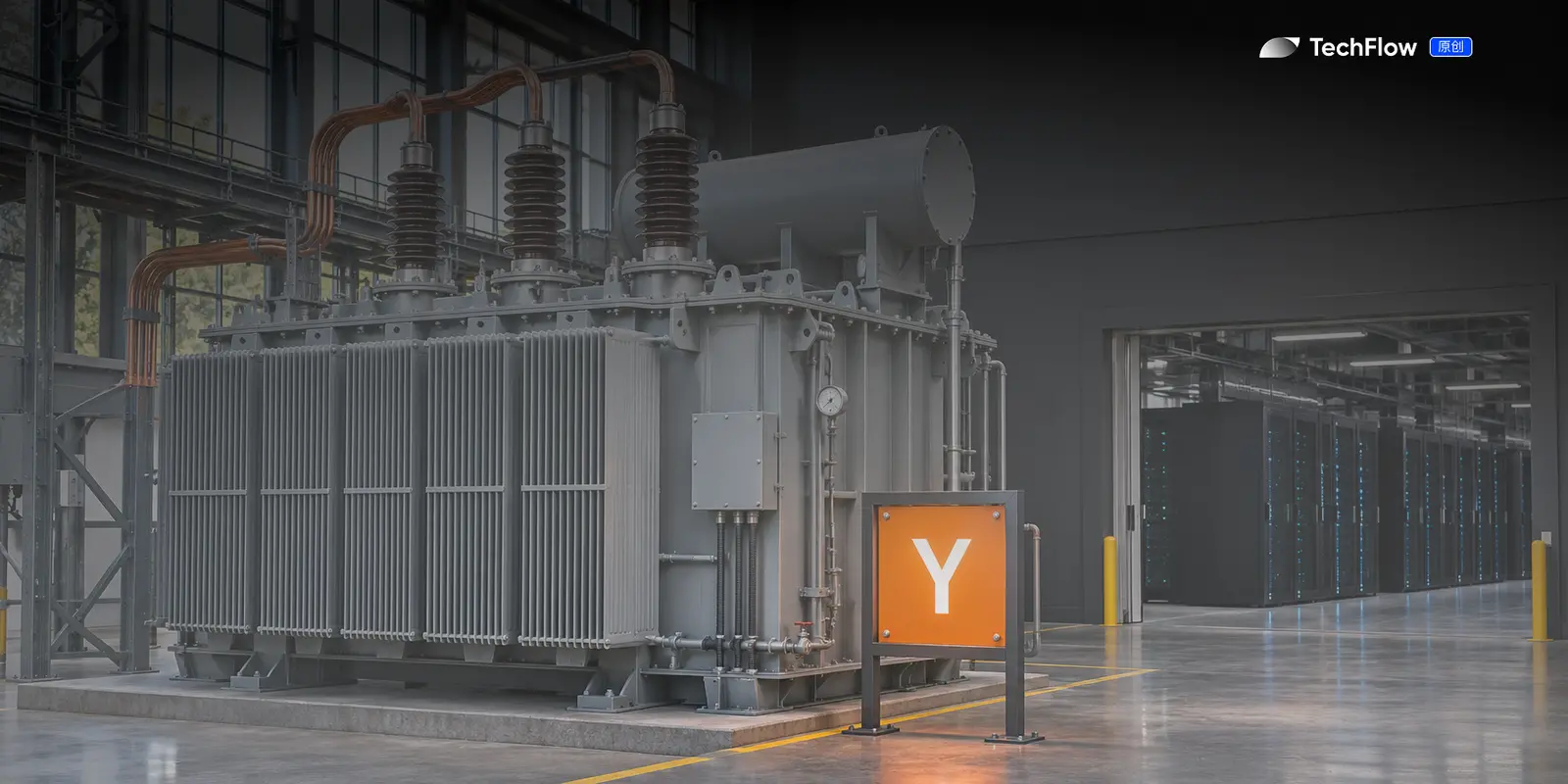
Jared Friedman's "Data Center Supply Chain" provides a shocking figure: the delivery cycle for large power transformers is three years.
No matter how many GPU chips there are, without power access, they are just scrap metal.
The entire AI industry's expansion speed is being choked by a type of power equipment from the last century.
Diana Hu's "Robots Made in America" points out another bottleneck: the U.S. only deployed 38,400 robots by 2025, while China has 94% of the global market for sintered rare earth magnet capacity.
Rare earth magnets are core components in robotic motors; with the supply chain in others' hands, the U.S. robotics industry is built on sand.
Transformers, rare earth magnets—these topics sound like ones from the last century, yet they are the directions YC wants to invest in most in 2027.
Brad Flora proposed two directions, forming an interesting comparison.
"The $15-an-Hour Expert" depicts a scenario of class transition driven by AI: when AI enables $15-an-hour ordinary workers to perform previously certified professional tasks, the entire vocational education and labor market will be rewritten.
"Wall Street for the Physical Buildout" points out that heavy asset projects like robotic factories, GPU clusters, and data centers need a set of entirely new financial products for financing and pricing.
One is liberating labor, while the other is liberating capital.
Diana Hu's other entry "Vertical Foundation Models" jumps out of the arms race of general large models and looks towards small specialized models in vertical fields like manufacturing, energy, and biology.
Jared Friedman's "LLMs That Write Well" points to a counterintuitive phenomenon: models that have been trained to become stronger in coding and math are regressing in writing ability.
This issue has a tangible impact on the content industry and marketing.
Gustaf Alströmer wrote two entries for government directions.
"Plaid for Government Benefits" creates a unified API for government welfare systems, while "AI for City Hall" aims to reshape local government administrative efficiency using AI.
The directions may not be sexy, but the market is enormous: the U.S. government spends over $100 billion annually on IT, most of which is consumed by legacy systems from the last century.
Jon Xu's "Own Your Intelligence" raises a strategic-level question: nearly all companies using AI are "renting intelligence," outsourcing core capabilities to a few model providers.
Open-source model performance has caught up; enterprises should consider "owning" their AI capabilities now.
Ankit Gupta's "Startups in a World of Abundant Space Access" looks at the space cost revolution brought by SpaceX's Starship.
Launch costs decreased by 100 times; things that used to only be possible for NASA can now also be done by startups.
"AI for the Air-Gapped Economy" focuses on environments such as military bases, nuclear facilities, and hospital operating rooms that cannot connect to the internet, where offline inference and localized deployment are almost a virgin territory.
Two Lists, One Main Line
When we overlay the Fall 2026 and Winter 2027 lists, an evolutionary trajectory of investment themes comes to the surface.
YC's focus is undergoing a fundamental shift: from software to hardware, from models to infrastructure, from the digital world to the physical world.
The sea-based computing, defense technology, and operating systems for the physical world from Fall 2026 have already sent signals; the supply chains for transformers, rare earth magnets, and domestic robot manufacturing in Winter 2027 have turned those signals into marching orders.
These directions share a common characteristic: each involves supply chain security and geopolitical contention, and YC's investment thesis is now deeply tied to U.S. industrial policy.
For the Crypto industry, the intersecting signals are also worth paying attention to.
The dedicated Crypto RFS from Fall 2026 and YC's USDC funding plan have already demonstrated the position.
Although Winter 2027 does not explicitly name Crypto, at least three directions naturally point to on-chain scenarios:
"Own Your Intelligence" calls for decentralized AI capabilities, DePIN, and decentralized inference networks are already in progress.
"Wall Street for the Physical Buildout" requires new financing tools, and on-chain RWA might be the most efficient answer.
"Proving You’re Human" (Fall 2026) combined with offline AI and Air-Gapped Economy (Winter 2027) forms a complete demand map for decentralized identity and privacy computing.
YC is doing subtraction, and Crypto entrepreneurs should be doing addition at these intersections.
免责声明:本文章仅代表作者个人观点,不代表本平台的立场和观点。本文章仅供信息分享,不构成对任何人的任何投资建议。用户与作者之间的任何争议,与本平台无关。如网页中刊载的文章或图片涉及侵权,请提供相关的权利证明和身份证明发送邮件到[email protected],本平台相关工作人员将会进行核查。


