Author: Glassnode, a digital asset data, analysis and research organization
Compiled by: Gu Yu, ChainCatcher
The sharp decline in Bitcoin has elevated the realized losses to capitulation levels and cleared out leverage. The price is holding in the recent buyer concentration area between $62,000 and $66,000, while the region below $60,000 has seen the largest buy orders since August. Demand for Bitcoin remains weak, while tokenized real-world assets continue to proliferate across the industry.
Executive Summary
This decline has brought about conditions seen at previous local bottoms: realized losses reaching capitulation levels, leverage being cleared, and the largest buy orders since August appearing below the price.
The price has maintained the recent buyer concentration area between $62,000 and $66,000, but demand for Bitcoin remains weak. If the daily closing price falls below this concentration area, it could trigger a rapid downward move towards the realized price of $53,700.
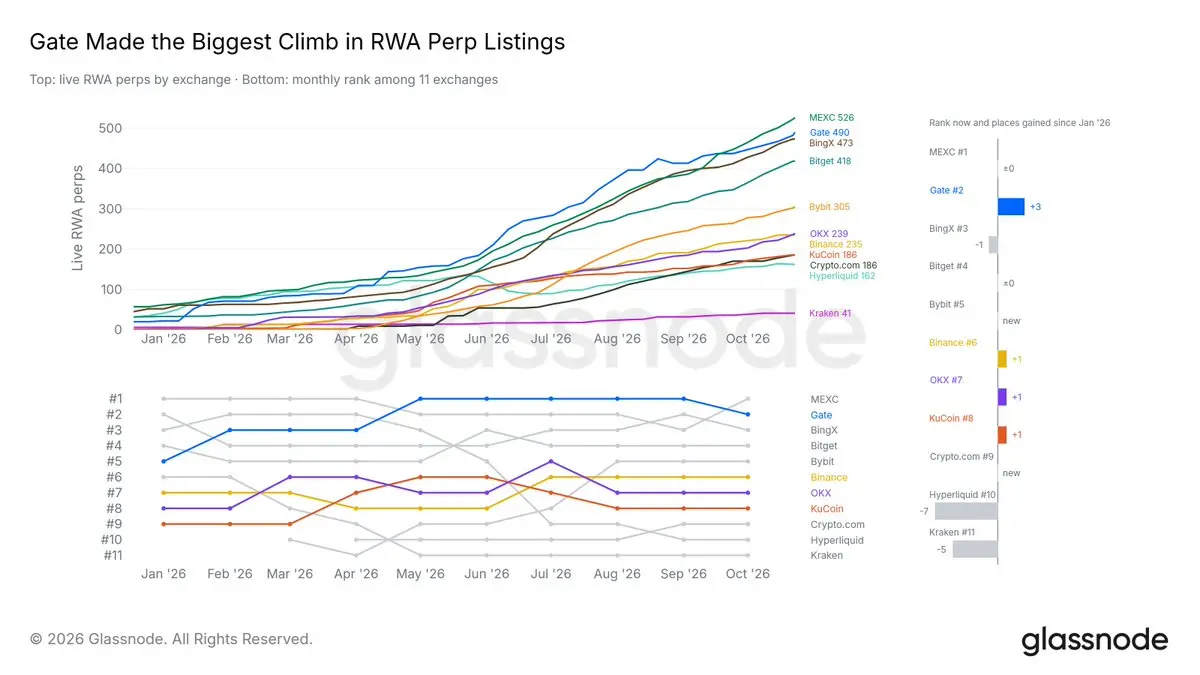
Major exchanges have now launched perpetual contracts for stocks, commodities, and other real-world assets: increasing from about 190 at the beginning of the year to more than 3,200 now. Gate has seen the largest rise in ranking, moving from fifth to second place.
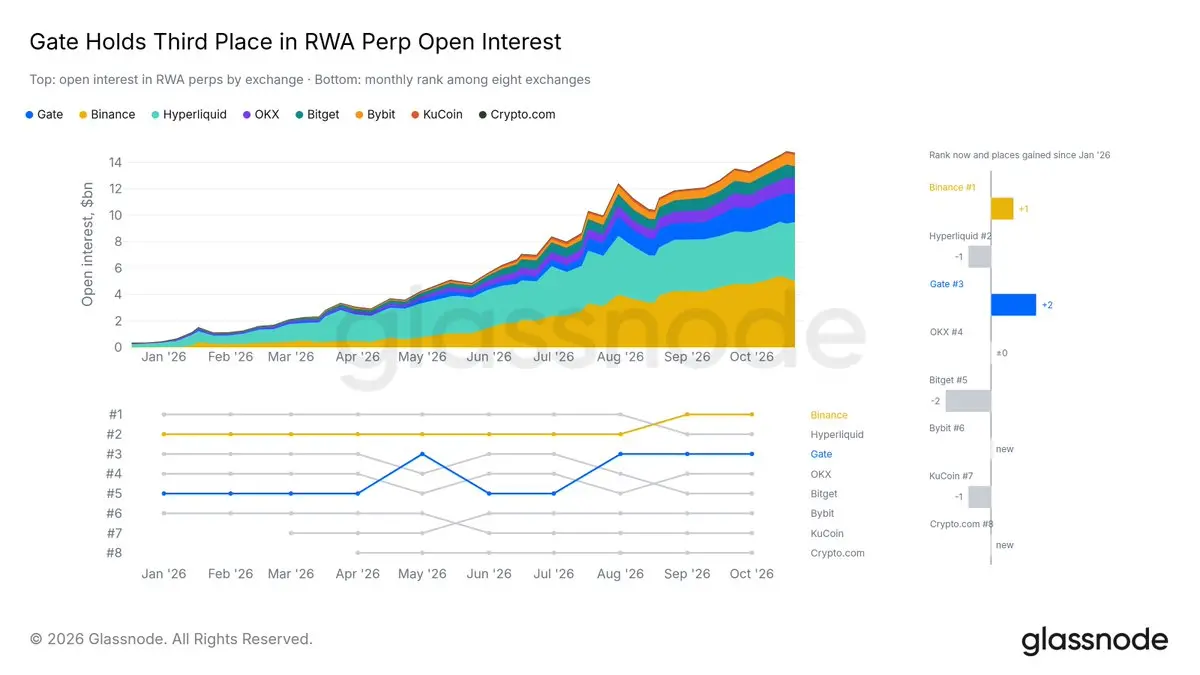
The open interest for these RWA perpetual contracts has grown to about $15 billion, with Gate ranking third, behind Binance and Hyperliquid.
Ready to stay ahead of the market and sharpen your forward insights? Welcome to try Glassnode. Register or Contact Sales.
Market Compass
Capitulation Sentiment Spreads
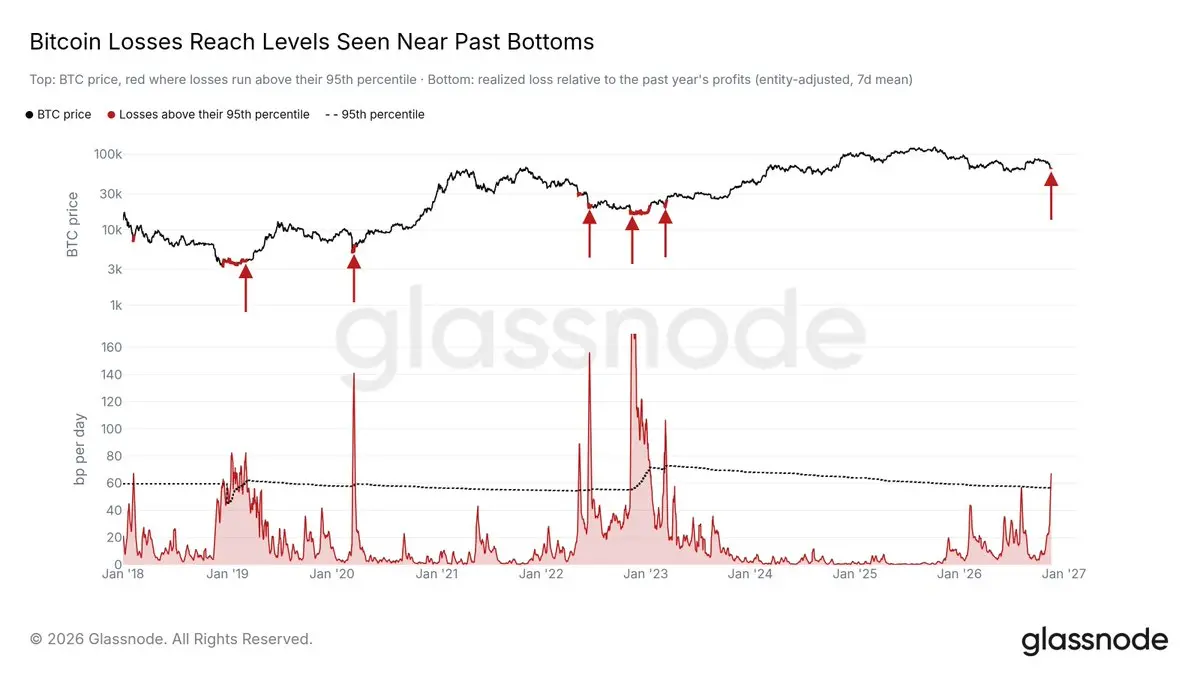
The crash caused Bitcoin to drop to $62,000 on November 15, with investors selling at an unprecedented scale. For cross-year comparison, this chart compares realized losses (i.e. losses locked in when tokens are sold below their purchase price) with profits obtained over the past year.
This indicator has currently reached levels only seen at prior lows in 2018, 2020, 2022, and early 2023, marking a first since then. Such a surge indicates a capitulation event where investors who bought at highs completely give up, selling to anyone willing to take over.
Recent Buyers Abandon Resistance
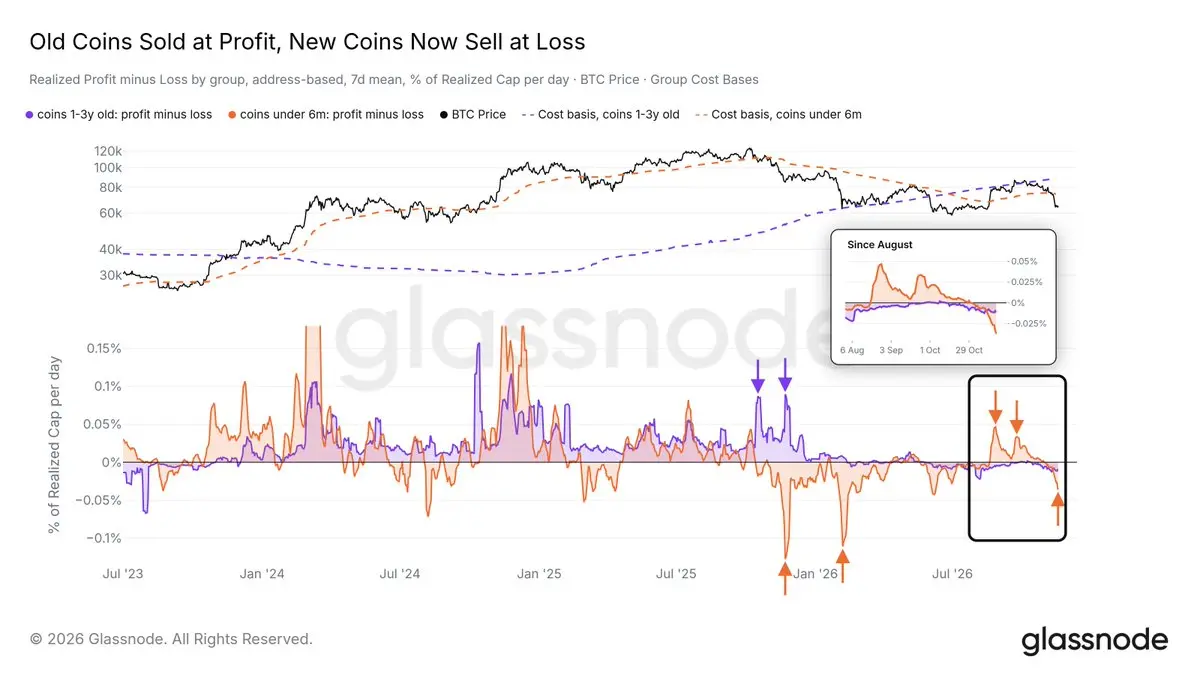
The sell-off is coming from recent buyers. Tokens held for one to three years locked in their last significant profits by the end of 2025 and have since been quiet. Holders with less than six months of ownership have suffered severe losses at the beginning of 2026, profiting from the rebound in September and October, but are now selling at a loss.
The current price is below the average cost paid by these two groups, as indicated by the dashed line on the chart. As long as the price remains below this level, more recent buyers may choose to sell at a loss rather than continue to wait.
Defending the August Concentration Area
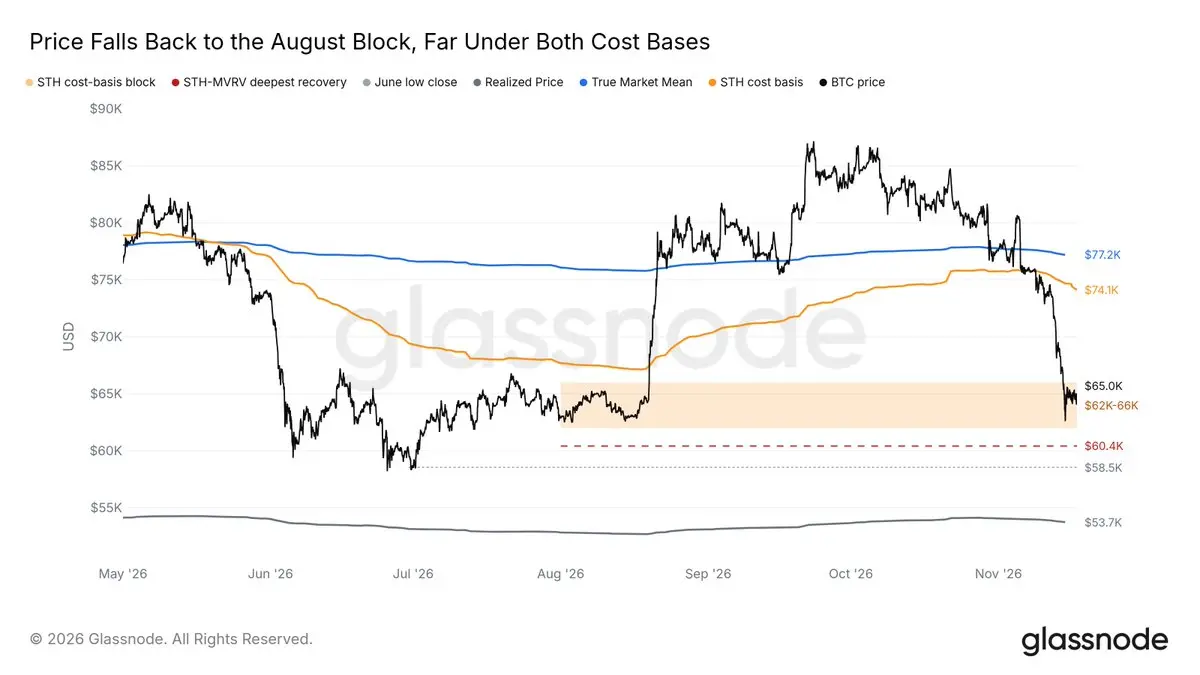
Last week, we pointed out that the concentration area between $62,000 and $66,000 is the only strong support below the price, and this crash has now touched that region. Short-term holder cost distribution shows where recent buyers have purchased. This concentration area formed around the August low contains about one-fifth of their tokens and saw an increase of approximately 6,600 BTC over a full two days of severe selling as buyers entered the market.
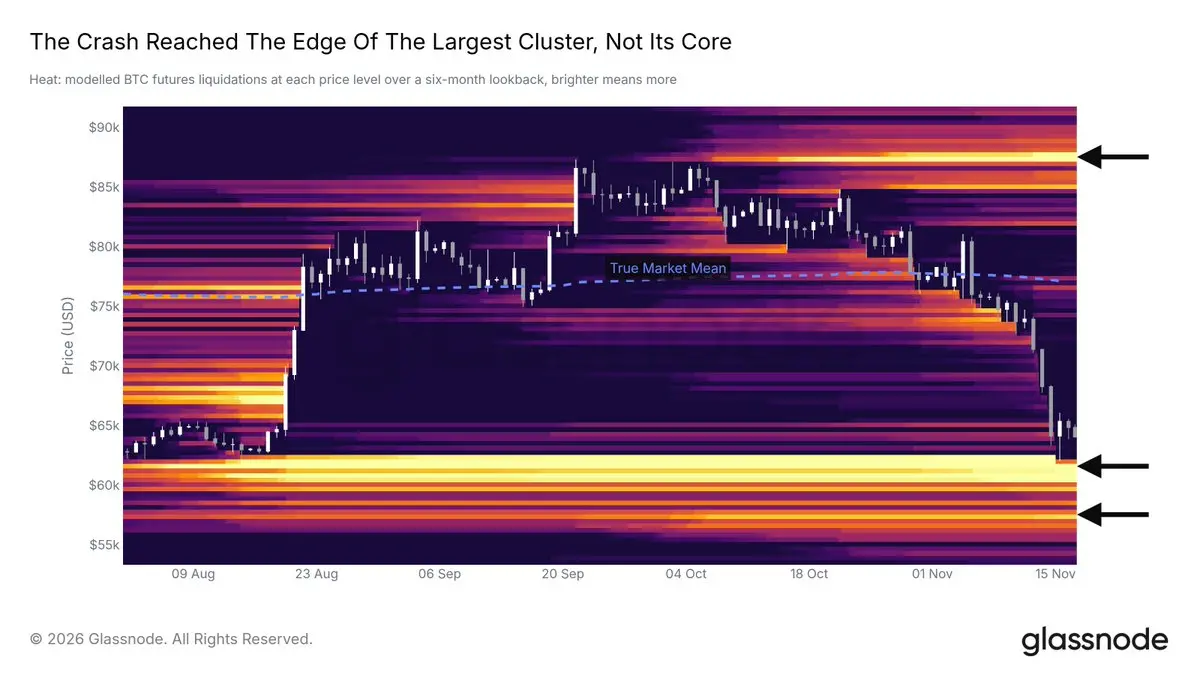
This makes it a line that must be held, with significant risks below it. Very few tokens were bought by short-term holders below $62,000, and the largest remaining long liquidation cluster on the map is just below it. If the daily closing price falls below this concentration area, it will put August buyers into a loss and force leveraged longs to exit, potentially turning the breach into a rapid decline. The next points to watch are the June low of $58,500 and the last average price of each token's movement—the realized price of $53,700.
Above, the $74,100 short-term holder cost benchmark marks the overall break-even position for recent buyers.
Complete Liquidation of Leverage
This crash massively cleared leveraged longs: measured by open interest, November 13 and 14 saw some of the largest long liquidations since 2023. The liquidation heatmap simulated the prices at which leveraged futures positions were forced to close, revealing that most of the longs piled up above $62,000 have disappeared. The heatmap from last week appears very sparse between the current price and the large cluster around $60,000, as this crash directly passed through that vacuum zone.
The cluster remains between $59,500 and $62,200 below. The low on November 15 touched its upper edge but remained above its core. If prices probe down again, there may be a final wave of cleansing there, although most of the passive selling above $62,000 has already occurred. The largest cluster of short positions is still far above around $87,500.
Buy Orders Await Below
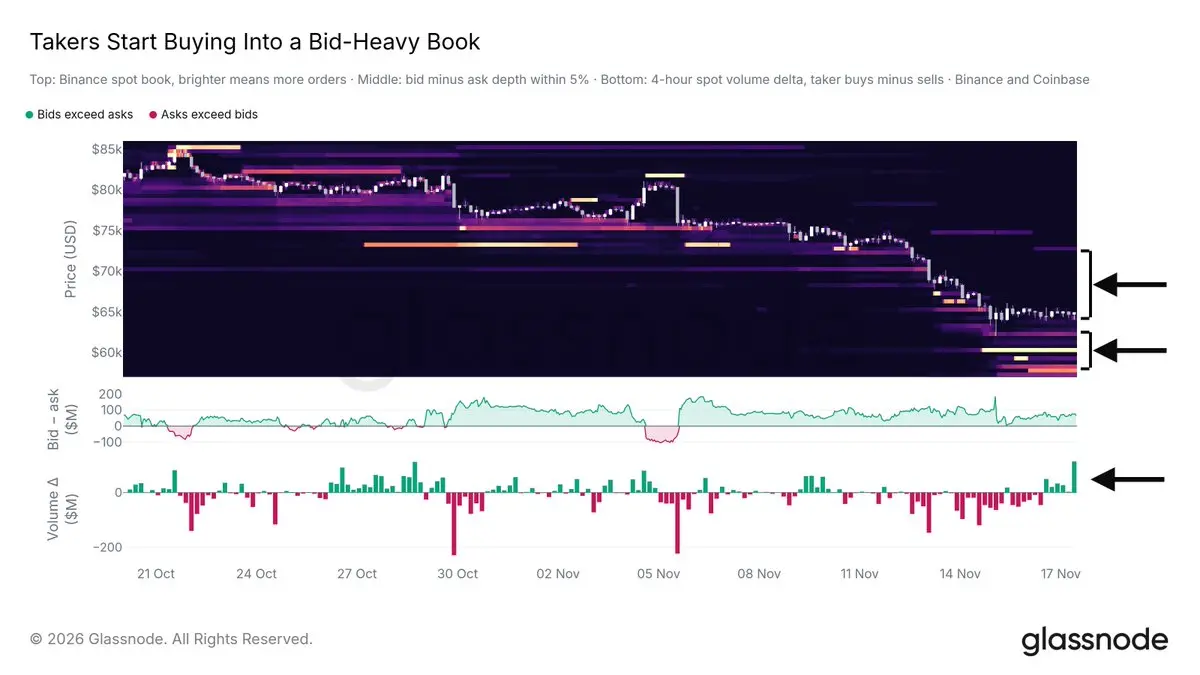
Within a 5% range of the price, buy orders on Binance and Coinbase are currently approximately 2.3 times that of sell orders. Since late August, buy orders have typically been only slightly above sell orders. The brightest band on the heatmap around $60,000 is the largest single buy price point from Binance since August.
As indicated by the red bar lines, the takers aggressively sold these buy orders during the plunge. Over the past day, they have turned to net buyers. Orders can be withdrawn at any moment, so these buy orders are only most important when they are filled.
Premium at the Low
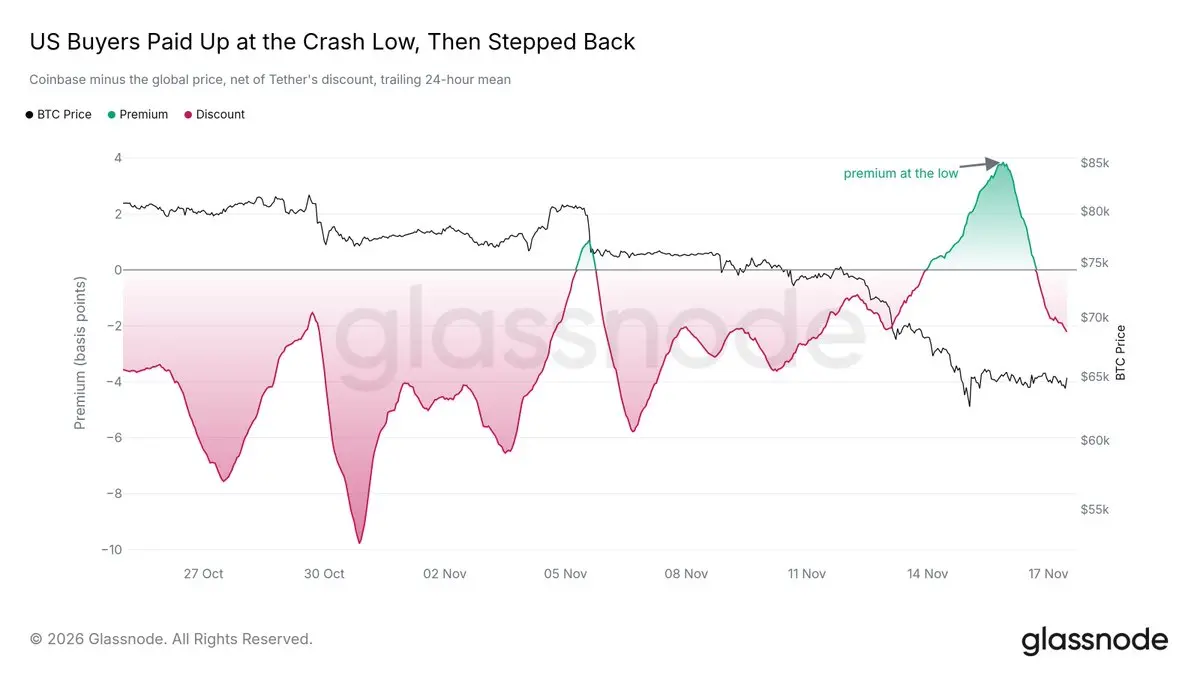
Coinbase Premium compares the Bitcoin price on Coinbase, the primary trading venue for U.S. investors, with global prices. Since late October, this premium has been negative almost every hour. Over the weekend of the low, as U.S. buyers were actively buying, this indicator turned positive and peaked on the evening of November 15.
Since then, it has retreated to a slight discount. If the premium can turn positive and hold, it will indicate that demand in the U.S. is genuinely returning.
Funds Flowing Out into Treasuries
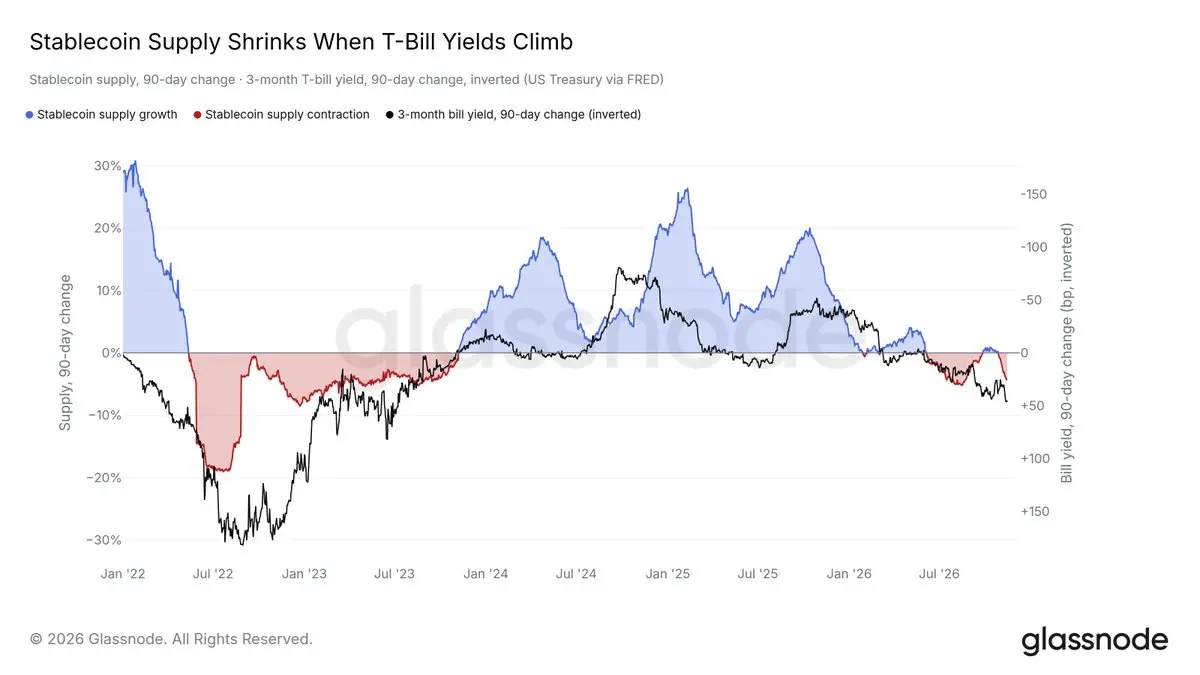
Aside from buying at the low, overall demand remains weak. As the cash of the crypto market, stablecoins have shrunk by 4.2% over the past 90 days.
Since 2022, when short-term Treasury yields rise, the supply of stablecoins tends to contract. Stablecoins do not pay any yield to their holders, while issuers can earn the yield from the Treasuries backing them, so when yields rise, holders will exchange stablecoins for Treasuries or money market funds. The yield on 3-month Treasuries has risen by about 45 basis points over the past 90 days, causing the supply of stablecoins to decline. During the period of the fastest rise in yields in 2022, supply fell by nearly one-fifth in three months. If yields stop rising, this pressure of extraction on crypto funds may ease.
Miners Selling to Fund AI Transformation
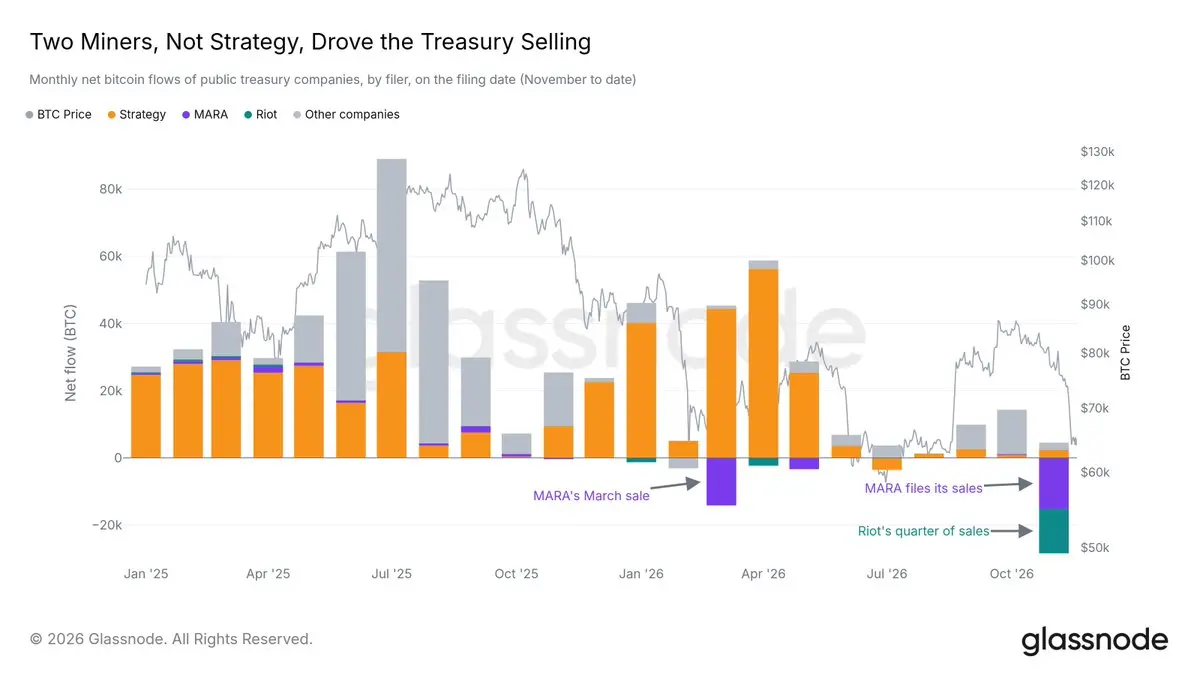
Miners have also been selling. MARA and Riot reported selling about 28,000 BTC in total this month, while Strategy continues to buy. Both mining companies are venturing into AI and high-performance computing data centers, and selling Bitcoin helps fund this transformation. Outside of these two, treasury reserve companies have been net buyers in November.
U.S. spot ETFs exhibit the same lack of interest, experiencing net outflows of $2.6 billion over the ten trading days ending November 13.
Key Upcoming Events
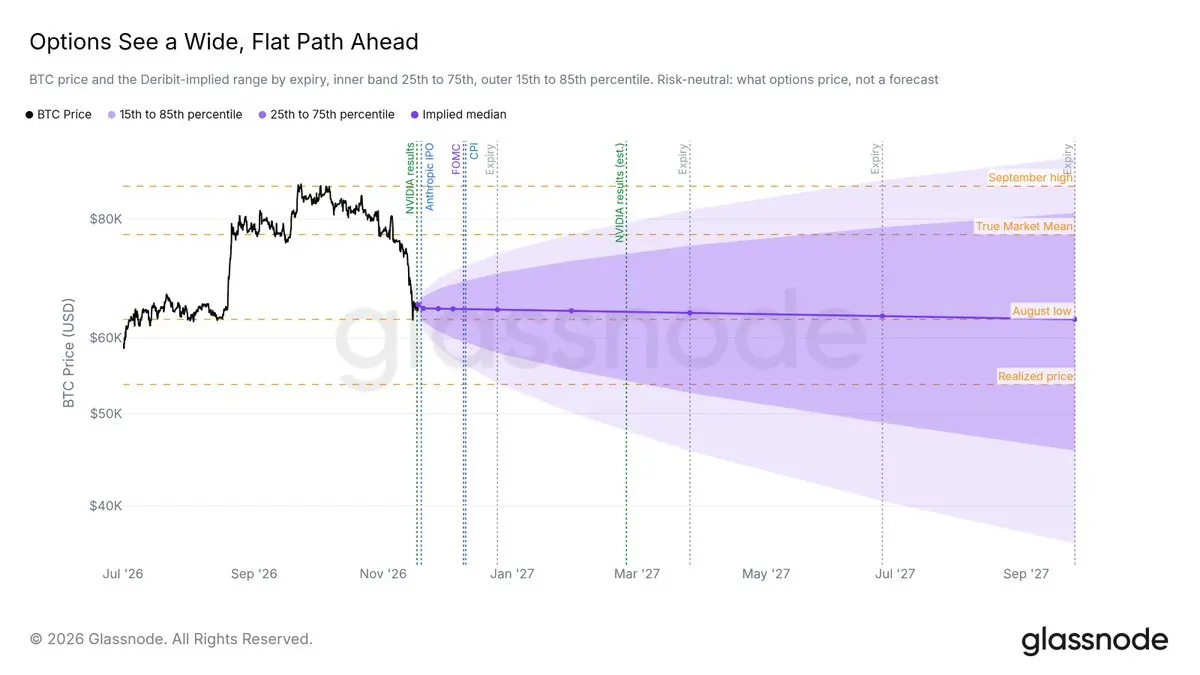
Options reflect the degree of uncertainty the market is pricing in. The Deribit options implied price range is steadily widening as we approach 2027, with the median remaining close to current price levels. By the time of the September 2027 expiration, the options pricing shows a probability of about one-third that the Bitcoin settlement price will be below the realized price of $53,700; while the probability of the settlement price being above the September highs is about 20%.
Several upcoming events in the coming weeks could change this range. NVIDIA will release quarterly results today following last week's CEO resignation. Anthropic is expected to be listed on NASDAQ on November 19. The Federal Reserve will decide on interest rate policy on December 9, the day before the November CPI data is released.
Familiar Altcoin Liquidation
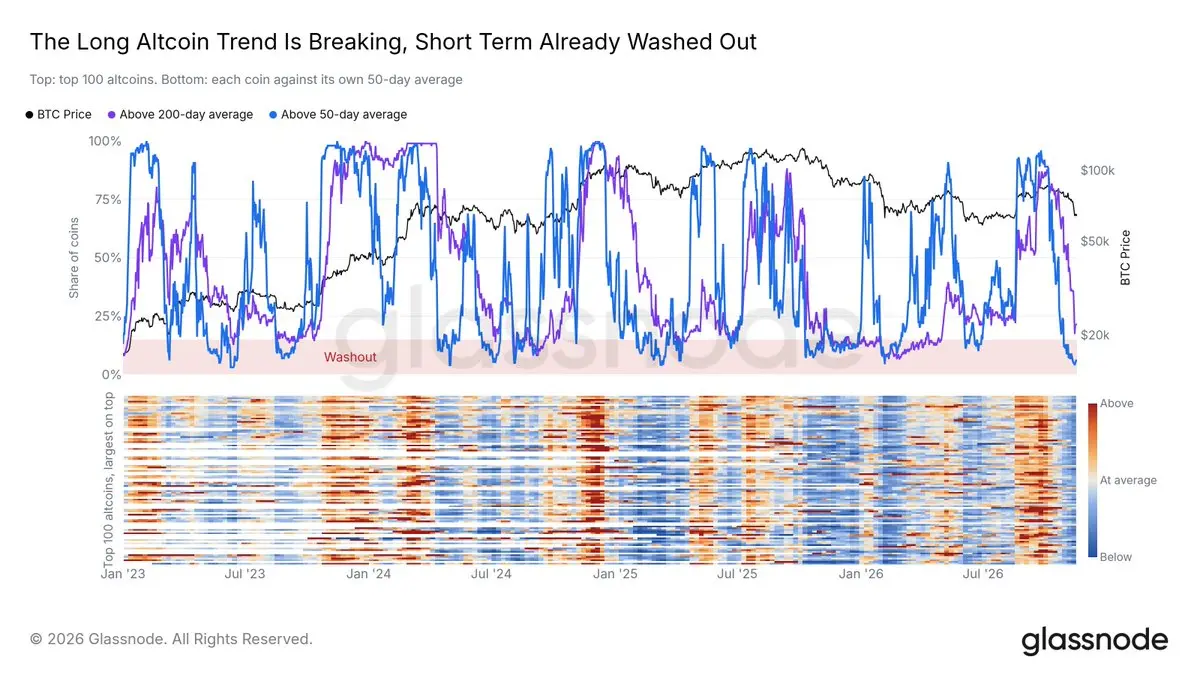
Among the top 100 altcoins, only 6% of trading prices are above the 50-day moving average, deeply trapped in the liquidation zone. The proportion above the 200-day moving average plummeted from over one-third to 21% in just one week.
In every year since 2023, the most thorough liquidations have occurred within four days of Bitcoin reaching local lows, and every time Bitcoin’s price has risen 60 days later. However, the longer-term trend remains compromised: the proportion above the 200-day moving average has not reached the bottom levels seen at previous lows. If the summer low can establish itself as a cycle bottom, these historical precedents indicate that the altcoin sell-off is nearing exhaustion.
Ongoing Development in the Crypto Space
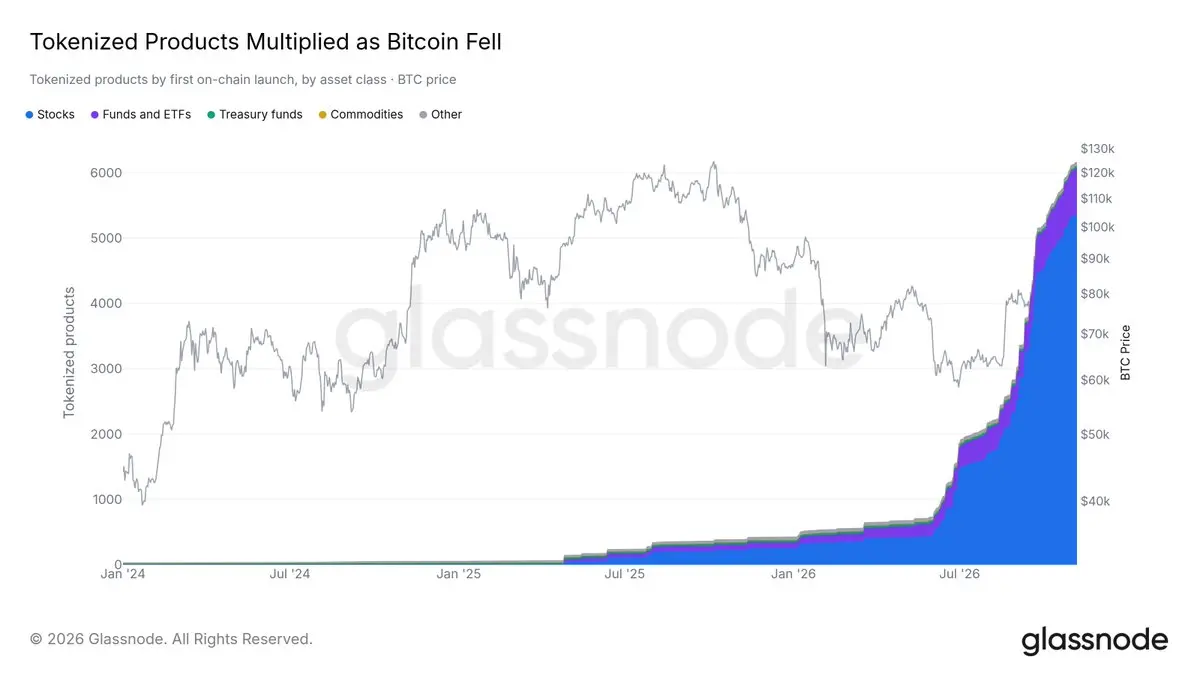
While Bitcoin is struggling to attract new funds, other parts of the crypto space continue to build. The number of active tokenization products bringing stocks, funds, and other real-world assets onto the blockchain has grown from 428 at the beginning of the year to about 6,200 by early November. During the same period, Bitcoin has dropped by 15%. Tokenized stocks account for most of the growth, and trading has extended to major exchanges.
Exchanges Competing to Launch
Perpetual contracts are futures contracts without expiry dates. Major exchanges are now also offering perpetual contracts covering stocks, ETFs, indices, commodities, and currencies. We refer to these as RWA perpetual contracts, which are based on real-world assets. The number of tradable RWA perpetual contracts available on the exchanges we track has grown from about 190 at the beginning of the year to over 3,200 now.
Based on the number of launched RWA perpetual contracts, Gate has seen the largest increase this year compared to any other exchange: rising from fifth in January to second now, and topping the rankings between June and September. The platform currently offers 490 varieties, up from just 20 at the beginning of the year.
Open Interest Climbing
Traders are closely following the newly launched varieties. In eight exchanges that we can track, the open interest for RWA perpetual contracts (i.e., the total value of all open positions) has grown from about $35 million at the beginning of the year to about $15 billion now.
Gate accounts for about $2.1 billion of that, more than 20 times its level in January, and has consistently ranked third in weekly data since late July, next to Binance and Hyperliquid.
Open interest is a way for traders to vote with their feet, indicating where they trust to place their margins. After experiencing the largest hacking incident in cryptocurrency history last month, the trust landscape of platforms has changed. To earn traders' trust (which this approach has proven very successful), Gate published a security statement alongside its proof of reserves to show how it secures these funds. Gate reports that even if all hot wallets are lost, the assets held in cold storage or by independent custodians can still cover 104.58% of user assets. Please note that this is data disclosed by Gate itself, and independent third-party audits are underway. To protect individual accounts, Gate also offers a Gate Guard free program that can compensate eligible users up to $200,000 each time their account is hacked and funds moved.
Conclusion
Bitcoin has undergone a cleansing: realized losses have reached capitulation levels, and leverage has been cleared. At the lows, the August concentration area absorbed the selling pressure, and buyers entered the market at a premium on Coinbase. However, widespread demand remains absent, stablecoins are shrinking, miners are selling, and funds are flowing out of ETFs.
The concentration area between $62,000 and $66,000 is the current focus. If it can reclaim the short-term holder cost benchmark of $74,100, it will confirm that a bottom is forming. If the daily closing price falls below $62,000, it will put August buyers in loss, and due to the lack of buyers below and the accumulation of long liquidations, this will open the downside channel towards the June low of $58,500 and the realized price of $53,700.
Data as of November 17, 2026, 13:00 UTC.
免责声明:本文章仅代表作者个人观点,不代表本平台的立场和观点。本文章仅供信息分享,不构成对任何人的任何投资建议。用户与作者之间的任何争议,与本平台无关。如网页中刊载的文章或图片涉及侵权,请提供相关的权利证明和身份证明发送邮件到[email protected],本平台相关工作人员将会进行核查。


