The goal of the project is not to pursue the number of licenses, but to ensure the integrity of the operational structure.
Written by: Shao Jia Dian
In the stage of a cryptocurrency payment project, licenses are usually not the first issue to surface. The company may have already obtained CASP authorization, completed FinCEN MSB registration, and connected with licensed payment institutions abroad, but the business may still get stuck in specific aspects like customer funds, wallet control, fiat accounts, and merchant settlements.
Once the business is actually running, several problems will quickly emerge: the institutions capable of handling digital assets may not be able to undertake euro payments; banks may be willing to open operational accounts but do not accept long-term aggregation of third-party customer funds; the companies responsible for customer development, contract signing, wallet control, and transaction execution may also belong to different entities within the group.
As a result, each company in the group has its own regulatory identity, yet the entire transaction still cannot be completed smoothly. The number of licenses does not solve this problem; the key is whether customer, asset, fiat, and responsibility are integrated into the same executory business chain.
Licenses can only answer whether a certain entity can engage in a regulated business. Who receives the customers, who controls the stablecoins, who pays the euros, why the bank accepts this fund, and who handles refunds or freezes, all need to fall under specific entities, contracts, accounts, and system permissions.
Previous articles have discussed MSBs in the United States, MSBs in Canada, DCEs in Australia, MiCA CASPs in the EU, VARA in Dubai, stablecoins in Hong Kong, and licensed collaborations. Returning to the actual operation of cryptocurrency payments, the question is quite simple: if each link has compliance arrangements, why can't the transactions still take place?
The focus of judgment is on which entities, accounts, and systems the transaction actually passes through; one cannot just look at the list of licenses.
The project needs to break down customer wallets, asset custody, stablecoin exchanges, on-chain transfers, fiat payments, and merchant settlements one by one, clearly stating which entity completes each function, based on which authorization, and who bears the responsibility when issues arise.
The project needs a table that corresponds business functions to regulatory identities: customer wallets, asset custody, stablecoin exchanges, on-chain transfers, fiat payments, and merchant settlements, indicating which entity completes each item, based on which authorization, and who bears the responsibility when problems arise.
01 The license list does not reflect real business
The most common mistake projects make is to place all regulatory qualifications obtained by the group on the same promotional page, and then believe that these licenses cover all operations.
For example, the group has MSB registration in the United States, CASP authorization in Europe, and partnerships with licensed payment institutions in other regions. These regulatory identities are certainly valuable, but they cannot simply be added together.
The MSB registration from FinCEN in the United States does not cover a unified operating license for all Money Transmission business across the United States; specific activities still need to be judged in conjunction with state laws.
EU CASPs can enter other member states through the Passporting mechanism of MiCA after completing the required cross-border notification, but what can be offered across borders is still limited to the original authorized range of cryptocurrency services. It will not automatically gain all the business permissions of payment institutions or electronic money institutions just by completing Passporting.
For stablecoin payment projects, the issues may be even more complex. On March 2, 2026, the transitional period previously set by the EBA for MiCA and PSD2 will end, and part of the services involving electronic money tokens (EMT), transfers, and custody wallet services may require resolving payment service authorization issues simultaneously.
This means that the project cannot simply ask how many licenses the group has; it must also confirm item by item: customer wallets, asset custody, stablecoin exchanges, on-chain transfers, fiat payments, and merchant settlements, which specific entity and authorization each falls under.
The project needs is a table that corresponds business functions to regulatory identities, not a list of group licenses.
02 Customer relationships, asset control, and fund paths do not match
Assume a corporate client is preparing to make a payment to a European merchant.
The client registers on the project's official website, uploads corporate information, and completes KYC/KYB, and then transfers stablecoins to a designated wallet on the platform. The platform completes the exchange and then transfers euros to the merchant's bank account through a payment partner.
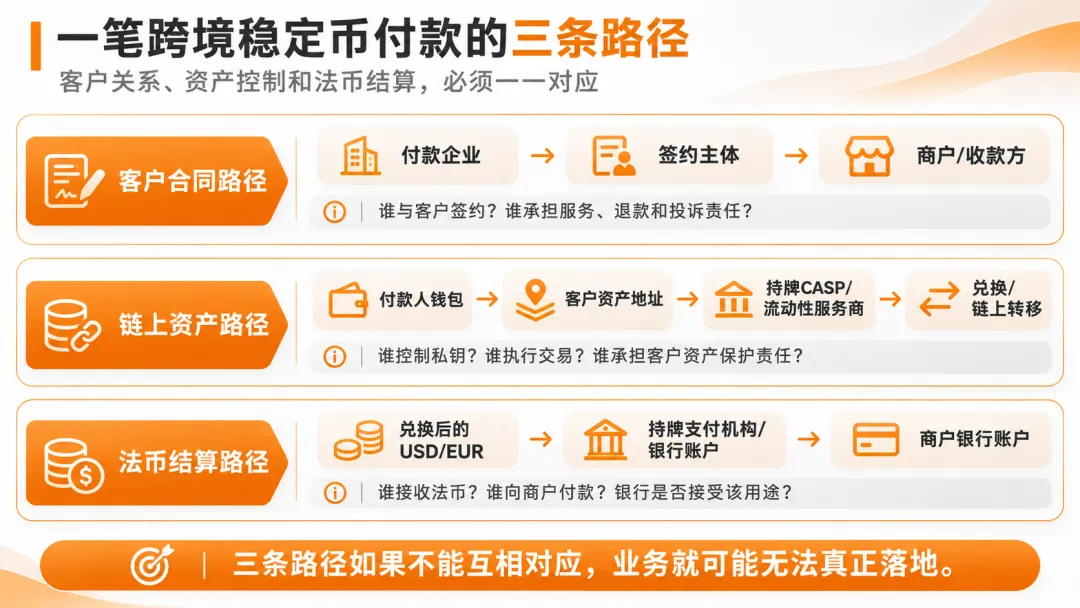
What the user sees may be just one payment, but regulatory and bank due diligence needs to reconstruct at least three different paths.
The first path is the customer relationship path. Which company in the group does the client actually sign the service agreement with? Does the client purchase digital asset exchange services, fund transfer services, or a complete cross-border payment service? In the case of refunds and complaints, which entity should be responsible?
The second path is the cryptocurrency asset control path. Which address does the client’s stablecoin enter? Who controls the private key? When is the asset transferred to a CASP or liquidity provider? Who has the authority to decide on transaction execution, and who bears the responsibility for protecting customer assets?
The third path is the fiat fund path. Whose account does the dollars or euros post-exchange enter? Is that account allowed to receive related funds? Who ultimately executes the payment to the merchant, and can the bank identify the actual payer and payee?
If the client signs a contract with a European CASP but the assets and fiat are controlled long-term by other entities without the corresponding business permissions, the project needs to re-examine the actual entities providing services and their legal responsibilities.
If the contract states technical services while it is a technology company that actually receives customer funds and decides transactions, it cannot simply be deemed as entirely unrelated to financial regulation based solely on the contract title.
03 Having licenses does not mean banks will be willing to undertake transactions
This is also where the earlier problems are likely to converge and expose themselves.
The enterprise may have obtained regulatory permission and found partners that can provide fiat services, yet it still cannot establish a stable payment and receiving account.
The reason is not necessarily that banks reject the cryptocurrency asset industry, but that the proposed account use cannot be recognized by the banks.
For example, banks may allow companies to open accounts for payroll, rent, and normal operational expenses, but this does not mean that the account can be used directly for receiving payment funds from multiple third-party clients.
A licensed institution may be able to process specific types of financial transactions, but that does not mean its banking partner has approved all customer regions, transaction amounts, sources of funds, and merchant categories.
The European Banking Authority (EBA) emphasizes that financial institutions should assess clients based on actual risk, and excessive de-risking should not be applied to entire classes of clients without adequate basis. However, banks still need to comply with anti-money laundering requirements and decide whether to establish or continue business relationships when they cannot effectively manage relevant risks.
Therefore, even if the project is licensed, it needs to explain to banks: what the account is specifically used for, how customer funds are formed, whether transactions correspond to real business activities, which steps the on-chain assets go through, and how the enterprise identifies and handles abnormal transactions.
If this explanation cannot be established, merely increasing licenses may not solve the account opening problem.
Licenses can prove that a business has a legal operational foundation, but banks still need to judge whether they can bear the risks that come with said business entering their account system.
Thus, a truly mature licensing plan should not wait until permits are approved before seeking out banks.
Account types, payment and receipt paths, clearing methods, and the business access scope of banking partners should be considered simultaneously when designing licenses and group structures.
04 Many licensed partners exist, but no one takes responsibility for the complete transaction
The cryptocurrency payment industry has formed numerous mature infrastructure cooperation modes.
Wallets can integrate third parties, identity verification can call upon KYC service providers, exchanges can be handled by liquidity institutions, and fiat payments can be undertaken by PI, EMI, or banks.
This division of labor in itself is not problematic. For companies not planning to hold licenses in every market independently, reasonably utilizing licensed institutions may even be a more efficient choice.
However, as the number of partners increases, the responsibilities become easier to spread out.
For instance, a customer payment is paused due to a risk alert triggered by the on-chain address. The wallet service provider believes it is only responsible for technology, the CASP believes that KYC is handled by the front-end platform, the payment institution thinks the assets’ source is not part of its review scope, while the project team believes the entire process has been entrusted to licensed partners.
If when an abnormal transaction occurs, all parties then begin to discuss who has the authority to freeze, who is responsible for explanations, and who contacts the client, it indicates that this cooperation relationship has not yet formed a truly executable responsibility arrangement.
Article 73 of MiCA poses clear requirements for CASP outsourcing: Enterprises can outsource operational functions but must not transfer their own regulatory responsibilities due to outsourcing, nor may it alter the relationship or authorized conditions between CASPs and customers.
Licensed cooperation must address interface integration and business sharing while clearly defining boundaries of responsibility.
Cooperation agreements should also specify customer access, transaction instructions, asset control, compliance monitoring, anomaly handling, data sharing, complaints and refunds, regulatory inspections, and how to transition customers after termination of cooperation.
For regulated services that enterprises have already provided, one cannot simply replace necessary authorizations with the licenses of partners.
The ability to delegate service completion does not equate to the ability to delegate regulatory responsibility.
05 Business has run smoothly, yet sustainable risk control cannot be established
Some projects can complete test transactions and provide transfer and exchange services for a small number of clients, but once they scale, they may still encounter significant obstacles.
The reason lies in that completing a single transaction and operating a financial business long-term require different standards.
Early projects may only serve a small number of corporate clients, with clear transaction sources and fund uses. However, as the platform begins to cover more countries, increase the number of merchants, support self-custody wallets, or integrate multiple liquidity providers, the risk management demands will also change.
In July 2026, the FATF published the seventh update on the regulatory implementation of virtual assets and service providers, particularly emphasizing concerns over stablecoins being misused, self-custody wallet-related transactions, offshore VASPs, DeFi arrangements, and challenges in actual implementation of the Travel Rule.
This means that for cryptocurrency payment projects, compliance cannot end at completing one KYC during account opening or purchasing an on-chain analysis tool.
The project needs to continuously identify customers and trading counterparts, monitor abnormal transactions, fulfill applicable Travel Rule information requirements, and handle sanctions, fraud, and suspicious fund risks.
The more immediate problem is how to address the situation when customer funds have entered the platform, but transactions cannot be executed or banks refuse to settle. If a partner suddenly stops services, can the platform promptly identify affected customer assets and arrange for refunds or other legal measures?
A truly mature risk control system should cover before a transaction begins, during execution, and after transaction failures.
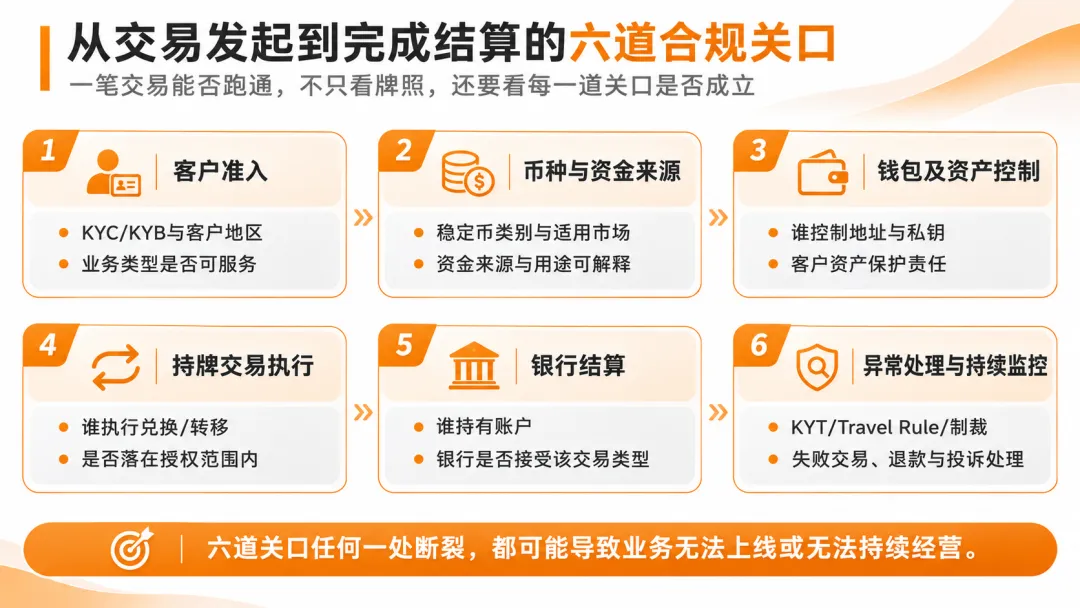
06 Before going live, conduct a complete stress test with one transaction
Instead of checking all licenses and regulatory documents together, it’s better to select a typical business scenario the project is preparing to launch and simulate it from start to finish.
For instance, an Asian company uses a stablecoin that meets applicable regulatory requirements to pay a European supplier, and the supplier ultimately receives euros.
The project needs to answer the following questions according to the actual business process.
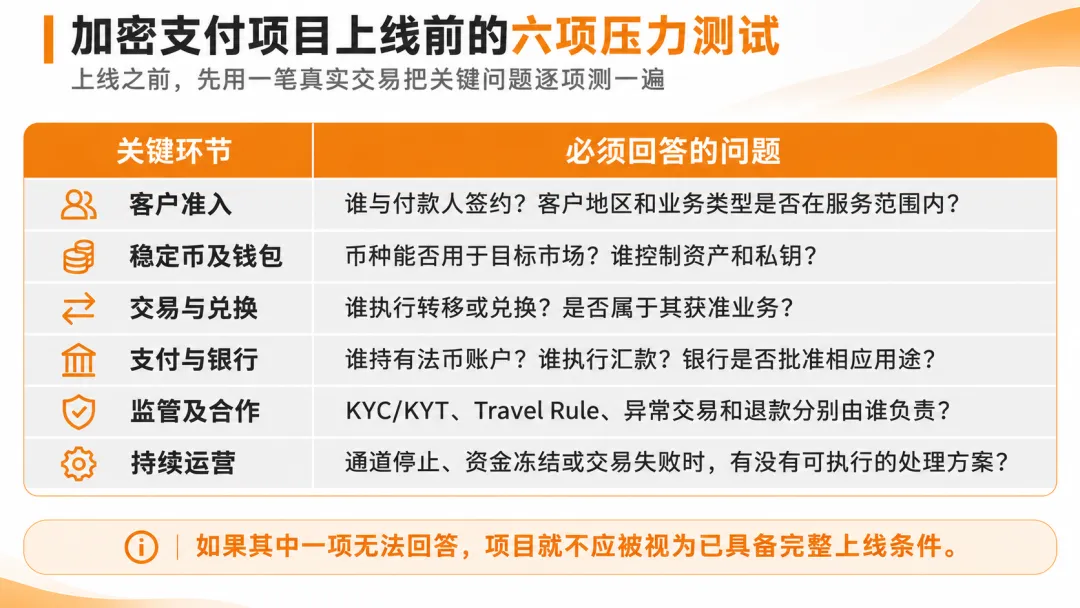
If there are questions that cannot be answered, the project cannot claim that it has met complete launch conditions, nor can it use previously licensed steps to cover this gap.
Some problems cannot be solved merely by obtaining an additional license. If banks reject specific types of customer funds, adjustments may be required for accounts and transaction structures; if internal responsibilities are unclear, the contracting and asset control entities may need to be redefined; if partners lack access to transaction data, then system permissions and agreement arrangements may need to be modified.
For enterprises, this inspection method is closer to real operations than simply comparing license numbers.
07 Collaborative multi-licensure, the three diagrams are essential
A company preparing to conduct global cryptocurrency payment business for the long term does not necessarily need to establish fully independent business systems in every market.
However, it must confirm that different regulatory entities can work together according to clear rules.
A more reasonable planning approach can be divided into three stages.
First stage: Design business, then choose regulatory pathways.
The project needs to clarify which countries the main clients are located in, where the funds come from, where the final settlements occur, and whether the products involve issuing, custody, exchanging, transferring funds, or traditional payment services.
On this foundation, the group can determine which qualifications it needs to hold independently and which businesses can be completed through licensed cooperation.
Second stage: Synchronize design of licenses, accounts, and funding paths.
Enterprises should determine customer contracting entities, asset control methods, bank account purposes, payment partners, and internal and external service agreements during the main structural phases, rather than add individual companies each time a license is obtained.
For projects that plan to expand into multiple markets in the future, they also need to consider local customer access, cross-border service restrictions, and business licensing scopes in advance.
Third stage: Verify the entire structure in real transactions.
Before officially launching on a large scale, representative clients and transaction types should be selected to verify whether the flow of funds, information, and responsibilities are consistent according to approved testing arrangements, and examine handling capabilities in case of abnormal transactions, cooperation interruptions, refunds, and customer complaints.
The focus is not on completing a successful payment, but rather on confirming whether the entire business can be sustainably executed in real operation.
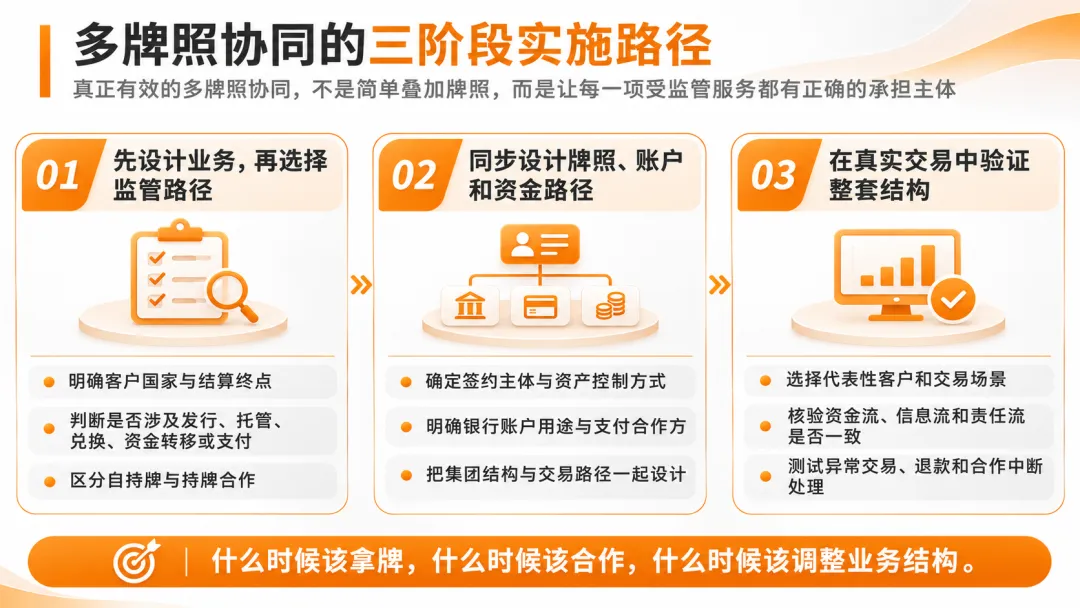
When to obtain a license, when to collaborate, and when to adjust the business structure.
Conclusion: Licenses must ultimately transform into executable payment pathways
From MSBs in the United States, MSBs in Canada, and DCEs in Australia, to DASP in El Salvador, VASP in the Cayman Islands, as well as EU MiCA, VARA in Dubai, stablecoins in Hong Kong, and collaborative multi-licensing, we discussed the regulatory paths of various countries and regions in the "Global Cryptocurrency Payment Compliance Map."
These systems each have their characteristics and correspond to different market and business needs.
However, if we look at the entire series together, we can find that one problem persists:
A cryptocurrency payment project must resolve not only what it is allowed to do by a particular country but also how to connect different countries, financial institutions, and various business functions.
An MSB registration cannot replace state-level permissions, a CASP cannot automatically cover all fiat payment services, VARA licenses cannot directly address all payment token issues, and having multiple licensed partners does not guarantee that banks will accept relevant funds.
The goal of the project should not be the quantity of licenses, but the integrity of the operational structure.
Who is the service provider for the customers, who legally holds and transfers the assets, who executes exchanges and payments, why can the bank accept this fund, and who bears responsibility when anomalies occur.
If these questions have clear answers, then licenses will truly convert into business capabilities.
The ultimate objective of global cryptocurrency payment compliance is not for every company to obtain the most licenses but to enable every fund to complete payments through legal, clear, and sustainable pathways.
This is also the core issue that the entire series of the "Global Cryptocurrency Payment Compliance Map" seeks to address.
免责声明:本文章仅代表作者个人观点,不代表本平台的立场和观点。本文章仅供信息分享,不构成对任何人的任何投资建议。用户与作者之间的任何争议,与本平台无关。如网页中刊载的文章或图片涉及侵权,请提供相关的权利证明和身份证明发送邮件到[email protected],本平台相关工作人员将会进行核查。


