The Indian police froze a Chinese user's Gate account for nearly 16 months in an investment fraud case and requested a transfer.
Written by: Maher, Foresight News
On November 17, on-chain detective ZachXBT pointed out in a lengthy article that the Criminal Investigation Department (CID) of Andhra Pradesh, India, incorrectly marked the withdrawal address of the Merlin Chain cross-chain bridge on the Bitcoin mainnet as fraud-related in a pig-butchering case, leading to the freezing of a Chinese user's Gate account.
ZachXBT stated that he found no connection between the user and the fraud case on-chain, yet an Indian court has ordered Gate to transfer the account funds to Indian victims.
ZachXBT mentioned in a follow-up post that the real victim (the Gate user) has been unable to access his funds for nearly 16 months.
The Origin: Indian Woman Encountering a Pig Butchering Scheme
The case itself originated from a pig butchering scheme in May 2025.
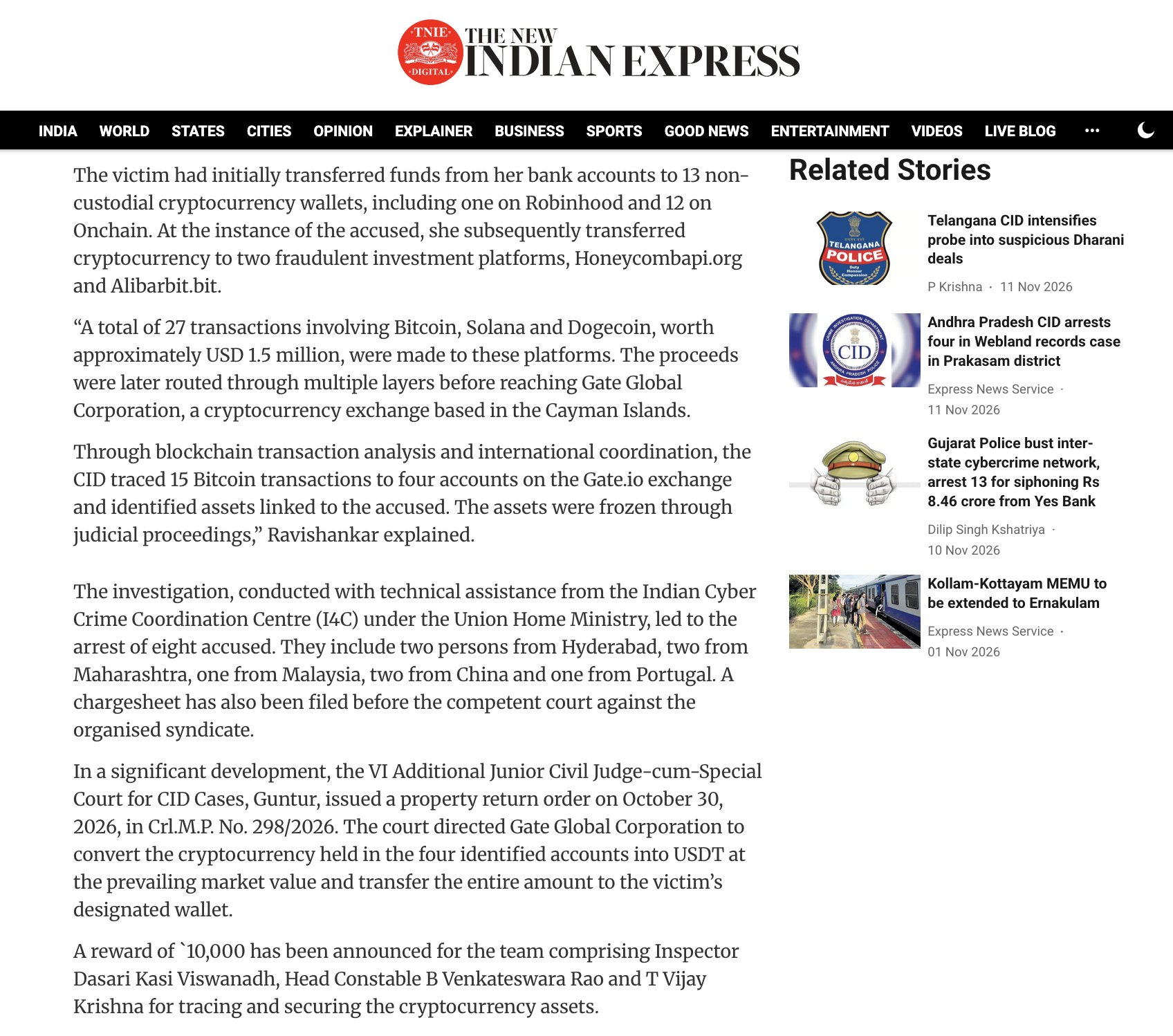
According to the Times of India, an Indian female victim lost approximately $1.5 million (in BTC, USDT, DOGE, and SOL) through a fake investment platform. The CID registered it and submitted a prosecution document in March 2026, stating that they traced 15 Bitcoin transactions flowing to four accounts on Gate and arrested eight people.
Times of India
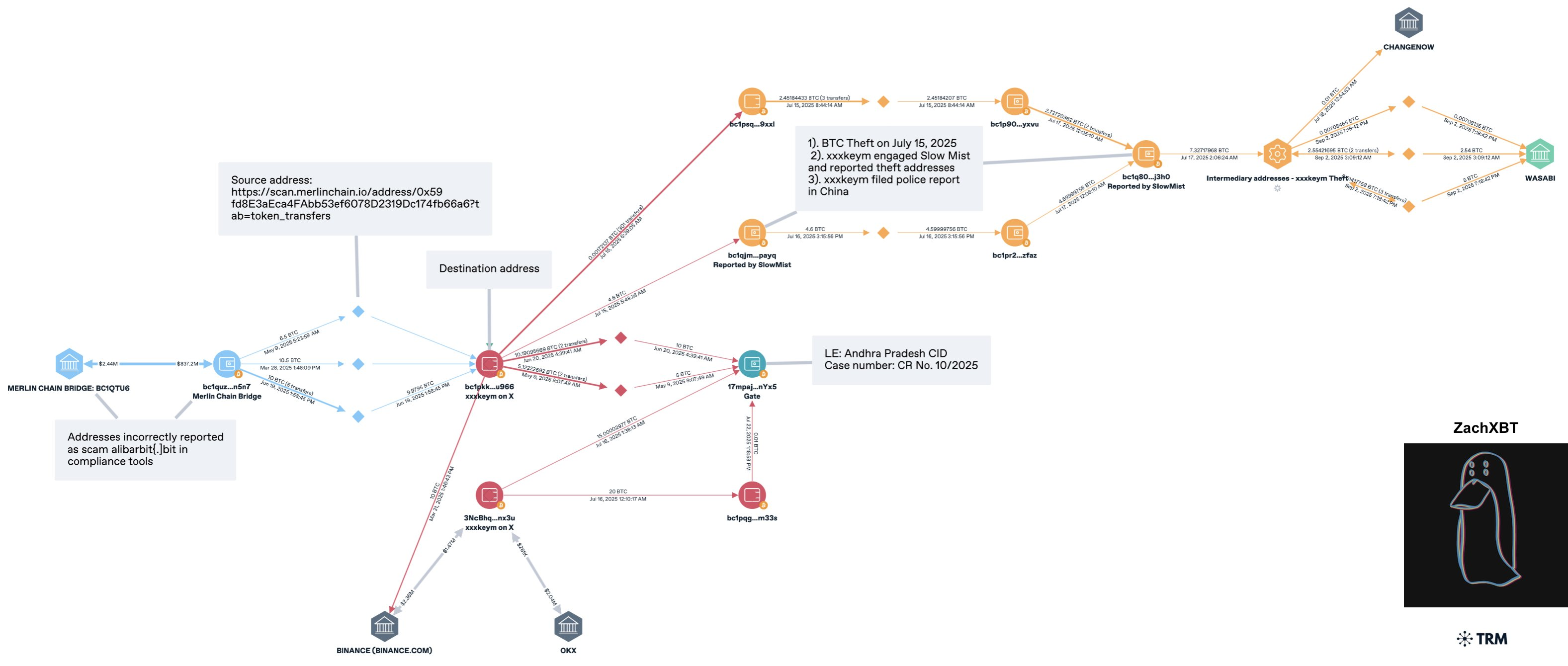
ZachXBT indicated that the key error lay in the identification of the funds' path.
In July 2025, the user xxxkeym deposited 15 BTC into the Gate recharge address (17mpajZ6Nq3dG3T6wUhaXxYF4Qy9HJnYx5), with a transaction hash of 885f3afab562251b222363cf12095e864ddb94636674b01f0cdb05997e5a54a0.
The source of the funds was an address controlled by xxxkeym (3NcBhqKnyo8dfzqfG1p5rbaKJFV8yLnx3u), which had withdrawn funds from OKX and Binance as early as January 2023, and then remained dormant until this deposit.
Indian law enforcement never froze his OKX or Binance accounts—which are the true source of these 15 BTC. ZachXBT pointed out that this alone demonstrates serious flaws in their argument.
The more core misjudgment lies in the other two related deposits.
The Gate address also received two deposits totaling 15 BTC from bc1pkkwqyxn3rm608ryuqg9hyqna0syq4jx5pxkr7pzg8n3usx6tyqfst5u966 (also controlled by xxxkeym). Prior to this, that address had received three funds from bc1quzwkggdf6ly06mrrnnled0qdr57w770k45n5n7 and bc1qtu66zfqxj6pam6e0zunwnggh87f5pjr7vdr5cd.
The Indian law enforcement agency marked these two addresses as fraud-related for alibarbit.bit.
ZachXBT stated this is incorrect: these two addresses actually belong to the Merlin Chain cross-chain bridge, and most compliance tools did not correctly label them.
Merlin Chain is a second-layer network for Bitcoin, allowing users to transfer BTC between the Bitcoin mainnet and Merlin.
ZachXBT explained that the owners of the involved addresses are regular interactors of Merlin's second-layer network. He transferred 50 BTC into Merlin on March 28, 2024, which was over a year before the alleged fraud incident in May 2025. After that, he made three withdrawals from Merlin, corresponding to approximately 10.1367 BTC, 4.907 BTC, and 9.9795 BTC; these withdrawals completely matched the timing and amount of Bitcoin outflow from the aforementioned bridge address.
Additionally, he disclosed specific transaction hashes and attached screenshots of bridge activities, clearly demonstrating that user xxxkeym had zero on-chain association with the theft event.
However, according to multiple reports, the special court for CID in Guntur, India, issued a property return order (Crl.M.P. No. 298/2026) on October 30, 2026, requiring Gate Global Corporation to convert the crypto assets within the four accounts at market value into USDT and transfer them to a wallet designated by the Indian complainant.
Gate's Response: No Fund Transfer, Currently Requesting More Information from Police
On November 15, Gate issued a detailed statement stating that as an independent third party, the platform will not judge or promise to transfer assets based solely on one-sided materials, and currently no assets have been transferred.
The official stated that since receiving the freeze request in September 2025, their AML team and legal department have continuously requested the police for additional evidence, noting that the on-chain records are complex and involve multiple wallets. When the platform received the transfer-related request in April 2026, it did not make a direct commitment to execute but continued to request additional materials, insisting on case-by-case review.
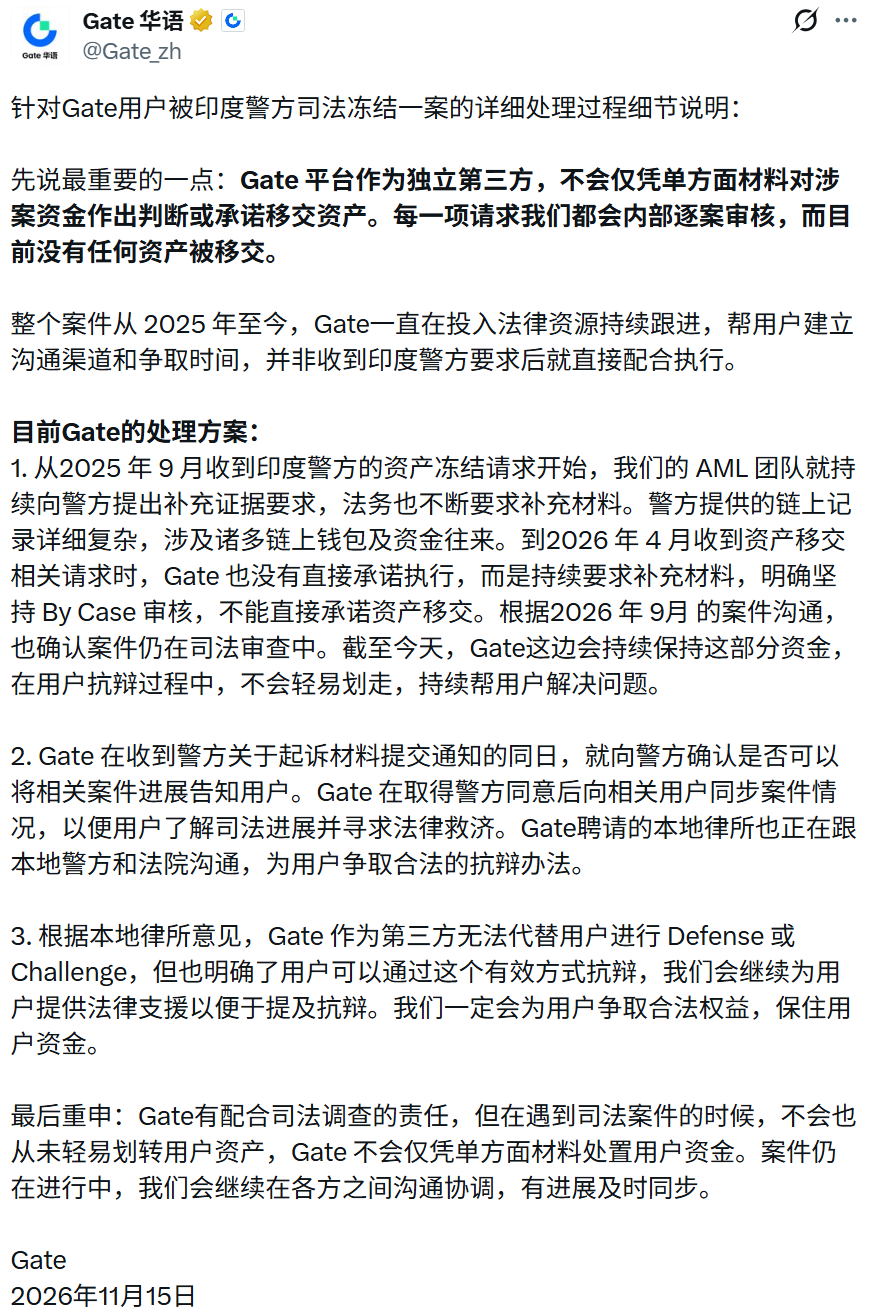
On the evening of November 17, Gate officials stated that after an internal review, they found ZachXBT's整理内容非常有价值,但是印度警方也提供了更多未公开的材料,由于未经授权,当前无法公开这些细节。
ZachXBT further pointed out that Gate should have directly refused after seeing the tracking errors, and to his knowledge, Gate had no judicial connection with India and had no legal obligation to comply with the Indian court order. He questioned why CID repeatedly made significant omissions in on-chain tracking. Currently, CID has not publicly responded to ZachXBT's specific analysis.
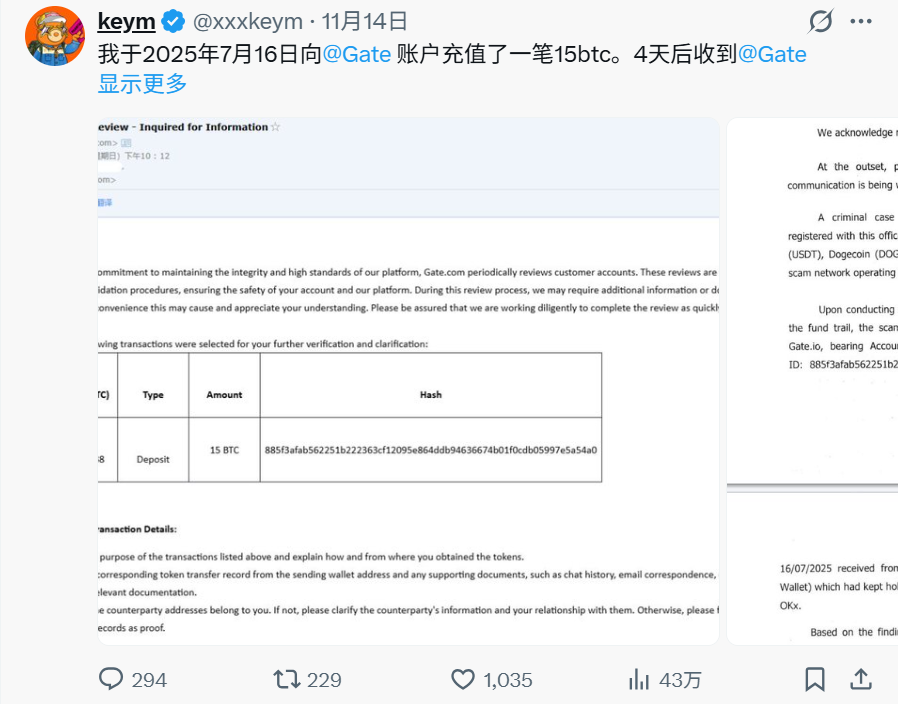
User xxxkeym also voiced that Gate treated him with a reason of not being able to disclose case details, forcing him to communicate with the Indian side himself, while the lawyer's multiple communications did not seem to have a substantial impact on the freezing and deduction process.
Furthermore, he indicated that when the account was frozen, it was worth over $3 million, and now due to market declines, only about $1.6 million remains.
Issues such as unmarked cross-chain bridge addresses, misjudgment by compliance tools, and insufficient evidence review in cross-border judicial assistance are not uncommon in the crypto industry.
Tracing pig butchering schemes is inherently challenging; funds can easily go astray after passing through multiple bridges and mixing. For ordinary users, even if the source of the funds is clear and traceable on-chain, they may still be subject to long-term freezing due to erroneous labels from foreign law enforcement agencies. When exchanges face freezing and transfer requests from different jurisdictions, how to balance compliance obligations and user asset protection has once again been brought to the forefront.
Self-Exemption?
In the gray area where decentralized ledgers clash with sovereign entities, this case reveals the passive position and deeper concerns of centralized exchanges in multinational judicial games.
In response to directives from foreign police, platform operators often prefer to choose the path of least resistance—mechanically executing asset freezes based on incomplete cross-checks, thereby shifting the complex burden of proof entirely onto the ordinary users in a weakened position.
Before this incident escalated, there was a female user who had a protracted battle for rights with Gate after her account was compromised and assets were stolen. Even when the user provided clear self-evident evidence, Gate platform still failed to provide a convincing reasonable explanation for a long time, ultimately triggering public outrage.
The overlap of these two cases may not merely reflect a delay in compliance processes but could expose a tendency for platforms to seek self-"exemption" when facing external pressures.
免责声明:本文章仅代表作者个人观点,不代表本平台的立场和观点。本文章仅供信息分享,不构成对任何人的任何投资建议。用户与作者之间的任何争议,与本平台无关。如网页中刊载的文章或图片涉及侵权,请提供相关的权利证明和身份证明发送邮件到[email protected],本平台相关工作人员将会进行核查。


