
Author: Castle Labs
Compiled by: Big Pliers, PANews
Editor's Note: In the cryptocurrency space, many people adhere to an ironclad rule when picking projects: "Choose the leader in the field, choose the protocol that makes the most money, you can't go wrong." However, reality has harshly contradicted this: even among the star projects that dominate their respective fields and generate substantial fee income, most of their tokens have underperformed against Bitcoin, with some projects even experiencing significant declines. Analysis indicates that solely relying on "protocol profitability" is no longer sufficient to support token prices. When evaluating projects, investors should focus on the future market expansion potential and whether the narrative logic is imaginative and appealing enough. Additionally, the proportion of actual revenue generated by the protocol that can be distributed to retail investors is also a key underlying logic that determines investment value. Below is the translated original text:
The money in the cryptocurrency space is almost entirely concentrated in a very few projects.
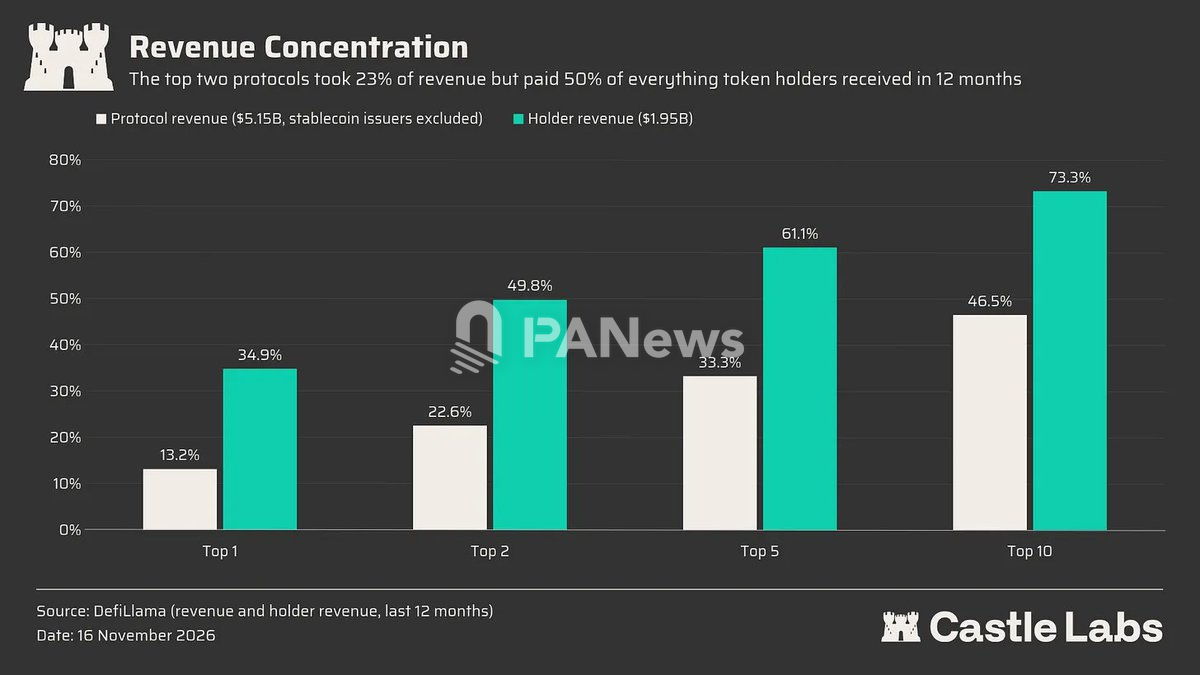
If we set aside companies issuing stablecoins, the top 10 protocols that earned the most over the past 12 months accounted for 47% of the total protocol revenue across the network.
The earnings that token holders can share are even more outrageous, as the top 10 protocols have taken 73% of all network dividends.
Typically, protocols that can make big money should have abundant cash flow, making their tokens more worthwhile to buy.
But what this article seeks to clarify is: does being number one in a specific field really guarantee that your token will soar? If not, among the leading tokens, what determines why some can skyrocket while others languish?
What is the reality of the money that actually reaches the pockets of token holders, and how does it reflect on token prices? We also need to discuss two major drivers that can't be explained by looking at income alone: how large the protocol can grow in the future and whether the story being told by the project is imaginative enough.
The "Bimodal Monopoly" of Field Leaders
In various segmented fields of the cryptocurrency space, the top players have almost drained the cash flow from the entire industry. Over the past 12 months, all protocols combined earned $13.7 billion in fees.
In each specific area, the top two usually take at least 52% of the income; in certain segments such as stablecoins, prediction markets, basis trading, and options markets, the top two have directly taken over 90% of all fees.
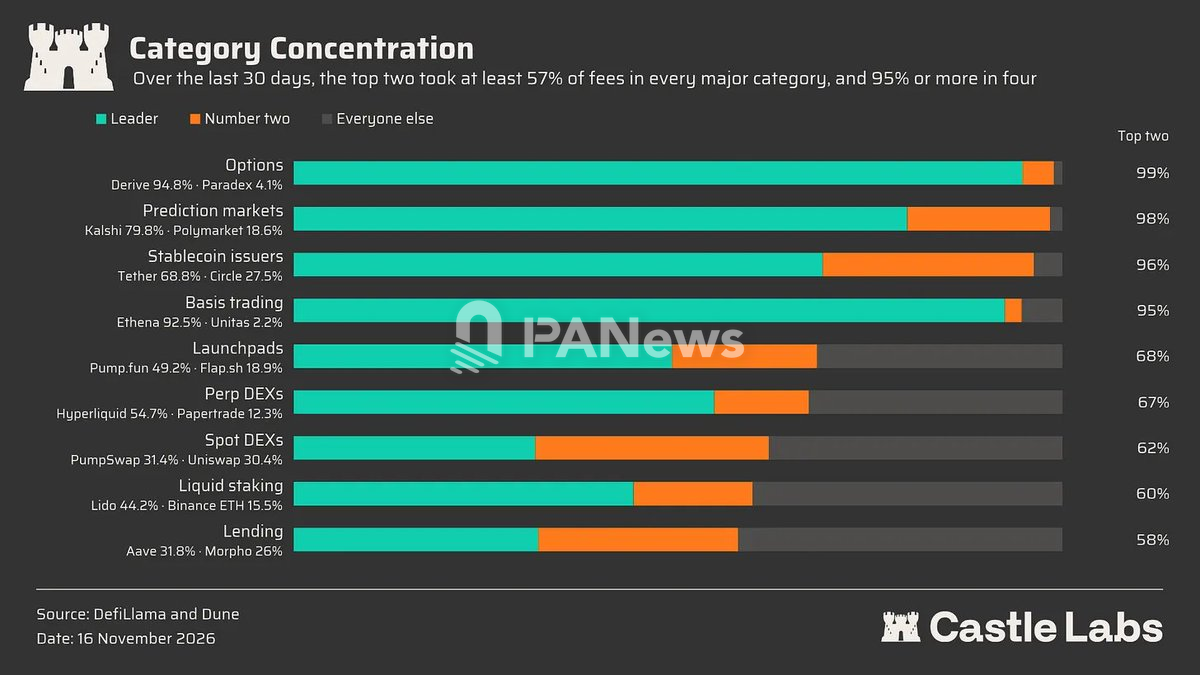
However, this monopoly does not apply to all fields. If the cost for users to switch is low, or if competition is extremely fierce, the leader's position can easily be undermined.
For example, Launchpads and spot DEXs aren't as monopolized. Because retail investors can switch trading venues with no cost, the competition is intense.
For those trading on decentralized exchanges, everyone cares about where the trading slippage is smallest and the fees are cheapest. Various aggregators will automatically compare prices, directing funds to the platforms with deeper pools. In the DEX domain, no single platform can claim that it provides the deepest liquidity and the best prices for all tokens, so trading volume is naturally distributed across various platforms.
As for Launchpads, this is purely a cyclical business dependent on external factors, hinging on whether the platform can ride the wave of new blockchains or ecosystems. For instance, Pons surged during the meme coin craze around Robinhood; most of the platform's income came from that highlighted moment, but as the hype fades, the trading volume also cools down.
Borrowing protocols and Perp DEXs attach greater importance to "crashing subsidies" and "capital depth." These two are intertwined: if subsidies are sufficiently attractive, they can draw in hot money; if the platform has a deep enough pool and good liquidity, it can retain that money long-term. A large pool can help the leader solidify its position, but if a competitor offers slightly more enticing subsidies, some fence-sitting funds will be quickly withdrawn.
Another scenario arises in highly monopolized segments like stablecoins and prediction markets, where retail investors simply cannot purchase the project tokens on the secondary market. For example, the stablecoin giant Circle only allows investment through the purchase of its stock coded as $CRCL on the U.S. stock market.
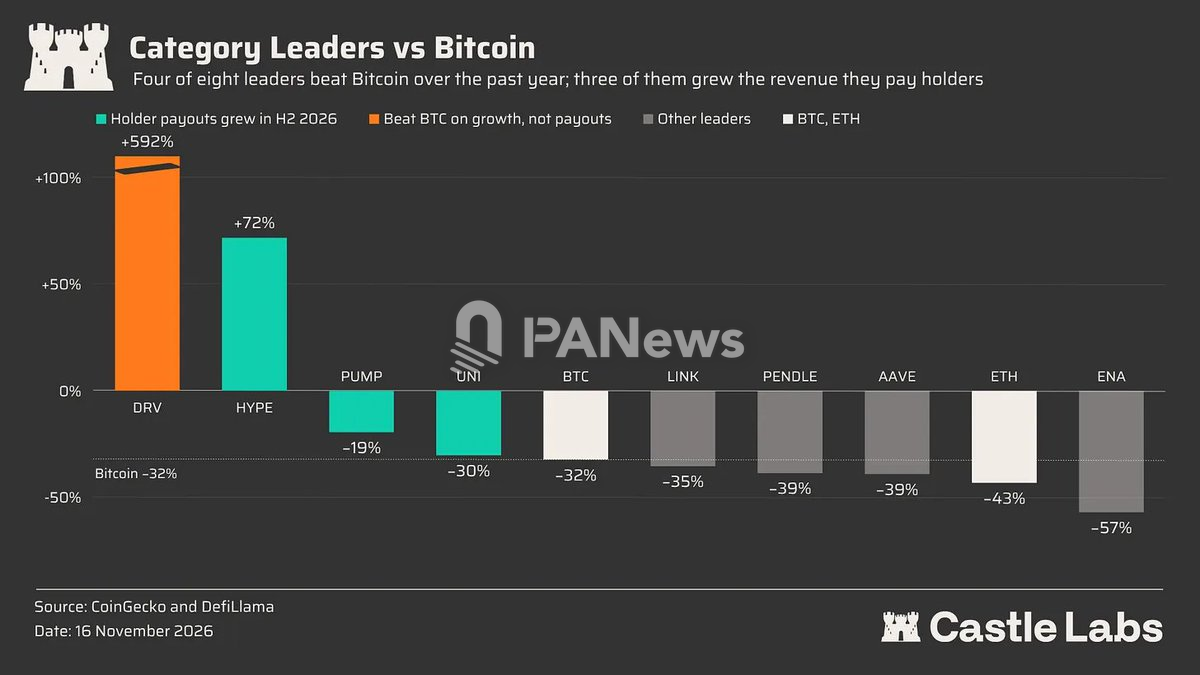
Consequently, investors' attention must reluctantly shift back to less severely monopolized fields. Ironically, even if you had bought all the tokens of these leading contenders at that time, the returns would still likely be disappointing because the vast majority of tokens failed to outperform Bitcoin.
Why is this happening? If the projects are indeed industry leaders, why are their tokens not rising?
Part of the answer lies in the actual income data—specifically, how much real money has truly ended up in the pockets of token holders.
Hyperliquid's monthly revenue skyrocketed from $38 million in July to $69 million in October, not only due to the platform's massive growth in trading volume but also because it benefitted from Circle's huge interest on dollar reserves. If the project makes money, the token naturally benefits as well.
Uniswap officially activated its "fee distribution switch" at the beginning of the year and passed the UNIfication proposal, then the platform continuously used its earned fees to buy back its own tokens in the open market.
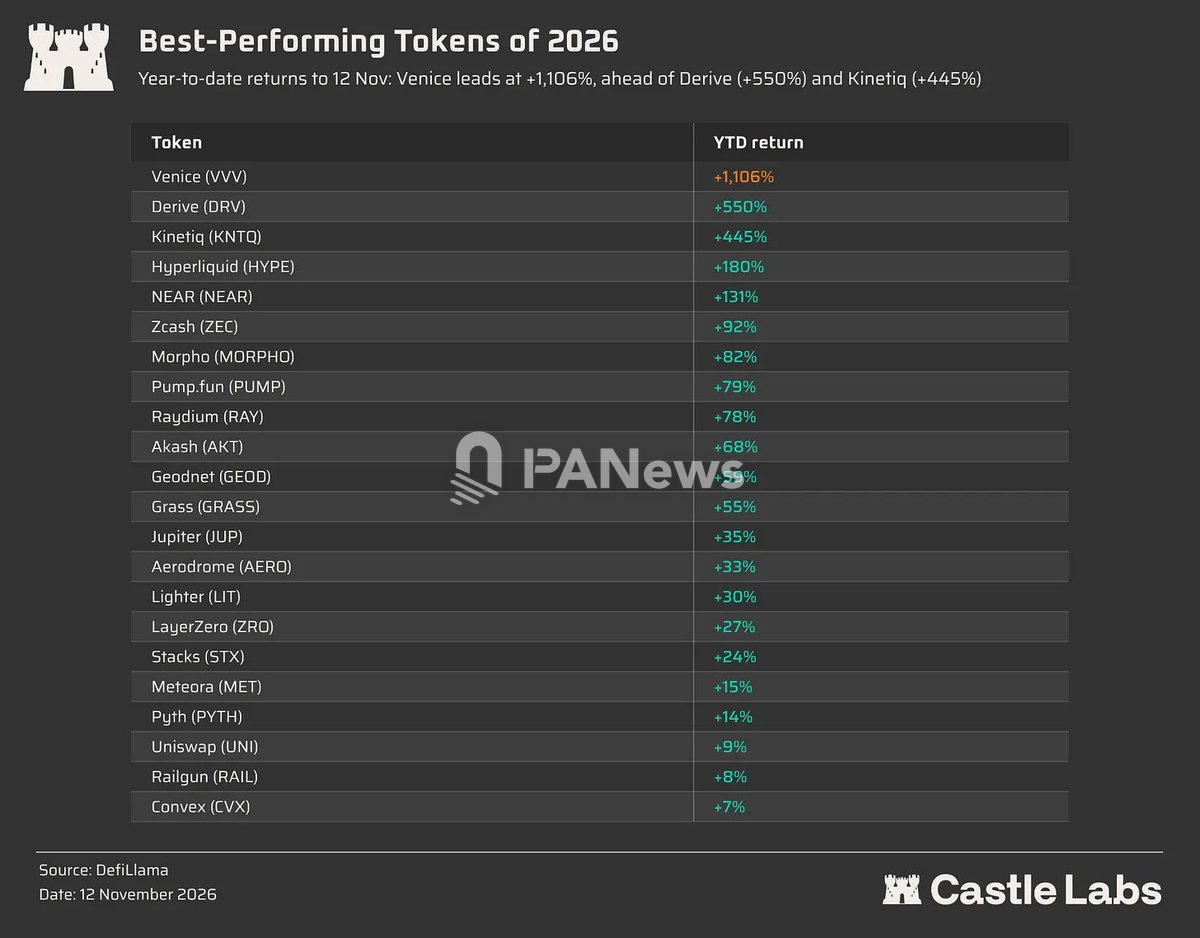
Derive has exhibited the most dramatic price performance, soaring 592%, ranking first among all leading tokens. However, in reality, Derive distributed only about $1.3 million to token holders last year. Clearly, those purchasing it aren’t driven by its current small dividends, but rather are betting that the future on-chain options market will multiply many times over (we will discuss this further later).
On the contrary, the lending giant Aave suspended its token buybacks after the KelpDAO incident; yield splitting protocol Pendle was even worse, with monthly revenues plummeting from $4 million to $050,000 within a year (comparing October 2025 to October 2026).
To ascertain whether the market has already priced in these positive and negative factors, we used the "market capitalization" of the token divided by "the total income distributed to holders in the past 12 months." This metric is simple: to get a dollar in dividends into the pockets of holders, how much is the market willing to pay in the secondary market now? Lengthening this metric to a yearly dimension for comparison can clearly show whether the token was overbought or a bargain.
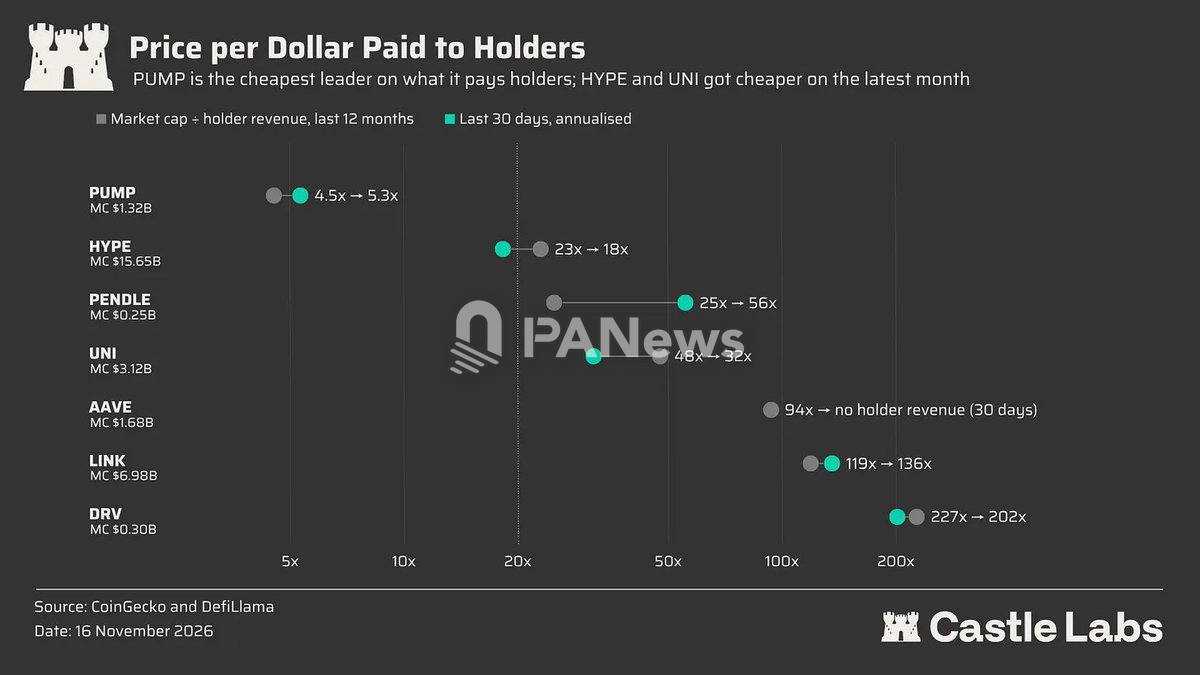
Over the past 12 months, the valuations of Uniswap and Hyperliquid have actually decreased, while other leading tokens have become more expensive. This significantly explains why the tokens of these two have performed markedly better than their competitors.
Derive is the most expensive token in terms of valuation, which vividly illustrates that those buying it are purely betting on expectations for super high future growth, showing no concern for its current dividends.
Pump, on the other hand, is the cheapest in the entire market; it continuously generates extremely high cash flow, and the money does actually flow back to the token, yet the product always has a poor reputation. In simple terms, it is a launch platform that profits from aggressively milking meme tokens, and many see this model of crazily harvesting retail investors as a zero-sum game for the entire industry.
Moreover, the project's team has been slow to distribute airdrops to old users, creating uncertainty that keeps many large investors at bay.
While DRV skyrockets, PUMP languishes, reaffirming the fact that merely looking at how much a protocol can earn or how much retail holders can receive is insufficient to help you pick good assets.
To capture truly skyrocketing tokens, you must closely monitor two things: the new story the project tells (narrative development) and its future positioning in the market. These often become the key to whether funds buy in or not. Next, we will discuss these two points, while also reviewing those tokens that, despite not making much money currently, tell an excellent story and have great potential for growth.
The Real Driving Force that Breaks the Ceiling
DeFi and RWA are both aiming for trillion-dollar-level gold mines. For the current industry leaders, the small change being made now is hardly enough to fill gaps in the future vast market.
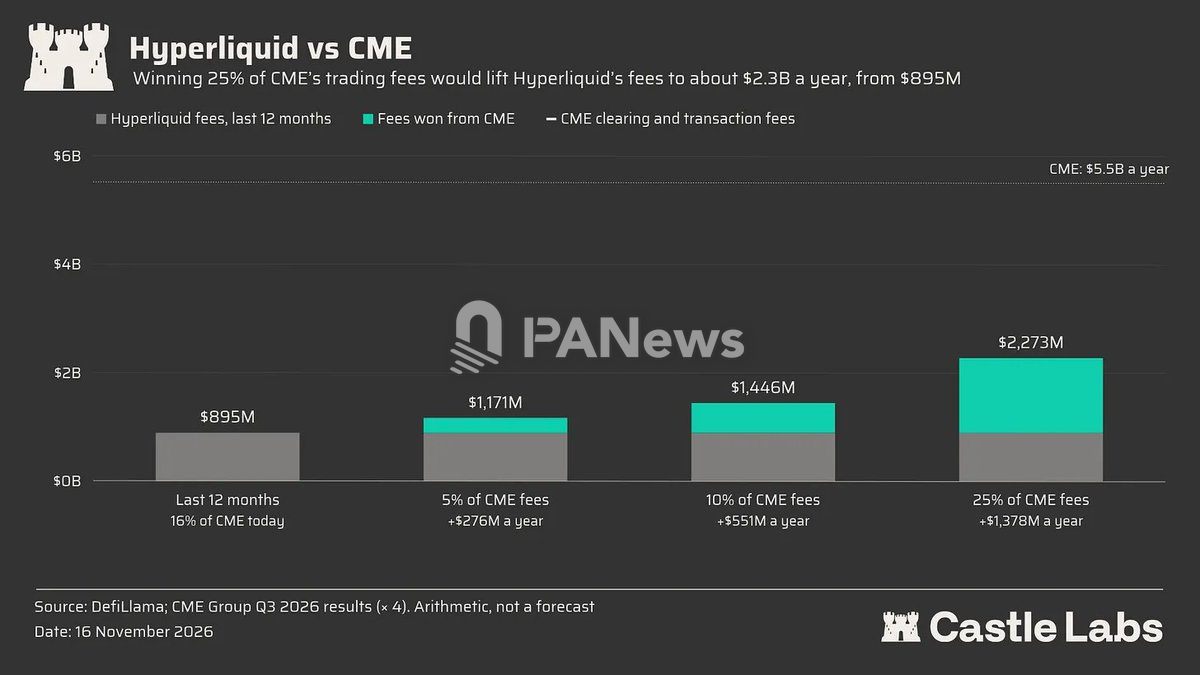
Let’s first look at Hyperliquid. It can generate $895 million a year solely from fees, which is approximately 16% of the annual token and clearing fees of the Chicago Mercantile Exchange (CME) (calculated on an annualized basis of about $5.5 billion for the third quarter of 2026). It’s worth noting that Hyperliquid previously had no business with U.S. clients due to compliance issues. But this situation is now being completely overturned.
Recently, Intercontinental Exchange (ICE), the parent company of the New York Stock Exchange, formally invested in and partnered with TradeXYZ to directly offer perpetual contracts covering cryptocurrencies, U.S. stocks, commodities, and forex on Hyperliquid for U.S. users. Kraken's parent company Payward has also become the first HIP-3 deployment entity to obtain legitimate regulatory licensing from the CFTC through its compliant trading platform, Bitnomial, and NinjaTrader clearinghouse.
Although these two partnerships are still awaiting final regulatory approval, it is already clear that once the largest funding pool in the U.S. fully opens, Hyperliquid can capture an astonishing market scale.
If Hyperliquid is the king of on-chain contracts, Derive is the absolute leader in on-chain options.
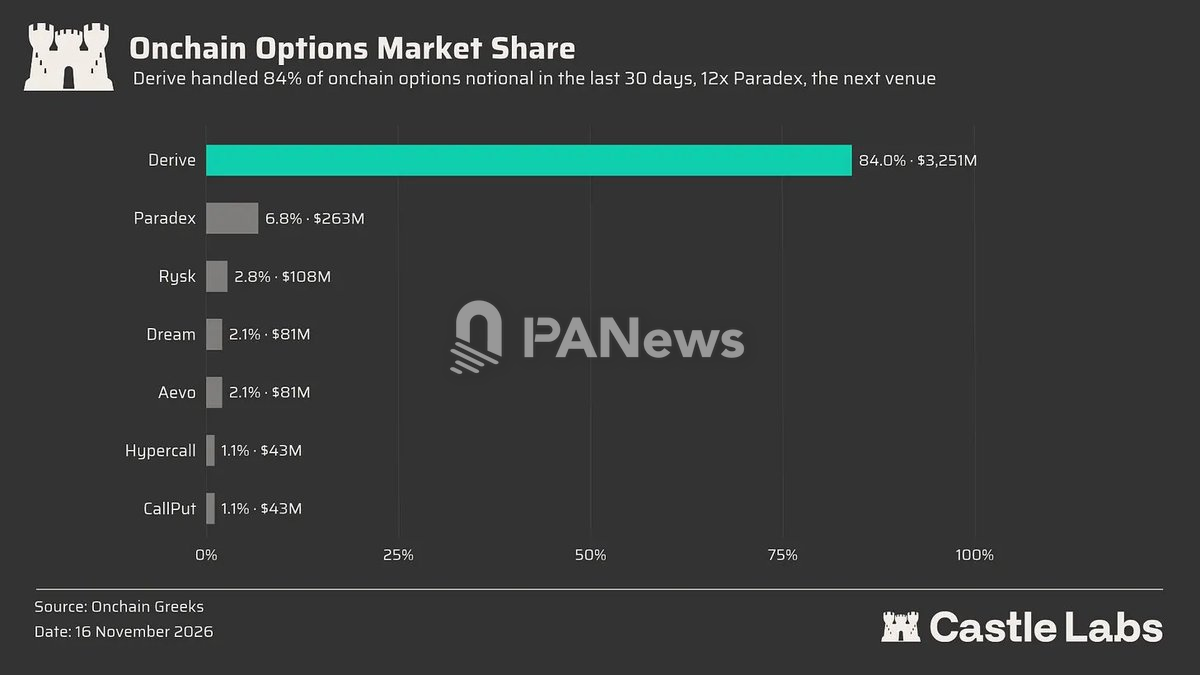
In the past 30 days, Derive captured about 73% of the total on-chain options trading volume across the network and dominates 93% of the open contract positions. Since the beginning of 2026, the nominal trading volume generated by this platform has reached $14.2 billion, which is roughly three times the total trading volume of 2025.
To further scale up, they launched the new Derive V3 version, which includes multi-currency mixed margin, automated financial vaults, and customized tools specifically for institutional investors. Particularly, the vault and open access features directly open up a new distribution channel, paralleling Hyperliquid's previously successful HIP-3 and exclusive commission codes.
This way, novices can easily use the product with just a click, while the institutional module steadily attracts large capital from traditional finance.
Ultimately, on-chain options mainly target the enormous traditional financial options market, and Derive’s newly launched RWA options are aimed specifically at this lucrative sector.
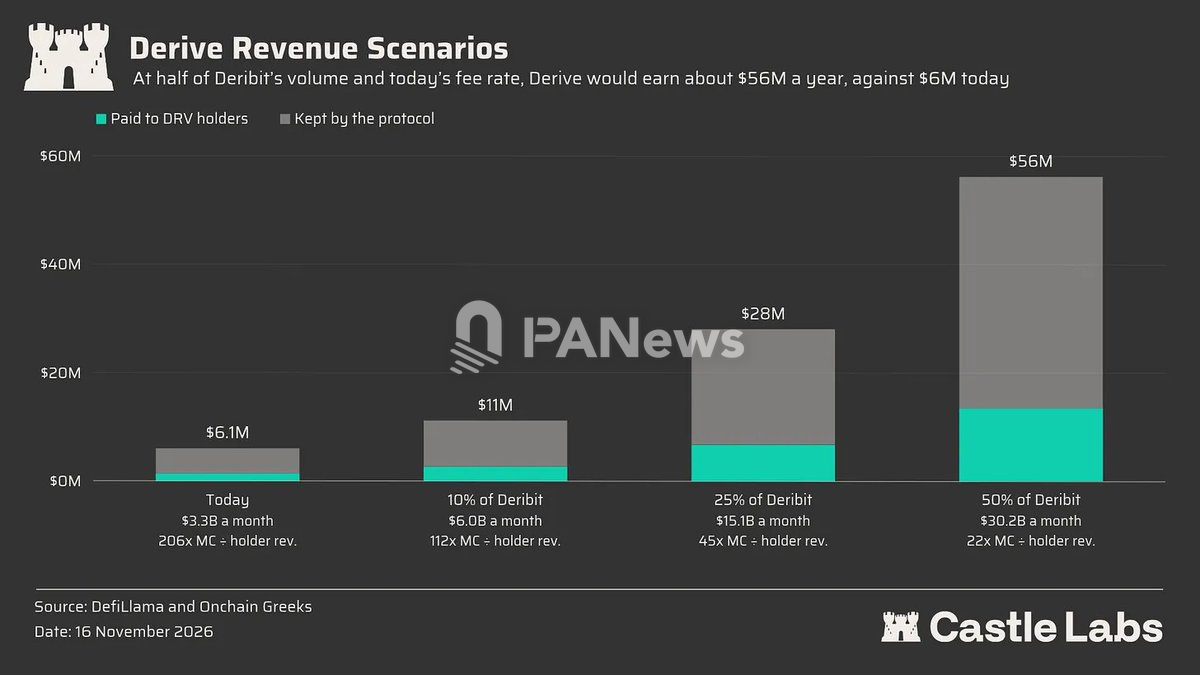
Currently, its biggest rival in the offshore traditional market, Deribit, recorded options trading volume of up to $60.4 billion in the last 30 days, which is a staggering 13.6 times the volume across all on-chain options platforms combined.
As more and more people become accustomed to playing with options on-chain, as long as Derive can capture just 10% of Deribit’s share in the future, its annual pure fees could easily exceed $10 million.
Now, let's turn to the leading spot trading platform, Uniswap. In the past 30 days, it accounted for 25% of the network’s trading volume and 31% of the net fees over the past year. Its revenues are set to surge in the second half of 2026, primarily driven by the tide of asset tokenization and a revival of retail trading on Robinhood.
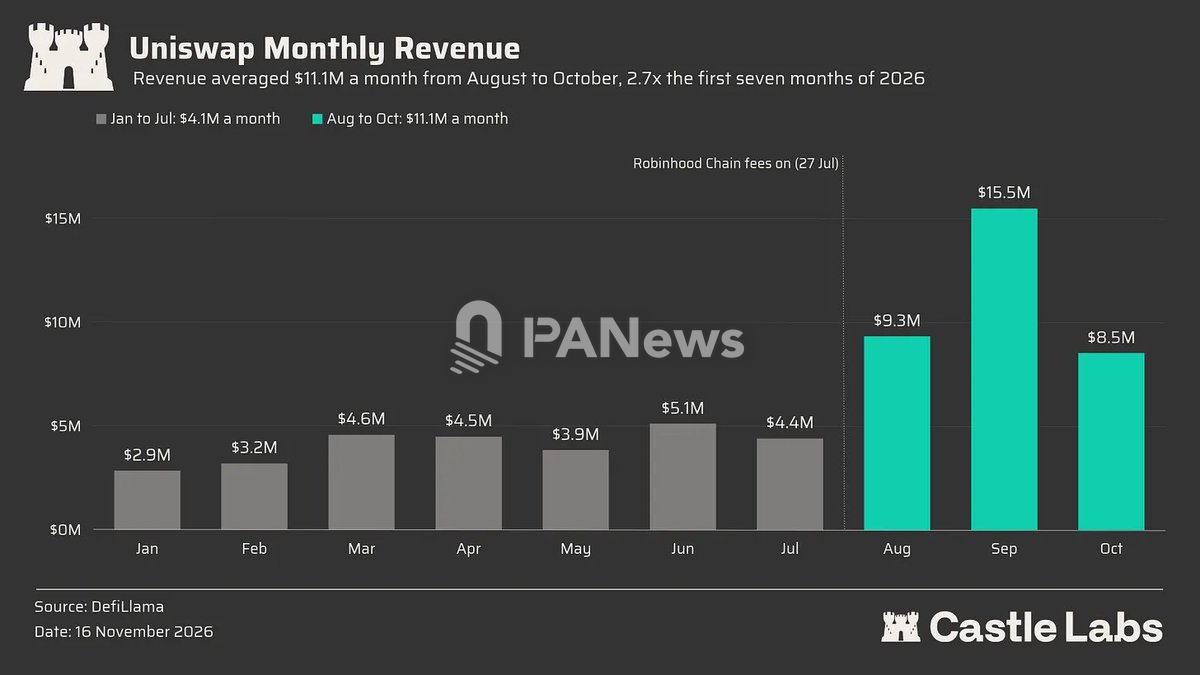
The retail trading frenzy driven by Robinhood may just be a temporary surge (though we believe this trend will resurface), but the more enduring logic lies in the on-chain reality of assets (RWA). This sector has progressed extremely rapidly this year, with the total scale of on-chain RWA skyrocketing from $25 billion at the start of the year to around $40 billion now. According to McKinsey's forecasts, global tokenized assets are expected to reach a staggering $20 trillion by 2030.
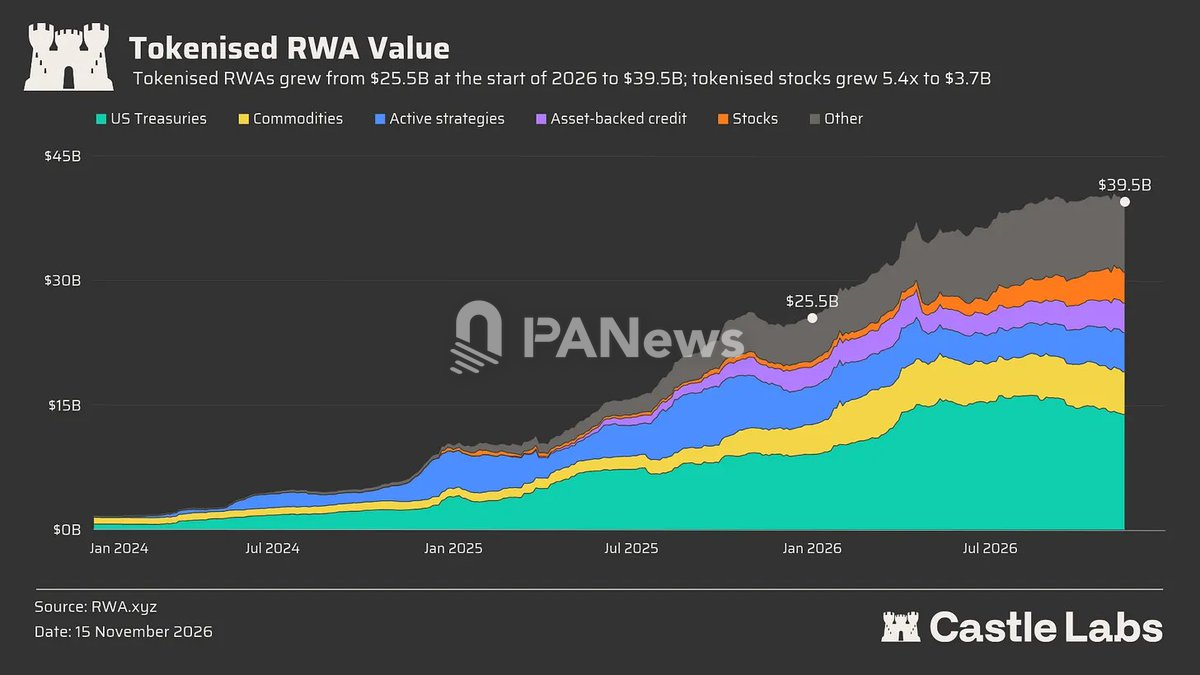
These assets, such as real estate, government bonds, and stocks, that have been moved on-chain naturally require a place for immediate liquidity available 24/7, which is the innate domain of DEXs. It can be said that for every increment in RWA, the leading DEXs are drinking from a rich broth.
Uniswap's greatest advantage in its underlying architecture is its V4 Hooks feature. This feature allows anyone to create exclusive liquidity pools that require permission for access, perfectly tailored for financial assets that are restricted from being transferred under traditional law. Moreover, V4 can support specific compliance regions for exclusive trading, and the recently launched OKXICE serves as a living example.
Another beneficiary of the RWA boom is the yield splitting protocol Pendle.
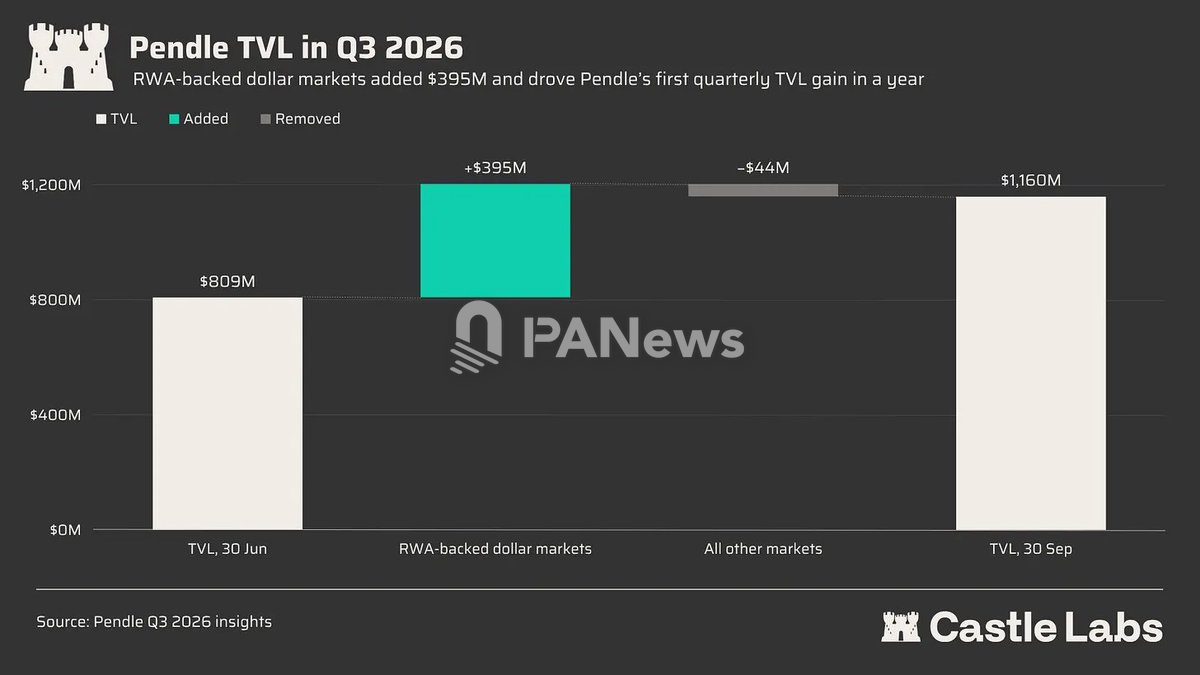
By the end of the third quarter of 2026, pools linked to real RWA dollar interest had already accounted for 82% of Pendle’s total locked value (TVL), directly driving a 43% surge in its TVL during the third quarter. These pools vary widely: some rely on real U.S. bond interests, while others involve on-chain re-insurance management by Re Protocol, and even GPU hardware loan offerings backed by USDAi lending pledges.
Now, as soon as a new RWA asset capable of generating interest emerges in the cryptocurrency space, to quickly make a name in the DeFi world and innovate in returns, the first stop must be Pendle to create a pool. Pendle has become the essential path for real-world assets to land in the crypto space for promotion. As long as the RWA cake continues to enlarge, Pendle will surely rise with the tide.
How far can Pendle go?
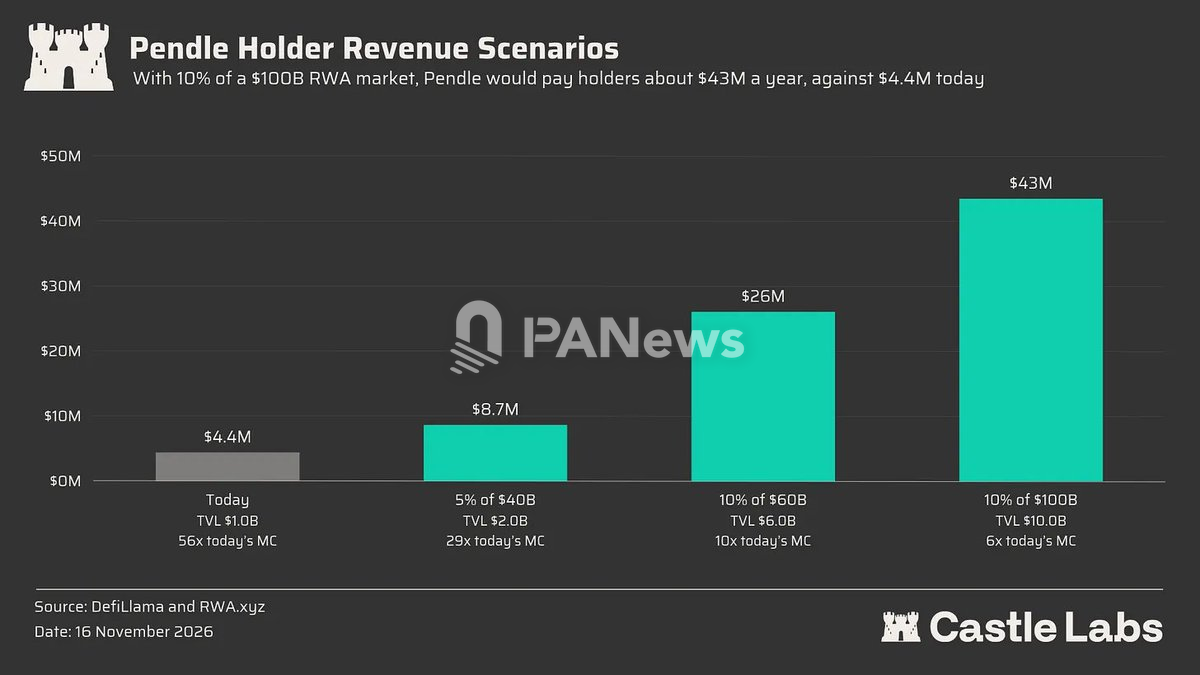
Currently, Pendle’s total lock-up volume, whether in crypto coins or RWAs, is around $1 billion. As the overall RWA market expands, Pendle’s RWA stock will definitely surge along with it. Even if it only captures 10% of the entire RWA market share in the future, this business alone could yield over $43 million annually in real dividends for Pendle's token holders.
Finally, let’s talk about Aave. Although its token price is currently lackluster, from a strategic positioning perspective, it sits at the crossroads of asset tokenization, mass consumer deployment, and underlying DeFi—three golden opportunities.
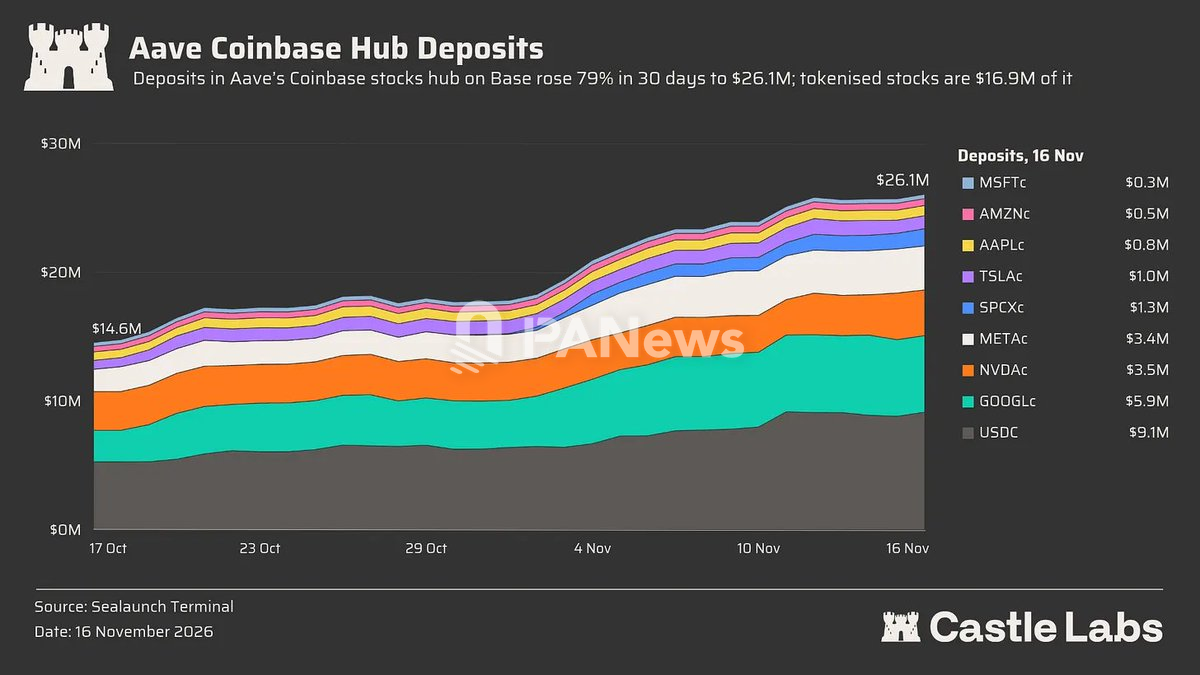
The explosion of real assets on-chain has tightly bound Aave and Pendle together—many savvy investors are now using the fixed income principal (PT assets) extracted from Pendle as collateral deposited in Aave, layering leverage for cyclic arbitrage. On the Base chain, the tokenized U.S. stock scale is rapidly surging, with net deposits exceeding $18 million, largely driven by substantial subsidies and arbitrage strategies provided by partners such as SuperForm and Dialectic.
For ordinary users, Aave's official app is becoming increasingly bank-like, offering returns higher than traditional U.S. treasury bonds and providing each user's account with up to $1 million in security (four times the standard $250,000 insurance threshold of an American bank). The on-chain emerging bank EtherFi is now directly building its underlying vault on Aave V4, holding approximately $350 million, allowing users to borrow money directly within the app. This continuously brings in new funds for Aave and makes it a widely accessible financial backbone.
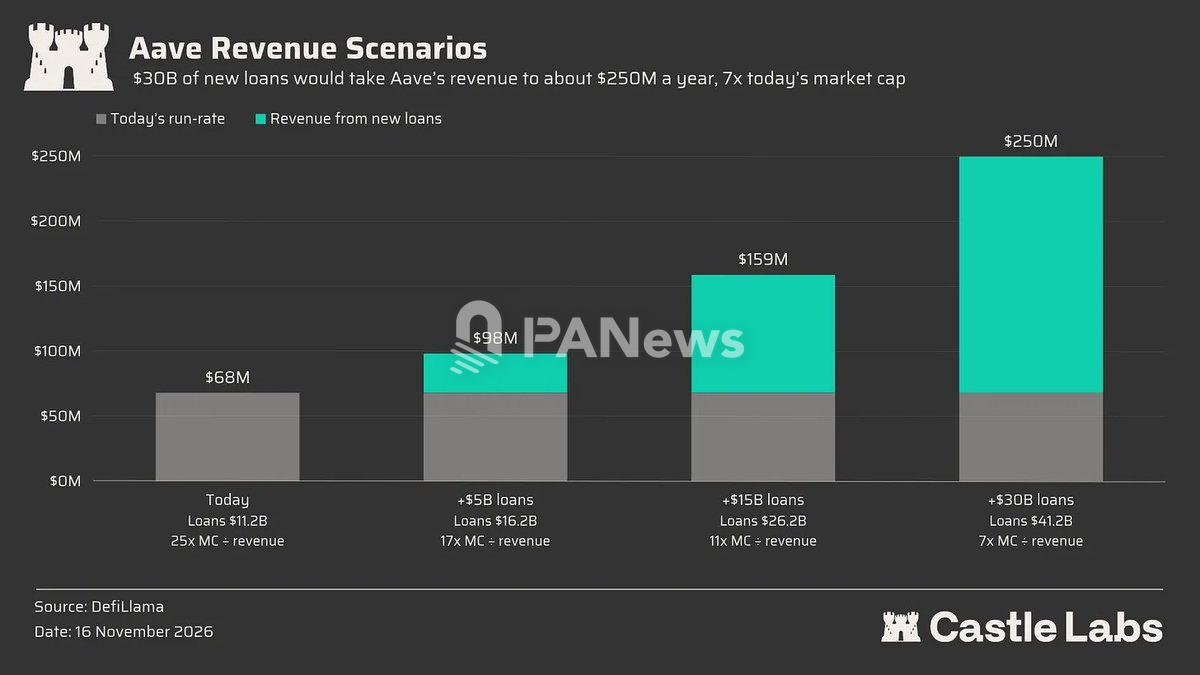
A multi-channel approach combined with various business flywheels is desperately pushing more borrowing demand into the Aave system, and the more borrowing, the higher the platform's fees. Currently, active loans on Aave have reached $12 billion, with cumulative revenue hitting $61 million this year. As on-chain borrowing demand continues to explode, its revenue will inevitably soar.
Everything is in place; the only stumbling block is that it suspended dividends to token holders in April this year. However, once this string is reconnected, all the accumulated business growth will quickly be reflected in the token price.
After discussing these core DeFi protocols firmly rooted in the main track, we also want to shine the spotlight on several projects breaking through with entirely new concepts: such as Pearl and Venice AI, which carry the "AI currency" halo, and Zcash, which is renewing itself under the banner of "privacy currency."
Let’s first talk about Venice, because it has already been able to generate substantial profits, not just an airy project that makes big promises.
Venice specifically provides users with absolutely private, content censorship-free AI model interfaces, being seen in the community as the best private alternative to ChatGPT and Claude.
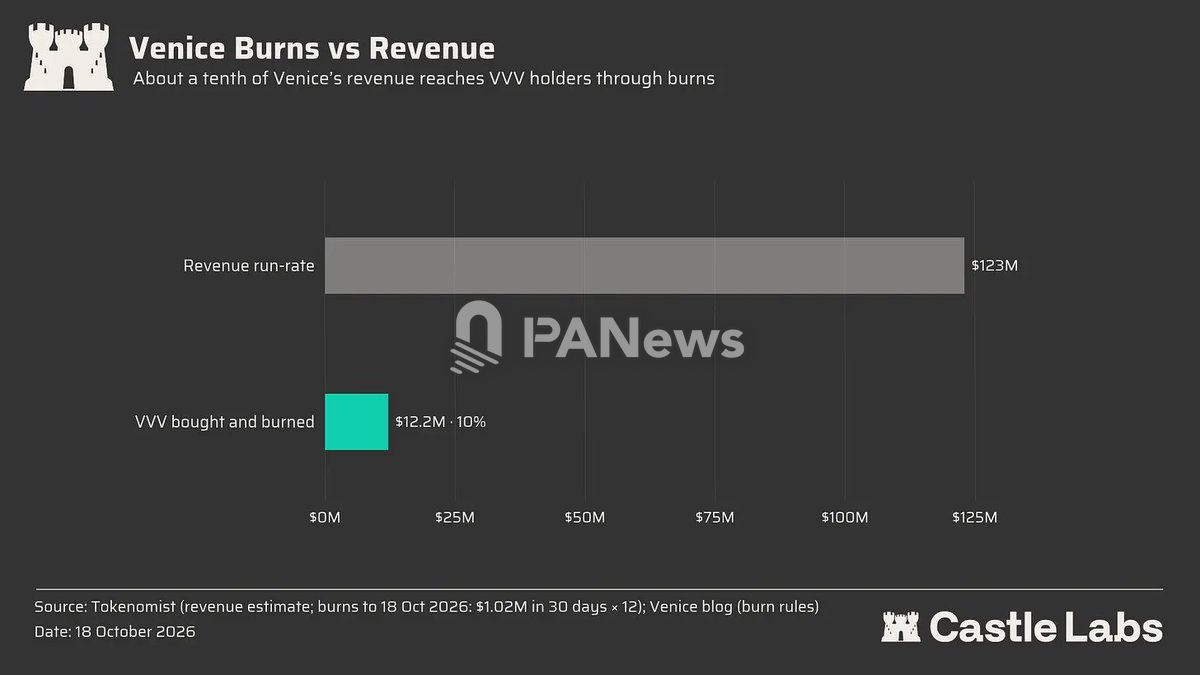
Its annual operating income has reached $123 million. Based on its current token circulation market value, its price-to-sales ratio (P/S) is only about 8 times; even when calculated against the total market value post full token release, the P/S ratio is only around 12 times. However, the project has a significant flaw: the token $VVV cannot completely monopolize this enormous profit, as traditional equity is also consuming the benefits. This leads to a disconnect between the profits of token holders and company shareholders—people internally are questioning, even if the project becomes a trillion-dollar giant, will the biggest share ever go to us retail investors?
To soothe retail investor concerns and tighten the bond of interests, Venice is currently employing a dual approach—manual buybacks and automatic on-chain buybacks of $VVV (using part of the business income to buy back tokens and burn them). In the past 30 days, they have burned tokens worth $1.02 million, which annualizes to $12.19 million, representing a solid 10% of the entire protocol's revenue.
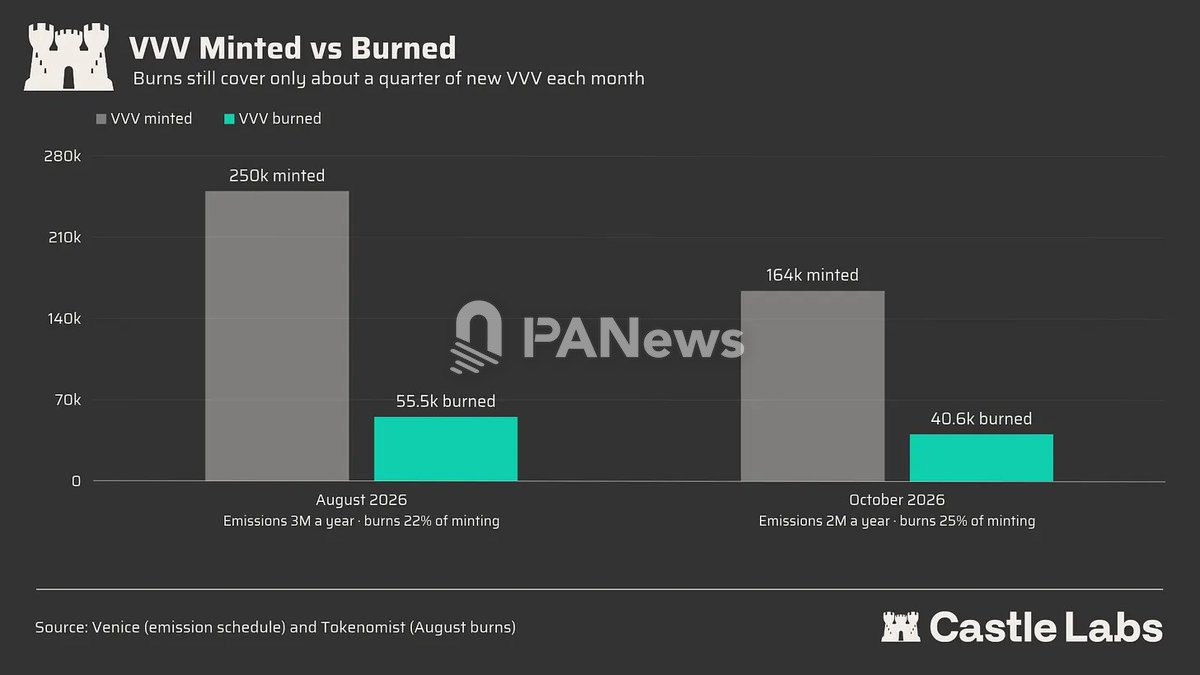
At the same time, the team this month has reduced the annual inflation cap for the token from 2.5 million tokens directly to 2 million, significantly decreasing the new selling pressure in the market. However, detailed calculations show that at the current burn rate, only about 500,000 $VVV can be eliminated in a year, offsetting just 25% of the new issuance inflation. Overall, the token still remains in an inflationary state. Nevertheless, as more users come on board, generating higher fee income, combined with further reductions in future issuance, the token will soon enter a phase of net deflationary surge.
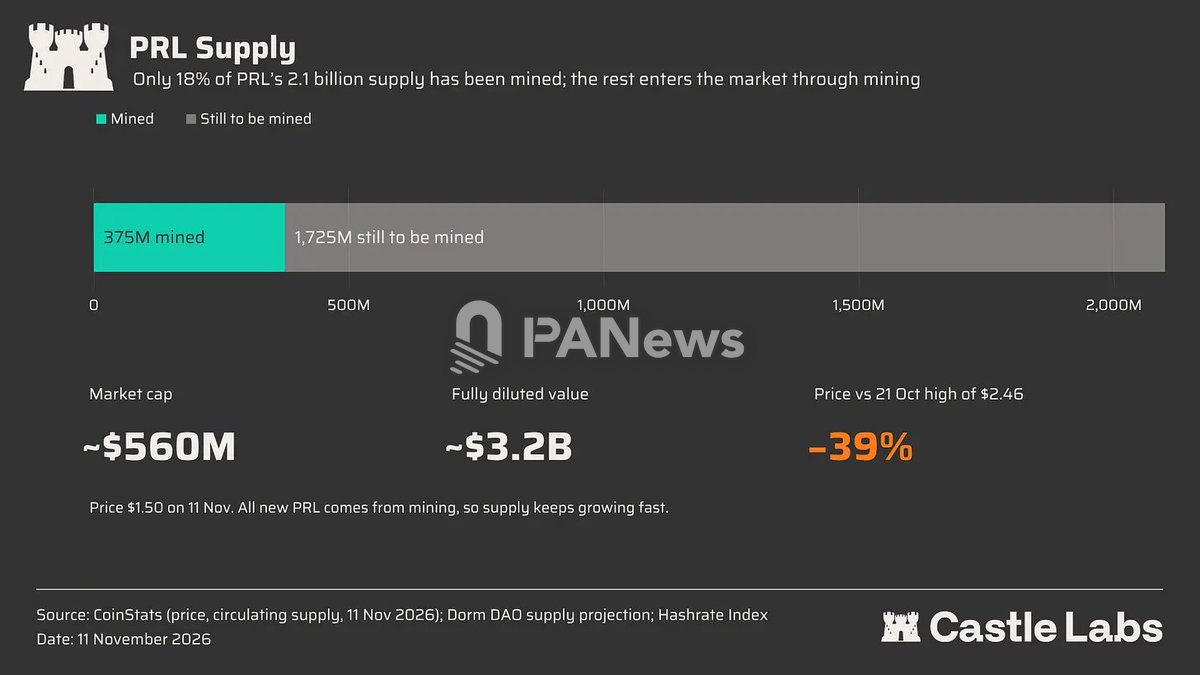
The second standout token is $PRL. Its rise to fame is entirely based on an exceptionally robust technical mechanism. In the Pearl network, miners do not calculate meaningless hash values with GPUs; instead, they tackle matrix multiplications, which is exactly the core computational process that every AI dialogue bot relies on the most for its computational power. This mechanism is vividly referred to as "Proof of Useful Work (PoUW)."
The mainnet for this network officially launched at the end of April, and after experiencing an impressive spike in October, the current circulating market value of $PEARL has consistently held above $500 million. We previously wrote a detailed article dismantling its operational model and the AI computing market it aims to capture.
However, for investors, a clear-minded approach is also necessary: most of the computational power contributed by miners on this network is not genuinely sold for cash to external clients; currently, only one partner named Together AI is utilizing it to subsidize its discounted services.
Although this dependency on a single customer raises some concerns, this technology's potential is much broader than most people anticipate. Imagine, in the future, if more businesses shift their AI computing tasks to this network for cost savings, and the platform mandates that $PRL be used as the pricing fuel and buys back and burns a large quantity, the profits for miners will experience geometric growth.
Moreover, when discussing $PRL, it’s necessary to mention that it employs a purely geeky "fair launch" mechanism, with no reserved allocations for teams; anyone can mine for tokens at no cost using a graphics card or trade directly on exchanges. So far, only 18% of the total supply has been mined, and early token holders benefit from substantial advantages.
As for Zcash, it relies on elite storytelling, having transformed itself into a "store of value (SOV)." If we strictly look at the fees earned on-chain, they are pitifully small, yet strangely, it has been one of this year's top-performing large-cap cryptocurrencies.
Wall Street found an entry point through the Grayscale Zcash ETF (code: ZCSH), which began trading on August 25 and quickly attracted over $1 billion in inflow, ranking in the top 1% of all ETF launches over the past decade.
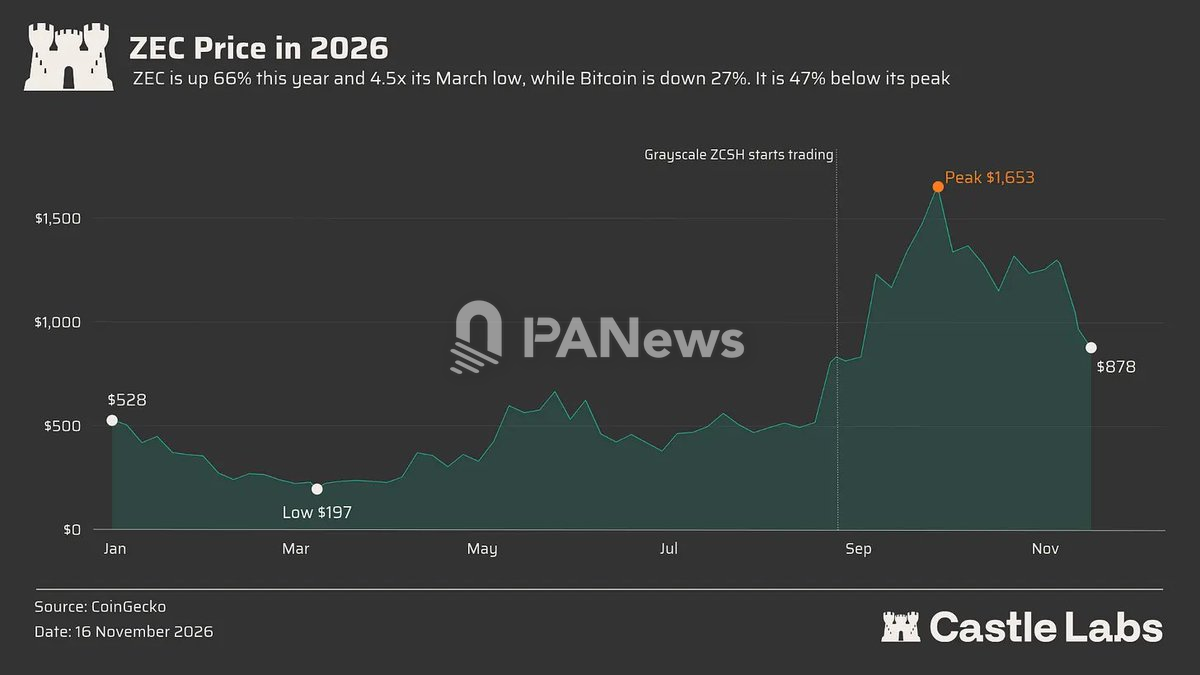
Essentially, Zcash is a Bitcoin with privacy features: it has the same supply cap of 21 million coins, a halving cycle every four years, and is equipped with a zero-knowledge proof concealment transaction mode that can be activated anytime. Privacy is not just an empty slogan created by the project; over the past three years, the proportion of ZEC in a privacy-shielded state has surged from 8% to 29.2%.
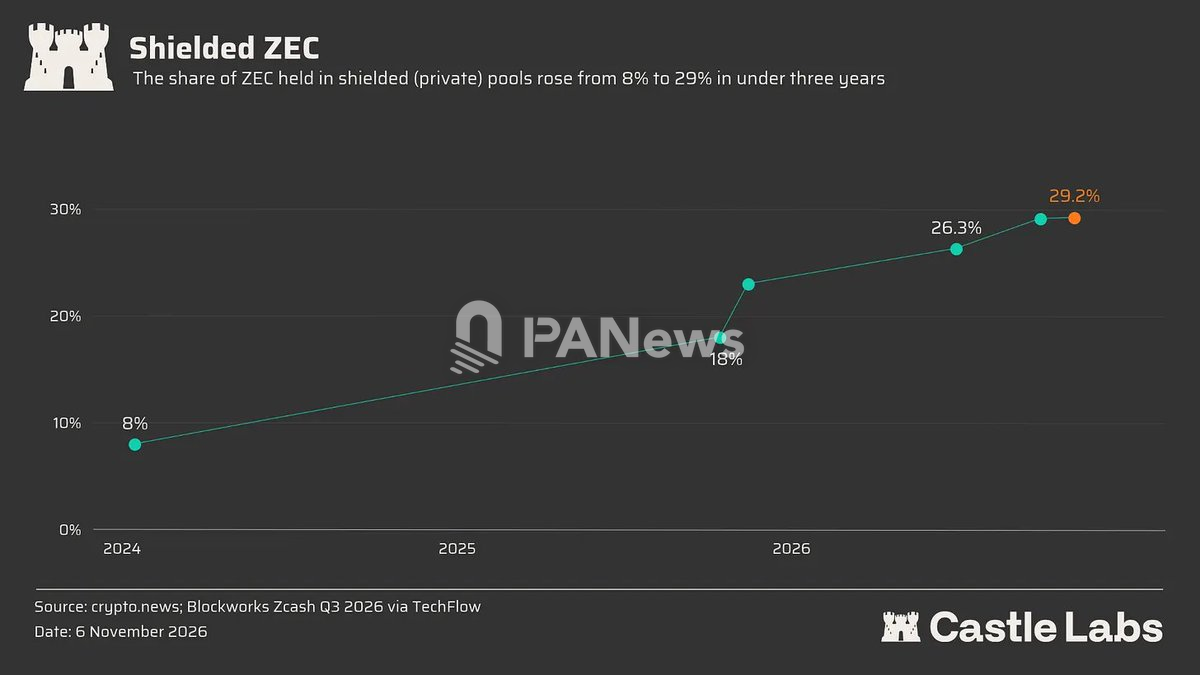
This strong privacy feature makes Zcash highly attractive. Recently, Zcash experienced a significant rebound when the Democrats won the midterm elections in the U.S. The reasoning is simple: if the Democrats gain power in the U.S., we can foresee a substantial tightening of financial regulatory scrutiny, thereby igniting a pressing demand for financial privacy, which Zcash can offer as its core value. This perspective must be considered when evaluating its investment logic.
In this section, we explored two types of tokens: one type consists of powerful projects with stable revenues that can continuously return value to token holders, preparing to leverage the asset tokenization wave to tap into a larger market; the other type consists of those with strong narratives that are more forward-looking investment targets, betting on the future.
A solid investment portfolio can effectively combine both, firmly grasping the current fundamentals while actively embracing infinite future possibilities. If you closely examine the tokens that have delivered impressive returns thus far this year, the answer will become abundantly clear.
Summary and Review
Reflecting on the question we posed at the beginning of the article: in the cryptocurrency space, can buying the number one in a segmented field truly guarantee profits?
The answer is certainly not a simple "yes." The reality is harsh; many seemingly flourishing industry leaders have seen price drops this year that made retail investors question their existence. Therefore, we must examine and formulate investment decisions regarding tokens from three different perspectives:
- The current fundamentals of the product, and how tightly they are connected to token value. If a token has a sustainable and stable cash flow backing it, it is undoubtedly a good target, but we must also consider it in relation to the inflation release of the token to truly understand the net capital flow around it.
- The target market the product seeks to enter, and how big that market can grow in the future. Asset tokenization is an immensely large incremental market, with numerous on-chain products attempting to carve out a piece; if a product can directly connect to this trend, its potential for growth will be boundless.
- The core narrative built around the product and successfully controlled. A product with a strong narrative can attract substantial market demand based on its potential for future growth. For Zcash and Pearl, their narratives are "privacy currency" and "AI currency," respectively—the former being the privacy version of Bitcoin, and the latter trying to meet the explosive demand for AI computing with its unique token economics and blockchain architecture.
In this selection system, the first gate serves as a foundation to help filter out excess and clarify how much cash the project actually holds; the second gate quantifies just how large the project can grow into a giant; while the third gate precisely identifies the core essence that the entire cryptocurrency market cares about most and is most susceptible to obsession with.
免责声明:本文章仅代表作者个人观点,不代表本平台的立场和观点。本文章仅供信息分享,不构成对任何人的任何投资建议。用户与作者之间的任何争议,与本平台无关。如网页中刊载的文章或图片涉及侵权,请提供相关的权利证明和身份证明发送邮件到[email protected],本平台相关工作人员将会进行核查。


