

Author: Zen, PANews
On November 9, South Korean esports team T1 was defeated 1:3 by Chinese team BLG in the semifinals of the 2026 League of Legends World Championship, stopping short of the top four.
Last September, Upbit launched a brand advertisement featuring T1 captain Faker, linking this esports legend to South Korea’s largest digital asset exchange, under the slogan “Our challenge, becoming the standard for the world.” Two months later, T1 secured a three-peat at the World Championship, and Upbit's revenue in Q3 last year rose along with the recovery of trading activity in the cryptocurrency market.
However, in November this year, the situation completely reversed; T1 led by Faker failed to lift the championship trophy again, and Upbit's operating company Dunamu also delivered a “worst” report card.
On November 16, Dunamu announced its Q3 2026 financial report, showing an operating revenue of 151.7 billion won, a year-on-year decrease of 60.7%; an operating loss of 3.5 billion won, and a net loss of 18.6 billion won. This marks the first quarterly operating loss since Upbit launched in 2017.
Decline in Trading Volume
Dunamu's operational difficulties primarily stem from the noticeable cooling of trading activities in the cryptocurrency market.
According to data from CoinGecko, in the first quarter of 2026, the total trading volume of five South Korean won exchanges was approximately $218.8 billion; this dropped to $146.7 billion in the second quarter, a quarter-on-quarter decrease of about 33%; and further fell to $133.2 billion in the third quarter, down 38.9% from the first quarter.
Among these, Upbit’s trading volume decreased by 7.57% quarter-on-quarter in Q3, while Bithumb's fell by 13.45%. Both leading exchanges in South Korea experienced a contraction in trading activity.
The decline in trading volume was directly reflected in Dunamu's financial performance. As the operator of Upbit, Dunamu saw a decreasing trend in operating revenue, operating profit, and net profit in the first three quarters of this year.
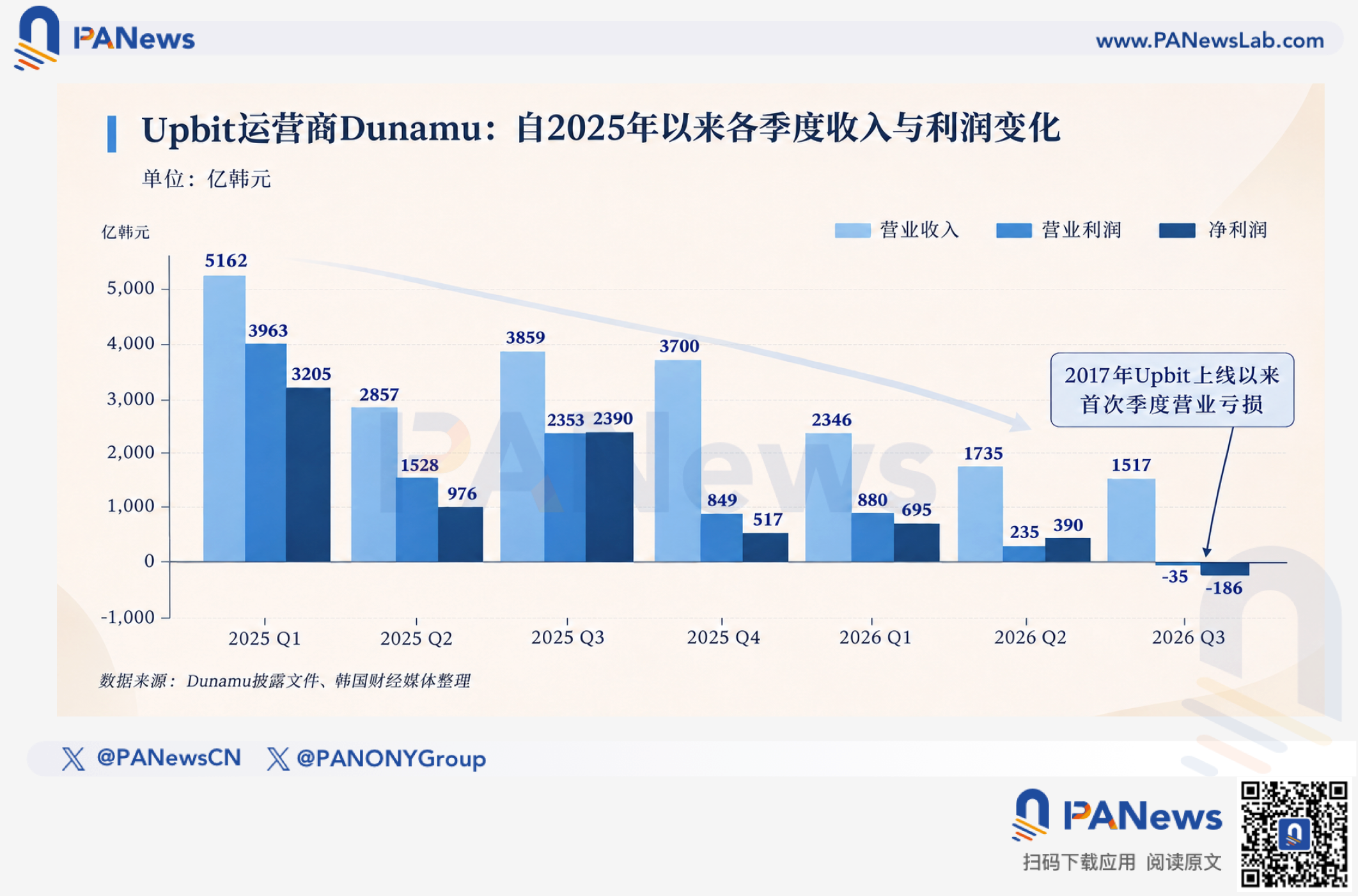
From a quarterly perspective, Dunamu's operating revenue has declined for two consecutive quarters, with a 26% decrease from the first quarter to the second quarter, and another drop of 12.6% in the third quarter. The cumulative operating revenue for the first three quarters was 559.8 billion won, a year-on-year decrease of 52.9%; and the cumulative operating profit was 108 billion won, a year-on-year decrease of 86.2%.
The situation for the second-largest exchange, Bithumb, is also not optimistic. Its Q3 operating revenue dropped by 69.7% year-on-year to 59.4 billion won, with an operating loss of 8.1 billion won, marking its third consecutive quarter of net losses.
Dependency on Transaction Fees
The cooling of the South Korean cryptocurrency market comes with a noteworthy backdrop of the previous strong performance of the local stock market.
In the first half of 2026, the South Korean stock market was buoyed by trends in artificial intelligence and semiconductors, with companies like Samsung Electronics and SK Hynix becoming focal points for retail investors. Meanwhile, the cryptocurrency market showed relatively weak performance, prompting investors to redistribute funds and attention.
More concerning than the decline in trading volume is the South Korean exchanges' heavy reliance on transaction fees as their business model.
According to Dunamu's Q3 report, in the first three quarters of this year, its transaction platform fee income reached 537.6 billion won, accounting for 96.04% of total operating revenue. Revenue from securities information platforms and other services was only 22.2 billion won. Bithumb's situation is even more pronounced, with transaction fee income making up 99.99% of its total revenue.
As a result, the income of South Korean exchanges largely depends on users' enthusiasm for trading cryptocurrencies. The exchanges had hoped to find new business growth points by expanding their client base to corporate clients and institutional investors, but the pace of relevant policy openings has clearly slowed.
With the market opening delayed, it becomes difficult for exchanges to expand their business landscape. According to The Korea Times, Bithumb, Digital X, and Coinone have already reduced or adjusted some enterprise business teams in the second and third quarters of this year.
Increased Regulation and Stricter Scrutiny
Amidst operational pressure, South Korean cryptocurrency exchanges also face increasingly strict regulatory requirements.
On August 11 this year, the South Korean Financial Services Commission announced that the government had approved amendments to the enforcement decree of the Specific Financial Transactions Information Act, further tightening registration conditions and anti-money laundering obligations for virtual asset service providers.
One significant adjustment is the expansion of the Travel Rule, which applies to the transfer of virtual assets between exchanges, from transactions over 1 million won to transactions of all amounts. Additionally, the receiving exchanges must also assume the obligation to obtain and verify the sender's information.
Moreover, transferring assets of 10 million won or more to overseas exchanges or personal wallets requires reporting to the South Korean Financial Intelligence Unit; for high-risk transactions, the regulatory authorities have imposed stricter limitations.
At the same time, Dunamu's merger with Naver Financial was originally an important opportunity to expand payment, financial services, and stablecoin business, but this transaction is also facing stringent competition scrutiny.

On November 10, the South Korean Fair Trade Commission announced the initiation of a final review of this transaction. The regulatory authorities believe that the merger could create competition issues in areas such as payment services, search, online advertising, online shopping, financial data aggregation, and the issuance of won-backed stablecoins, and are requiring the companies to propose corresponding corrective measures. The commission plans to hold a plenary meeting to deliberate on this on November 18.
From the first quarterly operating loss to a prolonged delay in opening up to institutional investors, and to continually strengthened anti-money laundering obligations and shareholder scrutiny, South Korean cryptocurrency exchanges are facing dual challenges of operation and regulation.
Faker once represented the championship spirit of South Korea's esports in Upbit's brand advertisement, while Upbit aimed to leverage his influence to shape the leading image of the South Korean digital asset industry. Now, with T1’s four-peat dream dashed, Upbit has also reported a loss for the first time in its quarterly operations.
Both the South Korean esports and cryptocurrency industries, which once relied on high activity levels and strong market sentiment to build advantages, are now confronting a new competitive environment.
免责声明:本文章仅代表作者个人观点,不代表本平台的立场和观点。本文章仅供信息分享,不构成对任何人的任何投资建议。用户与作者之间的任何争议,与本平台无关。如网页中刊载的文章或图片涉及侵权,请提供相关的权利证明和身份证明发送邮件到[email protected],本平台相关工作人员将会进行核查。


