
Original author: Mario Chow
Original source: IOSG Ventures
Stock price is the closing price on November 13, 2026; Bitcoin price is $64,400 on November 16. In the text, MW refers to critical IT load, which means the real power delivered to the servers. Gross MW refers to the total power consumption of the entire park, including cooling, usually 20% to 40% higher than IT load.
TL;DR
Why to transfer. CoinShares estimates that completed and leased AI data centers are valued at about $27 million per MW, while unleased miner power capacity is valued at less than $3 million. This 9-fold difference is not entirely due to grid interface prices, as the former includes $8 million to $15 million of construction investment per MW; after deducting construction costs, the gap remains 4 to 6 times. Based on operating profit per MW, mining yields about $230,000 annually at the current hash price, while AI leases yield about $1.9 million, necessitating Bitcoin's rise to about $250,000 to bridge this gap. Behind this is the power shortage for AI: in the hottest US markets, connecting a new power grid takes three to four years, while miners already have powered interfaces. The November 3 midterm elections made these interfaces scarcer, as Texas elected a governor who pledged to suspend data center approvals.
How to transfer. Power grid interfaces, substations, land, and permits can be reused; the rest can almost all be dismantled and rebuilt, costing about $8 million to $15 million per MW, roughly the same as new construction. Miners do not sell buildings, but the two to four years of queue time that tenants can skip.
Who is transferring. Eight publicly listed mining companies have signed about 6.3 GW of IT capacity. The morning after the election, Riot rented out the entire 910 MW Corsicana park; additionally, Cipher has about 700 MW of gross power. Approximately 1 GW is truly online. CoreWeave occupies 24% and has no guarantor behind the rent. Riot's AI lab tenant (reportedly Anthropic) now accounts for 18%, almost as large as CoreWeave.
Revenue and costs. After deducting operating costs, disclosed NOI leases range from $1.85 million to $2.15 million per MW annually; Galaxy Helios Phase II's NOI is estimated at about $2.3 million based on its profit margin, which is an exception. The annual return rate on construction costs is 15% to 20%. Riot's Corsicana lease breaks this range at about 33%, because the data center is built by tenants on land that Riot has already powered. The nominal rent difference primarily arises from lease structure, not credit risk compensation.
Impact. A few mining companies that remain committed have sold about 40% of their Bitcoin, with the remaining selling pressure mostly on MARA. Riot sold 20,264 coins this year, leaving only 2,418; after the quarter, MARA sold 13,597 coins to repay Bitcoin margin loans. MARA, CleanSpark, and Riot now hold about 36,000 coins in total, down from 60,500 in August, with approximately 20,400 from MARA most likely to continue flowing into the market. Hashrate has dropped and then returned; miners' exits have not weakened the network. Mining stocks are no longer substitutes for Bitcoin. After the election, they differentiated by state: Riot rose 25%, while Bitcoin dropped 12%; companies with projects waiting to be delivered in Texas and Georgia fell 15% to 18%.
IOSG Perspective
- CoreWeave is a rental risk without compensation; Texas is the second risk. Galaxy charges CoreWeave the highest rent in the industry, but the building return rate is the lowest at about 15% annually; CleanSpark rents to Meta at about 16%, and Hut 8 rents to investment-grade tenants at 17% to 21%. The weaker the tenant credit, the more landlords should earn, but the reality is quite the opposite. CoreWeave occupies 100% of Galaxy AI's business, about 53% of Core Scientific, and 28% of Applied Digital; Hut 8, CleanSpark, Riot, and TeraWulf have no exposure to it. CoreWeave's financial report on November 10 exceeded expectations, resulting in a 25% stock price spike the next day, but debt climbed nearly $10 billion to $41.6 billion during the quarter, and by November 13 the stock price had returned to $53.
- The elections have added a second layer of scrutiny. Approved, leased, and financed companies have seen MW increase, while those awaiting approvals in Texas or Georgia have seen MW decrease. Galaxy failed both tests: its business relies entirely on CoreWeave, and the Helios site is located in Texas; Helios II is still unleased. Before CoreWeave's credit stabilizes and Texas's suspension order has a clear end date, landlords with high exposure should be discounted compared to those with low exposure. Core Scientific is the cleanest example of CoreWeave exposure; its share price remained stable after the election because 485 MW of its 590 MW leased to CoreWeave are already under rental.
- When the two layers of scrutiny are combined, landlords can be divided into three groups. The first group contains those already leased, not in Texas or Georgia, and has financing in place: TeraWulf (New York and Kentucky, Google guarantees project financing for its Anthropic lease), Hut 8's River Bend (Louisiana, non-recourse bonds), and Applied Digital (North Dakota, guaranteed notes). The second group includes those leased but in Texas or Georgia, where subsequent phases still depend on state-level permits or funds yet to be secured: Riot's Rockdale and Corsicana, Hut 8's Beacon Point, Galaxy's Helios Phase I, and CleanSpark's Sandersville. The third group has not yet been leased or approved: Galaxy's Helios Phase II, MARA's Matagorda park, and Cipher’s reserve project in Texas. The discount for the first group should be the smallest, and the third group the largest; Galaxy falls into both the second and third groups and also has CoreWeave exposure.
- The main players who are selling coins as expected are the few who remain committed to mining, with the remaining pressure primarily from MARA. In August, landlords that had transformed held almost no Bitcoin, while MARA, CleanSpark, and Riot collectively held about 60,500 coins, all three having AI projects needing funding. Subsequently, two of the three sold. Riot sold 20,264 coins over the first nine months, worth roughly $1.5 billion, primarily for data center construction, leaving 2,418 coins by the end of September. After the quarter, MARA sold 13,597 coins at an average price of about $81,000 to repay $750 million in Bitcoin margin loans, stating they would continue to raise funds for AI business using Bitcoin. They now hold about 36,000 coins (about $2.3 billion), indicating they sold about 40% and retained 60%. Whether the remaining coins are sold depends on who still needs cash. Riot's remaining 2,418 coins are no longer significant; its cash and project loans will cover the payments due for Corsicana. CleanSpark’s 13,530 coins remain unchanged, funded through guaranteed notes, making it the least likely to have to sell coins; however, it has stopped issuing monthly production reports since October. MARA’s 20,400 coins (approximately $1.3 billion) require attention as pressure: it mentions it will continue to sell for AI funding; if the Texas park is approved for power supply, it may need to pay up to $600 million and is negotiating two leases, which will require their own construction. The inventory sell-off has peaked but has not ended.
- Mining company stocks are now AI credit trades, with an added layer of Texas permitting trades after the election. Former landlords are following CoreWeave and Nebius without following Bitcoin: when Bitcoin rose in October, they fell along with CoreWeave’s bonds. From November 3 to 13, Bitcoin fell 12%, while Riot rose 25% due to a 910 MW Texas lease with approved power; meanwhile, Galaxy, Cipher, and CleanSpark have pending delivery projects in Texas and Georgia, dropping 15% to 18%. Buying this basket of stocks bets on AI data center financing and state-level permits, with Bitcoin contributing only a small component.
Why miners want to transfer out
As prices rise, mining gets worse
Hashprice is the expected daily income generated per PH/s of hash power (before costs), determining whether a miner can survive, and this figure continues to decline.
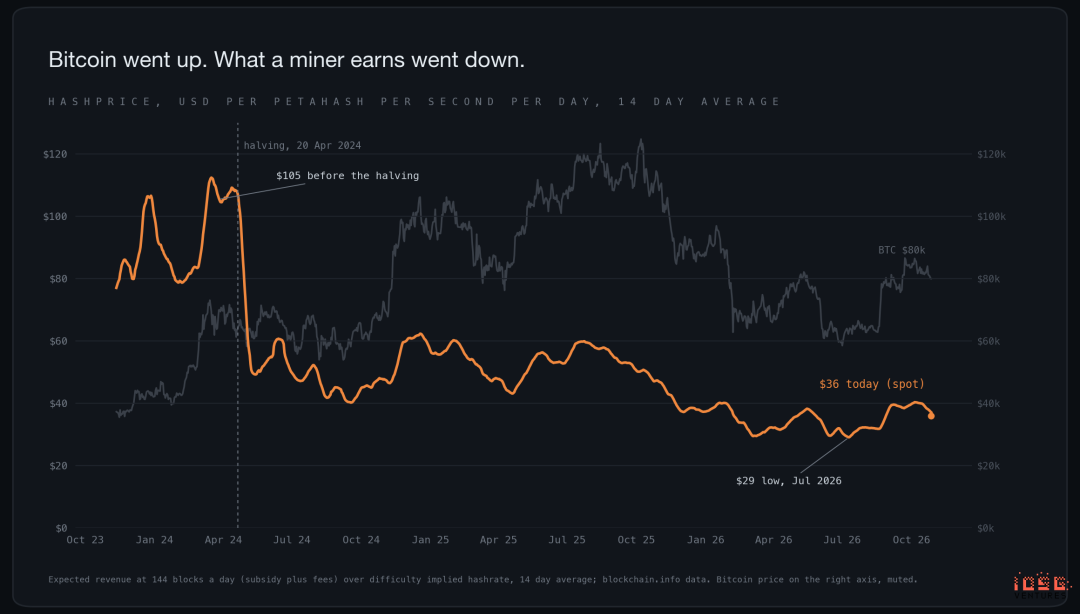
Before the 2024 halving, 1 PH/s could earn about $105 per day. Now it's about $30, while the Bitcoin price has returned to earlier levels. The halving cuts the block subsidy in half, yet the total network hashrate has increased by about 70%, compressing the share of each machine twice. This is already close to the seasonal low point this summer: hashprice once fell below $30; CoinShares estimates the average cash cost of publicly listed miners is $75,500 per coin, while the Bitcoin price was only about $60,000, causing the entire industry to experience a loss while mining.
Bitcoin rose to $84,000 in October but fell back to $64,400 this month. Neither change mattered, because the returns from another path differ too much.
The same 1 MW, two algorithms
The following chart uses a hashprice of about $35 in late October; according to the current $30, the mining column needs to be even lower.
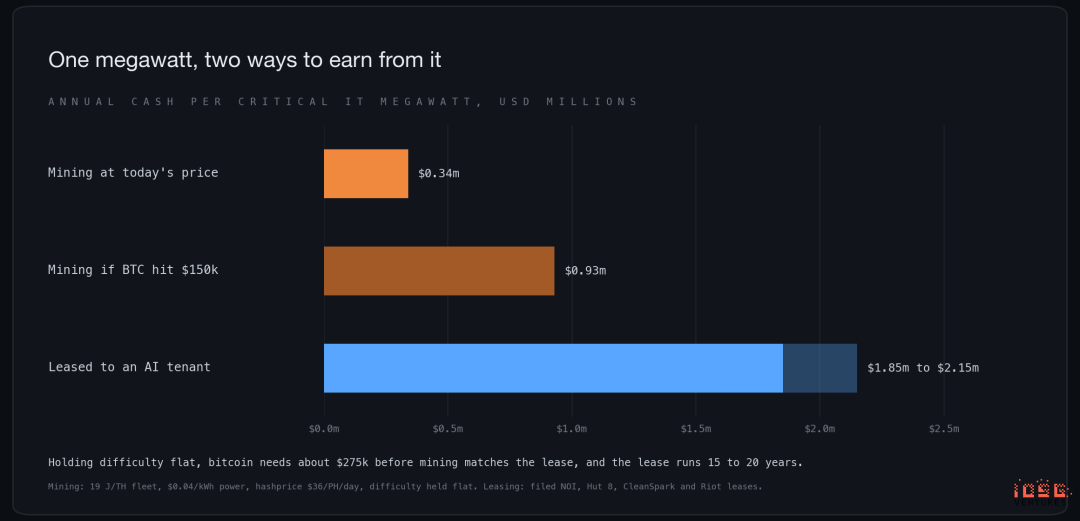
Based on operating profit per MW, a new generation miner's 1 MW can earn about $230,000 net after electricity costs at the current hashprice, and the next-generation miners will also need to be purchased separately. Renting to AI tenants, the same 1 MW can bring in $1.85 million to $2.15 million in NOI (net operating income), with contract periods of 15 to 20 years, with annual rent increases. Even if Bitcoin rises to $150,000 with unchanged difficulty, mining yields only about $1 million a year, with no contractual guarantees.
This comparison has a positive aspect for leasing: the $1.9 million NOI needs a construction investment of $8 million to $15 million per MW, while mining requires only about $800,000 per MW for mining equipment. CoinShares’ valuations cannot be directly taken to conclusions. It values completed and fully leased AI data centers at about $27 million per MW and miners’ powered but unleased capacity at less than $3 million, comparing two types of assets rather than the value of the same park before and after leasing. After deducting construction costs from the leased valuation, remaining every MW is $12 million to $19 million, still 4 to 6 times the unleased valuation, but this does not account for construction completion risk and the two years before leasing. The direction is clear, however, the specific multiples are not precise.
The most convincing evidence is how much mining companies are willing to pay to exit. Core Scientific spent about $42 million to cancel a new order of 15 EH/s mining machines. Keel (formerly Bitfarms) stopped mining in June. Galaxy completely remodeled the Helios mine and recognized an impairment.
How mining sites turn into data centers
Retain outlets, rebuild the rest
After the transformation, only items on the outside of the meter, the grid side, can remain.
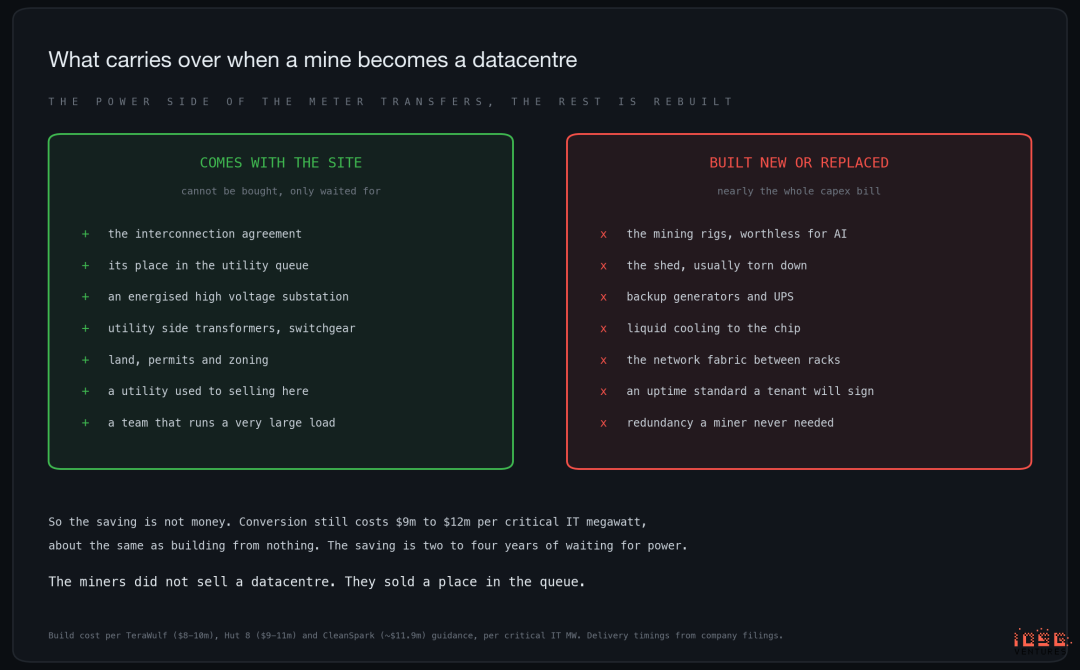
Items outside the meter can be reused, while almost all internal parts are rendered useless. ASIC miners have no use for AI, and the factory spaces usually need to be demolished. When electricity prices rise, miners voluntarily reduce load, hence they have never installed backup power or redundant distribution, nor can they provide the online rates promised to AI tenants. An NVIDIA GB300 cabinet consumes 130 to 140 kW, while a regular server cabinet only consumes about 9 kW, with heat needing to be dissipated through liquid cooling pipes attached to chips.
Thus, renovation costs range from $8 million to $15 million per MW: TeraWulf cites $8 million to $10 million, Hut 8 $9 million to $11 million, CleanSpark about $11.9 million, and Galaxy's Helios Phase II about $15.4 million, essentially equal to new construction. What is saved is not money, but time.
Three ways to sell MW
Landlords can lease out a shell, lease capacity, or sell the entire park directly.
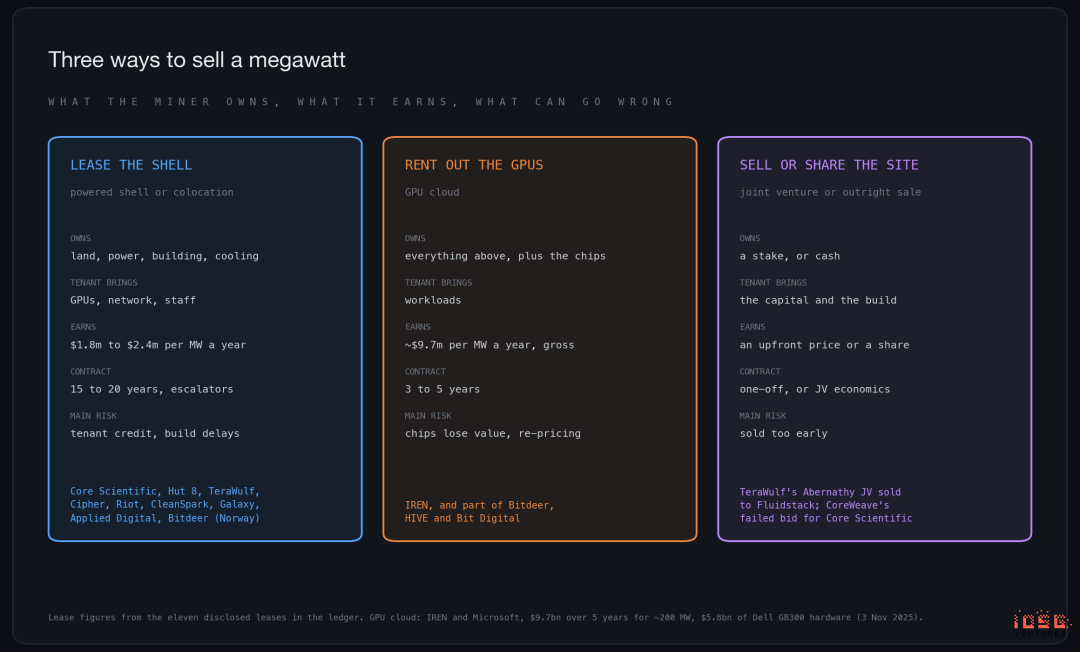
Most in the industry sell "powered shells": land, power, buildings, and cooling, with GPUs, networking, and operations being provided by tenants. With this division of labor, transformed mining companies can be valued like real estate companies. Riot's Corsicana lease goes further, selling "powered land": Riot merely delivers land, power, and footing platforms while tenants build and operate the data centers themselves.
IREN follows the path of leasing capacity, typified by a 5-year, $9.7 billion contract signed with Microsoft, requiring the purchase of $5.8 billion in Dell hardware. Its revenue per MW is about five times that of leases, but most of the chip value disappears within five years, and the contract duration is only one-third of the lease. Comparing revenue per MW between IREN and landlords is a common mistake in the industry.
The third route is selling the park. TeraWulf sold its equity in the Abernathy joint venture for about $530 million to Fluidstack, with $250 million received in the third quarter. CoreWeave attempted to acquire Core Scientific entirely in 2025 but was voted down by Core Scientific's shareholders.
Where the money comes from
A 200 MW park requires about $2 billion at $10 million per MW, and construction expenses need to occur about two years earlier than leasing.
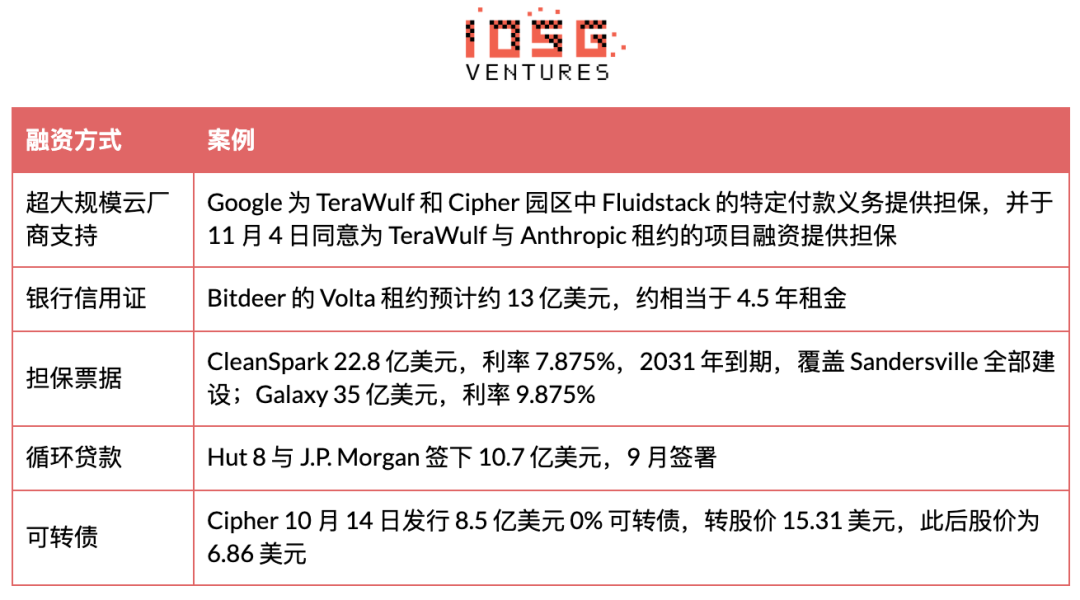
The crucial timing risk still pertains to Riot. Its $573 million Morgan Stanley bridge loan matures on December 31, 2026, but the first 96 MW of Rockdale will not start renting until December 2027, and the investment-grade guarantees for this $9.1 billion lease are still being finalized. Riot reported $950 million in cash and Bitcoin at the end of September, asserting it does not plan to issue new shares and is arranging project loans for Rockdale and Corsicana. This loan must be in place before the lease begins.
Who is doing it now
Landlords: Signing does not equate to being built
The Corsicana lease has made Riot the second largest landlord by contracted capacity, yet almost none are online yet.
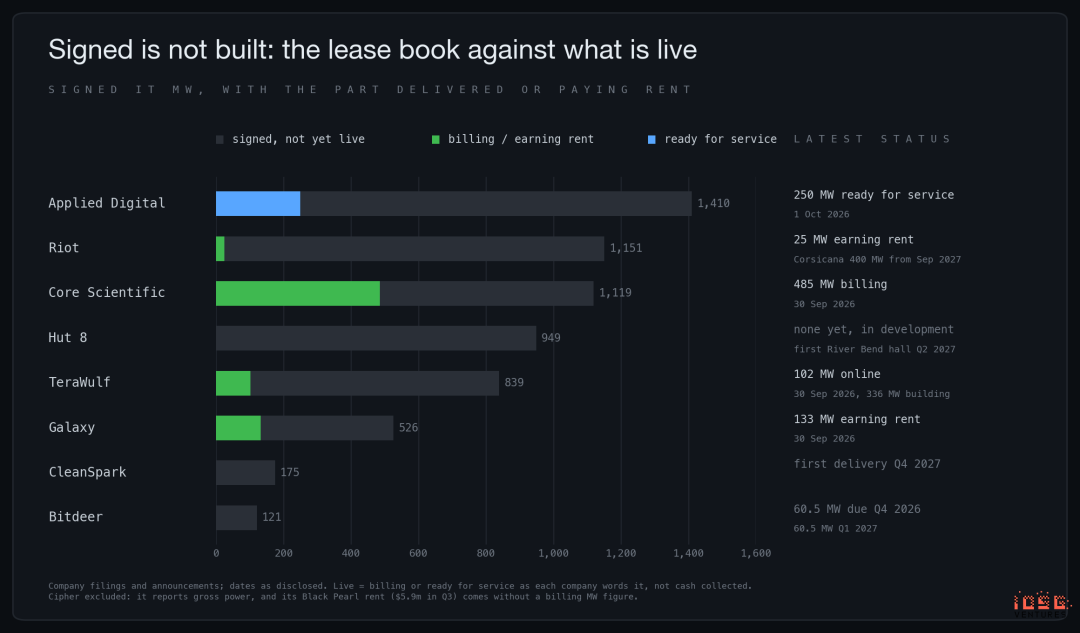
Contracted MW includes capacity to be delivered in the coming years, while billed MW is the part that has begun generating rent. Galaxy leased 526 MW to CoreWeave, with 133 MW currently paying rent. The remaining 393 MW are not sitting idle awaiting tenants; they have been leased and are still under construction. Core Scientific had 485 MW billed as of September 30, up from 395 MW on June 30, with the remaining 100 MW in Dalton expected to go online in early 2027. The grid interfaces resolve just one bottleneck; there are still financing, construction, cooling, redundancy, and tenant acceptance hurdles ahead, so low billed capacity and substantial forward contracts do not indicate weak demand.
Cipher's 700 MW is gross power, not IT load, so we do not include it in the capacity ratio. However, its documents provide Amazon’s IT load at Black Pearl of 216 MW, translating to about $1.7 million per IT MW annually. Black Pearl generated $5.9 million in leasing income in the third quarter, marking Cipher's first leasing revenue.
The largest lease in the industry appeared the morning after the election. On November 4, Riot leased the entire Corsicana park of 910 MW for 15 years at about $28 billion to the same AI lab in Rockdale. Prior to this, there had been no new leases since September 18; Cipher extended its Barber Lake lease to 20 years, increasing the contract value by $5.2 billion, but did not add 1 MW.
Tenants
With Corsicana, the proportion directly leased by AI labs has more than doubled.
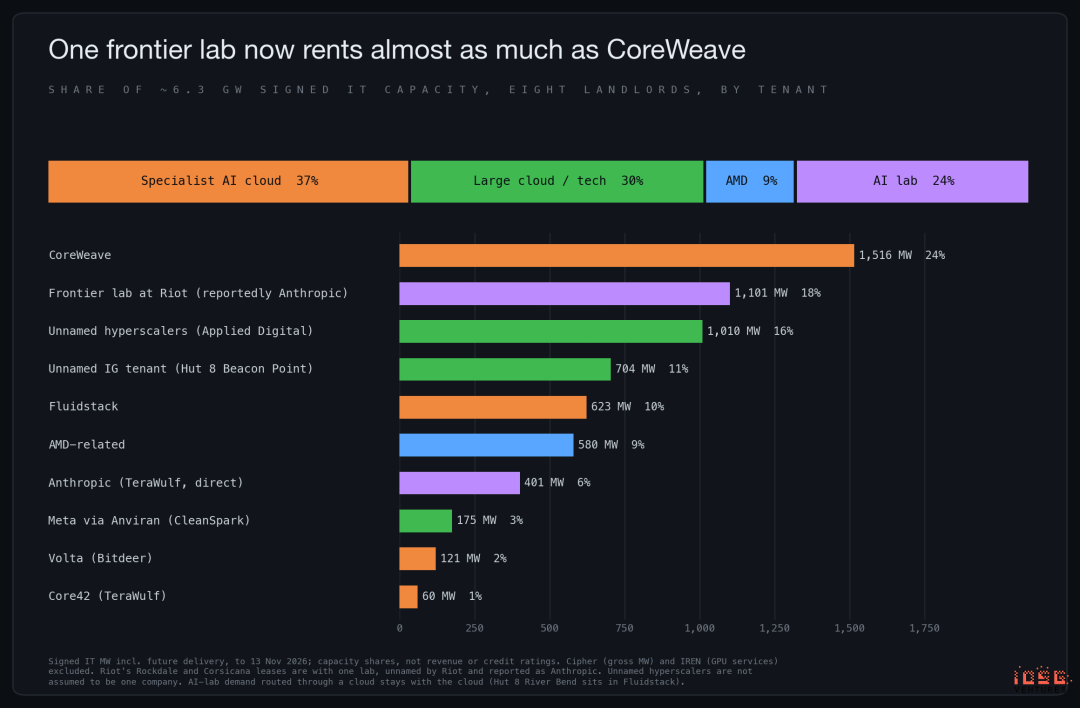
Professional AI clouds (neocloud) remain the largest tenant group, constituting about 37% of the 6.3 GW capacity. Among these, CoreWeave has leased 1,516 MW through Applied Digital, Core Scientific, and Galaxy, representing 24% of the total, with Fluidstack accounting for an additional 10%. Large cloud and tech companies occupy about 30%, AMD-related arrangements comprise 9%, and direct AI lab leases now account for 24%, up from just 11% before Corsicana. If Riot's tenant is indeed Anthropic, then Anthropic directly leases about 1.5 GW and, coupled with the 245 MW it rents through Fluidstack at River Bend, terminal demand already exceeds CoreWeave.
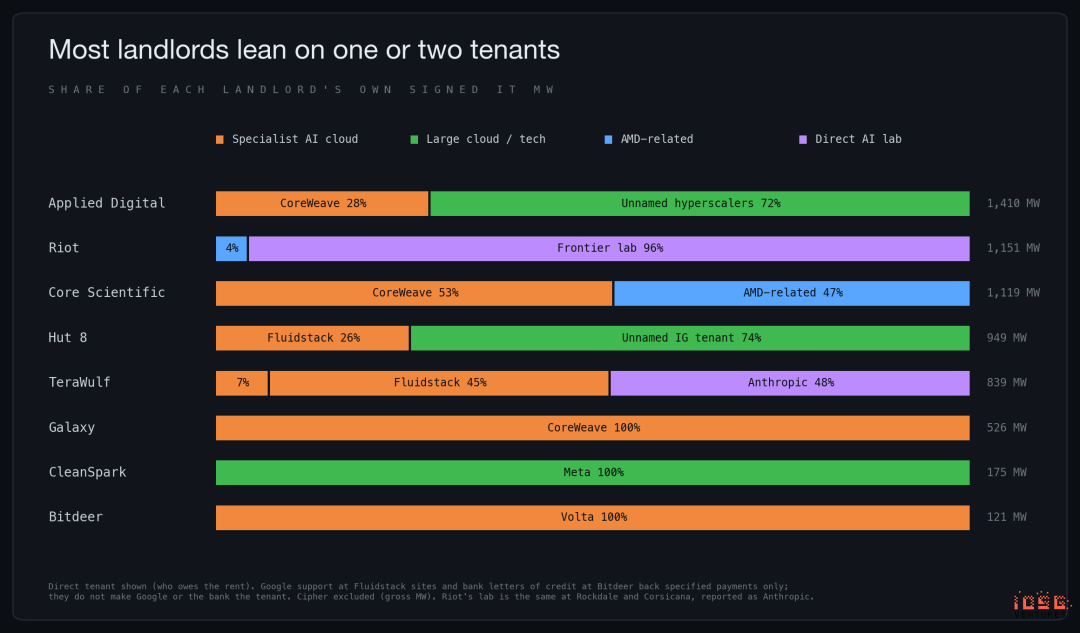
Each landlord has very concentrated tenants. Galaxy, CleanSpark, and Bitdeer each have only one tenant; now, 96% of Riot's capacity comes from the same lab. Crucially, the concentration of CoreWeave has reversed since summer in terms of credit dynamics. Earlier, concerns focused on unrated AI labs. Subsequently, Anthropic raised $65 billion at a $965 billion valuation, reportedly informed investors of $16.8 billion in revenues for the September quarter, filed for an IPO on October 26, and is currently on a roadshow, with reports suggesting a valuation approaching $1 trillion. The real market fear lies with CoreWeave: rated B+, pursuing debt of $41.6 billion, a quarterly increase of about $10 billion. By mid-October, its bond yield approached 15%, and 5-year CDS exceeded 1,000 basis points, remaining at this level ahead of the November 10 financial report. The biggest risk in these leases is not the labs, but the intermediaries renting capacity to the labs.
Few are still mining
Only a few companies are still mining at a large scale: Bitdeer at 82 EH/s, MARA around 71, CleanSpark 50, and Hut 8's American Bitcoin about 25. They are also preparing for both options. MARA’s 2 GW park in Matagorda, Texas, is already listed as "studied load" in ERCOT’s Batch Zero process; MARA plans to sign two leases by the end of the year but acknowledges it may drag on until next year. CleanSpark now has its Meta lease right next to its mining machines in Georgia. Riot nominally still adheres to mining: mining still accounts for a major part of its income, but it has already rented out 1,151 MW and almost sold all its Bitcoin.
Revenue and costs
How much rent can 1 MW collect
Nominal rent is derived from dividing the contract value by the number of MW and the number of years. NOI is the money left after landlords deduct property operating costs, not accounting for financing, depreciation, or taxes. Under a triple net lease, operating costs are borne by the tenant, and the two figures are nearly identical; in leases including services, landlords pay these costs out of a higher rent, needing to sacrifice 10% to 20%.
Based on IT loads, nominal rents range from about $1.44 million per MW per year (CoreWeave at Core Scientific) to about $2.6 million (CoreWeave at Galaxy's Helios II). The same tenant appearing at both ends of this range indicates that nominal rent is clearly not a credit pricing factor. At Core Scientific, most of the facility renovations are borne by CoreWeave itself; Core Scientific's capital input is about $1.5 million per MW, so lower rent corresponds to significantly less construction investment. The following chart discloses four leases that simultaneously reveal both rent and NOI, clarifying the situation.
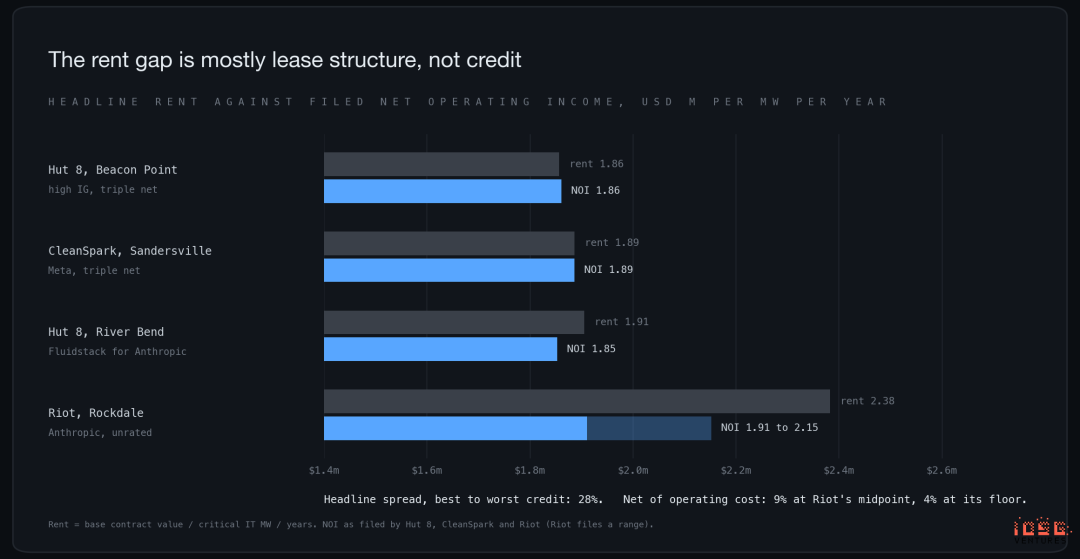
Riot's lease in Rockdale with an AI lab (reportedly Anthropic) has nominal rents 28% higher than Hut 8's high-rated triple net tenant. After deducting operating costs, based on the mid-range of Riot's disclosed range, it is only 9% higher, while at the lower end it only exceeds by 4%. The additional rent primarily covers the costs that the landlord bears, leaving almost nothing that can be considered compensation for weak credit.
Riot's Corsicana lease is the latest and represents another product. The average annual rent of 910 MW is about $1.8 billion, translating to about $2 million per MW (including rent increases), with an NOI profit margin of 99%, falling within the Rockdale range. What has changed is the cost. Riot invests only about $6 million per MW, while the full construction would be $8 million to $15 million, as the data center is built and owned by the tenant. This is the first lease priced based on "approved Texas power" rather than construction. The signing date coincided perfectly with the morning after the elections, during which the approvals for Texas power have become scarcer.
Timing may be more important than credit. Amazon signed with Cipher at the end of 2025 at about $1.7 million per MW; Meta signed with CleanSpark nine months later at $1.89 million, both being triple net leases with top credit. Direct leases from AI labs signed around mid-2026 (TeraWulf, Riot Rockdale, Bitdeer) range from $2.37 million to $2.43 million. The Corsicana lease signed in November came in at about $2 million, breaking this pattern; if calculated based on base period figures, it is even lower because its $2 million average rent includes increases, whereas other figures do not account for increases and cover much less construction. These are nominal figures under different structures, so we only take this pattern as a clue, not a conclusion.
Cost return
Construction costs are rising almost as quickly as rents, so the return on construction has remained within a narrow range. Here, the cost return rate is the annual NOI divided by construction costs, not accounting for financing, and does not equal shareholder return.
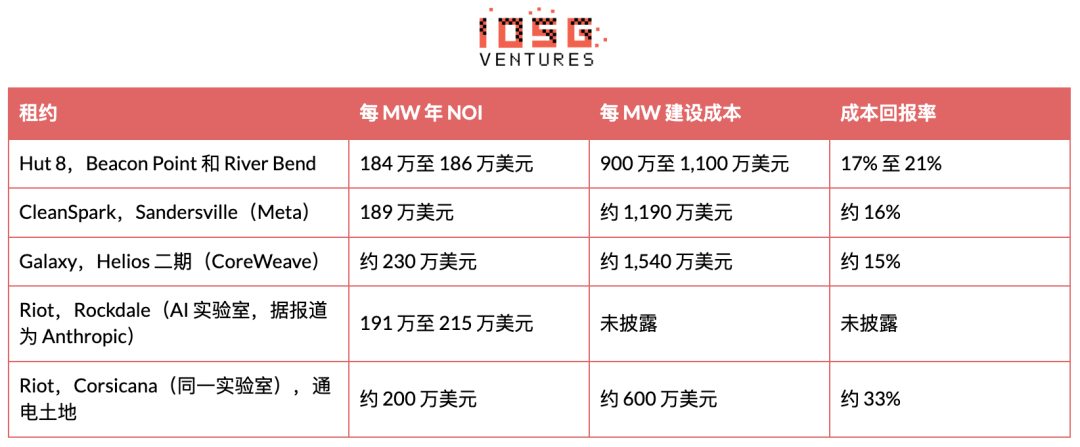
A building with a signed 15-year tenant yielding a return of 15% to 20% annually constitutes a very good property business. Miners can earn this because they hold scarce elements; Corsicana illustrates how much the element itself can earn when tenants bear the cost. The 33% is Riot's own figure, presuming project loans can be successfully secured, which is still in arrangement. Galaxy, with the weakest tenant credit, falls to the bottom of the range: the highest rent, the most expensive construction, the thinnest returns.
How many are truly collecting rents
According to the latest disclosures, Core Scientific had 485 MW billing as of September 30. Galaxy reported 133 MW generating income on September 30, which did not change throughout the quarter, with Phase II starting rent in Q2 2027. TeraWulf had 102 MW online by September 30, with another 336 MW under construction. Applied Digital had 250 MW available for delivery starting October 1, with guidance to reach 300 MW by year-end. Cipher received its first rental income from Black Pearl in Q3 but did not disclose MW figures; Amazon's six phases of delivery extend from September 30 to February 28, 2027. Riot's 25 MW for AMD have been collecting rent since Q2.
The rest are in the delivery pipeline. Two phases of Bitdeer, each 60.5 MW, are set for delivery in Q4 2026 and Q1 2027, respectively; the first data center for Hut 8's River Bend is in Q2 2027; the lab capacity at Riot's Rockdale is due in December 2027; Corsicana's delivery will be in three phases from September 2027 to July 2028; and CleanSpark's first rental income is expected in Q4 2027. These dates and milestone metrics differ across companies, so we do not sum them into an industry-wide percentage.
Impact
On Bitcoin: A few committed miners are selling
First, let's state the most compelling argument from the bears. Blockware's statistics show that Bitcoin inventory of publicly listed miners dropped from approximately 127,000 coins at the beginning of the year to about 99,000 coins by mid-August, which amounts to a net sell-off of about $1.8 billion, used for building data centers. MARA is the largest holder and was the loudest in its "only hoarding, not selling" stance; in March, it changed policies to allow selling reserves, and over six months, its holdings dropped from 53,822 coins to 35,577 coins. Blockware believes this selling pressure is one of the underestimated reasons for Bitcoin's 2026 weakness, a reasonable assertion. Furthermore, this trend continues.
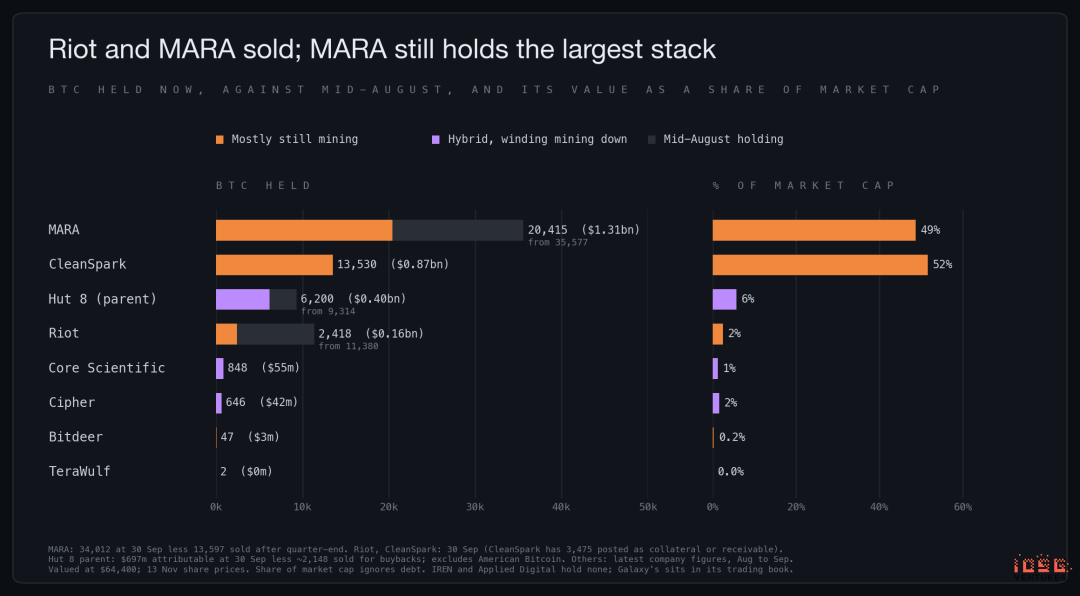
Transformed landlords have long had little to sell: Core Scientific and Cipher each hold fewer than 1,000 coins, roughly 1% of their market capitalizations, while TeraWulf, IREN, and Applied Digital hold essentially zero. Thus, the selling pressure has shifted to several firms that are still mining and beginning their own AI projects. Riot sold 20,264 coins over the first nine months, largely for data center construction, leaving only 2,418 coins by the end of September. After the quarter, MARA sold 13,597 coins at an average price of about $81,000, repaying $750 million in Bitcoin margin loans, and the pledged coins were subsequently released. Hut 8 sold around 3,100 coins to repurchase shares. CleanSpark's 13,530 coins are intact, being the only holder that hasn't reduced its balance and it has ceased issuing monthly production reports since October. Combined, MARA, CleanSpark, and Riot hold about 36,000 coins, worth about $2.3 billion at current prices, down from approximately 60,500 coins in August. This represents a reduction of 40%, not a complete sell-off. MARA has about 20,400 coins remaining, indicating it will continue selling coins for AI funding; CleanSpark’s construction is funded by notes, making Riot’s remaining 2,418 coins inconsequential.
Inventory isn't the only supply. The network issues about 450 new Bitcoins daily, and how much miners retain is up to them, with transformation pushing this choice towards selling. MARA revised its strategy in 2025 to allow selling mined coins, expanding to reserves in 2026; Riot sold more Bitcoin this year than it mined. Data from CryptoQuant shows that on October 26, miners transferred 21,140 coins to Binance, marking the sixth time since February that daily transfers exceeded 20,000 coins, bringing miners' reserves close to a five-year low. This flow also includes private miners and pools, and transferring to exchanges does not equate to sales: it indicates that coins are being moved to sellable locations but doesn’t prove they have been sold. Since then, Bitcoin has fallen from about $84,000 in late October to $64,400, hitting new lows since August, coinciding with outflows from spot ETF funds, hawkish statements from the Federal Reserve, and NVIDIA's AI stock sell-off following Jensen Huang’s resignation as CEO on November 12. Miners’ selling during the recent price drop added supply, but it was not the cause.
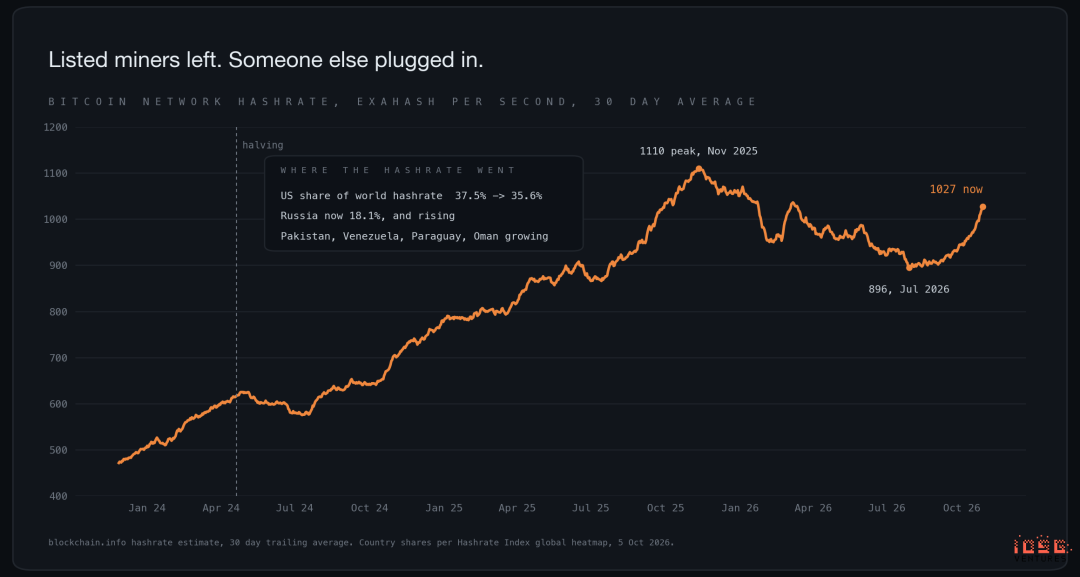
The network steadily absorbed this exit. The hashrate dropped 19% from its peak last November to July this year but rebounded above 1,000 EH/s in October, currently estimated at about 965 EH/s according to mid-November difficulty levels. The difficulty adjustment has played its role: after listed mining companies shut down, the remaining miners can extract more Bitcoin per unit of hash power, while elsewhere new production also kicked in.
More long-term problems include security budgets. This year, fees account for only 0.63% of miners' income, staying below 1% for the fifteenth consecutive month, with revenue almost entirely reliant on block subsidies, which will halve again by 2028. Adam Back's view is that mining and AI represent an arbitrage, which will reach a balance where both sides yield equal returns; this year's uptick in hashrate supports his view. The real test comes in 2028's halving: at current coin prices, even with electricity priced at only $0.04 per kilowatt hour, the new generation miners won’t even cover electricity costs, leading more miners to divert power to AI. This year's experiences show that the network can absorb; exits lead to re-entries.
On the crypto market: mining company stocks are no longer Bitcoin trades
Since August 3, Bitcoin has increased, while every mining company has decreased.
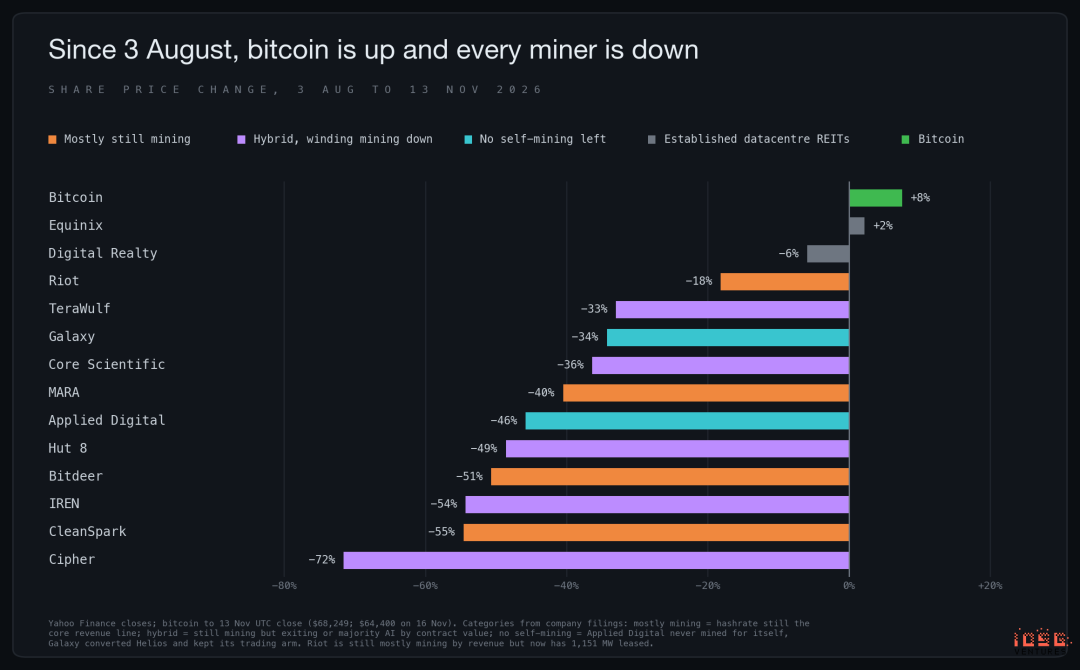
From August 3 to November 13, Bitcoin is up 8%, yet every mining company has faced declines ranging from 18% for Riot to 72% for Cipher. Both miners still engaged in mining and those transformed have faced similar declines, indicating it's not punishment for transformation. There are five reasons. First, the timing misalignment: mining company stock peaked in June with the AI infrastructure boom, while Bitcoin only bottomed around $63,000 in early August. Second, every single company, including the steadfast miners, now has AI projects requiring financing, and stock prices are set based on this financing. Third, the October credit turmoil with CoreWeave affected all entities associated with AI data center debts. Fourth, the assistance from Bitcoin price rises appears smaller, given hashprice has never clearly exceeded $35. Fifth, the elections on November 3 discounted all projects still awaiting approvals in Texas or Georgia. During the same period, Digital Realty and Equinix fluctuated between -6% to +2%, indicating the issue lies within the mining companies themselves: financing, permits, delivery, and tenant credit.
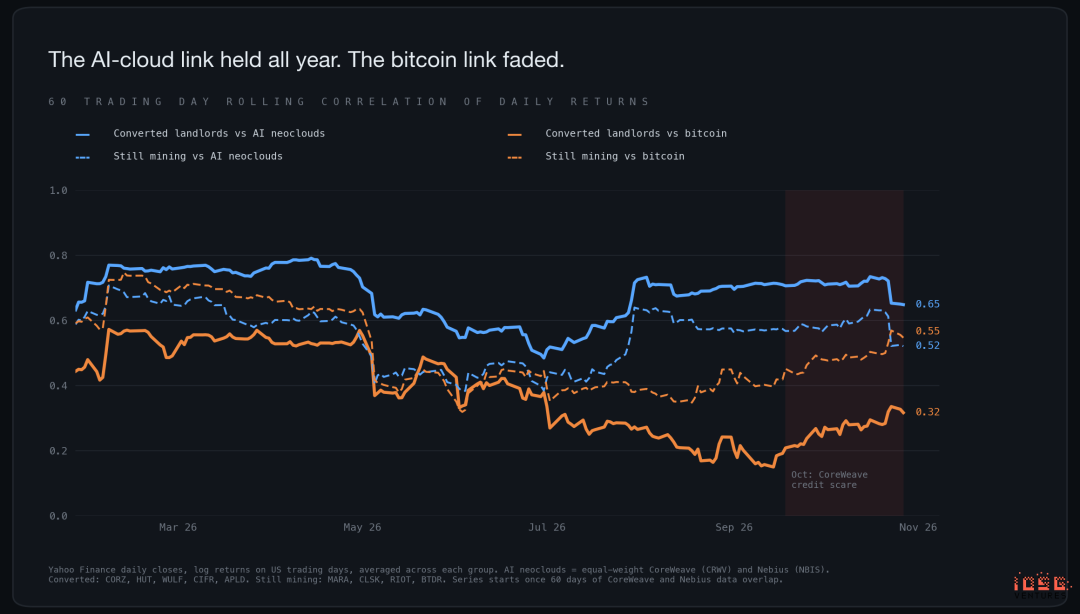
On a 60-day rolling correlation basis, transformed landlords have shown an annual correlation with CoreWeave and Nebius ranging from 0.6 to 0.8, tighter than with Digital Realty or Bitcoin. The link with Bitcoin has been severed, dropping from about 0.55 in spring to about 0.15 by mid-September. According to CryptoSlate, Hut 8's beta to Bitcoin dropped from 1.18 to 0.53, and Cipher's from 1.13 to 0.58.
The elections further split this sector. From November 3 to 13, Bitcoin dropped 12%, while Riot increased by 25%, Core Scientific by 2%, and TeraWulf by 1%; Galaxy fell by 15%, Cipher by 16%, and CleanSpark by 18%. Bernstein downgraded target prices for seven mining firms by 35% to 54%, now valuing the AI hosting business at 12 times next year's EBITDA, citing tightened financing markets and uncertainty in Texas. Morgan Stanley is more optimistic about TeraWulf, Hut 8, and Applied Digital, reasoning that their parks are located outside Texas, though Hut 8's Beacon Point is actually in Texas as well.
This round of sell-offs began with companies renting AI capacity based on debt, now spreading across the entire AI sector. Since August 3, CoreWeave's stock has dropped 38%, Nebius by 46%, and NVIDIA by 21%, the latter facing most of its declines after the CEO's resignation announcement. On October 14, CoreWeave’s bonds were sold off, while Cipher priced its convertible bonds on the same day; Cipher fell by 12%, with the sector broadly declining by 5% to 10%. The most notable mining ETF WGMI now holds major positions in Cipher, Nebius, CoreWeave, and Hut 8; two of these have never mined a single coin. For crypto investors, this basket of listed mining companies is no longer an exposure to Bitcoin, but rather to the credit risks of AI infrastructure, with only a small Bitcoin component.
On AI: real capacity, primarily used for training
JLL reports that North America has about 66 GW of data center capacity under construction; according to BNEF, new data center loads connected to the US grid usually do not exceed about 7.1 GW in a single year. The capacity that can be powered before 2029 includes a significant share of leases in miners' hands, as the grid interfaces are already in place. The midterm elections have made this even more evident: new governors in Texas, Georgia, and Ohio campaigned on pausing new data center constructions, which makes the already leased interfaces more valuable. Limitations will be discussed in the next section.
Risks
Texas. Riot, Galaxy, and Cipher's AI parks are all in Texas, along with Hut 8's Beacon Point and MARA's new park. Just Riot, Hut 8's Beacon Point, and Galaxy account for 2.4 GW, or 38% of the signed total, without counting Core Scientific's parks in Texas and Cipher. Texas has already pressed the pause button under the Republican governor’s tenure. On August 3, Greg Abbott ordered an audit of high load connection queues, and ERCOT subsequently halted Batch Zero studies and approvals for new large load connections; on September 21, he froze state environmental permit approvals for data centers. The market had originally expected him to ease up after the election. The result was that on November 3, Democrat Gina Hinojosa won, promising to halt all data center approvals until new laws are passed in the state legislature, and this suspension order has no end date. She is set to take office on January 19, which is a week later than the state legislature's convening. Her power has limits: utility commission members are appointed by Abbott, her nominees require two-thirds consent from the state senate, where Republicans still hold a 19 to 12 majority. Our judgment is that the pause will last at least until mid-2027, and the final outcome will be stricter conditions rather than a ban. The upcoming timeline is ERCOT's audit report on December 10 and the utility commission's meeting on December 17. The contracted capacity with approved electricity currently remains stable: when Riot signed Corsicana, the electricity was already approved. The risk pertains to sections still requiring access or permits: Galaxy has another 830 MW at Helios still unleased; MARA’s Matagorda park, where payments depend on power supply approvals; and backup generation permits required for signed projects. In Georgia, where CleanSpark's Meta lease is located, the new governor wishes to temporarily pause the whole state, and the utility commission is expected to have a Democratic majority by 2027.
Shift in demand towards reasoning. These parks are inherently training grounds: miners usually site them far from users for cheaper electricity. Gartner predicts that this year, spending on AI-optimized cloud services for reasoning will exceed that for training: $23.3 billion versus $19 billion, with reasoning's proportion expected to reach 59% by 2027. OpenAI has already cut back on some of its self-built plans, abandoning an 800 MW expansion in Abilene in March and pausing Stargate UK in April, though the capacities in Abilene and Norway are being taken over by Microsoft, indicating demand is shifting rather than disappearing. The opposing view holds: batch reasoning, intelligence agents, and reinforcement learning are not sensitive to latency, thus the two loads do not cleanly separate. However, a 15 to 20-year lease essentially bets that both will continue to overlap.
Credit of intermediaries. About 37% of capacity is leased to specialized AI clouds, which in turn sub-lease to labs. CoreWeave accounts for 24%, with no guarantor behind the rent, pursuing $41.6 billion of debt, which was at one point priced as distressed debt in October; management now states that it will no longer issue unsecured bonds at current yields. Fluidstack accounts for 10% and is an ungraded private company; Google only supports specific obligations for TeraWulf and Cipher, not covering all. Bitdeer’s Volta is still dependent on conditional bank letters of credit. If an intermediary collapses, landlords are left with a half-finished building with only one tenant, while the end laboratories never signed contracts with them.
Financing. Most of these leases haven't been paid for yet; funding must come either from stocks that have dropped more than a third since August or from debt priced against CoreWeave’s spreads. VanEck estimates that the industry faces a funding gap close to $50 billion, and Bernstein notes that the financing market is tightening. Hut 8 saw unrestricted cash drop to $157 million during the quarter, Bitdeer had $214 million at the end of September, and Tydal still has hundreds of millions in remaining capital expenditures. Riot's bridge loan maturing on December 31 is the most recent test.
Conclusion
Transformation is real, and decisions are largely complete. The power grid interfaces held by miners are the rarest elements in AI construction. Once built and leased, a park is valued at about $27 million per MW, while without tenants, it falls to below $3 million; after deducting construction, the interfaces with leases still hold four to six times' value. Bitcoin needs to rise to about $250,000 to change the operating accounting, so even the steadfast are preparing for both options.
The election raised the prices of this element and split it in two. New MW in the US is now more expensive and slower, so approved, leased, and financed MW are worth more, while MW still waiting for approvals in Texas or Georgia are worth less. The Riot Corsicana lease signed the morning after the vote represents the clearest pricing of the former: when tenants build data centers themselves, the return on investment is approximately 33% annually.
What remains unfinished is construction. About 6.3 GW has been signed, roughly 1 GW has gone live, and the rest must be financed over the next one or two years. With expected annual returns of 15% to 20% based on costs, these leases are good business, with the rent differentials primarily arising from lease structures between strong and weak tenants. This is both reassuring and problematic: CoreWeave, the landlord with the highest exposure, has received no additional compensation for it.
For Bitcoin, the inventory sell-off has already peaked but is not yet finished. The transformers were the first to sell, followed by Riot and MARA, with the three steadfast miners currently holding about 36,000 coins, including about 20,400 from MARA likely to continue flowing into the market. Hashrate has recovered, and the network has absorbed this exit so far. For crypto investors, mining company stocks are no longer a means to hold Bitcoin. They back the credit risk of AI infrastructure and Texas’s permit risks, with Bitcoin contributing only a small amount.
Methods and explanations
Capacity statistics are based on AI leases disclosed by November 13, 2026, excluding IREN's GPU cloud contracts. Contracted capacity includes parts for future delivery. Delivered, available, and billed capacities are listed as per each company’s descriptions, differing in statistical dates, so we do not calculate an industry total billing percentage. Capacity ratios represent the percentage of signed IT MW, not income percentages, nor credit ratings. Unnamed hyperscale cloud providers are not assumed to be the same company; demand from AI labs leased through cloud providers is still attributed to clouds. Neither of Riot’s lab leases disclosed tenant names; Bloomberg reports that Rockdale's tenant is Anthropic, while Riot indicated Corsicana is to the same lab.
Cipher’s disclosed 700 MW is gross power rather than IT load, hence does not count towards capacity percentages. Based on Cipher's February 2026 investor materials, Black Pearl accounts for 300 MW of gross power and 216 MW of key IT load, translating to Amazon's 15-year, $5.5 billion contract into about $1.7 million per IT MW annually ($1.22 million per gross MW). Cipher began receiving rent from Black Pearl in August but did not disclose the billed MW.
Nominal rent is derived from dividing the base contract value by key IT MW and years, excluding rent increases; Corsicana is an exception, with Riot only revealing average rent including increases. NOI is solely based on numbers disclosed by companies, coming from Hut 8, CleanSpark, and Riot. Galaxy's Phase II NOI is computed from its disclosed profit margins exceeding 90% multiplied by its disclosed income. Cost return rates adopt the construction cost guidance from each company; Corsicana applies Riot’s $6 million per MW, which includes $4 million reimbursed to tenants.
The breakdown of Texas ratios includes Riot (Rockdale and Corsicana), Hut 8's Beacon Point, and Galaxy Helios; excluding Core Scientific's Texas parks (not disclosed by park).
Mining economics assume miner efficiency at 19 J/TH (52.6 PH/s per MW), electricity price at $0.04 per kilowatt hour, full-time operation, and unchanged difficulty, only accounting for income minus electricity costs. Hashprice is calculated based on the total network hash rate estimated income from around 144 blocks per day, with the current figures applying difficulty at 134.8T and Bitcoin price at $64,400. The correlation assumes daily log return rates on trading days in American stocks. Bitcoin holdings are based on each company’s latest disclosures as of the date of the image, appraising at $64,400.
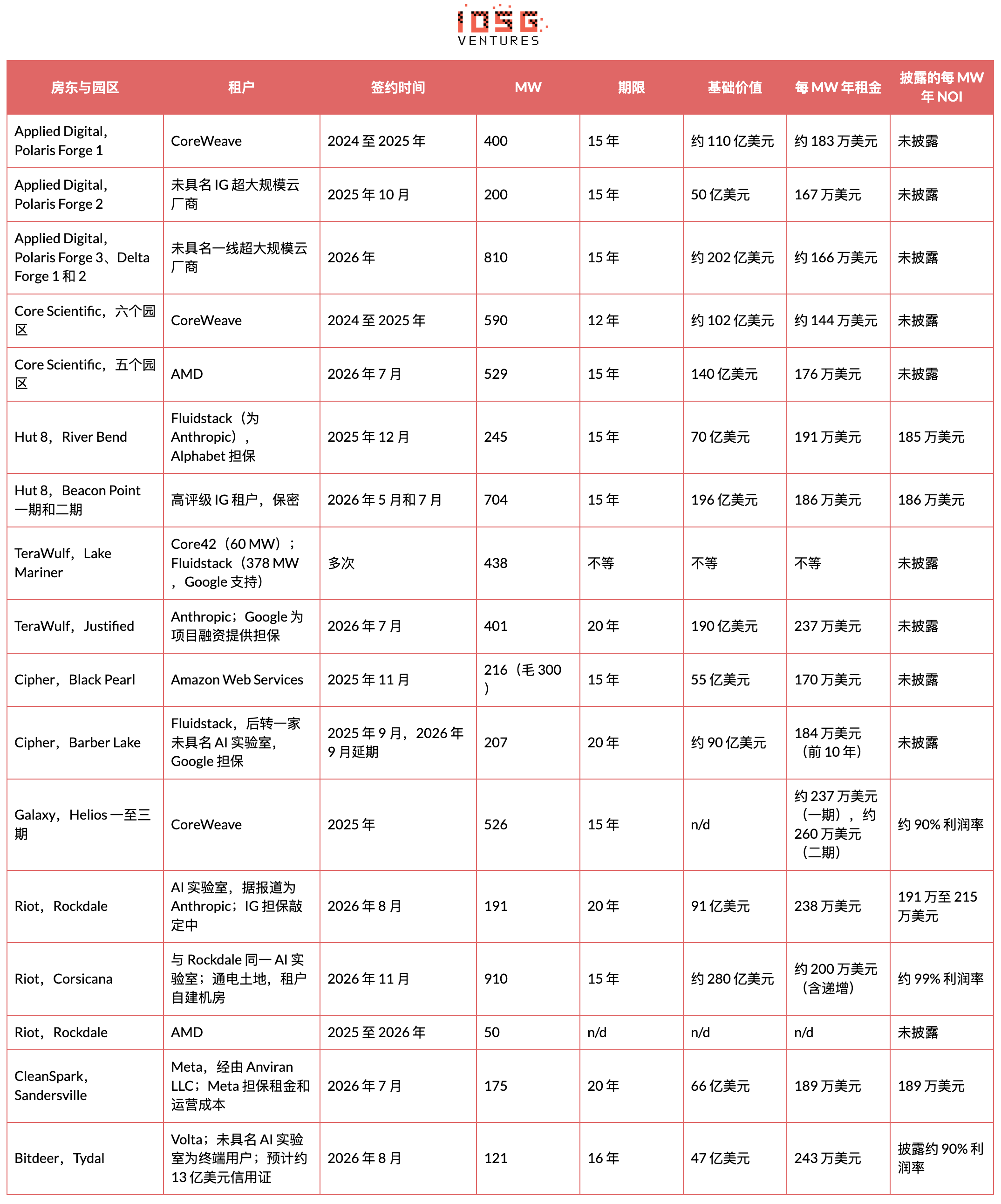
Lease details
IG denotes investment grade, n/d indicates not disclosed. Base value refers to the contractual value within the base period. "Undisclosed" denotes a lack of NOI figures found in the examined documents.
免责声明:本文章仅代表作者个人观点,不代表本平台的立场和观点。本文章仅供信息分享,不构成对任何人的任何投资建议。用户与作者之间的任何争议,与本平台无关。如网页中刊载的文章或图片涉及侵权,请提供相关的权利证明和身份证明发送邮件到[email protected],本平台相关工作人员将会进行核查。


