Revenue, market space, and narrative are three perspectives to assess tokens.
Written by: Castle Labs
Translated by: AididiaoJP, Foresight News
The revenue of the crypto industry is highly concentrated.
In the past 12 months, the top 10 protocols accounted for 47% of the total revenue in the industry. Revenue flowing to token holders is even more concentrated, with the top 10 protocols taking 73%. Protocols that can generate revenue often become better investments because of high cash flow.
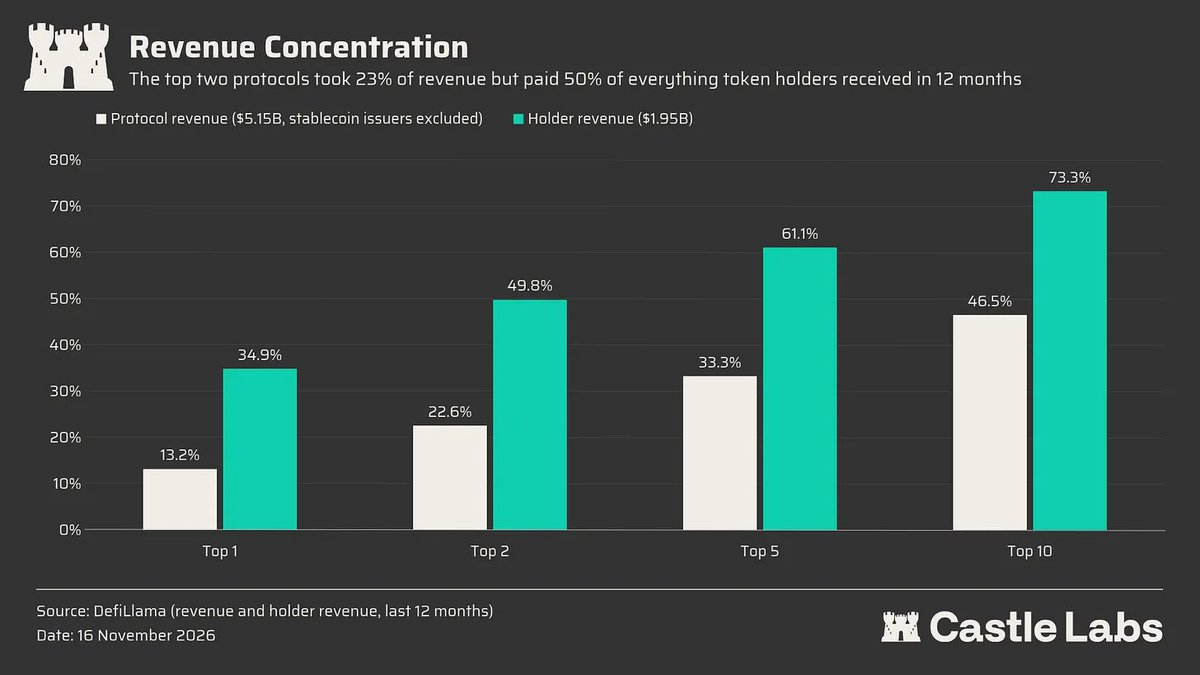
But the question this article wants to ask is: Is it possible to predict token performance well when a protocol is leading in its category? If not, what exactly is the difference between the leading tokens that perform well and those that do not?
This article connects the revenue flowing to token holders with token performance and discusses two factors that revenue alone cannot explain: how large the market for the protocol is and the narrative of the product itself.
1. Crypto revenue also has dual oligopoly
Leading projects in different categories take the majority of cash flow. In the past 12 months, crypto protocols in various categories collectively earned $13.7 billion.
In each category, the top two accounted for at least 52% of the fees. In categories like stablecoin issuers, prediction markets, basis trading, and options, the top two even took over 90%.
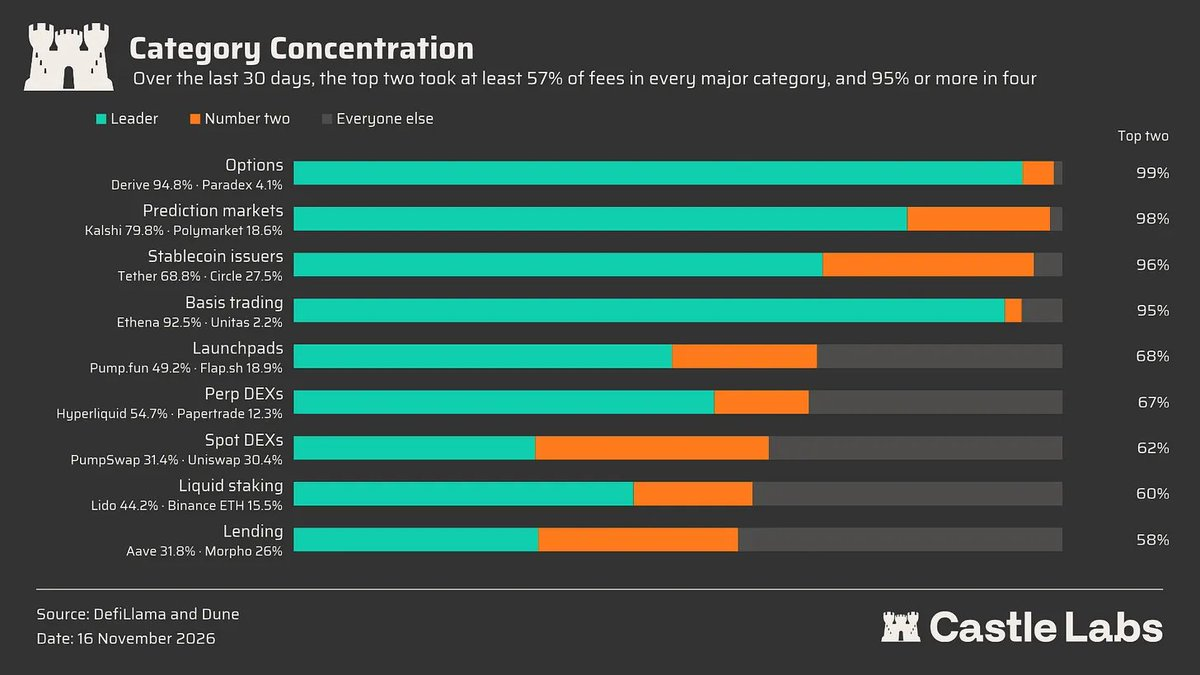
However, this concentration does not hold for every category. When migration costs are low and competition is fierce, concentration can be broken.
For example, launch platforms and spot DEXs are not so concentrated because user migration costs are low and competition is intense. For DEX traders, what matters is the optimal path and the cheapest trading venue, so aggregators choose based on liquidity. DEXs are competitive, and no single venue can provide the deepest liquidity and best prices for all assets, so traffic is dispersed across multiple venues.
Launch platforms are different; their business is cyclical and depends on whether the platform can capture traffic in emerging ecosystems. Pons was highlighted during the Robinhood memecoin seasonal peak and earned most of its revenue, but that activity now seems to be fading.
Lending and perpetual contract DEXs are more driven by incentives and liquidity. Traffic depends on a combination of both: better incentives can attract funds, and better liquidity can retain them. Liquidity helps top protocols maintain and expand their advantages over competitors, but some traffic will be siphoned off by better incentives.
Additionally, in categories with stronger dual oligopoly, like stablecoins and prediction markets, it is fundamentally impossible to invest from a token perspective. The only tradable equity is Circle, coded as CRCL.
Thus, opportunities naturally return to categories with lower concentration. But even if you invest in these leading tokens, the performance may not look good, as most underperform Bitcoin.
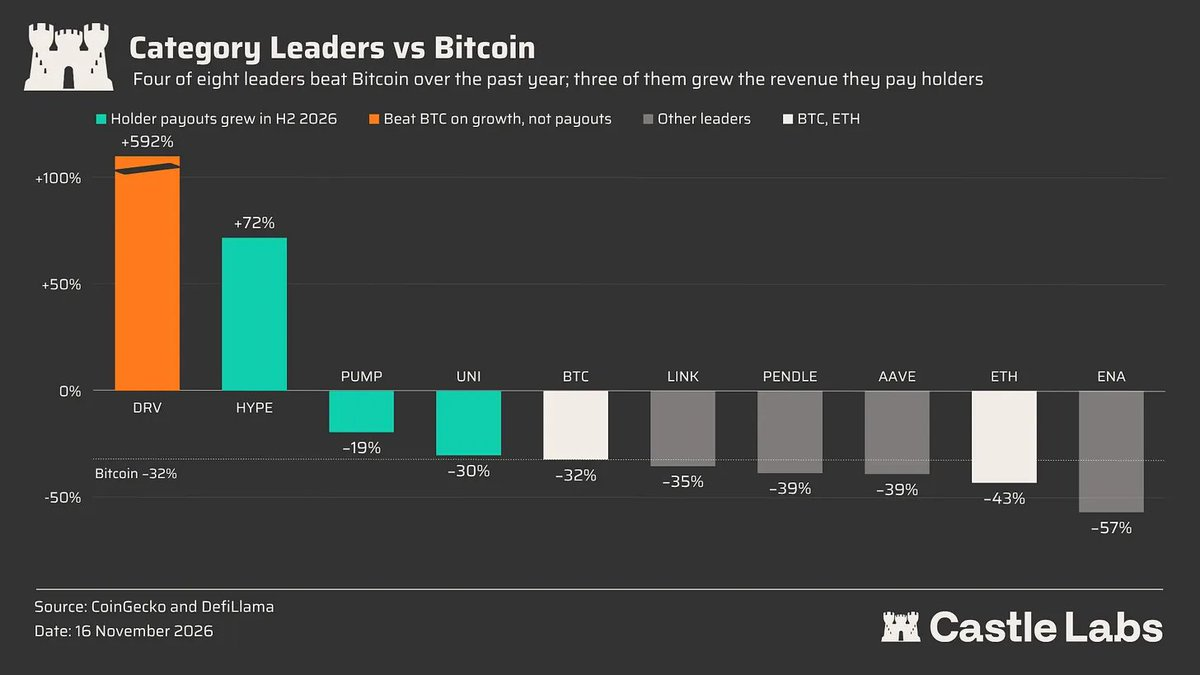
So why do these tokens still underperform despite leading protocols in their categories? Part of the answer lies in revenue data and how much token holders can receive.
Hyperliquid's revenue rose from $38 million in July to $69 million in October, benefiting both the protocol and the token from project growth and Circle reserve earnings.
Uniswap’s fee switch and the UNIfication proposal took effect at the beginning of the year, and the protocol has been using its revenue to buy back tokens.
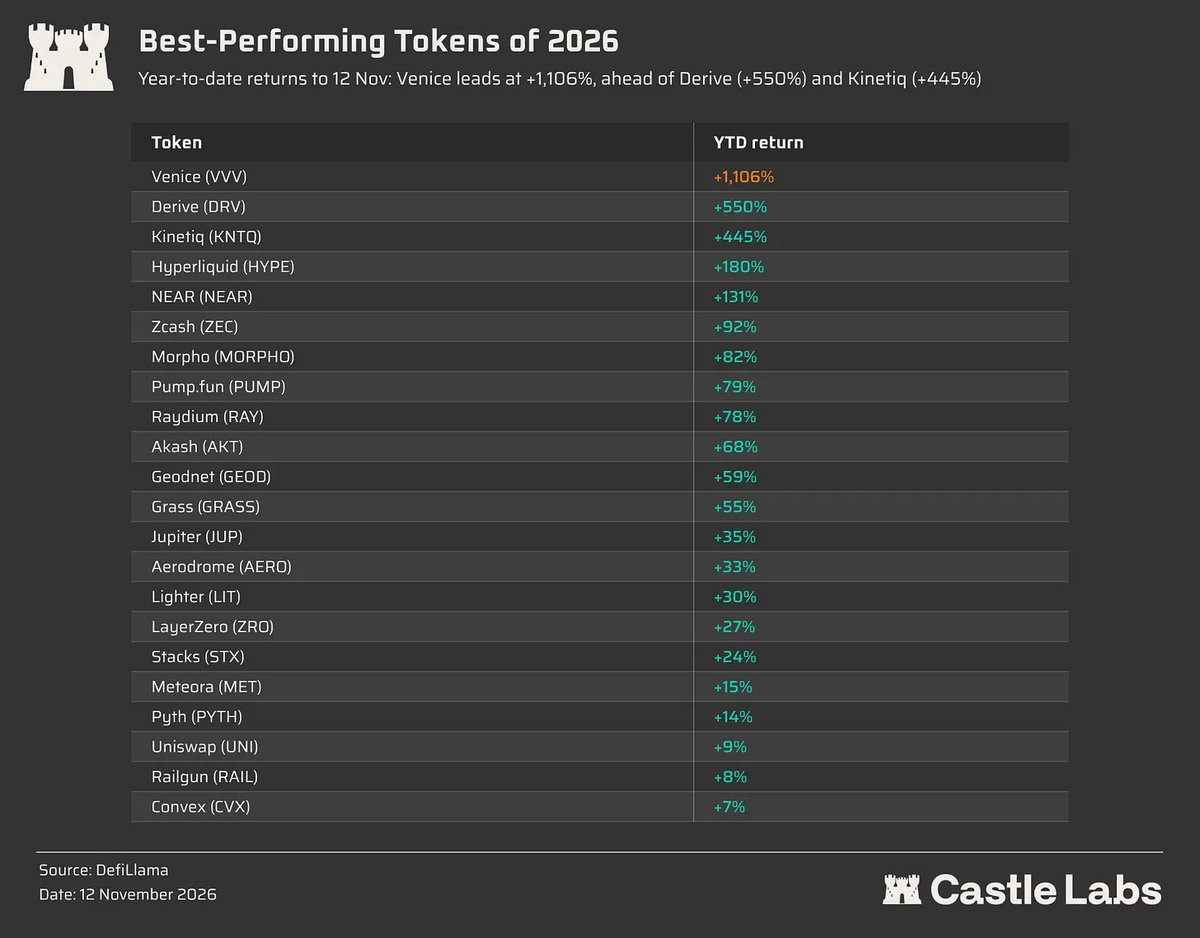
Derive increased by 592% in a year, marking the largest gain among the leaders. However, last year the protocol's revenue returned to token holders was only about $1.3 million, a rather small amount. Its price is not supported by existing holder income, but rather by market expectations of future growth in on-chain options.
Aave stopped its buybacks following the KelpDAO incident, which means it no longer uses revenue to buy back tokens from the market to return value to holders. Pendle's revenue has also significantly shrunk: by October 2026, monthly revenue had dropped from $4 million a year ago to $500,000.
To determine whether the market has reflected these changes in prices, we use a simple metric: the market capitalization over the revenue flowing to token holders in the past 12 months. This multiple is equivalent to the token's "price-to-earnings ratio"; the higher the multiple, the more expensive the market price for each $1 of holder income; the lower the multiple, the cheaper it is.
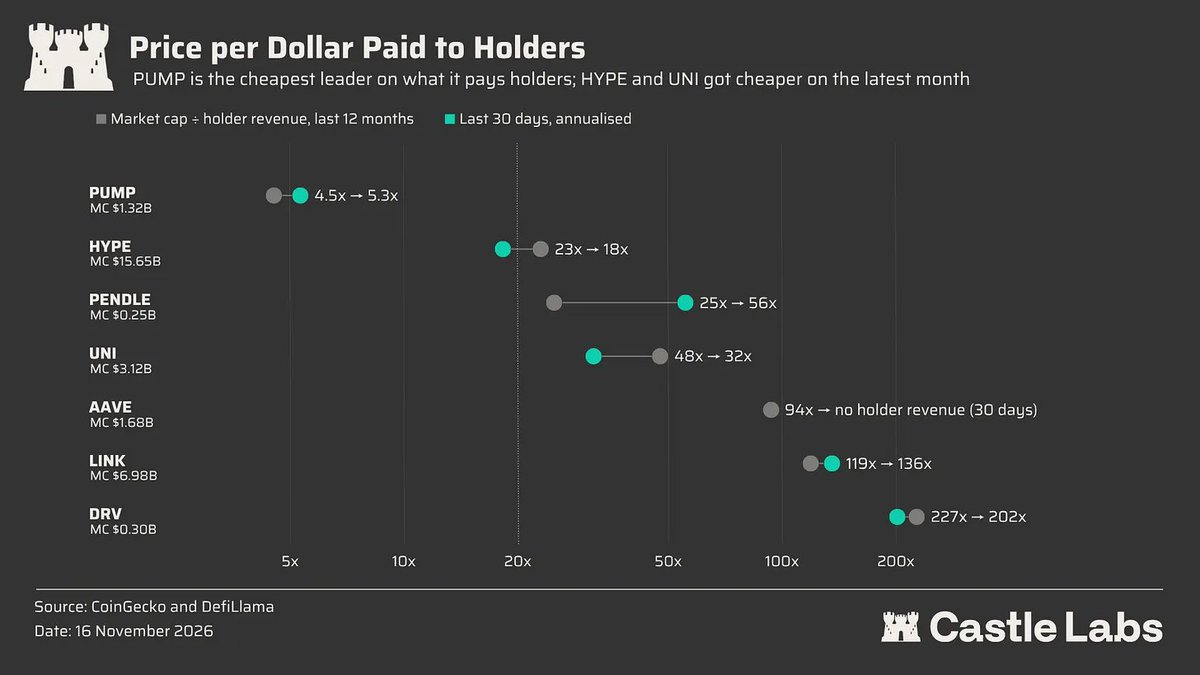
In the past 12 months, Uniswap and Hyperliquid’s valuation multiples have decreased, making them relatively cheaper; on the other hand, the valuation multiples of other tokens have increased, making them relatively more expensive. This precisely explains why Uniswap and Hyperliquid have performed better: they are not supported by valuation expansion but by revenue growth maintaining prices.
Derive is the most expensive, clearly indicating that its price is driven more by expected growth rather than current holder income.
Pump has the cheapest valuation; cash flow and value have been consistently flowing back to tokens, but market sentiment just cannot improve. The reason is that it is a launch platform, with revenue dependent on meme coin speculation, and this business is a negative-sum game—if someone makes money, someone else loses more. Additionally, the protocol has not yet airdropped tokens to users, adding uncertainty that causes many investors to choose to wait and see.
However, the cases of Derive and Pump illustrate that looking solely at revenue and holder income is not enough. Both have cash flow support, yet their token performances have not kept up. To assess token trends, two additional factors must be considered: how the narrative develops and how large the future market for the product is. These two aspects often determine whether capital is willing to flow into the tokens.
2. The true "escape velocity": market space determines the ceiling
DeFi and tokenization are targeting multi-trillion-dollar markets. For leading projects in their categories, today's revenue is still just a small portion of the addressable market.
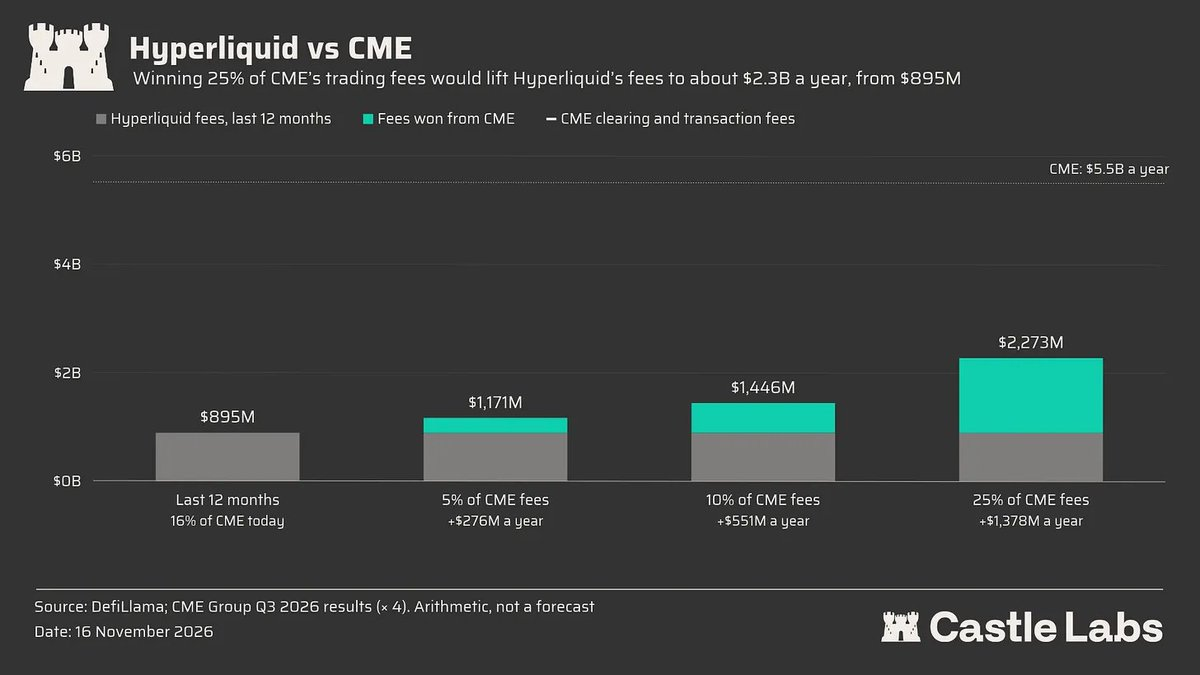
Let’s first look at Hyperliquid. Its annual fee revenue is $895 million, roughly 16% of CME's $5.5 billion (annualized Q3 2026) in clearing and trading fees. Due to regulatory restrictions, Hyperliquid does not have U.S. users, but this is changing.
Recently, ICE, the parent company of NYSE, has collaborated and invested with TradeXYZ to run U.S. perpetual futures on Hyperliquid, covering crypto, stocks, commodities, and forex. Kraken's parent company, Payward, has also become the first CFTC-regulated HIP-3 deployer through its Bitnomial exchange and NinjaTrader Clearing. Both are still seeking approval, but this shows the vast market Hyperliquid will enter once it opens up to the U.S.
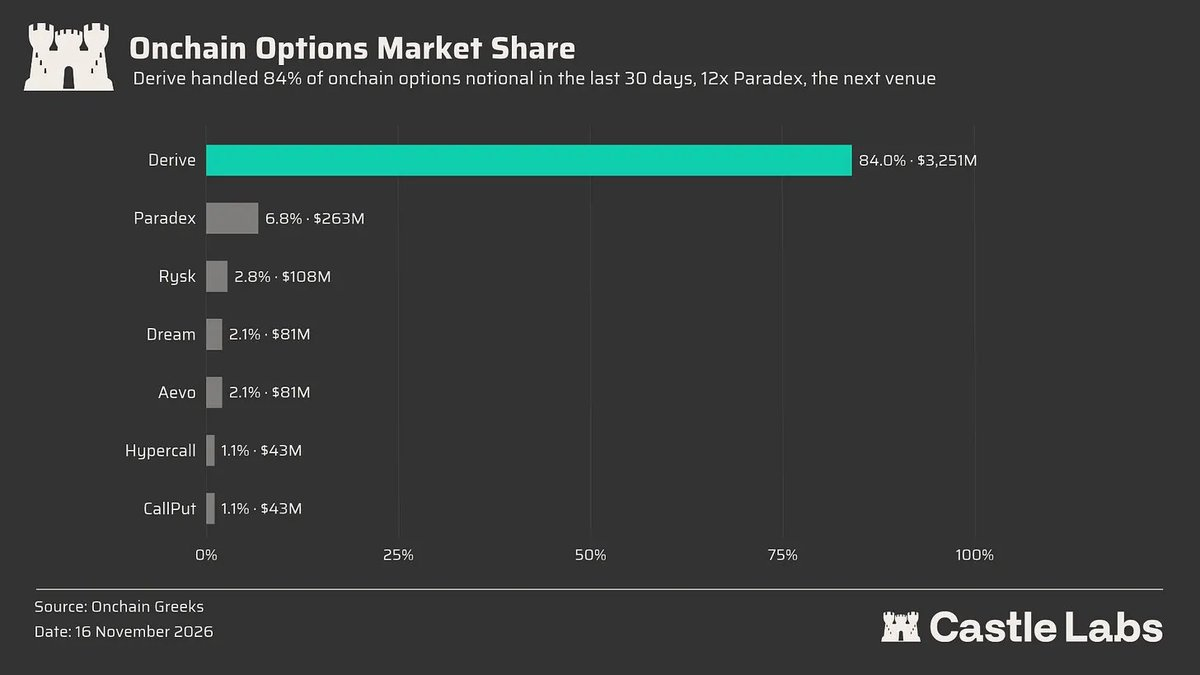
Derive's position in on-chain options is akin to Hyperliquid's position in on-chain perpetual contracts.
In the past 30 days, Derive processed about 73% of on-chain options trading volume, accounting for 93% of open contracts. From early 2026 to now, the platform has cleared around $14.2 billion in nominal trading volume, nearly three times the total trading volume for all of 2025.
To further expand, the team has developed Derive V3, adding multi-coin collateral, vaults, institutional support, etc. Especially vaults and integrations bring new distribution channels, similar to Hyperliquid's HIP-3 and builder codes, which have proven effective for the ecosystem. New channels allow products to engage with retail users more closely, while institutional support helps attract larger funds.
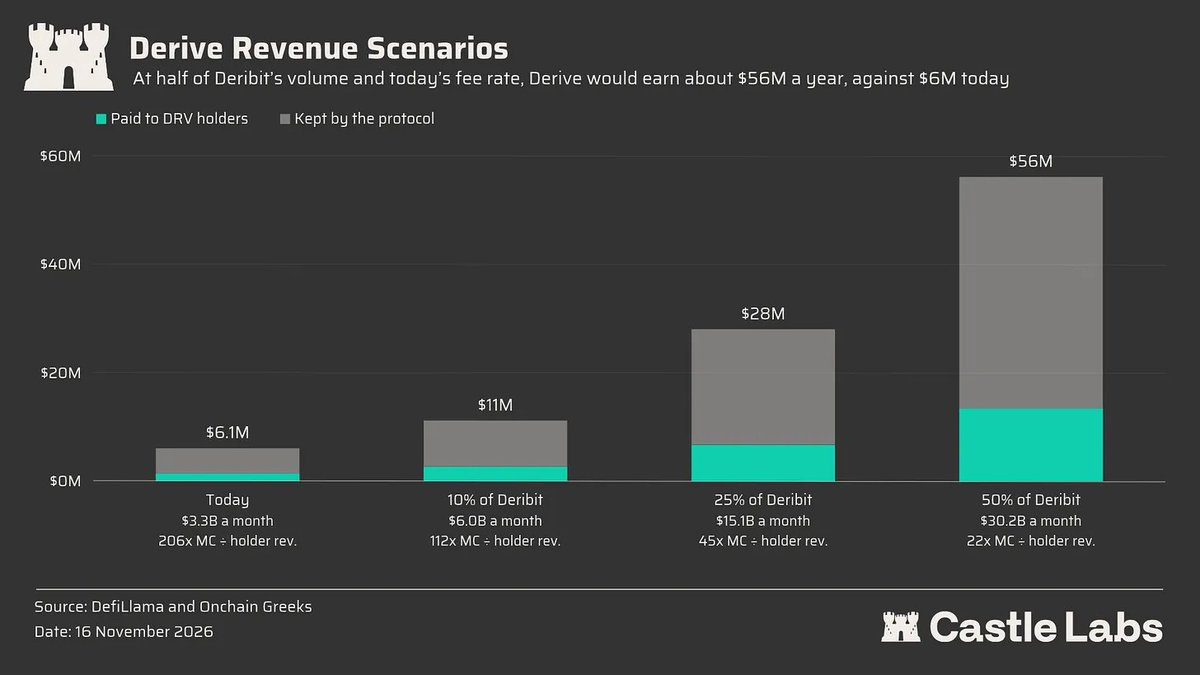
The ultimate target is the traditional options market, and Derive has started with upcoming RWA options. Its biggest competitor currently is the off-chain options protocol Deribit, which traded $60.4 billion in options nominal volume in the past 30 days, which is 13.6 times all on-chain venues combined. As on-chain options continue to expand and grow steadily, if Derive captures just 10% of Deribit's nominal volume, annual revenue could exceed $10 million.
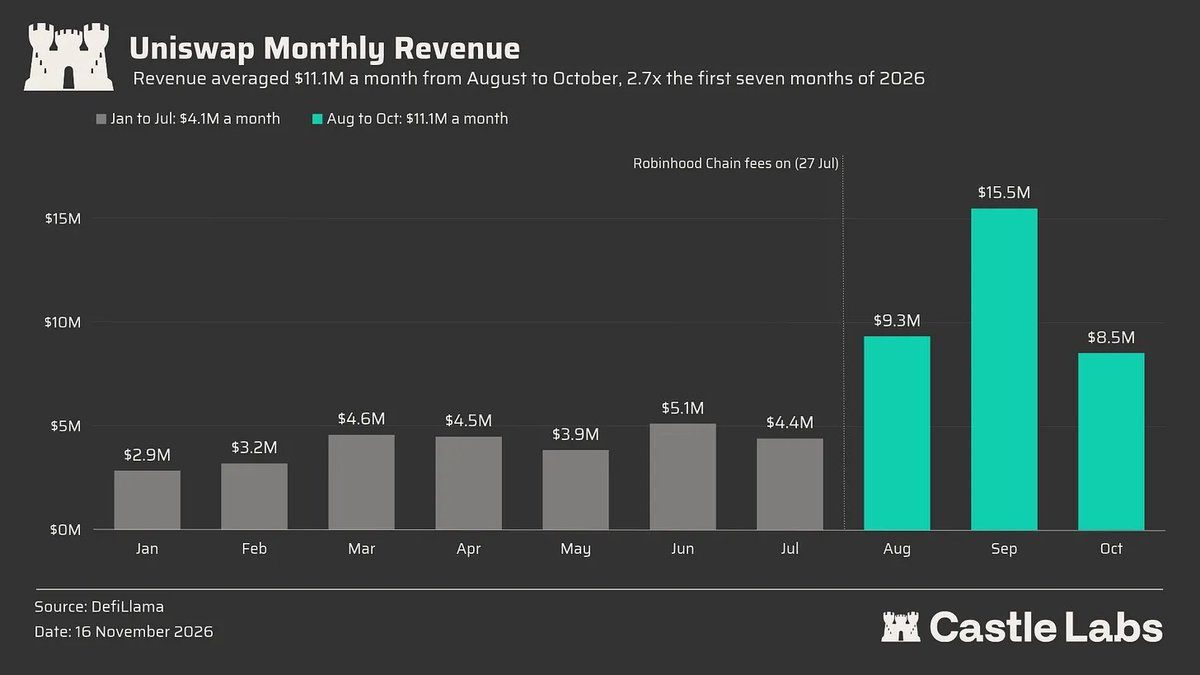
Uniswap maintains a leading position in the spot DEX space: it accounted for 25% of trading volume in the past 30 days and 31% of net fees in the past 12 months. In the second half of 2026, Uniswap's revenue growth mainly comes from tokenization and Robinhood activities. The influx from Robinhood may only be a one-time peak, but we expect it to rebound; the longer-term growth logic lies in tokenization. The RWA market size has grown from $25 billion at the beginning of the year to about $40 billion now. McKinsey predicts that by 2030, the tokenization market could reach $2 trillion.
These tokenized assets will be traded on DEX. DEXs provide 24/7 liquidity, which is directly correlated to growth for any on-chain DEX. The main advantage of Uniswap's architecture is the V4 hooks, allowing anyone to create permissioned pools, which benefits the transfer of restricted assets. V4 also supports trading in restricted regions, as seen in the recent collaboration between OKX and ICE.
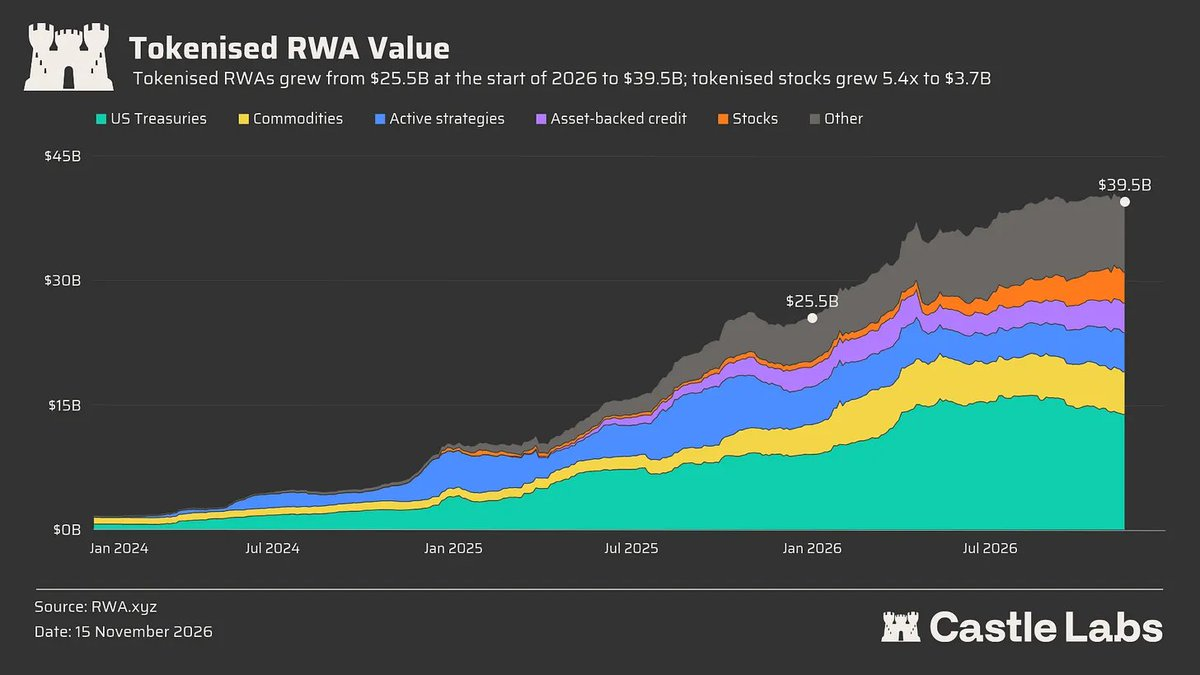
Another beneficiary of the growth in tokenization is Pendle.
As of the end of Q3 2026, 82% of Pendle’s TVL comes from the dollar markets supported by RWA, with a 43% growth in Q3 TVL. These markets include dollar assets issued by Agora and Global Dollar, backed by U.S. Treasury bonds, reinsurance products from Re Protocol, and GPU mortgages from USDAi.
Each new income-generating RWA asset needs Pendle's marketplace to reach more users and combine with other DeFi protocols. Pendle is increasingly becoming an indispensable part of tokenized asset issuance. The larger these assets grow, the more Pendle benefits.
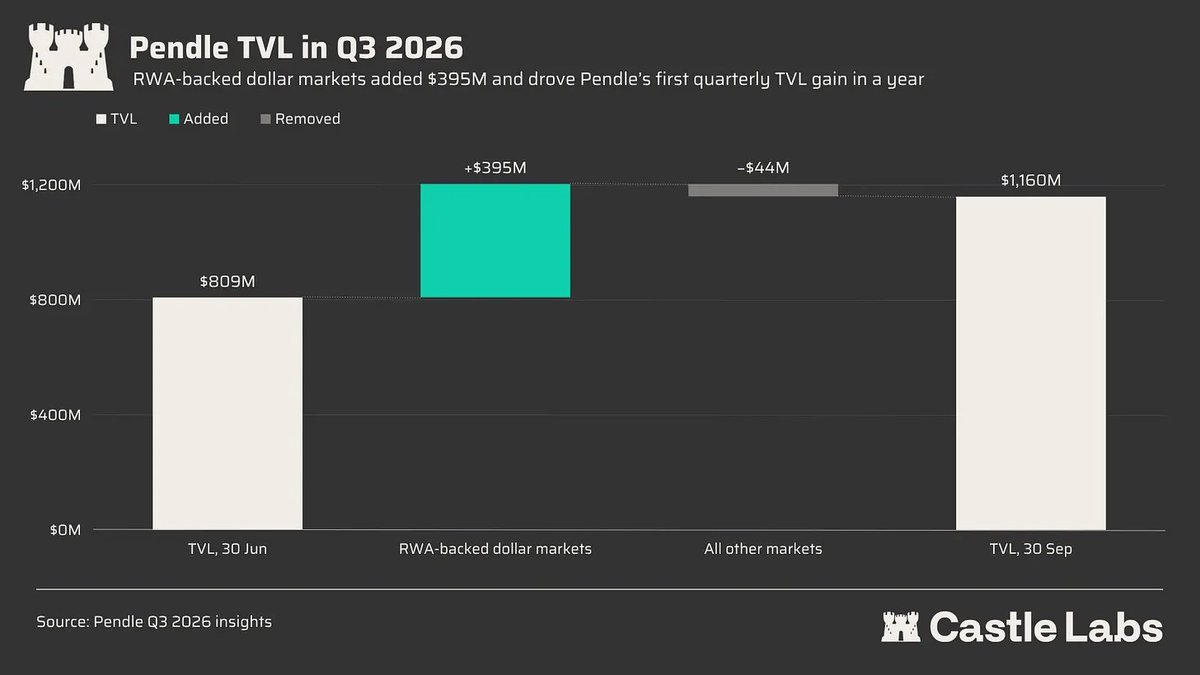
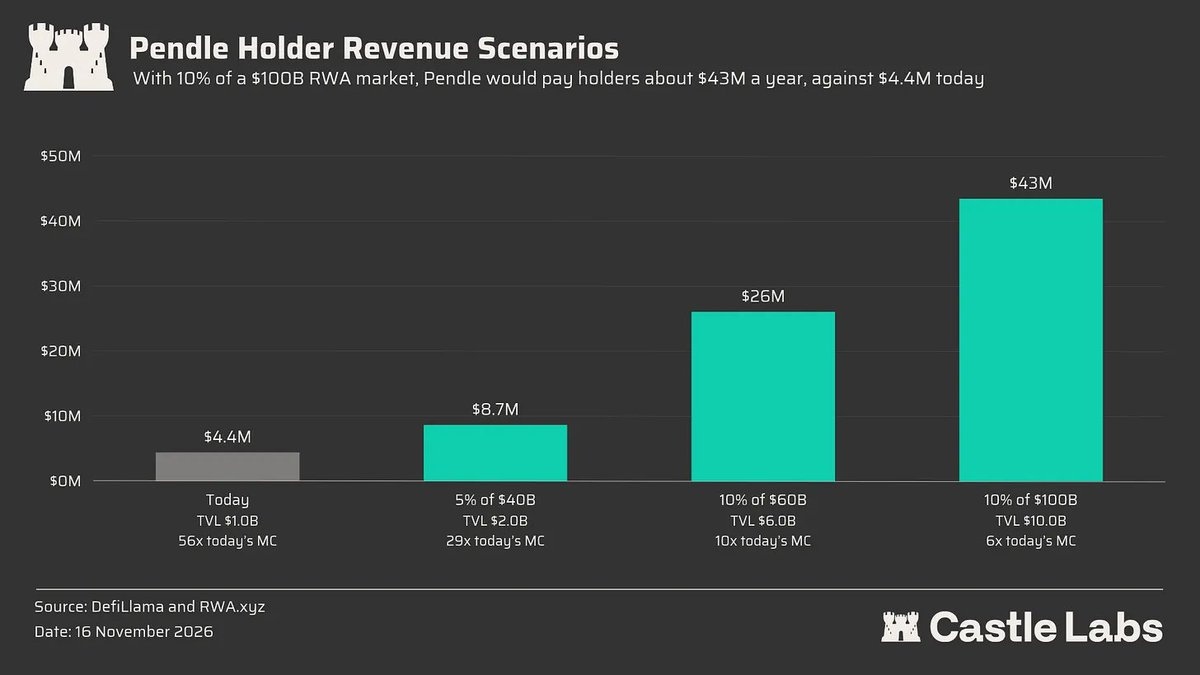
How big can Pendle get? Currently, its TVL is about $1 billion, which includes both crypto assets and RWA assets.
As the RWA market expands, Pendle’s RWA TVL will grow too. Assuming Pendle's RWA TVL can capture 10% of the entire RWA market, considering that the RWA market itself is still growing, based on this ratio, Pendle could return over $43 million in income to token holders annually. This is a hypothetical calculation based on the "10% share" assumption, not current revenue.
Growth in tokenized assets is beneficial for both Aave and Pendle. Pendle's PT assets can serve as collateral for loop lending, linking Pendle and Aave together. Tokenized stocks on Base are also growing, with net deposits exceeding $18 million, primarily driven by incentives provided by partners like SuperForm and Dialectic Group Vaults, along with arbitrage trading.
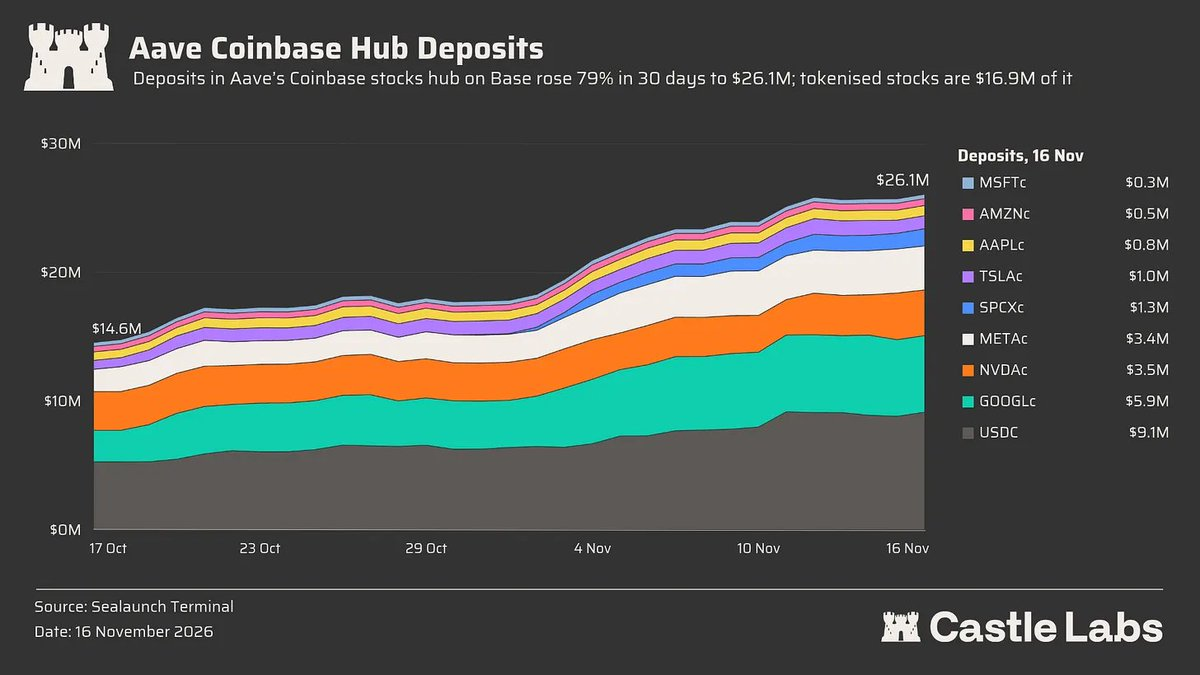
Aave applications allow users to earn DeFi yields above U.S. Treasury yields and provide a balance assurance of up to $1 million, four times the FDIC insurance limit of $250,000 for U.S. banking. The new bank EtherFi also runs its core business on Aave V4, with deposits of about $350 million, allowing users to borrow directly within the app. This brings new traffic to Aave and makes Aave more like infrastructure for ordinary users.
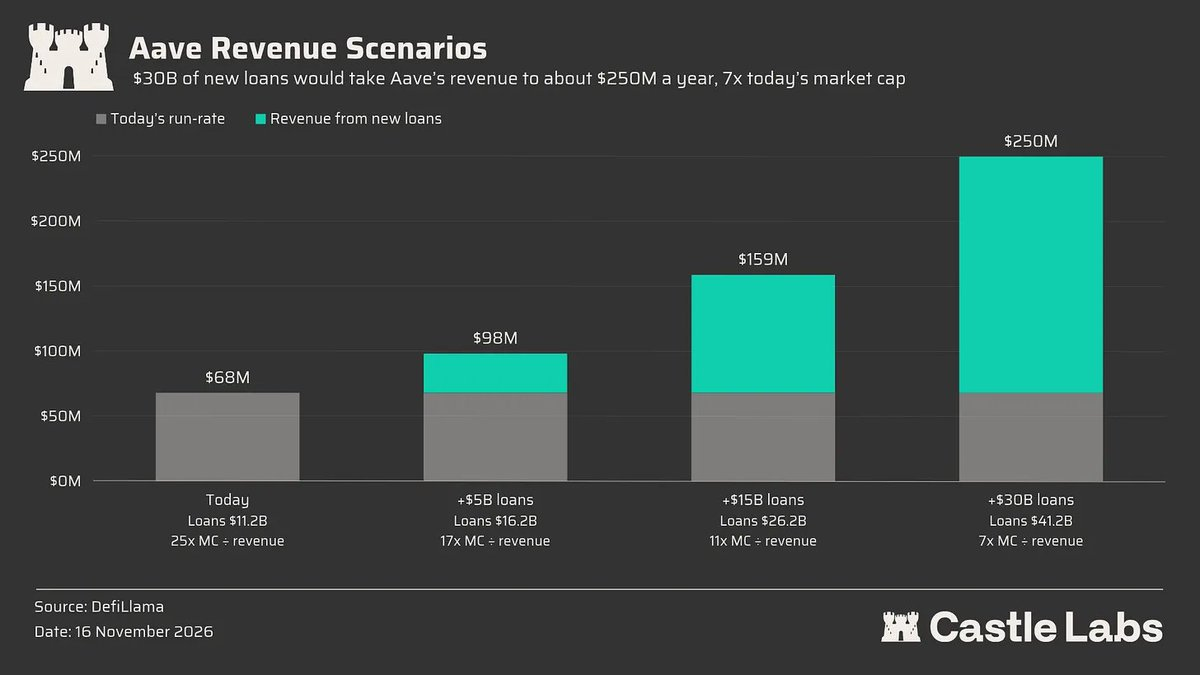
The more customer acquisition channels and diverse growth methods there are, the more loans in the system, and thus revenue will increase. Currently, the platform has approximately $12 billion in active loans, generating $61 million in revenue from the beginning of the year to now. As borrowing increases, revenue is expected to grow linearly. Growth methods are indeed all in place, but Aave has stopped distributing value to token holders since April this year. Once distribution resumes, growth should become apparent.
3. Future-oriented assets: AI currency and privacy currency
The above are core DeFi protocols that are indeed worth watching. However, there is another category of products also worth paying attention to: they do not rely on DeFi income but on narrative growth. For example, Pearl and Venice AI position themselves as "AI currency"; Zcash positions itself as "privacy currency."
Let's first talk about Venice. Unlike Pearl and Zcash, it already has actual revenue and is not purely supported by future expectations.
Venice provides users with access to private, uncensored AI models, serving as alternatives to Claude and ChatGPT. Its annual revenue is $123 million; calculated by market capitalization, the VVV price-to-sales ratio is approximately 8 times, and around 12 times based on fully diluted valuation.
However, the problem is that VVV has not captured all the value of Venice. The company also has equity, and income must be distributed between token holders and equity holders. The rights obtained by those buying VVV and those buying company equity are not the same. The more successful the project, the more pronounced this issue becomes: ultimately, who captures most of the value?
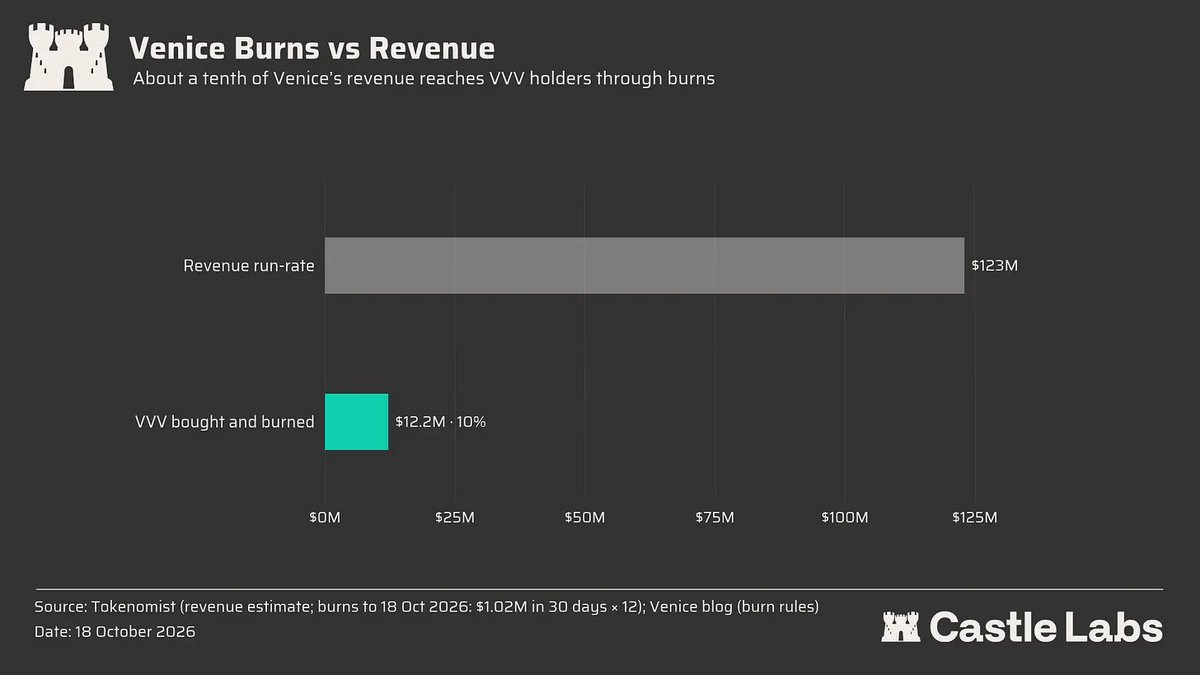
To align the interests of tokens and company equity better and reduce investor confusion, Venice has been buying back VVV, with a portion of sales revenue returned to tokens. Buybacks are executed automatically as well as determined by the team.
In the past 30 days, buybacks have destroyed $1.02 million in VVV, which annualizes to about $12.19 million, equivalent to 10% of revenue used for buybacks.
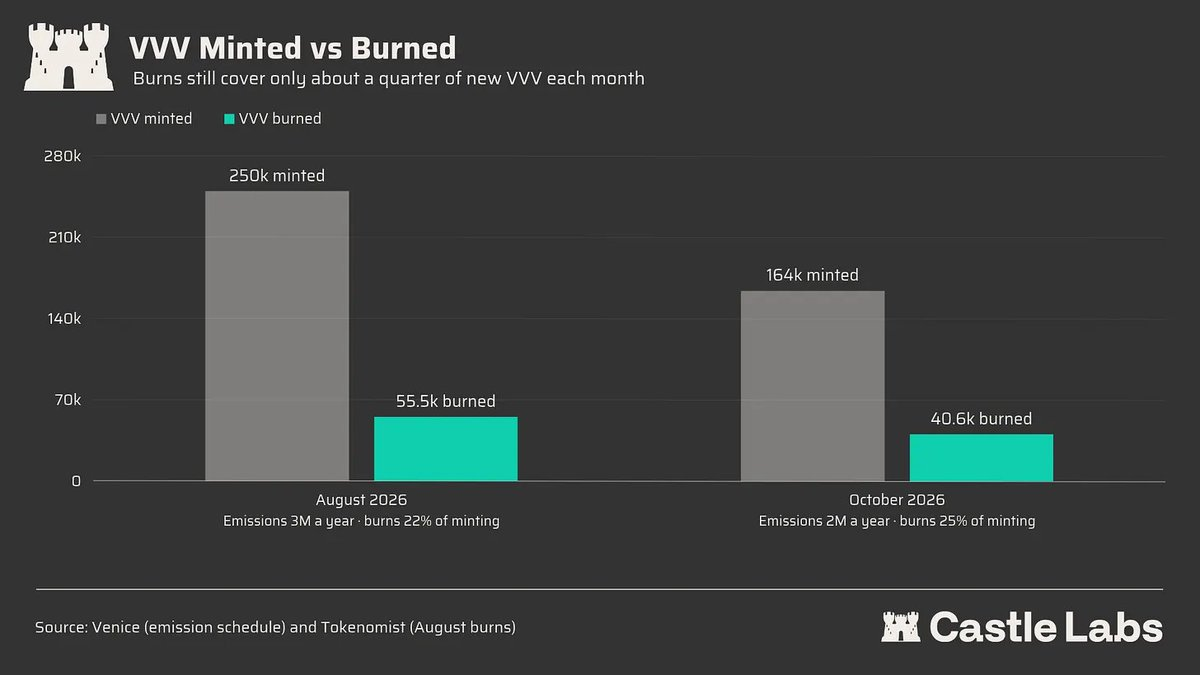
This month the team also reduced the annual token emission from 2.5 million to 2 million, aiming to decrease selling pressure. However, at the current pace, only about 500,000 VVV will be destroyed in a year, which accounts for 25% of the emission. This means that with an emission of 2 million and the destruction of 500,000, the net increase is 1.5 million, and the tokens are still under inflation.
As the network grows, revenue is expected to increase, and emissions continue to decrease before the token can trend towards deflation.
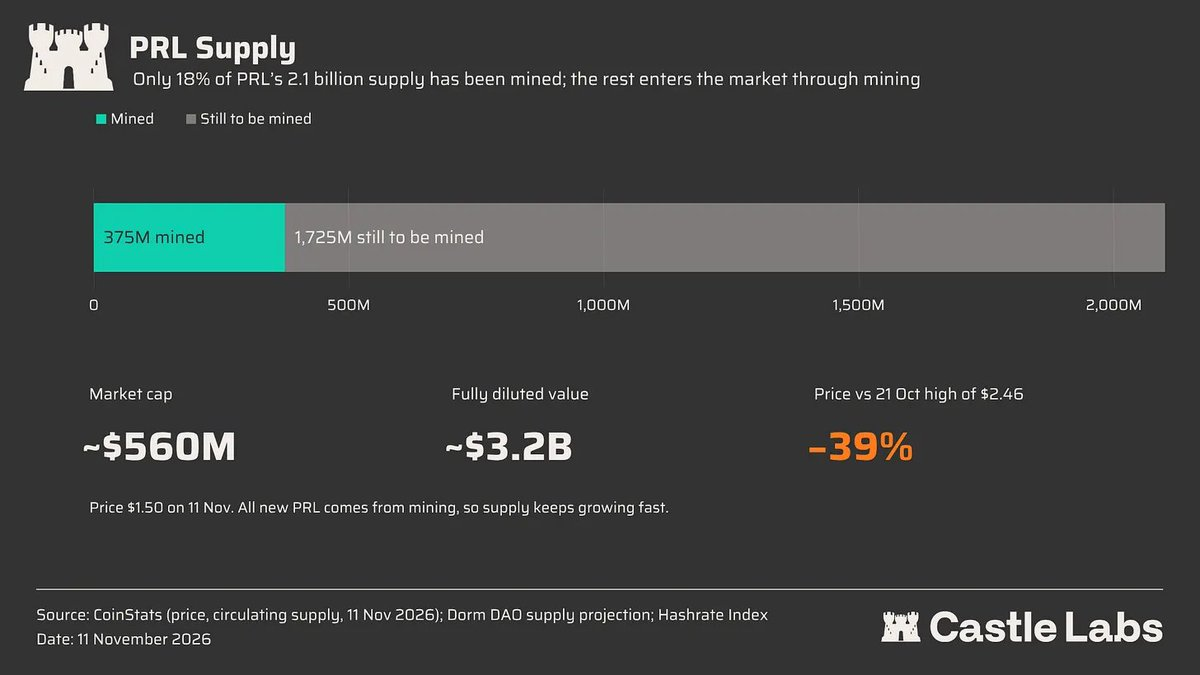
The second token is Pearl's PEARL, which has an eye-catching design. On PearlNetwork, miners use GPUs to perform matrix multiplication—this is the core operation behind every chatbot. This mechanism is called "proof of useful work" (PoUW). The mainnet went live at the end of April, and PEARL reached a peak in October, currently valued at about $500 million. We have previously written about how Pearl operates and which markets it aims to enter.
It is important to note that most mining power in the current network has not generated paid inference revenue; only one partner, Together AI, uses it to subsidize service discounts. This is indeed concerning, but the application range of this technology is larger than many people think. If more customers start using inference and paying, users can pay with PEARL, and these tokens will be destroyed, thus increasing miner income.
Additionally, PEARL's issuance method is very fair, allowing anyone to mine or purchase on exchanges. Currently, only 18% of the supply has been mined.
Zcash is another bet on the future that is becoming a value storage tool. The Zcash network itself earns very little yet is one of the top-performing large-cap tokens this year.
Wall Street has entered via Grayscale's Zcash ETF (ZCSH). This ETF began trading on August 25, attracting over $1 billion in capital, making it one of the top 1% of ETF issuances in the past decade.
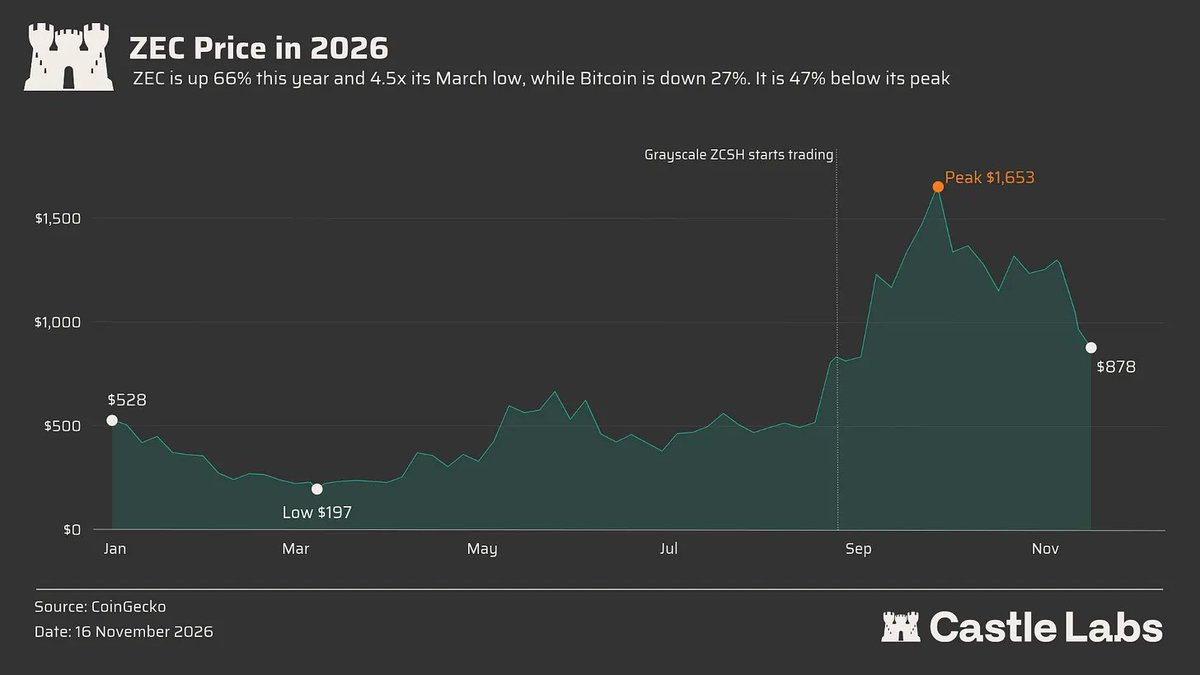
Zcash is essentially a privacy version of Bitcoin: a supply cap of 21 million, halving every four years, and optional zero-knowledge proofs for privacy. Privacy is not just appealing in theory; it is also increasing in usage: the percentage of shielded ZEC rose from 8% to 29.2% within three years.
What’s interesting about Zcash lies in its privacy. Recently, as the Democrats won the midterm elections, Zcash's price rose. The logic is that if the Democrats gain power in the U.S., regulatory scrutiny may intensify, leading to an increase in market demand for financial privacy. Zcash can provide this privacy precisely. When considering Zcash, this perspective should be taken into account.
This section discussed two types of tokens: one type has stable revenue that will return value to holders and is preparing to enter a larger market through tokenization; the other type bets more on the future and has a strong narrative. A good investment portfolio can combine these two categories, paying attention to fundamentals as well as the future. If you look at the tokens with strong returns this year, you will find that this framework can essentially explain why they have risen.
4. Conclusion: Three lenses to assess tokens
Returning to the initial question: Can leading in a category effectively predict token performance? The answer is not a simple yes or no. Most leading tokens in their categories do not perform well in price. Therefore, assessing tokens requires switching perspectives.
First, look at the current fundamentals of the product and how closely the token is tied to these fundamentals. A token that can consistently generate cash flow is a good token; but it is also necessary to consider token emissions to see how much net inflow there is.
Second, examine how large the market the product wants to enter is and how much that market can grow. Tokenization is a large market, and many on-chain products want a piece of it. If the product is directly linked to this market, the growth potential is greater.
Third, see what narrative the product conveys and whether it has established that narrative. Products with strong narratives attract the market to buy into their future growth potential. Zcash and Pearl are two examples: the former conveys "private currency," essentially a private version of Bitcoin; the latter conveys "AI currency," aiming to use tokens and blockchain design to meet AI computing needs.
These three aspects each have their roles: the first looks at token fundamentals, the second examines market space and growth, and the third considers what the market cares about most.
免责声明:本文章仅代表作者个人观点,不代表本平台的立场和观点。本文章仅供信息分享,不构成对任何人的任何投资建议。用户与作者之间的任何争议,与本平台无关。如网页中刊载的文章或图片涉及侵权,请提供相关的权利证明和身份证明发送邮件到[email protected],本平台相关工作人员将会进行核查。


