
During the third game of the NBA Finals in June 2025, Kalshi released a rather chaotic TV ad: a farmer floating in a pool full of eggs, an alien drinking beer, and a man draped in the American flag shouting about Indiana. Director PJ Accetturo produced this ad with Google's Veo 3, costing about $2,000, and it took only three days from conception to airing. The production company had previously quoted Kalshi a price of "six to seven figures." He generated 300 to 400 times to get 15 usable clips.
Ten months later, on April 26, OpenAI shut down the Sora app, a TikTok-like stream dedicated to promoting AI-generated videos. TechCrunch cited an investigation by The Wall Street Journal, which reported that the app's daily operating cost was about $1 million, with user numbers falling from a peak of about 1 million to less than 500,000. The Sora developer API also shut down in September, and OpenAI's current developer pricing no longer lists any video models.
These two events summarize the state of video AI in 2026: using AI to create videos has become cheap enough to change the way advertisements are made; however, simply watching AI videos has yet to form a business.
Core
Point of view
Video AI has become a real business: several companies that have disclosed their revenue have a combined annual income of about $2.3 billion, with their named clients being marketers, creators, and enterprises. It is not a smaller version of the large language model market: the cost of a minute of video is thousands of times that of a minute of text, with applications rather than model providers generating the most revenue. The first industry impacted is that which bulk purchases "good enough" videos: stock footage, advertising, training, and short dramas. Visual effects come after this. Gaming and robotics are last, as they rely on physical laws, and the best models currently score about half as well as real footage in physical tests.
Revenue Rankings: Companies Disclosing Data, Combined Annual Income Approximately $2.3 Billion
IOSF Research
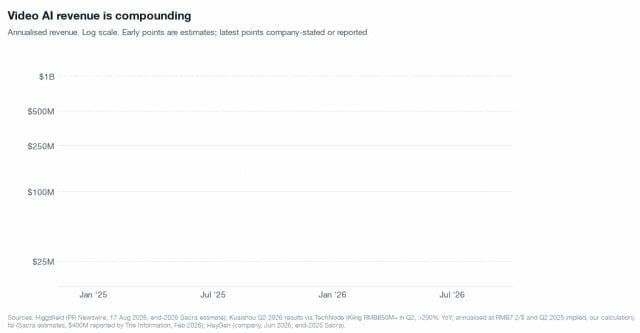
A few companies have disclosed their revenue and are growing rapidly:
- Higgsfield's ARR grew from $200 million at the end of 2025 to $700 million in August 2026.
- Kuaishou's video model Kuling surpassed $118 million in revenue in the second quarter, growing more than twice year-over-year.
- Fal, equivalent to a "shelf" for video and image models (model aggregation platform), had an ARR of about $400 million in March 2026, doubling from last October.
- HeyGen's ARR exceeded $200 million in June.
- Runway's ARR surpassed $200 million in September.
According to our calculations, visible revenues total about $2.3 billion annually. Part of this consists of image revenues, and another part is double-counted, as applications also source from fal. This figure does not include Google's Veo, ByteDance's Seedance, and several Chinese labs that have not disclosed video revenues separately. The discrepancies are twofold: image revenues and double-counts will inflate the total, while uncounted labs will lower it. Therefore, $2.3 billion can only serve as a size reference, not a calculated market size.
Video Generation Costs Thousands of Times Higher, Major Revenues in Applications
IOSF Research
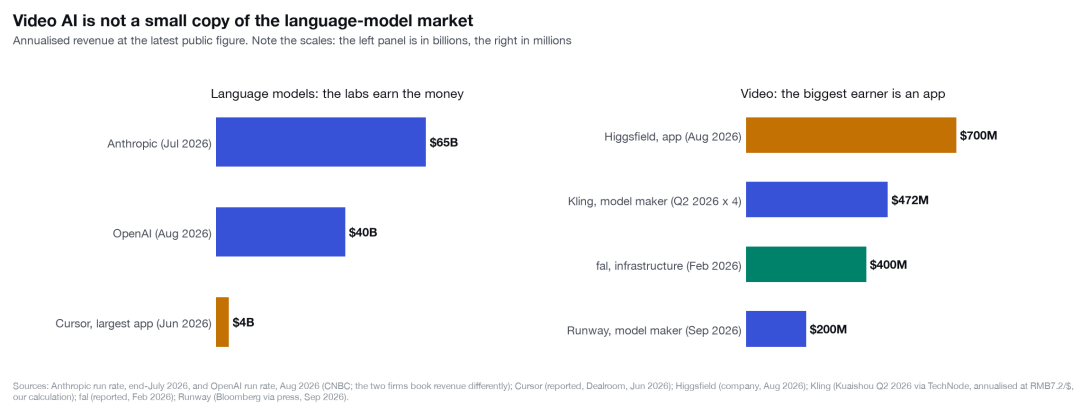
Video AI is often informally described as "years behind the large language model market." But the data does not support this claim, as there is a significant difference between running language models and running image/video models.
Simply put, language models write things like a person types: one word at a time, each word is a small guess at the next word, and while it is still writing, you can start reading. Image or video models are more like architects: they start from a random noise and refine the entire picture over 20 to 50 rounds until a clear image appears. Each round processes all pixels simultaneously, and nothing can be used before the final round is completed. Video increases the workload exponentially: one second equals about 24 frames, each frame must be consistent with the previous ones, cups must stay in the same position, and faces must always be the same. A piece of text only has a few hundred small units. This is why a tested open-source model requires about 350 seconds of chip computation time to generate one second of video, and why the cost of one minute of video is thousands of times that of one minute of text.
Anthropic told investors its annualized revenue reached $65 billion by the end of July, while OpenAI's was about $40 billion. Just these two labs' revenues are about 45 times the total visible revenues from video.
In the large language model field, most revenue goes to model labs; in the video field, the highest revenues come from applications. The largest language model application is the programming tool Cursor, which reportedly had an annualized revenue of about $4 billion in June, around one-sixteenth of Anthropic's. In the video space, Higgsfield leads with $700 million, while applications that wrap other companies' models (Higgsfield, HeyGen, Synthesia, Magnific) account for over half of the total visible revenue. Text customers buy the intelligence of the model directly to use. Video customers buy completed visuals for specific tasks, which require editing, consistency, and accompanying workflows; applications are built around these needs, forming the video workspace.
An image is worth a thousand words
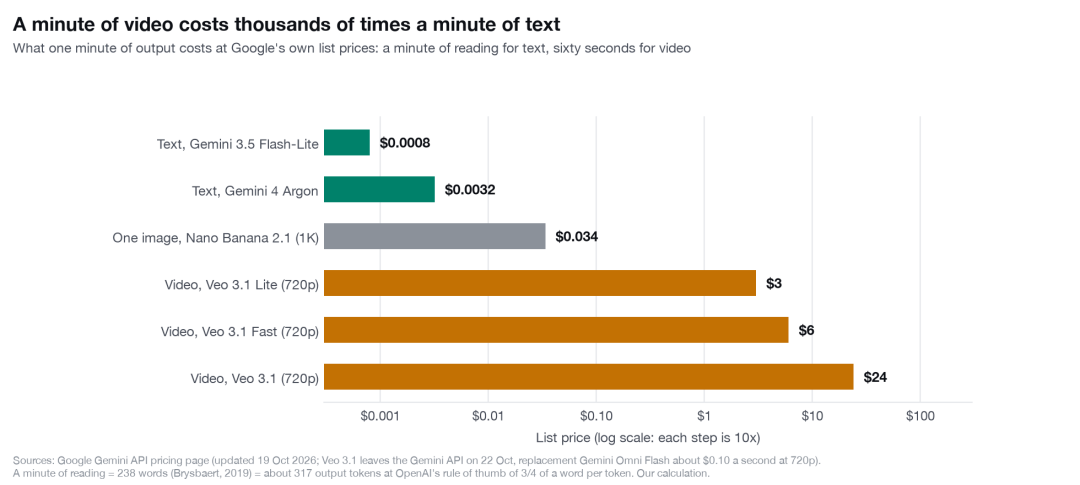
As of October 22, the recorded lowest price per minute of video is approximately $3, coming from the cheapest tier of Veo, differing approximately 7,600 times from the highest tier.
There are also some distinctions worth noting: code is the largest market for large language models, which can be automatically verified; video must rely on visual judgment, which is more subjective. Text is purchased by tokens; video is purchased by clips, corresponding to production budgets.
Who is Paying: Public Evidence Points to Corporate Clients
IOSF Research
Higgsfield describes itself as a platform "for creators, marketers, brands, agencies, and production companies" and claims to provide visual content production support for "390 Fortune 500 companies" (Higgsfield). HeyGen states that 85% of Fortune 100 companies are using it (HeyGen). Both companies have not broken down their revenue by use, so based solely on public data, it is unknown how much revenue comes from individual video creation for entertainment purposes. All publicly available evidence points to corporate buyers.
Breaking down buyers further shows a divergence in business models. People watch a lot of AI videos, but what they pay for varies, and their quality requirements differ.
- Short drama apps sell stories by episode, so quality determines whether viewers continue paying. Their largest cost is customer acquisition, not production: according to Media Partners Asia, the largest short drama platform ReelShort, with $785 million in revenue in 2025, spent 55% on user acquisition and marketing (Indian Television). Marketing takes 55% of revenue, and all other costs, including generation, must be solved with the remaining 45%. So, cheaper models can only compress the smaller portion of the budget. Better models impact the revenue-generating part: whether viewers are willing to continue paying for the next episode. ReelShort has not disclosed spending on generation, so this is our interpretation of its cost structure, not a measured breakdown.
- Viewers discover these dramas through social feeds (a survey by Meta and Ormax shows this proportion is 89% among Indian viewers), and producers are quickly shifting to AI: according to Owl & Co, about two-thirds of new vertical short dramas outside China in the third quarter were AI-generated, while the first quarter this proportion was just 3% (The Hollywood Reporter).
- AI companionship apps sell emotional connections, not visuals. Users return repeatedly for this relationship, so the video just needs to be "good enough." The key is cost and speed, as each user needs a lot of videos.
Just because production is cheap does not mean people will watch: Value shifts to the party deciding content distribution
IOSF Research
The music industry took this step first. According to Deezer, on peak days in June, tracks entirely generated by AI accounted for more than half of all new uploads on the streaming platform and are currently adding nearly 90,000 new songs per day. However, they only account for 1% to 3% of total plays.
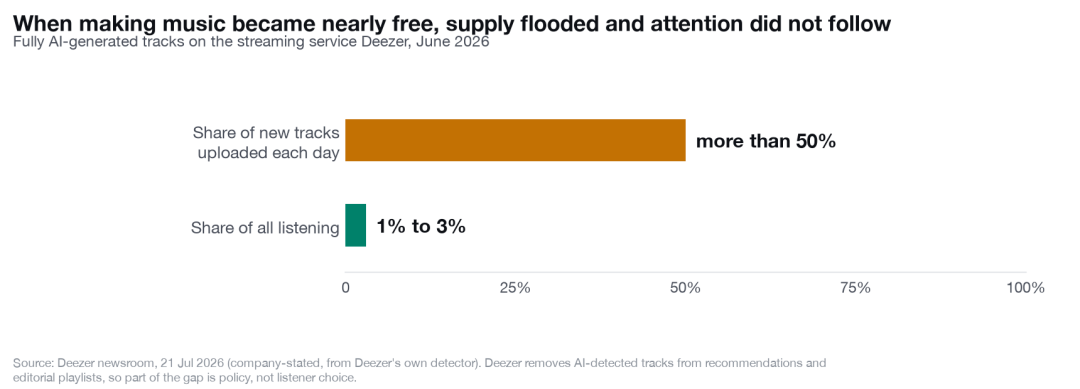
Deezer excludes detected AI tracks from recommendations and playlists, making the disparity between upload and play counts evident. This pattern is what economist Herbert Simon described in 1971: when information becomes abundant, attention becomes a scarce resource. When production is nearly free, supply will flood the market, and value shifts to the parties deciding which content is seen. Two researchers termed the quality threshold set by audiences for AI content the "slop ceiling".
Which industries are most affected first: Stock footage and advertising are at the forefront, gaming and robotics lag behind
IOSF Research
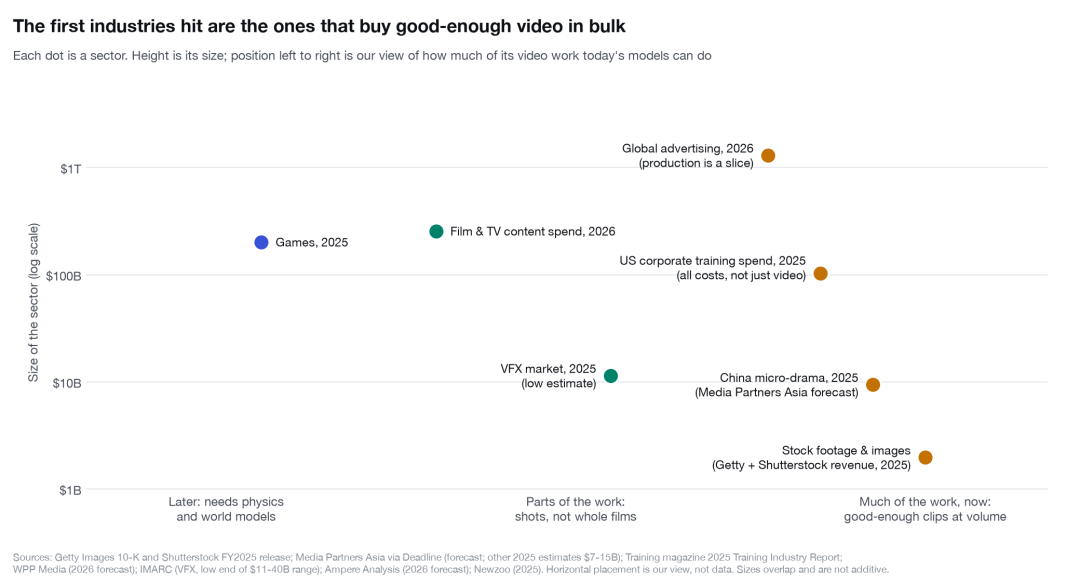
Today’s $2.3 billion is still small compared to existing video spending, and funding will not transfer evenly. Ranking by the proportion of video work currently achievable by the existing models:
- Stock footage and images. Generated clips can directly replace licensed material. The two major stock photo agencies, Getty Images and Shutterstock, had a combined revenue of about $2 billion last year, making this the most affected vertical.
- Advertising and product videos. WPP Media predicts global advertising revenue to be around $1.3 trillion this year. Only a small part of this is used for production, but Kalshi's advertising suggests how much this expense could be compressed as generation costs fall, eliminating many indirect costs of shooting ads.
- Training and instructional videos. In 2025, U.S. institutions spent $102.8 billion on training (Training Magazine). This is the market for HeyGen and Synthesia, where the easiest type of video to generate is a presenter reading a script.
- Short dramas. In China, revenue from micro-dramas (produced for phones, with episodes lasting one to two minutes) is expected to reach $9.4 billion by 2025, surpassing the country's total box office. These producers have already accepted material with phone-quality visuals, and the demand is significant.
- Visual effects. IMARC estimates the market size for 2025 to be about $11 billion (IMARC), but estimates vary greatly among parties. Producers have begun using generated shots (see below).
- Movies and television. Ampere Analysis estimates global content spending will be $255 billion in 2026. AI is entering this field shot by shot, not as entire works.
- Gaming and robotics. According to Newzoo, the gaming industry is expected to generate $201.6 billion in revenue by 2025. Video models will only be effective when they learn to simulate the world, which is the content of the last section of this paper.
How AI Changes Video Production Costs: Both Output Rate and Unit Price Matter
IOSF Research
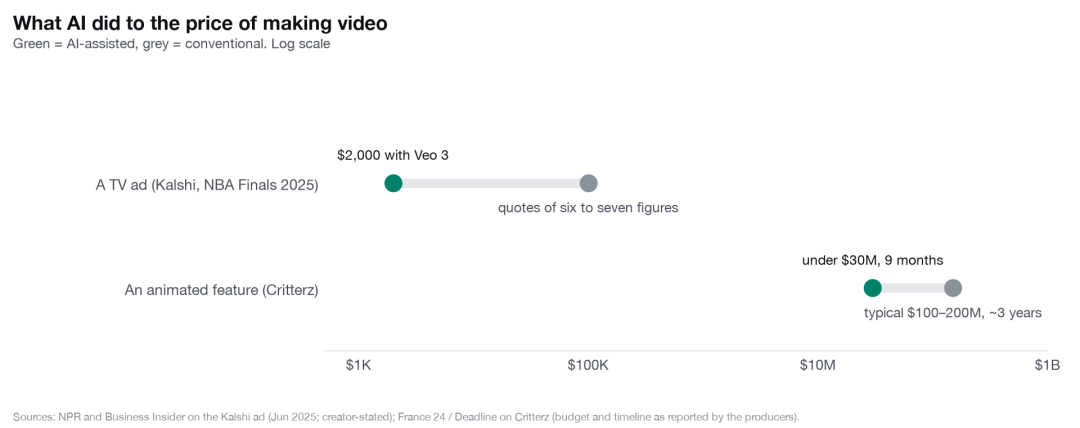
The most evident impact is on costs. Besides Kalshi's advertisement, OpenAI-supported animated feature Critterz had a budget of less than $30 million and a production cycle of nine months; a large animated film typically costs between $100 million and $200 million and takes about three years.
Pricing drops by tier, not across the board.
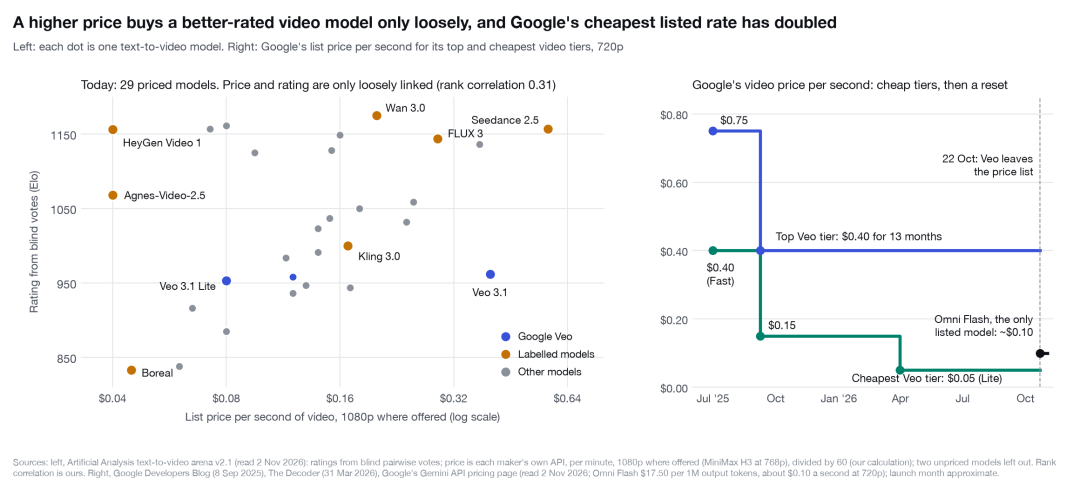
The next round of cost reductions is already in research. A tested study by Hugging Face researchers found that a large open-source model generates a 5.4-second clip on a flagship GPU in 1,875 seconds. According to our calculations, this equates to approximately 350 seconds of computation time per second of video. Distillation directly addresses this issue. One team increased the frame rate of a small open-source model by about 22 times, making it fast enough to generate in real-time on a single chip. The significant cost reductions needed for companionship apps will come from here: generating initially at low resolution and then upscaling.
Generating one second of video pricing is only part of the cost. The director of Kalshi's ad retains one out of about 20 to 27 clips, so for him, the cost of usable video per second is 20 to 27 times the quoted price. This is on the higher side. A video tool vendor's summary of other works shows that a three-minute animated episode retains one out of every four clips (41 out of 164). No one has yet published independent statistics on production rates. Consistency directly affects the production rate. If the model can maintain consistency in characters, products, or camera work across multiple generations, fewer generations are required; cutting the generation count in half also halves the cost of usable video per second. Lowering prices only makes each generation cheaper.
Our test: The same prompt with three models. On November 2, we used Runway's API to give three models the same prompt: a phone on a glass table ringing and vibrating toward the edge of the table, bouncing once on the concrete floor after falling. Each segment was 8 seconds, 720p, no sound, each model generated once, costing a total of $4.80.

▲ From left to right: Wan 3.0, Seedance 2.5, Veo 3.1
- Wan 3.0 ($0.80, ranking first) performed the best. The phone moved forward, fell, and stopped, with the shot tilting down to follow it.
- Seedance 2.5 ($2.40, the most expensive) had the most realistic shaking effect but cut to a new shot before the fall, and the screen went black.
- Veo 3.1 (silent version $1.60, ranking 22) had the phone starting upright instead of lying flat, bouncing several times on landing like rubber. Its screen text was the clearest of the three. (We continue to track Veo because Google provides the clearest price history, not because it is leading. In quality, it currently lags behind cheaper models, as our tests demonstrate.)
None of the three models fully executed the prompt, with generation time ranging from 2 to 4.5 minutes, 15 to 34 times the segment duration (according to our calculations). These three segments do not illustrate much, but the result ranking is consistent with the leaderboard, rather than the prices.
The Next Turning Point: Cost and Latency
IOSF Research
Cheaper models are one avenue. Another is to adapt existing production methods in film and animation: rough first, then refine.
First draft at low cost, then render only once.
Animators resolved this issue decades ago. They wouldn't start animating until the story was clear, instead first drawing storyboards, then creating a rough animatic for evaluation. AI video can also do this. A rough cut of one or two frames per second is enough to determine the story and shots, functioning similarly to comic strips; the selected and most suitable shots are then passed to the best models for rendering.
This also addresses the previously mentioned production rate issue. If most generated outputs will be discarded, it is better to discard them while they are still cheap.
ByteDance has turned this practice into a product. Seedance 2.5's Draft mode went live on fal on October 30, quickly generating low-resolution previews, then completing the same segment to full HD. Only the retained segments are charged at full price. The price difference accumulates quickly (fal):
- Preview (480p): about $0.22 per second
- Full HD (1080p): about $1.16 per second, approximately 5 times the preview price
- Completing the draft into a final piece: fal did not list prices. In our team's tests, costs were 6 to 8 times lower than generating full HD segments directly
The trade-off is quality. Final pieces completed from drafts look slightly softer than directly generated full HD segments, but they also corrected a strange last frame in the preview. As the scale increases, the savings can be substantial. If one out of every 25 generations is retained (a production rate of 4%), the cost of one hour of full HD production becomes:
- Generating full HD every time: approximately $105,000
- Producing drafts first, then completing retained segments: about $20,000 (our calculations)
Hybrid processes have emerged.
Generating drafts at low cost is a shortcut. Another is to combine old and new tools. Creators now first use 3D design tool Blender to create scenes with gray geometry, use OpenAI's GPT-6 Astra to position objects and camera angles and then turn one frame of the scene into a realistic first frame, generating the final piece through Seedance 2.5 (Kapwing tutorials, ByteDance Dreamina).
The two tools offset each other's weaknesses. Relying solely on 3D takes too long to achieve realism; solely on AI video, control becomes difficult. Combining both means that 3D drafts determine layout and shots while video models handle visual texture.
Real-time generation is coming.
The final step is speed. Watching while rendering videos is no longer just a lab demonstration:
- Runway Characters (March): a video model capable of real-time dialogue, based on Runway's GWM-1 (Runway)
- Runway Solaris (August 31): Runway's first "Interface World Model" (Crypto Briefing)
- Decart (May): instantly converts real-time video streams into generated scenes; raising $300 million at a valuation of about $4 billion (bne IntelliNews)
- Zoom virtual avatars: Replace camera footage with realistic virtual avatars that sync to mimic your expressions as you speak; functionality availability depends on plan and region (Zoom)
Once video generation speeds can meet the demands of real-time calls, the problems faced by companionship apps change: it will no longer be about cost per minute but rather how quickly the next frame can be reached.
Beyond Marketing: AI Can Create Visual Effects Shots but Not Long-form Projects in Film, Television, and Effects
IOSF Research
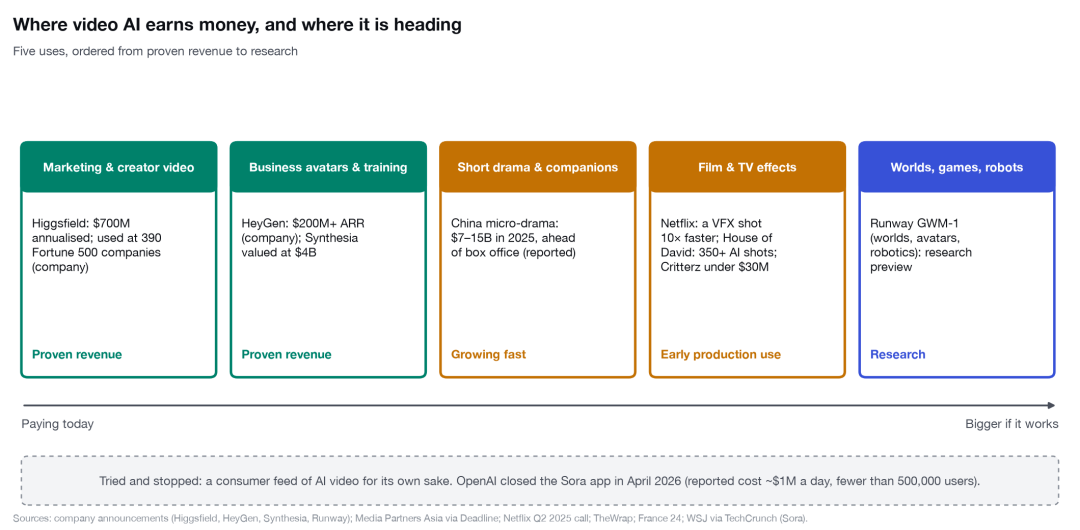
Hollywood is experimenting with whether video AI can step out of the advertising realm.
So far, producers have primarily used it in two ways: to create shots that their budgets originally could not cover, and to license their characters, receiving income when others use them.
First, to create shots that were originally unaffordable.
Recently, two series used AI to complete scenes that would otherwise have been cut:
- Netflix's The Eternaut: This Argentine series completed a building collapse scene using generative video. Co-CEO Ted Sarandos stated that this shot was completed ten times faster than traditional effects, and producing it via traditional methods was "totally unfeasible" under the series' budget.
- Amazon's House of David: This biblical drama's second season used 350 to 400 AI-generated images, compared to about 70 in the first season (TheWrap). The show's creator (showrunner) stated he couldn't afford those battle scenes without AI.
Other producers have gone further by collaborating directly with model vendors. Lionsgate acquired a stake in Runway in June (the equity percentage has not been disclosed) and plans to produce a short series based on their film library (Runway). AMC Networks has also signed a contract with Runway (Hollywood Reporter).
Second, earning income from character licensing.
The bigger competition is over who owns the characters. Disney's actions demonstrate a dual approach:
- June 2025: Disney and Universal sued Midjourney for copyright infringement.
- December 2025: Disney agreed to invest $1 billion in OpenAI and licensed Sora to use their 200+ characters (Disney).
- After Sora shut down: The agreement was terminated, and Disney stated it would seek other AI partners (Blooloop).
The conclusion is simple: producers want to be compensated when their characters are used, and they will sue those who use them without payment.
Japanese copyright holders have taken the furthest steps, moving from blocking AI to licensing it due to financial incentives. Japanese animation sells well overseas, but many production companies are struggling:
- Preliminary statistics from the Japan Animation Association indicate overseas revenue for 2024 is 2.17 trillion yen, surpassing domestic revenue (gamebiz).
- By 2025, 34.6% of animation production companies are expected to be operating at a loss (Teikoku Databank, via GameBusiness).
In October 2025, the organization representing Japanese copyright holders, CODA, demanded that OpenAI cease using its members' works to train Sora 2 without permission (Automaton).
Within a year, the stance changed. On September 11, Chinese AI lab MiniMax and Japanese company KAGAMIAI released H3 IP Edition in Tokyo. Creators can use it to make videos with licensed Japanese characters, and each character comes with approved materials, usage rules, and commercial terms, while reporting usage back to copyright holders. MiniMax claims over 60 companies have expressed interest (MiniMax).
Previously, KAGAMIAI did a pilot with *Captain Tsubasa* using another Chinese video model, PixVerse, with results indicating substantial demand (source similar to the above MiniMax page):
- About 126,000 creators
- Produced about 330,000 works within 45 days
- Over 99% of activity came from outside Japan
Licensing for fan creations may become the first mass consumer market from which AI video character copyright holders can earn income.
The pattern is: AI can create effects, but not long-form projects.
In all the cases mentioned, AI is handling shots that mid-budget dramas could not originally afford: expansive views, crowds, destructive scenes, and environmental shots. The remaining production is still done by humans. The entry of computer graphics technology into movies has been similar, with effects spreading one shot at a time, long before *Toy Story* in 1995 proved a full-length feature could be made with it.
One test result also points in the same direction. In the physical benchmarking described below, the Odyssey-3 Pro model's score depends on the starting point:
- Maintaining real footage: 63 points, single generation
- Starting from a single image: 50 points
AI video performs better when there is real material as a basis, which is how visual effects work: each generated shot is embedded within real footage. This test does not measure duration. No one has yet published tests on whether models can maintain consistency across multiple shots, and this type of testing can explain why long-form projects remain unattainable.
Will specialized labs emerge? They already have, video companies are diversifying into three types
IOSF Research
Specialized labs have emerged, and three types of video companies are diversifying:
General giants. Google (Veo), ByteDance (Seedance), and Kuaishou (Kuling) possess the most computational power and data. They compete on quality and price, with most applications reselling their models.
Production house-type labs. Runway currently has Lionsgate as a stakeholder and is developing products for film and television. Moonvalley trains its Marey model solely on licensed footage and, as of July 2025, has raised $154 million; its production division Asteria uses this model to make films. These types of labs can provide three things that the giants find difficult: training data that production methods can accept, fine control over every frame, and tools that integrate with existing effects workflows.
Application layer. Higgsfield, HeyGen, and Magnific package other labs’ models and sell them to specific clients.
New labs and their betting directions. The largest investments we found for 2026 are flowing into labs developing interactive or world models: AMI Labs $1.03 billion seed round, Runway's $315 million financing (Runway claims will be used for world models), and AMD's $8.2 billion acquisition of World Labs. We have not catalogued all funding for the full year in the video field; the following table blends funding rounds, one acquisition, and product updates:
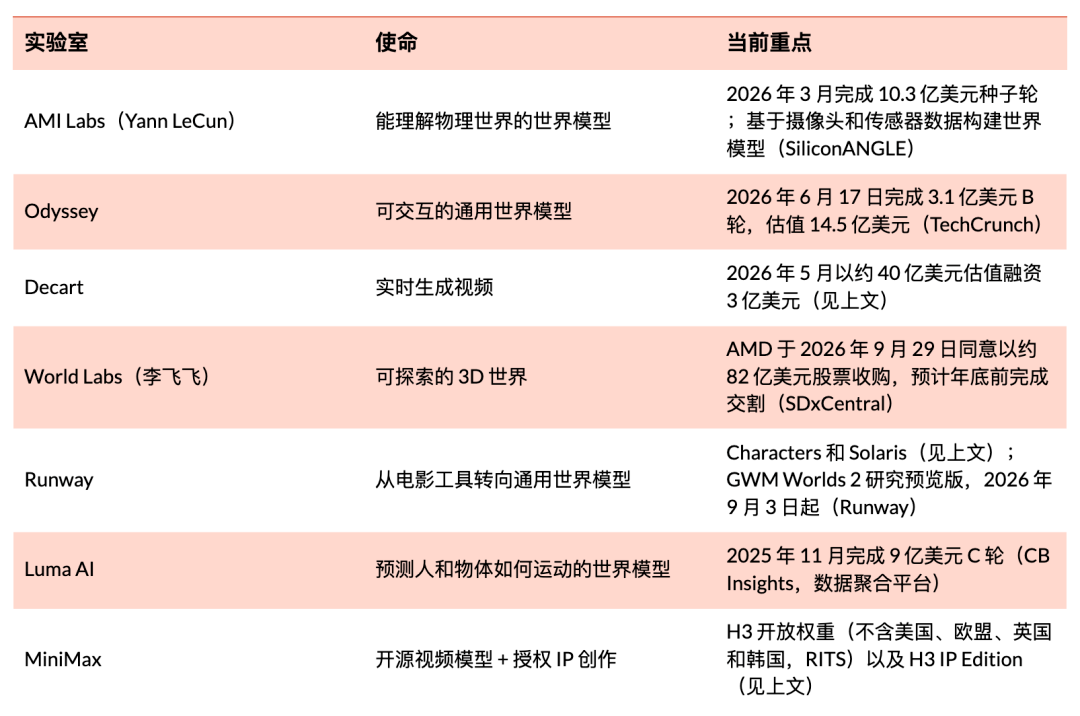
The most likely breakthroughs in the next 12 months also stem from this table: video generation capable of supporting calls and gaming in real time, interactive worlds rather than fixed segments, and scalable licensed character production.
In film and effects, production house-type labs are most likely to prevail. Producers cannot assume litigation risk for a key shot (hero shot), need to accurately recreate the director's intent, and have to collaborate with union crews; general vendors that only provide the strongest base models can only compete on price.
The Greater Opportunity is the World, Not Segments
IOSF Research
In this round of intelligent development, the largest market for video models may ultimately not be video at all. A model that can predict the next frame in a scene might be learning how the world moves, which will be very useful for gaming and robotics.
Runway released GWM-1 in December 2025, labeling it a universal world model, with three versions: an explorable world, a conversational virtual avatar, and a robot model for predicting what the camera will see after each action. It generates 720p visuals in real-time, up to two minutes long. When Runway raised $315 million at a valuation of $5.3 billion in February, it stated that the funding would be used to develop more powerful world models.
Plato first described this bet in the Allegory of the Cave in *The Republic*.
The prisoners can only see shadows on the wall, and they honor those who "can most keenly observe the passing shadows," the ones most capable of predicting which shadow appears next. Video models are award-winning shadow predictors but have never seen the objects casting the shadows. Plato’s point is that this skill is not knowledge. For video models, the question is whether predicting the next frame means understanding how the world moves; Physics-IQ is one way to test this.
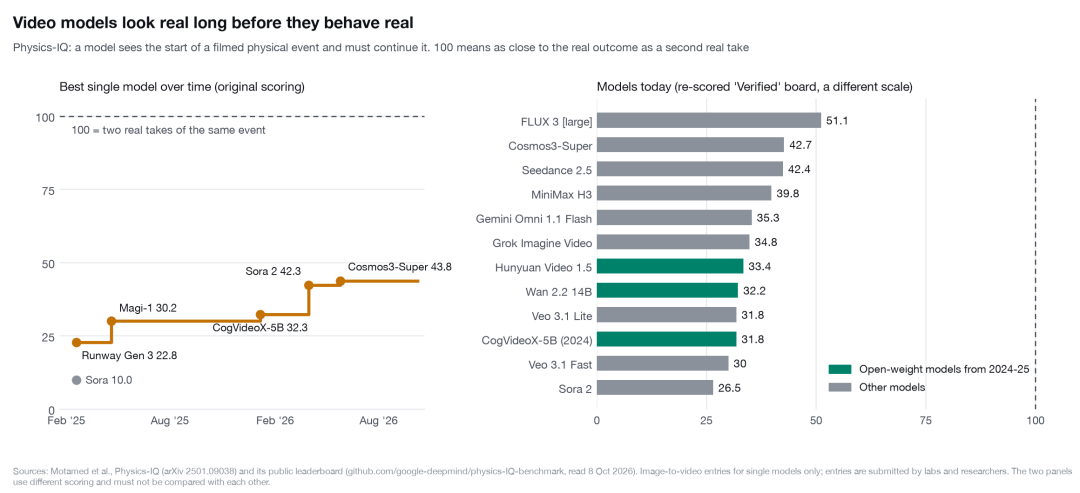
Physics-IQ is a benchmark test hosted by Google DeepMind: it shows a model the beginning of a real physical event and then assesses how closely the model's generated follow-up visuals match the real situation. A score of 100 indicates similarity to another real recording. According to the original scoring, the best single-image-to-video model improved from a score of 23 in February 2025 to 44 in May this year. In the re-scored leaderboard, the top single-image-to-video model scored 51, while Google's Veo 3.1 Fast scored 30, comparable to a 2024 open-source model with a score of 32. The finding is that physical understanding does not correlate with how realistic clips appear.
Realistic appearance has basically been resolved; realistic performance has not yet. In this test, the best models still score around halfway between 0 and another real recording. Given that realism and physical performance have been shown to be unrelated, better visuals do not automatically narrow this gap.
If this score moves closer to 100, video labs will transform into simulation companies, selling products to gaming studios and robotics manufacturers; in this market, first-mover advantages in the video field will be crucial.
Conclusion: Three Numbers Determine the Direction of the Industry
IOSF Research
Most of the questions left by this article can be answered by three numbers:
How many generated results are adopted? Currently, the only data we have indicates: Kalshi ads at 4% to 5%, and an animated series at 25%. I personally believe that consistency will impact this number more than original visual quality, and labs will develop in this direction: constructing environments that can manage consistency and support extensive contexts for generation, rather than pursuing outstanding single generations.
What does it cost to produce one hour of footage? Divide the quoted price by the retention rate. At today's prices, the cost of one hour of video might be:
- Veo 3.1 Lite (original price): $720 to $4,500
- Seedance 2.5 Full HD: $16,800 to $105,000
According to this formula, doubling the production rate and halving the price achieve the same cost reduction impact. The difference lies in how much space remains for each. With the current production rates of 4% to 25%, a model that makes each generation usable can reduce costs by 4 to 25 times. Prices have already decreased, and the reductions across tiers are uneven. We determine that production rates will be a greater lever in the next two years. If the next batch of disclosed production rates remains around 4% while prices continue to decline, this judgment will be incorrect.
- Does physical performance hold up? Physics-IQ is the only public test measuring whether the model's motion aligns with the real world, with the best model scoring about half the score of real footage; in scenes where the model has real footage as a foundation, the differences will narrow first.
Two years ago, the question was whether AI video could look good enough. This question has basically been answered: Kalshi's ad aired during the NBA Finals, and Netflix has also incorporated generated visuals into officially launched series.
What remains unresolved is the question of money and control:
- Who gets the money? Producers want to receive a share when their characters appear or establish mechanisms similar to royalties. Licensing for fan creations involving characters, individuals or idols may see substantial growth.
- What new possibilities will emerge? If the physical gaps close, video models will no longer be mere generators of segments but rather turn into simulators. Our judgment is that the first demand for payment will intersect with robot training, specifically capturing real camera footage extended by models. This is indeed the current highest-scoring scene (63 points vs. 50 points), and Runway's GWM-1 is already selling such products. Gaming will come later, as games require models to start from scratch and maintain consistency over several hours. By 2027, we expect the simulator market scale to remain smaller than the advertising and production market from which it derives. If a game studio releases work based on generative world models before then, this judgment will be incorrect.
免责声明:本文章仅代表作者个人观点,不代表本平台的立场和观点。本文章仅供信息分享,不构成对任何人的任何投资建议。用户与作者之间的任何争议,与本平台无关。如网页中刊载的文章或图片涉及侵权,请提供相关的权利证明和身份证明发送邮件到[email protected],本平台相关工作人员将会进行核查。


