In essence, regardless of how the narrative unfolds, the core essence is to drive the significant adoption of UDSC; this is fundamental.
Written by: A Wang
After the Q3 financial report was released, Circle fell along with tech stocks and crypto assets. Looking solely at the financial report, adjusted EBITDA increased from $143 million to $317 million, a significant rise. However, deducting the ARC presale revenue, the rough calculation shows only $135 million, lower than the previous two quarters.
Circle's total revenue and reserve income in the third quarter of 2026 was $865 million, a quarter-on-quarter growth of about 23%. Among that, reserve income was $658 million, a quarter-on-quarter decrease of about 1.5%; other revenue was $207 million, compared to $34 million in the previous quarter. Other revenue in the third quarter included approximately $182 million from ARC token presale revenue. The adjusted EBITDA for the quarter was $317 million, reflecting a quarter-on-quarter increase of about 122%, while the group's RLDC profit margin rose from 41.2% in the previous quarter to 52.4%.
When the Q1 financial report was released, we calculated Circle's valuation. Now, we will reassess the stablecoin business (issuance + payments): how much value can the reserve business support, and how much valuation can the payment business recharge?
1. ARC Presale Boosts Profit, USDC Average Balance Declines
At first glance, the Q3 financial report looks strong. Total revenue and reserve income in Q3 rose from $701 million to $865 million, with about $182 million from the ARC token presale. The company confirmed about three-quarters of the presale revenue after launching on the public mainnet and completing token minting and delivery.
After deducting ARC presale revenue, total revenue and reserve income in Q3 was approximately $683 million. This article deducts the disclosed adjusted EBITDA directly from the ARC presale revenue, resulting in about $135 million, which is lower than Q2's $143 million and Q1's $151 million.
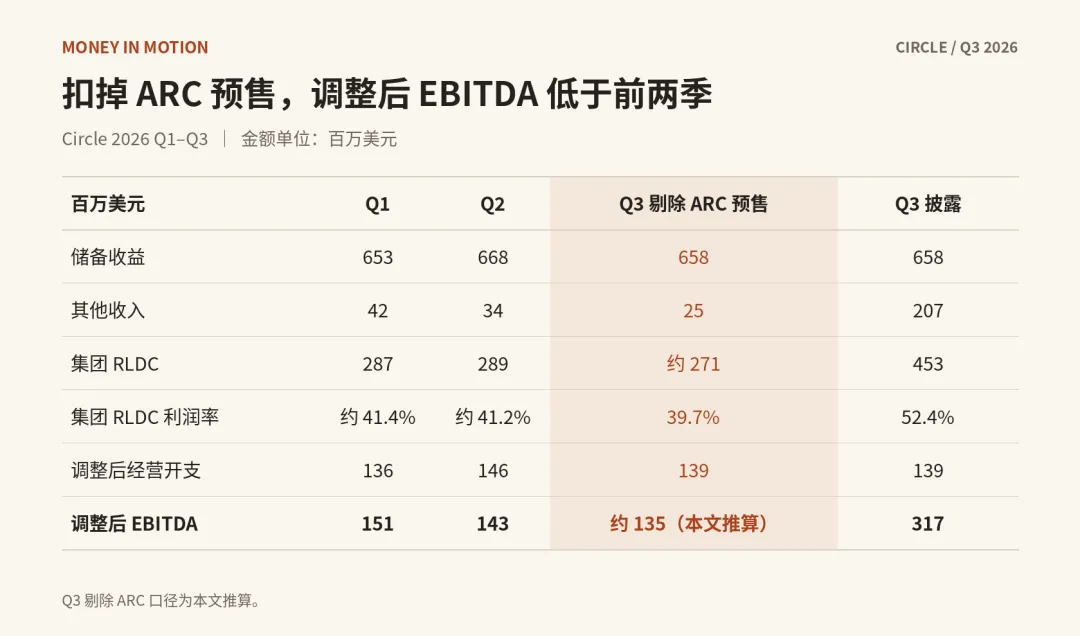
In the table, RLDC represents the money remaining after deducting distribution, transaction, and other costs from total revenue and reserve income. Dividing this number by total revenue and reserve income gives the group's RLDC profit margin.
1.1 For every $100 earned in reserve income, Circle kept 80 cents less
In Q3, reserve income decreased from $668 million to $658 million. The reserve income rate slightly increased to 3.54%, which could not offset the impact of a 4% decline in average USDC circulation. The average balance for the entire quarter was $73.3 billion.
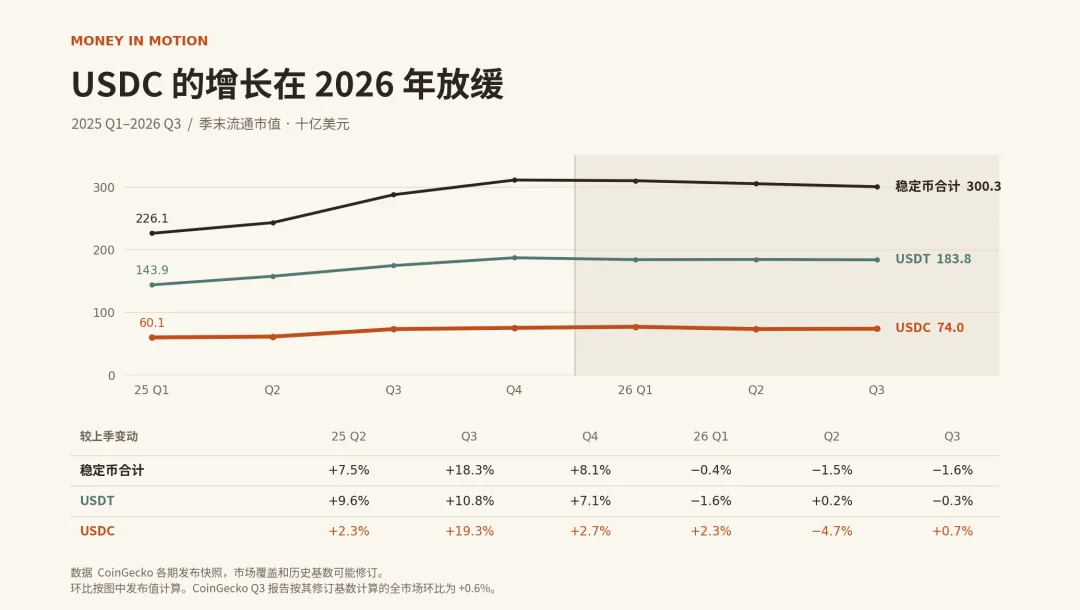
The figure shows the circulation market value at the end of the quarter, while the quarterly average balance affects the reserve income for that quarter. The main chart retains values released for each period, and the aggregated Q3 stablecoin usage is compared to the revised Q2 baseline from CoinGecko.
In Q3, for every $100 earned in reserve interest, after deducting related distribution and transaction costs, Circle retained $37.80. In Q2, they could retain $38.60. The CFO attributed this decline primarily to the full season operation of the Hyperliquid partnership, with relevant USDC balances placed on Coinbase. The revenue-sharing terms after Binance's renewal will fully reflect by Q4.
Coinbase and Circle renewed the contract under the original terms. The terms did not change, but the placement of funds did.
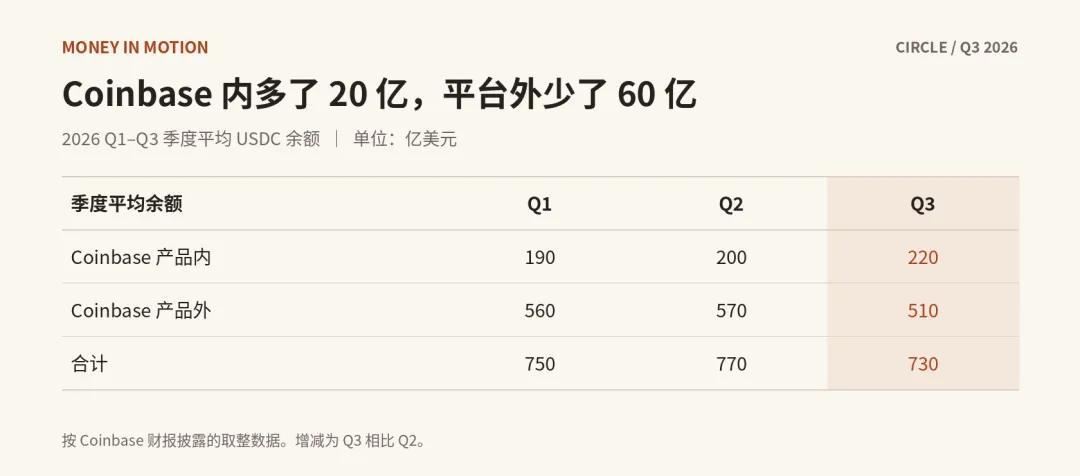
According to the integers disclosed by Coinbase, the average USDC balance across the network decreased by $4 billion in Q3. There was an increase of $2 billion within Coinbase's products and a decrease of $6 billion outside the platform. Allaire hopes to provide more incentives for large channels to eventually bring USDC outside the platform. However, there has been no observed growth in external balances this quarter. Market pullbacks may also drag down balances, and this needs to be monitored over several quarters.
2. Volume of Payments Increased, Where is the Revenue?
Deducing the ARC presale, Circle's other revenue dropped from $42 million in Q1 to $34 million in Q2, and only about $25 million remained in Q3. Management stated that fewer blockchain integration projects confirmed revenue this quarter. We believe this will be the norm, as there are currently very few new public chains and integration projects.
We are more interested in whether payments can generate a consistent stream of income each quarter.
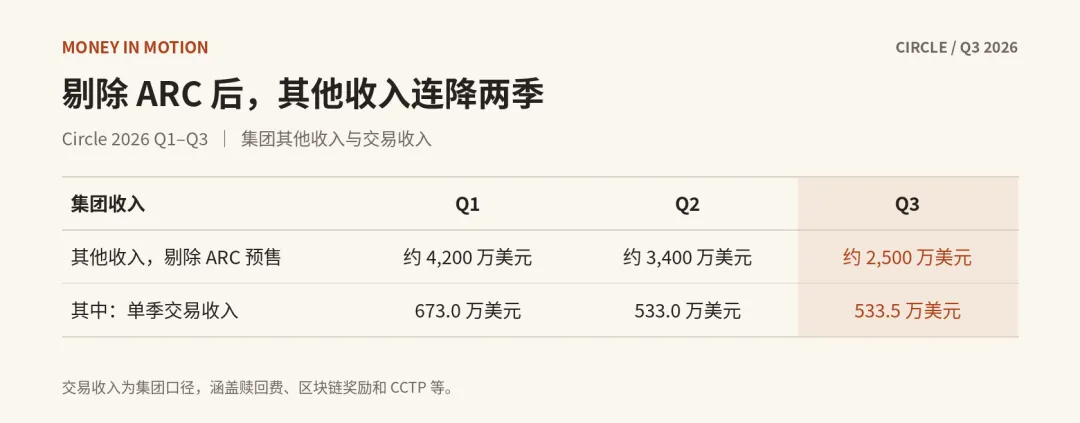
Other revenue also includes subscription and service revenue from chain integration and maintenance, fund management, etc. Transaction revenue covers redemption fees, blockchain incentives, and revenue from digital asset trading infrastructure (including CCTP). The transaction revenue for Q2 was derived from the cumulative figures for the previous nine months, deducting Q1 and Q3.
2.1 CPN Volume Increased, How Much Can be Seen in the Financial Report?
The Circle Payments Network (CPN) connects financial institutions and uses stablecoins for cross-border settlements. Its annualized payment volume at the end of the quarter rose from $8.3 billion in Q1 to $14.7 billion in Q2, and reached $41.3 billion in Q3. This figure is derived from approximately $3.4 billion in volume over the past 30 days before the end of the quarter.
Calculating at 5 basis points (0.05%), running at the end of Q3's speed for a year, CPN corresponds to approximately $20.65 million in revenue. The financial report only provided group transaction revenue, which includes redemption fees, blockchain incentives, and CCTP, among other projects. The actual transaction charges collected by CPN and how much was earned are currently unclear.
2.2 How Much Volume Can Tazapay Turn into Circle's Revenue?
Circle plans to purchase approximately $400 million in Tazapay shares it does not yet own, and the price will also require settlement adjustments. Tazapay's annualized payment volume exceeds $25 billion, with about 60% involving stablecoins. It was previously a design partner of CPN.
Since Tazapay was already a partner of CPN, why buy it? It has clients and a network for transferring money to local accounts. By acquiring these capabilities, Circle can potentially bring in more transactions and also handle collections, currency exchanges, and payouts. Assuming the volume at the end of Q3, if it can receive 10 basis points in 2027, the annualized revenue would be about $41.3 million. If Tazapay also brings in new chargeable transactions, the contribution of payments to other revenues will be even larger.
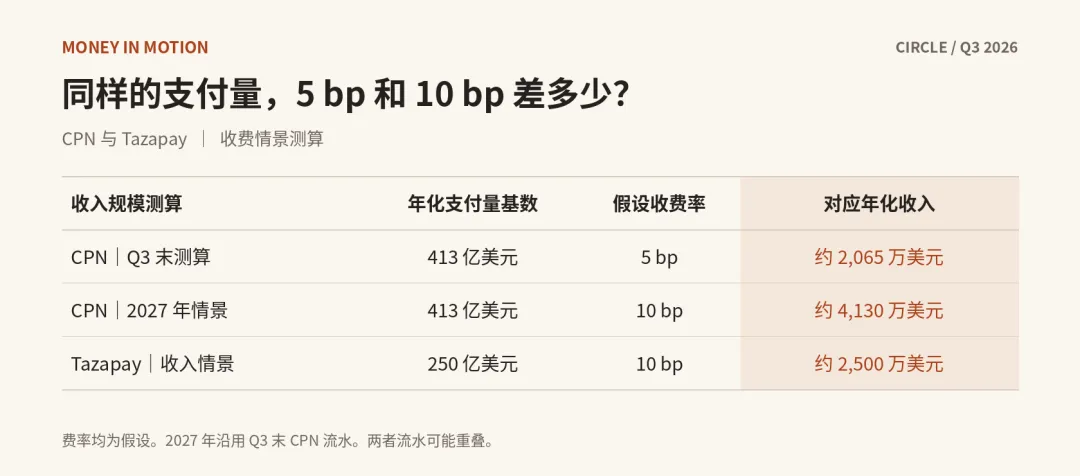
The table tests two rate levels with the same CPN volume. The two volumes will have substantial overlap and cannot be directly added together. However, Tazapay's volume will be more accurate (CPN's volume will be an aggregation). The 10 basis points is just a uniform calculation assumption; actual revenue will depend on which transactions are charged, who charges them, and how the revenue is shared.
Assuming this transaction is priced at an 8x price-earnings ratio, the $400 million equity acquisition needs to contribute approximately $50 million in tax-adjusted net profit per year. Whether this price is worth it depends on how much Tazapay earns itself and how much more Circle can earn after taking over.
3. Circle's Three-Layer Business, How Much is Each Worth?
We will use the method from May to separately calculate the reserve business, other businesses, and Arc. Using this quarter's data, the main range is about $59–95 per share, with a neutral estimate of about $77.
The first layer uses 10/14/18 times from Q1, referencing the pricing of banks, custodians, and asset management companies. A 10x multiple does not provide a growth premium, 14x includes the growth value of USDC, and 18x demands stronger scale growth and stabilized interest rates. The multiples are applied to the balance after deducting distribution, transaction, and other costs from reserve income, before deducting company operating expenses and taxes.
The second layer references the valuations of high-growth payment companies, giving 20/25/30 times for other income, with a separate pressure level of 10 times. The third layer estimates ARC at a presale price of $0.30 per token, combined with an initial supply of 10 billion tokens and assuming a 25% retention rate after sale, resulting in approximately $750 million.
The model uses Q3's annualized reserve contribution of approximately $984 million and an adjusted full year other income midpoint of approximately $138 million.
Valuation per share = (Reserve contribution × multiple + Other income × multiple + ARC valuation + approximately $1.7 billion in cash) ÷ approximately 256 million shares.
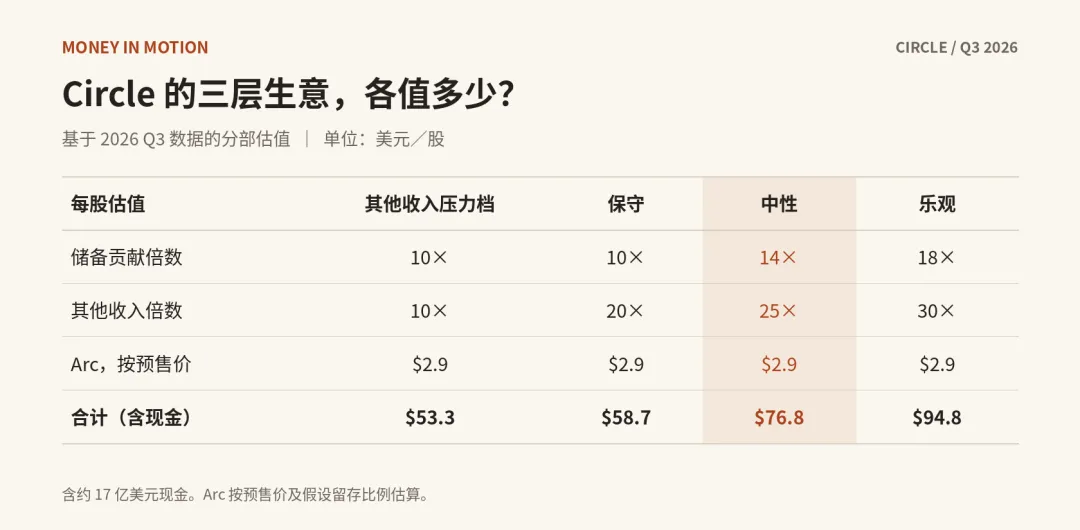
The full-year other income guidance, after deducting confirmed ARC presale, is approximately $128 million to $148 million. Tazapay is expected to close in 2027, with its profits and newly issued shares not included in this table.
Mizuho and Citi both attribute Q3's unexpected performance mainly to the ARC presale. Looking ahead, Mizuho is concerned that revenue sharing may push Q4 net reserve profit margin just over 30%, according to sell-side estimates. Citi places more importance on the adoption of payments and CPN, forecasting that other income in 2027 will be about $400 million, but the public summary did not breakout how much of that will be recurring payment fees.
4. The Take | If Money Can't Be Retained, Can It Still Make Profit?
Circle is attempting to have the same capital contribute to two types of revenue. Money stays in USDC to earn reserve income, and money passes through the payment network to earn service fees. Even if funds are exchanged back to local currency on the same day, it may still leave revenue for Circle, which is the notable aspect of Tazapay (closer to customers, solving the last mile).
Q3 has already shown the pressure on the first type of income. Balance declines, increase in channel sharing, and the gap between issuance scale and shareholder returns has widened. The second type of income has decent volume but lacks clear visibility on charges and costs. The calculation of 10 basis points indicates that this business is worth waiting for but is still insufficient to regard it as realized profit.— This might need to be assessed in 2027.
Therefore, the revenue structure in the following Q4 will also face challenges: the distribution agreement with Binance will reflect in a complete quarter, along with the compression of circulation and transaction volume amid a not-so-optimistic macro market.
Although we see many new stablecoins like OUSD emerging in traditional financial payments, these tend to be more internal system stablecoins, having a limited impact on the more widely circulated USDC and USDT in the market. However, the stablecoin market cannot escape the impact of the macro environment.
ARC is actually just a presale price calculated, effectively counting as an option. The future is uncertain, and we will not consider that at this moment. We only consider the CRCL value under pressure.
As for the Agentic Payment aspect, the narrative of CRCL is more towards the perspective of stablecoins, which remains narrative-focused, without solid scenarios (hard to reflect in reported income), and the opportunities integrated with AI gateways (fiat side and card side will be more attractive).
Thus, in recalculating the valuation, we are more concerned with the conditions behind the range. The reserve business supports today's operations, while the valuation of the payment business will depend on when it can convert volume into sustainable income.
In essence, regardless of how the narrative unfolds, the core essence is to drive the significant adoption of UDSC; this is fundamental. There must be volume for everything.
免责声明:本文章仅代表作者个人观点,不代表本平台的立场和观点。本文章仅供信息分享,不构成对任何人的任何投资建议。用户与作者之间的任何争议,与本平台无关。如网页中刊载的文章或图片涉及侵权,请提供相关的权利证明和身份证明发送邮件到[email protected],本平台相关工作人员将会进行核查。


