
Original authors: Myron Xie and Ivan Chiam, SemiAnalysis
Translation: Rhythm
Editor's note: An NVIDIA Feynman Ultra, in two models by SemiAnalysis, has an average price difference of about $77,000. On November 13, this semiconductor research institution lowered its average price forecast for this chip from approximately $175,000 to $98,000, a decrease of about 44%. The drop in high-bandwidth memory (HBM) costs explains part of this, while the remaining adjustment reflects analysts' new judgments of NVIDIA's pricing power. With more alternative options in the hands of major clients, the premium that NVIDIA can charge for its next-generation chips may be lower than previously expected.
This round of adjustments is not limited to NVIDIA. SemiAnalysis has lowered its global AI accelerator spending forecast for 2028 from $1.054 trillion to $758 billion, a reduction of nearly $300 billion. According to the new model, by 2030, annual spending will still exceed $900 billion, more than double that of 2026. The incremental growth remains substantial, but the net new annual recurring revenue for cutting-edge AI labs has slowed in the third quarter, and investors have tightened financing for data centers. Projects lacking large client procurement commitments often need to first resolve who will finance the construction of data centers, supply power, and purchase equipment before chip orders are likely to be fulfilled.
NVIDIA faces pressure from two types of clients. Anthropic can allocate computing power between Google TPU, Amazon Trainium, and the two GPU manufacturers. OpenAI is advancing its own chip development while also potentially benefiting from its warrant trading with AMD. At the same time, NVIDIA has the greatest exposure to emerging cloud service providers among all chip suppliers. These clients need to raise funds to purchase GPUs first, then recover their investments by renting out computing power. Top buyers have more choices, and buyers relying on financing expansion find it harder to place orders. With these two pressures compounded, SemiAnalysis has reduced NVIDIA's 2030 revenue forecast for corresponding computing product shipments by 66%.
The comparison between Broadcom and MediaTek reveals a calculation that can be easily overlooked in this round of competition. Both companies are involved in TPU projects, with MediaTek providing lower system costs, while Broadcom has the capability to support financing arrangements for land, power, data centers, and equipment. For cash-strapped buyers, the ultimate cost of a system and how much cash must be put up today are two distinct procurement thresholds. When chip competition extends to entire data centers, suppliers that can help clients build projects are more likely to receive orders.
The original text is as follows:

TL;DR
· SemiAnalysis has lowered its 2028 accelerator spending forecast from $1.054 trillion to $758 billion, with the 2030 forecast approximately 40% lower than the old version.
· The net new annual recurring revenue for cutting-edge AI labs has slowed in the third quarter, and both debt and equity investors have tightened financing for AI infrastructure, particularly projects lacking commitments from large cloud vendors.
· The downward revision of high-bandwidth memory (HBM) price assumptions is one of the main reasons for the decrease in accelerator spending expectations. Under the new model, the demand for HBM measured in bits continues to grow year over year.
· Both NVIDIA's quantity and price assumptions have been lowered. Measured by revenue of corresponding computing products, the forecasts for 2027, 2028, 2029, and 2030 have been revised down by 22%, 39%, 56%, and 66%, respectively.
· Broadcom's cumulative revenue forecast for custom chips from 2026 to 2030 has been adjusted downward by 11%, mainly due to the drop in HBM prices. MediaTek's Triggerfish, designed for Anthropic, sees its complete lifecycle shipment forecast reduced by 42%.
· AMD's long-term spending forecast has also been revised down, but the warrant trading has enhanced its appeal to Meta and OpenAI. The shipment forecasts for Amazon Trainium in 2027 and 2028 remain unchanged.
Demand Forecast Adjustments
We have adjusted our forecasts for the shipments, spending, and power demand for AI chips and servers throughout the forecast period, with the forecasts for 2028 to 2030 being affected most significantly. This revision reflects three aspects: a decrease in shipments, a drop in prices, and the adoption of lower single-chip power consumption assumptions for future accelerator projects in 2029 and 2030.
Overall, the reasons for our forecast adjustments are as follows.
1. We have reevaluated the total revenue expectations of the entire ecosystem, particularly considering the slowdown in the net new annual recurring revenue (ARR) in the third quarter for various cutting-edge AI labs. As a result, we have lowered our estimates for new supply, allowing revenues to more sustainably cover overall computing power costs, as noted in our recent report. We remain more optimistic about the revenues of these labs compared to the market consensus and observe many areas where cutting-edge AI capabilities can be deployed for a high return on investment. However, whether infrastructure construction can secure financing depends on the overall expectations of capital market participants, leading to the next point.
2. The capital markets have tightened, with debt and equity investors increasingly unwilling to fund capital expenditures related to AI infrastructure, especially for projects lacking commitments from hyperscale cloud vendors. We have discussed this issue in our financing framework report. This will reduce land development, power supply, and main construction for data centers, and affected projects will be more concentrated on those lacking the support of hyperscale cloud vendors, subsequently decreasing the power available for deploying systems.
3. The results of the U.S. mid-term elections have delayed the planned 5.8 GW U.S. data center capacity set to be operational in the second half of 2027 and the first half of 2028. Further delays caused by regulatory factors are also suppressing the total capacity of data centers in 2028. We have also considered this factor in our analysis, which has indeed led to a recent reduction in shipments of computing power equipment, but we emphasize that the first two factors are more significant.
The degree of downward adjustment varies between chip platforms and suppliers. According to our analytical framework, clients will still prioritize chips with the best performance per total cost of ownership (perf/TCO) and performance per watt (perf/W) and will consider financing terms based on these metrics. Platforms ranking lowest on these indicators will see larger cuts. As a result, NVIDIA is impacted the most, with most spending reductions concentrated on NVIDIA. In addition, for ASIC projects, we expect MediaTek's TPU project to also be affected, as its funding capacity is weaker than Broadcom's. The following chart summarizes the changes in total spending related to accelerators and HBM.
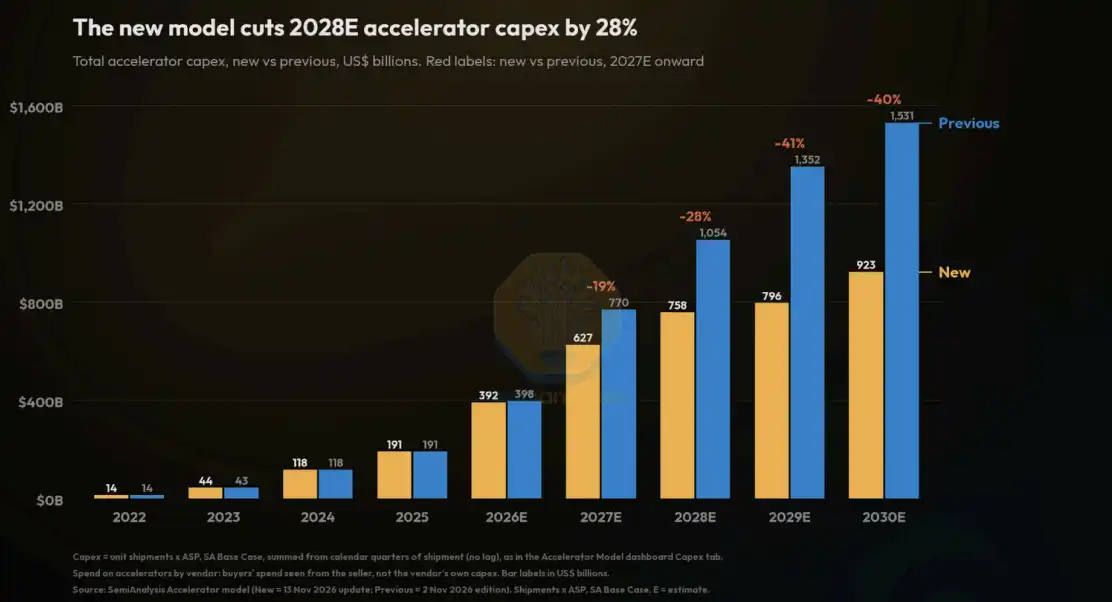
The new model reduces the 2028 accelerator capital expenditure forecast by 28%. A comparison of total accelerator capital expenditures between the new and old models, in billions of dollars. Starting from the 2027 forecast value, red numbers indicate changes in the new model compared to the old model. Yellow represents the new version, blue represents the old version.
The decline in total spending is mainly driven by falling prices. With the downward revision in shipment forecasts, the supply-demand relationship for HBM has become more balanced, and we have also lowered HBM price assumptions. More details can be found in the simultaneous release of memory model updates. Consequently, we incorporated changes in HBM prices into the forecasts for each chip to reflect changes in the bill of materials (BOM) costs. For NVIDIA's future products starting from Feynman, the reduction in the average selling price (ASP) also reflects a lower markup, along with changes in HBM costs. This illustrates that competition in the AI hardware market has intensified significantly.
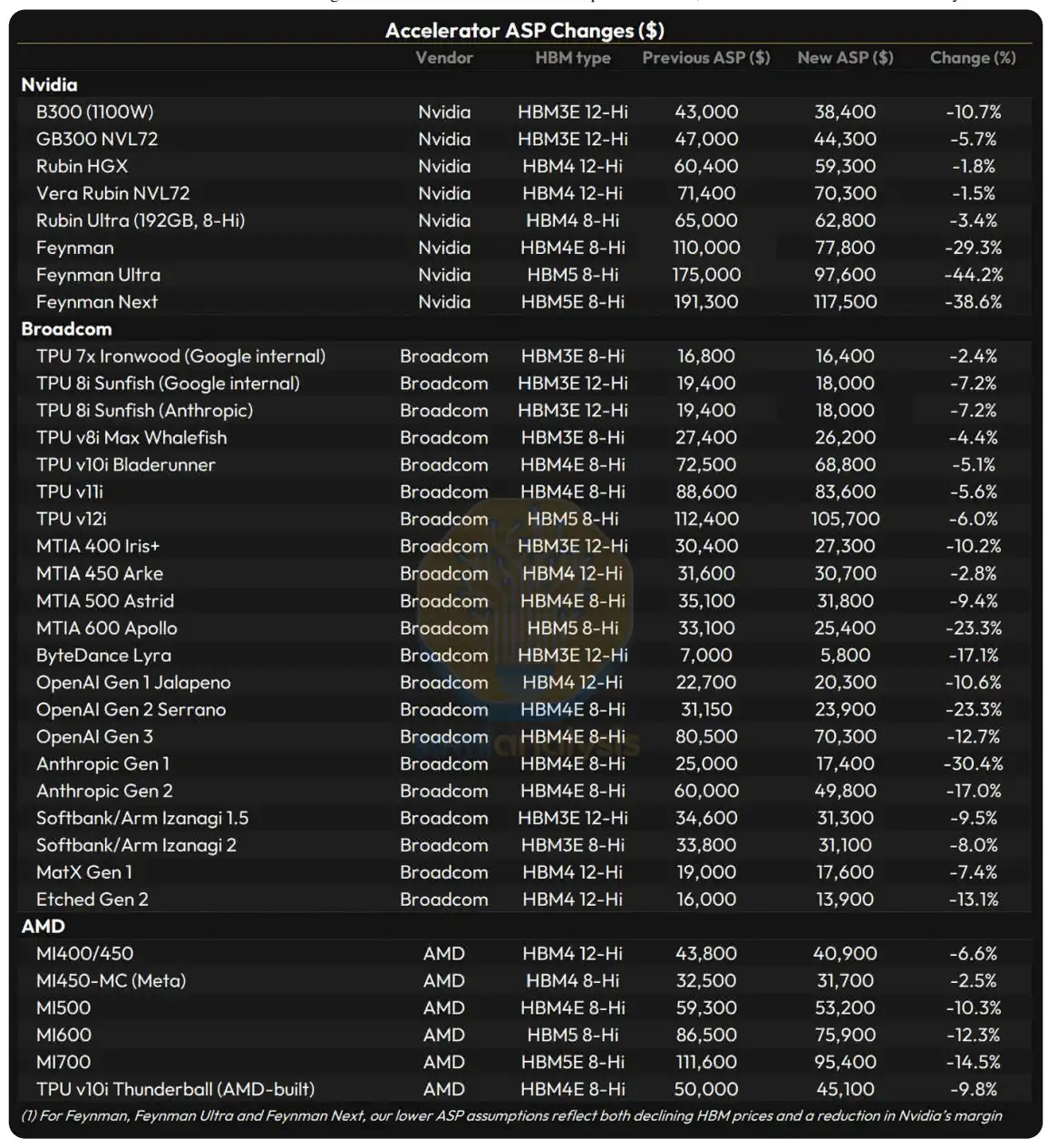
Adjustment of average selling price (ASP) of accelerators, in dollars. Product models, suppliers, HBM types, old model average selling price, new model average selling price, and change percentage (%). Source: SemiAnalysis.
A significant portion of the previously forecasted 2027 spending increment stemmed from price hikes, particularly memory price increases. Hence, the subsequent price drop indicates a return of the supply chain to a more "normal" state.
The price changes also explain why the silicon area corresponding to shipments and demand for HBM measured in bits continues to rise and is growing faster than nominal spending.
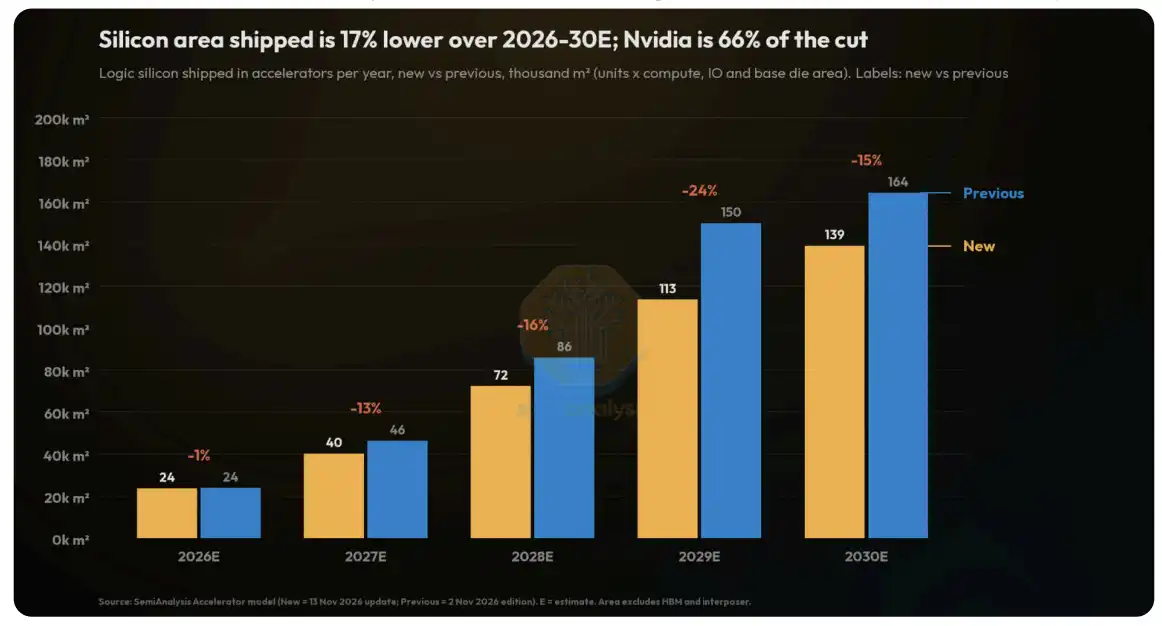
The forecast for the total silicon area of shipments from 2026 to 2030 has been adjusted downward by 17%, with NVIDIA accounting for 66% of the reduction.
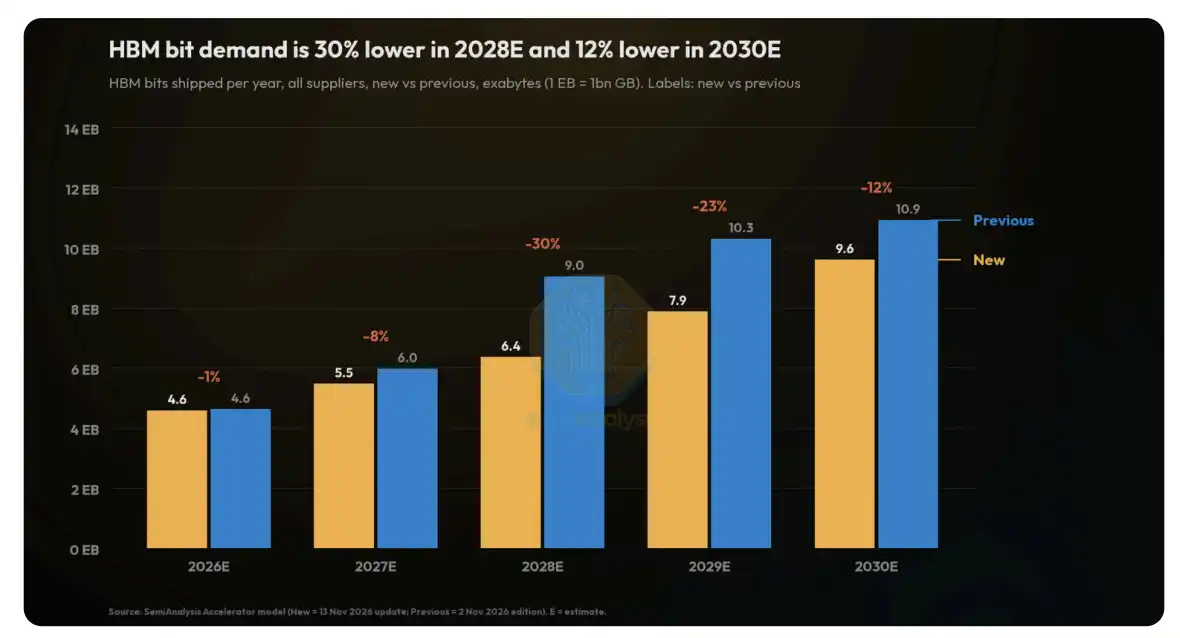
The forecast for HBM bit demand in 2028 is adjusted downward by 30%, and for 2030 by 12%.
Predictions for AI power demand have also been revised downward. This results from a combination of reduced shipments and lowered single-chip power consumption assumptions. Since power remains a limiting factor, we expect future product roadmaps to lower the maximum power consumption of chips. The reduction in power demand also indicates that, according to our revised data center model, the global (excluding China) power supply forecast for 2027 to 2029 has enough power to support the deployment of these shipped devices.
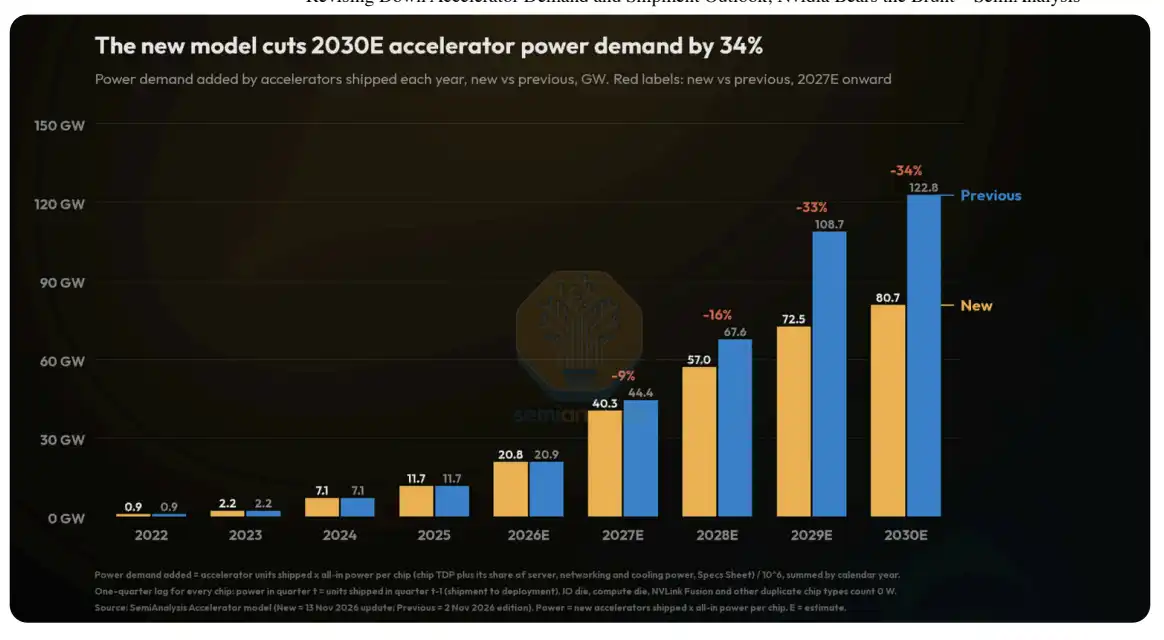
The new model reduces the 2030 accelerator power demand forecast by 34%.
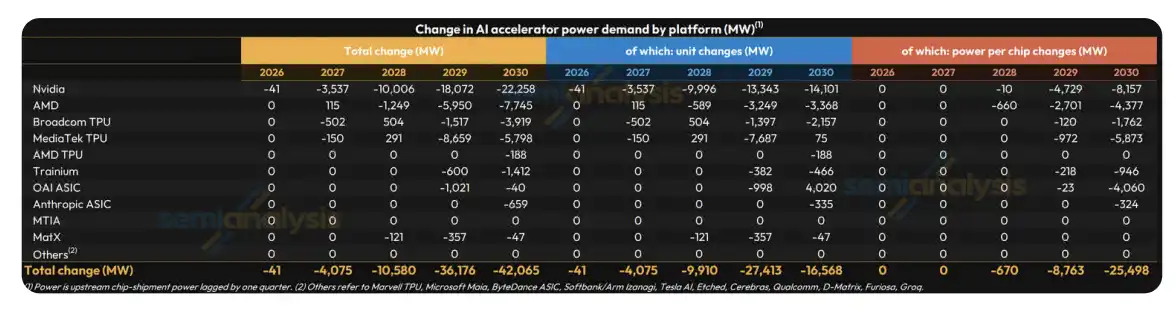
Changes in AI accelerator power demand across platforms, in MW.
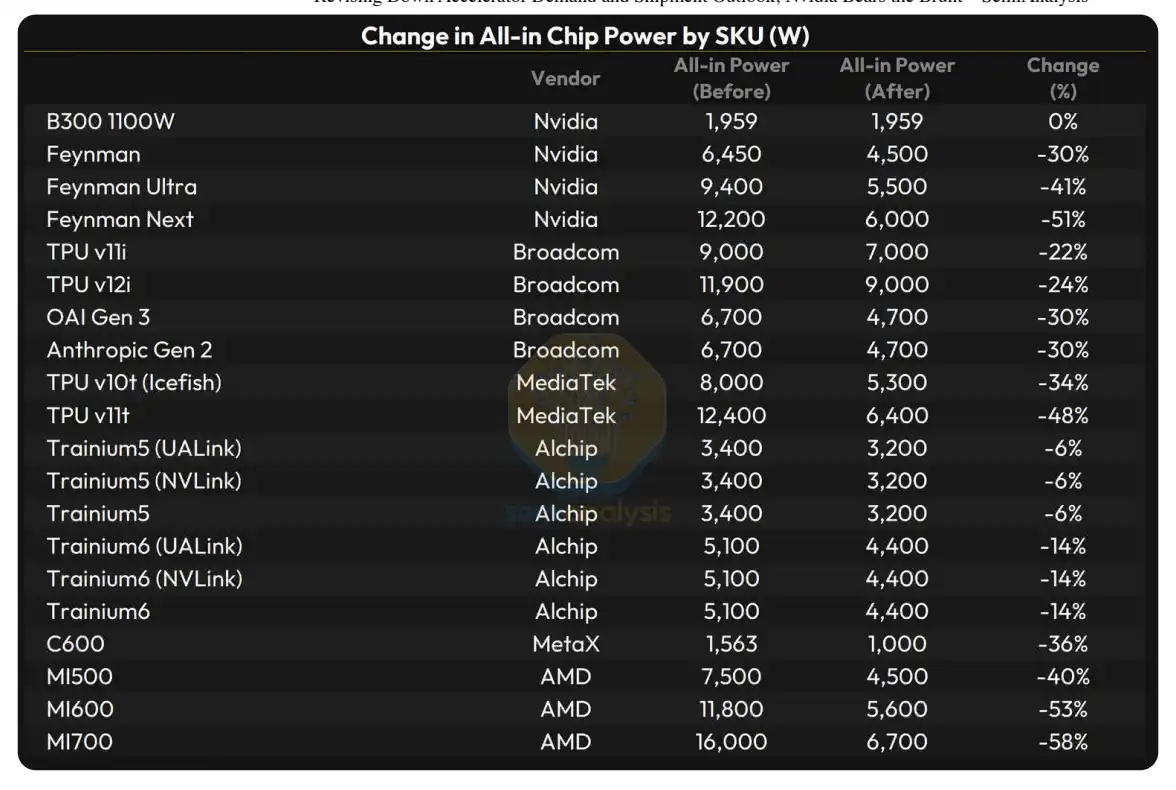
Changes in comprehensive power consumption across chip models, in W.
Next, we will review these changes by supplier and platform.
NVIDIA
Measured by revenue from computing power products, we have significantly revised down NVIDIA's shipment forecasts for 2027, 2028, 2029, and 2030 by 22%, 39%, 56%, and 66%, respectively. Measured in terms of comprehensive power consumption, they have been revised down by 14%, 35%, 50%, and 59%, respectively. Since Feynman, in addition to accounting for changes in HBM costs, we have further lowered the average selling price assumptions because we believe NVIDIA needs to accept lower profit margins to maintain competitiveness relative to other projects. The predicted selling price of Feynman has been revised down from approximately $110,000 to around $78,000, Feynman Ultra from approximately $175,000 to about $98,000, and Feynman Next from around $191,000 to about $118,000. The simultaneous adjustments to price and shipment mean that NVIDIA's projected revenue will decline significantly. The reductions involve GPUs, Groq LPUs, and standalone CPUs.
We have lowered NVIDIA's demand adjustments the most, as NVIDIA GPUs rank lower in the computing power ecosystem of cutting-edge AI labs. Among the four main computing power platforms used by Anthropic, namely TPU, Trainium, AMD GPUs, and NVIDIA GPUs, the position of NVIDIA GPUs is the most marginal. In terms of unit cost performance, Anthropic prefers other platforms.
Although GPUs play a more significant role in OpenAI's infrastructure, considering the substantial financial gains from the AMD warrant trading, AMD GPUs have become a very attractive option. Furthermore, OpenAI will prioritize deploying its ASIC projects Jalapeno and the next generation Serrano, as the unit total cost of ownership performance of these chips is leading.
Moreover, NVIDIA has the highest exposure to emerging cloud service provider (Neocloud) customers among all suppliers, especially among smaller long-tail customers. Currently, emerging cloud service providers face much larger risks in project execution and financing capabilities. The amount of computing power that Chinese end customers have pledged to procure from emerging cloud service providers is also quite considerable. The likelihood of the RASA Act becoming law seems to be increasing. Once effective, remote access to GPUs will be treated as an export, making remote access to advanced GPUs by Chinese customers a violation of export controls.
Lastly, we note that this model adjustment has not accounted for the impact of Jensen Huang's resignation as CEO of NVIDIA. Even if Jensen Huang continues as CEO, we would make the same adjustments. Given Jensen Huang's significance to NVIDIA, we believe that this leadership transition will increase the risk of market share decline, with the reduction potentially exceeding the forecasts listed here.
Due to the postponement of Vera Rubin L6 board shipments from the third quarter to the fourth quarter, we have also adjusted our forecasts for the third and fourth quarters of 2026. We have moved approximately 100,000 Rubin GPUs from the third quarter of 2026 to the fourth quarter, maintaining the total annual shipment volume of Vera Rubin at about 980,000 chips for 2026. GB300 shipments increased by approximately 130,000 in the third quarter, filling this gap. As Rubin accelerates its release, we have adjusted downward the forecasts for 2026's fourth quarter by about 260,000 GB300s and about 150,000 H200s. Combining these adjustments, NVIDIA's total revenue in the third quarter of 2026 is approximately $109.1 billion, and approximately $125.3 billion in the fourth quarter.
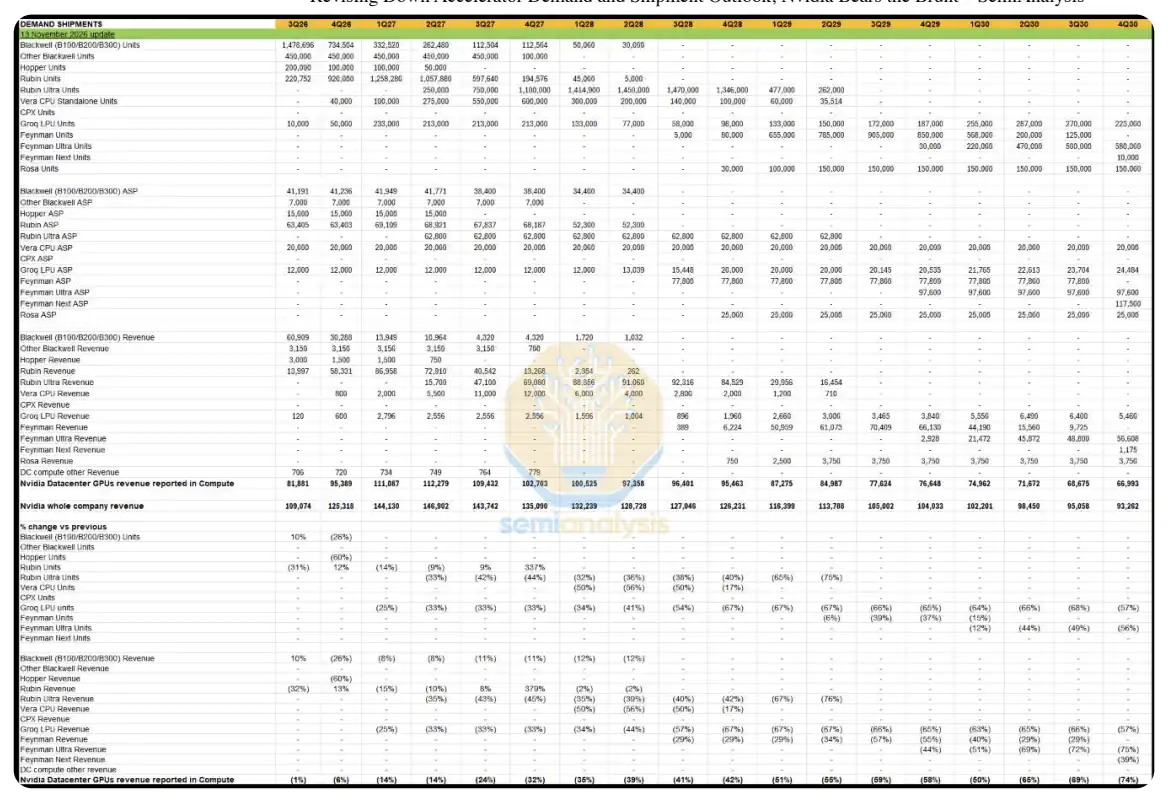
Shipment forecasts (NVIDIA). The table is updated as of November 13, 2026, and lists the shipments, average selling prices, and revenue for each model by quarter, along with their respective change percentages from the previous version. Aggregate items include NVIDIA data center GPU revenue and NVIDIA's overall company revenue. Source: SemiAnalysis.
Broadcom
Broadcom is impacted the least, with its cumulative revenue forecast for ASICs from 2026 to 2030 revised down by 11%, primarily due to lower HBM costs leading to an adjustment in average selling prices, while the impact on shipments is smaller. We believe that Broadcom's demand will not decline because its three major ASIC projects (TPU, OpenAI, and Anthropic) can provide end customers with higher unit cost performance and unit power performance, while Broadcom also has the capability to provide funding support from creditors for land, power, main construction, and system financing. For OpenAI, we have revised down the forecast scale for the second-generation Serrano in 2029 by 1 GW, while significantly increasing the shipment volume for the third-generation product in 2030.
We slightly revised down TPU shipment volumes, affecting Google and Anthropic. Due to the expectation that data center development in Texas will be paused, we have postponed the delivery of 700 MW of TPU originally set for Anthropic in 2027 to 2028. Our data center team anticipates that approximately 275 MW of capacity from the Crusoe/Goodnight project will be deferred from the fourth quarter of 2027, and another 330 MW from the Nexus project in Hubbard, which has not yet been approved, is also facing risks. Both projects are used to deploy Anthropic's TPU.
Another project where we have revised down the forecast comes from the startup MatX. We believe that MatX's uncertainty is higher and obtaining financing is more difficult, thus reducing the demand estimate for Anthropic's MatX chips.
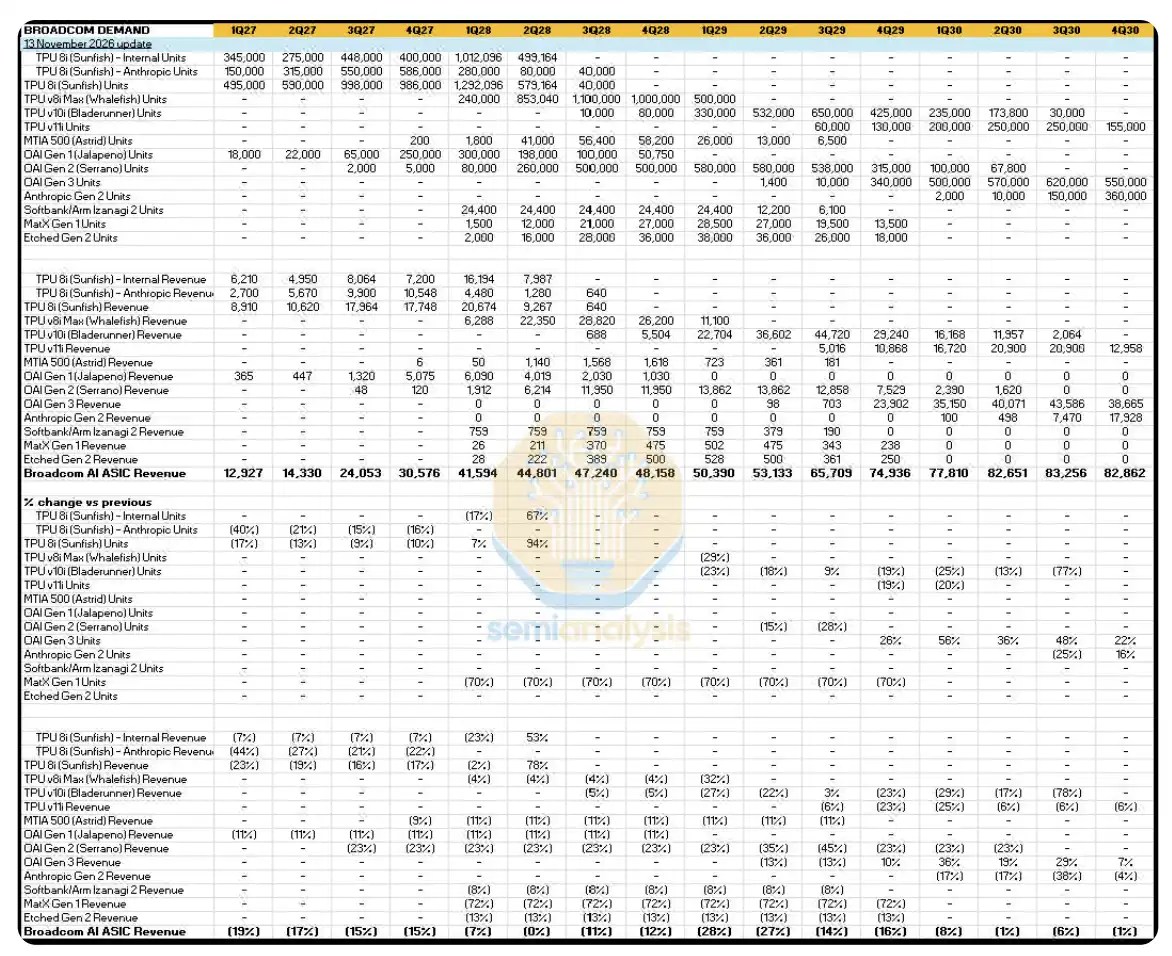
Broadcom demand. The table is updated as of November 13, 2026, listing the shipments, revenue, and change percentages from the previous version for projects such as TPU, OpenAI, and Anthropic by quarter. Aggregate items represent Broadcom’s AI ASIC revenue. Source: SemiAnalysis.
MediaTek
We have revised down MediaTek's shipment volumes more significantly.
This reflects both the financing factors leading to a decline in Anthropic's demand and our reevaluation of overall TPU demand, as our model suggests MediaTek will bear most of the TPU shipments in the future, particularly those used internally by Google. Even after this downward revision, MediaTek's TPU shipment volume in 2029 to 2030 remains higher than that of other partners such as Broadcom and AMD/Marvell. Additionally, as MediaTek's clients purchase HBM themselves, the drop in HBM prices does not impact MediaTek, thus changes in revenue forecasts entirely stem from lower shipment volumes.
The downward revision primarily focuses on two products of the TPU v9 series, Humufish and Triggerfish. We have revised down the total lifecycle shipment volume of Humufish in 2028 and 2029 by 470,000, reflecting ongoing risks to the EMIB-T yields.
Since financing constraints are one of the main reasons for this adjustment, we believe Broadcom's ability to provide financing support for the entire construction project is more critical for Anthropic. Consequently, the project with the largest downward adjustment is the TPU v9i (Triggerfish), with its total lifecycle shipment volume lowered by 42%. Triggerfish was designed with Anthropic’s input and was originally planned to be MediaTek's first TPU sold to Anthropic.
However, we also recognize that MediaTek's overall profit margins are lower than Broadcom's, making the total system cost more attractive when funds are constrained. This necessitates Google to take on more financing responsibilities or require Anthropic to increase prepayments.
For the subsequent TPU v10t (Icefish), we have slowed down the ramp-up in 2029, shifting more shipments to 2030.
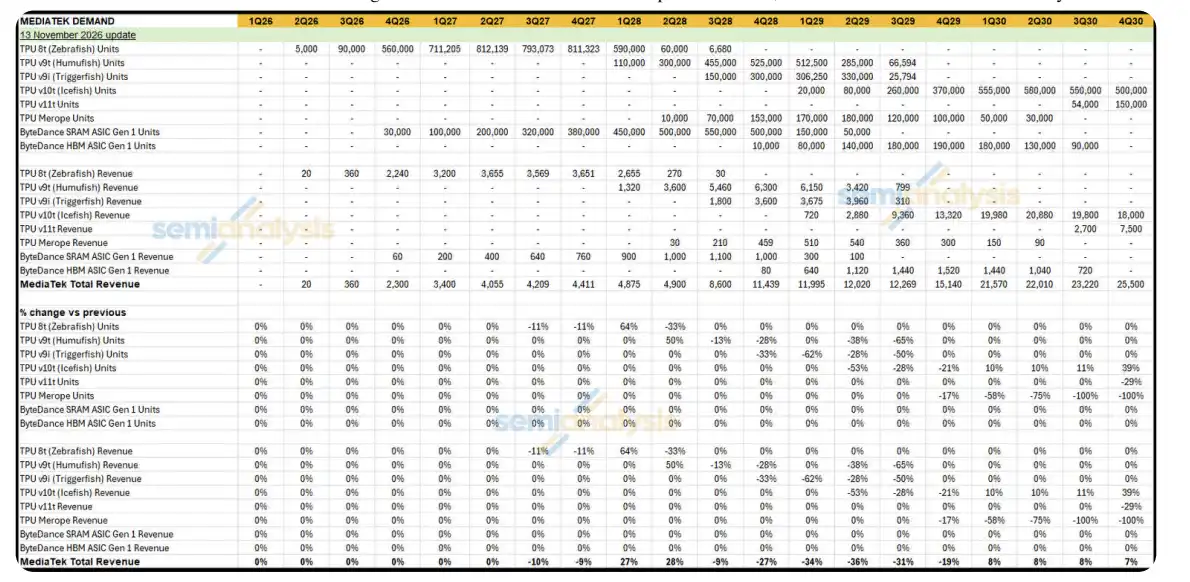
MediaTek demand. The table is updated as of November 13, 2026, detailing the shipments, revenue, and change percentages from the previous version for each model of TPU and ByteDance ASIC projects by quarter. Aggregate items represent MediaTek's total revenue. Source: SemiAnalysis.
AMD
Measured by comprehensive power consumption, we have revised down AMD's forecasts for 2028, 2029, and 2030 by 23%, 55%, and 57%, respectively, while for revenue, they are adjusted down by 29%, 35%, and 32%, respectively. The power consumption forecast for 2027 remains roughly unchanged, while the spending forecast is reduced by 11%. Although AMD also belongs to suppliers selling commercial chips to the public market, the revenue adjustment magnitude is smaller than that of NVIDIA, as AMD has greater exposure to hyperscale cloud vendors and cutting-edge AI lab customers, including Meta, OpenAI, and Anthropic. For Meta and OpenAI, the warrant trading makes purchasing AMD systems practically a no-brainer. Anthropic lacks warrant trading, but we believe AMD's pricing is still very favorable for Anthropic. In terms of unit dollar performance for inference, AMD is second only to TPU in attractiveness to Anthropic.
Moreover, in the short term, we have advanced the ramp-up time for MI400 to reflect a stronger production surge in the fourth quarter of 2026. We have moved about 25,000 MI400 and about 30,000 Meta custom MI450-MCs from the fourth quarter of 2027 to the fourth quarter of 2026.
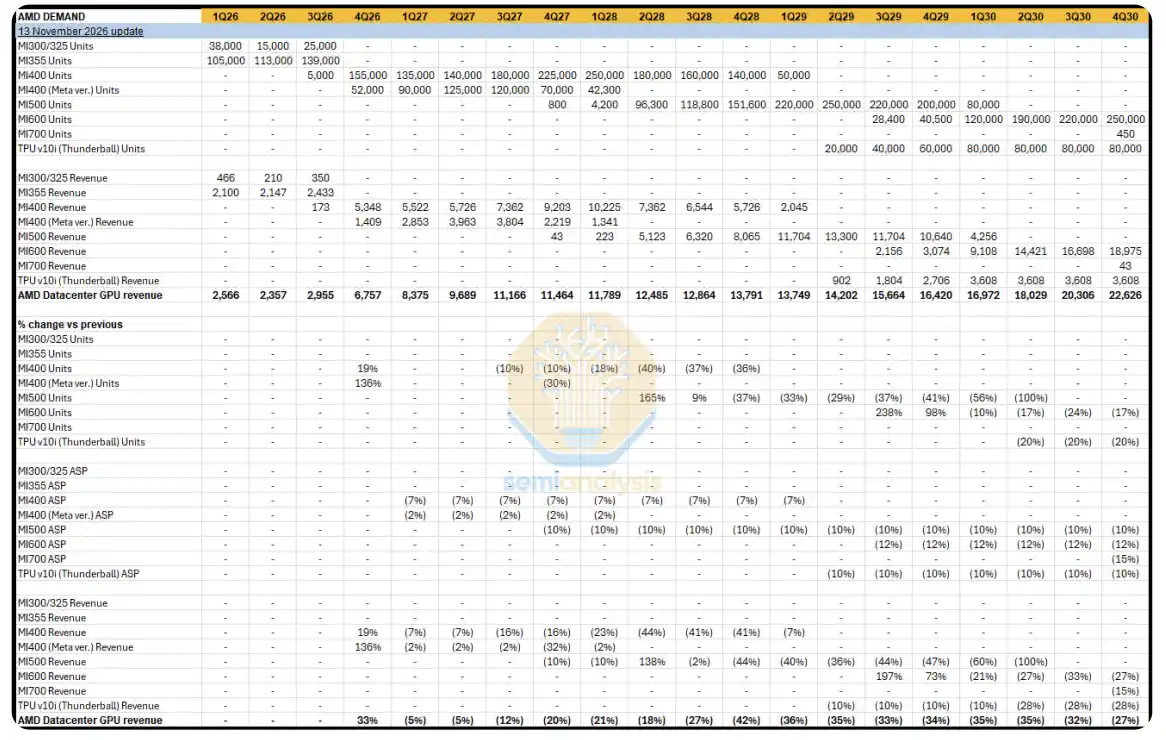
AMD demand. The table is updated as of November 13, 2026, listing the shipments, revenue, and change percentages from the previous version for each model by quarter, along with the percentage change in average selling prices. Aggregate items represent AMD data center GPU revenue. Source: SemiAnalysis.
Amazon Trainium
We maintain the shipment forecasts for Trainium in 2027 and 2028. For 2029, we are shifting the expected shipments from Trainium4 to Trainium5 and further extending the lifecycle of Trainium5 to 2030 while reducing the ramp-up scale for Trainium6. We retain the recent shipment forecasts for Trainium, as Amazon has a substantial backlog in its data center projects under construction and preparation, most of which remain unaffected. Additionally, Trainium's manufacturing costs are significantly lower, which also translates to lower costs for end customers. Amazon is also willing to subsidize the use of Trainium in projects for key clients like Anthropic and OpenAI for strategic reasons.
Other Adjustments
We have renamed TPU v9i (Whalefish) to TPU v8i Max (Whalefish).
We have renamed "B300 1200W" to "B300 1100W," and updated the thermal design power (TDP) accordingly. The comprehensive power consumption of the chips remains unchanged.
In the ODM model, we have reduced Microsoft's orders for Vera Rubin cabinets in 2027 by 200 units.
免责声明:本文章仅代表作者个人观点,不代表本平台的立场和观点。本文章仅供信息分享,不构成对任何人的任何投资建议。用户与作者之间的任何争议,与本平台无关。如网页中刊载的文章或图片涉及侵权,请提供相关的权利证明和身份证明发送邮件到[email protected],本平台相关工作人员将会进行核查。


