A VC proficient in storytelling is trapped in its own narrative.
Written by: Eric, Foresight News
In recent years, "narrative" has been an important reference for assessing the potential of a cryptocurrency project. Behind the market's calculation of the appropriate price for buying tokens based on the "market dream rate," VCs, as "dream factories," continuously bring new stories to the market, striving to maintain this beautiful dream.
a16z, renowned for its "narrative-mythology," is one of the dream makers. While most investment institutions adopt a wait-and-see or even disdainful attitude toward Web3, it boldly chose to enter alone, working hard to tell every story and even harder to turn those stories into reality.
To date, a16z has invested in 154 Web3 projects, with a total financing amount reaching $20.6 billion. These 154 projects account for only about 2.5% of all financed Web3 projects, yet $20.6 billion represents over 13% of the total financing amount. Among them, a $200 million investment in Coinbase yielded a cash return of about $7 billion for a16z, becoming a regular feature in its subsequent fundraising pitch decks.
Among the 154 projects, based on peak valuations or coin prices, projects that yielded over 50 times paper return account for at least 10%.
In the DeFi sector alone, of the top 11 DeFi projects ranked by TVL on DefiLlama, a16z has invested in 5. Among the 7,002 DeFi projects monitored by DefiLlama, these 5 projects account for less than one-thousandth in number but garnered at least 30% of DeFi's total TVL.
The ability to turn stone into gold is the source of a16z's arrogance. However, this confidence, bordering on hubris, gradually turned "arrogance" into "bias," leading a16z, which indulged in dream-making, toward extremes as cryptocurrency entered a new cycle...
When an investment institution increasingly believes in the stories it creates, can it still see the reality beyond the stories?
"Arrogance" – The Confidence from Frequently Capturing 50x Returns
Many people learned about the name a16z starting from crypto. However, before investing in crypto, a16z had already placed successful bets on celebrity companies like Facebook, Instagram, Twitter, GitHub, and Robinhood. The four flagship funds launched between 2009 and 2014 achieved a remarkable return rate that can only be described as "mythical," with the return rate of the third flagship fund reaching an astonishing 1570%.
In early 2026, well-known author in the American tech circle and founder of Not Boring, Packy McCormick, stated in "a16z: The Power Brokers" that when these four funds exited, the market cap of the invested companies, along with the final round financing valuations of projects that had not yet exited, reached $853 billion, over 200 times the total fundraising scale of the funds.
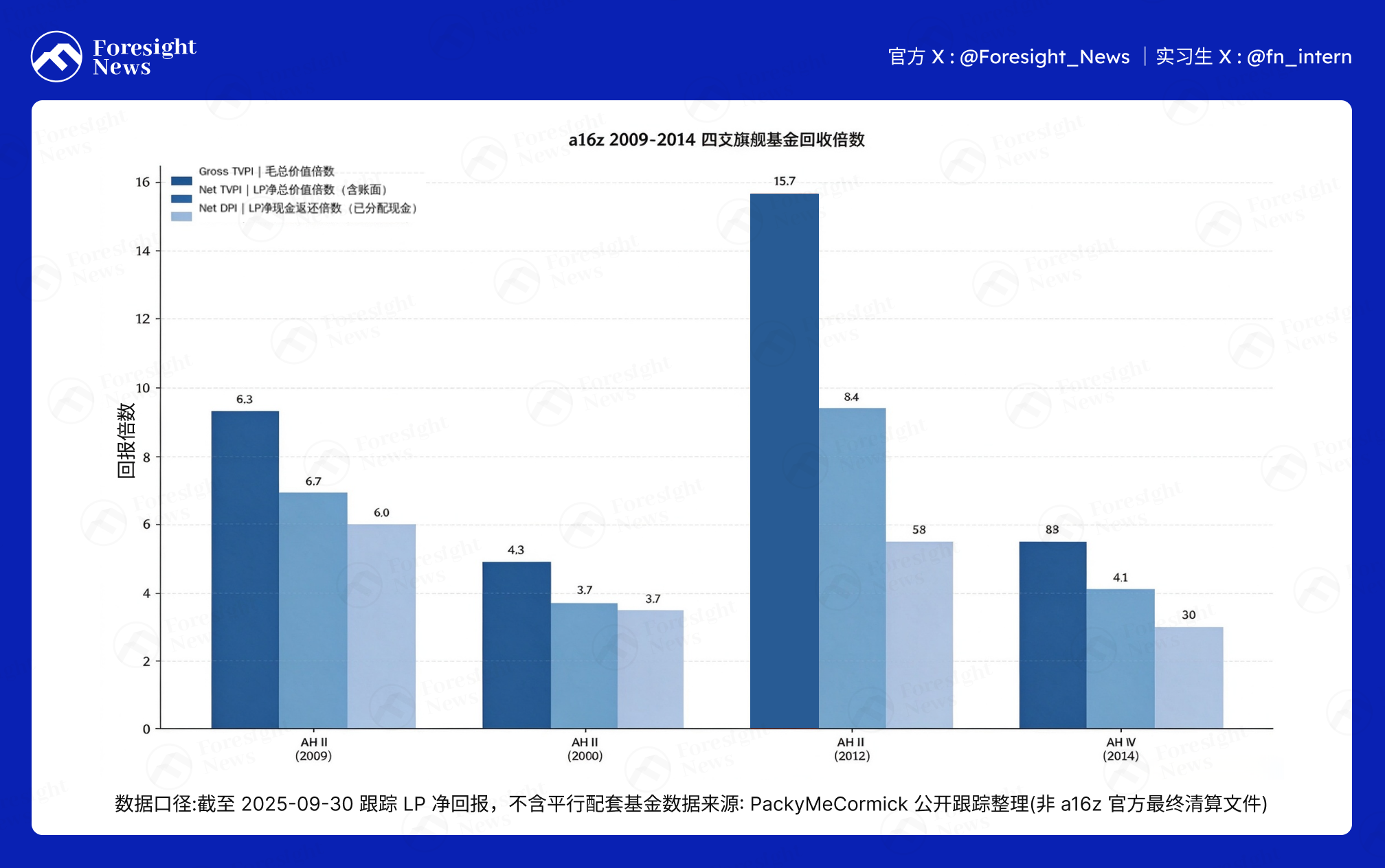
In 2011, a16z published a lengthy article in The Wall Street Journal titled "Why Software Is Eating the World," arguing that software was taking over traditional industries comprehensively. This article later became one of Silicon Valley's most influential narratives, frequently cited and helping to shape the consensus throughout the 2010s that "software companies will disrupt everything." a16z itself has long invested and voiced opinions around this framework.
Ben Horowitz, who founded a16z, repeatedly emphasized that "Storytelling is the most underrated skill," and "The company story is the company strategy." Senior public relations professional Margit Wennmachers joined a16z back in 2010, driving proactive pursuit of cover stories, debates, columns, and continuous content output. They do not rely on traditional media for passive reporting but produce narratives themselves.
This is also why a16z is referred to as "a media company that makes money through investment." Many critics have furiously output this point but have forgotten the most important aspect: if a company itself is a garbage company, no matter how advanced the narrative, it cannot be sustained. Several early projects a16z experimented with, despite some exiting the market and others becoming tier-two or three, essentially hit almost all the hot tracks from 2020 to the present, or at least those that were popular at one time.
As early as over a decade ago, a16z invested in Web3 projects like Coinbase and Ripple. According to The Information, a16z's total investment in Coinbase is around $200 million, and when it went public in April 2021, that stake was valued at over $11.2 billion, leading to a paper return of 56 times and ultimately providing about $7 billion in distributable value to investors, becoming a16z's hallmark great victory.
As for Ripple, based on the $40 billion valuation when it raised $500 million in November 2025, a16z's multi-round investment's paper return is estimated to be around 50 times.
To tell stories, sharp insight and substantial capital are both indispensable, which is a16z's foundation for "arrogance."
In Eight Years, Investing in 154 Cryptocurrency Companies
More than eight years ago, in June 2018, a16z established its flagship fund a16z crypto, focused on investing in Web3.
According to my statistics, from the establishment of a16z crypto until the end of October 2026, a16z has invested in a total of 154 Web3 projects (excluding financial technology companies that provide cryptocurrency services). These projects have raised a total of approximately $20.6 billion.
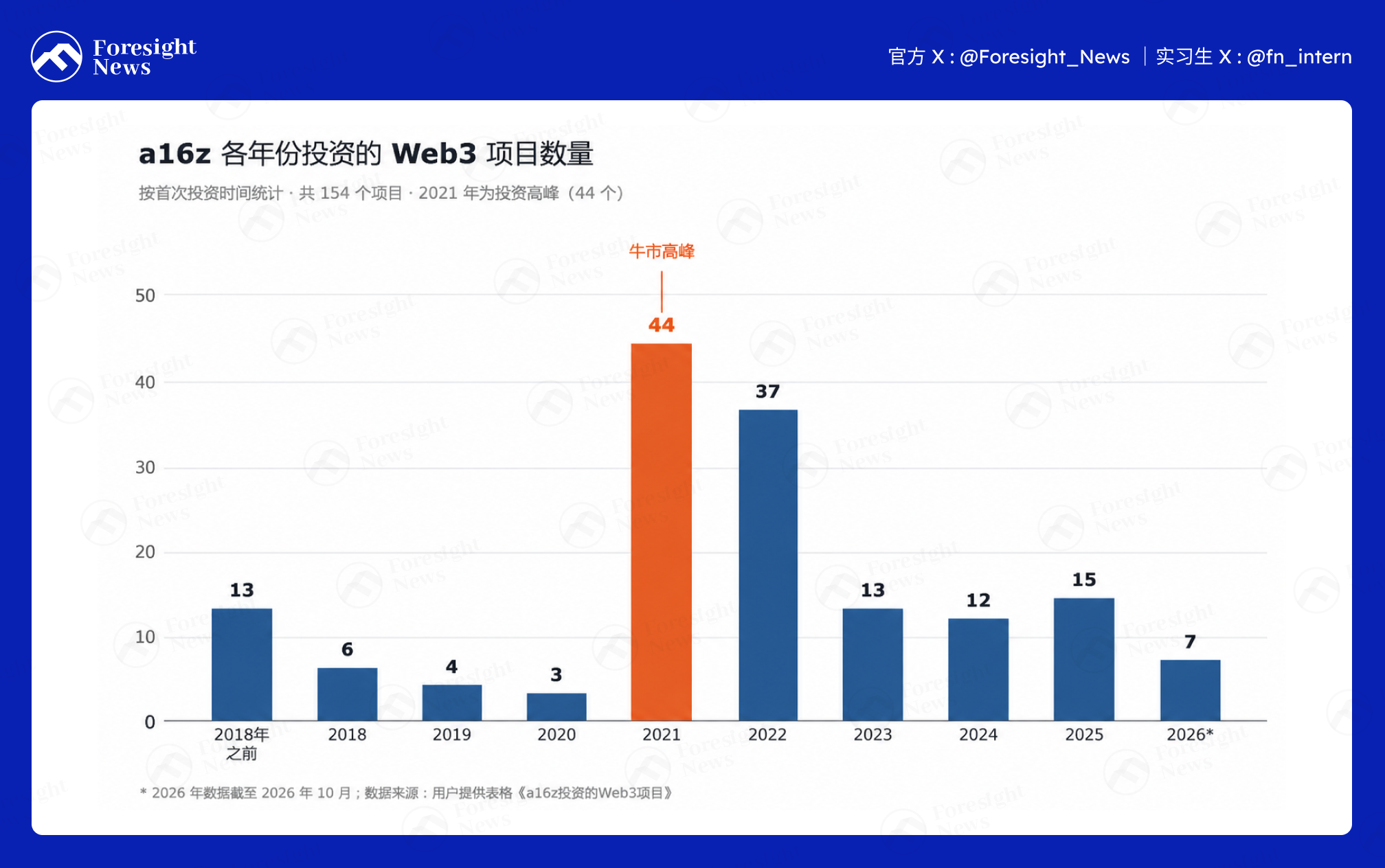
The total number of financed Web3 projects exceeds 6,000, with a total financing amount exceeding $150 billion. Projects that a16z has participated in amount to less than 2.5%, yet they contributed over 13% of the total financing amount.
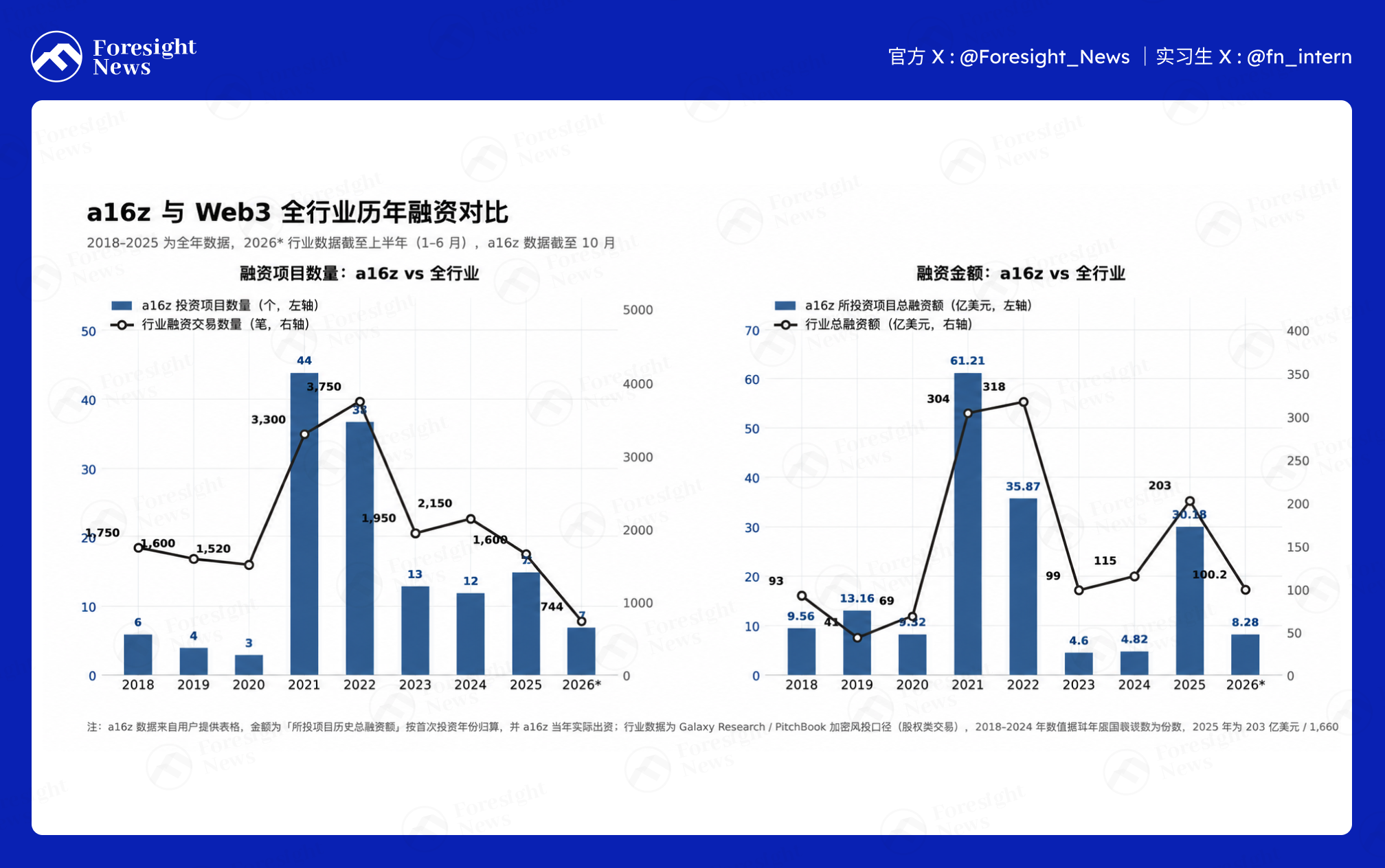
2021 was particularly remarkable, with over 3,000 projects in the Web3 industry receiving financing that year. Although a16z only participated in slightly over 1% of those projects (44 vs. 3,300), those projects accounted for over 20% of the total financing that year ($6.121 billion vs. $30.4 billion).
This is part of what a16z has invested in the Web3 industry.
In July of this year, airdrop.io compiled the 15 largest airdrops in Web3 history. Among them, Uniswap, Yuga Labs, dYdX, and Optimism all originated from a16z, collectively distributing over $14 billion. Notably, Uniswap transformed the concept of "airdrop" from an unexpected celebration into a milestone in the token issuance process.
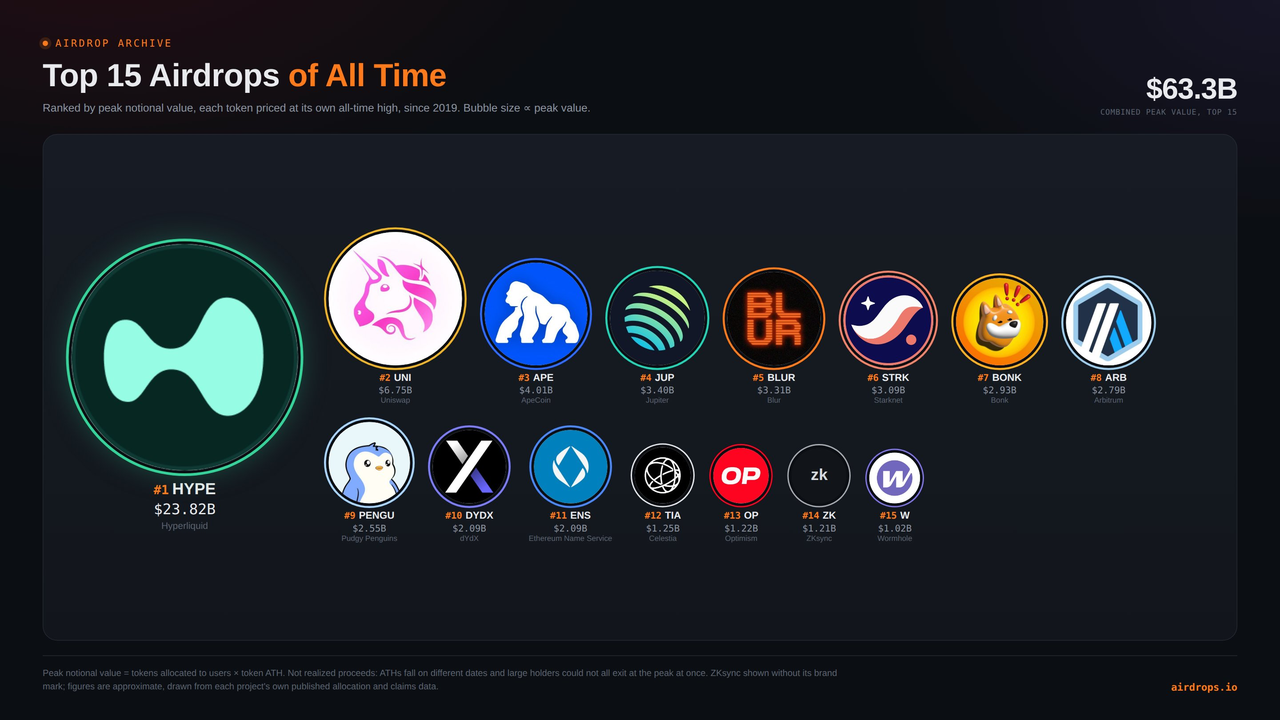
Therefore, even in terms of the two simplest metrics of "investing money" and "distributing money," a16z is undoubtedly a key player in the capital history of Web3 projects.
If we set aside coin prices and discuss actual value, these 150-plus projects are already sufficient for us to recount in detail.
As of the time of writing, among the top ten in DefiLlama's TVL rankings, Lido, Morpho, EigenCloud (formerly EigenLayer), and Sky (formerly MakerDAO) are all in a16z’s investment portfolio. Including the 11th-ranked Uniswap, five projects in the top 11 have received a16z’s investment, contributing to at least 30% of DeFi's total TVL.
Even in a DeFi market that has almost become a red ocean, a16z still managed to invest in Morpho, which is currently second only to Aave and has surpassed the "old veteran" Compound.
In terms of public chain layout, a16z has invested in projects like Solana, Sui, Avalanche, and NEAR. Solana and Sui are among the few outstanding performers in this round, while Avalanche and NEAR have slowly found their place in RWA tokenization and privacy transactions after several years of exploration.
Optimism, which contributed a $1.22 billion airdrop, also uses its Rollup stack to support independent L2s like Coinbase's L2 Base, Kraken's L2 Ink, and Uniswap's Unichain.
In the once-glorious NFT space, a16z led multiple rounds of investment in OpenSea, which had a valuation that peaked at $13.3 billion in early 2022; the BAYC NFT series from Yuga Labs once became one of the social cards pursued by stars from various fields, with individual pieces valued as high as several million yuan at their peak.
Besides these big names, there are many projects with generally lower recognition but are shining in the infrastructure realm. In any case, whether through once-popular applications and public chains or quietly serving as unsung heroes in infrastructure, many projects have received the "a16z seal of approval."
Even for NFTs and games, which are now less popular, just like a16z realized its IPO dream with Coinbase eight years after its investment, who can say they won't return to the spotlight one day in the future?
Institution and Discourse Power
If money is a16z's explicit input to the industry, then institutions and knowledge are two other layers of contribution that are less obvious but potentially more lasting.
a16z has long acted as the de facto "policy department" for the Web3 industry. It continually submits policy opinions to the SEC, from its proposals related to the Exchange Act in 2022 to the DeFi safe harbor proposal in 2025. Almost all significant regulatory topics in the industry have documentation submitted by it.
At one point, its partner list included former federal prosecutor Katie Haun, and the team comprises several former financial regulators, systematically applying their expertise and connections to one goal: to move crypto from the opposing side of regulation to the negotiation table. When the GENIUS Act was enacted in 2025, a16z viewed it as landmark evidence of regulatory change, and the traces of this act can be seen everywhere, from lobbying texts to congressional hearings. The process of compliance in the industry has never been spontaneous; it has been backed by sustained investment over many years, ramping up year by year.
In 2024, Wyoming passed and signed the Decentralized Unincorporated Nonprofit Association Act (DUNA), providing DAOs with legal entity status: the ability to sign contracts, open bank accounts, pay taxes, and have limited liability protection while striving not to undermine decentralization. a16z crypto directly participated in this process, publishing model legislative proposals, with many provisions of the bill based on their proposals. The team also testified before the state senate and house committees for the legislation.
a16z (including Marc Andreessen and Ben Horowitz personally) is also one of the primary funders of the Fairshake super PAC and its affiliated PAC. Also in 2024, the crypto industry invested heavily through Fairshake to help defeat several legislators seen as anti-crypto (such as Ohio Senator Sherrod Brown, then the chair of the Senate Banking Committee) and supported bipartisan pro-crypto candidates. Reports indicated that the candidates supported by Fairshake mostly won, directly shifting the balance of power among crypto-friendly factions in Congress.
Besides influencing policy, a16z does not hesitate to compile its successful experiences and lessons learned from investing in Web3 projects into books, frequently publishing views on topics like DAO governance, talent recruitment, and community operation on its official blog; the annual "State of Crypto" report has become the industry’s factual standard, cited by global media each year; Crypto Startup School offers free entrepreneurial education to anyone wishing to enter the field.
Chris Dixon, founder of a16z crypto, has turned the concept of a "decentralized internet" from a slogan into a complete narrative that can be preached externally with his "Read Write Own." The research team even publishes papers meeting academic standards. For entrepreneurs, "being invested by a16z" is a signal and endorsement in itself, significantly lowering the friction costs for follow-up financing in quality projects.
Beyond these, a16z is also quietly pushing the boundaries of Web3 behind the scenes. According to informed sources, the entry of Pudgy Penguins’ penguin toys into Walmart is aided by a16z and ZKsync, which a16z invested in. Additionally, Story Protocol, heavily backed by a16z, includes team members from ZKsync.
It involves letting experienced individuals from mature projects drive development in new projects, utilizing resources from themselves and the projects they invest in to push Web3 beyond its usual confines, and such endeavors are continually pursued by a16z but without being showcased in media.
With capital, institutions, and knowledge combined, a16z has crafted a complete script for Web3, which has been performing according to this script for many years. The issue lies in that audiences will not keep buying into the same script repeatedly.
"Bias" – When the Era's Dividend Becomes Path Dependence
"Narrative-mythology" in the early stages of an industry may not inherently be a bad thing.
The core contradiction of an early industry is the lack of consensus; capital dares not enter, talent dares not come, and regulation understands little. In this situation, an institution that can translate complex technology into compelling stories effectively takes on the role of market educator. During DeFi Summer and the NFT wave, a16z's narrative ability indeed aided the industry in completing a cold start, bringing capital, attention, and entrepreneurs together rapidly. For an industry starting from zero, this cohesion is a scarce resource in itself.
As a result, we witnessed the successive emergence of DeFi, NFTs, the metaverse, and new public chains in the previous cycle, as well as the rapid decline of NFTs and the metaverse, which once deceived Facebook.
a16z once held very high evaluations of NFTs, chain games, and the metaverse.
NFTs were seen by a16z as the key primitive to realize true digital ownership, enabling art, music, game items, and more to be truly owned by users, flowing across platforms, allowing creators and players to share value instead of being siphoned off by platforms. Regarding chain games, they were optimistic about players owning assets, Play-to-Earn, and open economies, believing games should be built around user ownership to enhance loyalty and interoperability. For the metaverse, a16z argued it must be open, decentralized, with property rights strictly enforced by code, user-controlled identities, combinable, and value belonging to users, not platforms; NFTs and blockchains form its necessary foundation, with game developers being crucial builders.
The combination of these three creates a virtual world built on blockchain, which was the vision of a16z and indeed all practitioners at that time. However, the subsequent narrative did not unfold as everyone envisioned, and the Web3 sector rapidly entered a downtrend. This cycle's DeFi revived because of many real applications, while new concepts like NFTs nearly lost their voices.
Yet, a16z did not reflect on this but rather obsessively sought to recreate the former mythic narrative, ultimately getting slapped by reality. In the directions of the metaverse and gaming spawned from NFTs, its betting density increased significantly, and these sectors later experienced severe bubble bursts.
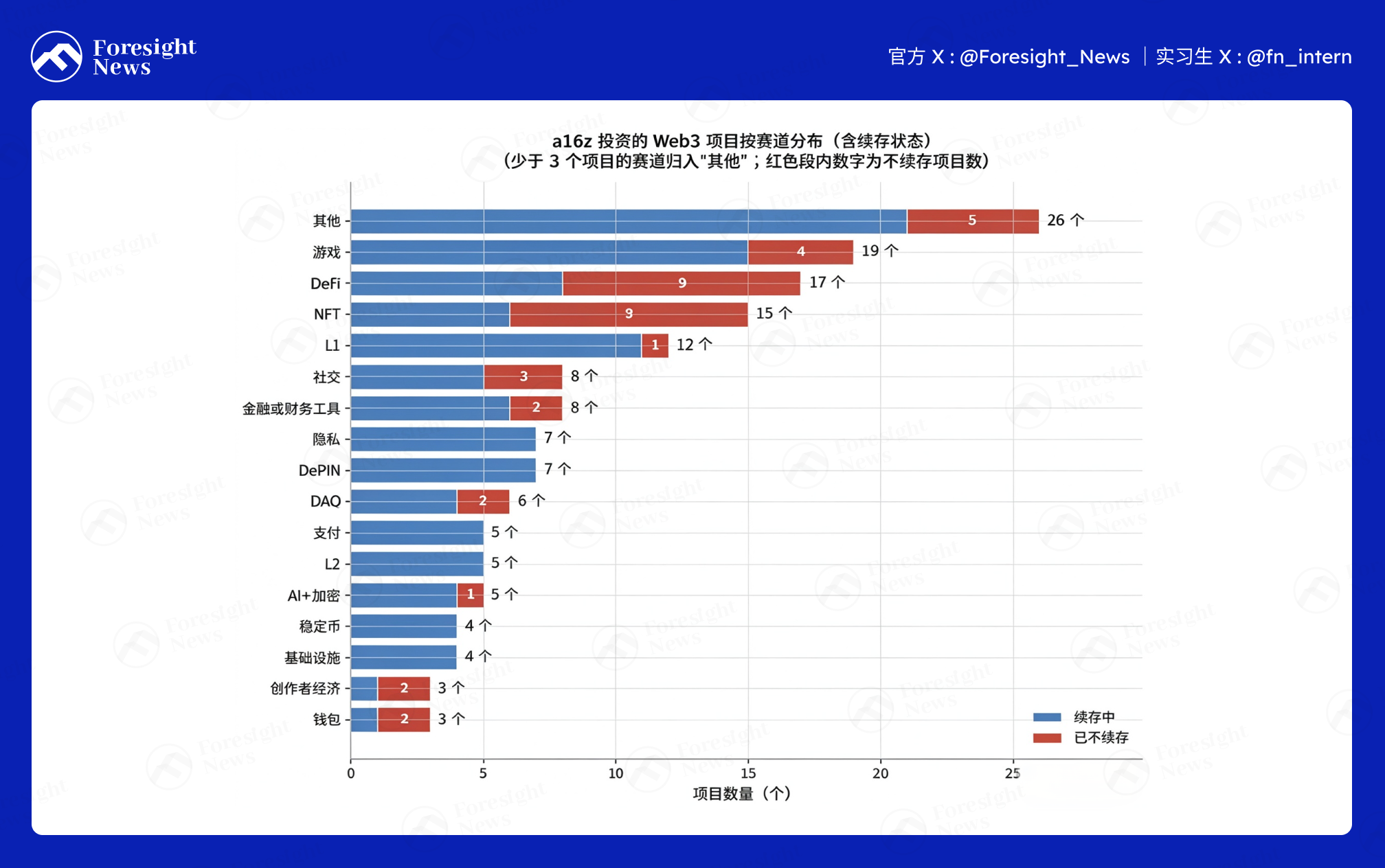
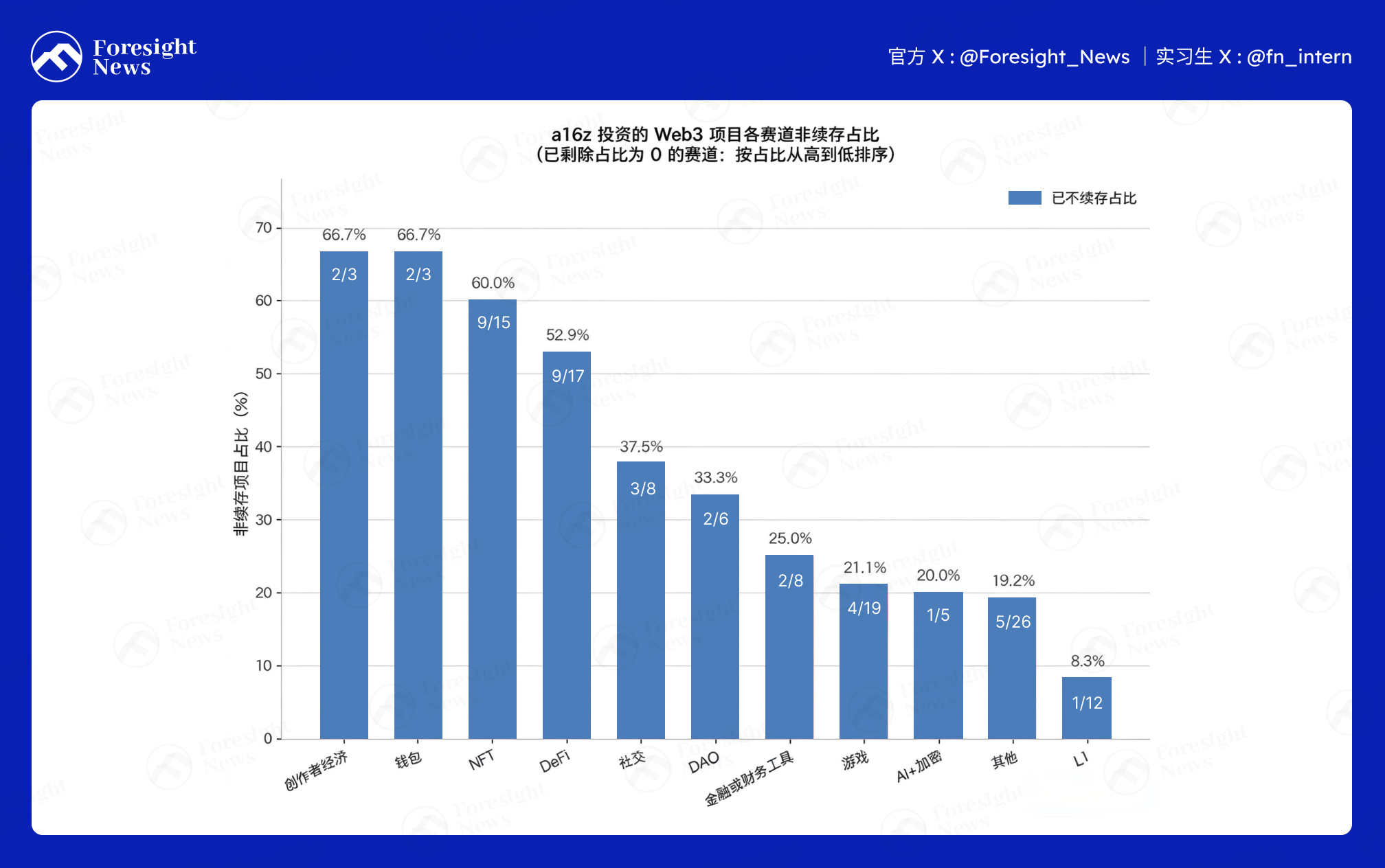
Game, NFT, social, DePIN, creator economy, and other sectors have proven difficult to scale in the short term and fit market demands. Even in the DeFi field, a16z's investment failure rate exceeds 50%. In the gaming sector, while many projects have not directly closed down, many have ceased to pursue Web3 gaming, shifting towards the development of casual games or gaming infrastructure.
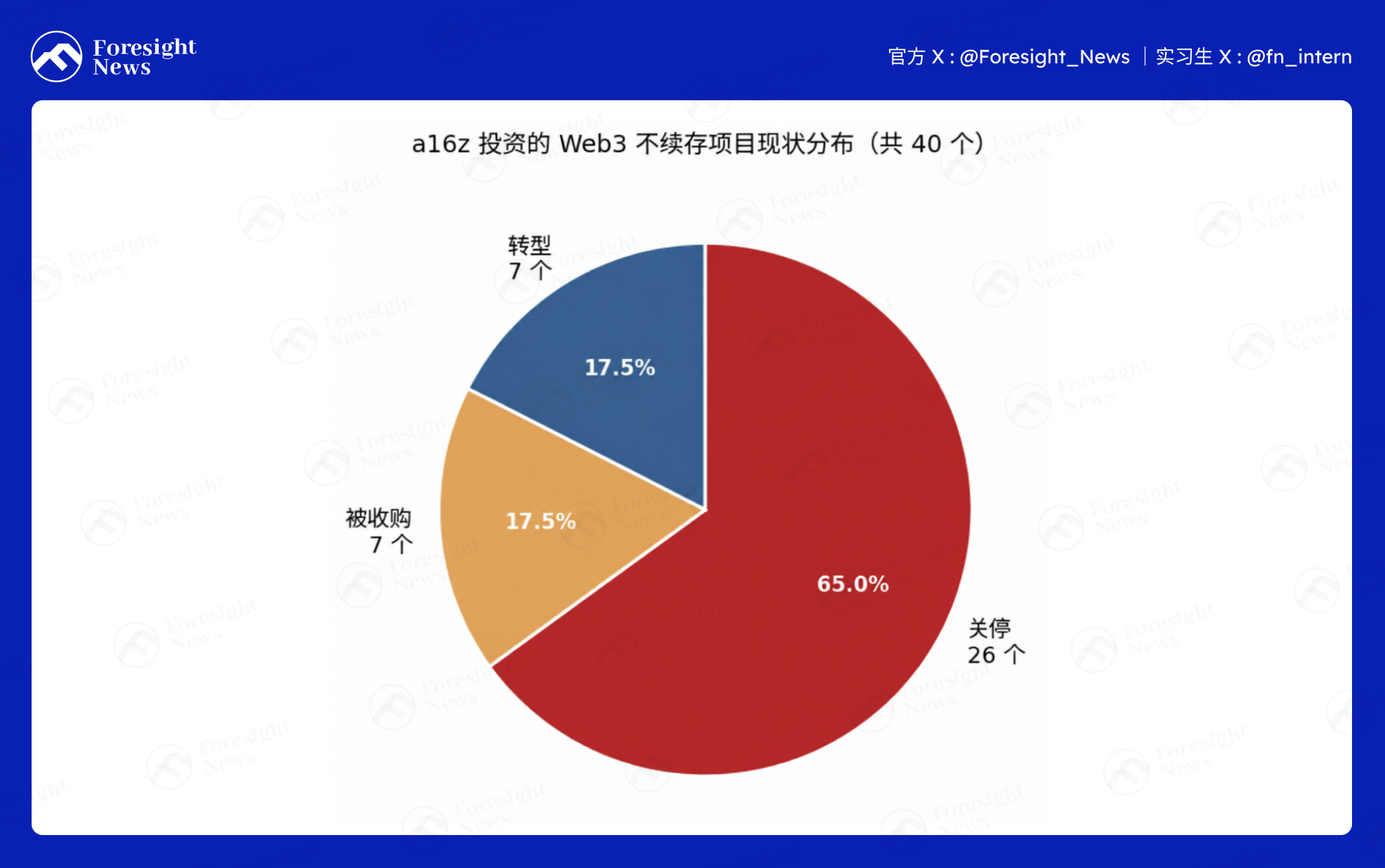
Among the 40 projects that are no longer in existence, 13 are from the NFT and gaming sectors, accounting for nearly one-third.
Although the objective conclusion presented by the data shows that these fleeting sectors are not as dire as imagined, still surviving does not mean thriving, nor does it mean that the money a16z invested yielded positive returns. Some projects may have temporarily provided a16z and other investors with high exit paths, but at the cost of burying countless retail investors.
The most typical examples among these are EigenLayer and Story Protocol.
EigenLayer is a16z's second attempt in the Ethereum staking realm following its success with Lido. "Re-staking" is essentially "a second layer of yield on Ethereum’s shared security," significantly increasing the cost of malicious actions by using liquid staking tokens of ETH as collateral for other network consensus nodes.
Initially, under the stimulus of the new concept and incentivized programs, a massive influx of funds poured in, with TVL once soaring. However, the fees actually paid for re-staking services could never cover the basic staking yields and risk premiums, and additional yields were nearly never genuinely realized; after penalty measures were implemented in 2025, risks went from theoretical to priced risk, leading core liquidity re-staking protocols like ether.fi to withdraw massively due to "no substantive returns, only risks."
Ultimately, EigenLayer was renamed EigenCloud to diminish the original narrative focus and pivot toward verifiable computation. EigenCloud mainly positions itself as a verifiable cloud platform for "open intelligence," aiming to bring blockchain trust and verifiability to off-chain applications and AI scenarios, rather than emphasizing re-staking yields as its main product. It uses re-staking (EigenLayer) as an underlying economic security layer to provide for upper-level services with forfeitable cryptoeconomic guarantees.
Re-staking itself bets on new blockchains constantly emerging while directly utilizing the security guarantees offered by EigenLayer. The logic is correct and indeed there is actual demand, but the demand cannot cover the risks even when the market is not that bleak.
Story Protocol attempts to turn intellectual property into on-chain programmable assets, launching several projects in the music copyrights field initially, some of which secured financing. However, traditional rights holders lack motivation to go on-chain, a gap persists between genuine licensing and on-chain registration, on-chain revenues have long been close to zero, and the usage scenarios are severely disconnected from market expectations.
IP was the concept that a16z forcefully promoted when it had given up hope for finding the next native growth point in the Web3 market. Perhaps the ownership and programmability of IP is indeed a worthwhile area to explore, but it cannot sustain an independent company, an independent on-chain ecosystem, or its last private financing round's valuation of $2.25 billion.
Recently, the project was renamed DATA, shifting the narrative from "programmable IP" to "AI training data," and considering shutting down its own chain, declaring the original story effectively bankrupt. At the time of announcing the closure of L1, the TVL of Story Protocol's chain had already dropped from a peak of over $45 million to about $3 million, and the on-chain transaction fee income in September was less than $4,000, a fraction of September from the previous year which was $145,000.
The common failure point of these two cases lies in: grand narratives precede genuine demand, with supply-side technologies and token stories running very quickly, but the demand-side payment and usage never managed to catch up. In fact, NFTs also share this issue, but in 2021, the availability of funds on the market was excessively abundant and heady and abruptly prolonged the life of NFTs.
Starting in 2024, many investment institutions have begun to shift their focus towards stablecoins, payments, RWA tokenization, and other directions. a16z has invested in only 9 projects in the payments and stablecoin sectors, accounting for less than 6% of its investment portfolio, with only one more than it invested in the social sector; in the RWA tokenization direction, a16z has garnered nothing.
It is evident that a16z remains adamant in seeking new opportunities in the crypto-native space, seemingly completely ignoring the drastic changes in the market environment, or perhaps it still believes its narrative is enough to sway the market.
a16z has not let go of its former "arrogance," and this arrogance has gradually morphed into "bias."
The Legacy of the "Dream Factory"
Just after midnight on October 23, 2026, a16z announced that its flagship fund a16z crypto was renamed to a16z frontier, expanding its investment targets beyond crypto to all frontier technologies.
a16z let go of its obsession, choosing to embrace reality, while crypto also lost a "die-hard fan" that had persisted for 8 years.
But even with a deviation from the direction in the second half, a16z's overall investment record remains above average. According to a Harvard University study, about 75% of all projects that received VC investment failed to provide positive returns; statistics indicate that nearly half of the projects in the Web3 industry that have received VC investment have already shut down, been acquired, or been forced to pivot.
Even by the strictest standards, that is, if a project varies from its original narrative, it is considered a "failure," a16z's current failure rate is only at 20.6%. Among these, over one-third of projects continue to survive in a manner more dignified than being kicked off the table.
Besides intrinsic reasons, the macroeconomic downturn has also stripped the base from the "narrative-mythology" model. Interest rates, liquidity, and risk appetite determine how much premium the primary market is willing to pay for "stories." As the market transitions into a downtrend, the marginal return of new concepts sharply diminishes, the positive feedback loop that boosts valuations and turns them into returns has broken, and what remains are only the losses and grievances of high-position buyers.
a16z misjudged the situation, attempting to bolster valuations with narratives during a macroeconomic downturn when the wealth effect in crypto had evidently diminished.
Eight years ago, that contrarian move coincided with the darkness before dawn; this time, however, it was after the sun had already set.
For Web3, a16z's contributions are evident; the infrastructure of capital, institutions, and knowledge will not disappear due to a fund’s name change; the past is also real, as it brought the "narrative-mythology" play from Silicon Valley into a sector already saturated with speculation and paid a price of reputation when the cycle turned down.
Over two hundred years ago, Austin wrote at the beginning of "Pride and Prejudice": "It is a universally acknowledged truth that a wealthy single man must be in want of a wife." In the context of Web3, this truth has been rewritten to: A high-achieving VC must tell the next story. In the novel, Darcy's arrogance and Elizabeth's bias ultimately dissolve after they see themselves clearly; in reality, a16z's capital, track record, and taste give it the confidence to look down on the market, yet the same three pillars of confidence make it obsessively wish to reverse the tide.
The name a16z crypto has become a thing of the past, and looking back in the future may turn out to be a very important node in the history of Web3 development. It is a self-redemption of an industry benchmark capital after recognizing reality and also a starting line for the industry itself to begin exploring true value.
免责声明:本文章仅代表作者个人观点,不代表本平台的立场和观点。本文章仅供信息分享,不构成对任何人的任何投资建议。用户与作者之间的任何争议,与本平台无关。如网页中刊载的文章或图片涉及侵权,请提供相关的权利证明和身份证明发送邮件到[email protected],本平台相关工作人员将会进行核查。


