Author: Zhou, ChainCatcher
Recently, an 11-page anonymous whistleblower letter has been circulating in several cryptocurrency industry chat groups. The whistleblower claims to be a former senior executive of Amber Group, accusing the company's management of misappropriating client funds and engaging in conflicts of interest.
On Monday afternoon, Amber Group issued a statement claiming that the related accusations are false, that the company's operations are running normally, and stated that they are preserving evidence and reserving the right to pursue legal action.
Many voices have pointed out that only when the tide goes out can we see clearly how many people in this industry are swimming naked, with even top-tier market makers starting to spread such news.
In fact, over the past few years, Amber has shifted its focus to wealth management and AI agents, and market making is no longer its main business.
In contrast, Wintermute, which was established around the same time as Amber, recently secured about 76% of the top priority data seat auction on Hyperliquid, becoming one of the most aggressive traders on-chain.
Both companies' founding teams originated from traditional financial trading desks, and they have now diverged paths.
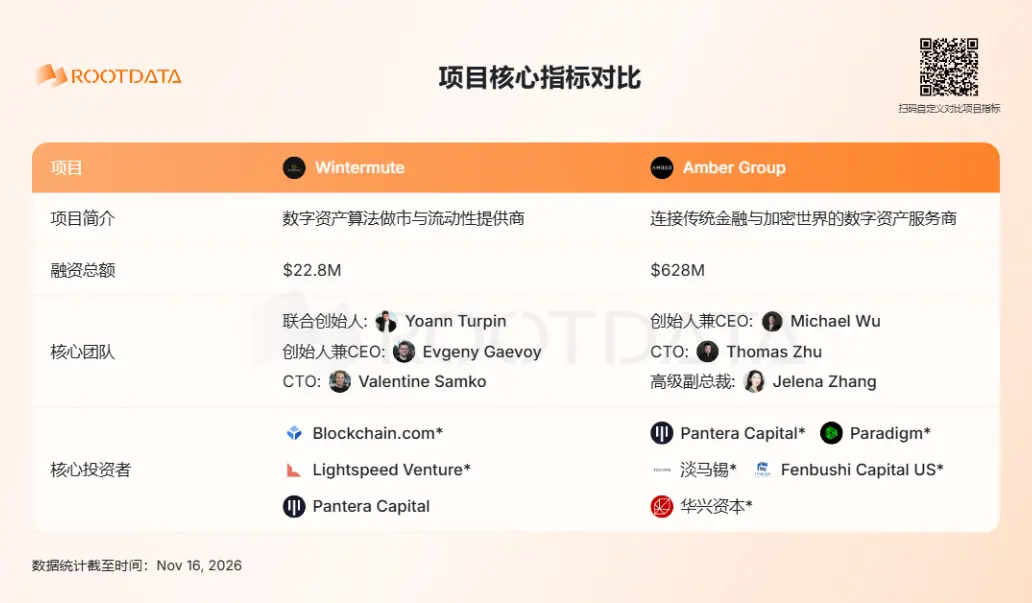
1. Amber Gradually Moves Away from Market Making
Amber started out as a market maker, founded by six co-founders, most of whom are Chinese, including several from Wall Street trading desks. The founder Wu Zhiwei(Michael Wu)was previously a forex and interest rate trader at Morgan Stanley.
It is reported that in 2017, he and a few colleagues utilized machine learning for pricing and trading, quickly discovering that about 95% of revenue and profits came from the crypto market, prompting a full switch to crypto in early 2018.
In its early days, Amber primarily provided market making and liquidity services to institutional clients, such as hedge funds, venture capital firms, and family offices, gradually establishing a reputation among institutional clients by continuously quoting in volatile markets.
During the bull market in 2021, Amber began to expand rapidly, laying out business in the metaverse, NFTs, and payment card services, launching products geared towards individual users, and engaging in multiple external acquisitions.
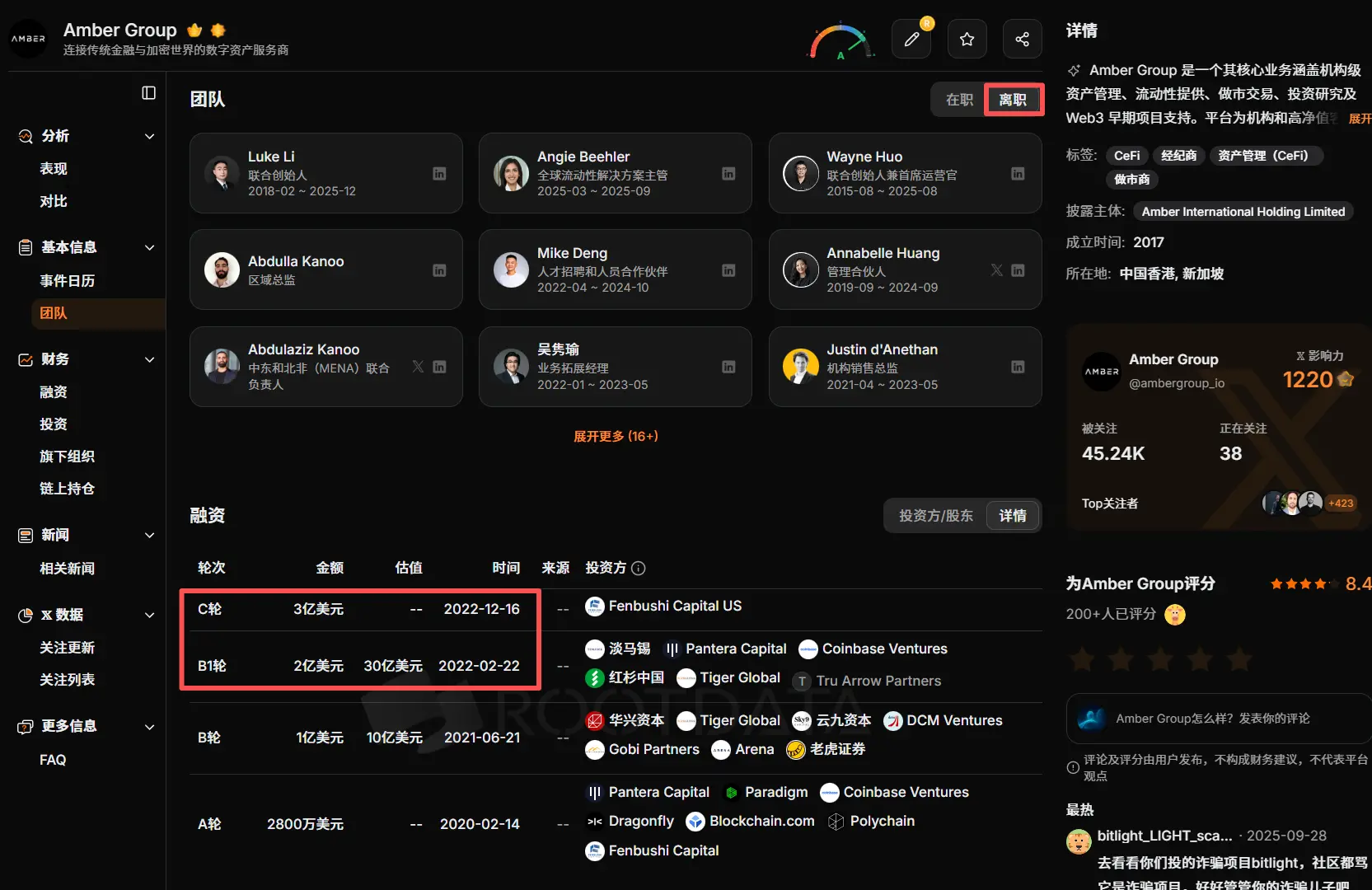
The valuation also soared accordingly. In February 2022, Amber completed a fundraising round that included Temasek, achieving a valuation of $3 billion.
At the end of the year, the collapse of FTX interrupted this expansion. Reports say that about $60 million of Amber's funds were frozen at FTX, reducing its staff from a peak of about 1100 people to around 300, while all consumer-facing operations were halted by the end of that year.
Since then, Amber has not returned to its former path of market making. In March 2025, its wealth management business, Amber Premium, went public on NASDAQ through a merger with iClick, a U.S.-listed company.
In the same year, Amber's accelerator launched the AgentFi platform AIAC and issued its first AI agent token, MIA. The companyalmostbegan to fully pivot to AI.
The co-founder Luke Li, who had long been responsible for the group's trading operations, resigned from the board of AMBR in December 2025, taking on the role of company advisor. In June of this year, Wu Zhiwei stepped down as CEO of Amber Group to fully manage the public company AMBR.
AMBR launched an AI market making system called A-MM, which onlyconfirmed its first revenue of $3.5 million this year in the second quarter.
In October of this year, AMBR announced the termination of its acquisition of WhaleFin Markets in Hong Kong, which will also withdraw its application for a license for the Hong Kong virtual asset trading platform, citing that the related license can only bring limited commercial benefits.
Reflecting on this nine-year transition,Wu Zhiwei candidly expressed in a recent interview and narrative that the expansion in 2021 was too aggressive, at that time sending executives a bilingual version of "Lightning Expansion," and he regretted this approach afterwards. The collapse of FTX was the biggest setback in his entrepreneurial career and even in his life; at that time, a pre-IPO financing term sheet had already been given with an $8 billion valuation.
In 2024 and 2025, he devoted about 70% of his time and nearly all his interest to the AI agent. Friends joked that he resembled a professor who teaches at university by day and sells skewers at the school gate by night. The company then saw strategic disagreements emerge, with trading, investment, and other business lines not aligning with his direction, leading to the gradual departure of many early partners.
2. Wintermute Places Resources on Top Competition
Wintermute was also established in 2017, founded by three former Optiver traders and developers, with Evgeny Gaevoy serving as CEO.
It also experienced the winter of 2022, during which about $160 million was stolen by hackers due to a wallet security vulnerability. Gaevoy admitted that it was difficult for the company to be profitable that year.
In contrast to Amber’s trajectory, Wintermute continued to stay on the trading track after its low point, consistently paying for speed and information. During the Terra collapse, it even built its own servers and ran Terra nodes, just to receive on-chain trading and price information in real time.
This year, it continued the same strategy on Hyperliquid. Hyperliquid launched a priority data auction mechanism in April, auctioning every three minutes, offering three seats, with the top seat allowing participants to see unexecuted orders about 60 milliseconds earlier than those without priority access.
According to a report by Bloomberg on November 12, a wallet identified as Wintermute by the on-chain analysis platform Loris Tools won about 76% of the top priority seat auctions in the past month.
Gaevoy stated that traditional trading firms need to invest in low-latency networks, microwave towers, and data center hosting, and building this infrastructure requires funds, time, and expertise, whereas auctions make this competition more transparent.
However, speed advantage is not the main source of Wintermute's profits. On-chain analyst Psyche reported that the main account marked as Wintermute has made a cumulative profit of about $229.7 million on Hyperliquid since 2024, of which approximately $204 million was earned before the auction mechanism went live.
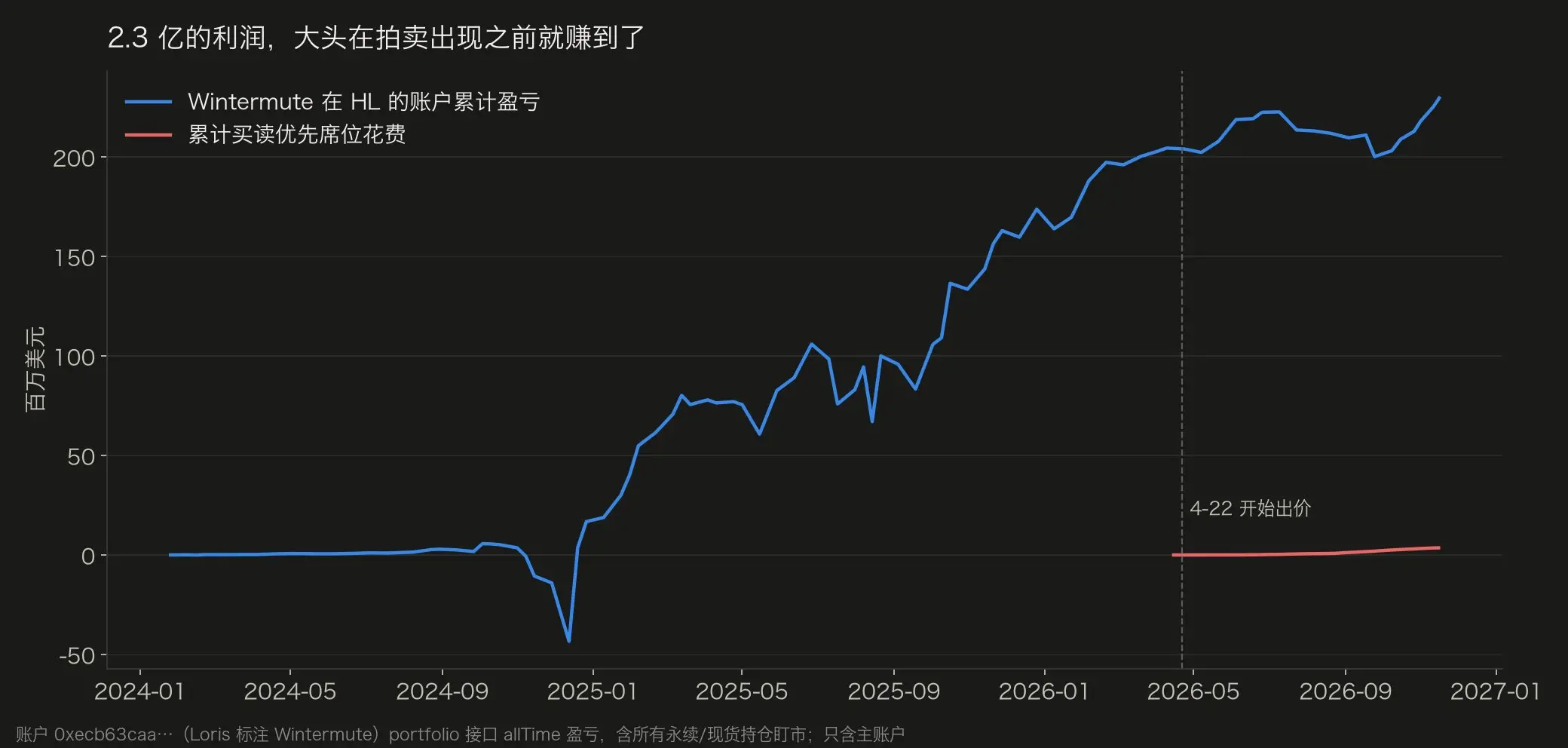
In the seven months after the auction launch, that account has profited about $25.6 million, with seat expenditures amounting to around $3.58 million during the same period. Psyche believes that there are still a large number of perpetual positions in the account used for hedging OTC and token cooperation inventories, and that priority only brings marginal improvements to market-making operations.
After November 11, Wintermute significantly reduced its bidding, concentrating its efforts only in the hours following U.S. stock market openings, spending about $10,000 daily.
Outside of Hyperliquid, according to an August report from Bloomberg wintermute plans to invest about $1 billion over the next five years to build high-frequency trading and AI infrastructures, with all funds coming from retained earnings.
In the same month, WSJ reported that Wintermute's U.S. subsidiary completed its broker-dealer registration, qualifying it to apply to be designated market makers on the NYSE and NASDAQ, and it will directly compete with institutions like Jane Street Capital and Castle Securities.
Currently, the company's non-crypto market accounts for about 10% of its revenue, with a goal to increase it to over 50% by the end of 2027.
In the same vein of diversification, every expansion of Wintermute revolves around trading and market making as its core capability, only the asset categories are changing.
3. The Middle Layer of the Market Making Industry is Being Pushed Out of the Table
Wintermute's choices reflect the polarization of the entire market-making industry.
Gaevoy recently stated that the middle layer of the market-making industry has become increasingly difficult in recent years, and AI is accelerating this trend. Many medium-sized trading companies cannot afford an arms race on latency, much less compete in AI.
In his view, top trading firms generate net trading revenues in the hundreds of billions each year, and spending billions on AI is merely a small cost.
Smaller market makers, on the other hand, can survive by focusing on niche markets, such as digital assets linked to stocks. Companies caught in the middle have neither the scale at the top nor the expertise at the bottom.
Hyperliquid's auction mechanism makes this layering more visible. According to official documentation, to fully enjoy the speed advantage of the top seat, one needs to directly connect to the non-validated nodes operated by Hyper Foundation. Direct connection qualifications include staking 10,000 HYPE tokens, trading volume of limit orders accounting for over 0.5% of the entire network for 14 days, and maintaining an online rate of 98% for one's own node. Based on the current price, staking just one requirement would need about $660,000.
Psyche's statistics show that as of November 15, the auction has accumulated expenditures of approximately $7.33 million, with Wintermute, Selini Capital, and one unnamed market maker collectively contributing 99%, while the remaining 40 addresses accounted for less than 1% combined.
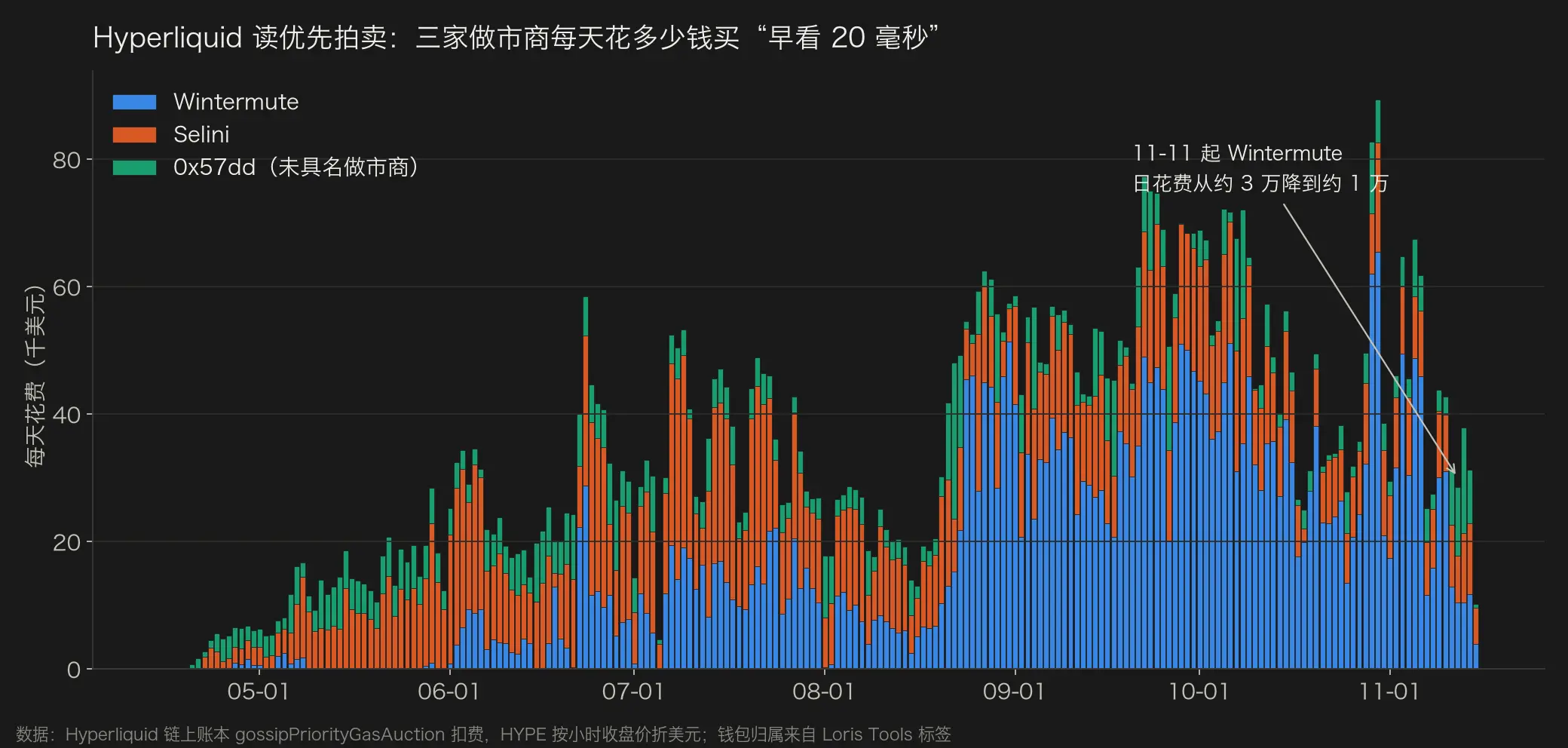
Wintermute bids only for the top priority seat, while Selini bets on both sides, and that unnamed market maker specifically picks up missed opportunities, having staked only 10,236 HYPE tokens just over the threshold.
The losers in this speed competition are primarily those peers without priority rights. The pairing rules of Hyperliquid favor the limit order side, with cancellations executed before orders are filled.
When a large market order sweeps through multiple price quotes, the market maker that first sees the order can pull back ahead of time, allowing the order to fill at the slower market maker's quote. In other words, market makers do not need to be faster than the order fillers; they just need to be faster than other market makers.
Conclusion
In short,market making is turning into a capital and technology contest between a few institutions. The divergence between Amber and Wintermute illustrates that to stay at the top, resources must be concentrated long-term on the same capability.
This is likely also related to the environments they face. Wintermute is rooted in London and has also secured broker-dealer registration in the U.S., with clear regulatory paths. Many Chinese teams have long lacked a stable main base, having to circle between Singapore, Dubai, and Hong Kong to apply for licenses.
Chinese capital and teams once dominated the mining and exchange sectors, but they have consistently lacked top players in the market making realm. Amber was once not far from the top; its nine-year journey may, perhaps, be a testament to this gap.
Therefore, viewing Amber as "another market maker that has collapsed" not only misinterprets its changes in recent years but also overlooks the polarization happening within the market making industry.
免责声明:本文章仅代表作者个人观点,不代表本平台的立场和观点。本文章仅供信息分享,不构成对任何人的任何投资建议。用户与作者之间的任何争议,与本平台无关。如网页中刊载的文章或图片涉及侵权,请提供相关的权利证明和身份证明发送邮件到[email protected],本平台相关工作人员将会进行核查。


