Author: Tencent Technology Xiaojing
On November 15, Deedy Das (@deedydas), a partner at the long-established Silicon Valley venture capital firm Menlo Ventures, shared a ranking of global AI companies based on valuation and revenue on social media.
Founded in 1976, Menlo Ventures is one of the longest-running venture capital firms in Silicon Valley, having invested in well-known tech companies such as Uber and Chime. In recent years, the firm has focused on AI as a key investment direction and released the widely circulated report “State of Generative AI in the Enterprise” at the end of 2024. Menlo Ventures is also an early investor in Anthropic, participating in its Series C funding round in 2023 and co-establishing a $100 million AI investment fund, Anthology Fund, with Anthropic in 2024.
This ranking counts, as of November 14, privately held AI companies with a valuation exceeding $10 billion and an annual revenue of over $100 million. There are currently 30 companies that meet both criteria.
The tiered effect of the leading "dual oligopoly" has widened further, with OpenAI continuing to lead with an estimated valuation of about $1.25 trillion, while Anthropic closely follows with an estimated valuation of about $965 billion. The two companies have established a trillion-dollar valuation gap from other competitors.
However, when ranked by annual revenue, the positions of the two companies have swapped: Anthropic has surpassed OpenAI. While the two companies maintain a valuation gap from other competitors, the revenue competition has seen new changes.
Among Chinese companies, DeepSeek and Moonshot have entered the global top ten. DeepSeek ranks fifth with a valuation of $89 billion, while Moonshot ranks seventh with a valuation of $50 billion. According to data disclosed in the ranking, both companies have achieved an annual revenue of approximately $1 billion.
However, from the overall ranking, the United States still holds an absolute advantage. Of the 30 companies, 23 are from the United States, covering various fields such as foundational models, AI programming, and cloud computing services. China has two companies on the list, with the other five coming from Canada, France, Germany, and the United Kingdom.
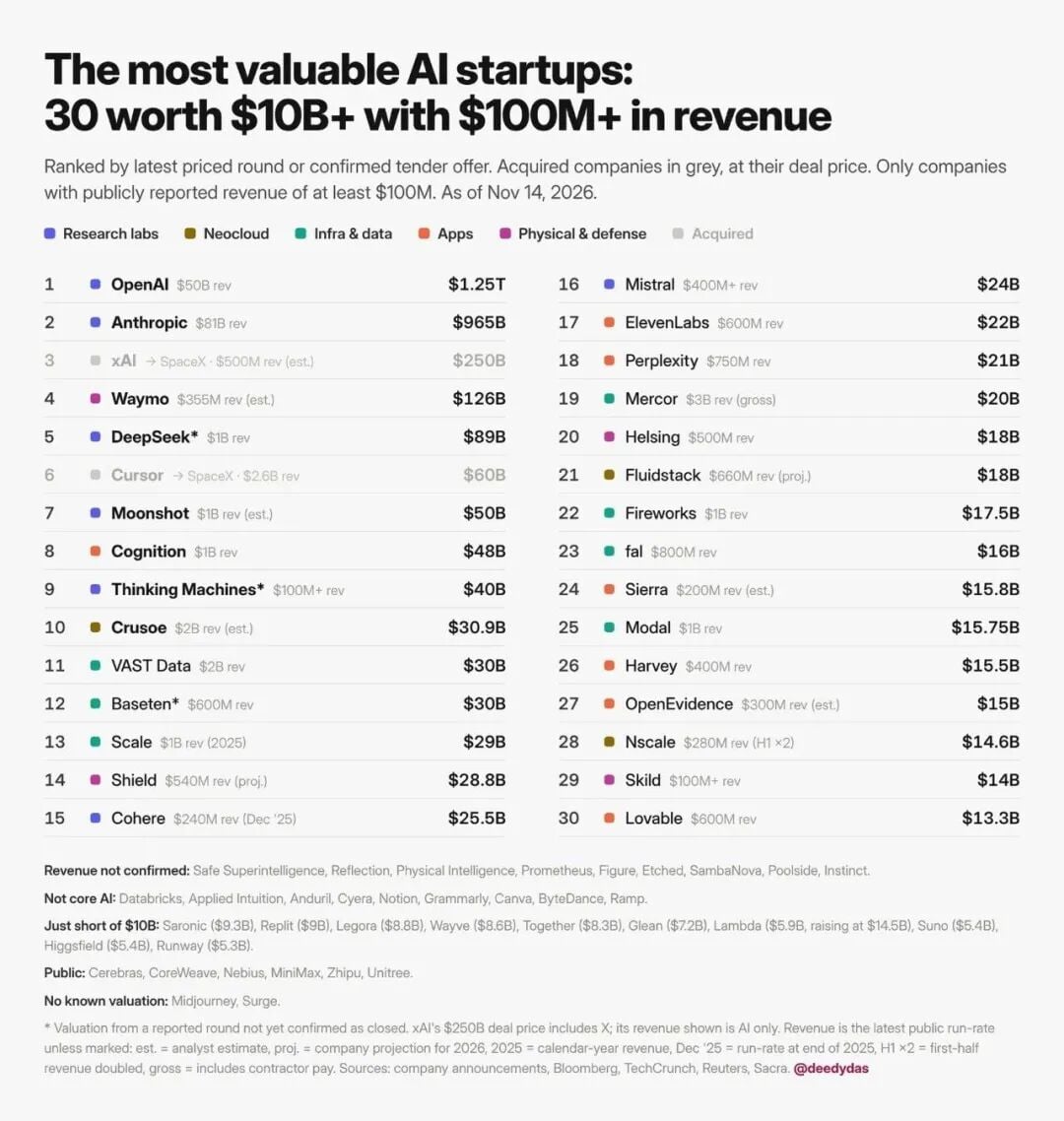
Image: Global ranking of privately held AI companies with valuations over $10 billion
The "Dual Oligopoly" Tiered Leaders
If we turn back time to a year ago, OpenAI was still "far ahead."
By the end of 2025, OpenAI's annual revenue had reached about $20 billion, while Anthropic only had $9 billion. At that time, there was still more than a dollar difference in revenue between the two companies.
However, entering 2026, Anthropic's growth rate has clearly begun to exceed that of OpenAI. By the end of September this year, OpenAI's annual revenue was about $50 billion; by the end of October, Anthropic's annual revenue had reached $65 billion, surpassing OpenAI.
From a revenue perspective, this change is also evident. In the third quarter of this year, Anthropic achieved approximately $17 billion in revenue, while OpenAI had about $10 billion. Although there are still differences in how each company calculates cloud platform revenue, such as whether Anthropic included certain managed revenues from Amazon Bedrock and Google Cloud, its rapid penetration into the enterprise market is directly reflected in the revenue growth curve.
Both companies' leading positions remain solid. The competition for the global foundational model market has entered the trillion-dollar valuation stage.
Of particular note is that Anthropic is sprinting towards its IPO amid this growth momentum. On November 10, Anthropic announced an IPO price range of $70 to $78 per share, anticipating a listing on Nasdaq on November 19, with the stock ticker "ANT." If calculated at the upper limit of the issue price, its fully diluted valuation will reach $965 billion, making it one of the largest tech IPOs globally this year.
OpenAI's choice is different. Previously, OpenAI had indicated it would not go public in 2026, postponing its IPO plan to 2027. On November 6, OpenAI completed the first batch of about $11 billion in its new funding round, resulting in a post-money valuation of $1.25 trillion. This round of financing was led by SoftBank, with follow-on investments from Microsoft, Coatue, and Thrive Capital. This funding not only set a record for the largest single financing in global startups but also temporarily alleviated OpenAI's financial pressure on computing expenses.
A year ago, OpenAI still held a significant advantage in model market share, user scale, and commercial revenue. Now, Anthropic has taken the lead in revenue growth and is preparing to go public ahead of it.
Chinese Companies Breakthrough
Chinese AI companies have also successfully entered this global high-valuation AI company ranking.
DeepSeek ranks fifth with a valuation of $89 billion and revenue of about $1 billion; Moonshot ranks seventh with a valuation of $50 billion, with revenue also around $1 billion. Both companies are in the top ten of the ranking, being the only two Chinese enterprises on the list.
Although DeepSeek and Moonshot both have annual revenues of about $1 billion, their corresponding dynamic price-to-earnings ratios are 89 times and 50 times, respectively, indicating that the capital market's pricing of the two companies is not solely determined by current revenue, but also comprehensively considers their technological routes, commercialization paths, and future profit potential.
In addition to American and Chinese companies, Canada's Cohere has a valuation of $25.5 billion and an annual revenue of about $240 million; France's Mistral has a valuation of $24 billion and an annual revenue exceeding $400 million.
Germany's defense AI company Helsing ranks 20th with a valuation of $18 billion and an annual revenue of about $500 million; UK's computational infrastructure provider Nscale ranks 28th with a valuation of $14.6 billion and an annual revenue of about $280 million.
Super Acquisitions Begin
Two companies highlighted in gray in the ranking are particularly noteworthy: xAI and Cursor.
These two companies correspond to transaction valuations of $250 billion and $60 billion, respectively, and are both marked for incorporation into the SpaceX system. Among them, xAI's $250 billion transaction valuation includes the value of the social platform X, but the $500 million revenue listed does not include advertising revenue from X. For xAI, joining SpaceX means leveraging the latter's massive satellite internet and energy infrastructure to build larger data center clusters.
The other acquired company, Cursor, is one of the fast-growing AI programming tool companies in recent years. Its transaction valuation reached $60 billion, with revenue of about $2.6 billion. According to the ranking data, Cursor's revenue scale has already surpassed that of many computational service providers and vertical application companies. With AI programming's high penetration among developers, it rapidly converted users into high-frequency paying customers.
These two transactions involve foundational models and AI application products, showing that leading companies are expanding business boundaries through capital integration. The connections between model research and development, application products, and commercialization channels have been further strengthened, and competition in the AI industry is beginning to evolve from a singular technological advantage to ecosystem scale.
Computational Power and Data Infrastructure Thriving
While foundational model companies occupy the top positions on the valuation list, another group of companies worth noting is those providing computational power, data, and inference services for the entire AI industry. As the demand for model training and application deployment grows, these companies have run through the commercial loop first.
Companies Directly Providing Computational Support
Crusoe is mainly engaged in AI data center construction and cloud computing services, with a valuation reaching $30.9 billion and revenue of about $2 billion. Fluidstack provides computational capabilities to AI companies through GPU computational resources and cloud services, with a valuation of $18 billion and revenue also around $2 billion. CoreWeave ranks 14th with a valuation of $23 billion and an annual revenue of $3.2 billion.
The business of these companies is similar to traditional cloud computing providers, but they build infrastructure around the demands of AI training and inference, requiring continued large investments in GPU purchases, data center construction, and securing long-term client contracts.
Data Infrastructure Service Providers
VAST Data has a valuation of $30 billion and revenue of about $2 billion, primarily providing large-scale data storage and management services for enterprises. Scale AI has a valuation of $29 billion, with 2025 revenue estimated at around $1 billion, focusing on AI data annotation, model evaluation, and high-quality synthetic data generation.
As AI models continuously evolve towards complex inference, multi-modal, and intelligent-agent directions, the quality of training data, data processing efficiency, and model evaluation's importance are also rising. VAST Data and Scale AI are both becoming indispensable service providers in large model training and enterprise deployment, tackling data storage and processing issues.
Rapidly Growing Model Inference Service Platforms
Baseten has a valuation of $30 billion and revenue of about $600 million; Fireworks AI has a valuation of $17.5 billion and revenue of about $1 billion; Modal has a valuation of $15.75 billion and revenue of about $1 billion; Together AI has a valuation of $15 billion and revenue of about $840 million; fal has a valuation of $14 billion and revenue of about $1 billion.
These companies primarily help developers and enterprises deploy and operate AI models, lowering inference costs and improving operational efficiency. Among them, fal focuses particularly on the inference services of generative AI models for images, videos, etc.
Compared to large model companies, these infrastructure companies can serve multiple model and application vendors simultaneously, and they can support various technological routes. As more AI applications enter practical operation stages, the volume of model calls, computational power consumption, and data processing demands continue to expand, allowing infrastructure companies to quickly increase revenue.
However, this does not mean that infrastructure businesses are necessarily more stable. Computational service providers face high capital expenditures, while inference service platforms need to cope with continuously decreasing model call prices and competition from large cloud providers. Whether the growth in demand can ultimately translate into healthy profit margins remains a question these companies must answer.
Application Layer Differentiation Intensifies
In contrast to foundational models and computational infrastructure, the AI application layer presents another competitive landscape: while company valuations are generally below leading model enterprises, some application firms' revenue growth and valuation multiples are already quite remarkable.
High-Frequency Scenarios Lead in Scaling
Among them, the first to scale up are high-frequency applications such as AI programming, voice, and search.
Cognition, powered by the AI programming agent Devin, has a valuation of $48 billion and annual revenue of about $1 billion; ElevenLabs, through its voice generation and voice agent business, has achieved a valuation of $22 billion and revenue of about $330 million; the AI search engine Perplexity has a valuation of $18 billion and revenue of about $200 million.
Founded in 2024, Lovable aims to enable ordinary people without programming experience to develop software through natural language. Its valuation has reached $13.3 billion, with annual revenue of about $600 million.
Vertical Specialized Fields Build Strong Barriers
More noteworthy changes have occurred in vertical industries such as law, healthcare, and enterprise services.
The legal AI company Harvey has a valuation of $15.5 billion, with annual revenue exceeding $400 million. It has already entered 80% of the top 100 large law firms in the United States, assisting lawyers with contract review, legal research, and due diligence.
The enterprise customer service AI company Sierra has a valuation of $15.8 billion. Its business model is also very representative: clients can pay based on the actual problems solved by AI, such as successfully handling an after-sales inquiry, rather than simply paying for software accounts.
The healthcare AI platform OpenEvidence provides certified doctors with free clinical research and medical information retrieval services, generating revenue through advertising aimed at the pharmaceutical industry. According to Sacra's estimates, its annual revenue has reached $130 million, with a valuation of about $10.5 billion.
These companies share a commonality: they have begun to enter work processes originally carried out by professionals such as lawyers, doctors, and customer service personnel. Compared to simply providing an AI chat tool, they need to understand industry rules, integrate with existing enterprise systems, and even redesign business processes. This also lets them not only have clear willingness to pay but also make it easier to establish competitive barriers in vertical scenarios.
This also makes the valuation logic in the application layer more interesting. According to a simple calculation from the ranking, some vertical AI application companies' valuations have reached multiple times their annual revenue, even higher than many computational infrastructure businesses. What investors value has expanded beyond just the software's sales scale to include its long-term potential to replace traditional human services in specific industries.
This trend is also mirrored in other research. On November 11, the investment firm Leonis Capital released the "2026 AI 100" report, which shows that the number of vertical industry AI companies on the list has increased from 28 last year to 43 this year, highlighting an acceleration of enterprise-level AI service focus from general tools to vertical industry penetration.
The AI application market is rapidly differentiating. As foundational model capabilities continue to enhance, the functional advantages of general AI applications are becoming increasingly easy to replicate, making it difficult for products relying solely on model capabilities to maintain high valuations over the long term.
In contrast, the capital market is starting to favor enterprises that are rooted in vertical industries, possessing unique data and professional barriers. They often require long-term accumulation of industry experience, client trust, and business processes, and once they deeply engage in core business, the cost for clients to switch would be significantly higher.
Amid the nightmare of models consuming everything, the opportunity for AI startups may lie in this application layer.
免责声明:本文章仅代表作者个人观点,不代表本平台的立场和观点。本文章仅供信息分享,不构成对任何人的任何投资建议。用户与作者之间的任何争议,与本平台无关。如网页中刊载的文章或图片涉及侵权,请提供相关的权利证明和身份证明发送邮件到[email protected],本平台相关工作人员将会进行核查。


