Resigned for three days, the script turned around
When Huang Renxun resigned last Thursday, many people lamented: After 33 years as the leather jacket swordsman, he is bowing out just like that.
As a result, just after the weekend, the Financial Times broke a big story: Huang Renxun is discussing a return to Nvidia as CEO with core confidants. A group of tech executives in Silicon Valley quickly formed a "war room," pressuring the board while trying to establish connections with the White House.
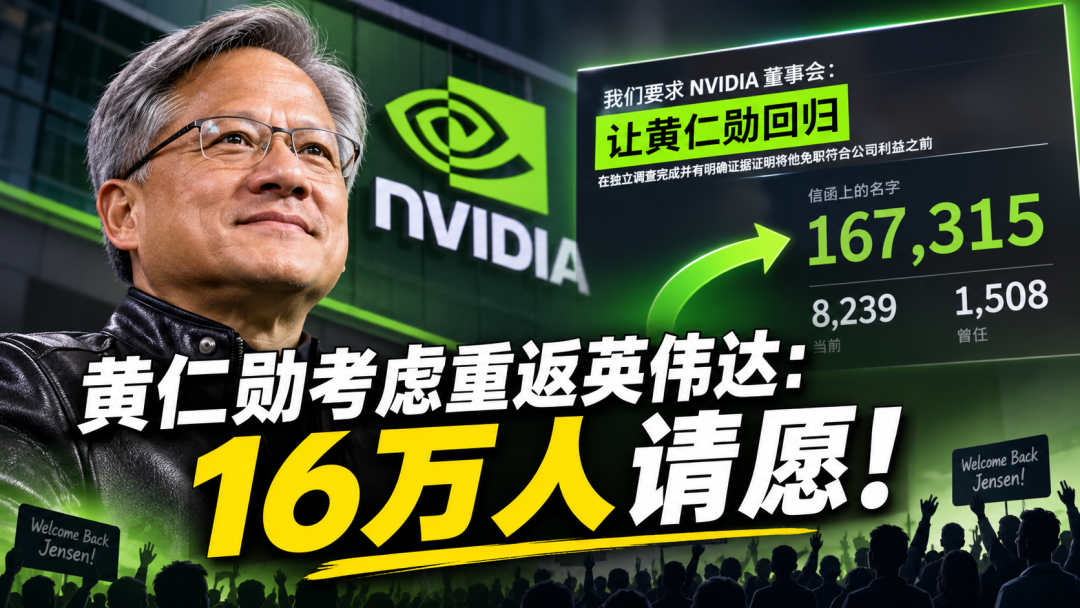
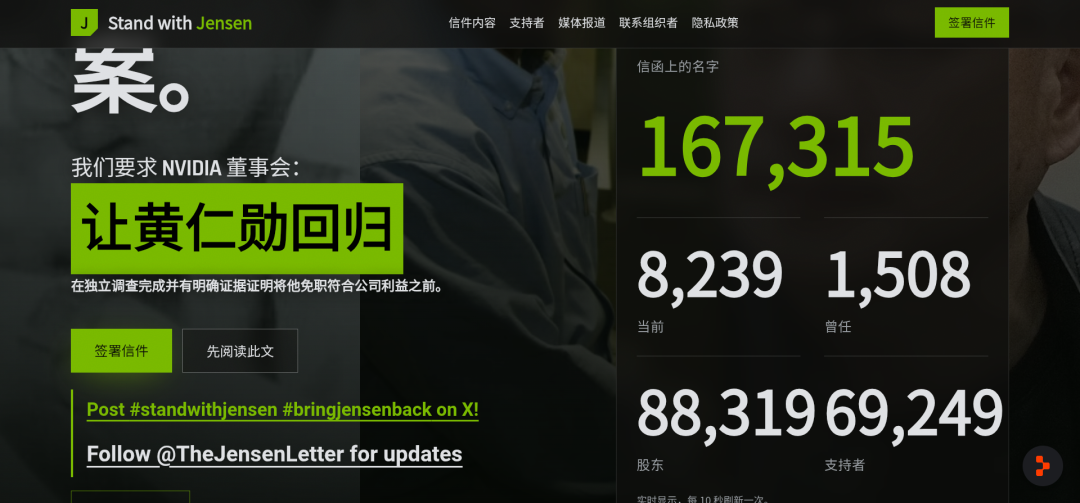
The momentum in the spotlight is even more exaggerated. An open petition letter titled "Bring Old Huang Back" saw the number of signatories exceed 160,000 over the weekend, including about 8,000 current Nvidia employees and over 80,000 shareholders—of course, these identities were self-identified by the signers without third-party verification, so it’s hard to say how many onlookers got involved. However, those who publicly supported the cause carry weight: Musk, Epic Games’ Tim Sweeney, YC’s Garry Tan, and even major shareholders Altimeter and Atreides released open letters demanding the board "retain all options, including Huang Renxun’s return."
Upon the news, Nvidia's dark market saw a rise of over 4%, with Micron and SK Hynix following suit. The capital market voted with real money: they want that person back.
But on the same weekend, Fortune magazine interviewed three former CEOs from the Fortune 500, asking them what they thought of this uproar. The only evaluation they gave was one word: absurd.
On one side is Silicon Valley collectively urging to retain him, while on the other side are former CEOs fiercely criticizing the board for negligence. These two matters may seem contradictory, but they are actually the same thing— the more signatures on the petition, the more it demonstrates how poorly this board has performed.
This is not Ultraman's script
Many people compare it to the 2023 OpenAI internal strife: Ultraman was fired, 700 employees collectively threatened to resign, Microsoft was waiting to take over, and days later he made a triumphant return.
Superficially, it does look similar, but upon closer inspection, Huang Renxun's hand is far weaker than Ultraman's.
Ultraman was facing the board, backed by Microsoft, the biggest financial supporter. Huang Renxun faces not only the board but also a completely opposing force: U.S. Treasury Secretary Janet Yellen directly stated on a television program on Sunday that Nvidia should look for a new CEO externally, to completely overhaul its leadership. While the war room seeks to secure support from the White House, the White House has publicly taken a stance against them.
The key issue is the chips. Ultraman had employees and Microsoft; what does Huang Renxun have? 3.5% of the shares. No Class A and Class B shares, no super voting rights—the board's vote to have him leave means he doesn't even qualify for a veto. Last weekend, his stock value was still over $130 billion, but that money cannot buy him a guaranteed seat on the board.
And let's not forget, an independent law firm's investigation has just been launched, and the export controls are still looming overhead. When Ultraman returned, he had no pending investigations.
Therefore, the expectation of "repeating Ultraman’s 48-hour reversal" is fundamentally untenable. The Silicon Valley big shots are not oblivious; they simply have no other options—because Nvidia, apart from Huang Renxun, truly has no second plan.
Why has no second capable leader been cultivated in 33 years?
This is where the Fortune report cuts deeply.
Several former CEOs listed a set of numbers: Nvidia has been operating for 33 years and publicly traded for 27 years, is the second largest company in the world by market capitalization, yet it cannot find a long-term trained executive ready to take over. Huang Renxun will turn 64 in February next year and is the oldest CEO among the seven tech giants—logically, succession planning should have been presented to the board a decade ago.
Why not? Two details make it clear.
The first detail is Huang Renxun's pride in flat management: about 60 executives report directly to him. The recognized reasonable number in management theory is 8 to 12 people. Sixty people reporting directly means that each VP only manages their own slice, with no one having a complete oversight of the entire situation. It's not that Nvidia lacks talent; this structure inherently does not allow for the emergence of a second "overall capable person."
The second detail is the composition of the board itself. Excluding Huang Renxun, none of the seven directors have ever been a CEO of a Fortune 500 company, with four having been on the board for 13 to 29 years. The average term for directors is 15 years, whereas the average for S&P 500 companies is 8 years. Among the board members are former presidents of Taco Bell and former marketing executives of Pepsi. Musk directly mocked on X: "Is this the board making decisions for what was once the most valuable company on Earth?" A company that rates boards placed Nvidia 609th out of 650 companies.
A former CEO bluntly stated: The board's rules and regulations can be written endlessly, but the core responsibilities boil down to two: don't make deals that would ruin the company and select the right successor while preparing substitutes. Nvidia utterly failed on the second point.
The most telling issue is the arrangement of the interim CEO. Kress worked in finance for 25 years and has no experience managing business or bearing profit and loss responsibilities. One former CEO commented: "It appears to be a panicked emergency response from the board— we need to find someone to fill the gap!" He added a sharp critique: In a tech company, why would they have someone from finance take this position?
Essence: The petition is a collective testimony of governance failure
Now when you piece together the information from both sides, you will see a very ironic picture.
After Huang Renxun resigned, initially he cooperated with the handover and even personally participated in the search for a new CEO, calling candidates himself. However, after assessing the situation, he and his allies concluded that no one could take the steering wheel. Thus, he changed his mind and decided to return.
The board's communication was even more chaotic. First, they claimed to have contacted Arm's CEO Rene Haas, then on November 14, issued a statement saying that the CEO selection was still in the stage of choosing a headhunter without having decided on a recruiting agency or having contacted any candidates. For the second largest company in the world, the first step in finding a new CEO is—finding a headhunting company.
Look, whether it’s "Huang Renxun must return" or "the board hasn’t even selected a headhunting firm," both point to the same fact: what this company built over 33 years is not a system but an individual.
Therefore, the petition of 150,000 people fundamentally proves not "he should come back," but rather "with him gone, no one is capable." In a healthy company, the founder's departure should be news, not a disaster. The more signatures, the more big shots involved, the more severe the stock price fluctuations, the more they underscore the phrase "key person risk."
This is the real deadlock: bringing him back is equivalent to confirming to the world "Nvidia = Huang Renxun," and every time there are health, behavioral, or personal life issues, the stock price will have to replay this week's story; not bringing him back, there’s only an interim CEO without profit and loss experience, a board without management experience, a fractured organization with 60 reporting lines, plus an unfinished investigation report.
Coming back is a loss, not coming back is also a loss. This situation was not created this week; it accumulated from the past decade's repeated reliance on "Old Huang is here."
Conclusion: What needs to be fixed is not the person but the system
After the close on November 17, Eastern Time, Nvidia is set to release its Q3 financial report for fiscal 2027, with Kress presenting. The market expects revenue of about $109.2 billion, a 90% year-over-year increase, and the figures will likely not look bad. However, more important than the quarterly performance is whether the preliminary outlook provided in August of "approximately 70% revenue growth for fiscal 2028" still holds after the leadership change. This figure is what Wall Street truly wants as a reassurance.
However, the financial report cannot save governance. If this situation can have a good ending, it must not be Huang Renxun putting on a leather jacket, returning, with a rebound in stock prices, and everyone acting as if nothing has happened; rather, Nvidia must be forced to address the courses it has neglected for over a decade: compress reporting lines, allow several VPs to genuinely rotate through overseeing everything; bring in board members who have experience in running enterprises; make succession planning a regular agenda item for the board instead of always being pushed behind acquisitions and buybacks.
For those domestic companies with founders whose IP shines too brightly, this is a mirror as well. The more the boss is the soul of the company, the more they need to build backups during prosperous times—because crises never make appointments in advance.
When Jobs left Apple, it took Apple many years to learn to no longer rely on one genius. What Nvidia needs to learn now is the same lesson: a great CEO is not an irreplaceable person, but one who can enable the company to continue running without them.
免责声明:本文章仅代表作者个人观点,不代表本平台的立场和观点。本文章仅供信息分享,不构成对任何人的任何投资建议。用户与作者之间的任何争议,与本平台无关。如网页中刊载的文章或图片涉及侵权,请提供相关的权利证明和身份证明发送邮件到[email protected],本平台相关工作人员将会进行核查。


