
Author: Nancy, PANews
A concealed power hijacking nearly turned 64,000 Bitcoin mining machines into a "cash machine" for hackers.
On November 15, Luxor mining management software Commander suffered a security breach. The attackers used AI-assisted attacks to remotely alter the mining pool configuration, quietly redirecting about 13 EH/s of computing power to the OCEAN mining pool and replacing the mining revenue address with a wallet they controlled.
Although this attack did not result in the hackers completely succeeding, it caused actual losses to the affected miners. For Bitcoin mining operations that rely on complex software and centralized management systems, the more alarming issue than lost profits is that AI is empowering hackers with stronger attack capabilities, making security challenges particularly severe.
64,000 mining machines hijacked by hackers, still able to profit without mining blocks
Late on November 15, approximately 64,000 Bitcoin mining machines suffered a power hijacking. It is estimated that around 13 EH/s of mining power was redirected to the OCEAN pool without authorization, with profits directed to a Bitcoin address believed to be controlled by the attackers.
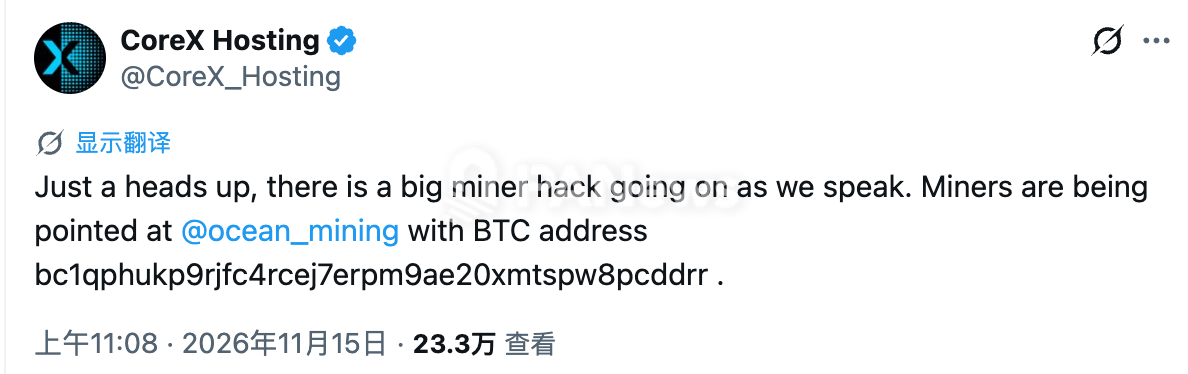
CoreX Hosting, a Bitcoin mining machine hosting provider, was the first to raise the alarm, stating that the pool configuration of its mining machines had been tampered with and that they were working to restore the machines to their original settings. Hours later, CoreX announced that the attack was mostly over, with the computing power associated with the affected address dropping from about 13 EH/s to around 100 PH/s.
The computing power dashboard of the OCEAN mining pool also showed anomalies. Its total network computing power surged significantly to nearly 50 EH/s before dropping back to about 40 EH/s.
Subsequently, Bitcoin mining services and pool operator Luxor officially confirmed a security breach. Their internal monitoring system revealed that the computing power of some clients had been redirected without authorization through the mining management software Commander, affecting over ten client accounts.
Luxor stated that this incident did not cause data leaks or external exposure; the impact was limited to Commander, while Luxor Pool and LuxOS were unaffected. Upon discovering anomalies, Luxor's engineering team took rapid countermeasures, completing security patch updates for Commander within about two hours and beginning to restore the affected machines to their original mining pool configurations.
The concealment of this power hijacking attack lies in the fact that the mining machines themselves operated normally throughout. Miners might be completely unaware, while their machines had silently switched to other mining pools, "working" for the attackers. The hackers attempted to redirect the revenue addresses to transfer the mining income that originally belonged to the miners into their wallets, resulting in actual output losses for the miners within hours.
In response to this incident, Luxor promised to fully compensate all affected clients, paying based on the earnings that should have been obtained under normal mining circumstances with the redirected computing power.
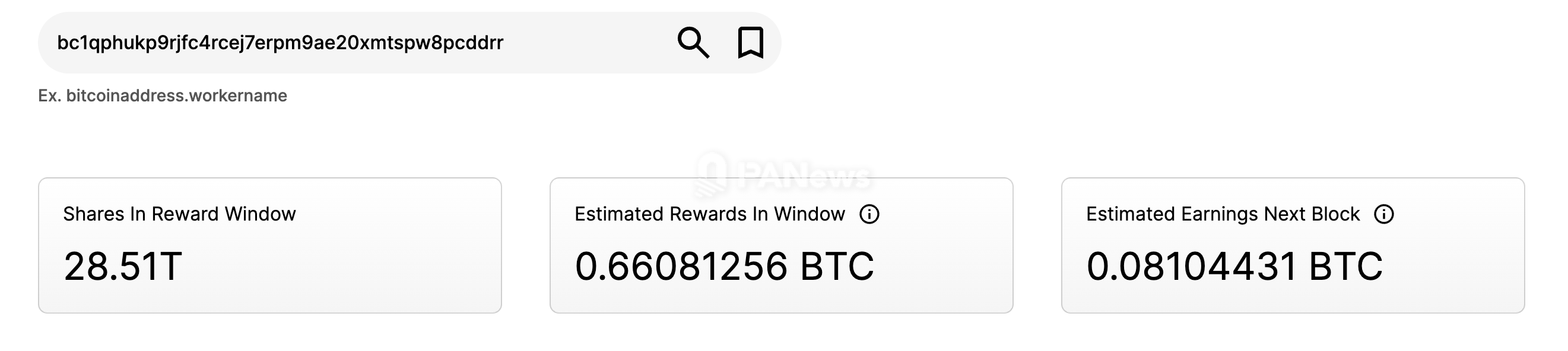
Interestingly, although the hackers did not successfully mine blocks during the hijacking, due to OCEAN's TIDES revenue distribution mechanism, previously submitted valid computing power still has the opportunity to participate in subsequent block reward distributions within the corresponding reward window. In other words, even if most of the hijacked mining machines have switched back to their original pools, the attackers may still obtain rewards based on the valid computing power submitted earlier when OCEAN produces subsequent blocks.
The OCEAN dashboard estimated that the mining revenue corresponding to the affected address in the current reward window is approximately 0.66 BTC. As subsequent blocks continue to be generated, this portion of rewards will gradually be realized. So far, OCEAN has paid two rewards to that address, totaling approximately 0.162 BTC, valued at about $10,500.
Mining security defenses at risk, AI hackers initiating automated hunting
While the Bitcoin protocol and consensus rules themselves were not compromised, this alarming attack has sounded the alarm for Bitcoin mining. When large-scale power scheduling relies on third-party management software, centralized management tools can become a weak link in the entire mining infrastructure. Especially as AI technology is gradually mastered by attackers, these types of security risks are being further magnified.
According to Luxor CEO Nick Hansen, this attack exploited complex AI-assisted attack methods. He pointed out that over the past 4 to 6 weeks, the situation regarding network attacks has significantly worsened. Currently, any company with a certain scale of operations, especially in the crypto industry, is facing a large number of AI-driven network attacks. Attackers use models that have had security restrictions removed to scan the entire attack surface of companies around the clock, seeking potential vulnerabilities and rapidly expanding their attack scope once a breakthrough is found. This trend does not seem to be slowing down; rather, it is accelerating as model capabilities continue to strengthen and more attackers join in.
In light of this change, Luxor has also begun adjusting its security strategy and even paused most new feature development. Hansen revealed that the company specifically procured bare-metal GPUs for self-deployment and operation of models that had security restrictions removed, to proactively enhance their security defense capabilities. He suggested that all companies providing similar services should take similar measures. In a new AI-driven "dark forest," firms must possess the technical capabilities to counteract attackers. The more critical task at hand is to comprehensively fortify every aspect of the infrastructure, including rotating keys, updating kernels, locking software dependency versions, and promptly responding to the many CVEs (Common Vulnerability Exposures) disclosed each day.
In fact, AI is significantly lowering the technical threshold for network attacks. Tasks like vulnerability discovery, penetration testing, and attack deployment that previously required professional hackers to invest considerable time and effort can now be performed more efficiently by attackers using AI tools to scan targets, find vulnerabilities, and launch attacks. More alarmingly, attack methods are evolving from purely AI-assisted models to AI Agent automated attacks, allowing attackers to link vulnerability discovery, attack path planning, and attack execution, further enhancing attack speed, coverage, and persistence.
Just last month, the global internet experienced "Black October," as hackers began launching large-scale attacks utilizing AI. For example, PHP was previously discovered to have two high-risk remote code execution vulnerabilities lurking for nearly 20 years, analyzed under AI assistance. It is estimated that these vulnerabilities affect about 70% of websites globally. Following the disclosure of the vulnerabilities, hackers quickly launched attacks, with attempts to exploit the relevant vulnerabilities surging to millions. Binance also experienced a significant security incident, where attackers used internal AI tools to breach a wallet engineer's system, resulting in an attack totaling over $6 billion.
Although this mining machine hijacking incident ultimately did not result in more severe losses, it has exposed weak links in the mining management authority and security defenses. As AI continues to lower the threshold for network attacks and improve attack efficiency, attackers may initiate larger-scale and more concealed attacks in the future.
This incident may just be the beginning. In the face of increasingly automated and complex AI attacks, whether mining companies and the entire industry can upgrade their security defenses in a timely manner to establish sufficient security capabilities to cope with new types of attacks will become an unavoidable examination question.
免责声明:本文章仅代表作者个人观点,不代表本平台的立场和观点。本文章仅供信息分享,不构成对任何人的任何投资建议。用户与作者之间的任何争议,与本平台无关。如网页中刊载的文章或图片涉及侵权,请提供相关的权利证明和身份证明发送邮件到[email protected],本平台相关工作人员将会进行核查。


