According to Coinglass data, in the past year, there have been 13 instances of liquidations exceeding $500 million in a single day, with 3 instances exceeding $1 billion.
Written by: Bao Yilong, Wall Street Insight
The massive liquidations in the Bitcoin market are turning from unexpected events into a daily phenomenon.
On Saturday, Bitcoin fell to $66,586 during the Asian trading session, the lowest since August; on Sunday, it further dipped to $62,022, setting a new low since July 14, before rebounding to approximately $64,800. Since October 21, Bitcoin has cumulatively fallen over 20% and is on track for a sixth consecutive week of decline.
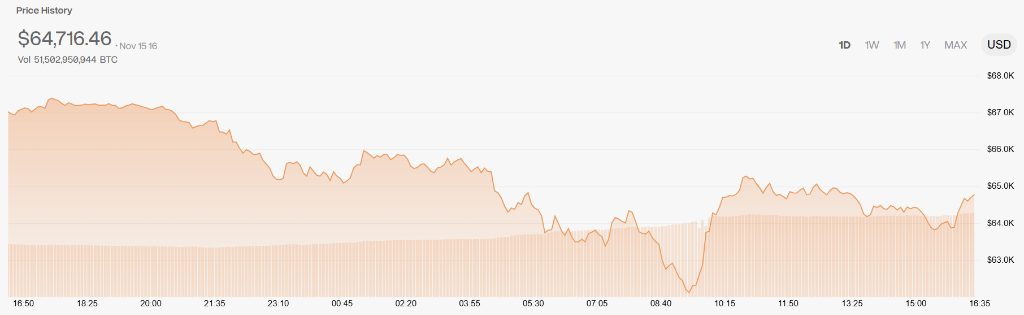 Bitcoin price trend on Sunday
As of 5 PM on Sunday, according to CoinGlass data, over 310,000 people were liquidated in the past 24 hours, with a total liquidation amount of $1.971 billion. The largest single liquidation occurred on Binance for ETHUSDT, valued at $16.173 million.
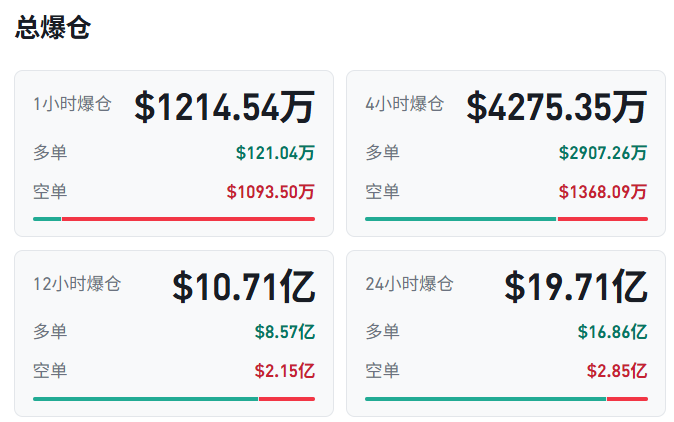
Liquidation amount statistics for cryptocurrencies in the past 24 hours
On Friday, the drop in Bitcoin triggered around $1.3 billion in long crypto positions liquidated within 24 hours, with Bitcoin accounting for the majority.
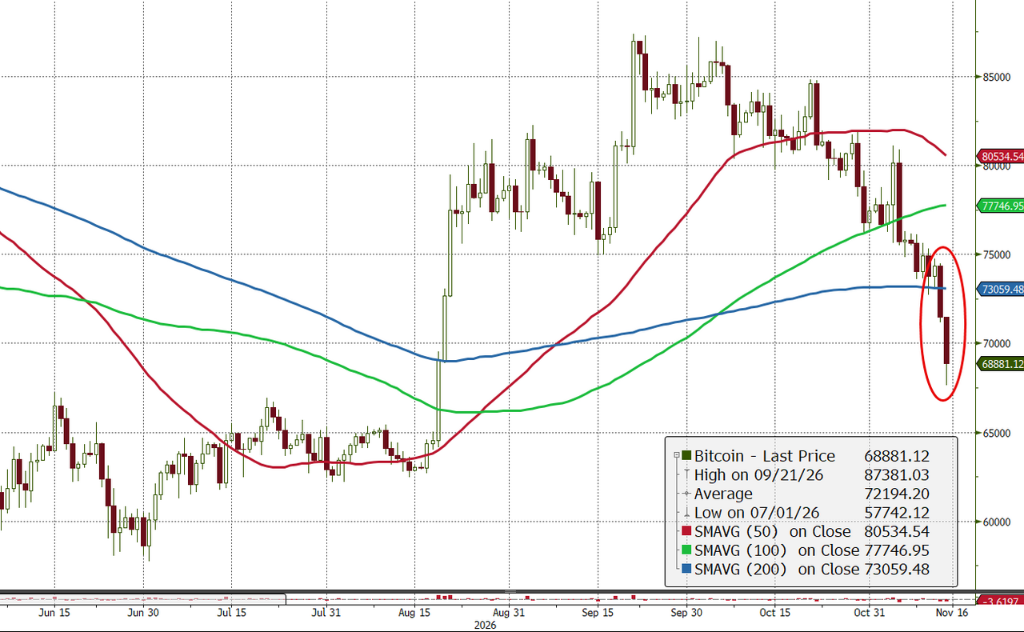 Bitcoin price fell below $70,000 on Friday, losing the 200-day moving average
Reports indicate that since the $6 billion theft incident on Binance on October 29, institutional buyers have continued to retreat, with nearly $3 billion in net outflows from U.S.-listed spot Bitcoin ETFs between October 30 and November 13.
According to Coinglass data covering 28 futures exchanges, there have been 13 instances of liquidations exceeding $500 million in a single day over the past year, with 3 instances exceeding $1 billion. This means that the market experiences a drastic fluctuation capable of wiping out a significant amount of leveraged positions on average less than once a month.
Industry views on whether liquidations equal market weakness are not unanimous. Fabian Dori, Chief Investment Officer of Sygnum Bank, stated that such chain reactions merely reflect the concentration of market leverage.
However, Paul Howard, Senior Director of Wincent Trading Company, noted that compared to previous periods, such liquidations have become more frequent in the past 12 months. He mentioned that many crypto investors seek high-risk, high-return trading strategies, generally holding leveraged positions, including external events influenced by macro news, thus leading to even more severe liquidations.
Sixth Consecutive Week of Decline: Macroeconomic Headwinds and Regulatory Expectations
Bitcoin is approaching a sixth consecutive week of decline, with multiple factors concentrated at the same time.
On one hand, high oil prices and persistent inflation have strengthened market expectations for further interest rate hikes by the Federal Reserve, suppressing the overall valuation of risk assets. On the other hand, the market anticipates that the Democrats will regain control of both houses of Congress in the U.S. next year, which is seen as a signal that the industry will face more stringent regulatory scrutiny.
The pressures from within the industry cannot be ignored either. ETF funds continue to flow out, with the risk preference driven by the AI boom accelerating the downturn of various tokens, while the aftermath of the recent $6 billion theft incident on Binance is still fermenting. The combination of these factors forms the backdrop for the current downturn.
Alex Kuptsikevich, Chief Market Analyst at FxPro, pointed the finger at the distribution of liquidity timing. He noted that the use of derivatives "has become the norm even for investors with limited funds"; liquidity tends to be relatively thin before the European trading session begins, and the absence of institutional funds makes market direction harder to predict. He wrote that prices would soon hit the dense stop-loss area, triggering a chain reaction of selling.
Competition for Speculative Funds: Bitcoin vs AI
Another explanation circulating in the crypto circle is that Bitcoin is losing its competition for speculative funds.
The sell-off of AI stocks may be creating buy opportunities more attractive than cryptocurrencies for investors, which is exactly the opposite of the bullish logic popular months ago.
At that time, some investors expected that once the AI markets cooled, speculative funds would shift to Bitcoin; however, the current reality is that the decline in tech stocks has instead provided buyers with a more robust reason to choose AI stocks.
Noelle Acheson, author of the "Crypto Is Macro Now" newsletter, commented on the changing market landscape following the launch of the spot Bitcoin ETF in the U.S. in 2024: When Bitcoin becomes a macro asset, one can say that with the advent of ETFs it certainly is, it has to compete with all other macro assets for the crown of risk assets.
Richard Galvin, Executive Chairman of crypto investment firm DACM, stated that the upcoming IPO of AI company Anthropic may be siphoning off funds from the crypto market. He said: The price performance is very similar to the situation during the pricing of the SpaceX IPO earlier this year, suggesting that crypto still serves as a short-term source of funding, especially for retail investors.
Not Everyone Reads It as a Signal of Collapse
Some industry insiders also warn against directly equating massive liquidations with market weakness.
Fabian Dori, Chief Investment Officer of Sygnum Bank, wrote: This chain reaction depends on how leverage is distributed in the market and does not constitute a judgment on the underlying assets themselves.
He pointed out that large liquidations have long been an inherent characteristic of the crypto market.
Technical factors also played a role. Rich Rosenblum, co-founder of crypto market maker GSR, stated that this was a technical move as Bitcoin broke below the 200-day moving average of about $73,000, triggering large-scale liquidations and new short positions. He believes that Bitcoin may be approaching a technical bottom.
This disagreement itself constitutes a key variable in current market judgments: under a trading structure dominated by derivatives, price fluctuations will more frequently trigger forced liquidations, and whether the scale of liquidations reflects market structural changes or deteriorating asset fundamentals will determine how investors view the next round of declines.
免责声明:本文章仅代表作者个人观点,不代表本平台的立场和观点。本文章仅供信息分享,不构成对任何人的任何投资建议。用户与作者之间的任何争议,与本平台无关。如网页中刊载的文章或图片涉及侵权,请提供相关的权利证明和身份证明发送邮件到[email protected],本平台相关工作人员将会进行核查。


