Original Title: Who Is Really Behind the Hunt for Jensen Huang?
Original Author: Liang Yimeng
Original Translation: TechFlow
Introduction: The public opinion siege against NVIDIA CEO Jensen Huang seems to have erupted suddenly, but a clear picture of the industry game strategy emerges behind it. From media revelations, think tank challenges to congressional pressures, the key nodes of voice have been continuously confirmed to overlap with NVIDIA's most aggressive industry rival, Anthropic.
Investigative authors trace two trajectories: on one side, politicians and think tanks relentlessly press on chip exports; on the other side, Anthropic invests tens of millions of dollars to build a network of political donations and a Washington team. When commercial competition is cloaked in national security, the underlying funding chain deserves deep industry reflection.
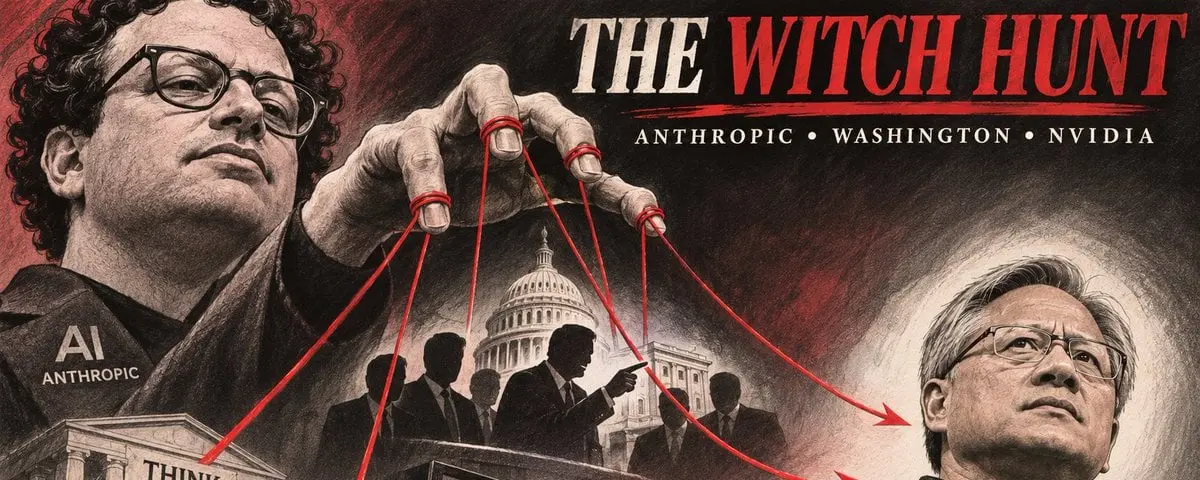
NVIDIA CEO Jensen Huang and Anthropic CEO Dario Amodei openly confront each other over AI policy and chip export controls, from the fierce divisions in Washington to Huang's public opposition to a blanket export ban, which has long been known within the industry.
However, examining the recent sudden gathering of forces calling for Huang’s resignation reveals concerning ties. Core members of Anthropic highly overlap with the think tanks, former officials, and forums behind this wave of reports; their funding even directly supports the lawmakers challenging in Congress.
Furthermore, this organization’s funding network has also been involved in incubating several critics' affiliated think tanks. A coincidence may be just an accident, but a series of coincidences is certainly not. When the arena of commercial competition is moved to public opinion and politics, who is the biggest beneficiary of this siege?
Initially, the outside world generally believed this was merely the attack of hawkish politicians and media on NVIDIA during the election cycle. However, as reports became increasingly bizarre, even intertwining with undercurrents of prejudice against Asians, the investigative authors began to trace the core reporting chain that first sparked the wave of controversy.
Tracing the sources of NY Times reporter Ana Swanson's reports about AI and chips, it is well-known in journalism that if there isn't a high level of trust, reporters will never repeatedly adopt the framing from the same source. That repeatedly appearing source is none other than Anthropic co-founder and policy chief Jack Clark.
Deep Intertwining of Journalists and Sources
Jack Clark previously worked as a Bloomberg reporter before becoming OpenAI’s policy director, fully aware of the communication mechanisms and agenda-setting of modern news media.
Last May, he delivered a pre-dinner speech titled "The Software Singularity" at an AI policy summit held by the Aspen Institute. The audience consisted of core decision-makers specializing in chip export and technological geopolitics.
Senators Taking Advantage and Political Donations
Following the accusations against Huang issued by the NY Times, Senator Chris Coons quickly spoke out, claiming Congress would investigate the so-called relationships.
And in July this year, Coons accepted a $2500 political donation from Anthropic’s corporate political action committee AnthroPAC. Notably, Jack Clark himself had previously injected $5000 into that political action committee.
Clark has long lived and worked in San Francisco, while Coons represents Delaware, and they have no local ties. Additionally, Clark is also a non-resident researcher at Georgetown University's Center for Security and Emerging Technologies (CSET).
Georgetown University and the CSET Scholar Network
Among the most radical voices targeting Huang recently, a substantial number come from the scholar community at Georgetown University:
· Georgetown University Law Professor and former Supreme Court clerk Mark Jia;
· Georgetown University adjunct professor and former CSET analyst Ryan Fedasiuk, who has publicly called for Huang’s resignation;
· Former senior CIA official and current Georgetown University educator Dennis Wilder.
CSET was established in 2019 to study the security issues related to AI and chips. At its inception, it received $55 million in startup funding from the effective altruism funding organization Open Philanthropy, whose co-founder, Holden Karnofsky, later joined Anthropic.
When the Pentagon identified Anthropic as a supply chain risk, legal scholars cited Mark Jia’s research to defend its rights, advocating for extremely high legal thresholds for national security assessments. Why does this cautious standard vanish when the target shifts to Huang?
Narrative Advancement and Exclusive Sources of the Financial Times
Financial Times reporter Demetri Sevastopulo, in subsequent reports, directed the accusations against Huang to so-called emotional relationship aspects.
And in September 2025, it was this reporter who exclusively revealed that Anthropic cut off access to its AI models from companies controlled by Chinese capital. Such exclusive news precisely aligns with corporate public relations strategies and often stem from deep information exchange.
Issue Detonator on Social Platforms
The true ignition of public opinion on social networks came from a tweet by Chris McGuire of the Council on Foreign Relations published on November 6. That tweet took the allegations to an extreme, claiming that Huang was sharing a bed with specific individuals.
McGuire’s social account has just over ten thousand followers, but he previously served on the National Security Council, directly under the leadership of Tarun Chhabra. And Chhabra is now the national security policy director at Anthropic. In June of this year, the two also co-attended a forum held in Taipei.
Within hours of that tweet being published, it rapidly garnered concentrated retweets and citations from several lawmakers and columnists. An account with merely ten thousand followers saw its tweet views quickly soar past 9 million, becoming the post with the highest engagement throughout the entire incident.
Senate Banking Committee and Closed-Door Lobbying
In February of this year, Anthropic CEO Dario Amodei held closed-door talks with members of the Senate Banking Committee, fervently lobbying to tighten AI chip export controls to China. Shortly after, relevant senators proposed the Senate version of the "AI Oversight Act."
Senior Republican Senator Kevin Cramer accepted a $1000 political donation from AnthroPAC in July. It is now he who has publicly called for Huang to resign from his position as CEO of NVIDIA.
Funding Network and Governance Overlap
In the current political cycle, Anthropic operates two major funding vehicles: one is the direct funding of electoral campaigns via AnthroPAC; the other is the $40 million injected into Public First Action and associated super PACs, with Amodei himself adding $1 million.
This action organization continuously runs ads to support lawmakers who advocate for chip export control legislation, including House Foreign Affairs Committee chairman Brian Mast. Mast not only accepted donations from AnthroPAC but is also one of the lead signers of the letter to hold Huang accountable released on November 4.
In terms of corporate governance, Richard Fontaine, CEO of the New America Security Center, has served as a long-term trust member of Anthropic since June 2025, which holds the nomination power for the majority of board seats. Meanwhile, the think tank's research framework combating chip smuggling precisely constitutes the current accountability blueprint targeting NVIDIA.
Capital Time Windows Behind Continuous Coincidences
The reporter disclosing espionage narratives has long-term sources that happen to be from the competitor’s founder; the media sensationalizing emotional relationships recently received exclusive endorsements from competitors; individuals igniting controversies on social networks were previously subordinates of competitor executives; and the lawmakers demanding resignations have previously accepted political donations from competitors.
More thought-provoking is the official clarification from Singapore. In response to earlier rumors regarding an investigation of Alice Huang, the Singapore Ministry of Home Affairs issued a formal written statement as early as October 31, sternly refuting claims of such an investigation. However, global mainstream media curiously remained silent about this.
In the absence of substantial evidence, the espionage narrative increasingly struggles to maintain its validity, and public opinion is swiftly redirected to personal moral controversies. All of this intensive public discourse coincidentally occurred during a sensitive juncture when NVIDIA's market value was experiencing severe fluctuations, and Anthropic was about to launch a historically significant IPO valued at around $61 billion.
Luxurious Lobbying Team Spanning Two Administrations
While advancing capital market and policy demands, Anthropic has formed a Washington think tank matrix spanning core functional departments of two U.S. administrations:
· From the Biden administration: Tarun Chhabra serves as the national security policy director, previously a technology and national security coordinator at the National Security Council;
· Ben Buchanan currently works at Anthropic, previously a White House AI advisor and central architect of chip proliferation rules;
· Elizabeth Kelly now works at Anthropic, formerly the director of the U.S. AI Safety Institute;
· Joel Meyer responsible for federal civilian public sector business, previously a senior official at the Department of Homeland Security and established its first AI task force;
· Benjamin Della Rocca and Kristine Lee, both formerly part of the National Security Council’s staff.
· From the Trump administration: Chris Liddell serves as a board member, previously the White House deputy chief of staff;
· Sihao Huang serves as the cutting-edge computing strategy director, previously a senior advisor on AI at the White House Office of Science and Technology Policy;
· Sarah Heck serves as the policy director, previously part of the National Security Council;
· Mary Croghan oversees policy business in Washington, D.C., previously working at the White House Office of Cabinet Affairs.
免责声明:本文章仅代表作者个人观点,不代表本平台的立场和观点。本文章仅供信息分享,不构成对任何人的任何投资建议。用户与作者之间的任何争议,与本平台无关。如网页中刊载的文章或图片涉及侵权,请提供相关的权利证明和身份证明发送邮件到[email protected],本平台相关工作人员将会进行核查。


