Author:Xu Chao, Wall Street Watch
The market for storage chips is shifting from “uniform increases” to “divergence.” Bank of America believes that the logic behind the price increase of DRAM has not been broken, while the spot market for NAND has clearly loosened, making it the first item to need repricing in this round of storage upcycle.
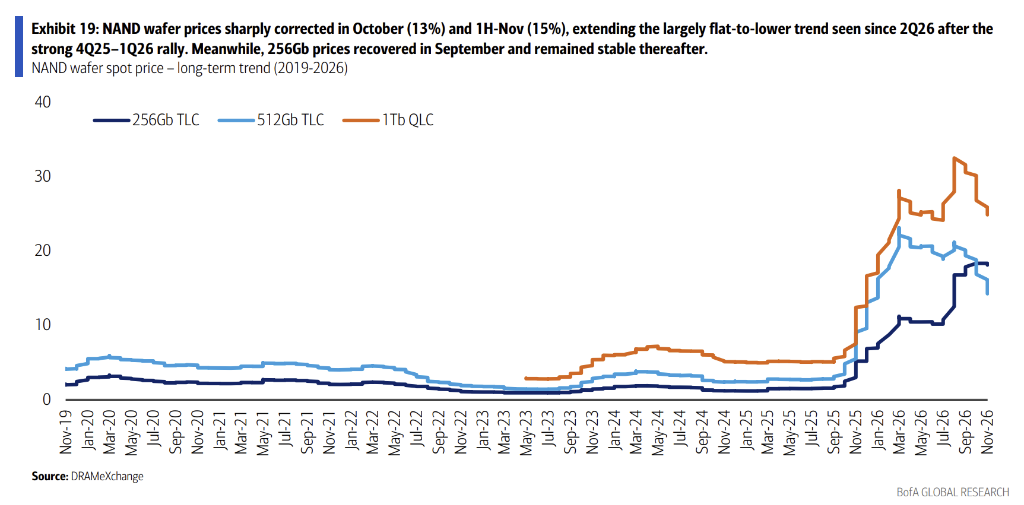
Bank of America’s report on November 13 shows that NAND spot prices have dropped significantly, with 512Gb wafers down more than 10%, and 1Tb down nearly single digits, while 16Gb DDR5 spots remain flat. Since mid to late October, the cumulative adjustment of NAND spot has been about 20%.
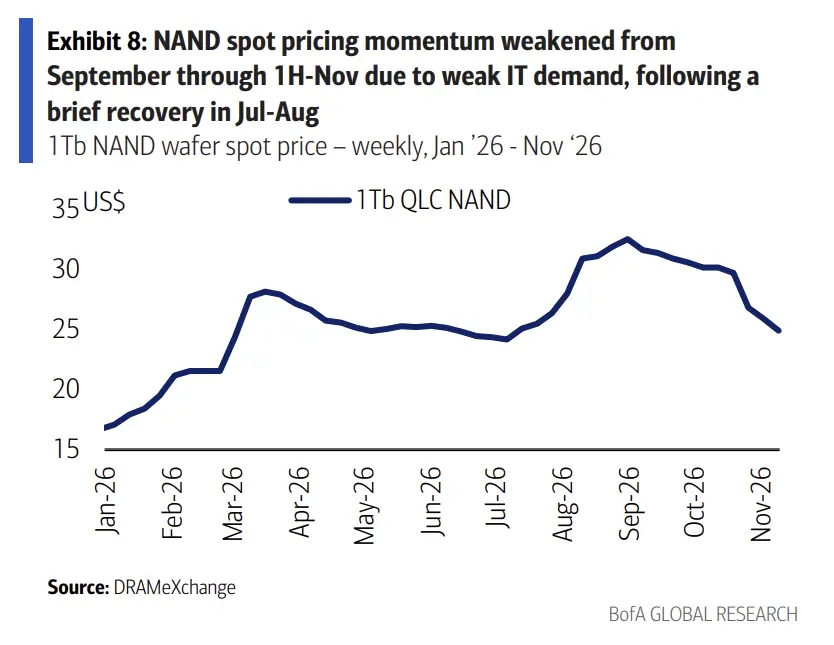
Based on this, Bank of America maintains a cautious assumption for the average selling price of NAND in the first quarter of 2027: IT NAND prices are expected to fall by 5% to 10% quarter-on-quarter, while enterprise-grade applications will remain basically flat or slightly rise, leading to an overall low single-digit decline This judgment differs significantly from the market's expectation of more than a 10% increase in NAND prices. Meanwhile, Bank of America continues to assume that DRAM price increases will last until the fourth quarter of 2026 (up 8% quarter-on-quarter) and the first quarter of 2027 (up 5%).
Bank of America stated that after communicating with investors this week, sentiment towards storage stocks has improved compared to last week, with companies holding a high weighting in DRAM seen as having limited downside. Most DRAM targets currently correspond to a price-to-earnings ratio of only 3 to 5 times for earnings from 2026 to 2027, significantly lower than that of AI semiconductor peers.
Three Signals of Weakening NAND Spot
Bank of America attributes its concerns about NAND to three points: spot prices have adjusted about 20% since mid to late October; orders from PC and smartphone OEMs, as well as Chinese hyperscale cloud providers, have weakened; and contract price negotiations for the first quarter of 2027 may be delayed, with no rush orders appearing in the market.
The differentiation in spot data is quite intuitive. According to DRAMeXchange, the spot price for 512Gb wafers is reported at $14.3, down 12% week-on-week and down 32% quarter-on-quarter, but still up 121% year-on-year; 1Tb reported at $24.9, down 4% week-on-week, down 19% quarter-on-quarter, and up 194% year-on-year. In comparison, 16Gb DDR5 is priced at $60.2, remaining flat week-on-week and up 150% year-on-year.
Original manufacturers still emphasize strong demand for enterprise-grade SSDs, which can somewhat offset the weakness in IT NAND. However, Bank of America warns that older production lines account for 20% to 30% of the global wafer production capacity and are not suitable for producing high-end NAND and eSSD, and must continue to be used for IT NAND, which exerts structural pressure on prices. The price per bit for high-capacity NAND (over 2Tb) and eSSD (over 30TB) has seen a slight down adjustment, but Bank of America believes this is more like proactive promotion by manufacturers to promote the new generation of QLC—most eSSD NAND prices still show a slight upward trend.
Divergence: Contract Prices Still High, But Negotiations May Be Delayed
The current trend of NAND contract prices is diverging from spot prices.
According to TrendForce, the contract price for 1Tb TLC wafers remained basically unchanged in October, continuing the horizontal pattern from the second to the third quarter; the 512Gb contract price is about $27, close to historical highs and about ten times the low of $2.5 in February 2025.
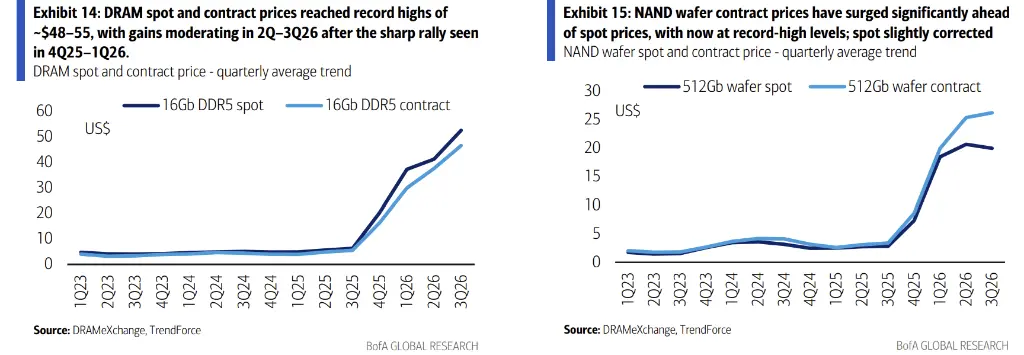
Bank of America’s concern lies in the timing: If the downstream does not place urgent orders soon, the contract price negotiations for the first quarter of 2027 may be postponed, weakening manufacturers' bargaining power in the new round of negotiations. This judgment directly correlates to its divergence from market expectations—sellers generally assume that NAND prices will still rise by about 10%, while Bank of America anticipates a low single-digit decline.
On the DRAM side, a different picture emerges. According to TrendForce, the contract price for 16Gb DDR5 rose again by 5% month-on-month in October, with a year-on-year increase of over 500%; the contract prices for server-side DDR5 and DDR4 64GB modules rose about 15% month-on-month in October, with module prices breaking the $1000 mark, reaching $1600 and $1500 respectively. Based on this, Bank of America maintains its assumptions of an 8% quarter-on-quarter increase in DRAM for the fourth quarter of 2026 and a 5% increase in the first quarter of 2027.
Samsung: Optimistic about HBM, But Not Aggressive
Bank of America held an investor communication with Samsung Electronics on November 12, and the three key points were: demand for AI data center chips in the United States is strong, with no reductions in orders despite concerns; the market position of HBM has improved significantly compared to a year ago; and the long-term contract prices (LTA) for DRAM business are strongly upward, with high prices and high margins sustainable over a long period.
However, the management's statements are not aggressive, which is also one of the focal points for investors. Samsung's target share for HBM is set at about 30% to 40%, rather than over 50%; even by the end of 2027, the profitability of LPDDR5 will still outperform HBM, so aggressive expansion of HBM capacity is unlikely in order to avoid encroaching on the market share of traditional DRAM. In terms of technology, HBM4e will share the same 1c node and 4nm logic chip as HBM4. Bank of America also mentioned that the contract price increases in 2027 are unlikely to reach the levels expected by TrendForce, as prices have already risen in 2026.
It is worth noting that Samsung's guidance on IT NAND is not as optimistic as that for eSSD, which aligns with Bank of America's price judgments.
Emotional Rebound, Valuation Remains Main Support
Storage stocks rebounded this week, with an overall cumulative increase of more than 100% for the year; SanDisk and Kioxia have returned more than 250% since the beginning of the year. Bank of America states that investors communicated this week that the downside space is limited, citing reasons such as resilience in AIDC chip orders after the US midterm elections, DRAM prices still rising (in contrast to NAND), and low valuation multiples.
The valuation table shows that SK Hynix corresponds to a price-to-earnings ratio of 3.6 times for 2026, Samsung is at 4.7 times, Micron is at 10.7 times, and Nanya is at 5.1 times; in the NAND camp, Sandisk corresponds to a price-to-earnings ratio of 4.3 times for 2027, Western Digital is at 13.2 times, SIMO is at 16.4 times, and Phison is at 7.7 times. Bank of America believes that, compared to AI semiconductor peers, the pricing of the storage sector remains mild.
Bank of America summarizes that the supply and demand dynamics and price trends of DRAM are still supported by AI data centers and HBM crowding out capacity, while the pricing power of NAND is shifting towards buyers. The valuation difference between the two and the performance elasticity will depend on whether the contract price negotiations for the first quarter of 2027 can proceed as scheduled.
免责声明:本文章仅代表作者个人观点,不代表本平台的立场和观点。本文章仅供信息分享,不构成对任何人的任何投资建议。用户与作者之间的任何争议,与本平台无关。如网页中刊载的文章或图片涉及侵权,请提供相关的权利证明和身份证明发送邮件到[email protected],本平台相关工作人员将会进行核查。


