Author: Hualin Dance King
Editor: Jingyu
The era of Agents "consuming" for users has finally arrived.
On November 13, 2026, U.S. time, two press conferences from two companies took place on the same day. On one side, enterprise-level conversational intelligence company Sierra partnered with Meta to officially launch the personal agent protocol Poppy v1.0, solving the problem of how assistants can "gain access"; on the other side, OpenAI launched ChatGPT Wallet for personal assistants called dots, solving the problem of how assistants can "make payments".
To connect both access and checkout in one day is intriguing in itself. What is even more noteworthy is the same set of names standing behind both solutions. Visa and Mastercard appear on both lists, while companies like Shopify and Stripe, which oversee e-commerce and payment infrastructure, are among Poppy’s core partners.
The next competition for Agents, on the surface, seems to be the giants fighting for entry points, while the underlying thread is an early positioning around commercial channels.
Personal Agent Protocol, PPP

Sierra and Meta jointly launched the personal agent protocol Poppy v1.0 | Image source: Sierra official blog
In the past, personal assistants could only access business websites like invisible visitors; merchants could not determine who was knocking and dared not allow sensitive operations such as checking orders, changing addresses, booking flights, or financial pre-approvals.
The core issue that Meta and Sierra's Poppy aims to solve is trust, allowing businesses to confirm three things upon receiving a request: which assistant is knocking, which user it represents, and what permissions it has.
The core of the Poppy protocol is "doorplate," "foundation," and "two-way authorization."
"Doorplate." Businesses integrating Poppy will place a configuration file at the standard website path /.well-known/poppy. You can think of it as a visitor's guide posted at the shop entrance, detailing which communication endpoints are open, how to log in, and what operations are allowed. When an assistant comes knocking, they no longer have to guess how to click the webpage buttons; they can check the doorplate to know how to proceed according to the rules.
"Foundation." Poppy does not overturn existing internet communication methods; it directly builds upon OAuth authorization, HTTPS encrypted transmission, OpenAPI, and model context protocols. If a user is only checking product prices, the assistant can converse as an anonymous visitor; but once account operations are involved, authorization login is required to confirm the identity with the business.
"Two-way authorization." The user side can decide whether to grant the assistant read-only permissions or to allow modification of information and transactions; the business side determines how far external assistants can go on their premises. Only when both sides agree does an interaction count as established.
From the information released, Sierra’s collaboration with Meta to promote this protocol can be described as very complementary. Sierra, founded by former Salesforce co-CEO Bret Taylor and ex-Google executive Clay Bavor, primarily helps businesses build their own customer service intelligent agents, naturally sitting on the "reception side"; while Meta’s personal assistant Muse is a typical "visitor" needing to knock on countless website doors. With both the receptionist and the visitor putting in half the effort, this standard was created. Currently, Muse prioritizes searching for and utilizing the Poppy protocol when accessing participating sites.
Open protocols often fear encountering the age-old chicken-or-egg problem of cold start. This time, the real push for Poppy to cross the threshold came from e-commerce infrastructure giant Shopify.
At the time of the protocol's release, Shopify automatically activated and generated Poppy discovery files for every merchant in over 175 countries without any manual configuration required from the merchants. Coupled with over 100 design partners, including representatives from Delta Airlines, 1Password, Okta, and Cloudflare, this access control system had a significant coverage from day one.
Agents Without Cash
With the entry problem solved, the next challenge is payment.
Most people's instinctive reaction to having an Agent pull out their wallet is resistance. The ChatGPT Wallet launched by OpenAI has a clear design objective: to enable Agents to push transactions to completion without ever touching real financial information.
During the shopping process, users can have their dot search for products, compare prices, add items to carts, and prepare the checkout page. However, as soon as they reach the payment step, the dot must stop and return the decision-making power to the human. Users must personally verify the product list, total amount, and selected debit card, and must complete authorization through biometric methods such as facial recognition or fingerprint scanning for the transaction to go through.
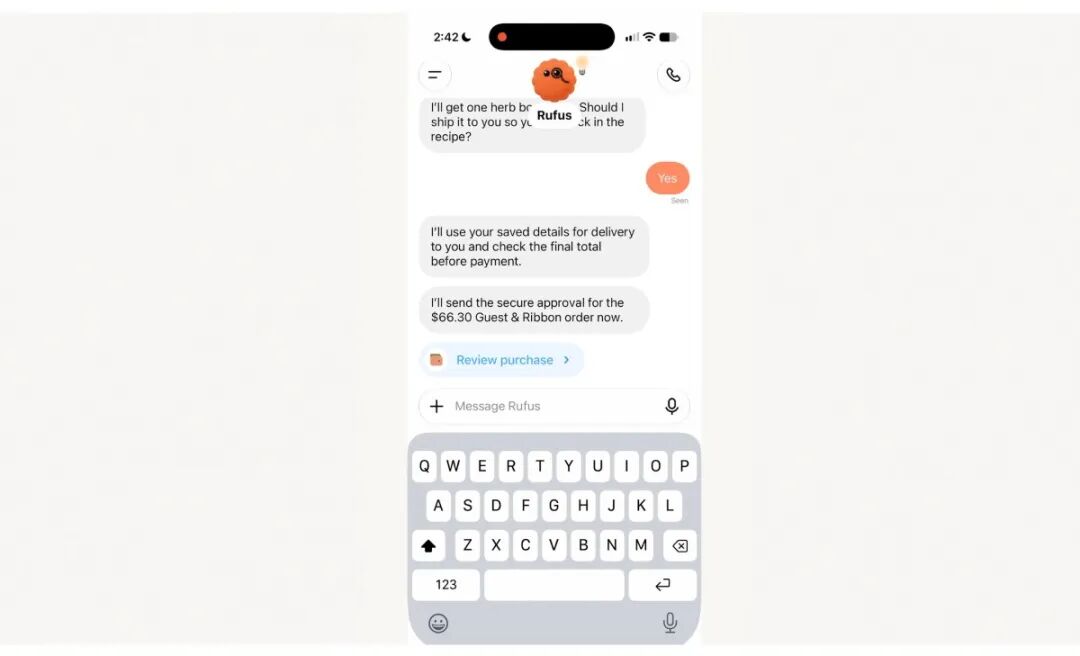
OpenAI personal assistant dot (Rufus) initiates "Review purchase" for checkout confirmation in a conversation | Image source: OpenAI
The more crucial safety design is hidden in the background. Whether it's the running dot or the merchant receiving funds, neither will ever see your real credit card number during the entire transaction. After user authorization, the partnered card organization network generates a one-time payment credential, including a temporary card number, security code, and expiration date. Merchants only receive this temporary information; your real card number never shows up.
To achieve this mechanism, OpenAI enlisted American Express, Mastercard, and Visa for joint development, fully preserving the original credit card points, benefits, and chargeback protections. OpenAI also clarified at the launch,emphasizing that ChatGPT Wallet is definitely not a cryptocurrency wallet, does not operate on blockchain or stablecoin payments, and completely runs on the infrastructure of traditional fiat banks and card organizations.
From publicly available information, it's clear that each party's business motives are well-defined. For OpenAI, if personal assistants only offer suggestions and send links, they will remain at the recommendation stage forever; the checkout loop must be closed within the conversational ecosystem for dots to transform from suggesters to deal-makers. For traditional card organizations, once intelligent agents become new consumption entry points, no one wants to see transaction flows siphoned off by new payment networks. Through this collaboration, the three card organizations naturally brought the new channel back to their clearing networks.
Even so, OpenAI's first step remains quite restrained.
In the initial phase, ChatGPT Wallet is limited to U.S. users aged 18 and older who subscribe to ChatGPT Pro, supporting eligible U.S.-issued cards, including Amex, Visa, Mastercard, and Chase cards. From the publicly available information, testing on paid users first likely aims to ensure stability in risk control.
When Giants Collaborate
Comparing these two pieces of news side by side reveals an interesting intersecting picture.
In the initial core partner list of Poppy, Shopify, Stripe, PayPal, Visa, and Mastercard are all included; shifting over to ChatGPT Wallet, the developers are also Amex, Visa, and Mastercard. The only ones that successfully bridge both sides are Visa and Mastercard, as they are on both the Poppy's list and serve as Wallet development partners.
A more intriguing detail is that OpenAI's name also prominently appears in the list of over 100 design partners of Poppy.
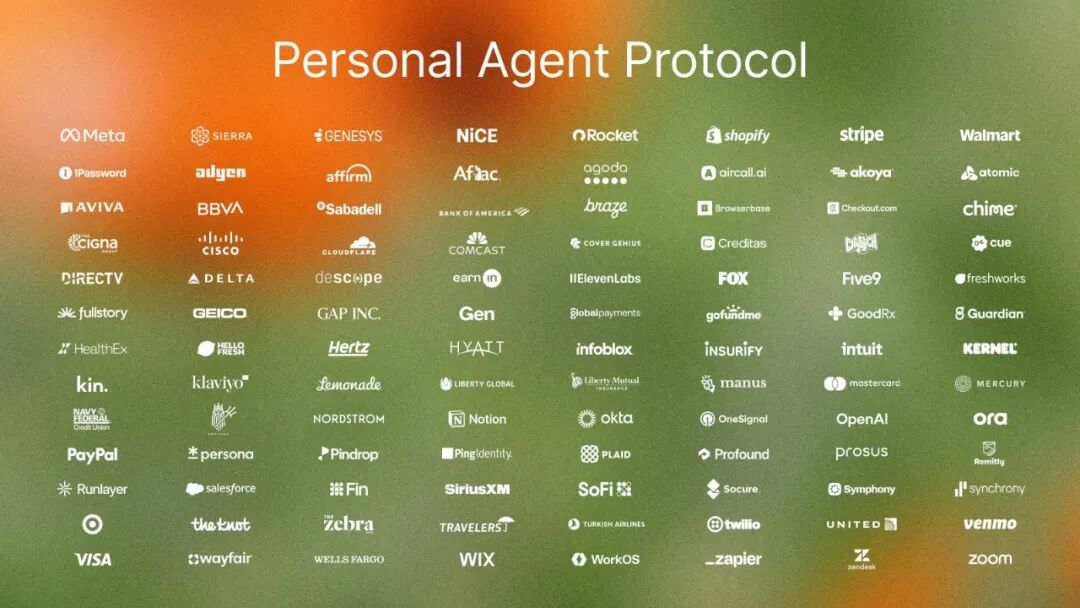
Personal Agent Protocol's first batch of over 100 design partners, with OpenAI, Visa, and Mastercard all included | Image source: Sierra
In the consumer market, Meta's Muse and OpenAI's dots are direct competitors, both fiercely vying for the first entry point users open every day. However, once they move to the enterprise access level, both giants find themselves at the same conference table, ready to share the same access card. This is easy to understand; airlines and retailers are unlikely willing to maintain a set of incompatible interfaces for each model vendor. The C-end can compete freely for entry points, while the B-end must co-create the same access passport.
There is also a signal in the technical aspect. Automated transactions between intelligent agents were once considered a potential scenario for stablecoins. But from this round of implementation, both financial and e-commerce infrastructures chose a gradual route of "standard authorization protocol plus one-time virtual card credentials," temporarily setting aside crypto solutions. This path is the most hassle-free for the traditional business system.
Of course, there remains a suspense in the publicly available information.
Poppy and ChatGPT Wallet have yet to specify whether they are interoperable. In the future, when a user's dot enters a Shopify store that has activated the Poppy protocol, whether it can smoothly complete the handshake and then use the Wallet for payment remains to be verified.
The Autonomy of Agents Stops at the Checkout Cart
Looking at the two-way authorization of Poppy and the mandatory biometric recognition of ChatGPT Wallet together reveals the common bottom line established by the industry — Human in the loop.
Whether reading data, modifying orders, or deducting real money, the agent's autonomy accurately stops before the checkout cart. It can help you compare prices across the web, fill in the checkout fields, but ultimately, the one who switches to confirmation must still be the user themselves.
This design ensures safety but also leaves a few unanswered questions.
For instance, there is ambiguity in the attribution of transaction responsibility. If the assistant misunderstands your intent during product selection or is induced by hidden malicious prompts while browsing the web, even when it’s ultimately you who verified with facial recognition, can the bank's existing chargeback protections cover "mistakes made by the assistant"? Public information has yet to clarify this.
There remain questions about the coverage and thresholds for participating in protocol transactions. Shopify has activated a massive number of merchants, but when will countless long-tail websites on the internet finally display the Poppy doorplate? On the other hand, ChatGPT Wallet is currently only open to domestic Pro subscribers in the U.S.; how long will other markets and ordinary users have to wait remains unknown.
Additionally, while mandatory biometric recognition does indeed provide a strong sense of security, consider a future where you get used to having an assistant order coffee or buy daily necessities for you — if each small task requires pulling out your phone for a facial scan, the promised convenience of an all-automated agent might become a source of new operational friction in high-frequency scenarios.
At a stage where assistants aren’t perfect, and societal trust has yet to be established, keeping a firm grip on the final "click confirmation" power may be the cost that the industry has to pay for entry, determining the pace of commercialization for personal assistants.
The next time you have your AI assistant change a delivery address or conveniently settle a bill, it will no longer be treated as a crawler turned away from the door. It will present its compliant identity upon entering the store, understand the doorplate, fill the shopping cart, then stop at the checkout page, handing you the phone to align your face with the camera.
Today's facial scan serves as the last threshold before people trust the assistant. But one day, when everyone is accustomed to having programs run their daily consumption, will this final confirmation become just another click people effortlessly swipe through? Just like all the websites and references asking you to sign authorization agreements that almost no one truly understands or desires to read thoughtfully.
免责声明:本文章仅代表作者个人观点,不代表本平台的立场和观点。本文章仅供信息分享,不构成对任何人的任何投资建议。用户与作者之间的任何争议,与本平台无关。如网页中刊载的文章或图片涉及侵权,请提供相关的权利证明和身份证明发送邮件到[email protected],本平台相关工作人员将会进行核查。


