Author: xparadigms, Four Pillars
Translation: Deep Tide TechFlow
Deep Tide Overview: Although real estate is the largest physical asset in the world, it accounts for less than 1% of the scale of on-chain RWA. Past attempts to fragment ownership of single properties have nearly all failed, with the core issues being the cumbersome off-chain property maintenance, high platform operation costs, and poor secondary liquidity.
The latest market evolution suggests that physical buildings should not simply be transferred on-chain; the path with real scaling potential lies in the assetization of “debt” and “price.” On one hand, on-chain housing mortgage credit represented by Figure has accumulated hundreds of billions of dollars and has deeply integrated into the composable DeFi ecosystems like Solana;
On the other hand, leveraged trading and macro hedge products based on authoritative housing price indices are attracting significant institutional investments. By discarding the burdens of heavy asset maintenance, focusing on standardized credit and indexed exposure, the paradigm of on-chain real estate is being reshaped.
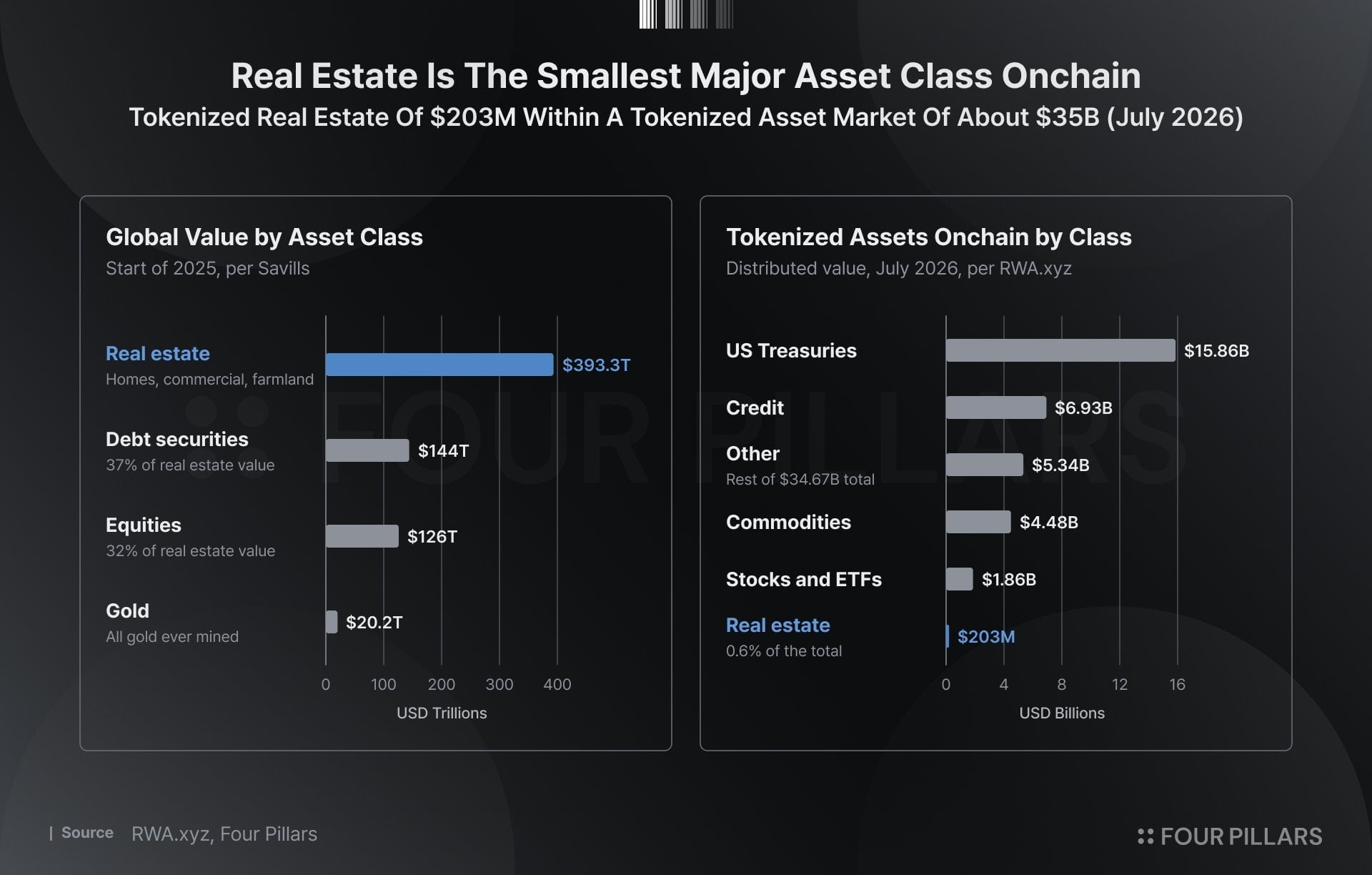
Real estate is the largest asset class globally but is also one of the sectors with the lowest on-chain penetration. According to RWA.xyz, as of July 2026, the total distributed tokenized real estate on the entire network amounts to only about $203 million, which is minuscule compared to the approximately $35 billion tokenized asset market.
Many past attempts aimed at bridging this gap have largely ended in failure; however, this sector continues to attract fresh capital. Recently, Index Industries announced the completion of $50 million in seed funding aimed at packaging housing prices across the United States into a single index token.
Will on-chain real estate become the next growth engine for real-world assets (RWA)?
My answer is affirmative, but it cannot be built on the conventional pathways most previous projects have taken. Future substantive growth will inevitably need to be realized through credit and index products. The “fragmented ownership of single buildings,” which most people envision, is precisely the model with the worst historical performance and the most cumbersome operational structure.
The further from a single building, the more viable the business model
The so-called “on-chain real estate” actually encompasses five distinct business models that share the same industry label but differ greatly. The core distinction lies in what underlying rights the tokens grant to their holders, and it is this crucial difference that determines the different models' ultimate development trajectory and survival rates.
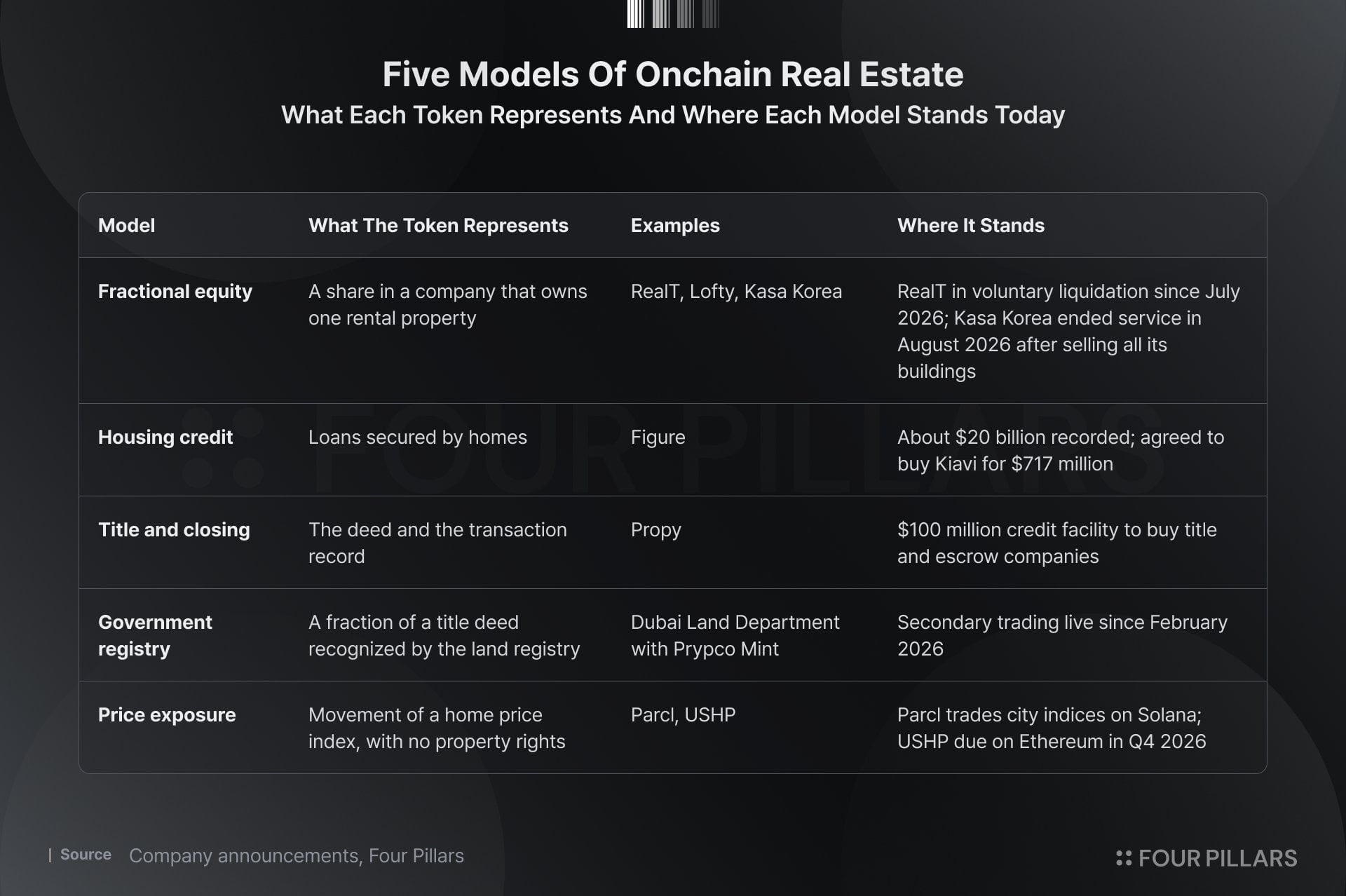
First, fractional equity. This model publicly sells shares of companies or trusts that hold a single physical property to investors. Token holders receive rental dividends periodically and await future asset sales, while the platform relies on listing and management fees for survival.
However, these meager fees can hardly cover the high daily operational costs, making it the weakest link among the five models: RealT, Kasa Korea, and Funble have all ceased operations and liquidated.
Second, housing credit. This model directly records housing loans on a distributed ledger, and investors earn mortgage interest from borrowers through holding debt rights. Its business profitability comes from interest rate differentials between loan origination and post-loan management, and service fees.
Figure alone achieved $393 million in net revenue and $132 million in net profit in the first half of 2026. This is a verified pathway, but it heavily depends on a large asset scale: Comparatively, although Pineapple Financial has put over $1 billion in housing loans on-chain, its total revenue over nine months is only $2.1 million.
Third, title and closing. This phase involves verifying property titles, securing third-party escrow funds, and managing transfer registrations, assisting in the transfer of real estate from seller to buyer, without providing any investment financial products itself.
Propy records the entire process of title and closing on-chain, charging closing fees per transaction, and is currently gradually acquiring traditional title companies through a $100 million credit line. This business's cash flow is very stable, but expansion relies entirely on acquiring licensed institutions one by one, which is relatively slow.
Fourth, government registry. This is part of a fragmented ownership system deeply involved with government regulatory bodies. The official land registry directly registers token holders as legal owners, thus providing the most solid legal affirmation of rights for holders.
The Prypco Mint platform in Dubai primarily collects fees through token issuance and transfer transactions and is currently only open to local residents in the UAE. The business has very high credibility but is completely at the mercy of a single regulatory entity's approval speed.
Fifth, pure price exposure. This model entirely removes the cumbersome underlying physical property: Parcl provides leveraged derivative contracts for property price indices of various major cities; while the USHP, constructed based on the Index Industries housing price index, plans to launch a mortgage-backed spot index token in the fourth quarter of 2026.
Its business model relies on the total asset scale absorbed by the index and the fees accumulated from secondary trading volume. Furthermore, the highly updated daily index could also serve as the trading target for perpetual contracts, similar to the HIP-3 for traditional stock indices on the Hyperliquid platform.
In a broad view, any model built upon existing, real, mature cash flows (like mortgage interest or transfer fees) has successfully achieved scalable expansion; while most models requiring investors to bet on single, independent buildings have largely led to failure, since each physical property brings about tenant defaults, maintenance, and legal hurdles.
Why hasn’t on-chain real estate exploded yet?
Investor allocation to real estate mainly stems from two core demands: obtaining stable cash dividends and enjoying long-term capital appreciation of assets. Tokenization initially promised to break down investment barriers, similar to how American REITs made previously expensive and illiquid heavy assets accessible to everyone and easily tradable.
However, existing on-chain real estate products have failed to deliver on their promises across various dimensions. I have summarized four critical pain points: the proclaimed yields cannot be maintained, the platforms themselves are not financially sustainable, the secondary market is extremely lacking in liquidity, and the pure price increase is too low.
Yields seem attractive, but actual realizations are rare
On-chain real estate products typically advertise or actually distribute annualized yields ranging from 3.4% to 16%. However, these figures are mostly not subjected to independent and rigorous third-party audits; thus, investigating the calculation basis behind each yield is far more important than focusing on their surface absolute values.
History shows that platforms that tout the highest advertised yields are often the ones that collapse. RealT once claimed to offer annualized rental returns of 6% to 16%, but it halted the vast majority of disbursements by the end of 2025 and officially stopped dividends in February 2026, ultimately announcing voluntary liquidation procedures in July 2026.
Currently, a few that maintain high yields often rely on self-reported expectations or mean estimates. Dubai's Prypco Mint claims its annualized net returns reach 8% to 12%, but this expected figure actually ties current rental income to anticipated future price increases;
Lofty claims that as of May 2026, the average rental yield of its 111 properties is 9.2%, yet it has never disclosed its specific underlying calculation formula.
In contrast, credit products transmit the actual interest paid by borrowers up the chain. Figure's home equity mortgage funding pool disclosed in February 2026 has an actual yield of 9%; while the PRIME token issued by Hastra on this asset pool maintains a native annualized yield of 6.01% on DefiLlama.
The most reliable data is often the most restrained. Before successfully selling its property in Daejeon, South Korea in October 2025, Lucentblock distributed actual dividends yielding about 5%; while Mitsui & Co.'s AEON Omiya Shopping Center land token, issued under Japan's Financial Instruments and Exchange Act, has a pre-tax expected yield of only 3.4%.
Overall, yields that have been regulated under formal licensing, actually credited to accounts, or tracked by third-party authoritative institutions, essentially fall within a real range of about 3% to 6%.
Liquidity remains scarce: Japan issues the most but trades the least
Japan currently has the largest regulated real estate securities token (ST) market globally. In the fiscal year 2025, the issuance scale of Japanese real estate securities tokens reached 140.8 billion yen, accounting for about 85% of the total issuance of securities tokens in Japan. BOOSTRY predicts that the cumulative public issuance scale will reach 530 billion yen in fiscal year 2026.
The rapid expansion of the Japanese market stems from its deep integration with the traditional financial system: trust banks hold the underlying real estate, and large brokerages like SBI and Nomura Securities distribute tokens directly to their retail high-net-worth clients, using blockchain technology only to replace the back-end inter-institutional settlement accounting system.
However, this highly compliant traditional closed structure explains why it cannot evolve into a truly vibrant open on-chain market. It faces three significant bottlenecks:
First, secondary market liquidity is nearly zero. As of March 2026, the Osaka Digital Exchange (ODX) had listed only 8 token products (with a total market capitalization of 33.6 billion yen), and actual delivery still requires up to two working days (T+2).
Second, the underlying network is highly closed. The vast majority of tokens are deployed on private consortium chains formed by licensed institutions, completely insulated from global offshore capital and the open DeFi liquidity system. Progmat has only recently begun to attempt bridging some tokens to the Avalanche public chain.
Third, products essentially become substitutes for savings. An annualized return of about 3.4% can certainly attract risk-averse Japanese local savers, but is utterly unattractive to global crypto capital; the extremely low turnover reflects that most buyers merely treat it as a long-term holding to maturity fixed income certificate.
The Japanese practice fully indicates that a sound traditional licensed distribution network can indeed swiftly spur the issuance scale of tokenized assets, but solely relying on the issuance business itself cannot spontaneously nurture a truly deep secondary liquidity market.
Asset appreciation is insufficient to attract on-chain funds
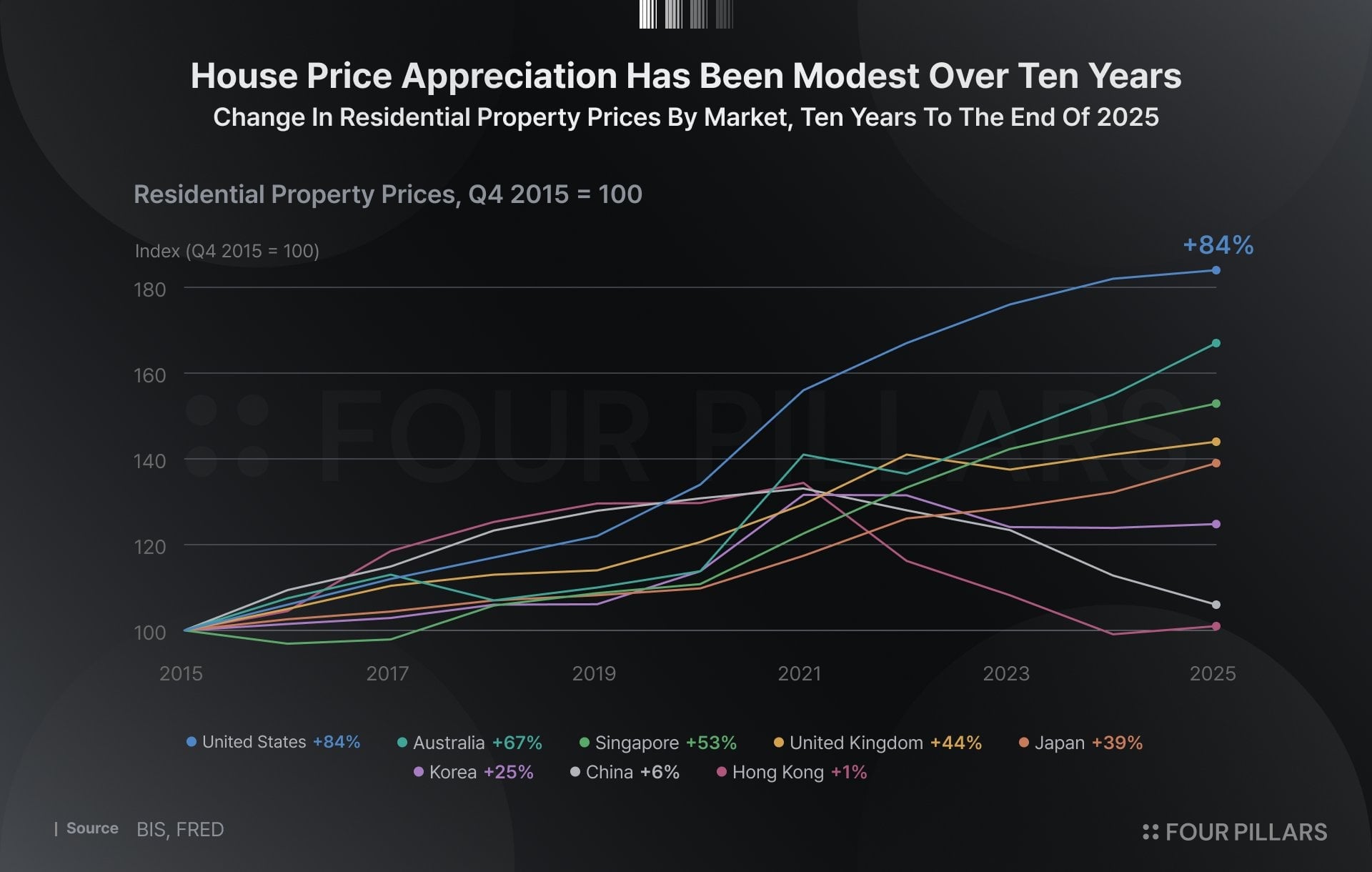
The annual price increase of physical properties is too slow to effectively attract significant on-chain capital. According to the Bank for International Settlements (BIS data), over a ten-year period ending in 2025, the most outstanding U.S. real estate market posted a cumulative increase of 84%, translating to an annualized increase of about 6%;
Singapore's annualized increase during the same period was about 4%, Japan 3%, Korea only 2%, while the property price index in China and Hong Kong nearly returned to its starting point by the end of the ten-year cycle.
To investors accustomed to high turnover yields on-chain, such compound returns seem incredibly dull. Nowadays, on-chain housing mortgage credit can stably distribute fixed returns of 6% to 9% without bearing any risks of falling property prices;
Meanwhile, on the risk-free asset side, the scale of tokenized U.S. Treasuries has rapidly ballooned to $15.9 billion, whereas the scale of narrowly defined on-chain real estate remains stagnant at $203 million.
In reality, homebuyers can accumulate significant wealth through home purchases primarily because they borrowed at high leverage ratios from banks and have the irreplaceable utility of physical habitation; however, on-chain token holders only enjoy unlevered pure price fluctuations. Therefore, the price exposure of on-chain real estate must incorporate leverage mechanisms or generate interest on top of the underlying assets to have competitive strength against mainstream assets.
Historical lessons: Only by moving price and debt on-chain
Those early projects that met with failure essentially fell into the trap of "trying to transfer reinforced concrete buildings unchanged onto the chain," and inevitably collapsed under the weight of complex rental management, narrow exit channels, and heavy operational costs.
The real breakthrough in the industry belongs to two other models, as they leave the cumbersome physical buildings in the off-chain physical world and only extract and move “price” and “debt” onto the chain.
The first model focuses on building an on-chain marketplace for leveraged trading and liquidity hedging.
There has long been a real demand in the global market for pure real estate price exposure, yet significant obstacles have kept an effective pricing market from forming, similar to the Pre-IPO equity market: liquidity remains long-term scarce, and it is difficult to establish widely accepted fair prices on-chain. Before this, Parcl had not effectively overcome this challenge.
However, the real estate sector possesses a unique advantage: standardized indices compiled and released periodically by authoritative institutions provide indisputable pricing references. This enables derivatives platforms to offer high leverage to those speculators who find the annual 6% growth too slow while also providing indispensable tools for down-side risk hedging to numerous homeowners, builders, and credit institutions.
The second model is to construct an on-chain private credit system deeply embedded in a composable ecosystem.
Housing mortgages naturally provide a stable cash flow continuously repaid by residents, and the Figure platform has now fully recorded approximately $20 billion of such loans on-chain. Once these underlying loan assets are standardized and tokenized, they can be rapidly resold, cyclically pledged, and freely disassembled on-chain:
Figure Connect allows home mortgage rights to be directly distributed to qualified buyers off-chain; while the PRIME token issued backed by its underlying home equity mortgage funding pool has already been used as core collateral in the Solana lending market.
The core advantage of these two models lies in the fact that the platform does not have to deal with tenant payment collections, leaks, repairs, or cumbersome territorial litigation, which is precisely the heavy burden that previous single property tokenization platforms could not withstand.
Real estate still has a significant potential to become the next explosive growth engine for RWA, but its prosperity will inevitably be built upon the modern financial derivatives layer constructed around credit and price indices.
Currently, only the on-chain housing credit alone has actually accumulated about $20 billion in asset scale; however, RWA.xyz classified it under “private credit” in its statistics, excluding it from the $203 million narrowly defined real estate data.
With USHP having already secured up to $100 million in subscription commitments before its official launch, its future real trading performance will demonstrate to the entire industry whether indexed exposure can ultimately inject abundant liquidity into the ancient asset of real estate that single physical buildings can never possess.
免责声明:本文章仅代表作者个人观点,不代表本平台的立场和观点。本文章仅供信息分享,不构成对任何人的任何投资建议。用户与作者之间的任何争议,与本平台无关。如网页中刊载的文章或图片涉及侵权,请提供相关的权利证明和身份证明发送邮件到[email protected],本平台相关工作人员将会进行核查。


