Put the progress of the systems in the United States and Hong Kong on the same chart and answer one question - how much is regulatory certainty really worth.
Written by: EX.IO
What is the CLARITY Act? The final window for a bill
The CLARITY Act (Digital Asset Market Clarity Act) is fundamental legislation in the United States aimed at establishing the market structure for digital assets. Its core goal is to answer a question that has troubled the market for ten years: is a token a security or a commodity, and should it be regulated by the SEC (Securities and Exchange Commission) or the CFTC (Commodity Futures Trading Commission), and under what identity should trading platforms register.
The first half of the bill's journey was relatively smooth. In July 2025, it passed the House with a bipartisan majority of 294:134; in May 2026, it was approved by the Senate Banking Committee with a vote of 15:9; in July, a combined text of the results from both committees was released. However, on September 15, the Senate voted 49:50 against the motion to end debate (cloture) - falling 11 votes short of the 60 needed to start formal debate, with no defections from Democrats and three Republicans opposing it.
Strictly speaking, senators have never voted on the content of the bill itself. With the midterm elections concluded and Congress entering a "lame duck" session, the bill's fate has been squeezed into a very narrow corridor: either miraculously gathering 60 votes before the recess on January 3, or starting anew in the 120th Congress—reintroducing, re-committing to committees, and renegotiating everything from scratch.
Why the CLARITY Act failed: three major deadlocks
The failure of the CLARITY Act did not stem from a principled debate over "whether to regulate," but rather got stuck on three specific provisions.
First, the moral clause. How to restrict federal officials and their families from profiting from cryptocurrency business has never reached a bipartisan consensus. The White House agreed in July to include a revised clause, but Democrats believe it leaves loopholes for avoiding it through intermediaries and family-affiliated companies, and its expiration in January 2029 makes it insufficient.
Second, the responsibility of DeFi developers (Section 604). This clause was intended to protect non-custodial software developers from being classified as money transmitters; however, critics argue it leaves a regulatory gap for DeFi.
Third, yield restrictions on stablecoins (Section 404). This provision limits payment stablecoins from offering yields and directly ignited a confrontation between the banking and cryptocurrency industries—banks fear deposit outflows, while platforms view stablecoin rewards as a core income source. Just this provision has led to top companies in the industry withdrawing their support for the Senate draft twice in early 2026.
Each of the three deadlocks has its opponents, and untying one does not mean the other two will loosen. This is why "re-voting" is easier while "restarting negotiations" is difficult.
After the midterm elections: US cryptocurrency regulation clock ticking slower
The midterm elections on November 3 reshaped the legislative landscape. After Democrats took both houses, they are pushing for significant reworking of the CLARITY Act: expanding SEC oversight, compressing CFTC jurisdiction, and tightening ethical constraints on officials. Republicans have labeled it a "messaging bill."
The personnel dynamics are also critical. The market widely expects Elizabeth Warren, who holds a strong stance against the cryptocurrency industry, to lead the Senate Banking Committee; meanwhile, a key proponent of the bill in the House, Bryan Steil, chairman of the Digital Assets Subcommittee, has lost in the midterm elections. Analysts at TD Cowen predict that this bill has virtually no path to passage in the next two years.
Of course, there are also positive signals: nearly half of the candidates endorsed by industry organizations are Democrats, indicating that bipartisan consensus has not disappeared. The question is whether consensus can translate into 60 votes in a divided Congress.
Institutional interim measures: SEC and CFTC can bridge the gap, but cannot build the pillars
After legislative stagnation, the focus of US cryptocurrency regulation has shifted to administrative agencies. In August 2026, the SEC released a proposal for "cryptocurrency asset regulations," establishing a two-tier financing exemption of up to 75 million dollars; in October, it proposed new custody rules for crypto assets. The CFTC publicly sought opinions on retail cryptocurrency trading rules and clarified the capital handling standards for cryptocurrencies as collateral.
However, institutional rules have three structural shortcomings:
- Reversible: Administrative rules can change with government transitions, and courts have previously struck down numerous SEC rules on the grounds of overreach;
- Incomplete Coverage: The CFTC has no authority to establish a licensing system for spot exchanges, and client asset bankruptcy priority can only be achieved through congressional legislation;
- Discounted Certainty: For institutions requiring long-term investment, the difference between "possible rules" and "codified provisions" is directly reflected in investment decisions.
Hong Kong's answer: Four layers of the already effective virtual asset regulatory framework
The US path is one of "one bill determining everything," betting on a one-time political breakthrough. Hong Kong has chosen another route: gradual legislation, taking small steps quickly, with every step codified into law.
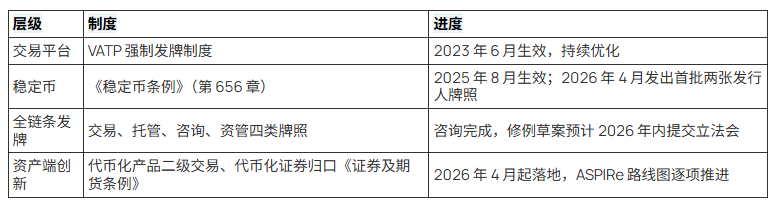
The common feature of this system is to set rules first and then act: practitioners do not need to gamble on whether a certain provision can pass through; they just need to build capabilities in accordance with the rules that have already taken effect.
Risk points: Regulatory certainty also comes at a cost
Objectively speaking, certainty is not without cost. First, capital requirements, custody standards, insurance, and audit arrangements constitute a real compliance threshold, designed for long-term operators. Second, details such as cross-border rules, DeFi handling, and transitional arrangements for new licensing systems are still being refined; there is a time lag between "certain direction" and "complete details." Third, certainty does not equate to market size—regulatory advantages must ultimately rely on liquidity depth and international capital participation to be realized, something that cannot be achieved unilaterally through regulation.
EX.IO Research perspective
This transatlantic (and transpacific) comparison provides a true insight: regulatory certainty itself is a scarce infrastructure, and it can be designed through institutional arrangements.
The experience of the United States indicates that even in markets with a deep legislative tradition and strong industry lobbying, a market structure bill can be dragged into countdown by political issues unrelated to cryptocurrency. Institutional "rules bridging" can address immediate needs, but cannot provide legislative-level certainty—which is a prerequisite for institutional capital to make long-term investments.
The value of Hong Kong does not lie in whether regulation is looser or tighter, but in its predictability: rules are layered down through regulations, circulars, and consultant summaries, with timelines made public and clear boundaries. For the industry, this means that compliance investments will not be wiped out overnight by political winds; for platforms that choose a licensed path, certainty itself becomes a source of long-term compounding returns—when the system becomes scarce, those who build according to the rules become the beneficiaries.
In the next two years, the industry is likely to face a "dual-speed world": the US repeatedly calibrating between legislative restart and institutional rules, while Hong Kong continues along its already laid track for cryptocurrency networks. The real question is not which market is "better," but whether your business structure can maintain resilience between the two rhythms.
Signals to watch
- January 3, 2027: The 119th Congress recesses. Whether a second vote to end debate occurs prior is the final theoretical window for the CLARITY Act.
- The 120th Congress: Whether the market structure bill is reintroduced with new text, and the choice of the Senate Banking Committee chair and the bipartisan ratio.
- SEC "crypto asset regulations": The degree of leniency in the results of public consultation and the final rules will determine how far institutional bridging can go.
- Hong Kong Legislative Council: Progress of the amendments for licensing systems in trading, custody, consulting, and asset management.
- Hong Kong stablecoin ecosystem: The rhythm of the second batch of issuer licenses and the actual adoption of licensed stablecoins in retail and institutional scenarios.
Frequently Asked Questions (FAQ)
What is the CLARITY Act?
The CLARITY Act (H.R. 3633) is a market structure bill for digital assets in the United States, aimed at defining the regulatory boundaries between the SEC and CFTC for cryptocurrency assets and establishing a registration framework for trading platforms. The bill passed the House in July 2025 and failed in the Senate's end debate vote on September 2026 with a vote of 49:50.
What does the failure of the CLARITY Act mean for the cryptocurrency industry?
In the short term, US digital asset regulation will rely on administrative rules from the SEC and CFTC, but such rules can be reversed and are incomplete, with uncertainties in market structure expected to persist into the new Congress.
What does the Hong Kong virtual assets regulatory framework include?
Hong Kong's framework consists of four layers: mandatory licensing for VATP trading platforms (effective June 2023), Stablecoin Regulations and issuer licenses (effective August 2025, with the first batch of licenses issued in April 2026), a comprehensive licensing system for trading / custody / consulting / asset management (under amendment), secondary trading of tokenized products, and market optimization measures under the ASPIRe roadmap.
Why is regulatory certainty important for the cryptocurrency industry?
The premise for institutional capital to make long-term investments is stable rules. Legislative-level certainty ensures that compliance investments do not become worthless due to political shifts, thus making "predictability" itself a competitive advantage for jurisdictions.
Reference Materials
[1] U.S. Senate, Roll Call Vote 234: Cloture on the Motion to Proceed to H.R. 3633 (2026-09-15). https://www.senate.gov/legislative/LIS/roll_call_votes/vote1192/vote_119_2_00234.htm
[2] Congress.gov, H.R.3633 — Digital Asset Market Clarity Act of 2025, 119th Congress. https://www.congress.gov/bill/119th-congress/house-bill/3633
[3] Troutman, "In the Wake of CLARITY Act's Failure, Agencies Move Forward Without Congressional Action or Certainty" (2026-09-25). https://www.troutman.com/insights/in-the-wake-of-clarity-acts-failure-agencies-move-forward-without-congressional-action-or-certainty/
[4] BIT Knowledge Hub, "Will the CLARITY Act Pass After the 2026 Midterms?" (2026-11-10). https://www.bit.com/knowledge-hub/clarity-act-midterms
[5] Hong Kong Monetary Authority: Regulatory Regime for Stablecoin Issuers (first licenses granted 2026-04-10). https://www.hkma.gov.hk/eng/key-functions/international-financial-centre/stablecoin-issuers/
[6] SFC Circular: Provision of Relevant Stablecoin services by VATPs and licensed corporations (2026-05-27). https://apps.sfc.hk/edistributionWeb/api/circular/list-content/circular/doc?refNo=26EC26&lang=EN
[7] FSTB & SFC: Consultation Conclusions on licensing regimes for VA dealing and custodian service providers (2025-12-24). https://www.info.gov.hk/gia/general/202512/24/P2025122400265.htm
[8] Stephenson Harwood, "Virtual assets in Hong Kong: upcoming regimes for VA advisors and managers, and trading of relevant stablecoins" (2026). https://www.stephensonharwood.com/insights/virtual-assets-in-hong-kong-upcoming-regimes-for-va-advisors-and-managers-and-trading-of-relevant-stablecoins/
[9] SFC Circular: Secondary trading of SFC-authorised tokenized investment products (2026-04-20). https://apps.sfc.hk/edistributionWeb/api/circular/openFile?lang=EN&refNo=26EC23
免责声明:本文章仅代表作者个人观点,不代表本平台的立场和观点。本文章仅供信息分享,不构成对任何人的任何投资建议。用户与作者之间的任何争议,与本平台无关。如网页中刊载的文章或图片涉及侵权,请提供相关的权利证明和身份证明发送邮件到[email protected],本平台相关工作人员将会进行核查。


