Author: Zen, PANews
There is less than a month left until ZetaChain's own Layer 1 shuts down.
On December 9, as the mainnet block height reaches 20,755,000, the original Layer 1 will cease operation, and ZETA will be migrated to Solana at a 1:1 ratio. At that time, holders will be able to claim new SPL tokens through the official page, and assets that are staked will also be automatically included in the migration.
But the changes brought by this migration go far beyond this. The end of the independent public chain era also marks the beginning of ZetaChain's official entry into the Solana ecosystem. The second governance proposal passed on November 7 also rearranged the supply structure of ZETA and further clarified the product roadmap after Anuma upgraded to ZetaLabs.
On one hand, 55 million ZETA tokens are about to be burned, and the original inflation mechanism has been canceled; on the other hand, the project will shift its focus toward financial AI. ZetaChain is rebuilding an economic and business system for its new phase.
Reconstructing ZETA Token Supply: Canceling Inflation, Burning 55 Million Tokens
The first change brought by the migration is the adjustment of the original supply arrangement of ZETA.
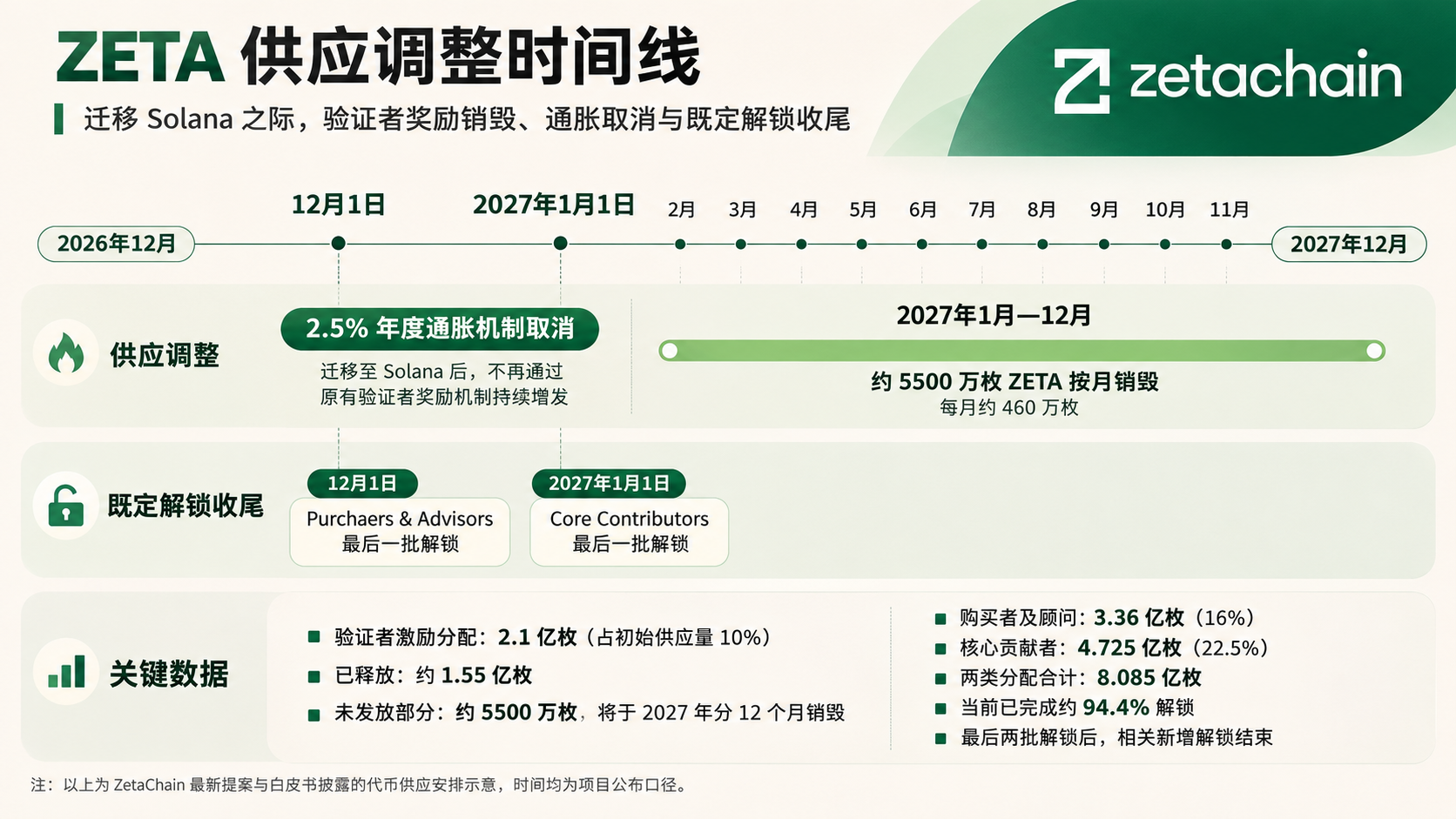
According to the official plan, out of the original maximum supply of 2.1 billion ZETA tokens, 210 million tokens were originally earmarked for validator incentives, accounting for 10% of the initial supply. As of the migration snapshot, approximately 155 million tokens have been released through block rewards, with around 55 million tokens remaining unissued.
As the independent L1 ceases operation, the original validator reward mechanism will also become a thing of the past. ZetaChain has decided not to introduce this portion of tokens into the market anymore, but rather to destroy them as per the original release schedule, monthly destroying about 4.6 million tokens from January to December 2027.
Meanwhile, the planned 2.5% annual inflation mechanism, which was supposed to start in the fourth year of the mainnet operation, will also be suspended. After migrating to Solana, the tokens will no longer be continuously issued through the original validator reward mechanism.
For the tokens already allocated to investors and core contributors, ZetaChain has chosen to complete the final stage of unlocking according to the original plan.
According to the original token economics, purchasers and advisors received 336 million ZETA tokens, accounting for 16% of the total supply; core contributors received 472.5 million tokens, accounting for 22.5%, totaling 808.5 million tokens.
Currently, approximately 94.4% of these two allocations have been unlocked. The remaining portions will be released as the final batch of tokens on December 1 and January 1, 2027, completing the unlocking plan for these distributions, with no further related unlocks afterwards.
The other distributions held by the foundation have different arrangements. The ZetaChain Foundation has also committed that in 2027 it will not sell newly released tokens from the User Growth Pool, Ecosystem Growth Fund, Protocol Treasury, and Liquidity Incentives.
Thus, this adjustment by ZetaChain effectively involves three levels of supply management: burning unissued validator rewards, completing the planned unlocking for investors and core contributors, and restricting the foundation from selling newly released tokens in 2027.
This means that as the independent L1 shuts down, the original plans for increasing issuance and unlocking for ZETA will gradually phase out, and the future supply release cadence will undergo significant changes.
After initiating migration, how can ZETA holders complete asset conversion?
In addition to clarifying the token supply adjustment plan, the second proposal also finalized the specific process for ZETA to migrate from the native network of ZetaChain to Solana.
According to the proposal, ZetaChain will take an asset snapshot at block height 20,755,000, expected to be reached on December 9, 2026. At that time, the ZetaChain native L1 will cease operation, validator nodes will shut down, and the original network will not restart.
After the snapshot is complete, ZetaChain will issue a native SPL version of ZETA on Solana, at a 1:1 exchange rate, with the token name and code remaining unchanged. The total issuance of the new token will correspond to the native ZETA balance recorded in the snapshot, and after issuance is completed, the minting rights will be revoked to ensure that ZETA on Solana cannot be issued further.
- For regular token holders, this migration does not require completing through a third-party cross-chain bridge. ZetaChain will provide asset claim services through the official migration process and ZetaHub page. Users only need to connect their original holding wallet and sign a message containing the Solana receiving address after the migration entry opens on December 9 to claim the corresponding amount of SPL tokens. The entire process does not require payment of transaction fees and does not need to hold SOL in advance, with a minimum claim balance of 10 ZETA per address.
- For staked assets, users also do not need to un-stake in advance. The snapshot will automatically record normal balances, delegated staked balances, un-staking balances, and unclaimed rewards, counting the corresponding amounts toward the migration balance. It is important to note that staking rewards will stop being calculated as of the snapshot height.
- For users who have placed their ZETA tokens on centralized exchanges, the respective platforms will be responsible for completing the token conversion without needing to claim them personally, with specific conversion times and arrangements subject to the announcements of each exchange.
In addition to the native ZETA, users' other cross-chain assets held on ZetaChain will also have corresponding processing plans. Assets that still exist in ZRC-20 format at the time of the snapshot can be applied to be returned to the original blockchain through ZetaHub starting December 9. This mechanism covers 9 original networks, with a minimum claim amount of 5 USD for each asset.
However, users holding wrapped ZETA or liquidity pool shares will need to handle relevant assets in advance. Because these assets are stored in smart contracts or liquidity pools, they cannot be directly signed for claim through normal wallet addresses, so they need to unwrap or exit the funding pool before the snapshot to transfer the corresponding assets back to their personal wallets.
Regarding migration security, ZetaChain stated that the Solana token distribution program and migration claim services are undergoing independent security audits by Hacken, with reports to be published before the migration page is opened. The project will also publicly disclose snapshot data and verification documents, token minting records, and program verification information for external verification of asset quantities before and after migration.
Meanwhile, the original ZetaScan browser will continue to provide historical transaction query services, and the project will at least retain a read-only archived node until October 31, 2027, for users to check historical records.
It is particularly noted that this migration only involves ZETA on the native network of ZetaChain. The previously issued ERC-20 version on Ethereum is not affected and will continue to retain its original form.
From Market Tracking to On-Chain Memory, ZetaLabs Builds a Crypto-Native Financial Intelligent Assistant
As the original public chain gradually exits, ZetaChain's next phase of business focus will concentrate on the AI product, ZetaLabs. However, compared to the previous Anuma, which primarily focused on general AI interaction, ZetaLabs further refines its product positioning to focus on the cryptocurrency market, aiming to integrate real-time market information, users' own on-chain activities, and AI models into the same workflow.
As early as February 2026, ZetaChain launched Anuma Chat, which allows users to switch between different AI models while retaining personal preferences and historical context through multi-model aggregation and a private memory layer. ZetaLabs builds upon this technology by adding features closely related to the cryptocurrency market. According to the official roadmap, the platform plans to launch Chat, Radar, Bloom, and ZETA Dashboard on December 9.
Among them, Radar and Bloom are two important components that distinguish ZetaLabs from ordinary AI chat tools—Radar is responsible for tracking the market, while Bloom allows AI to understand users' own on-chain activities.
Radar provides real-time, personalized streams of market information that cover cryptocurrencies, perpetual contracts, prediction markets, stocks, and commodities. Users can obtain market dynamics according to their areas of interest and then further inquire about relevant information through Chat. Compared to having to repeatedly describe the subjects and backgrounds of research to general AI, this method allows users to conduct their research around continuously monitored markets more directly.
Bloom extends the AI's analysis range from the public markets to users' own on-chain activities. After connecting a Solana wallet, Bloom can build private memories around the user's on-chain transactions, allowing users to inquire about their transaction status in natural language. This means that the AI no longer only needs to understand the price trends of a specific token but can provide relevant context by combining the user's own on-chain activities.
For example, when a user wants to review their recent transactions on Solana, they can simply ask the AI about their wallet activities without having to individually open the block explorer, look for transaction hashes, and compile transaction records themselves.
This design also provides a foundation for more in-depth trading analysis in the future. According to the roadmap for Q1 2027, ZetaChain also plans to launch the Lens feature, where users can input a specific on-chain transaction to gain insights into what exactly happened during the transaction, what operations were involved, and how much cost was incurred.
If Radar solves the problem of fragmented market information, then Bloom and Lens aim to address the difficulties in understanding on-chain transaction information and organizing personal transaction histories.
Another key focus running through ZetaLabs product design is user privacy.
When using AI analysis, crypto investors typically involve wallet addresses, transaction records, and position information. Once this information is combined with AI chat records, it forms a rather complete personal financial profile. However, while using ordinary AI chat tools, users generally have to submit prompts and relevant contexts for the model service providers to process.
ZetaChain hopes to change this model through a Private Memory Layer. This infrastructure aims to encrypt users' chats, research, and memories while allowing users to control the keys, so that ZetaChain itself cannot read this content. The AI model will only receive the information necessary to answer the current question and will not directly access the user's entire historical records.
On this basis, ZetaChain plans to launch Zeta Intelligence and Zeta MCP in Q1 2027. The former will provide deeper financial research and decision support by combining users' private memories; the latter will allow third-party applications to call ZetaLabs tools, only being able to access the corresponding memories after user authorization.
For the cryptocurrency market, this design also has a longer-term direction: as AI agents begin to take on market information collection, trading analysis, and other financial tasks, they require not just modeling capabilities but also user-authorized data, continuous personal context, and payment mechanisms.
ZetaChain's goal, therefore, is to integrate these capabilities into a unified product system through private memories, open interfaces, and payment standards like x402.
ZETA Token Re-establishes Value Support
Compared to the product roadmap, the change in the uses of ZETA in the new business may be the more noteworthy aspect of this proposal.
The original ZetaChain is an independent Layer 1 public chain, where ZETA serves functions such as network gas payments, validator staking, and rewards. As L1 stops operations, this economic model will also be phased out. After migrating to Solana, transaction fees on the network will be borne by SOL, and ZETA will need to build new usage demands through the application layer.
According to the new white paper, the current clear uses of ZETA include three aspects.
- First is payment for AI services. Users can pay ZETA for AI service fees in ZetaLabs and receive certain discounts while unlocking more reports and product functions.
- Second is Premium membership. Starting from Q1 2027, users can obtain ZetaLabs Premium access by locking ZETA, allowing them to use more in-depth market research reports and higher service limits. According to official statements, the locked tokens still belong to users, and only their own wallets can withdraw them.
- Third is product governance. Users can use ZETA to participate in voting on product direction, such as deciding which markets, data sources, and AI models ZetaLabs should support.
Compared to the previously discussed ZETA Access mechanism for locking tokens to exchange for AI usage points, the new white paper specifies the uses of the token as service discounts, Premium access privileges, and product direction voting.
Additionally, according to official statements, all users will have access to a daily free usage limit, and additional AI calls and research services can be paid through ZETA, USDC, or credit cards. This means that ZETA is not a necessary condition for using the product but rather a method of payment and access that provides discounts and specific rights.
From this perspective, ZetaChain has not set ZETA as the only barrier for entering ZetaLabs but aims to establish richer application scenarios for the token through payment discounts, Premium membership benefits, and product governance. Regular users can experience services through USDC or credit cards, while as usage demands deepen, ZETA can offer more product benefits.
With the successive launch of features like Radar, Lens, Zeta Intelligence, and MCP, ZetaLabs is also expected to gradually evolve from an AI assistant into a service platform that connects financial data, market research, and third-party AI agents.
For ZetaChain, migrating to Solana signifies the end of the independent public chain operation phase, while ZetaLabs bears the business exploration of the next stage. How to convert the previously accumulated AI technology capabilities into ongoing product demands and further expand the application scope of ZETA in the ecosystem will be important focal points in this transformation going forward.
免责声明:本文章仅代表作者个人观点,不代表本平台的立场和观点。本文章仅供信息分享,不构成对任何人的任何投资建议。用户与作者之间的任何争议,与本平台无关。如网页中刊载的文章或图片涉及侵权,请提供相关的权利证明和身份证明发送邮件到[email protected],本平台相关工作人员将会进行核查。


