
In the past two years, the narrative about AI reshaping the job market has been dominated by two completely opposite extremes: on one end, the doomsday theory that "AI will completely eliminate product managers and junior programmers," and on the other end, the myth of wealth creation that "mastering large model tools can achieve a hundredfold leap in personal productivity." The two industry reports released simultaneously in November 2026 offer a picture that diverges from both claims.
On November 10, Lenny Rachitsky, author of "Lenny's Newsletter," released the fifth report in his series on the tech job market, titled "State of the tech job market: late 2026"; on the same day, OpenAI's official website, in collaboration with the freelance platform Upwork, published a research article "Work at the Frontier: AI's effect on freelance work" along with a complete report titled "The Rebundling of Freelance Work in the AI Age."
These two sets of data cover full-time tech positions and the gig market for freelancers, and when viewed together, the conclusions drawn differ from market rumors: AI has neither "eliminated" a particular job title as scripted nor has it led to an overall boom in software development positions. Instead, it has dismantled the boundaries of traditional roles, compressing single-skill positions into composite tasks, with new positions appearing more frequently in physical sectors such as hardware and data centers, and concentrating in the Bay Area.
Another side of "PM is thriving": the divergence between job postings and actual hiring
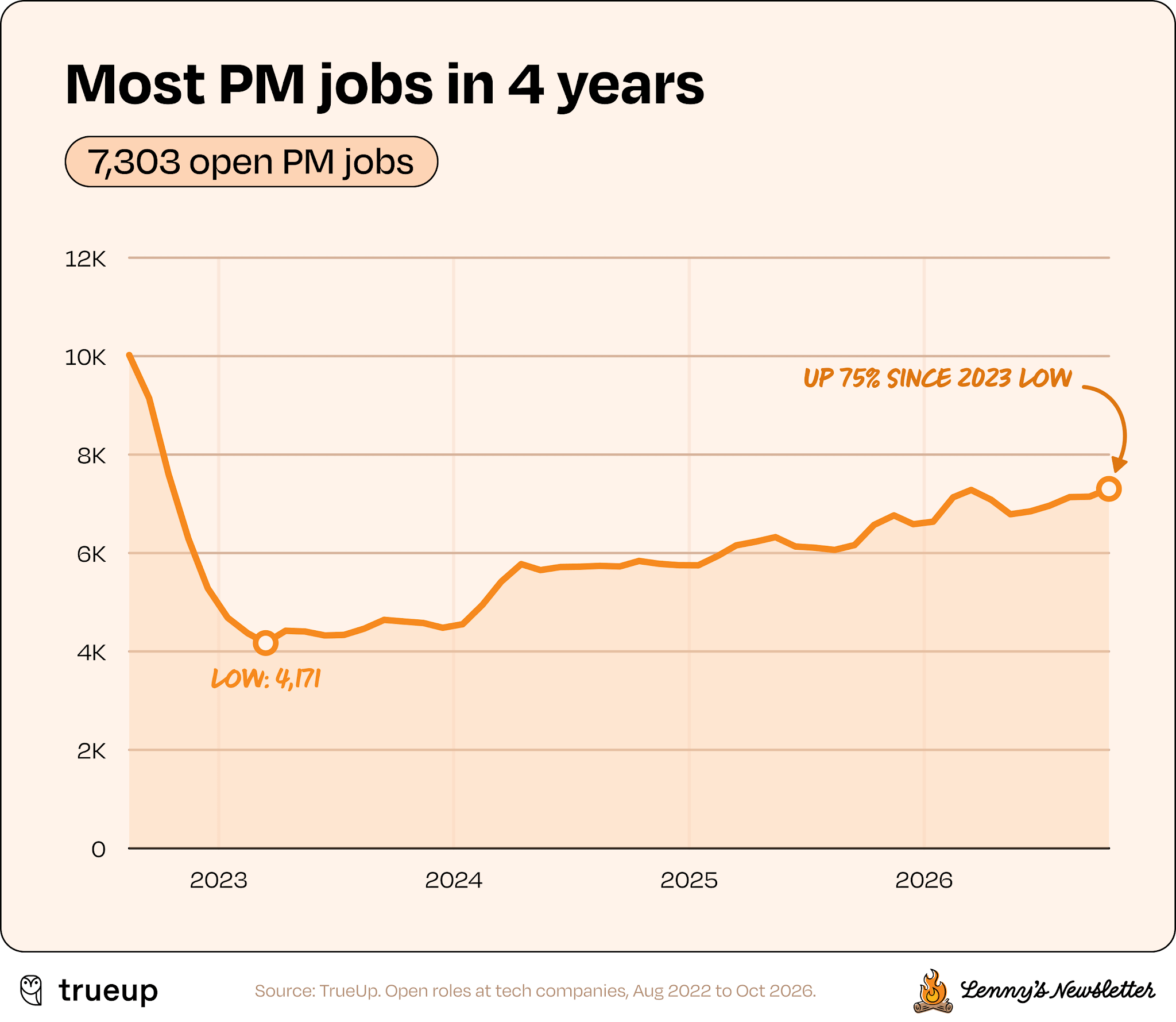
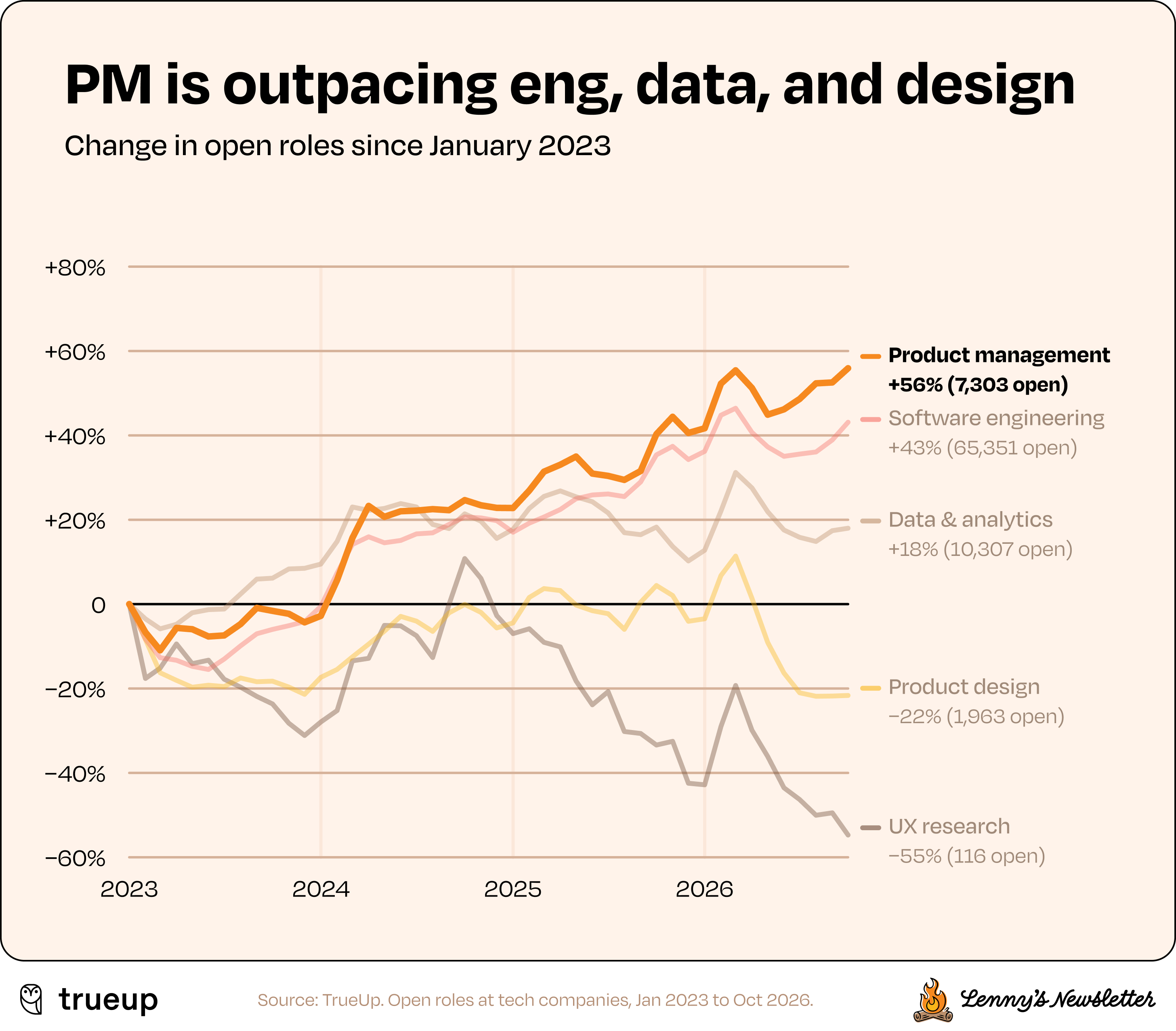
The first surprising finding in Lenny's report concerns the performance of product managers (PMs). Based on TrueUp data tracking open positions at over 9,000 tech companies globally, as of October 2026, the number of open PM positions at global tech companies reached 7,303, a near four-year high, rebounding 75% from the low in March 2023; since January 2023, the cumulative growth of open PM positions is 56%, significantly outpacing engineering roles (+43%), data and analytics roles (+18%), product design (-22%), and user experience research (-55%).
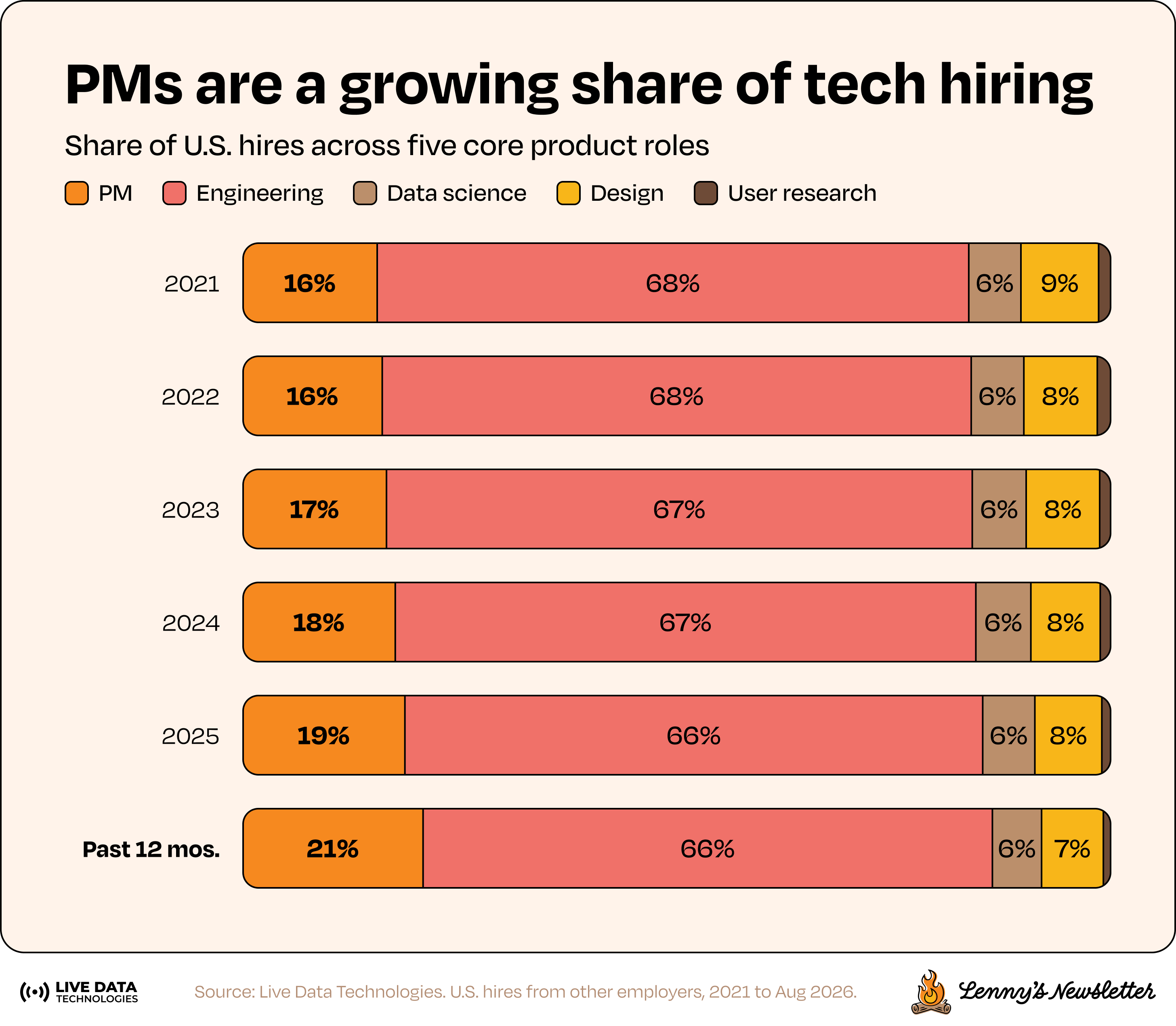
However, if one only looks at the number of open positions, it is easy to conclude that "everyone is competing for PM roles in the AI era." The report also introduced data from Live Data Technologies (LDT), which tracks the career changes of 124 million professionals (its hiring statistics only cover the U.S. market). According to actual hiring statistics, the number of PM actual hires has remained flat or declined, with PM roles only showing the best resilience among the five core functions, growing its actual hiring share from 16% in 2021 to 21% currently, becoming the only core role to expand its share.
Independent product analyst Aakash Gupta released another report on October 22, 2026, presenting data contrary to the "PM expansion" narrative. This analysis, also based on underlying hiring data, showed that from February to June 2026, the number of external PM hires in the U.S. decreased by 18% compared to the same period in 2023 (down 45% from 2022), while job postings on TrueUp surged by 77%. In 2025, for every PM that a company lost, it only replaced 0.92 from external sources (1.16 in 2022). Overall, U.S. PM hiring size is only 52% of that in 2022, with an even deeper drop in regions outside the U.S. (-23%, with India and Europe each at about -25%), although the median salary for U.S. PMs rose from $220,000 to $250,000 (+14%).
As companies post more positions, the number of actual hires is decreasing. Aakash Gupta bluntly points out: "Job postings represent the ads companies put out; the number of hires represents the people actually starting work. Only one number represents the real market." Additionally, a blog by Falkster manually audited 200 PM job postings in April 2026 and found that 196 of them "could have been written in 2022." Falkster's statistics show that AI PMs occupied 46% of open PM positions, but only about 7 out of every 100 PM hires. Aakash Gupta's report indicates that the number of AI PM hires increased from 789 to 1,988 (approximately 2.5 times), but only accounted for 6.8 out of every 100 PM hires.
The keywords in job postings are expanding, and the standards are rising. In my view, companies may no longer easily increase headcount but instead are posting high-standard positions, long-term seeking a small number of versatile individuals who understand both the business and AI. The so-called victory of PMs is merely a relative resilience amid a contraction of existing roles.
Stagnation in engineering growth, design in decline, and isolated job types collapsing
Compared to PMs, the situation in software engineering and design fields is significantly worse.
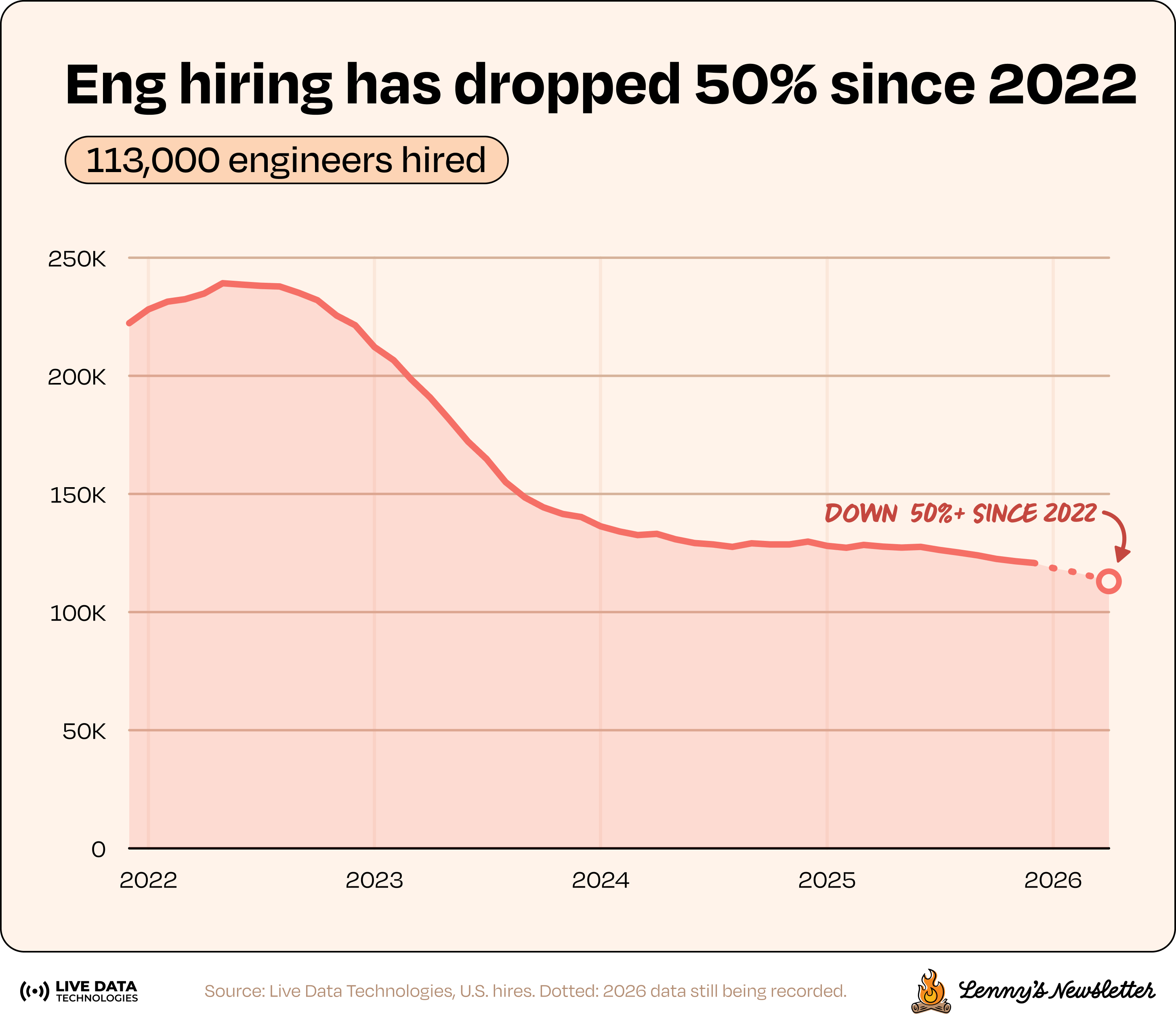
The Lenny report recorded that the demand for engineering positions in tech companies has stagnated. TrueUp data indicates that the growth rate of open engineering positions has sharply slowed from +29% in 2024 and +15% in 2025 to just +2.5% over the past year; as of October 2026, the global number of open engineering positions stands at 65,351, having fallen below the level of March of the same year. From the perspective of actual hiring in the U.S., during the period from May 2025 to April 2026, U.S. companies hired approximately 113,000 software engineers, which is less than half of the peak in 2022 (239,000). Since January 2024, the engineering field has also seen a "vacancy +44%, actual hires -17%" gap.
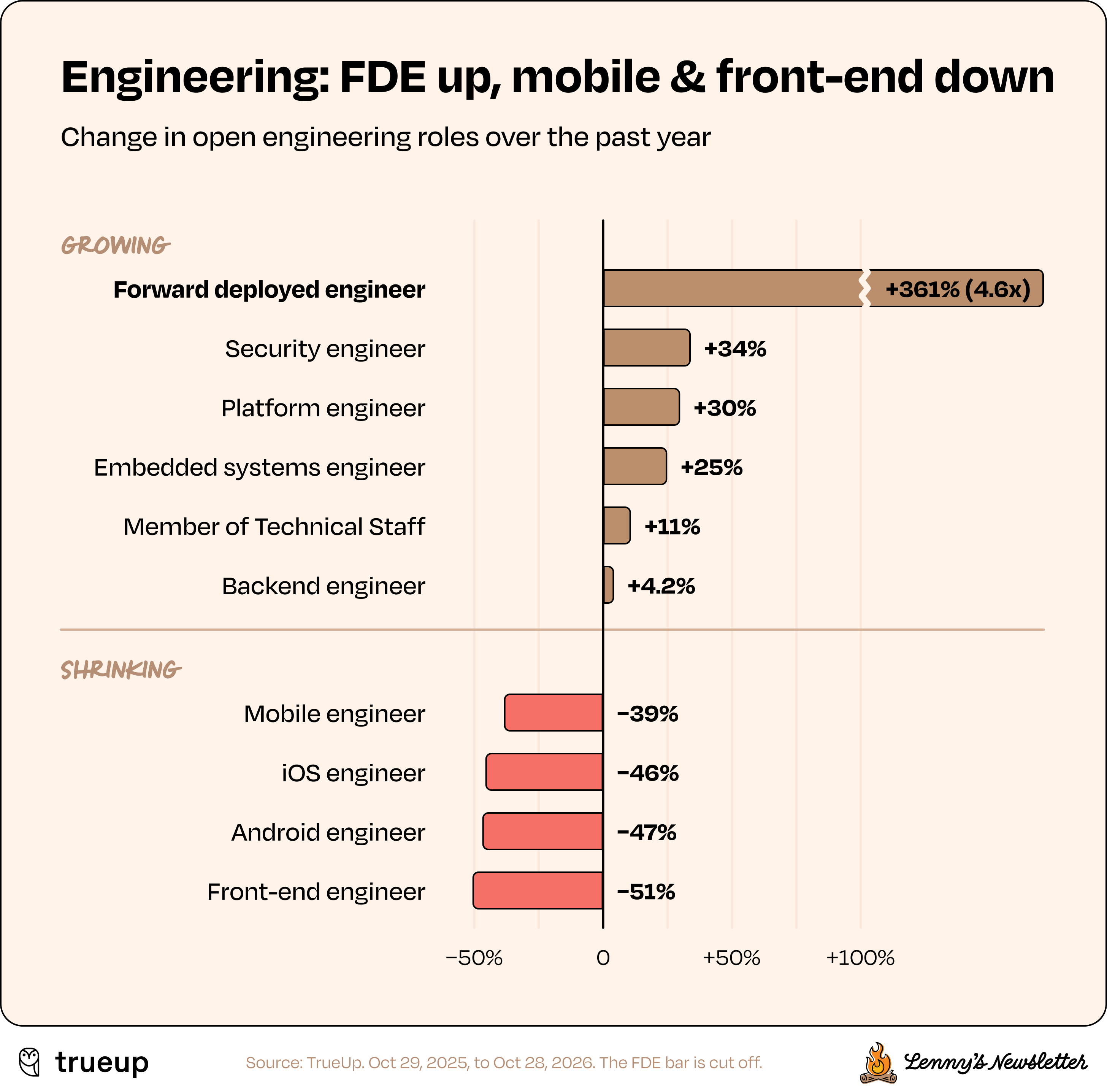
The more noticeable impact of AI tools is reflected in the internal structural differentiation of engineering. The report qualitatively noted that the demand for front-end engineers and mobile development engineers has "nearly halved." Lenny believes this reflects the "collapse of specialized, siloed engineering disciplines": with the help of AI programming tools, smaller engineering teams are taking on broader end-to-end responsibilities.
Meanwhile, some emerging engineering positions closer to clients are experiencing a boom. The number of global open positions for Frontline Deployment Engineers (FDEs, a composite role that directly assists clients in implementing products, combining engineering and delivery capabilities) has surged 4.6 times over the past year, reaching around 1,500. However, Lenny also notes that the growth of FDEs is likely a result of both increased demand and the renaming of positions like "Sales Engineer" to FDE.
Among the five core product functions, product design and user research (UXR) have been hit the hardest. The number of open product design positions at global tech companies has dropped to about 1,900, a year-on-year decline of 28%, marking the lowest since tracking began; over the past 12 months, the U.S. has seen the actual hiring of approximately 12,600 product designers, which is less than half of that in 2022 (27,600). The ratio of open PM to design positions has deteriorated from 1.9:1 in early 2023 to the current 3.8:1. User research has nearly become marginalized: the U.S. hired only about 1,800 UX researchers over the past year, down 66% from 5,300 in 2022; currently, only 108 open UXR positions remain globally.
This merging of responsibilities is also directly reflected in hiring requirements and interview processes. In statistics of skill word frequency, "LLM" has surpassed all traditional skills to become the most mentioned term in PM position descriptions, with "Claude" ranking third, and terms like Cursor, OpenAI, and MCP making the top eight, while "evals (model evaluation)" enters the top ten; in engineering positions, "LLM" has also surpassed Java in frequency; in design roles, "Claude" even surpassed CSS in the spring of 2026 to rank second. Tao Zhang, co-founder and CPO of Manus, bluntly states that AI is now adept at completing tasks, and companies no longer need engineers who "only excel at executing tasks."
Freelance market sample: tasks are being repackaged
The freelance market data is more granular and reveals similar changes. A joint 24-page study by OpenAI and Upwork compared the distribution of work-related conversations on ChatGPT with changes in gig orders on Upwork, attempting to answer a central question: Is AI really taking away freelancers' jobs, or is it changing how they take on work?
The authors of the study explicitly emphasize that the findings "do not point to a simple substitution story." Among the 63 job categories that can be matched, 43 categories exhibit a trend of "common on ChatGPT, declining share on Upwork," while 20 categories show the opposite trend. The differentiation is very clear. Standardized text and basic support tasks are more common on ChatGPT and have a lower share on Upwork. For instance, content writing accounts for 14.5% of work-related ChatGPT usage but only 1.3% of Upwork positions, and this category's share on Upwork has dropped by about 31% from the first half of 2025 to the first half of 2026; customer service and technical support account for 6.5% on ChatGPT but only 1.2% on Upwork. Conversely, fields that require complex visual judgment, interactive delivery, and multimodal integration still highly depend on human freelancers: video and animation account for 10.0% of Upwork positions (ChatGPT only 1.0%), graphic/editorial/presentation design accounts for 10.5% (ChatGPT 2.3%), and mobile development accounts for 7.8% (ChatGPT only 0.2%).
A more critical finding is called "Rebundling." The diversity of common tasks in AI-related freelance orders increased from an equivalent of 14.6 tasks at the beginning of 2023 to 21.2 tasks by the end of 2025, an increase of 45%. Although the number of tasks included in a single AI-related order (3.3 tasks) is not significantly different from non-AI orders (3.2 tasks), the proportion of orders forcibly containing "previously seldom occurring tasks" in the same order is 8.4% in AI positions, over three times that of non-AI positions (2.4%). The report provides a typical example: today, a request can simultaneously require the freelancer to complete AI video generation, video editing, and motion graphic design, delivering the final product all at once, whereas previously this would require finding three separate people.
This structural change is also reflected in the billing. Controlling for work subcategories and publishing months, the fixed total budget for AI-related freelance orders is 52.4% higher (before adjustments, it was about 70% higher), and work hours on contracted hours within the first 90 days are 40.6% longer; meanwhile, the published hourly rate, controlling for variables, is only slightly higher by 1.5%. This indicates that AI has not increased freelancers' unit time quotes; it can be inferred that clients are packaging more cross-role tasks into larger composite projects.
This corroborates the previous research released by OpenAI on September 16, 2026, which analyzed over 1.5 million work-related ChatGPT messages from April to July of the same year: among approximately 6,200 tracked employees, the proportion using AI to handle cross-profession tasks increased from 13.1% to 25.9% within just three months, and the probability that individuals with cross-disciplinary experience repeat this behavior in the following month is as high as 23.6% (compared to only 8.4% for those without this experience). According to media reports citing Upwork's Q2 financial report released on August 10, 2026, the number of active clients on the platform decreased by 4% year-on-year to 763,000, total Gross Services Volume (GSV) slightly declined by 4% to $966.4 million, yet GSV per active client rose against the trend by 5% to a record $5,230, with AI-related GSV growing over 22% and AI strategy and consulting growth exceeding 50%. The number of clients is decreasing; it can be inferred that the remaining clients may be paying for more complex, high-ticket AI composite solutions. (It should be noted that the OpenAI and Upwork research itself consists of descriptive statistics related to stakeholders, with indicators not fully aligned in time windows and not tracing cross-platform migration causality.)
The fastest-growing positions are outside of software, and hiring is concentrating in the Bay Area
Many believe that the stagnation in the tech job market in 2026 is due to a hiring freeze throughout the industry. However, Lenny disclosed in the report: the total number of open positions at global tech companies now exceeds 281,000, a year-on-year increase of 17%, and a staggering 73% increase from the low point in March 2023. The tech industry has not stopped hiring; it is simply that the combined growth in these three traditional core software roles—PMs, software engineering, and product design—has been negligible at only 2%.
The additional positions are primarily concentrated in chip-making, data center, and physical delivery roles. Data shows that open hardware engineering positions doubled in the past year, with around 4,200 positions added in business operations and a 63% increase in supply chain roles; the fastest-growing positions in the entire tech industry are mostly physical roles such as data center technicians, installation engineers, and field service engineers. Lenny believes that the AI boom is creating jobs primarily in building and operating physical infrastructure like chips, data centers, and hardware, rather than in software development.
Remote positions are also rapidly decreasing. Currently, the proportion of open positions in tech companies offering remote options has fallen to a historical low of 14% (down from 21% at the end of 2022); among these, the remote ratio for engineering roles dropped from 25% to 14%, design roles from 34% to 19%, and even the relatively flexible PM roles are holding steady at about 21%.
In contrast, hiring is concentrating in the San Francisco Bay Area. The number of positions in the Bay Area has increased by 43% year-on-year, accounting for 15% of all open positions; in the core product development segment, one in every four open PM and design positions is in the Bay Area, and one in every five engineering positions is in the Bay Area.
As for whether there is still hope for software engineers caught in a plateau, the report shows that the number of open positions for Tech Recruiters has risen nearly 300% since mid-2023, reaching a historic high. This may suggest that companies are preparing for the next wave of engineering hiring, or it could simply be a structural adjustment due to the outsourcing of recruitment processes and the rise of headhunting, which still awaits subsequent hiring data for confirmation.
Conclusion
Putting together these data slices from the end of 2026, the real impact of AI on the job market has moved beyond the crude imagination of "machines replacing humans."
In my view, accelerating clearance may be those positions with overly detailed divisions of labor that rely solely on single execution skills, such as engineers who only write front-end pages and basic mobile code, executing roles that only conduct standardized research and cut graphics, and freelance writers who only rely on single articles for payment.
In my view, the higher fixed budgets, rising median salaries for PMs, and the concentration of high-density offline collaboration in the Bay Area may be flowing towards two types of scarce talent: one that is growing upwards, capable of cross-role "repackaging" tasks, understanding the boundaries of model evaluation, and directly delivering complex outcomes to clients; and another that is moving downwards, directly participating in the construction of physical foundations like AI computing power, hardware, and data centers.
免责声明:本文章仅代表作者个人观点,不代表本平台的立场和观点。本文章仅供信息分享,不构成对任何人的任何投资建议。用户与作者之间的任何争议,与本平台无关。如网页中刊载的文章或图片涉及侵权,请提供相关的权利证明和身份证明发送邮件到[email protected],本平台相关工作人员将会进行核查。


