Written by: Xiaobing, Deep Tide TechFlow
When Huang Renxun was nine years old, he had to cross a suspension bridge every day on his way to school.
The bridge was missing wooden planks, and deep water was below. There were boys waiting for him on the other side; some shook the bridge forcefully, while others called him names with discriminatory connotations. He was small and thin, his English was poor, and he was one of the few Asian faces in the school. There were no counselors, and no one came to teach him what "anti-bullying" meant. All he could do every day was walk past.
In 1973, he and his brother were sent to the Oneida Baptist Institute in Eastern Kentucky. His uncle thought it was an elite boarding school, but in reality, it was a religious reform school for "troubled boys." The students smoked, carried knives, and had little interest in studying. Huang Renxun was called "Chink" by classmates and was responsible for cleaning the boys' dormitory toilets every day.
His roommate was seventeen years old and illiterate; on the first night, he lifted his shirt to show Huang the knife scars from fights. Later, he taught his roommate to read, and the roommate taught him how to bench press. At fourteen, he made it into Sports Illustrated for table tennis.
A nine-year-old Chinese immigrant boy learned to survive in a strange, rough, and even dangerous environment like this.
He did not retreat.

More than fifty years later, Huang Renxun stood again on a shaky bridge. This time, below the bridge was a chasm filled with private morals, corporate power, national security, geopolitical issues, and ethnic prejudice.
From Inquiry to Ethnic Hunting
On November 8, 2026, Huang Renxun admitted to all employees in an internal letter that he had been unfaithful to his wife. He said, "There are no excuses."
This is not a trivial matter.
On the other end of the incident lies national security. The New York Times previously reported that Alice Huang, a former executive at Singapore-based data center company Megaspeed, had a close relationship with Huang Renxun. Between June 2024 and February 2026, Megaspeed's Malaysian affiliate purchased over $4.8 billion worth of equipment containing NVIDIA chips, and the case has been transferred from the Department of Commerce to the Department of Justice.
The NVIDIA board initiated an independent investigation. Three committee chairs from the House of Representatives requested that Huang Renxun attend a closed-door briefing on November 18. The FBI intervened. Shareholders filed lawsuits. When the market opened on November 9, NVIDIA's stock dropped as much as 8%, with its market value evaporating by over $300 billion at one point.
Every inquiry was reasonable. Matters of marital misconduct, information disclosure, conflicts of interest, and export control violations can and should be questioned.
But the distance from inquiry to hunting often comes down to just a headline.
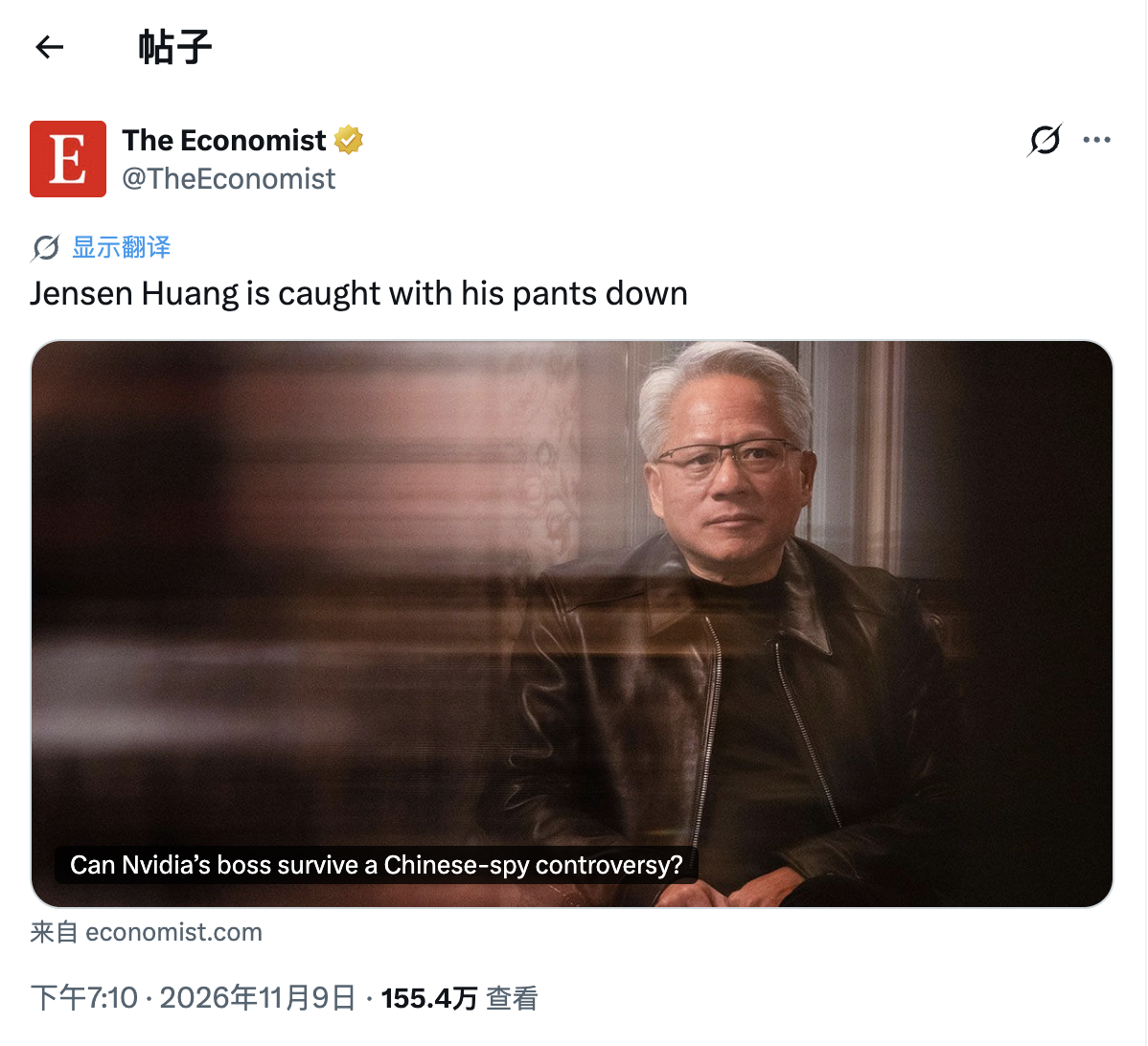
When The Economist wrote a related report, its headline read "Jensen Huang is caught with his pants down," with the subtitle "Two Huangs don't make a right," making a pun on the shared surname of Huang Renxun and Alice Huang, implicitly referring to the English saying "Two wrongs don't make a right."
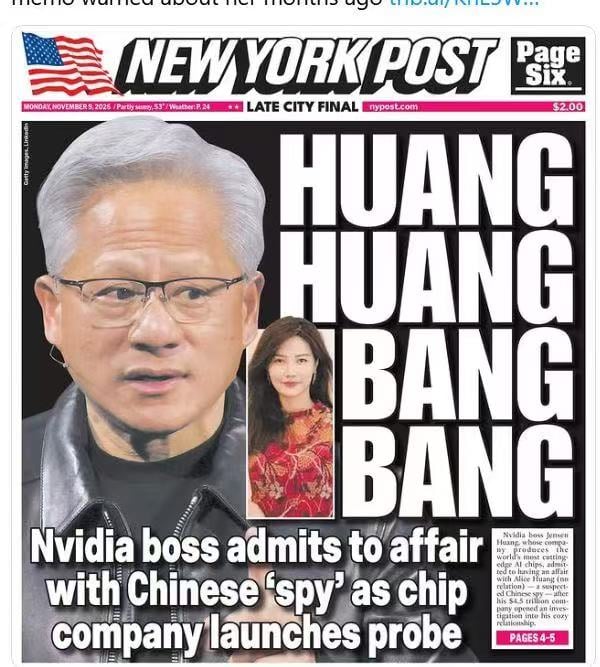
The New York Post was even more direct, featuring the headline "HUANG HUANG BANG BANG," with a title that carries a dual metaphor of sexual innuendo and gunfire.
Social media took it further.
A widely circulated tweet lined up photos of Mark Zuckerberg with Priscilla Chan, Brian Armstrong with Angela Meng, and Larry Ellison with Jolin Zhu, captioned: "I'm seeing a pattern here."
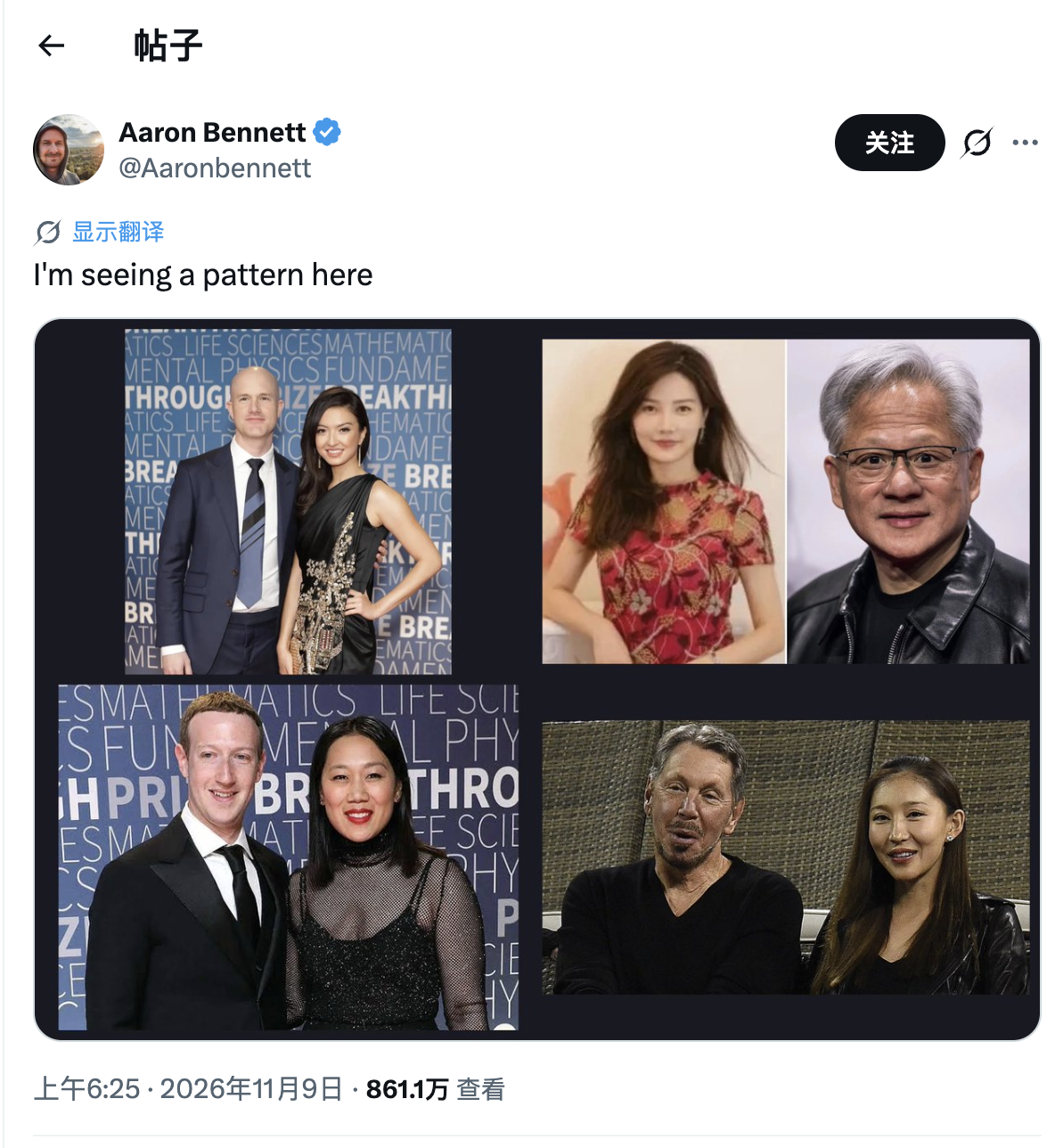
All these tech moguls had Asian female partners, yet none were implicated in the espionage accusations. Someone created a flowchart titled "How To Tell If Your GF Is A Spy," listing "Is she Asian?" and "Does she work in a tech company?" as determining factors; the post featured photos of Asian women with the caption "How your Chinese gf looks at you before asking for state secrets."
A personal scandal was diluted into a collective scrutiny of all Asian women within hours.
The Asian American Journalists Association (AAJA) issued a public statement on November 11, directly criticizing The Economist and The New York Post. The statement pointed out that turning Asian surnames into punchlines could "potentially strengthen harmful associations between identity and suspicion, misconduct, and loyalty divide." The AAJA will contact the editorial heads of both media outlets to discuss wording issues.
At the end of that apology letter, Huang Renxun wrote that he loves America, supports national security, and is proud to be an American. A person who came to America at nine and has lived there for over half a century; a person who founded one of America's most important tech companies and staked his entire career on America's innovative system; a person who personally brought NVIDIA to the first company in human history to reach a market value of $5 trillion, still needed to publicly reaffirm his loyalty at the age of sixty-three.
Of course, one can criticize Huang Renxun, but that should not turn all Huangs into punchlines or all Asian women into suspects.
Hawks' Patience and Long Memory
The outbreak of this scandal is not just a natural fermentation of a moral event; it is also a release of long-built political energy.
Semafor's reporting on November 11 had a headline: "Revenge of the China hawks: Jensen Huang's enemies take a victory lap."
The timeline is very clear.
On September 25, 2025, Huang Renxun's remarks on the Bg2 podcast angered the hawkish camp in Washington regarding China. He said that China is "only a few nanoseconds behind the U.S." in chip technology, and he referred to the "China hawk" label as not being a "badge of honor," but a "badge of shame," and stated that destroying the pipeline to the American dream was "not patriotic at all."
These words instantly infuriated some, with Steve Bannon calling Huang Renxun a "proxy for Chinese Communist influence" and saying he should be "arrested immediately" on his podcast "War Room," while Florida Senator Rick Scott shared clips of the interview on X.
The hawks remembered.
Semafor quoted Eric Sayers, a former congressional defense aide and now managing director of lobbying firm Beacon Global Strategies, saying: "Let's put it this way, the China hawks are patient and have a good memory."
The report revealed a cold fact: Huang Renxun is not only in trouble due to an extramarital affair; he also stands at the center of an ideological war over chip export controls.
Several individuals familiar with the hawkish policy agenda told Semafor that Huang Renxun's departure would make the impending legislative battle over export controls "much easier." NVIDIA also believes that this storm has substantially destroyed the company's lobbying capabilities regarding chip exports to China.
As for who leaked the national security documents used to undermine Huang Renxun, Semafor's phrasing was subtle: "It remains unclear."
A person's moral defects collided with a group of "patient and good-memory" political forces, amidst a struggle over the decoupling of U.S.-China technology and a time window that needed a "killing the chicken to warn the monkey" approach.
It has never been a coincidence.
The Ceiling for Chinese Exam-Takers
In a sense, Huang Renxun is the pinnacle reachable by Chinese "exam-takers."
He has pushed the life methodologies most familiar to Chinese people to their extremes: patience, learning, doing professionalism to an impeccable level, exchanging more effort than others for a position that originally did not belong to oneself.
Cleaning toilets at nine, later washing dishes in a restaurant. At thirty, he founded NVIDIA in a Denny's restaurant with two partners, starting with an initial capital of $600 to make graphics cards.
When CUDA was launched in 2006, Wall Street was extremely skeptical: integrating general computing functions into gaming graphics cards increased chip costs by about 50%, and the company's market value plummeted to around $1.5 billion.
NVIDIA executives later recalled that it took Wall Street nearly a decade to believe that the investment in CUDA was worthwhile.
However, Huang Renxun did not exit; he kept placing bets when no one understood, refusing to give up when the company was on the verge of collapse multiple times. By the time AlexNet ignited the deep learning revolution in 2012, and when data center revenue surpassed gaming to become NVIDIA's largest business in 2020, and finally in October 2025 when NVIDIA became the first publicly traded company in human history to surpass a market value of $5 trillion, the combined market value of all its global competitors—AMD, Intel, Broadcom, TSMC, Qualcomm, Arm—could barely match NVIDIA's, people finally realized that the "unpopular answer" from 2006 was, in fact, the most significant strategic bet in the history of technology in the past twenty years.
Huang Renxun's success has never been a victory of chasing trends; he continuously placed bets when no one understood, ultimately etching the name of a Chinese individual in the global technology power center.
Therefore, when cracks appeared in his image and some rushed to attack, the malice became particularly complex.
Of course, there is anger over personal morals, reasonable doubts regarding corporate governance, and real anxieties from investors about their interests. But beyond that, there mixed an excitement that was hard to disguise: you finally made a mistake, you are no longer perfect, you can finally be brought down.
The more successful a person is, the more intense this excitement becomes.
And when this person is a Chinese American, one who controls a strategic technology asset in the U.S., personal scandals are more easily transformed into identity judgments, and commercial accountability is more easily wrapped into the geopolitical witch-hunting sentiment.
What they criticize is sometimes not just "what Huang Renxun did wrong," but rather "why Huang Renxun is allowed to stand there."
Having Chips, But No Microphone
Looking at Huang Renxun's situation within the power map of Silicon Valley’s tech giants reveals a cruel structural difference.
Elon Musk owns X (formerly Twitter), one of the most significant public opinion platforms globally.
Jeff Bezos owns The Washington Post, a benchmark for American political reporting.
The Rupert Murdoch family controls Fox News, The Wall Street Journal, and The New York Post.
Mark Zuckerberg controls Facebook and Instagram.
The founders of Google own YouTube, which 35% of Americans consider their primary news source.
The Ellison family acquired CBS and has its eyes on CNN and TikTok's U.S. operations.
What does Huang Renxun have?
He has the world's strongest AI chips, and the CUDA ecosystem. He has a market value of $5 trillion and the ability to have every tech company globally lining up for goods.
But he does not have a microphone.
When the scandal broke, Musk could control the narrative pace on his own platform, Bezos could choose to keep The Washington Post silent or make it speak the way he wanted, and Murdoch’s media empire could turn the front page into a weapon, just like they did with Huang Renxun.
Huang Renxun could only send an internal letter and then wait for others’ headlines to define him.
This is a structural power deficit. No matter how well you perform, scoring the highest globally, and achieving a $5 trillion report card, the rules outside the examination room are not set by the examinee.
At the power table, chips are merely chips; narrative power is the dealer.
The Struggle Always Exists
Chinese people can easily believe in a sense of security: as long as I am excellent enough, diligent enough, and law-abiding enough, as long as I leave no handle for anyone, I can be treated equally.
At this moment, think of a small figure, Chinese American Chen Guoren.
In 1982, Chen Guoren was beaten to death by two white auto workers in Detroit. At that time, the American auto industry was in decline, and anti-Japanese sentiments were high; the attackers mistook a Chinese man for a Japanese, directing their anger at an Asian face due to industrial competition. The two murderers ultimately served no prison time. Chen Guoren had no involvement in the Japanese auto industry and harmed no one. He simply had a face that could be blamed during such times.
Therefore, what we seek today is never "Huang Renxun is always right."
What he did wrong should be borne by him. But the unverified parts cannot be compensated for by his lineage; recognized mistakes cannot become permits for racial humiliation; one person's responsibility cannot be expanded into the original sin of an entire ethnic group.
For exam-taking Chinese, it is essential to understand that the real world is not just about test papers; there is also the poker table; apart from standard answers, there are power, interests, factions, and narratives.
At nine, Huang Renxun faced bullying and crossed the suspension bridge alone.
More than fifty years later, he has amassed wealth, reputation, and an almost irreplaceable company, yet he still has not completely escaped the situation of "having to be more perfect than everyone else to earn trust."
Abandoning illusions, the struggle always exists.
免责声明:本文章仅代表作者个人观点,不代表本平台的立场和观点。本文章仅供信息分享,不构成对任何人的任何投资建议。用户与作者之间的任何争议,与本平台无关。如网页中刊载的文章或图片涉及侵权,请提供相关的权利证明和身份证明发送邮件到[email protected],本平台相关工作人员将会进行核查。


