It's really never-ending!
Just after the scandal about his infidelity broke, Old Huang "perseveres," and another scandal erupts about him having an affair with a female subordinate.
This is serious!
If he cheated with a woman outside, it could be said to be a mistake that all men dislike, but cheating with a subordinate from his own company is a direct violation of company regulations, giving the board a reason to dismiss Old Huang.
Initially, it was said that the probability of him being replaced was low, but now there has been a complete turnaround, raising the probability to the maximum.
There are indeed reports that the board plans to dismiss Old Huang, and the stock price briefly fell nearly 10% after hours.
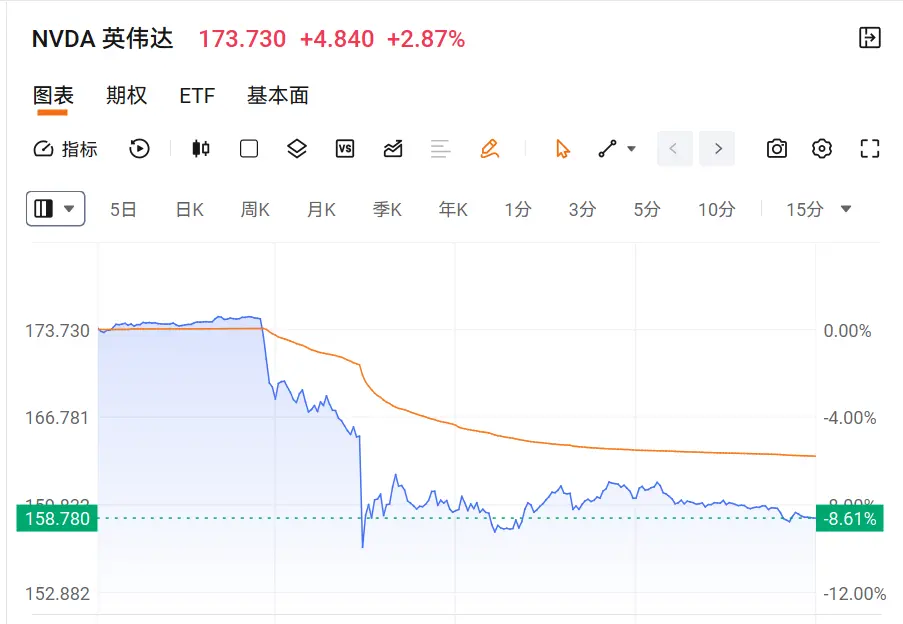
It's believed that various institutions' risk control and valuation models are frantically calculating how much Nvidia would drop if Old Huang loses his position.
Let's calculate it below.
From the level standpoint, if Huang Renxun is really dismissed by the board, this will be a seismic event comparable to Steve Jobs leaving Apple in 1985 in the history of US tech.
In the face of such a significant shock, one can only forcibly strip away all emotional attachments and must rely on pure business physics logic and institutional valuation models.
First, let's talk about the real impact on operations.
Many retail investors are likely to fall into the linear panic of "if Huang Renxun leaves = Nvidia is finished."
But in fact, Nvidia has already become a modern organization with a market capitalization of over 4 trillion dollars and tens of thousands of top engineers.
Its business barriers consist of irreplaceable hardware/ ecological moats, and a high reliance on the strategic dividends of the founder.
In the next 1-2 years, these hardware and ecological moats will not change.
Millions of AI developers and cloud behemoths globally have their underlying code deeply bound to CUDA, and the migration costs are astronomical.
Major clients like Microsoft, Google, Amazon, and Meta will not stop using the H200/Blackwell architecture just because a new CEO is in place.
Already locked in orders and product roadmaps: the development of the Rubin architecture for the next 1 to 2 years has already been finalized, and TSMC's CoWoS advanced packaging capacity has also been secured in advance.
Revenue and free cash flow will not cease just because Old Huang leaves.
In terms of corporate governance, even if Huang Renxun departs, Nvidia still has veteran executives like Colette Kress (CFO) and Jay Puri (Executive Vice President of Global Operations) supporting daily operations.
However, within 2-5 years, the "founder premium" will gradually disappear.
The greatest value of Huang Renxun lies in his boldness to invest in CUDA in 2006 and AI in 2016 when no one believed in it, despite significant losses.
With a professional manager at the helm, the company will become more stable and compliant, but the sharpness of radical innovation will inevitably decline, similar to how Apple operated very efficiently but saw disruptive innovation slow down after Cook replaced Jobs.
Regarding core supply chains, Huang Renxun's personal bargaining power with TSMC, and his close relationships with Morris Chang and Wei Zhejia helped Nvidia secure a substantial amount of rare capacity during times of extreme scarcity.
After the appointment of a professional manager, supply chain negotiations will revert to purely commercial terms, potentially facing a long-term marginal compression of 2%-4% in gross margins.
There is also a risk of losing core technical talent; in the next six months, the market will closely watch whether VPs in hardware and software architecture are poached by competitors (AMD, Broadcom, Google TPU team) with high salaries.
How much does the stock price need to drop to complete the valuation of "dismissing Huang Renxun"?
When Wall Street re-prices tech giants in the event of a "founder’s dismissal," it usually executes a very cold formula of "removing founder premium + governance discount."
During the peak of Huang Renxun’s halo, Nvidia enjoyed a dynamic price-to-earnings ratio (PE) of 30x–35x.
Once the leadership change is confirmed, Wall Street will downgrade it from a “high-growth belief stock” to a “mature monopoly tech cash cow,” compressing its reasonable valuation center to 18x–22x PE, comparable to Broadcom, Qualcomm, or a mature Apple.
The correspondingly specific price valuation ranges are calculated
Combining Nvidia’s current expected earnings per share (EPS), if the dismissal of Huang Renxun is officially announced, the market needs to go through the following three steps to complete the full valuation:
First Step: 145–155 (dynamic PE about 20x-22x)
When the stock price drops to this level, the market will roughly digest the negative impacts of commercial violations and management turmoil.
Second Step: 125–135 (dynamic PE about 17.5x–19x)
If the board officially announces the removal of Huang Renxun from the CEO position, and the new interim CEO has not yet proven themselves, the market will impose an additional 10%–15% transition period uncertainty discount.
This will roughly digest the "personal premium of Huang Renxun," leaving the asset value of locked TSMC capacity, CUDA ecosystem, and several billion dollars in pure cash flow.
Third Step: 110–120 (dynamic PE about 15x–16.5x)
This range falls into a multiple negative shock zone, for example, another leadership change, poor earnings report on November 17 (significant order cuts), the Department of Justice issuing a massive fine of a hundred billion dollars, macroeconomic and liquidity crises, and so on.
The above is just a prediction, and there are unspecified matters; how things will unfold will also depend on other market factors. Therefore, the results are for reference only and do not constitute investment advice.
免责声明:本文章仅代表作者个人观点,不代表本平台的立场和观点。本文章仅供信息分享,不构成对任何人的任何投资建议。用户与作者之间的任何争议,与本平台无关。如网页中刊载的文章或图片涉及侵权,请提供相关的权利证明和身份证明发送邮件到[email protected],本平台相关工作人员将会进行核查。


