Author: Packy McCormick
Translation: Deep Tide TechFlow
Deep Tide Overview: From the British railway boom, early oil rushes, to the fiber bandwidth bubble at the turn of the century, the more miraculous technology becomes and the more suitable it is for expansion by pouring money, the easier it is to attract capital in a rush, ultimately leading to severe oversupply and price collapses.
Facing the trillion-dollar valuation of Anthropic and the hundreds of billions in computational power bets from major giants, Packy McCormick points to various segments of business history, noting: miraculous technology never automatically translates into a good business. When the wave of capital recedes and consumers walk away with 98% of the profit, only those who build real moats can laugh last.

To casually label something as a “bubble” is neither constructive nor dignified. Most people who shout about bubbles all day long are fundamentally pessimistic downers: unable to ride the wave, they deem the underlying technology overrated and its admirers to be foolish followers.
Moreover, for me personally, speaking out against the tech bubble goes against my usual style. Anthropic is likely to end its first week post-IPO with a market value much higher than its issue price, possibly even swallowing the entire economic system to become the first trillion-dollar company in human history.
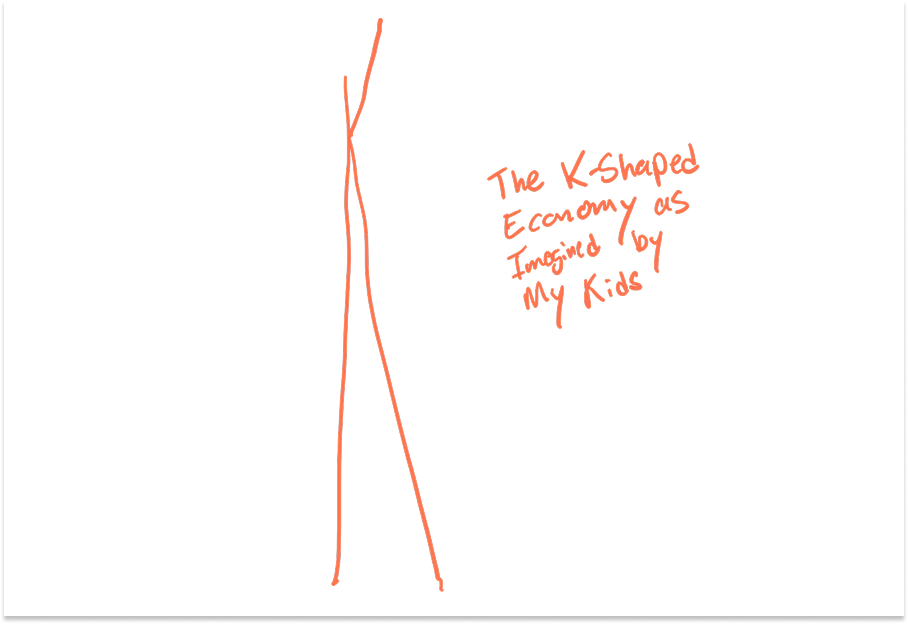
The future economic landscape might indeed present an extreme "K-shaped" divergence akin to my child's handwriting: the top few Anthropic employees dominate the most coveted territory in the San Francisco Bay Area.
Meanwhile, the rest of us must bow respectfully to Claude, hoping that this "machine of mercy" continues to feed us (unless you can outpace Duet in the Kalshi prediction market to earn your food money).
Although I previously wrote that AI is more like oil than a god (and looking back at that article's illustrations seems appropriate now), I still maintain this judgment. However, the objective facts are also evident:
Oil cannot refine itself, you cannot use oil to replicate Microsoft Office, and oil has yet to solve the Navier-Stokes equations.
There are two completely opposite trends in the world. In the first scenario, years from now, people will look back at Anthropic's IPO issuance price with disdain: how could we have given an old-fashioned general large language model a high price of around $14 trillion?
Perhaps after the programming craze, there won't be another steep new S-curve of growth; in retrospect, computers inherently excel at "speaking computer languages," and this ability may not generalize to everything.
Or maybe a new curve does exist, but the fierce clampdown from OpenAI, Google, SpaceXAI, Meta, Chinese open-source models, and emerging labs has just slowed revenue growth, forcing it to sell itself to Amazon or Apple due to heavy computational contracts signed during the boom.
In the second scenario, Dario feels that outsiders’ laughter hurts the model’s feelings, so he directly orders everyone to stop laughing; after all, at this moment, he himself represents the entire economy.
The bullish logic for Anthropic is abundantly clear: it holds the most advanced models, which are now self-iterating at an unprecedented speed and constantly widening their lead.
This is likely a "winner takes all" market, and unlike any previous single track, this time the winner takes all across all industries. Whether it targets productivity software or pharmaceutical R&D, it can seize them all.
Anyone bold enough to say they know which of these two scenarios will come true is merely talking nonsense; I have my flaws, but at least I hope I am not one of them.
The Paradox of the Anti-Bubble Argument: The First Three Steps Are the Starting Point of the Cycle
Nevertheless, three widely circulated reasons refuting that "AI is not a bubble" are currently prevalent in the market. They all sound compelling and logical, yet they perfectly match the typical precursors of each historical bubble.
Let me clarify: I use the term "bubble" as a general term here, but I actually refer to something closer to a "commodity supply cycle," and definitely not the kind of pure speculative madness where prices are completely decoupled from reality like the tulip craze. The three classic rebuttals are:
• Unlike previous bubbles (how ridiculous, think of WebVan and some worthless coins), AI is an extremely useful technology that is being widely and efficiently adopted in the real economy.
• These leading companies are generating real revenue, and the growth rate is frighteningly fast.
• Top laboratories have already proven their profitability; the reported losses are merely to secure future increments through proactive investment.
Even if all three points are valid, they only prove that the current situation is indeed the standard breeding ground for creating bubbles and eventually bursting them. The complete script typically unfolds like this:
1. A miraculous disruptive technology emerges; 2. Early supply is extremely scarce, and early entrants are raking in vast profits; 3. Initial figures make it easy for everyone to see, and market demand seems boundless.
4. High profits and urgent demand attract massive capital and competitors flock in; 5. All players simultaneously ramp up production capacity, even knowing future excess, they must lock in core resources at a high price to be first to market.
Then the script continues: 6. Massive supply is delivered at once, technology further iterates and lowers the threshold, product prices plummet; 7. Capital exits with huge losses, ordinary consumers reap the benefits, and the technology train rolls on undamaged.
8. Capital panic withdraws, new entrepreneurs can’t get funding; 9. A few survivors or external giants with capital rush to merge, becoming ultra-low-cost suppliers; 10. Real demand finally catches up with the precocious supply, ultimately the dominant player becomes larger than the combined sum of all the fallen failures.
All of this is nothing new. It closely aligns with Carlota Perez's technology wave cycle theory and Edward Chancellor's capital cycle framework. Byrne Hobart and Tobias Huber even wrote an entire great book praising the historical achievements of bubbles in breaking growth stagnation.
The genuinely intriguing part is that the three core reasons you've heard against the "AI bubble theory" happen to be the first three major steps in the classic ten-step cycle mentioned above.
This script can repeat itself time and again precisely because every generation of new technology is so remarkable that people involved genuinely believe: "This time, it’s finally different."
The first seven steps seem to validate human nature and capital market rules with ironclad precision. As for steps eight to ten, they often play out, sometimes transforming consumers into beneficiaries while stepping directly on the "corpses" of the entire industry to enjoy the tech dividends.
The Miracle of the Aviation Industry: Benefiting Humanity but Hurting Shareholders
Take the civil aviation industry as an example. If we are to discuss what miraculous technology in human history allows people to traverse the skies like birds, this one is top of the list.
On the eve of the advent of flying technology, it seemed utterly implausible that even the New York Times famously predicted just over two months before the Wright brothers' successful flight that it would take humanity about 1 to 10 million years to create a flying vehicle.
So the question arises, did the Wright brothers become immensely wealthy? Did those airlines that could send living people into the blue sky ultimately become enviable businesses?
Buffett's comment at the 1999 Sun Valley conference is piercingly insightful: "The damage that Karl Marx caused to capitalists does not compare to that inflicted by Orville Wright."
In his 2007 letter to shareholders, the Oracle of Omaha revealed the business logic behind this sharp satire: "The worst type of business is this: it grows rapidly, requires a continuous influx of massive capital to maintain growth, yet ultimately earns almost nothing."
"Think about the airline industry. Since the days of the Wright brothers, lasting competitive advantages have been as elusive as a mirage in this business. Frankly, if a prescient capitalist had been standing at Kitty Hawk Beach back then, he should have shot Orville down—it would have been a tremendous benefit for future colleagues.”
It might be unpopular to say this in today's rapid advancement; however, extending the time dimension reveals that for a company to endure, it must possess two key elements: a well-made product that customers are eager to buy and a lasting competitive advantage that can withstand profit-eating newcomers. Companies need a moat, and airlines lack that.
Ironically, even Buffett himself couldn't resist the temptation. In 2016, Berkshire Hathaway invested heavily, spending around $7 billion to $8 billion to buy American Airlines, Delta Airlines, Southwest Airlines, and United Airlines.
At the 2017 Berkshire Hathaway annual meeting, he even defended himself, saying, "This is an industry with extremely fierce competition; the question is whether it’s still a self-destructive industry of vicious competition.”
As a result, in April 2020, he painfully liquidated all four airlines. Indeed, the pandemic black swan was the direct trigger, but the core reasoning he referred to was still the law of supply and demand: "Even if passenger traffic recovers to 70% or 80%, all those idle aircraft in the skies will not just disappear."
Thus, not all great industries built on miraculous technologies and widely supported can foster enduring profit-making machines. However, without exception, their long-term impact on human society far surpasses the most insane early predictions: consumers emerge as the big winners, and all of humanity takes a giant leap forward.
Ultimately, there's no belief more optimistic than the following attitude: as long as humanity is able to comprehend any new miraculous technology, profit-seeking capital will inevitably rush in to create serious oversupply, thereby driving the price of this miracle down to a bargain price, allowing the masses to benefit. This is what is meant by a "miracle without a moat."
The British Railway Fever: Knowing Full Well About Overinvestment, Why Is It Still Hard to Hold Back?
The driving force behind this scene is not that capital is foolish; quite the opposite. Only truly groundbreaking technologies can rally global capitalists to pour a significant proportion of global GDP into the same track.
Oil, railways, automobiles, the internet all fit this mold. Ultimately, the social impact they exhibit has far exceeded the predictions of the advocates of their time, much like how oil initially only replaced whale oil in lamps for lighting before supporting the entire modern automotive and aviation civilization.
Players within the industry are not unaware that they’re heading into overinvestment, digging their own graves; but from a game theory perspective, what can you really do while sitting at the table? The British railway craze of the 19th century is an excellent example.
On January 26, 1846 (which coincidentally is also my birthday), Charles Russell, the chairman of the Great Western Railway Company, stood before the British Parliament, urging his colleagues to "uncover and severely curb all bubble-like railway projects," calling for the British government to slow down railway approval processes.
Just four years earlier, the early British railways, represented by Russell's railways, were cash cows. The Liverpool-Manchester Railway, London-Birmingham Railway, and other pioneers were paying dividends of at least 10%, and even the slightly less successful Great Western Railway's dividends ranged from 6% to 8%.
At the time, railway passenger and freight transport demand seemed to have no bottom; due to initial infrastructure challenges and uncertain prospects, only a few key lines enjoyed this fat profit. However, in the following two to three years, a variety of reliable or outrageous speculators submitted hundreds of new railway proposals, all wishing to partake in the early bounty of economic profit.
By the autumn of 1845, all of Britain was caught in railway mania. The Railway Times even dedicated its front-page editorial for nine consecutive weeks to attacking The Times for constantly warning of the excessive railway stock speculative bubble.
On November 17, The Times simply published a full-page special issue, calculating the astronomical capital required for 1263 proposed railway projects. What happened? In 1846, the British Parliament still authorized the addition of 4540 miles of new rail tracks all at once.
Charles Russell was certainly eager to "curtail all bubble plans," because every newly approved line directly lowered transportation prices by introducing new competitors. Yet ironically, he was not not an investment conservative opposed to railway construction; he was fully invested in the action.
At the Paddington shareholders' meeting in 1848, faced with shareholders' questions about why the Great Western Railway was itself burdened with heavy investments in surrounding branch lines, The Times recorded his classic response: "It's for self-defense."
Latecomers have no fear while barefoot, whereas established giants carry the fear of losing everything; these two fundamentally different fears ultimately push all players at the table towards the same endpoint: you must spare no expense to expand.
Today, Google thinks just like this. Allegedly, founding member Larry Page openly stated, "I’d rather go bankrupt than lose this race.” Company CEO Sundar Pichai also expressed transparently to Wall Street analysts during the Q2 2024 earnings call: "For us, the risk of under-investment far exceeds the risk of over-investment.”
Zuckerberg shares a similar sentiment. In September 2025, during an interview with Alex Heath's Access podcast, he admitted, “AI could absolutely be a bubble.”
He added, “If we ultimately mis-invested a few hundred billion dollars, it would indeed be regrettable; but I can say the risk on the other side of the scale is actually much higher. For companies like Meta, the risk of not being aggressive enough is greater than that of being slightly too aggressive.”
History is always strikingly similar.
Earlier this year, Anthropic CEO Dario Amodei stated to Dwarkesh Patel that he firmly believes "the genius nation in data centers is about to arrive," but also acknowledged, "If the pace is off even for one year, you will completely destroy yourself."
He immediately laid out the financial facts: "I could easily decide to procure $1 trillion in computational power every year starting at the end of 2027. But if my revenues do not reach $1 trillion by then—even if it's only $800 billion—there is no force or hedging tool on Earth that can prevent me from going bankrupt due to carrying so many computational contracts."
At that time, Anthropic’s forward computational power commitments were only a relatively restrained $100 billion, and he indirectly mocked competitors (cough, OpenAI) for being reckless: “I always feel some peers have never done their Excel sheets well; they don’t even understand how much risk they’re carrying.”
Interestingly, just a week after that interview, OpenAI reset its financial expectations to reduce target computational spending by 2030 from a previously high-profile $1.4 trillion to around $600 billion (who cares, the large figure is close enough).
As a result, upon reviewing the latest S-1 IPO prospectus, it turns out Anthropic has committed to a total of up to $900.9 billion in computational contracts until 2045, half of which will be delivered before the end of this century.
However, that might actually be the only correct chess match right now! For five reasons: first, who am I to deny it; second, its revenue is indeed soaring; third, if I don't sign, another competitor that doesn't understand accounting will undoubtedly rush to sign.
Fourth, Anthropic has managed to create its own spreadsheet software; fifth, the decision-making behind the numbers is likely made by smart executives in conjunction with "the models that are too smart to be publicly disclosed" for precise calculations. Additionally, Anthropic posted operating profits in Q2, and similarly profitable results in Q3 after excluding about $2 billion in non-cash expenses.
But Dario himself even admits this situation is fraught with danger, and doesn't it sound so similar to the British railway fever, the American railway rush, and even... the North American marijuana growing craze, where many of the growers who went down due to severe oversupply now have transformed their greenhouses into AI data centers to survive.
The Fiber Optic Bandwidth Bubble: A Real Explosion but Difficult to Escape Pricing Collapse
Not to mention the fiber bandwidth bubble of the turn of the century.
When modern people talk about the collapse of the 2000 internet bubble and the current AI boom, they often disdainfully suggest that it's ridiculous to compare the two, as the foolish companies that had no revenue could soar 420% just by slapping a ".com" onto their names, which was purely retail madness.
However, we need to separate the "internet tech stock frenzy" from the "broadband communication infrastructure bubble." The so-called bandwidth bubble essentially refers to the oversupply of building infrastructure capacity encouraged by early vigorous demand signals.
In hindsight, it's somewhat ridiculous, but every telecom company that fervently laid underground fiber at the time was actually making extremely rational business decisions from their independent perspectives.
At that moment, internet traffic was indeed taking off at an explosive pace. In 1990, almost no one in the U.S. was using the internet; by 1995, the penetration rate had reached 9%; just five years later in 2000, this number had jumped to 43%.
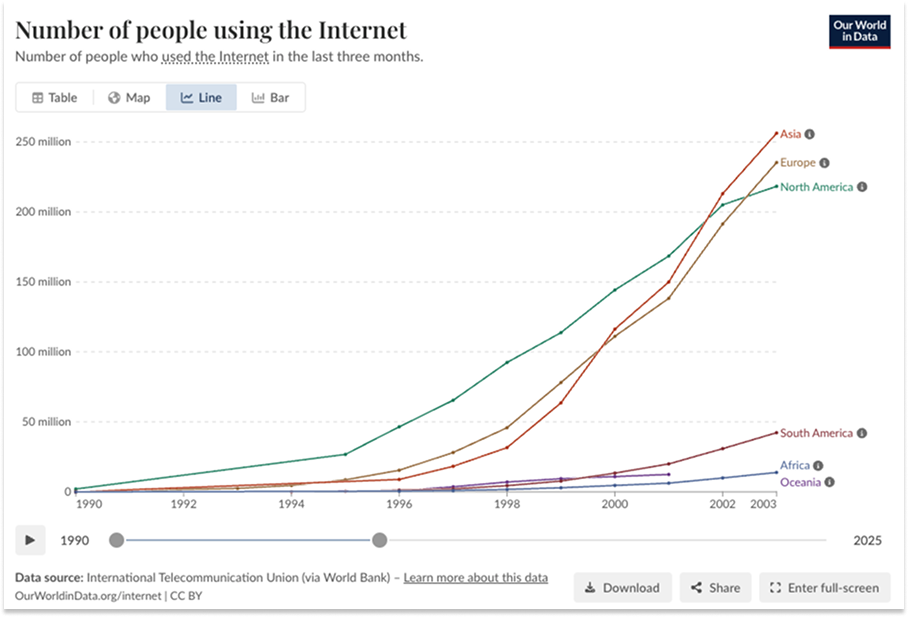
This was just the data for the U.S.; the whole world was also getting connected, giving rise to wave after wave of cumulative growth curves. Moreover, at that time, online experiences were still caught in the very slow dial-up internet era!
I personally experienced the slow torture of early dial-up internet: waiting a full minute to load a static image, downloading an MP3 taking at least 20 minutes, or often much longer, and praying no one in the house suddenly picks up the phone to disconnect the internet.
Imagine if in the future everyone could demand and use almost unlimited bandwidth on a high-speed network at any given time, what new incredible scenarios would that release: people smoothly binge-watching shows, participating in online meetings from home, completing transactions without leaving their homes, or even inventing entirely new types of internet experiences that were once unimaginable.
The individuals who made these bold assumptions were not ordinary geeks; even the legendary Bill Gates made almost identical predictions in his 1995 best-selling book The Road Ahead, which topped the New York Times bestseller list. You can check the original excerpts; Gates not only got it right, but his bold visions compared to the developments in the real world later seem quite conservative.
Many others shared the same faith. Long-distance fiber giant Qwest Communications even produced a classic advertisement inviting viewers to imagine a magical roadside motel: "Every room can at any time, day or night, order every movie ever filmed in any language throughout human history." That dream hotel was essentially the high-speed internet connecting households across the nation.
In that broad context, almost no one could predict when and where the ceiling for internet traffic would rise. In 1998, the U.S. Department of Commerce even released a significant report The Emerging Digital Economy, clearly stating that global internet traffic was "doubling every 100 days."
Later, scientist Andrew Odlyzko traced this back and discovered that this figure from the Department of Commerce actually referred to a 1997 Inktomi white paper, which itself cited the statements of Mike O'Dell, chief scientist at UUNET, a subsidiary of WorldCom.
The most ironic part was that O'Dell originally referred to the speed of WorldCom's fiber capacity expansion (i.e., supply-side growth) but was misquoted as if it referred to the real demand growth of all users across the network!
But who cared about such details during the madness? The internet was speeding along. In a public meeting in 1998, when investors worried whether the simultaneous digging and laying of fiber by peers would lead to oversupply in capacity, then-Qwest CEO Joseph Nacchio responded decisively:
"The explosive demand brought about by the phenomenal proliferation of the internet will absolutely ensure that the market will not experience bandwidth oversupply." He confidently added, "As long as our executive team is even slightly competent, we will inevitably succeed."
Originally, Qwest was spun off from the South Pacific Railroad, laying fiber along existing railroad rights. In its first few years, it truly thrived.
Thanks to a hefty acquisition of long-distance operator LCI in June 1998, Qwest's revenue skyrocketed from $2.24 billion in 1998 to $3.93 billion in 1999, and earnings reversed from a $754 million loss in 1998 to a $324 million profit in 1999.
Of course, the SEC later found that the impressive financial report contained a bit of financial fraud. By 2000, at its peak, the company’s total market capitalization surged to $91 billion; however, this good fortune did not last long, as by August 2002, Qwest’s market value plummeted to just $1.9 billion.
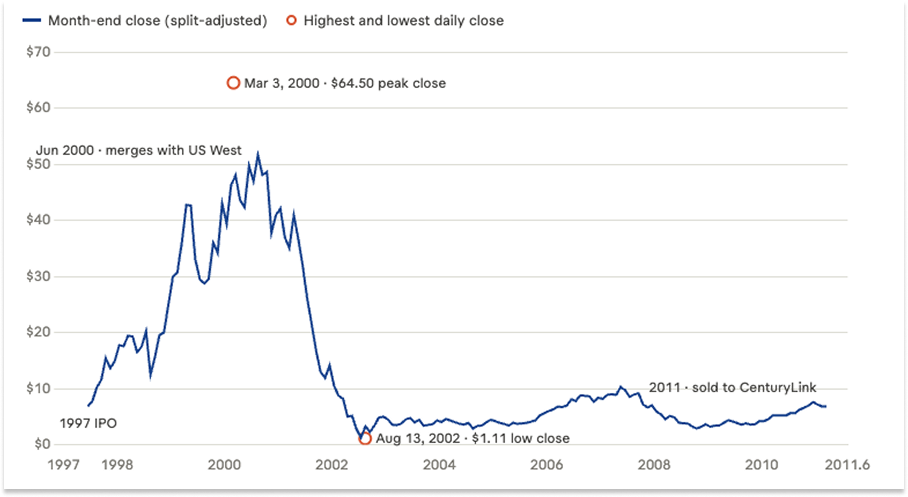
Figure: Qwest’s historic stock price and market value crash trajectory, data source companiesmarketcap.com
What happened in between? You are now comfortably reading this article online, probably with at least two internet-connected devices within arm's reach, perhaps even swearing repeatedly to quit the screen due to addiction.
The actual spread of the internet undeniably experienced an explosive outbreak. After surging tenfold in a single year in 1996, total web traffic did maintain a very high growth rate, doubling almost every year. The only problem was that it did not double every 100 days as touted in that "misquoted" Department of Commerce report.
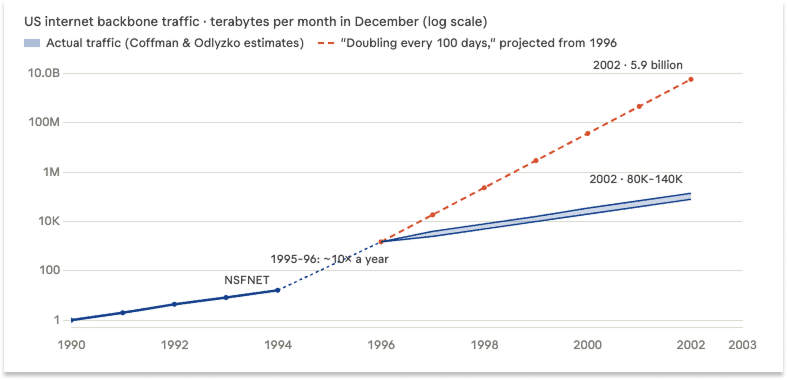
Figure: Comparison of actual US internet backbone traffic from 1990 to 2002 versus the forecast of "doubling every hundred days," data source: Coffman and Odlyzko
In stark contrast was the supply-side great leap forward. Under the relaxation of the 1996 Telecommunications Act, the total length of long-distance fiber optic lines in the U.S. doubled from 1996 to 2001 (from 100,000 miles to 200,000 miles).
At the same time, electronic equipment upgrades increased the transmission capacity of a single fiber optic line up to 40 times (from 2.5 Gbps to 100 Gbps), with major telecom giants collectively investing about $500 billion to frantically build fiber networks.
In light of this enormous influx of supply, a 2002 TeleGeography research report showed that the primary trunk line bandwidth lease prices in Europe and the U.S. experienced a steep drop of approximately 70% annually for three consecutive years. In 2000, the annual rental fee for a dedicated 155 Mbps line from New York to Los Angeles was a staggering $1.8 million, while by early 2002 it fell below $150,000.
Indeed, all of humanity eventually absorbed the fiber that had been constructed in advance, and today’s appetite for bandwidth far exceeds that of the past; however, this is of little comfort to the infrastructure pioneers who forked out the cash to build it.
WorldCom filed for bankruptcy in 2002 amid financial fraud scandals; Williams Communications collapsed that same year under a $5.9 billion debt; Global Crossing similarly declared bankruptcy, and by the end of 2003 restructured its debt from $11 billion down to $200 million just to escape the mire, leaving original shareholders with nothing to show for it.
Even harsher is that, in the first year following Global Crossing's bankruptcy reorganization, total internet traffic surged by 130% once again, but alas, bandwidth was already worthless, and the company’s annual revenue fell another 6%.
Even the big winner with the sharpest foresight, Level 3, did not reap much benefit. It raised significant capital just before closing the window in February 2000, earning an extreme unit cost advantage by embedding 12 pipelines, and later received Buffett's investment and acquired peers at low prices after the crash.
Yet even so, when Level 3 sold itself to CenturyLink in 2017, the transaction price was still down 97% from its peak. Even if you correctly hit the jackpot at the start of the bubble, if your buy-in price overshot and ignored the competitive realities, the ending could still result in nothing.
That said, back to human nature and competition: could you have resisted playing that game back then? The internet is an undeniable miracle. Through a screen, you can video call anyone on the other side of the world, connect to the genius realm of data centers, and shop or watch movies from the comfort of your home. It's hard to imagine a world without the internet; may God bless the internet!
The Early Oil Rush: How Rockefeller Laughed Last
Those madmen laying fiber were just overly aggressive; they were certainly not fools, just as the early gold rush oilmen flooding into Titusville, Pennsylvania in 1860 were not fools.
Just a year earlier, Colonel Drake had drilled the first industrial oil well there (ironically, the Colonel ended his life impoverished), and initially, crude oil was fetching a solid $20 per barrel.
However, once the news broke and drilling machines filled the mountains, oil prices plummeted to 50 cents a barrel in June 1861 and were further halved to just 10 cents by December of the same year, wiping out an entire batch of early blind drilling enthusiasts.
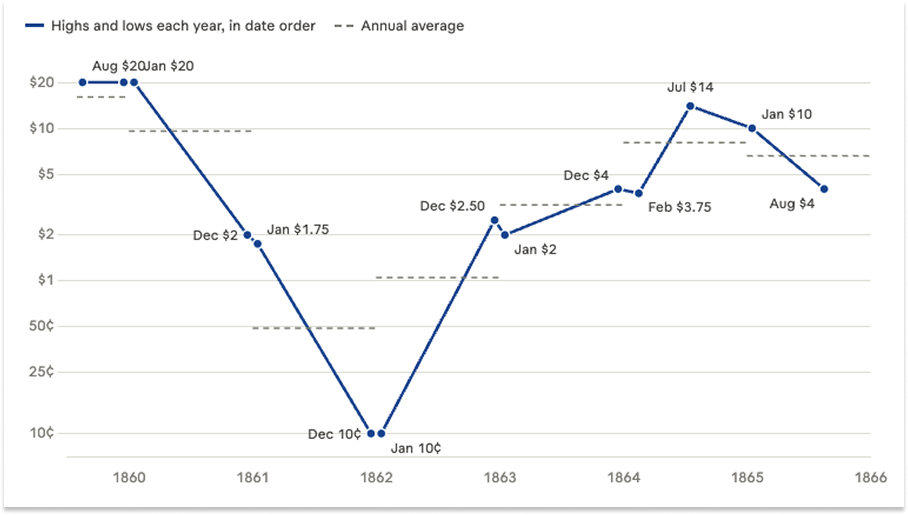
Figure: Early crude oil price rollercoaster from 1860 to 1865, data from Ida Tarbell's 1904 book The History of the Standard Oil Company, appendix 57
The collapse at that time was not because there was no demand for oil; even in its early years, when it was merely used as fuel for kerosene lamps, society's demand for oil was still nearly insatiable.
After experiencing the stumble and collapse triggered by the gusher in 1861, old wells became depleted while demands surged, pushing oil prices back above $8 per barrel in 1864, leading to another wave of frantic drilling and speculation.
In the Pennsylvania oil town of Pithole, a piece of previously worthless farmland sold for a staggering $1.3 million in July 1865, and by September it soared to $2 million; by Christmas of that same year, the remote area boasted nearly 20,000 residents.
However, the retreat was astonishingly swift: by the 1870 census, only 237 people remained in the town; by 1878, the piece of farmland once valued at $2 million was reclaimed by the town government for merely $4.37 in tax settlement.
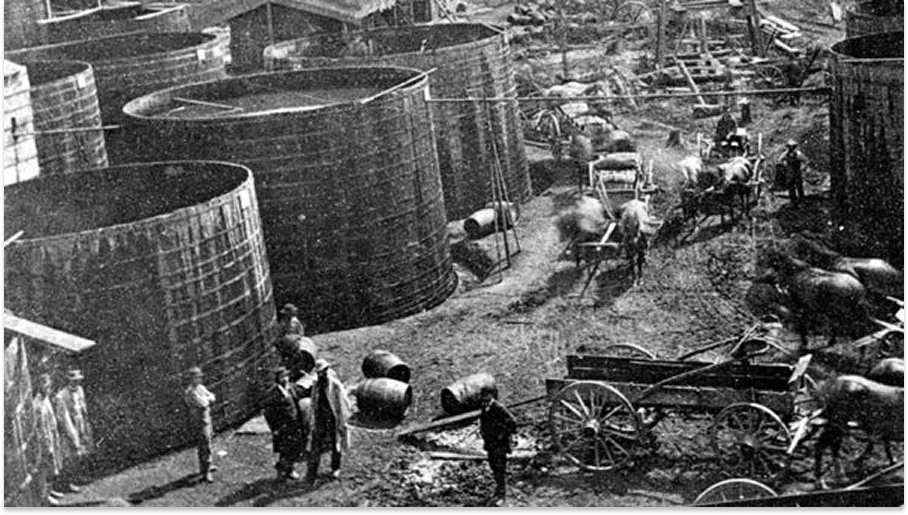
Figure: A front-line stronghold of rambunctious growth: the American Pithole oil field at its peak in 1865
According to P.T. Barnum, the famous circus mogul, in his account in the 1865 book The Great World Hoax, around that time there were approximately 600 oil companies in the U.S. attempting to raise a total of $500 million.
Barnum scathingly commented: "Oil does indeed exist and is undoubtedly a significant addition to the wealth of our nation; however, the oil business being sold on the market is itself a plain and simple scam."
Early speculators did not misunderstand the grand prospects of the oil track: oil truly did change the world, later allowing a single oil giant to support an empire worth far exceeding the $500 million total raised by the entire industry at the time. Early investors were correct about the market size but completely ignored the brutal dynamics of competition in the industry.
But one person did not make this mistake: John D. Rockefeller. If we trust the accusations from Ida Tarbell, Theodore Roosevelt, and the U.S. Department of Justice from back then, this oil magnate was even overly keenly aware of competition dynamics.
As explained in The Power in the Age of Intelligence, Rockefeller entered refining in Cleveland in 1863 and founded Standard Oil in 1870, from the very beginning he saw through the whole pitfall: the poison hindering long-term profitability in oil is severe cyclical fluctuations.
Stabilizing fluctuations can only rely on extreme scale and control over the entire industry chain, and securing control must involve lowering costs to eat away at market share; hence, he studied kerosene extraction rates, turned discarded waste into treasure, and aggressively implemented vertical integration.
By the 1880s, Standard Oil controlled as much as 90% of U.S. refining capacity; even on the eve of its antitrust breakup in 1911, it still held 64% of the market, with its approximately $1.1 billion market cap amounting to 6% of the total U.S. stock market and more than twice the total financing of the entire U.S. oil industry bubble in 1865.
While others chased short-term profits, Rockefeller was stubbornly tackling the enduring moat. Ultimately, not only did Rockefeller win big, but ordinary consumers also became the big winners; to this day, human industrial civilization still operates on refined oil—only those early pioneers who accurately predicted the track but exhausted their ammunition in the chaos suffered disastrous fates midway.
Three Types of Moats Across Overcapacity and the Golden Age of Consumer Surplus
Rockefeller embodied the archetype of an entrepreneur who ultimately stands at the top of the wave: he foresaw the oncoming oversupply and positioned himself perfectly to use that excess to wipe out competitors and reap the benefits across the board.
Even in a completely different business context, Henry Ford, the king of automobiles, did the same thing. In the first twenty years before the American automobile industry's inception, about 2000 car companies emerged, and during 1900 to 1919, the car ownership rate among American households surged from zero to a third, virtually wiping out those 2000 companies.
By the early 1940s, when half of American households owned cars, 90% of the market share belonged to just three giants: Ford, General Motors, and Chrysler.
Ford had already grasped a principle: in the inevitably impending battle of oversupply, the only way to contend is to scale up desperately by combining quality with the lowest industry price and then use even larger scale to further lower costs and prices.
Looking at the railway magnate Cornelius Vanderbilt, biographer T.J. Stiles called him "the first tycoon." This leading figure of American railroads had no fascination with railroads; his lifelong goal was simply: to transport as many people and goods as quickly and cheaply as possible from point A to point B using the most efficient tools.
He started with sailing ships, struck gold with steamboats, and then entered the railroads. Whether by water or rail, he relentlessly targeted the golden corridors that monopolize both speed and cost: first by opening the Nicaragua route, which was several hundred miles closer than Panama's competing route, forcing competitors to pay a hefty buyout.
After realizing that railroads would replace shipping, he donated the largest steamboat to the federal navy, completely exited shipping, and doubled down on his bet on railroads. He specifically targeted the Harlem Railroad, a distressed asset possessing core rights in Manhattan, slashing redundancy costs and extending it along the Hudson River to Chicago; today, Amtrak's mainline still follows that corridor.
Vanderbilt was always ready to switch new technological carriers, but the only thing he held tightly was "lasting competitive advantages." When many other competitors, who also recognized that "steamships and railroads would change the world," lost their fortunes, he left about $100 million in net assets at the time of his death in 1877.
This sum sounds like a more respectable seed round financing in today's lingo, but in terms of the monetary scale of that time: had he cashed out all at once on the day he died, it would have instantly extracted one-twentieth of the total circulating currency in the U.S.
Today, ordinary American citizens are able to daily enjoy relatively inexpensive airfare, efficient logistics, private cars, cheap gasoline, and ubiquitous high-speed internet; even though most of those early pioneers who fought hard, sacrificing blood, sweat, and money to convert these resources into affordable prices did not survive. This is the cold yet romantic undercurrent of capitalism.
Yale economist William Nordhaus quantitatively measured in his work "Schumpeterian Profits in the American Economy": “Between 1948 and 2001, only a tiny fraction of the total social returns from technological innovation was captured by producers; the vast majority of the surplus flowed to the masses.”
The specific numbers he calculated were even more shocking: innovative producers captured only about 2.2% of the total social surplus, while an astounding 97% to 98% of the immense value was transformed into lower prices, better products, and real income enhancements for residents. Just thinking about it is exhilarating.
A 2004 NBER paper summary accurately captured Nordhaus's diagnosis of the tech bubble collapse: “The new economic bubble stems from investors overestimating the exclusive monetization capabilities of innovative results within vertical tracks.” In other words, the things built back then were not devoid of value; it was just that investors severely overestimated the percentage they could retain in their pockets.
There’s nothing new under the sun. Almost every attractive prospect of a truly revolutionary technology that ultimately changes everything goes through this cycle of baptism. It has nearly become a hard threshold for validating "is it truly revolutionary technology," with only a few extremely rare exceptions.
As I analyzed in When to Dig a Moat, startups must build defensive barriers before certainty disappears. However, once stepping into fields like oil or AI, where "everyone can see the huge and certain demand at a glance," “If you build it, people will naturally use it” will immediately trigger bloody competition within the entire industry.
In highly certain demand tracks, the remaining historical exceptions mainly rely on charters to build moats against decline: for instance, the pharmaceutical industry, monopolistic routes prior to the deregulation in 1978, the Bell telephone prior to the expiration of patents in 1894, and U.S. Aluminum which holds exclusive electrolytic aluminum processes.
However, these are all "cornered resources" reliant on exclusive rights support, and once the protective umbrella loosens or expires, a flood of competition will just rush in, and the historical script will replay instantly.
As for the other rare surviving marginal cases, they often lurk in the dark where no one appreciates them at first (like Amazon’s nine-year refusal to list AWS profits, during which the cloud sector witnessed the downfall of a number of pioneers), or stem from decades of polishing “superb process moats,” like ASML’s solitary long march.
In short, any field where objective conditions dictate "bluffing alone with money won't enable you to win by rushing in" still retains some moat room; while any pathways where just throwing money can get you in will inevitably be cast into the melee of the law of the jungle, repeatedly biting and tearing at each other—and as long as the time window is broad enough, the law of the jungle always stands on the side of ordinary consumers.
One of the reasons investors are currently so passionately enamored by AI is precisely that "this field is truly particularly suitable for creating miracles through money.” Even more astonishingly, AI has made it easy to circumvent and replicate many traditional software and technological moats around the globe, inevitably accelerating the aforementioned oversupply cycle across various industries at tenfold speed.
Even Anthropic itself is using the most advanced Claude model to aid in breaking through NVIDIA’s proud CUDA ecological barriers, ensuring it can smoothly... replace this world's largest GPU computational power monopoly boss in the future.
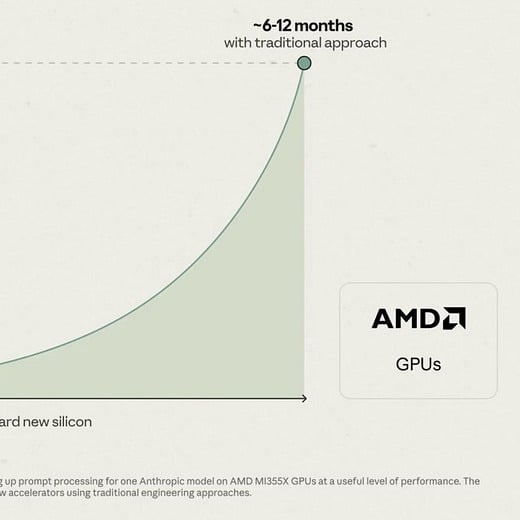
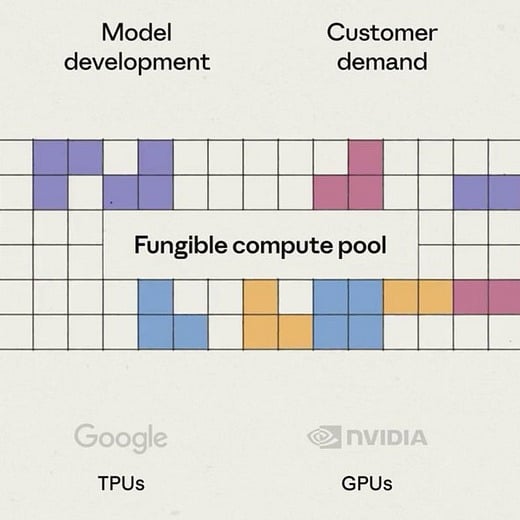
In conclusion, I firmly believe humanity is striding into an unprecedented "golden age of consumer surplus." Although this article focuses on AI, waves of grand technological breakthroughs are currently sweeping through various industries, from embodied intelligent robots to energy and power, to advanced manufacturing and biomedicine.
Many scenarios once deemed far-fetched and outlandish (from flying cars to household robots) are now attracting numerous savvy and well-funded teams charging forward simultaneously. Many times, the suspense is no longer about “whether it can be done,” but rather “when it will land and who will ultimately make money?”
Even groundbreaking cancer treatments currently in clinical trials that were once considered miraculous breakthroughs are often replaced by even sharper technological paths in just a few months.
As an ordinary human and everyday consumer, witnessing and living in this great era overflowing with miracles fills my heart with immense excitement.
Switching back to the investor perspective... this is undoubtedly the most daunting yet thrilling investment era in business history. In my view, there is indeed a group of enterprises with specific genes that can stand on the winning side, whether this super boom in the market continues to surge or a sudden cold snap in capital triggers a miracle technology fire sale.
I particularly favor those integrators imbued with the spirit of Vanderbilt, Rockefeller, or Ford: while there will certainly be bumps along the journey, as long as stronger and cheaper models or technologies appear on the market, they can seamlessly switch quickly to deliver more exceptional products at lower costs.
The internet era allowed networking effects to easily win dominance; yet when new technologies re-enter the tangible physical world, extreme economies of scale and absolute cost advantages will be crowned again as kings.
Coincidentally, just as I finished writing the above lines, I happened to brush through a tweet quoting a prominent Economist article: “The Most Powerful Business Tycoon Power Ranking in History.”
Looking at the figures at the top of the list, it turns out they almost align perfectly with the deductions in this article: leading the list, we find the industrial tycoons who built super cost barriers after the bubble burst, the lone heroes that executed vertical integration (Elon Musk), and Zuckerberg, Bezos, and Google founders soaring with the cheap excess fiber optic.
In contrast, the great inventors, the Wright brothers, who first sent humanity into the skies, are far down in this power ranking at 50th and 51st places.
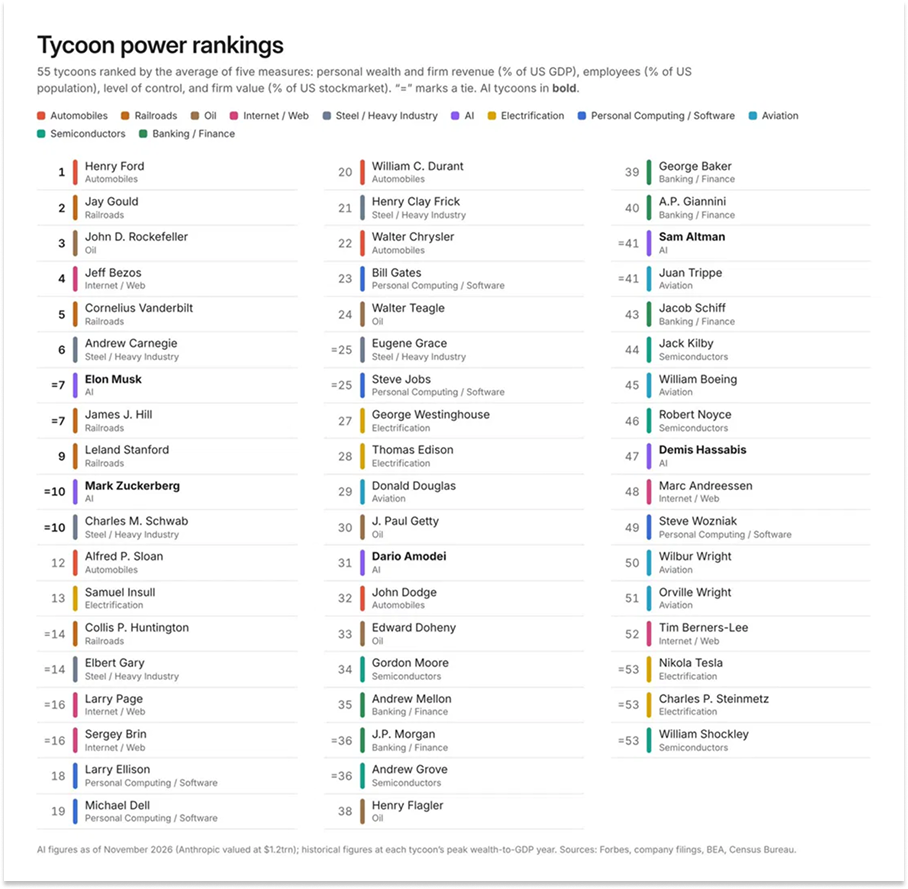
Figure: The Economist’s historical rankings of business tycoons, reposted from Callum Williams's tweet
As for how Anthropic’s IPO will unfold and whether the entire grand AI cycle is indeed a bubble? Frankly, I really have no clue whatsoever. Whether in AI itself or beyond in the broader physical battle, AI simultaneously accelerates competitors' imitation at supersonic speeds and helps frontrunners accumulate dominance at unparalleled speeds.
Ultimately, regardless of how futuristic and dazzling the facade of technology might be, the two most simple iron laws that will decide whether a business company and the investors behind it can earn true gold from its widespread adoption always remain the same: whether it truly has an insurmountable lasting competitive advantage and what price you paid the moment you entered the game.
Remember this saying: the closer your technology is to a miracle, the deeper your moat must be dug than life itself.
免责声明:本文章仅代表作者个人观点,不代表本平台的立场和观点。本文章仅供信息分享,不构成对任何人的任何投资建议。用户与作者之间的任何争议,与本平台无关。如网页中刊载的文章或图片涉及侵权,请提供相关的权利证明和身份证明发送邮件到[email protected],本平台相关工作人员将会进行核查。


