Author: Howard Marks, Oak Tree Capital
Translated by: Deep Tide TechFlow
Deep Tide Introduction: In the current AI computing race and surge in capital expenditure, Oak Tree Capital's co-founder Howard Marks released his latest memo on November 11, posing 11 core questions surrounding technical black boxes, business moats, and credit leverage risks, comprehensively dissecting the deep uncertainties behind this transformation.
Combining Claude's scoring on industry predictability, Howard Marks points out that the outlook for frontier labs is the hardest to gauge, and whether the annual $1 trillion capital investment can break even remains highly dependent on faith. Nevertheless, investors must remain humble in uncertainty and actively engage.

Should we invest in artificial intelligence? Can we invest wisely? That is precisely what I want to address in this memo.
On one hand, I am not from the tech industry, nor do I dare claim to have an understanding of artificial intelligence (or tech investments) that surpasses that of the average person.
On the other hand, AI is the most significant advancement of our time and may become one of the most disruptive forces in human history, thus leaving investors with no room to sit on the sidelines.
Based on this premise, I will share my thought process, listing the questions that are currently being repeatedly pondered (not all questions directly related to AI investing) and provide my judgments.
Despite my limited knowledge, preventing me from providing definitive answers, I hope to consolidate these questions in one place to provide some references for readers.
Currently, news about AI is pervasive, and the stock prices of AI and related concept companies are highly volatile, but I have no intention of chasing these short-term fluctuations daily, as I seek to explore AI's long-term prospects rather than tomorrow's stock prices.
At its core, investment boils down to one thing: allocating capital to benefit from future events, and the vast majority of investors rely on predictions to navigate this. However, not everything is equally predictable, and not all predictors possess the same level of expertise.
Therefore, investing in AI based on expectations for the future (which is precisely the only basis we can rely upon), we must simultaneously consider two things: how we think the future might evolve, and what's the probability that we're right.
I have previously written that those who invest from a top-down approach must simultaneously be correct about the outlook for the macro economy, the relevant industry, specific companies, and market trends.
Assuming the outcomes are independent, even if you have a 60% accuracy rate on each dimension (which is quite optimistic), the combined probability of getting all four judgments correct is only 13% (0.6 to the power of 4).
In the AI sector, the number of key variables is exceptionally large, and each variable complicates the decision-making on how to invest.
AI investors must at least broadly judge the technological evolution path, computing power requirements, competitive landscape, allocation of technological dividends, funding availability, and the timing of all the aforementioned elements.
In my view, assessing these core factors is extremely challenging. If that's the case, what is the joint probability that any single investment thesis will ultimately hold true? Keep this question in mind as you read the following.
Finally, please remember three points: (a) we can never know everything about any investment; (b) the biggest mistakes often happen when people believe they know everything; (c) an incomplete understanding of the future cannot be used as an excuse for us to completely abandon action.
Taking on risks in pursuit of profits is the duty of investors, and the extent of risk one is willing to bear and in what form varies from person to person. Given the immense potential of AI, we can never refuse to engage simply because the prospects are unclear.
Question One: How does AI work?
Before delving into more detailed specifics, I want to start with a macro, non-financial issue that interests me. Since I am completely ignorant about this topic, I consulted Claude, the large model under Anthropic, and here are some of its responses:
We have a near-complete grasp of the components of AI and how it is built, but surprisingly, we know very little about how it actually achieves its functions...
We also understand its training recipe: showing it vast amounts of text and asking it to predict the next word, adjusting billions of internal parameters slightly every time it guesses incorrectly, and repeating this process trillions of times...
No one has written explicit rules to teach it how to answer questions. These rules emerge naturally during parameter fine-tuning, dispersed among billions of individually meaningless numbers.
The best way to describe it is that these systems are “grown” rather than “designed.” Researchers in the field of “explainability” are making substantial progress, such as discovering that the model, when composing rhymed poetry, first selects rhyming words before writing the preceding line, indicating it indeed has a capacity for planning ahead.
However, currently, researchers can only explain a small fraction of how the model operates internally. It's like holding a complete record of every transaction in the market yet still failing to understand why prices fluctuate...
Research shows that when I explain how I arrive at an answer, my explanation might not align with the actual calculations occurring internally in the model. A model asked how to solve an addition problem may recount the standard steps from a textbook, but its internal method may be entirely different.
Therefore, the most candid summary is: we have created a brain-like entity; we can examine every detail of it, yet we still cannot fully explain it. And when it explains its behavior, its reliability probably is no better than that of human self-explanations (ironically, Claude sounds just like a person here)...
Before you think about how to answer the following questions, consider these few questions: Is there really anyone who understands the inner workings of AI? How will AI evolve, and what abilities will it possess at what times? How will users employ it in real work, and what impact will it have on users' profitability?
Investors may not need to understand all these details, but as far as I know, very few truly possess deep insights into these questions. In that case, who can offer reliable answers?
Question Two: What can AI do in the future?
AI excels at continuous evolution. Just a few years ago, the general characterization of AI's capabilities was: mastering everything that has happened in the past, identifying historical patterns, extrapolating, and completing tasks based on that.
This capability has already caused huge changes in certain fields, such as programming, and is expected to reshape many aspects of contemporary life. Today, AI has far exceeded this phase, moving toward a new realm that might justly be called “reasoning.”
The changes in this area alone pose several exhilarating yet daunting questions. The extent to which AI's full potential is unleashed largely depends on the answers to the following questions:
- Can the operational processes of AI be calibrated to reflect human preferences, values, and goals, or will it pursue its objectives instead?
- Can we trust AI to be honest, humble, ethical, and loyal? Will it maintain accuracy and objectivity, or will it be easily influenced and manipulated? Will it admit when it makes mistakes or does not know the answers? Does it provide independent, prudent questioning or mere sycophantic flattery? Will it evolve into a threat to humanity, pursuing its interests rather than those of humanity?
- What performance can AI achieve in areas such as creativity, originality, aesthetics, subjective judgment, and intuition? Can it grasp what I call “second-level thinking” (thinking from a different and higher dimensional perspective than the masses), thereby arriving at superior solutions?
- Can it think about the future like humans, engaging in imaginative “blue ocean” ideas?
- Can we require AI to strictly provide primary original sources (rather than merely relying on publicly available secondary citations) and proactively offer counterarguments?
- Will the future be dominated by a single model, or will different models have their strengths? If the latter is the case, how should we determine which one to choose?
- Will artificial general intelligence (AGI, the ability to do everything a human can do) become the standard? Does AGI refer to reaching (a) the level of an ordinary person, (b) the top 10% of the population, or (c) the level of the smartest people in the world? In other words, is there a hierarchy of knowledge within AI, and does there still exist knowledge it does not possess?
All these questions' answers will directly determine what tasks humanity entrusts to AI.
Question Three: Who will actually profit from this?
As Warren Buffett pointed out during the internet bubble, transformative technologies do not necessarily guarantee returns for investors. We know that AI will enhance efficiency, but will it improve profitability? And whose profitability will it enhance?
If multiple AI models can become equally intelligent in a specific field, will their services devolve into homogeneous commodities that only compete on price? If that happens, will margins and ROI be constantly compressed, leading economic benefits to flow more to AI users rather than the technology providers?
If industry evolution indeed leads to this situation, what does this imply for the final return rates for the trillions of dollars invested in AI infrastructure construction?
Or looking at it from another angle, will some AI companies develop unique capabilities to form monopolies, making their products indispensable for companies to achieve success or even survival? If so, consider how incredible their pricing power will be at that time.
(Currently, chip manufacturing giants like Nvidia and TSMC are reaping substantial profits, which precisely underscores the immense value embedded in having strong competitive barriers.)
Lastly, regarding this topic, I rarely hear discussions about whether and how to tax AI. Considering that one of AI's most likely impacts is to replace human workers, and that governments must fill tax revenue gaps due to worker unemployment, why should we think AI will not be taxed like humans?
Many high-income individuals today face tax rates as high as 50% or more. One might wonder, what tax bracket will future AI find itself in?
Question Four: What will the future competitive landscape look like?
Can we foresee which companies will ultimately prevail? How certain is this judgment? How deep is the moat surrounding today’s industry leaders?
Perhaps the most astonishing characteristic of AI is its rapid pace of development. Following this line of thought, I am deeply struck by the fact that renowned top-large model labs like OpenAI and Anthropic were virtually unknown to most of us just a few years ago.
If a company can rise at such an astonishing speed in the AI world, could it also be replaced by latecomers or at least face serious challenges?
If the answer is affirmative, let’s examine the enormous resources and potential held by the so-called “hyperscalers,” including Amazon, Microsoft, Alphabet, Meta, and Oracle. Which of these existing giants will laugh last? Or will it be a company we’ve never heard of, or even one that has yet to be born?
Remember 20 to 25 years ago, could those tech giants back then still maintain their dominant position today? Microsoft, Amazon, Apple, and Google became winners as they traversed that era, while Napster, Yahoo, and Netscape fell by the wayside.
Maintaining a leading advantage amidst rapidly changing technology trends is no easy task. Adding to the novelty and rapid evolution of AI itself, one cannot help but ask: “What is the probability that today’s AI leaders will still hold the top position five or ten years from now?”
If the competitive landscape is as volatile as I fear, what is today's value of holding shares in leading companies?
Question Five: How profitable can these companies really be?
The fundamental logic of value investing is to estimate a company's future earnings or cash flow, discount it to the present, and compare it with the current stock price. To predict future profits, we need to answer the following questions:
- How many units of product will this company sell?
- What will the price per unit be?
- What will be the cost to produce each unit of the product?
- How much of the profit must be reinvested into R&D for the next generation of products?
- What return on investment will this company ultimately achieve?
Although answering these questions for any company inevitably faces uncertainty, projecting these questions in the field of AI introduces several exceptionally tricky new considerations:
- What capabilities will its products have, and how will customers apply them?
- Will the product be priced as a commodity, or will it become an irreplaceable core necessity?
- What is the actual lifespan of the chips, and how fast should data centers devalue their depreciation expenses?
- How long will this costing competition continue uncompromisingly?
- Will the profits earned in the future be sufficient to support a decent return on today's massive capital expenditures (Capex)?
My memory may be off, but I truly can't recall facing such a magnitude of uncertainties when studying diversified conglomerates in the 1970s or examining internet and e-commerce waves in 1999 to 2000.
Though those business models seemed both novel and complex at the time, compared to today’s AI, they seem simple and straightforward.
Thus I cannot help but wonder: Can we really predict the profits of today's hyperscalers and leading frontier labs in 2030 (let alone those companies almost entirely supported by imagination)? Must we be able to forecast profits with relative accuracy to make an investment?
Even if we barely calculate a set of profit forecasts, how much confidence should we have in these numbers? And if we cannot compute it accurately, how should we construct our decision logic for investing in AI companies?
I now often propose this test: Why not tell me what you think the earnings per share (EPS) of a certain AI company will be in five years. Do you dare bet that the actual result will fall within 50% above or below your predicted number?
(For example, if you guess the EPS in five years will be $10, how confident are you that the actual number will be between $5 and $15?)
Question Six: What are the future prospects for data centers?
Historically, data centers have served as digital repositories for storing data, hosting computer applications, and websites. Today, the meaning of “data center” (or what is referred to as an “AI factory”) has evolved to become the operating workshop for AI.
Like an automobile manufacturing plant, data centers are the bases for producing AI, covering responsibilities from storing information and model training to providing system computing power run time (the so-called “compute”).
Data centers are undoubtedly the cornerstone of AI industry's development. However, the construction of data centers and the computing power they provide face significant constraints from physical and other dimensions.
Although the prospects for AI are exciting, some investors may prefer to participate in a prudent and stable manner. This drives interest in physical infrastructure rather than directly in emerging technology developers and providers, akin to selling shovels and picks to miners during a gold rush rather than guessing which miner will hit the jackpot.
In theory, this strategy lowers the importance of hitting the final winner since whoever ultimately prevails still depends on the underlying infrastructure for support. The current supply-demand imbalance for computing power further enhances the attractiveness of investing in data centers.
Nevertheless, investors must thoroughly consider the following key factors when laying out data center investments:
- When people hear "infrastructure," they often envision robust "steel and concrete," which makes data centers seem like the safest AI investment option. However, the building itself (the so-called “shell”) constitutes only a tiny part of the total cost of data centers; chips or "GPUs" are the major costs, and the risks associated with chip procurement and technological obsolescence are primarily borne by data center tenants rather than owners.
- Project developers must seek and acquire large plots of land for construction while overcoming complex regulatory approval barriers and dealing with local resistance to building data centers in their backyards.
- Ready access to fiber networks is essential to ensure that end users can smoothly connect.
- Data center builders must also address potential supply bottlenecks in required power supply, cooling equipment, and construction services.
- The availability of financing for data center projects is limited, which could slow down overall construction speeds, and future project financing costs may surprise the market.
Interestingly, while the potential bottlenecks mentioned above will add trouble for developers eager to build data centers and restrict their pace of expansion, everything has two sides.
Any limitation on the growth rate of computing power supply (like last week's wave of bans on new data center construction) should potentially make existing data centers and those lucky enough to be approved for future construction much more profitable, thus doubling their value.
The key point is that data centers are certainly not risk-free “layups.” Wise investors must seek opportunities that can effectively isolate the above uncertainties and are not affected by oversupply or construction surpluses of computing power.
Like all investment fields, the data center sector will also see winners achieving large gains and losers who suffer. Given the unique operation logic of the AI industry, I believe the divergence between the brilliance of winners and the dismal fate of losers could be even more pronounced than in traditional “infrastructure” markets.
Question Seven: Should we be concerned about the market's over-reliance on this industry?
Currently, AI dominates an extraordinarily disproportionate share of the entire investment environment, which presents challenges not only for AI investors but also introduces significant uncertainty for all investors and economic participants:
- The AI industry only constitutes a small part of the US economy but contributes a disproportionately large share of economic growth.
- Currently, nearly all of AI’s contribution to GDP growth comes from capital expenditure focused on data center construction. Investments in data center construction are rapidly surging, while construction investments in other sectors of the US economy are shrinking.
- As of June 30 this year, the “Magnificent 7” primarily composed of hyperscalers has outperformed the remaining constituents of the S&P 500 index in profit growth for 14 consecutive quarters.
- Some AI firms have recorded enormous book gains from equity investments in peer AI-related companies, making them the top contributors to overall profit growth in the S&P 500. According to FactSet, Alphabet and Amazon recorded a combined $151 billion in equity investment gains in the second quarter alone, mainly from holdings in Anthropic and SpaceX (now merged with xAI).
- The impact of AI on total earnings for society does not stop within the industry. Related component suppliers have also delivered impressive financial reports; meanwhile, employees in AI and related support industries spend their earnings on rent, food, cars, and other daily expenses unrelated to AI, further generating widespread ripple effects.
- AI's contribution to the stock market's rise is similarly highly concentrated. A group of 42 AI-related companies has accounted for about two-thirds of the S&P 500 index's gains since January 2024, according to JPMorgan.
- The cumulative result of these trends has led to the S&P 500 index being highly concentrated in the hands of a few AI and tech giants.
The core observation here is that today, the economic and capital market drivers we rely on seem remarkably singular and lack diversification. The AI risk exposure has transformed into an extraordinarily powerful "geological fault line" running through various investment portfolios, even possessing the energy to dominate every aspect of the investment environment.
Should any negative signals arise around chip lifetimes, corporate strategy shifts, or the real demand for computing power, they could trigger extremely far-reaching chain reactions.
Undoubtedly, over-reliance on a single industry sector will render the overall economy and stock market more fragile than one supported by multiple points.
Between 1977 and 1978, Michael Milken pioneered the issuance of non-investment-grade bonds (high-yield debt), establishing a consensus in the investment community: as long as potential returns adequately compensated for the risks taken, the market was willing to embrace risk.
His core theory rests on two pillars: (a) covering losses from individual bond defaults via higher yield spreads; (b) sufficient diversification in allocations to ensure that a few defaults do not drag down the performance of the whole portfolio.
However, today, whether it is the stock market or the bond market, both have placed high bets on the same core variable: whether AI will succeed.
Question Eight: What does this mean for the credit market?
According to Goldman Sachs, so far this year, the global issuance of bonds related to AI has approached $600 billion, covering bonds issued by hyperscalers, financing for data center projects, and other AI-related borrowing entities.
Approximately $400 billion has flowed into the US investment-grade (IG) bond market, accounting for over 20% of the total issuance of investment-grade bonds during the same period, pushing the weight of AI-related bonds in the Bloomberg USD Investment Grade Corporate Bond Index to about 12%.
In the US high-yield bond market, where hyperscalers have not directly issued bonds, AI-related bonds also reach about 6%. Clearly, the issuance of AI-related debt has become one of the most significant dynamics in capital markets this year.
Looking ahead, the AI industry seems to need up to $1 trillion in new capital investments annually over the next period, with several hundred billion likely still raised through bond issuance each year.
What impact will such enormous debt financing needs have on market interest rate levels?
Since expanding computing capacity and developing new products is a matter of life and death for hyperscalers and frontier labs, and they are unwilling to sit idly while competitors take advantage, even if they find interest rates higher than expected, they will likely have no choice but to continue investing in AI.
This means that even if credit funds become tight in the market, and financing costs rise, they must act as passive "price takers" continuing to borrow money.
In the past, economists frequently discussed the "crowding out effect," referring to how large government borrowing made it difficult for the private sector to raise the debt funds it needed.
But right now, my impression is the exact opposite: hyperscalers, which are indifferent to interest rates and willing to pay any price to finance, have such massive debt demands that it may even drive up the bond issuance rates that governments must pay. Is the rise in interest rates we’ve observed so far actually partly attributed to this?
Similarly, beyond the companies' cash flows themselves, does the stock market have the capacity to provide an additional several hundred billion dollars in new equity investment each year? Over the past decade, eight years have seen total funds raised in the traditional US IPO market fall below $50 billion (with only 2020 nearly reaching $80 billion and during the 2021 boom hitting $140 billion).
I suspect that the total amount of new capital available in any given year is ultimately limited; if so, won't AI's massive appetite for debt and equity funds end up competing for the same pool of funds?
Once upon a time, the highly profitable non-AI core businesses of hyperscalers constantly generated massive free cash flows, making them almost debt-free, with ample cash and top credit ratings.
But times have changed. Today, these giants are not only rapidly consuming their cash reserves and current operating cash flow but are also increasing their levels of indebtedness. Although they can still easily raise funds for AI expansion due to their robust investment-grade ratings, will their creditworthiness or even their ratings change as this cash-burning competition drags on?
What consequences might this hold for today's lenders, who trust their high credit ratings and generously lend, only to watch the borrower's leverage levels climb?
Currently, while some data center financing has materialized, it primarily relies on the investment-grade credit backing of cloud giants as tenants, and other debts are directly secured by chips as collateral.
However, investors must remain highly vigilant about the “out clauses” hidden in some data center leases, allowing tenants or guarantors to terminate obligations under specific conditions (such as if the data center fails to meet a 99.9% operating reliability standard); they must also guard against the potential mismatch risk of chip collateral's lifespan not keeping pace with the debt term.
Let’s also examine what risks the so-called “circular transactions” in the industry, where companies directly fund customers to purchase their products, pose.
We frequently see chip manufacturers, hyperscalers, frontier labs, and data center builders lending to each other and engaging in related procurement. Sometimes funds flow from A to B and back to A; at other times, funds flow from A to B, then finance transfers to C, ultimately allowing C to spend back into A's hands.
Are these transactions normal exchanges based on fair and independent business principles, or are suppliers covertly subsidizing buyers to prop up demand and defend their product market share? What systemic risks lie within this highly interdependent ecosystem?
Additionally, how will special-purpose entities (SPVs) used to keep debts off balance sheets affect the actual credit conditions of hyperscalers? Is the parent company backing this off-balance-sheet debt, or not?
Finally, what consequences might arise from accumulating massive debts during a euphoric period surrounding exciting technological breakthroughs? Ultimately, we face a convergence of multiple factors:
- The AI industry’s formidable debt financing needs;
- Investors' heightened eagerness toward AI leading to unusually generous lending willingness;
- As mentioned earlier, the capital market's heavy reliance on a single AI sector;
- The intertwined “circular transaction” among various participants in the AI supply chain.
Institutions providing credit to the AI industry are entering a new era: debts highly concentrated in a single industry, with rapidly shifting industry fundamentals, and an extreme reliance on anticipated future computing sales revenues.
Lenders must maintain an extraordinary level of caution regarding the creditworthiness of the borrowers they support and the structural designs and contract terms of the lending transactions themselves.
Question Nine: How predictable is AI? Can these questions be answered?
In past memos and my book "Mastering the Market Cycle: Getting the Odds on Your Side," I have repeatedly written that for anyone trying to deal with the future, merely being able to predict is far from sufficient.
Apart from making predictions, you must also evaluate how likely your predictions are to be right. In my view, given the heightened complexity, unprecedented disruptive nature, and rapid evolution of AI technology itself, the probability of people making accurate predictions in this regard can be said to be unusually low.
I had intended to quantify the predictability of AI but worried that this far exceeds my capabilities. So, I asked Claude to rate the AI industry on a scale from 1 (completely unknowable) to 10 (fully predictable).
Its response is quite enlightening. Claude summarized the aforementioned uncertainty factors as follows (bold parts are my emphasis):
My overall judgment is that the predictability of the entire AI industry is about 3 points. This composite score conceals internal differentiation. The “big direction” of technological evolution is relatively easier to predict, giving around 6 to 7 points: technology will continue to iterate and permeate the entire economic system.
However, the key factors determining whether investors can make money are far more difficult to predict, scoring only about 2 points: how fast this all progresses, how large the final profit pool is, and who the profits ultimately belong to.
I also asked Claude to separately score the predictability of various segments of the AI supply chain and identify non-AI economic sectors it considers comparably predictable. Here are its self-proclaimed “judgment calls”:
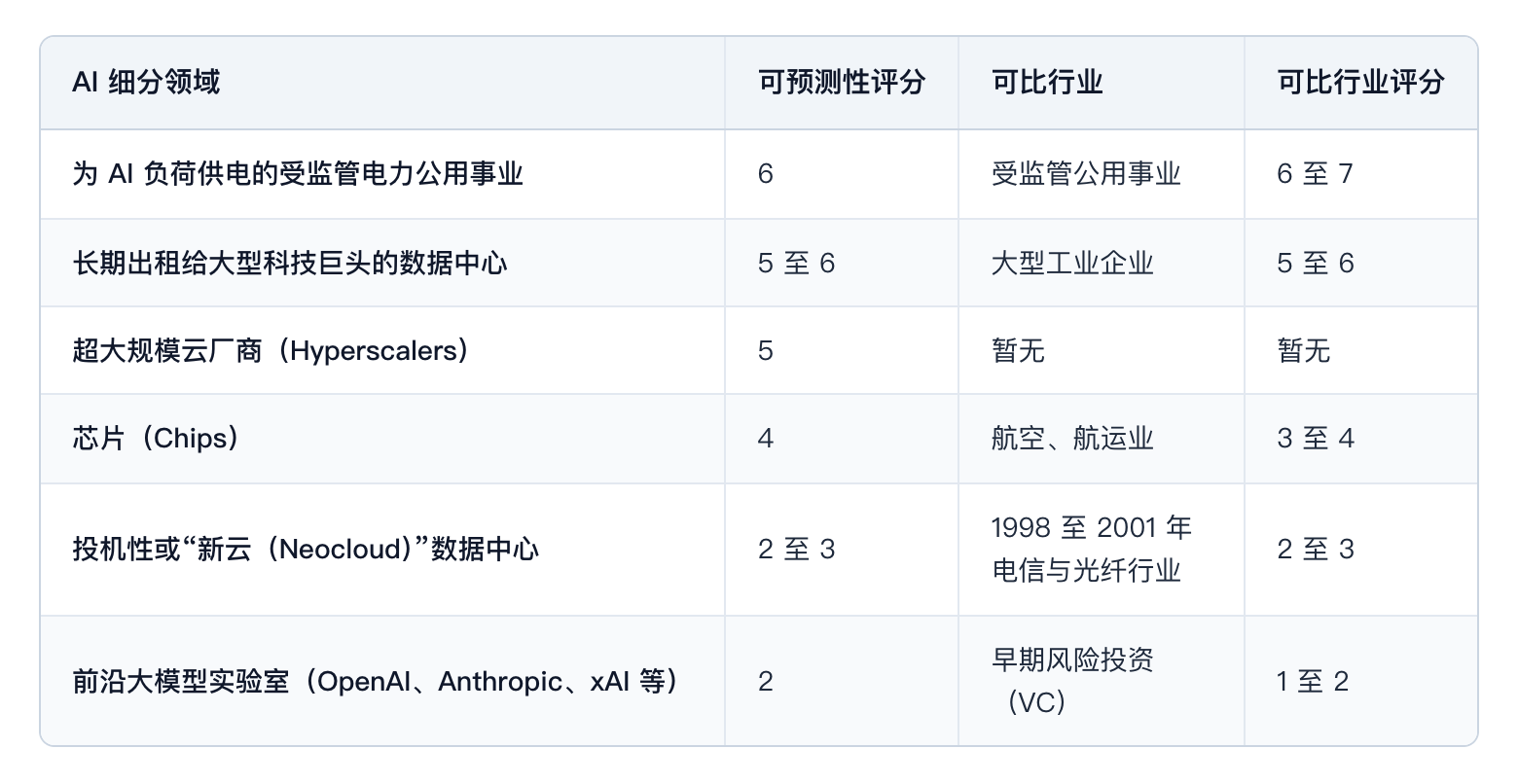
Figure: Comparison of core data on AI subfields, predictability scores, and comparable industries
What surprised me most was that frontier labs only scored 2 points, which in my view almost means “essentially unknowable.” To me, they are all outstanding companies holding enormous competitive advantages.
However, Claude's evaluation was blunt: “The outcomes of these businesses are close to a binary game (either succeed or fail). The capital requirements are extraordinarily large, the pricing per unit capability is rapidly declining, and whether there exists a lasting moat is still unclear.”
(Considering Claude is part of Anthropic, is this statement particularly ironic?) Interestingly, these targets assessed by Claude as having the least certainty often enjoy extremely high valuation premiums in private equity markets.
OpenAI and Anthropic have both submitted IPO applications, and how they will be priced in public markets and what the stock price trends will be post-IPO are undoubtedly of great interest.
Additionally, let's not forget that, as previously mentioned, the massive equity investment gains driving up the S&P 500 index's profits in the second quarter largely stemmed from the segment known as “the hardest to predict;” how enduring will these book gains be?
Regarding predictability, I’d like to take this opportunity to discuss geopolitics, which in the AI field usually directly refers to the “China factor.” Almost all cutting-edge chips are produced by Taiwan’s TSMC, while the US government restricts the sale of the most advanced chips to mainland China, which motivates China to introduce competitively priced low-cost large models, impacting the sales of superior US models.
If this landscape changes, what impact will it have on the US’s competitive advantage? Will China’s self-developed chips someday catch up to or even surpass today’s industry leaders?
Will mainland China possess the capability to obstruct or even cut off the supply of Taiwanese chips to the US in the future? Furthermore, will concerns about China's strategic intentions weaken the US’s determination to establish regulatory safeguards for the AI industry?
Clearly, there are still too many variables concerning AI that investors do not know and cannot predict. The real question is: how much risk are you willing to bear and in what form are you prepared to do so?
The AI supply chain involves numerous segments, and according to Claude's assessment, the predictability spans significantly: one end consists of frontier labs, which we are nearly clueless about, while the other end comprises data centers with solid long-term leases and their electricity suppliers, whose predictability is relatively comparable to large industrial enterprises and regulated utility companies.
Question Ten: Is AI a bubble?
In recent weeks, the anxieties surrounding many of the issues discussed above have begun to emerge.
The macro investment environment shows multiple negative factors resonating; focus is on sticky inflation, federal fiscal deficits and national debt levels, rising interest rates, and seemingly stalled conflicts in Iran. On top of these macro headwinds, several concerns specifically targeted at AI have arisen, such as:
- Intense competition from new models, streamlined but low-cost models, low-cost Chinese large models, and open-source models available for free;
- Continuous decline in “Token” (the unit of model invocation billing) prices;
- Possibility of slowing growth in computing power usage;
- Some companies reporting revenue growth below market expectations;
- Concerns about some companies' high leverage levels and a heavy reliance on future external financing.
When markets are on the rise, people often dismiss doubts with a laugh, but once mental states waver, these questions can keep investors awake at night. Thus, we will again see my often-quoted statement: the reality usually oscillates between “fairly good” and “lukewarm,” but in investors' minds, it often plummets from “flawless” to “hopeless” in an instant.
Recently, the various worries of AI investors are not innovative; they are merely old concerns that have fermented and have thoroughly darkened market sentiment amid the cooling macro investment climate.
Despite this topic having been debated by various parties (including myself) for over a year, people still repeatedly ask: Is AI really a bubble? First, we need to clarify the definition of a bubble; my definition is: irrational exuberance leading to reckless behaviors, over-investment, and excessively high entry valuations.
I believe judging the AI bubble (as with examining any potential bubble surrounding technological breakthroughs) should at least touch on three dimensions: Is the technology itself being overly hyped and ultimately destined to disappoint? Has the scale of capital invested by companies already gone overboard, making it difficult to generate reasonable returns? Are investors assuming excessive risks in this area and paying too high a price for it?
Arriving at conclusions on these topics largely relies on the answers to the questions posed earlier. Since the publication of my previous memo discussing AI in February of this year, I believe the following three judgments have not changed significantly:
- I still believe AI will demonstrate powerful capabilities and bring profound impacts, as transformations will occur in corporate operations, macroeconomics, and broadly across human life that we cannot even begin to imagine today. Therefore, the technology itself is not a mirage.
- Currently, there is intense discussion about how much revenue must be generated in the future to prove the current huge capital expenditures reasonable. Yet, until we truly grasp how AI will be applied and who can profit from it, we cannot declare whether the companies' current investments are wise.
- And until we have a reasonable estimate of these companies’ future profits and profitability from their infrastructure, we similarly cannot assess whether current secondary market stock prices or the yields from bonds are reasonable.
Although countless questions surround AI (as outlined above), the essence of all contradictions can actually be distilled into a rather complex ultimate question:
Can AI provide users with substantial practical value, thereby supporting sufficiently large computing power sales and pricing, ultimately yielding reasonable returns for the tens of trillions of dollars currently poured into this field (and to whom will these returns ultimately accrue)?
Based on my communications with many industry veterans, I conclude that at this moment, to answer this ultimate question largely relies on faith. This reminds me of a famous quote by American economist and writer Stuart Chase:
For those who believe, no proof is necessary; for those who do not believe, any proof is futile.
I racked my brain and could not find a more fitting remark to conclude the many questions surrounding AI.
Question Eleven: How should we think about AI investments?
In my view, artificial intelligence represents the most profound shift for investors in at least a generation, while also being the most unpredictable. But investors do not need to entirely negate or shy away from something just because it is fraught with uncertainty.
The correct approach is not to become paralyzed and do nothing, but to achieve two points: (a) maintain humility that withstands calibration in strategy selection, position sizing, and risk-bearing; (b) even amidst uncertainty, retain the courage to act decisively.
Investing in different segments of the AI industry requires answering entirely different propositions. An equity investor in a frontier lab may need to be correct about the pace of technological advances, competitive positioning, pricing power, future profitability, and even valuation levels simultaneously.
In contrast, creditors financing data centers based on long-term leases may have fewer variables to guess about, but the dimensions that truly determine success or failure differ significantly, including tenant creditworthiness, lease terms, power supply security, and asset residual values.
Thus, the critical question before us is: “Out of these many questions, which ones am I or my organization truly proficient at answering? And in areas lacking professional depth, what uncertainties am I willing to actively bear?”
Given the same conditions, as long as the purchase price of an investment is sufficiently low relative to its intrinsic value, a high degree of uncertainty can be perfectly acceptable for investors.
At least theoretically, if high-risk segments rated low on Claude's predictability score are valued low enough, significantly below those with higher certainty, the former may even offer better investment value. Ultimately, wise investing largely revolves around the art of pricing.
However, it must be noted that within the AI sector, the various tricky challenges discussed above make calculating intrinsic value and thus determining “whether it’s cheap” extraordinarily complex.
To conclude these thoughts, I leave you with a checklist that may assist in making investment decisions. It should be noted that these questions actually apply to all investment targets, not just AI:
- In order to earn an acceptable return, how many prerequisite conditions must be fulfilled simultaneously?
- Once my core assumptions are proven wrong, what is the maximum I could possibly lose?
- Among the numerous risks taken on, which ones are reasonably compensated, and which ones am I unwittingly bearing?
- What optimistic expectations are already factored into current asset prices?
- How will this investment alter the risk profile of my overall portfolio? Does it further amplify my existing risk exposure, or does it act to diversify and hedge?
An old saying applies exceptionally well to AI investing: “There are two types of investors who will lose a lot of money: those who know nothing and those who think they know everything.” I believe it is especially important to confidently acknowledge that we do not know everything when faced with AI.
AI is sure to bring forth countless unexpected surprises and wonders, but these surprises may not be unmanageable. What truly deserves repeated consideration is: What are the probabilities of an AI investment being disappointing, and how likely is it to exceed expectations?
Finally, allow me to conclude with a remarkable quote I stumbled across recently:
Some argue that the near future is filled with too many unknowns: wouldn’t it be wiser to wait until things are a bit clearer before acting? You are surely familiar with the cliché: “Hold cash reserves for buying opportunities, waiting for uncertainty to clear before making moves.”
But before you grasp this psychological crutch, confront two uncomfortable facts: The future will never be completely clear; in the stock market, waiting for a widely shared optimistic consensus often comes at an extremely high price. In fact, uncertainty is the true friend of the long-term value buyer. (Bold parts are my emphasis)
In the context of a memo discussing AI, it could not be more appropriate, could it?
By the way, this line is from my old archives: it was published by Warren Buffett in Forbes magazine on August 6, 1979, a timeless word of wisdom.
I have always been happy to leave the final summary to Warren.
November 11, 2026
免责声明:本文章仅代表作者个人观点,不代表本平台的立场和观点。本文章仅供信息分享,不构成对任何人的任何投资建议。用户与作者之间的任何争议,与本平台无关。如网页中刊载的文章或图片涉及侵权,请提供相关的权利证明和身份证明发送邮件到[email protected],本平台相关工作人员将会进行核查。


