Author: David Christopher, Bankless
Translated by: Shenchao TechFlow
Shenchao Introduction: The former extreme performance-focused Ethereum L2 project MegaETH has officially been renamed MEGA and announced a $30 million treasury fund to transform into self-developed products, with the first application focusing on the decentralized AI inference market expected to launch in December.
In the face of increasingly homogenized model validation technologies in the market, relying solely on proving that nodes "have not dropped packets" is no longer sufficient to establish a moat. This article delves into the two most eye-catching differentiated ideas in the MEGA white paper: privacy desensitization from a decentralized perspective and highly persuasive long-term computing power contracts.

This Tuesday, the MegaETH Foundation officially changed its name to MEGA and announced a $30 million treasury fund to develop self-researched products, the flagship of which is an AI inference market (Inference Market) that will launch in December.
The inference market is an emerging track I have been tracking recently: in this open market, anyone can buy or resell AI model invocation rights, with prices typically lower than official quotes from large laboratories. Current market demand is very strong, and the usage of most inference markets is steadily rising.
Given that this niche is still in its early stage and the financial integration of AI services is just in its infancy, I believe that for the MegaETH team, which once built the “ultimate speed” Ethereum L2, this pivot, though abrupt, is a smart choice.
This shift also carries a sense of urgent realism. Currently, the public chain has a TVL of less than $10 million, a significant drop from the peak of over $245 million in May. Co-founder Shuyao Kong also candidly mentioned on X platform: “After creating the fastest public chain but failing to find a product-market fit (PMF), the team has to make changes.”
The specific mechanisms of the new inference market, computational power providers, and the list of models to be launched remain confidential before formal release, but a three-page white paper has already outlined the team’s core ideas.
Next, let us break down the core claims of this business narrative to see where its weakest links are and what MEGA can leverage to break through.
MEGA's official account (@mega_holdings) announced in a tweet: “Today, we commit to invest $30 million in developing new products on MegaETH, with AI inference being the first entry point. Details at mega.holdings.”
Core Narrative Claims
MEGA’s entry point stems from its proposed so-called “supply paradox”: prices from many third-party computing power providers running the same open-source model are far lower than the native lab quotes that developed those models.
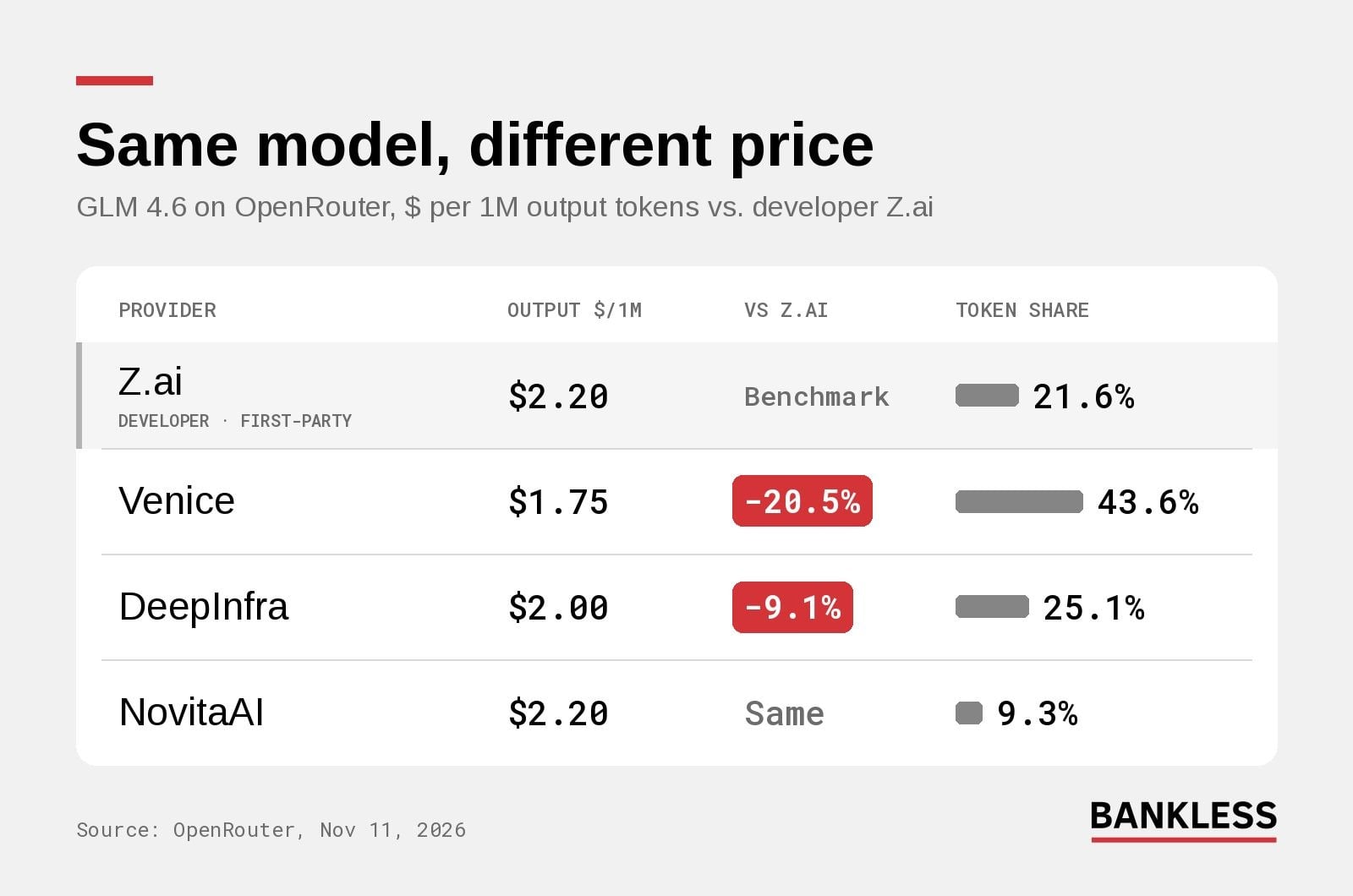
For example, on the OpenRouter platform, GLM 4.6 from developer Z.ai is quoted at $2.20 per million output tokens, while third-party provider Venice only charges $1.75. Despite the significant price difference, MEGA believes the vast majority of buyers still prefer to pay a high price for familiar official channels.
In response, MEGA’s solution is to introduce a comprehensive verification mechanism called “Purified Intelligence,” to validate the authenticity, privacy compliance, and security of the service providers' models, proving that unfamiliar third parties can also be trusted.
The ultimate goal is to create a trading market that completely standardizes inference capabilities. As the white paper states, ideally, "who provides this inference service will become increasingly irrelevant."
In other words, the entire narrative is built on “establishing trust,” particularly on the basis of “validating the real invocation model.” But that is precisely where I have doubts.
Without MEGA, verification technology is also advancing rapidly
First and foremost, the industry premise presumed by MEGA is not entirely valid.
Low-cost computing power providers are not currently being neglected by the market: popular inference routing platform OpenRouter itself prioritizes rewarding low-cost channels in its default routing, and the platform attributes most output quality differences to the configuration differences of their tool-calling software, rather than deliberately swapping models.
Although the ‘model swapping’ phenomenon criticized in the white paper does objectively exist, the most concrete evidence is primarily found in informal resale gray market channels. A study published in March tested three such black-box resellers and found that as many as 46% of the identity verifications failed.
More critically, tools to expose these swapping behaviors are emerging rapidly from all directions:
• Fingerprinting: Last week, the inference market Antseed officially enabled a newly added fingerprint verification layer. This system tests computing power sellers with niche questions that only specific models will answer, and once it is discovered that the party has not run the purported model, the buyer's requests are immediately redirected elsewhere.
• Trusted Execution Environment (TEE): A TEE is like a secure black-box area within the chip that even the machine owner cannot peek into, allowing for public proof of what code is running inside the chip. Antseed buyers can currently directly request service providers to enable this hardware verification.
• Cryptographic Proofs: Earlier this month, Anthropic open-sourced a prototype scheme (FlashProve) that mathematically verifies that answers are indeed generated by specific model weights, although a single inference requires 70 to 95 times the computing power of regular requests.
Additionally, the Pearl team is also developing a self-researched proof version relying on Attestable .
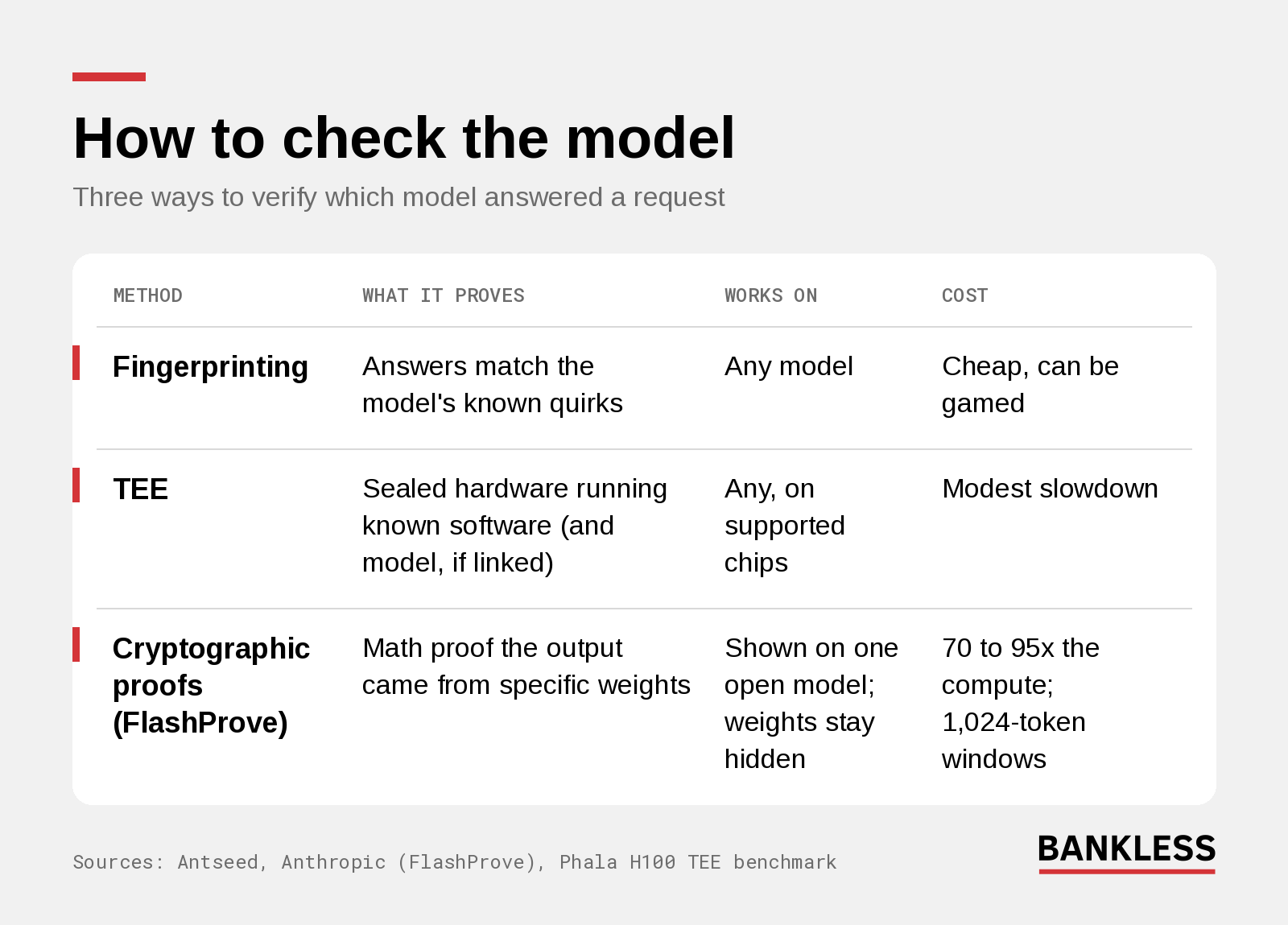
MEGA’s white paper also names the three aforementioned solutions and admits that each has its technical limitations, but it does not specify which one it will ultimately adopt. The team is likely to integrate one or more of these combinations, which is of course commendable.
However, the reality is that many teams are currently focusing on the same pain point, and the vast majority of verification tools have already been open-sourced for the entire industry to directly call. The buyer's psychological barrier of distrust towards third-party service providers is rapidly diminishing; solely launching a “model verification” feature is unlikely to make MEGA stand out.
The two directions where MEGA might breakthrough
Given this, the real chips that can truly differentiate MEGA lie in the other two major ideas in the white paper.
The first direction is privacy protection. MEGA envisions desensitizing sensitive details before computing power providers see user requests and splitting complex tasks to be handled separately by trusted and untrusted nodes. This design is highly meaningful as, currently, true privacy protection that prevents service providers from peeking at prompts (Prompt) through closed hardware largely still limits to open-source models.
To safely invoke cutting-edge black-box models while considering privacy, “local sensitive information desensitization” is almost the only compromise path. But the engineering implementation of this solution is also extremely high in difficulty.
Last year, Freysa launched a similar feature in its now-rebranded application Silo by replacing private phrases with placeholders, allowing users to securely access closed-source models like GPT and Claude.
However, Freysa announced in November 2025 that due to varying actual performance on mobile, the team had to move desensitizing calculations out of mobile; in the July update log of its iOS application, it directly listed this feature as removed.
Similarly, MEGA's desensitization process must also run entirely outside MEGA's view, for instance, by fully residing in the user's local computer or closed hardware; otherwise, the user essentially transfers the sensitive information that should be handed over to the inference seller to MEGA instead.
MegaETH co-founder Yilong Li (@yilongl_megaeth) also pointed out in his recent white paper release: “Expanding more AI computing power is only half the battle. Even if the service provider has the right model, abundant spare computing power, and lower prices, as long as users cannot be confident that the service provider is genuinely running the model as advertised and protecting their data, they still will not buy in.”
The second core highlight is future computing capacity. The MEGA white paper envisions a mechanism where buyers can pre-order specific models, fixed invocation volumes, and minimum performance standards (including response speed and stability) at a locked price within a specific time window, and support secondary market transfer of these future computing capacity contracts in the future.
One can liken it to enterprises booking hotel rooms in bulk months ahead of a large industry summit. Buyers can secure ample computing power ahead of significant product releases; if plans change, they can resell; while sellers—computing power providers—can use these locked demands as collateral to secure financing from lenders for purchasing more GPUs to expand capacity.
If such contract transactions scale, the market will give birth to a public and transparent "long-term inference pricing curve." Although traditional financial giants like the Intercontinental Exchange (ICE) plan to launch GPU computing futures that can hedge chip rental costs, they cannot specify which model to run or what the output will be; in contrast, MEGA's long-term contracts anchor directly to the model's ultimate "output itself."
Among all the on-chain inference markets I have assessed so far, none currently offer a similar mechanism, which is precisely where blockchain technology can best utilize rights confirmation and circulation value.
However, there remains a deep contradiction here: AI inference costs are rapidly dropping, with main models being replaced every few months; why would buyers want to lock in fixed quotes or even specific model types months in advance today?
Perhaps what enterprise buyers are purchasing is not a low price, but a “certainty seat of never going offline during peak times,” or a hedge against skyrocketing invocation bills after major AI companies' expensive subsidies decline. For this, I currently do not have a definitive conclusion.
The key missing puzzle piece
At least for now, the two major highlights still remain in the sketch phase of the white paper. The team has not publicly disclosed any code, and the white paper does not clarify which computing power parties are qualified for admission, who will execute the verification audit, and where the privacy desensitization tool will ultimately operate.
The entire white paper also mentions nothing about the native token. When asked about the role of the MEGA token in the inference market, Shuyao Kong responded in an interview with The Block: “As long as there are scenarios that empower the MEGA token, we will utilize them.”
As for the more than $30 million treasury fund that exceeds MEGA's current circulating market value, no detailed budget plan has been disclosed yet.
The upcoming December should gradually reveal some of the answers. Next, I will focus on three landing indicators: the first batch of signed named service providers and admission criteria, the truly operating desensitization schemes outside of MEGA's view, and the first long-term computing capacity contract undertaken by genuine trading counterparties.
Ultimately, verifiability can only place MEGA at the starting line of the inference track; only by solving the problems of real privacy and long-term computing power delivery can it determine whether it can truly stand out.
免责声明:本文章仅代表作者个人观点,不代表本平台的立场和观点。本文章仅供信息分享,不构成对任何人的任何投资建议。用户与作者之间的任何争议,与本平台无关。如网页中刊载的文章或图片涉及侵权,请提供相关的权利证明和身份证明发送邮件到[email protected],本平台相关工作人员将会进行核查。


