The Democratic Party will take over Congress, and Warren is expected to assume the chair of the Senate Banking Committee. Wash's public schedule shows limited contact with Democrats, and experts believe he needs to seek bipartisan support while facing scrutiny over inflation and employment judgments.
Source: Jin Shi Data
Federal Reserve Chairman Kevin Wash is about to face a new Congress led by the Democratic Party. According to The Washington Post reported this Wednesday, all six Congressional contacts listed on his public schedule for September are from the Republican Party.
In public records, his most recent contact with a Democratic member was a call on July 14 with Virginia Senator Mark Warner. The Democratic Party will take over both Houses in January next year.
Massachusetts Democratic Senator Elizabeth Warren is expected to assume the chair of the Senate Banking Committee, where she has long criticized Wash's relationship with the White House.
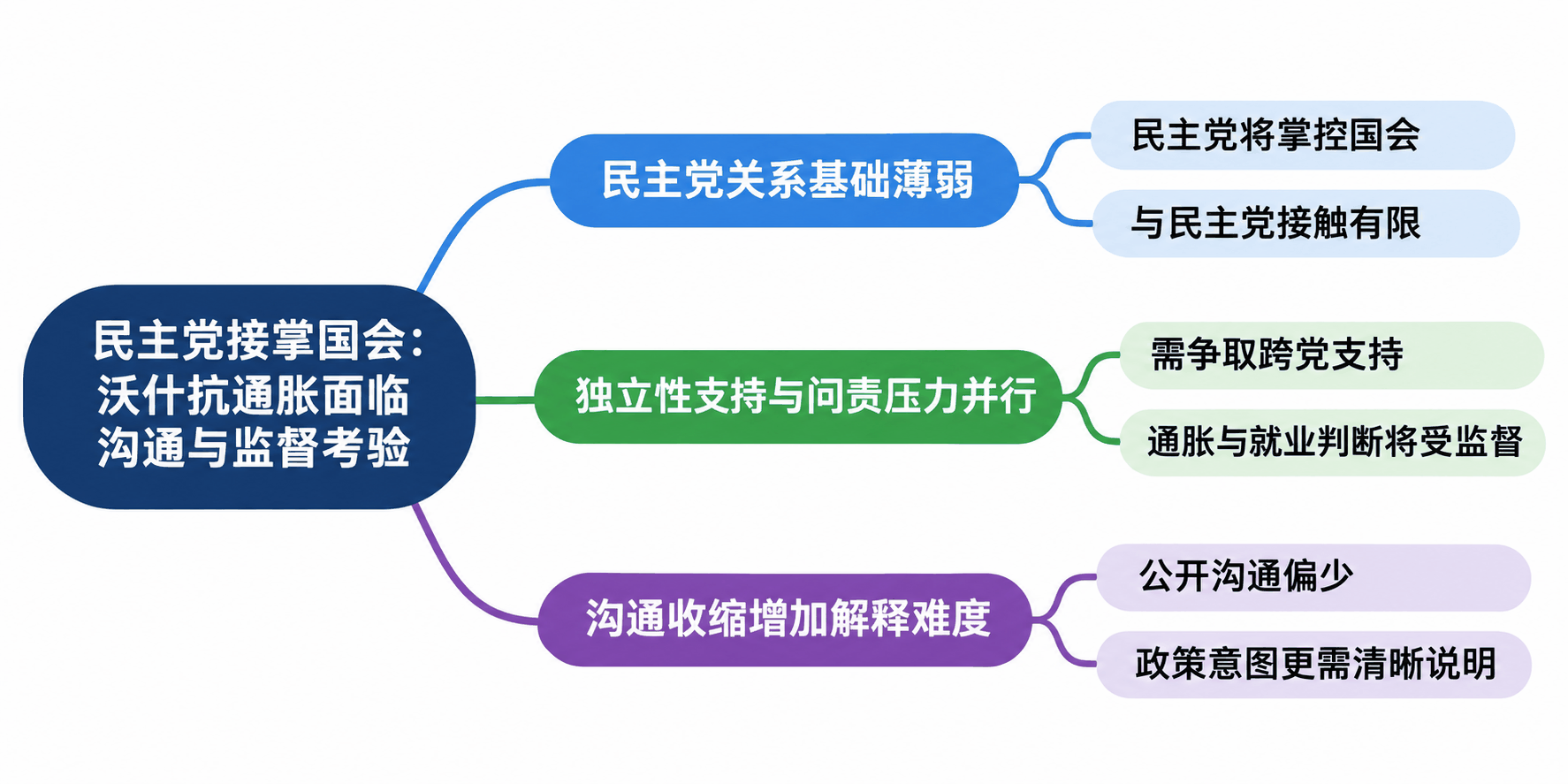
Wash's Weak Relationship with Democrats
Wash was confirmed by the Senate in May with a vote of 54 in favor and 45 against, receiving support from only one Democratic member. The Washington Post stated that this is the smallest confirmation margin for a Federal Reserve chairman nomination in nearly 50 years.
Michael Pedroni, CEO of Washington consulting firm Highland Global Advisors, stated: "He does not have the same working relationships on the Democratic side. To some extent, this is a consequence of the Federal Reserve becoming so politicized."
Warren has referred to Wash as President Trump's "puppet." However, during his tenure, Wash has raised interest rates when Trump advocated for lower rates, indicating a lack of alignment between the two on the direction of interest rates.
Sarah Binder, a scholar at the Brookings Institution studying the relationship between the Federal Reserve and Congress, believes that the Federal Reserve requires political support from Congress to fulfill its responsibilities. "Faced with a new Democratic Congress, he must maintain these communication channels. He needs to talk with members of both parties."
Support for Independence and Accountability Pressure Running Parallel
Warren and other Democrats have consistently supported the Federal Reserve's independence. The new Congress will not directly decide monetary policy, but after the Democrats take control of the Senate, the White House's ability to change the Federal Reserve through personnel appointments may be constrained.
The Washington Post analysis suggests that a Senate led by the Democrats is unlikely to confirm new Federal Reserve candidates, and Trump's push to remove Board member Lisa Cook may also face obstacles.
The Federal Reserve chairman must report to Congress on monetary policy twice a year and face questioning from committees in both Houses. Pedroni stated that if Congress is dissatisfied, "they can take measures to make life very difficult for the Federal Reserve."
Clay Lowery, executive vice president of the Institute of International Finance, believes that Wash may face dual pressures from the president and Congress, which is an inherent situation of the job of Federal Reserve chairman.
Reduced Communication May Increase Difficulty in Explaining Policy
Wash has advocated reducing policy communication since taking office, believing that some of the public speaking practices formed during the crisis are no longer applicable. However, The Washington Post noted that reducing speaking engagement may make it more difficult for members to understand the basis for the Federal Reserve's decisions.
Jon Faust, a former advisor to former Federal Reserve Chairman Powell and current researcher at the Johns Hopkins University Center for Financial Economics, stated that Powell used to spend a lot of time communicating with relevant lawmakers to ensure they understand what actions the Federal Reserve is prepared to take and how to think about issues.
For Wash, future oversight may involve inflation measures. The report suggests that Democratic members may question him about his interest in alternative inflation metrics, some of which indicate increases lower than the measurements commonly used by the Federal Reserve.
Judgments on employment may also become a focal point of debate. The Federal Reserve regards a 4.1% unemployment rate as evidence that the economy is at or near full employment, but according to the report citing Bureau of Labor Statistics data, nearly 2 million Americans have been unemployed for over six months, an increase of more than one-third since Trump took office.
免责声明:本文章仅代表作者个人观点,不代表本平台的立场和观点。本文章仅供信息分享,不构成对任何人的任何投资建议。用户与作者之间的任何争议,与本平台无关。如网页中刊载的文章或图片涉及侵权,请提供相关的权利证明和身份证明发送邮件到[email protected],本平台相关工作人员将会进行核查。


