Pump.fun wants to reward diamond hands, but the algorithm can recognize holding time but cannot identify hedging, arbitrage, and true conviction. The question is not whether it will start to change, but who will remain after the subsidies are stopped.
Written by: Wealth
Why begin rewarding those who don't sell
On November 6, 2026, Pump.fun co-founder Alon announced on X that the platform launched a new reward algorithm called Diamond, renaming the old algorithm Degen, with both running in parallel.
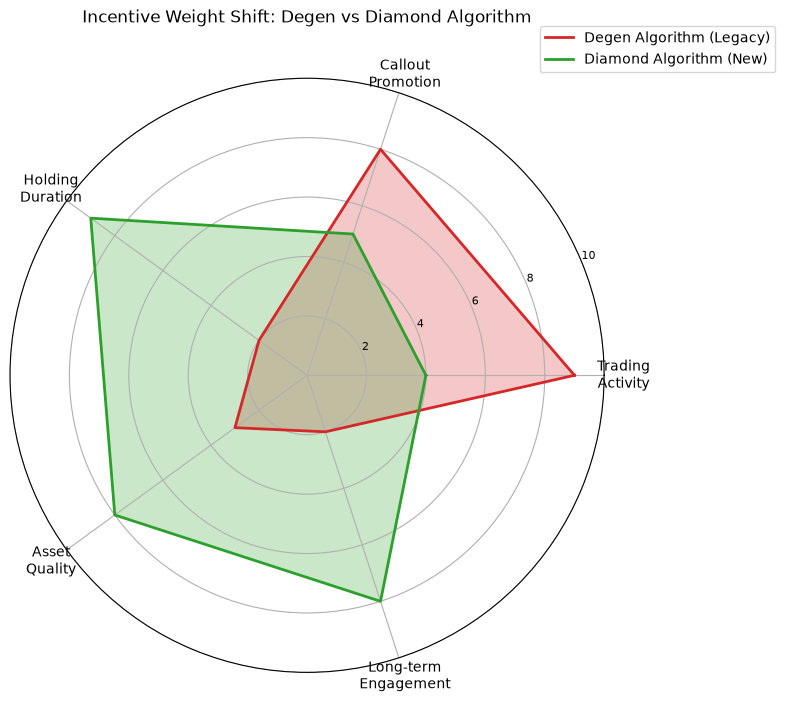
The old algorithm Degen rewarded the individuals who called out and brought in trades; whoever issued a Callout (recommended post) that could attract more trading volume could receive a larger share of USDC rewards. This logic is simple, akin to the commissions earned by croupiers at casinos for bringing in customers. The new algorithm Diamond is different; it adds a multiplier for calls on high market cap tokens, assigns weight to perps (perpetual contracts), EVM chain assets, and non-Solana assets, changing the core — it starts rewarding holding time, long-term holding, and those not in a hurry to sell.
For a platform that initially thrived on quick buying and selling, high-frequency token issuance, and repeated trades to earn fees, to suddenly encourage users not to sell feels unusual.
Behind this peculiarity is not Pump.fun suddenly having a moral revelation to make everyone hold valuable tokens. The old ways simply no longer work.
Diamond is not a new invention
The term Diamond Hands was not coined by Pump.fun.
It first emerged from the 2021 GameStop incident, as retail investors from r/WallStreetBets on Reddit shouted it out—facing institutional short selling and extreme stock price fluctuations, they resolved not to sell, holding until the end. Diamond Hands correspond to Paper Hands, who sell at the first sign of volatility. Later, this term entered the crypto sphere and merged with HODL culture, becoming a symbol of long-term holding.
Turning this culture into a quantifiable reward mechanism, Pump.fun is not the first to do so.
Virtuals Protocol introduced a Diamond Hand Bonus in 2025, where users holding tokens from the Genesis ecosystem could earn additional points every 24 hours, with more points for longer holding durations. This was later upgraded to require staking to receive rewards, turning passive holding into active locking. BNB Chain's $4 million Meme season in September 2026 centered around the HODLer Index, scoring based on holding size and duration, with penalties for selling mid-way, qualifying for rewards only if holding over $100. Moonshot was even more direct, distributing 80% of new token issuance fees, with 70% going to the first 50 holders, effectively turning early supporters into shareholders, allowing them to profit from the long-term increase in token price. The BONK ecosystem’s BONKRewards earned fees by locking assets, with longer locking times yielding more distributed transaction fees.
Even the act of pricing social attention has been explored elsewhere. Kaito's Yaps mechanism uses AI algorithms to score every piece of crypto content, not based on who posts more or receives more likes but on the information increment, interactor weight, and influence within specific narratives, transforming social attention into accumulable, redeemable Yapper Points, ultimately linking to project quotas and airdrops—essentially turning information and attention into tradable assets.
What Pump.fun is truly doing is not inventing diamond hands but piecing together previously scattered elements: social recommendations, trading results, asset market values, holding times, cross-chain asset incentives, all integrated into the same Callout Rewards system.
Former platforms rewarded those issuing tokens, trading, or creating content separately. Pump.fun aims to combine these three roles: if you can produce engaging content, hold real tokens, and bring in actual trading results, you can earn the most rewards. At this point, it’s no longer just a token issuance tool.
From a token machine to a trading social network
Pump.fun's initial model was extremely simple.
Anyone spending a few dollars could issue a Meme token through a Bonding Curve; if someone bought, the price went up, and if someone sold, the price went down. Once enough liquidity was amassed, they would "graduate" to PumpSwap for AMM trading, with the platform taking a fee from each transaction. The core of this model is "new"—new tokens are continuously issued with new speculative opportunities, allowing users to pull the lever of a slot machine, switching to the next token immediately when one is gone.
The obvious problem with this model is the extremely short lifecycle of tokens; users come quickly but leave even faster, so the platform cannot retain either users or funds.
Later, Pump.fun gradually added products: first, creating PumpSwap to capture liquidity from graduated tokens; then introducing Callout Rewards to allow users to post recommendations and pay creators who brought in trades; followed by launching Terminal trading terminals, mobile apps, and perp contracts; and on October 17, 2026, introducing a platform fee of 0.45% that could drop to 0.40% with referral codes; now it has integrated the Diamond algorithm, directing rewards toward high market capitalization, cross-chain, and holding.
The dual-track positioning is clear: Degen continues to serve the existing users who enjoy small tokens and high-frequency trading, while Diamond is responsible for attracting new groups—traders in perpetual contracts, EVM chain users, and long-term participants willing to hold large-cap assets.
PumpSwap has now become the platform's largest source of income, contributing about $107 million in fees in October 2026, accounting for 61% of the total fees from all products. This means Pump.fun has long since stopped relying solely on earnings from token issuance—it is now aiming for the entire chain: discovering new assets, discussing assets, completing transactions, and holding assets all happen within its grasp.
Callout serves as its social core. Previously, users saw KOLs on X making calls and had to jump to an exchange to trade; after trading, they had no way of knowing when the KOL sold their position. Now, when you issue a Callout on Pump.fun, your holdings, trade history, and the trading volume generated by the tokens you recommend are all verifiable on-chain, and the platform directly awards you cash prizes.
This is the social network born from trading. Unlike X, which profits from ads, Farcaster, which monetizes through ecological applications, or Hyperliquid, which only earns trading fees, Pump.fun aims to create a closed loop where content, assets, trading, and rewards exist within the same product.
Competition has shifted from issuing tokens quickly to retaining funds
Pump.fun didn’t suddenly realize it needed to embrace social elements; the entire industry’s competitive logic has changed.
The competition directly for the token issuance business has never ceased. Raydium launched LaunchLab, leveraging its own AMM liquidity advantage on Solana to capture traffic for new token issuance and post-graduation trading; Meteora implemented Dynamic Bonding Curves to differentiate on issuance curves and liquidity management; StonkFun paired stock Meme tokens, binding traditional stock narratives with Meme trading; Flap.sh introduced a one-click token issuance feature on BNB Chain and other chains, vying for cross-chain traffic; and Ponsfamily, emerging in 2026, even exceeded Pump.fun's daily revenue for several days.
But these competitors are still vying for business in the old lane—who can issue coins more conveniently, who has lower trading slippage, who offers higher cuts for creators. The real changes are happening elsewhere.
BNB Chain's $4 million Meme season was not about who could issue more tokens, but about who could keep users and funds on the chain longer; Moonshot distributing issuance fees to early holders binds early users’ long-term interests with the token, rather than allowing them to profit and run; Virtuals changed holding rewards to require staking, prompting users to lock their funds within the ecosystem actively; BONK allowed users who locked their assets to share the entire ecosystem's trading fees, turning competition over individual tokens into competition for the entire ecosystem.
Previously, everyone competed on issuance efficiency—who could let users issue a token within a minute would win. Now everyone’s competing on retention—who can get users to hold onto their tokens without selling, who can keep users’ money in the ecosystem longer, will win.
This represents two entirely different business logics. Token issuance platforms need to continuously create new speculative targets, similar to how a casino must keep opening new tables; holding platforms must create reasons to hold long-term, just as a community must make its members willing to renew their memberships continuously.
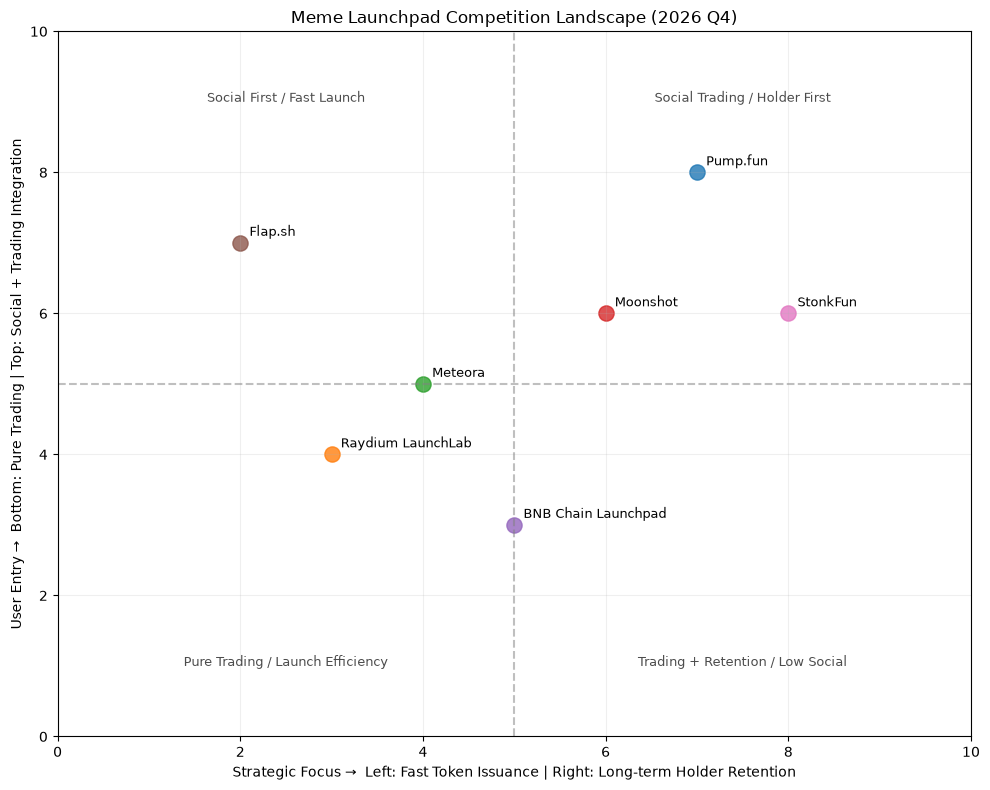
As of November 2026, Pump.fun maintained a market share of about 74% in transaction fees on the Solana Launchpad and approximately 49% across the entire chain, remaining the clear leader. However, its share of new token trading volume has dropped from over 90% at its peak to 52%, slowly being eroded. It certainly knows this.
Record revenues, but trading is cooling down
Data speaks volumes.
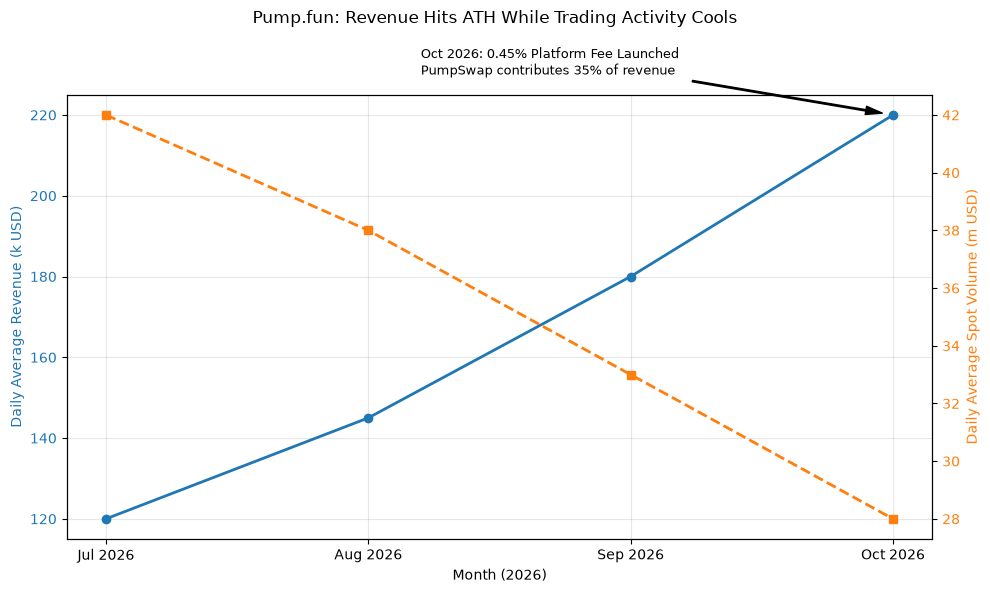
In October 2026, Pump.fun’s total product fees reached a historical high of $175 million, with PumpSwap contributing $107 million and Bonding Curve and the official site contributing $61.91 million. It seemingly appears promising.
But a closer look reveals a different story. The last 30 days saw approximately $50.2 million in fees on the Launchpad side, a 15% decrease compared to the previous 30 days, with protocol revenue around $35.6 million, similarly down 15%. Weekly data are even clearer; the first week of October had weekly fees of about $15.9 million, dropping to $9.88 million in the first week of November, representing a near 40% decline within a month. Daily revenues fell from peaks of over $1.5 million to $841,000 on November 10.
Trading volumes have seen an even more pronounced drop. Weekly trading volume fell by about 46% for Pump.fun from the first week of October to early November, while combined trading for the other seven Launchpads dropped 74%—it is certainly less vulnerable than competitors, but the decline in trading activity is an undeniable fact. The last 30 days saw around $3.88 billion in Launchpad spot trading volume, fluctuating daily between tens of millions to $100 million, far from the fervor witnessed in early 2025.
So why did fees still hit a record? Two reasons.
First, the 0.45% platform fee added on October 17 provided an additional revenue source atop the original 1.25% Bonding Curve fee, increasing the potential earnings per transaction; second, PumpSwap sustained income post-graduation, with token trading contributing over half of the fees, no longer relying entirely on new token issuance for profits.
In simple terms, this is "using a higher fee efficiency to hedge against declining trading volume." Revenue has increased, but that doesn’t mean more users are playing or trading more frequently; it just means the platform is extracting more from each transaction, allowing old business to be substantiated by new.
However, there is a cap on the fee; you cannot keep raising fees indefinitely; new businesses also have a ceiling, as PumpSwap’s trading volume is dependent on overall market activity.
What exactly are they afraid of?
Pump.fun is not in immediate danger, but it has indeed sensed the ceiling of the old growth model.
The first layer of concern is the fatigue within the Meme market itself. The essence of Meme is attention, which is the easiest asset to dissipate. When users have been repeatedly led to losses and realize that most new tokens ultimately go to zero, they will not mindlessly rush in as before. Without a new wealth effect, even the most effective token issuance tools will fail to attract users.
The second layer of concern is that the traffic entrance is being taken away. By creating Terminus, Apps, and Perps, its concern is that users might start trading Pump.fun’s tokens on other trading terminals, allowing the platform to earn only from issuance fees without receiving ongoing trading fees or user data. The trading entry point is far more crucial than the issuance entry point—where users open software to trade daily determines where the money flows.
The third layer of concern is that creators will not stick around. To clarify the Callout Rewards’ calculations: the rewards that creators receive essentially form a bonus pool from the overall platform's trading fees, augmented by some issuance of PUMP tokens, reflecting a redistribution of traffic earnings—not a direct cut from followers' trading, nor a betting split like on exchanges; the money ultimately comes from the platform's total trading income as a subsidy. This creates a dilemma: lower subsidies may drive quality KOLs away to shout on other platforms; higher subsidies may attract arbitrageurs who market manipulate, produce junk content, and run off after cashing in on rewards. Some community members have even proposed canceling Callout rewards, arguing that subsidies create not creators but opportunists. Block analysis firm Bubblemaps calculated that leading KOLs could earn about $125,000 per packaged recommendation, of which $80,000 came from platform awards and $45,000 from self-positioning followed by selling; the new algorithm has not completely closed off this route.
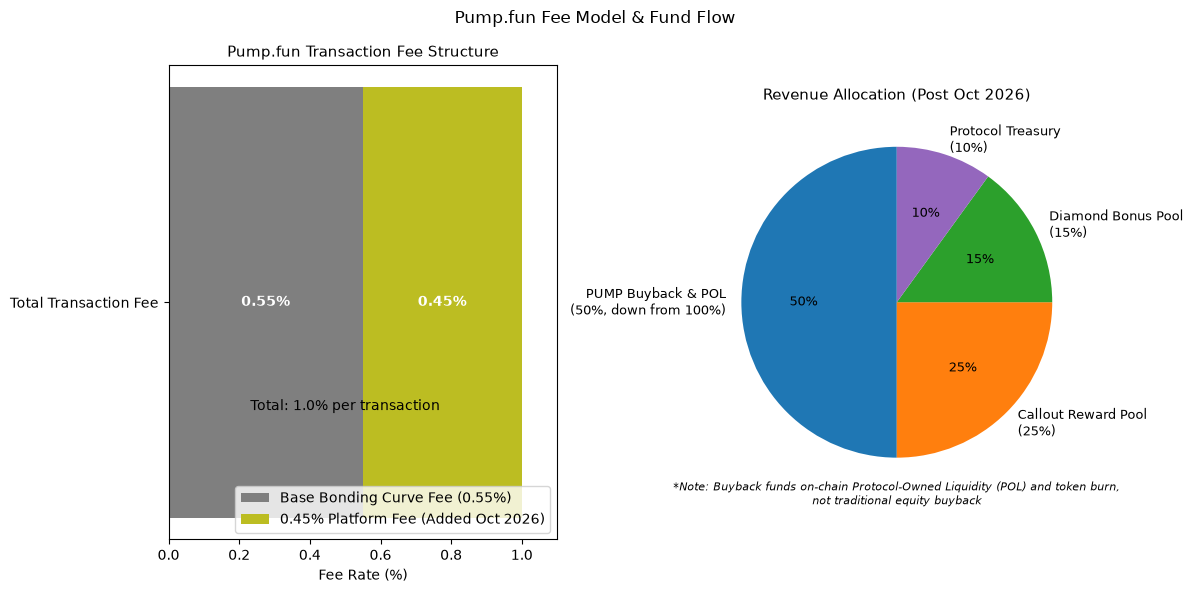
The fourth layer of concern is that the value of the PUMP token cannot be sustained. Let’s clarify a key point: the buyback here is a self-initiated income distribution mechanism on the chain and does not equate to the buybacks of listed companies—buyback funds come from platform fee income, and the bought-back tokens are primarily used to supplement Protocol-Owned Liquidity (POL) and for limited destruction, lacking any logic of buying back equity for shareholders. In July 2026, the platform completed a massive unlocking of 82.5 billion PUMP tokens, with the proportion of protocol income allocated to the buyback pool dropping from 100% to 50%. In the last 30 days, buyback expenditures reached about $22.4 million, accounting for 45% of income. Earning more does not imply that token holders can share in that profit; continuous selling pressure exists with the token fundamentals themselves under strain. After the Diamond launch, PUMP’s 24-hour futures trading volume increased by 92%, indicating speculative activities rather than genuine demand growth.
It remains the absolute leader on Solana, but it must seek the next growth curve.
The greater war is beyond Meme
The true threat does not even come from other Meme launching platforms.
In July 2026, the Robinhood Chain mainnet went live, which is an Ethereum Layer 2 based on Arbitrum, with initial partners like Uniswap and Pleiades, focused on Stock Tokens, RWA, DeFi lending, and on-chain derivatives. Robinhood itself has 28 million retail customers, spanning 38 countries and regions, many of whom have never encountered chain-based Meme, yet they are already trading stocks, ETFs, and cryptocurrencies on Robinhood. Now they can trade stock tokens, Meme tokens, and DeFi products throughout in one wallet without jumping around.
Coinbase's Base is also doing something similar. As an exchange-incubated L2, Base currently has a TVL exceeding $5 billion, with monthly active addresses peaking at 38 million. The Base App integrates wallets, trading, social features, and DeFi all in one, having absorbed significant Meme and SocialFi traffic since 2025, trying to intertwine social and trading since Friend.tech.
These two competitors will not directly seize the Meme Launchpad business; they won't create an identical one-click token issuance page like Pump.fun. Instead, they are after more critical assets—the entry points for user financial activities.
Pump.fun is expanding from the crypto native community to pull in more asset classes and trading populations; Robinhood and Base aim to extend from traditional finance and exchange users onto the chain, placing stocks, crypto, and Meme into the same trading scenario. The two paths are opposing, but the endpoint is the same: allowing users to discover assets, discuss assets, trade assets, and hold assets entirely within their products.
By giving rewards weight to perps, EVM assets, and non-Solana assets, Pump.fun is effectively expanding its asset boundaries, not wanting to be merely a casino for small Meme tokens. It recognizes that if users can trade Nvidia stock tokens, Bitcoin, and Meme tokens simultaneously on Robinhood, no one will bother to jump on Pump.fun to issue tokens or trade.
Rewards yielding diamond hands do not make true diamond hands
But a question arises: can relying on rewards create genuine diamond hands?
The answer is not necessarily.
The first issue, and the most lethal mechanism flaw, is risk-free arbitrage. When you reward spot holdings, some individuals can turn holding into a risk-free business. Large players can easily use multiple addresses to hold tokens on the spot side, meeting the requirements for holding time and market capitalization of the Diamond algorithm, thus receiving the highest reward multiplier, while opening equal-sized short positions in Perps or in PumpSwap's deep pools to fully hedge against price fluctuations. This means holding a position with zero price exposure, effectively earning the platform's rewarding subsidies for free. Not to mention the use of on-chain MEV extraction, counter trading through associated addresses to inflate trading volumes, or using flash loans for temporary snapshots of holdings—all of which are undetectable to the algorithm, which only sees on-chain balances but can't recognize hedging behind positions or identify several layers of associated addresses. Ultimately, subsidies may mostly land in the hands of professional market makers and arbitrage teams, leaving genuine ordinary holders with little to nothing.
The second issue involves conflicts of interest. Although the rewards received by creators come from the platform's fee pool, not directly from followers’ trades, when a recommendation is directly linked to the creator's benefits from the platform and their pre-established positions, users will question each Callout: Does this person genuinely believe in this token, or are they just waiting for me to take their position while also cashing in on platform rewards? The most crucial asset of a social platform is trust, and once every piece of content is tied to direct economic incentives, establishing trust becomes incredibly challenging. Creators on X make money through ads and subscriptions, at least not directly linked to followers’ trading profits; creators of Callouts on Pump.fun, even if not directly profiting from followers, have a strong incentive to lure followers into taking their positions, enhancing their holdings and rewards.
The third issue is that subsidies do not translate into genuine demand. When the platform spends money to reward holdings, users might hold for a time to capitalize on those rewards, but what happens once the rewards cease? If a token has no inherent value, lacks genuine community consensus, and is merely propped up by platform subsidies, once the support ends, those who would sell will still sell; paper hands will remain paper hands, and the few days of rewards won't turn them into diamond hands. Those receiving subsidies through hedged arbitrage are even less likely to develop lasting conviction for the token, and as soon as the rewards are collected, they will close their hedged positions and withdraw, retaining no genuine users. Subsidies can manufacture short-term holding data but cannot cultivate long-term belief.
The algorithm can recognize holding times, can see balance addresses, but cannot identify the hedging behind positions or discern true conviction.
What exactly are the next-generation platforms competing for?
The competition among Meme platforms has gone through three stages.
Initially, it was about issuance volume: who could let users issue tokens the fastest, who issued the most tokens, who was the leader; then it shifted to trading volume: who had the best trading depth, who had lower slippage, and who could attract the most traders; now it has started focusing on holding time, social relationships, and entry points for asset discovery.
Pump.fun's intentions are clear: it no longer wants to be the casino that allows quick token issuance, fast gambling, and swift exits; it aims to become a social finance platform on-chain—where users discover interesting assets, discuss these assets with others, engage in real buying and holding, and continue trading, all completed within the platform without needing to jump elsewhere.
This is a grand ambition. If accomplished, its competitors will not merely include other Launchpads but all trading communities, trading terminals, and social trading applications, even giants like Robinhood and Coinbase.
Yet it cannot escape the most crucial question: when all rewards stop, when no USDC is distributed to Callout creators, when no holding multipliers are in place, will users still stay?
If users stay merely for the profits and rewards, then Pump.fun is simply trading past subsidies on token issuance for subsidies on holdings—the essence remains relying on money to buy traffic, indistinguishable from its previous casino model. If users remain because there are genuinely worthy assets to discuss, trustworthy creators to follow, and smooth trading experiences, then it has truly built a trading social network.
This question currently lacks an answer.
But at least it has begun to change. A casino has started rewarding loyal gamblers; regardless of whether it ultimately succeeds in forming a community, it’s certainly better than constantly opening new tables, continuously collecting commissions, and waiting for players to lose and leave.
Just don't forget, diamond hands are never created by rewards. True diamond hands are those willing to hold onto their chips without leaving, even without incentives.
免责声明:本文章仅代表作者个人观点,不代表本平台的立场和观点。本文章仅供信息分享,不构成对任何人的任何投资建议。用户与作者之间的任何争议,与本平台无关。如网页中刊载的文章或图片涉及侵权,请提供相关的权利证明和身份证明发送邮件到[email protected],本平台相关工作人员将会进行核查。