Author: sparsitydata
Translation: Plain Blockchain

"The on-chain environment is too poor." "All KOLs are draining liquidity." "Everyone is blindly worshiping bundlers."
These are prominent issues laid bare, but searching for the root cause at the lowest layer is pointless. The holder culture in the trenches has completely collapsed. Now no one is willing to hold coins anymore: people are busy vampiring hot replicas (vamp runners), releasing dozens of coins at once, bundling launches for quick runs, frantically promoting buy orders and rebates, because that's the only way to make money. The root of the problem lies higher up — within the bottom platforms controlling the entire trench. This largest meme coin launch platform is paying for all the vices that everyone hates, turning the meme market into an abyss of infinite supply with rapidly dwindling demand.
Now everyone demands KOLs to be responsible for their promotions, which is certainly a good thing. But if the platform that sustains them behind the scenes never has to bear any cost, simply pointing fingers at promoters does nothing to address the root cause.
pump.fun profits wildly from the "death" of tokens
In the past 30 days, pump.fun accounted for 92% of all token issuance and 84% of trading volume across all launch platforms. It directly determines the rules of wealth distribution in the trenches.
Of its protocol revenue, 95% comes from trades on tokens still on the bonding curve or with a market cap below $250,000. Every transaction on the bonding curve incurs a 1.25% fee (0.95% to pump.fun, 0.30% to creators), meaning that before the price of a coin experiences any fluctuation, a round trip of buy and sell has already worn down 2.5%.
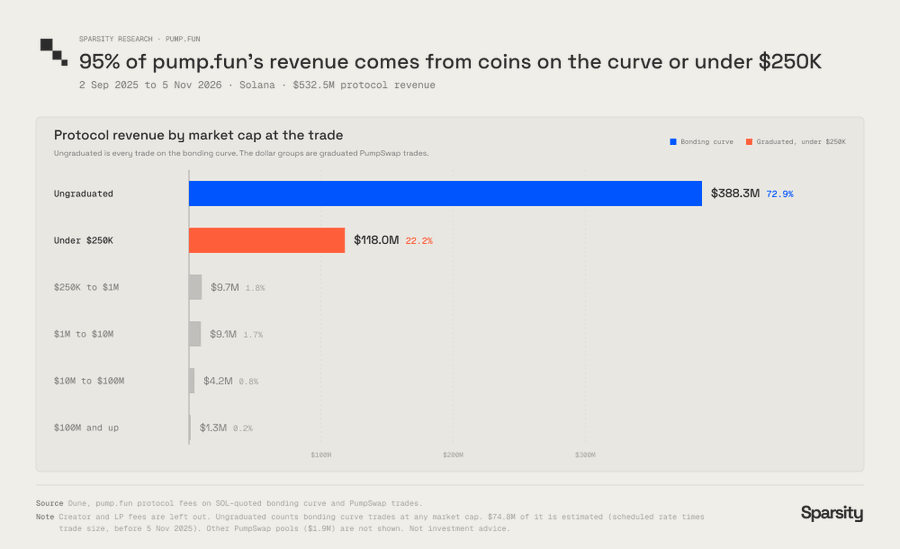
No matter how tokens perform later, the vast majority of money has already been drained in the early stages with a market cap of a few hundred thousand.
The lifespan of tokens confirms the same reality. The platform earns 75% of its revenue from tokens born in less than an hour, while 87% comes from tokens born in less than a day.
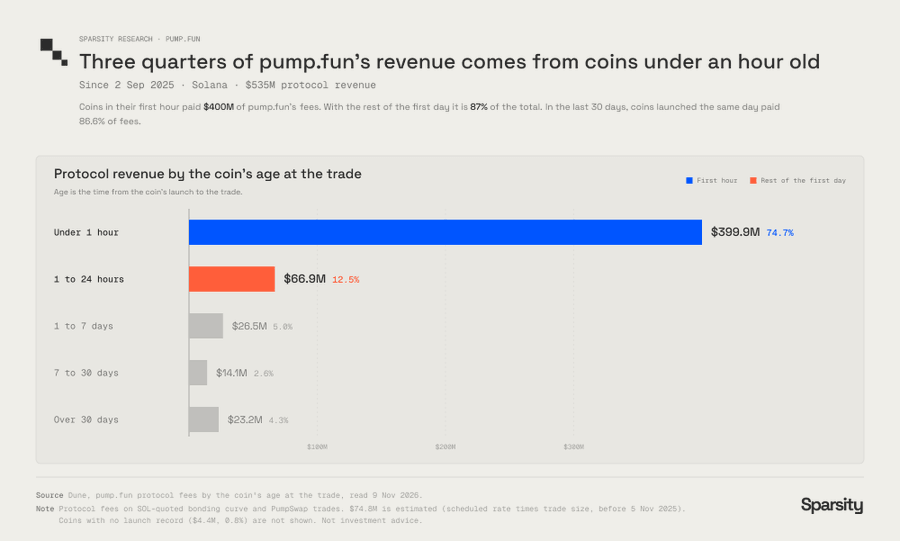
pump.fun is already well-fed within the first hour of a token's birth.
The runners that truly reach massive market caps provide almost negligible profits to the platform. Among the 15 top star projects with a peak market cap totaling $1.4 billion, they cumulatively contributed about $1.5 million in revenue to pump.fun; while the junk coins that die on the bonding curve or under $250,000 have brought it $506 million in income. In short: one thousand dead tokens at a $20,000 market cap yield far more profit than a super token that spikes to a $100 million market cap.
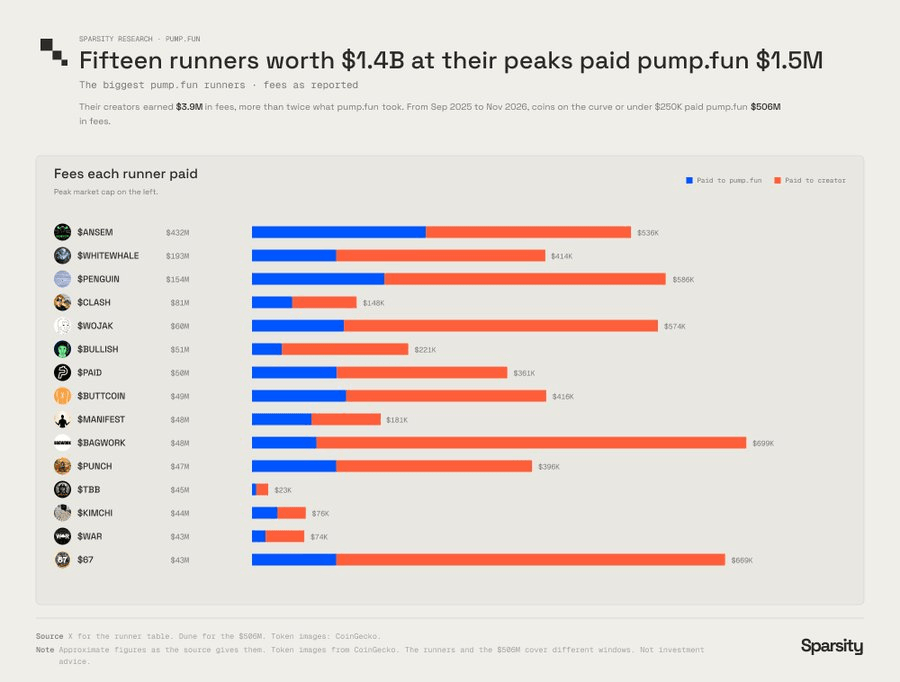
The revenue from the 15 strongest tokens is less than one-third of what those tiny dead coins generate.
Thus, the entire product is entirely skewed towards "stimulating more token issuance". Every incentive mechanism on the platform is pushing for a skyrocketing quantity, because only the volume running is the most lucrative.
Fourfold incentive mechanism
Each of the malicious acts reviled on the timeline has an underlying commercial logic on the platform. These four types of behaviors generate more trades, and each transaction contributes to pump.fun's fees.
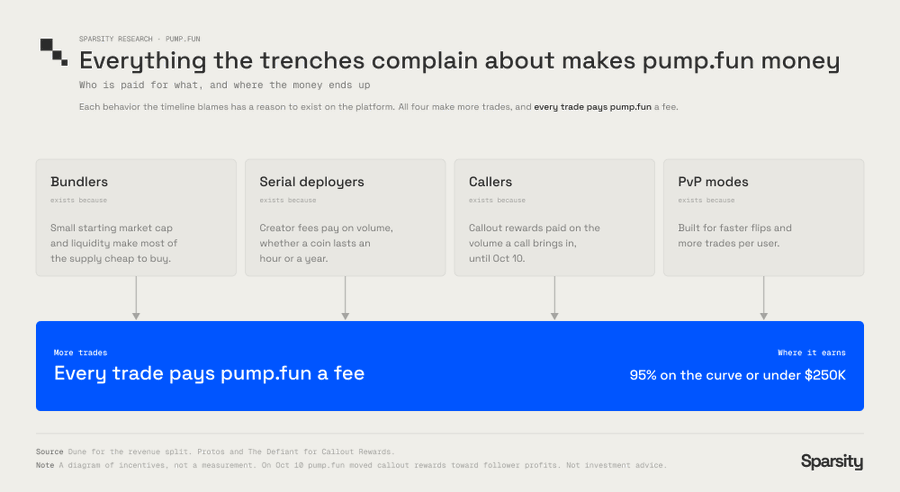
Bundled rush purchases, bulk coin farming, paid promotions, and PVP mutual liquidation models ultimately all lead to the same fees.
Bundlers rush to buy the first block due to extremely low costs
Bundlers are rampant because initial market cap and liquidity are extremely thin. By spreading a few SOL across dozens of wallets in the launch block, they can purchase vast shares at a very low cost and then dump them heavily on the buyers. The lower the starting market cap, the cheaper the rush purchase costs, and this threshold is set by pump.fun itself.
Token mass producers flood launches because creator fees depend solely on trading volume
The existence of pipeline token producers is due to the fact that the creator's fee distribution rewards frequent launches rather than long-term building. Regardless of whether a token can live for a year or just an hour, creators can take 0.30% from every transaction. Therefore, the optimal strategy must be to issue as many tokens as possible, clear the early trading volume, and then immediately move on to the next. The top 25 issuing addresses cumulatively released 761,000 tokens, with a graduation rate of less than 1%, yet they made a whopping $128 million.
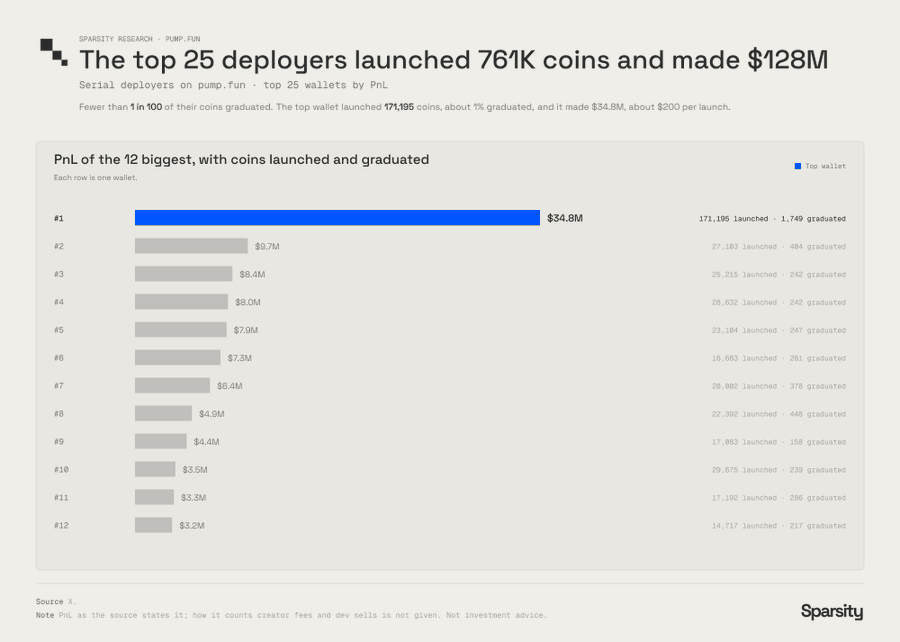
The top wallet alone issued 171,195 tokens, netting approximately $200 per token on average.
Token farming occasionally does coincide with major winners as well. For instance, the best two tokens from several wallets have seen market caps reach $122 million and $327 million respectively. However, the golden tokens are merely byproducts of massive trading volumes; it's only the huge transaction volumes generated by the assembly line that serve as their core for stable profits.
Promoters exclusively push low market cap tokens because rebates are purely linked to trading volume
The promotion reward mechanism provides a brand new monetization channel for various promoters on Twitter. The platform has directly turned "promoting tokens" into a business with a clear price: since August, it has distributed $29.6 million in promotion rewards to 51,115 wallets, and this wealth is highly concentrated — just 10 wallets accounted for 16% of the total, while the median wallet only obtained a pathetic $13.
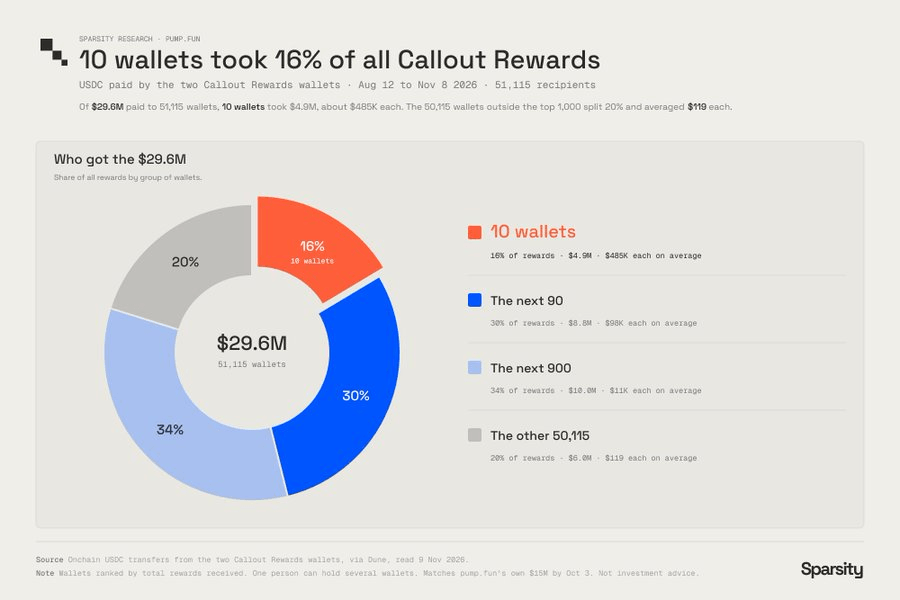
The top 10 wallets averaged around $485,000 each.
The calculation basis for rewards completely depends on the trading volume generated by the promotions, and very low market cap tokens are the easiest to incite huge turnover. In August, among the top 50 earning wallets, 40 promoted tokens with an average market cap below $100,000.
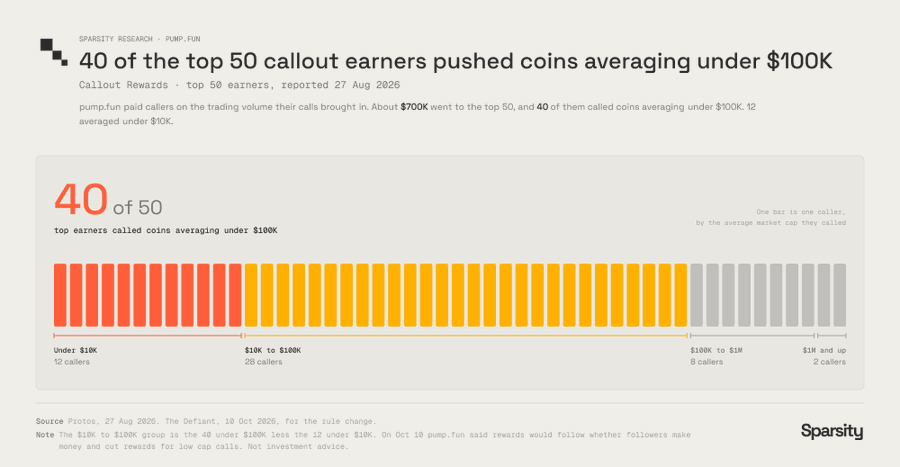
Among the top 50, even 12 had promoted tokens with an average market cap of less than $10,000.
pump.fun has not been deaf to the protests from the outside. On October 10, the platform announced that rewards would be linked to whether "followed fans make money" and would reduce the rebate weight for extremely low market cap promotions. However, in the three weeks following the policy adjustment, among the revenue streams of the top 20 promoters, the median market cap of promoted tokens dropped from 68% to 94%, and the total bonus pool distributed weekly surged by 53%.
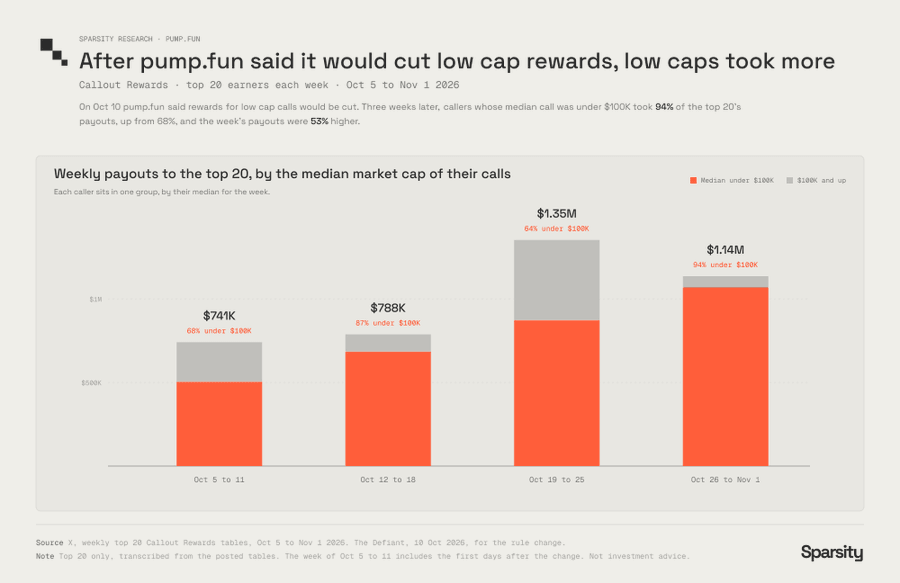
After the new rules took effect, not only did total dividends increase sharply, but the proportion of extremely low market cap junk coins turned even more exaggerated.
The ultimate cost is borne entirely by the following fans. We tracked 14 promoters: among them, 10 had median market caps of promoted tokens below $100,000, and their followers collectively lost $926,000 within just one day after the promotion. The median performance of the promoted tokens was: a rise of 6% one minute after promotion, a fall of 48% one hour later, and a direct halving of 74% after 24 hours. Regardless of how the coin price eventually collapses, the promoters had already securely pocketed their gains from the start.
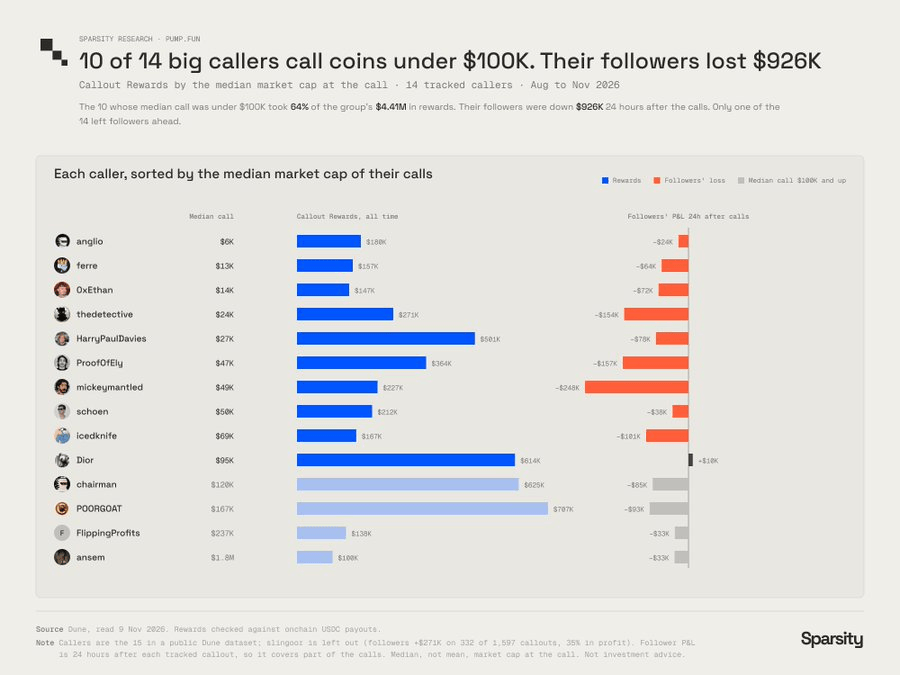
Out of these 14, only 1 had followers who barely maintained a small profit (profit of only $10,000).
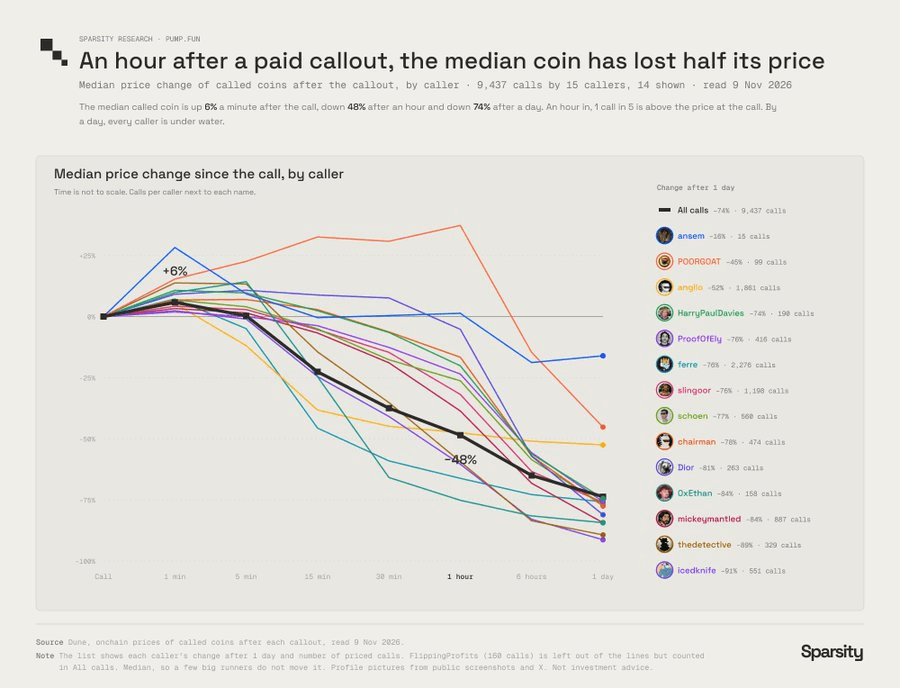
The median price of each promoter's promoted tokens had, without exception, plummeted within 24 hours.
When everyone wonders why KOLs shamelessly promote junk coins at the expense of their fans' livelihoods, this is the harsh truth: because the platform is literally buying them to do so.
The essence of the PvP model is to squeeze more trading frequency from individuals
Without any new off-exchange fund injections, the only logic for PvP functionality is that higher-level predators harvest new retail investors. Various derivative models are purely tailored to achieve this: faster transaction speeds, more individual operational frequencies, and every operation can generate a platform fee. Even pump.fun officially took down the Tokenized Agent model on June 30, publicly admitting that the excessive variety of token issuance had prompted a "toxic player-versus-player dynamics."
Unlimited expanding supply, dying demand
When this distorted incentive mechanism operates long enough, the entire market will be completely divided into two extreme and disconnected sides.
On the demand side (retail investors), if you chase after junk coins, the laws of statistics dictate that you will inevitably incur losses. Only a very few extremely lucky wallets can strike it rich. On the supply side (issuers), as long as tokens are continuously issued, you can almost generate income with zero risk.
Now, becoming a supplier has no barriers. It can be done with one click, all tricks are already known: clone a hot token in seconds, create fake volume to manufacture a false sense of prosperity with a left-hand-right-hand shuffle, then buy out old wallets in bulk to prevent control. This harvesting assembly line is becoming more professional and efficient every month.
Consequently, we believe that more and more individuals who might have become long-term holders are being forced to become token issuers. Getting rich through issuing tokens while holding them to zero, every new player who understands this harsh reality will quickly transform into a member of the assembly line of token issuance, turning back to compete for an already increasingly scarce pool of buyers. This is the true culprit that thoroughly destroys the holder culture: it is not that people suddenly change their minds and choose not to hold for the long term, but rather the platform mechanism has transformed "holding" into a mathematically likely losing strategy.
This distortion is directly reflected in the quality of the tokens being produced. pump.fun's current frequency of token issuance has returned to the crazy levels seen at the peak of the bull market at the end of 2024. In the fourth quarter of 2024, the platform issued tokens a total of 3.16 million times, resulting in 207 tokens surpassing a market cap of $10 million; while in the third quarter of 2026, amidst the same frenzy of 3.05 million token issuances, only a pitiful 24 tokens emerged.
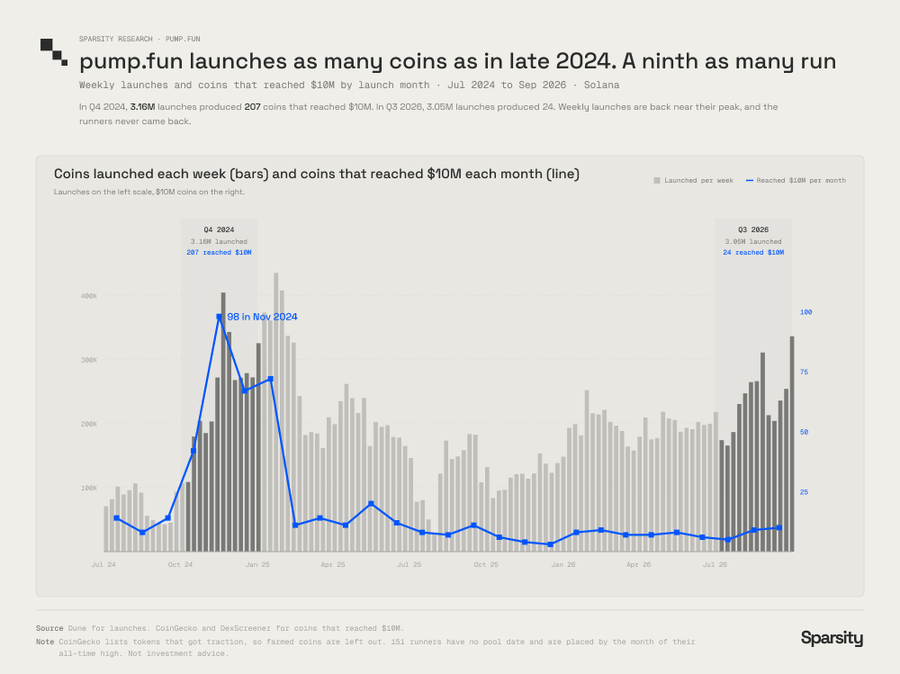
The weekly token issuance volume has once again soared past 300,000, but the production rate of tokens with a market cap of under $100,000 has plummeted from 6.5 to 0.8 per 100,000.
Some may counter that since June, trading volume on the bonding curve has been rebounding. Indeed, but when factoring in the total trading volume of both the bonding curve and PumpSwap, it has shrunk from monthly totals of $25 billion to $30 billion in the first quarter of 2026 to about $13.8 billion in October. pump.fun survives by extracting fees from trading volume, but regular buyers must rely on generating hundredfold or thousandfold golden tokens to make money, while the probability of golden tokens being born has now plunged to one-ninth of what it was before.
From the perspective of retention, the outcome is equally cold and ruthless. Among pump.fun’s cumulative token issuance history of up to 24.4 million, only 312 still maintain a market cap above $100,000. The probability is approximately one in 78,000, or a 0.0013% survival rate.
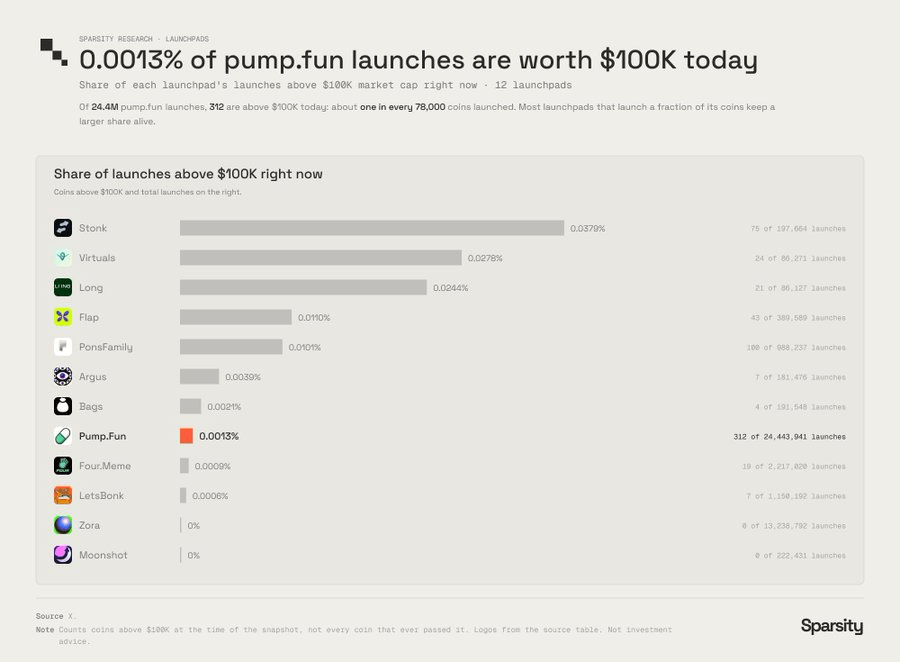
The survival rate of pump.fun tokens is even lower than the platforms with total token issuance only a fraction of theirs.
This is the first time we have seen a market where supply is crazily and exponentially inflating while real demand is sharply shrinking. It would have been impossible for this farce to evolve to such an out-of-control scale without the platform persistently subsidizing these vices at an institutional level.
We are equally culpable
pump.fun built this meat grinder system, but the flows and fuel that keep it running wildly come entirely from us retail investors. Every evil mechanism mentioned in this article is able to generate profit because there are always blind followers on the other side of the screen — and most of the time, that follower is ourselves.
We curse the evil while simultaneously offering rewards to it
We vehemently curse bundling rushers, yet privately follow their addresses like sharks scenting blood. A predatory developer who monitors popular concepts, drains huge fees and runs away will be revered on Twitter as a "miraculous trader" with lengthy analysis and praise. A promoter who pushes 20 junk tokens a day is chased by thousands, solely because he promotes quickly enough, not because it's actually profitable to follow him. Just like the previously tallied top 14 promoters, only 1 provided any earnings for their followers, while the rest led their fans to evaporate nearly $1 million in just 24 hours.
We are essentially being cut twice: the first cut is our real cash trading volume (the core nutrient that feeds pump.fun and unscrupulous developers), the second cut is our attention (the next round of malicious replicas and false promotions is crafted stepping on the corpses of our attention).
"Holding long-term" has become a completely ineffective death strategy
A year ago, the winning strategy was "finding early good tokens and holding through short-term noise." Now, the median drop for promoted tokens after one day is as high as 74%, and in such a suffocating slaughterhouse, the only survival rule is to run faster than anyone else. For every individual, being the first to panic sell is absolutely rational; yet this coalesces into a joint tragedy that kills all potential long-term golden tokens. If no one is willing to hold the first hour, then a token can never grow to a market cap in the millions — and ironically, that first hour is when pump.fun extracts three-quarters of its protocol income.
If we change, how will the situation differ?
To reverse all of this, there is no need to wait for pump.fun’s grace and approval. Hold the core tokens you truly trust, and do not engage in frantic trading on every one-minute K-line. The only standard for measuring KOL value should be whether his followers have actually made money, not how many tweets he can send in a day. Immediately stop venerating and spreading malicious vampirism and bundling of retail investors as "smart operations." Inject real trading volume into platforms that reward "long-term token sustainability," not those that reward "high-frequency flipping to death." These measures alone may not entirely eradicate the distorted mechanism, but each transaction we refrain from feeding into the meat grinder is a heavy blow against that machine’s bloodsucking essence.
What kind of mechanism can truly rectify disorder?
We are not contract engineers, so the following thoughts are merely directional considerations, not final product implementation schemes. The common core of these ideas is to completely detach profit distribution from the “first hour” of token birth.:
Significantly increase the initial market cap and liquidity pool depth, introducing a compound liquidity pool mechanism so that liquidity can follow the trading volume to appropriately accumulate and expand.
Share transaction fees with long-term holders (Holders) and LPs, completely ending the situation that only favors issuers, and the creator’s fees must be released linearly based on the token’s survival time.
Make promotion rewards serve long-term holders rather than short-term top takers: the assessment of promoters’ compensation should depend on whether the followers still hold and achieve net profit days later, rather than being based on how much fake trading volume was pried loose at the moment of promotion.
If similar reforms can be implemented, there is still hope for the trenches, and with pump.fun’s current scale, it can fully afford and test it. Its on-chain deposited funds exceed approximately $2.84 billion, firmly monopolizing the entire traffic and transaction entry. In the long run, a healthy market with a long-term wealth effect can bring returns that far surpass the short-sighted behavior of digging its own grave, rapidly draining buyer liquidity. The platform chooses excessive blood extraction merely because draining the swamp today generates faster cash, but this cannot last.
However, even with these adjustments, the problem may still not be fundamentally resolved. These changes merely raise the barriers for bad token issuance, but they cannot reverse a cruel objective reality: the tools with dimensional reduction and information asymmetry in the hands of suppliers will always be far more advanced than the retail investors at the bottom.
What would a thorough abandonment of the bonding curve launch mechanism look like?
All the proposals discussed above essentially still parasitize the logic of traditional bonding curves. If we want to start over, the complete solution lies in completely abandoning bonding curves.
In this new conception, all participants will enjoy a completely indiscriminate uniform purchase price. Without the curve-increasing mechanism, rushing to buy in the first block will become meaningless, and scientists’ high-frequency sniping will completely lose its profitable advantage. Creators need to set a minimum soft cap and a maximum hard cap for fundraising. If the minimum soft cap is not reached within a set period (e.g., 24 to 48 hours), the smart contract will automatically refund participants in full, allowing retail investors to incur zero principal loss in the event of a failed launch; once the fundraising cap is triggered, the contract will automatically form a full liquidity pool and permanently transfer it to a black hole for destruction or lock-up, strictly prohibiting the project party from touching any raised funds midway. At the same time, implement extremely stringent single investment limits on each wallet (e.g., an individual address may not exceed 1% of the total fundraising amount), completely locking out the possibility of big whales or bots directly seizing half the funds.
The moment the platform collects fees will be strictly postponed to the moment “fundraising is successfully achieved.” Only when the token successfully launches can the issuing platform charge a service fee; and in the case of a thousand aborted junk projects, the platform will gain nothing.
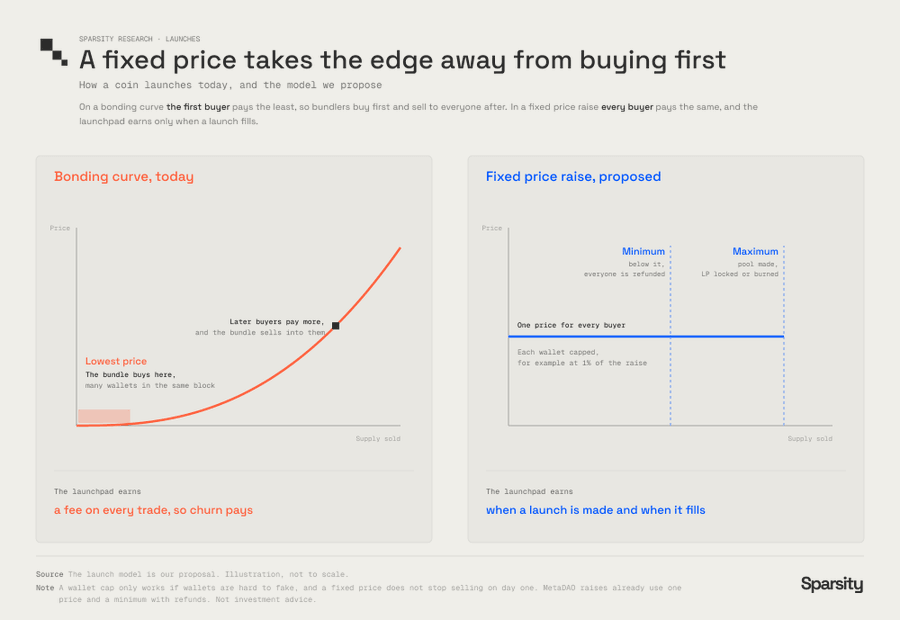
The profitability model of launching platforms will completely shift from “taxing every death transaction” to “taking commissions from every successful fundraising project.”
This paradigm will fundamentally uproot the ugly industrial chains characterized by bundle rushing, bot sniping, liquidity pulling, and maliciously squeezing out 50 zero-value coins while profiting from firewall arbitrage at the bottom physics logic level of bonding curves.
Of course, this model still has blind spots and loopholes that need to be addressed. The single wallet limit highly relies on the capacity to resist Sybil attacks, and nowadays, purchasing a bulk-aged whitelisted wallet for low costs is nearly effortless. Without high-threshold personal proofs or strong Sybil identifications, bundling arbitrageurs can still easily disperse their funds into 100 wallets to grab tokens. Furthermore, the uniform fixed sale price still cannot prevent speculators from dumping stocks for cash on the first day of launch. Its only significance is to give everyone a fair and transparent starting line.
The ending is near
The current form of the meme speculation era has thoroughly reached a dead end. We believe this track will not regain vitality unless the entire launch mechanism undergoes the disruptive reconstruction described above — that is, the platform can only profit when tokens move towards lasting success, rather than sucking blood by relying on tokens continuously trading, zeroing out, and dying.
As long as there is a monopoly-level platform profiting wildly from "every token's death," the trenches are destined to be a hopeless wasteland of bones, and "holding long-term" can only ever be a joke the retail investor inevitably loses. A new order must arrive to break the deadlock. But it will no longer be traditional meme coins, and it certainly won’t come easily in the short term.
This article link: https://www.hellobtc.com/kp/du/11/6497.html
Source: https://x.com/sparsitydata/status/2120176652462276897
免责声明:本文章仅代表作者个人观点,不代表本平台的立场和观点。本文章仅供信息分享,不构成对任何人的任何投资建议。用户与作者之间的任何争议,与本平台无关。如网页中刊载的文章或图片涉及侵权,请提供相关的权利证明和身份证明发送邮件到[email protected],本平台相关工作人员将会进行核查。


