The intelligence of the physical world can only be learned through data from the physical world.

Author: Zhan Zhu
Hand Rolled Quantity丨100%
The speed at which universal large models enter the physical world is faster than many people expected.
The first climax occurred in September, due to the release of GPT-6 Astra. It was called by OpenAI as "the world's best computer usage model," because it is no longer limited to text interaction, but can directly operate software like a human to accomplish complex workflows.
Quickly, research teams connected it to robots for testing. In the 42 operational tasks of RoboDojo, GPT-6 Astra scored above all 40 publicly available action strategies without any fine-tuning for these tasks.
In the early hours of November 10, Beijing time, Anthropic released Claude Fable 5.2, which also never received specialized training on robots, and achieved a success rate of 64.9%, jumping from the previous generation's 27.6% in the RoboDojo Sim robot simulation test. In real machine demonstrations, it successfully operated a robotic arm to open bottle caps and solved a Rubik's cube.
Coincidentally, on the same day of Fable 5.2's release, Ant Group Lingbo released an embodied foundational model LingBot-Touch. This is the world's first true universal tactile foundational model, and it complements a piece of capability puzzle in Lingbo's ongoing "embodied native" technology route.
The unexpected performance of the two universal models in the embodied field has led the industry to discuss whether the underlying reasoning and planning capabilities of universal large models can also directly transfer to physical control tasks and be applied to robots.
In fact, using digital world models to solve physical intelligence issues is still quite challenging. GPT-6 and Fable 5.2 are digital world models whose knowledge comes from texts and images on the internet, addressing the semantic understanding issues of "what is this task and how should it be done?"
But the physical world requires responses to specific environments and situations. This results in the core difficulty of physical intelligence often occurring "after the hand touches the object"—at the moment the robot's dexterous hand touches the object, how does it quickly adjust the posture and force for the next moment?
Third-party evaluations have shown this gap. As Fable 5.2 was just released and more tests are pending, researchers found in the aforementioned RoboDojo evaluation that the ability of GPT-6 Astra is "polarized": it generalizes well in tasks requiring semantic understanding, but struggles obviously when it comes to high-precision control, dynamic control, or complex dual-arm coordination.
The conclusion of a system evaluation by the Galaxy Universal team is similar: universal large models can make useful task decisions, but there is still a gap from reliable physical control. In one simulation walking test, the robot needed to call the model 250 times to walk for 30 seconds, with each call taking nearly 40 seconds on average, meaning the simulation had to pause until it finished calculating. The real world does not pause for any model.
In response, Ant Group Lingbo's CEO, Zhu Xing, candidly stated, "The advancements represented by Claude Fable 5.2 and GPT-6 Astra have indeed strengthened the reasoning and physical operation capabilities of robots in complex tasks, and we are actively absorbing this. However, practical experience in the industry tells us that to truly operate closed loops, the issue of generalizing physical operations remains a tough nut to crack, and largely depends on breakthroughs in embodied foundational models themselves."
If universal large models help enhance the understanding and reasoning of tasks and environments, then native models born from the physical world are the final step in completing the loop of physical perception and closed-loop operation capability. To enable robots to perform high-precision complex operations, merely understanding semantics is clearly insufficient; there also needs to be physical modal perception of distances and tactile sensations.
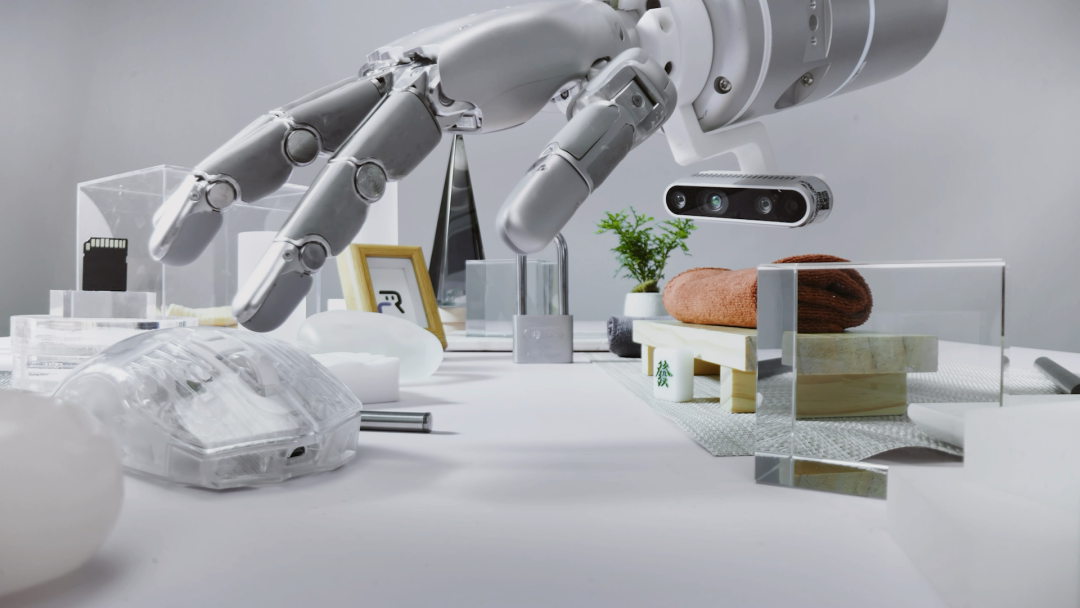
Returning to the recently open-sourced LingBot-Touch, it is pretrained on nearly 5000 hours of real tactile data, covering three major sensor principles: magnetic touch, visual touch, and piezoresistive touch, capable of converting different signals into a unified set of tactile representations. This capability can be used by different dexterous hands and action models, enabling robots to supplement the tactile perception needed for fine operations while "seeing clearly and thinking clearly."
In 26 real machine tests on two dexterous hands, after integrating LingBot-Touch, the average task success rate improved by about 14 to 26 percentage points. For instance, using the T-Rex action model to control the Sharpa Wave dexterous hand to open a bottle cap, the success rate was 56.25% without tactile feedback; directly inputting the raw sensor signal into the action model improved it to 62.5%; after switching to LingBot-Touch's tactile representation, it rose to 90%.
Completing all 26 tests was just a lightweight version with about 5.3 million parameters, and after integrating LingBot-VLA, π0.5, and T-Rex, the model's overall scale only increased by about 0.13% to 0.16%. This means the improvement isn't achieved by merely stacking parameters; the example of opening a bottle cap also indicates that simply connecting sensors is not enough; what truly matters is the "feel" learned from real contact data. This "feel" cannot be learned from the internet.
This is backed by Lingbo's proposal and commitment to the route of "embodied natives." The goal of this technical route is to provide physical intelligence with its own "roots" by matching data, sensations, and corresponding pre-training in real physical world scenarios, rather than just an adaptation layer grafted onto digital world models.
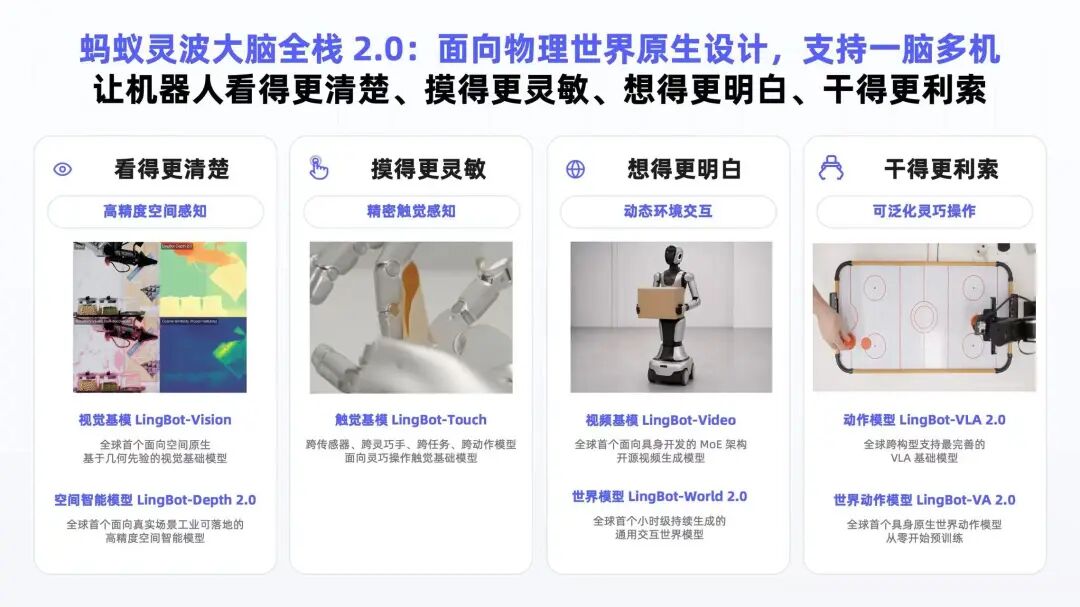
Previously, Lingbo's universal brain had already covered high-precision spatial perception, high-dynamic environmental interaction, and generalizable dexterous operations. The newly launched LingBot-Touch has integrated the LingBot-VLA model, extending the robot's perception abilities to the fingertips.
With this step, Lingbo aims to tackle a hard nut to crack for technological breakthroughs in physical intelligence.
The Path of "Embodied Natives"
To understand this new tactile model, we need to return to Lingbo's technological starting point.
In January of this year, Ant Group Lingbo released its first universal robotic brain, LingBot 1.0. At that time, the core model in this system was based on Qwen for post-training, which was a very reasonable choice since Qwen served as a general large model foundation for the digital world, possessing strong language, image, and reasoning capabilities; "grafting" it onto robots was the most mainstream approach in the industry at that time.
However, very soon, the Lingbo team realized something in industrial implementation: robots needed more than just digital world capabilities to work in the real world. When robots shift from "watching videos to recognize objects" to "reaching out to grab a cup," they need not only to identify what the object is but also to judge how far away it is, the location, how tightly to grasp it to avoid slipping, and how much force to apply without breaking. These capabilities were not present in the corpus of the general large model, nor were they inherently included in its architecture.
Therefore, Lingbo made a significant decision at that time—to initiate self-research and pre-training, effectively building the foundational model from the ground up.
In July, Lingbo released the LingBot 2.0 "full-stack brain." The key transformation in this version is that Lingbo now has its own pre-trained foundational model, specifically addressing the needs for robots to work in the physical world, and has completed high-precision spatial perception and abilities focusing more on the rationality of physical laws and the real deployment needs of robots. It unified "understanding instructions, executing actions, and adjusting in real-time based on feedback" under one framework for the first time, which is also the industry's first truly embodied native world action model.
In other words, the "grafting" road has been traversed by Lingbo itself; "embodied natives" is not just a slogan, but a conclusion drawn from on-the-ground practice.
At this point, Lingbo’s universal brain has covered high-precision spatial perception, high-dynamic environmental interactions, and generalizable dexterous operations, enabling robots to see more clearly, think more clearly, and work more efficiently.
However, when the team put the robots into commercial testing scenarios such as retail sorting and industrial assembly, the fourth divide emerged, which is what happens after the hand touches the object.
For example, when the fingertip pinches a glass marble, it must discern minute changes in contact positions; when the palm holds a package, it needs to perceive weight distribution; while twisting a bottle cap, the same wrist angle could either mean the cap is moving or that the fingers slipped. In these scenarios, vision fails because the contact point is obstructed by the fingers, and the images appear nearly identical, yet completely different things have occurred in the physical world.
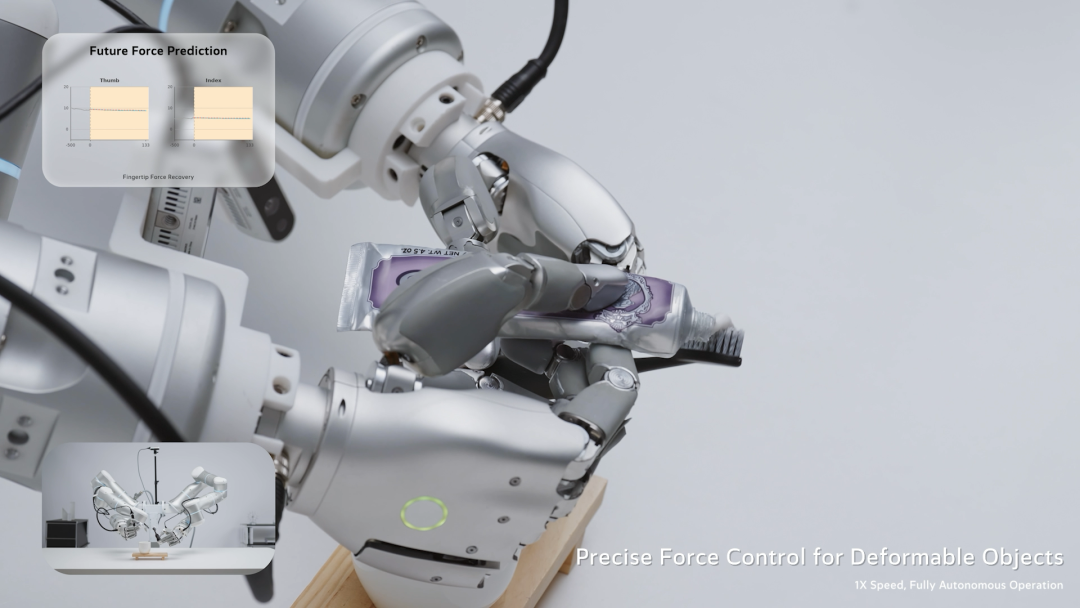
This is the direct reason why Lingbo decided to develop a tactile foundational model. Robots, stationed in the real physical world, receive information from sensors and act on the environment, needing to understand depth-type spatial perception information while also processing tactile, force, and temperature contact perception modalities.
Thus, LingBot-Touch supplements this key link of tactile perception, enhancing the contact perception capabilities required for robots to perform complex dexterous operations, allowing robots to "feel more sensitively."
Making "Touch" Experience More Universal
An important feature of LingBot-Touch is its universality, meaning this model can be compatible with different sensors, different dexterous hands, different action models, and different downstream tasks, providing a universal base for contact perception modality across various dexterous operation scenarios.
The industrial background behind this is that currently no single sensor can excel simultaneously in precision, response speed, coverage area, and cost. This means that in the short term, different technological routes will develop in parallel, and different dexterous hand products will adopt different sensor solutions based on their needs.
However, if every action model has to learn from raw readings, it becomes challenging to accumulate past experiences. This is the problem Lingbo wishes to solve, transforming the tactile experiences accumulated by different hardware in various tasks into universally applicable and reusable foundational capabilities.
The solution provided by LingBot-Touch is to uniformly "translate" these different signals into one language—tactile tokens. As a result, the action model doesn't need to focus on where the signals are coming from; it can read contact information like "where the fingers touch, how much force is applied, whether there is slipping," etc.
In simple terms, the universal tactile model allows data collected by different hardware to be trained together, with the abilities learned being applicable across different robots.
In the comparative experiment with LingBot-Touch, retaining the original magnetic touch or visual touch data while adding other types of tactile data for joint training has improved the model's judgment of contact position, area, and force variation. This leaves room for hardware manufacturers to continue exploring different routes and gives all avenues of hardware accumulated data a chance to play a larger role.
This presents significant long-term industrial value. For instance, teams making dexterous hands can continue to improve their hardware, teams making action models can continue developing their strategies, and players in different industrial segments can collectively invest in training for tasks like turning pages, opening caps, and moving objects using the existing contact perception capabilities.
It is worth mentioning that LingBot-Touch has also released a technical report, code, and model weights publicly. The project homepage, GitHub, and Hugging Face have all been launched. This means Lingbo has not treated it as a product locked within its ecosystem, but rather as a layer of open foundational industry capability.
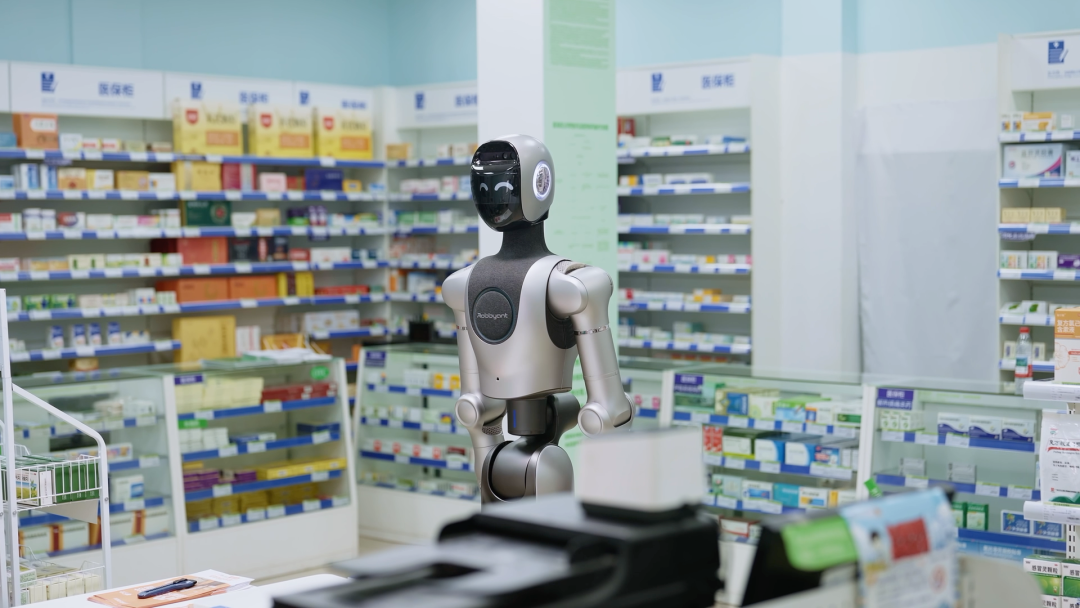
Ecological cooperation on the industrial side is already underway. Currently, Ant Group Lingbo has engaged in commercial testing with original equipment manufacturers like Leju and Taihu, as well as scene partners like Guoda Pharmacy and Longsheng, covering scenarios including retail sorting, logistics sorting, and industrial assembly, and has collaborated with data partners such as Jianzhi Technology to build standardized data systems.
Returning to the "First Principles" of Physical Intelligence
Looking back, the release of LingBot-Touch is not the start of a new story, but a necessary step in Lingbo's "embodied native" route reaching today.
Robots need to know where objects are, how far away they are, need to predict how actions will change the environment, need to understand commands and generate actions, and need to perceive what happens after the hand makes contact with the object, leading to the development of a series of LingBot model family.
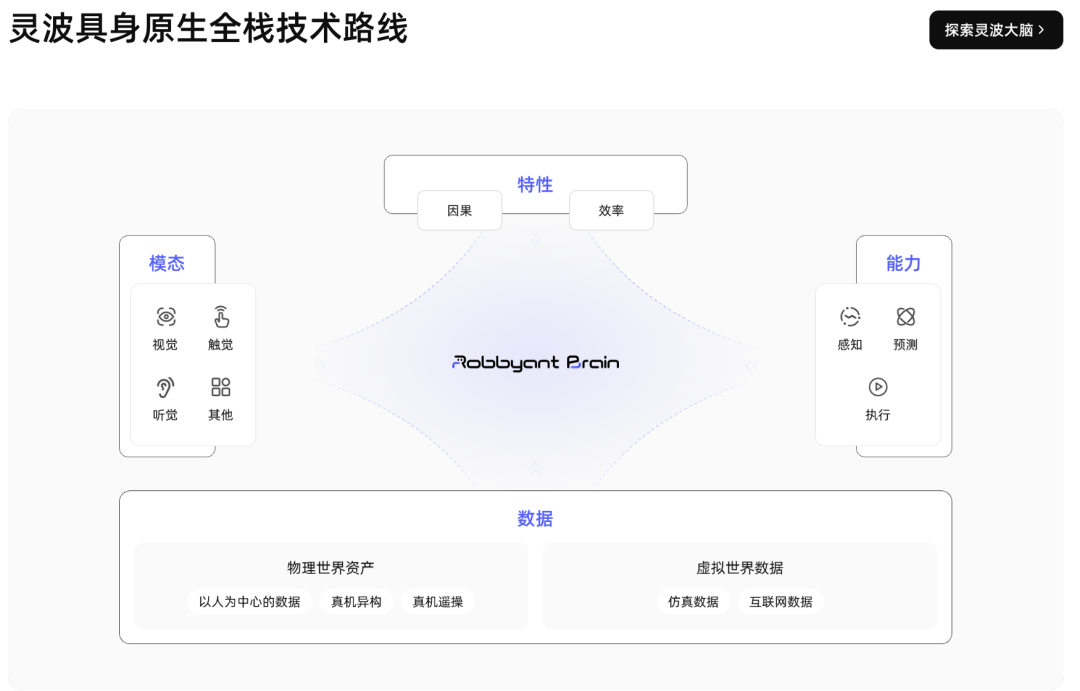
The newly released tactile model supplements the fourth divide in robotic work, expanding Lingbo's universal brain capability map from "seeing clearly, understanding well, and acting smoothly," to "feeling sensitively"—from spatial perception, world prediction, command understanding, and action generation, to this new sensory modality of touch.
Behind this lies a very clear underlying logic in Lingbo's technical route, following first principles from the shared information needed when robots accomplish tasks in the physical world, determining how to design models and what data to train them with. This is also the core consideration for Ant Group Lingbo Technology's insistence on embodied native core propositions, striving to create a cross-configuration universal brain for the robotic industry.
"In our experience, the quality of modal input largely determines the upper limit of action output," Zhu Xing said. "In the future, we're not limited to vision, depth, and touch; we will continuously enrich other physical perception modalities to provide higher quality inputs for action models."
Regarding the relationship between universal large models and embodied models, Zhu Xing's judgment is: "Similar situations have already occurred in the autonomous driving field: large models significantly enhance the understanding and reasoning of complex scenarios, but whether vehicles can drive stably still relies on closed-loop control capabilities targeting driving tasks. In our view, the two are more of a synergistic relationship of 1+1>2, jointly accelerating the maturity of the embodied intelligence industry."
1+1>2 has a premise: both sides must be complete "1s." Universal large models raise the upper limit of task complexity a robot can understand, while embodied native models raise the upper limit of generalizing physical operations. If this side of embodiment is merely a plug-in for the universal large model, that equation can only be written as "1+0.x." The stronger the universal large model, the higher the demands for the other "1" will be.
This path may seem slow and heavy, but precisely after the universal large models accelerate their entry into the physical world, it reveals its unique value: while everyone discusses whether universal large models can "consume embodied intelligence," Lingbo has spent an entire year proving another matter, "The intelligence of the physical world can only be learned through data from the physical world."
免责声明:本文章仅代表作者个人观点,不代表本平台的立场和观点。本文章仅供信息分享,不构成对任何人的任何投资建议。用户与作者之间的任何争议,与本平台无关。如网页中刊载的文章或图片涉及侵权,请提供相关的权利证明和身份证明发送邮件到[email protected],本平台相关工作人员将会进行核查。


